MyFitnessPal vs FatSecret 2026: Best Free vs Best Paid
 ChatGPT
  Claude
  AI Mode
  Perplexity
As a NutriScan nutritionist, I get this question constantly: should I use MyFitnessPal or FatSecret? A 2026 scoping review of 68 studies in JMIR mHealth and uHealth found the biggest barriers to using calorie tracking apps are limited food databases and the burden of manual entry (Dugas et al., 2026). Both apps try to solve those problems, but they pick very different sides on what you get for free and what you pay for. This guide breaks each one down feature by feature so you can pick the right fit for 2026.
TL;DR - MyFitnessPal vs FatSecret 2026
- Free winner: FatSecret. Free barcode scanning, full macros, web dashboard, and community.
- Paid winner for meal planning: MyFitnessPal Premium+ ($99.99/year). 1,500+ recipes, grocery lists, Instacart/Walmart+ sync.
- Paid winner for budget: FatSecret Premium ($59.99/year). AI photo and voice logging at 25% less than MFP Premium.
- Database: MFP is larger (14M+) but crowdsourced; FatSecret smaller (2.3M+) but human-verified.
- Verdict: Start with FatSecret free; pay for MFP only if you want meal planning or Apple Watch logging.
Quick Verdict: Who Wins What
Before we get into the details, here is the short answer.
FatSecret wins the free plan. You get barcode scanning, full macro tracking, community features, and a web dashboard without paying a cent. MyFitnessPal locks barcode scanning and macro customization behind its $19.99/month Premium paywall.
MyFitnessPal wins the paid plan if you need meal planning. Premium+ ($24.99/month or $99.99/year) adds a Meal Planner with 1,500+ recipes, grocery lists, and Instacart/Walmart+ delivery sync. FatSecret Premium ($6.49/month or $59.99/year) adds AI photo scanning and voice logging, but nothing close to an integrated meal planner.
Neither app wins on database accuracy. MyFitnessPal has the larger database (14 million+ entries), but it is crowdsourced and full of duplicates. FatSecret has a smaller but human-verified database (2.3 million+ entries), though gaps still appear for regional and restaurant foods.
| Category | MyFitnessPal | FatSecret |
|---|---|---|
| Best free plan | No | Yes |
| Best paid plan for meal planning | Yes | No |
| Best paid plan for budget | No | Yes ($59.99/yr) |
| Largest food database | Yes (14M+) | No (2.3M+) |
| Free barcode scanning | No | Yes |
| AI photo logging (paid) | Yes | Yes |
| Voice logging (paid) | Yes | Yes |
| Web dashboard | Paid only | Free |
 That "yes, finally, the right pick" moment after the 7-day test.
Pricing Side by Side 💰
Let us start with what each app costs in 2026.
MyFitnessPal has three tiers:
| Plan | Monthly | Annual | Per Day |
|---|---|---|---|
| Free | $0 | $0 | $0 |
| Premium | $19.99/mo | $79.99/yr | $0.22 |
| Premium+ | $24.99/mo | $99.99/yr | $0.27 |
FatSecret has two tiers:
| Plan | Monthly | Annual | Per Day |
|---|---|---|---|
| Free | $0 | $0 | $0 |
| Premium | $6.49/mo | $59.99/yr | $0.16 |
The annual gap is significant. FatSecret Premium at $59.99/year costs 25% less than MyFitnessPal Premium at $79.99/year and 40% less than Premium+ at $99.99/year. Over a full year, that is a $20 to $40 swing.
FatSecret also has regional pricing that makes it even cheaper in some countries. In international markets, monthly plans drop to $6.99 and annual plans to $38.99 (NutriScan FatSecret pricing guide).
For a full breakdown of MyFitnessPal tiers, see our MyFitnessPal pricing 2026 guide.
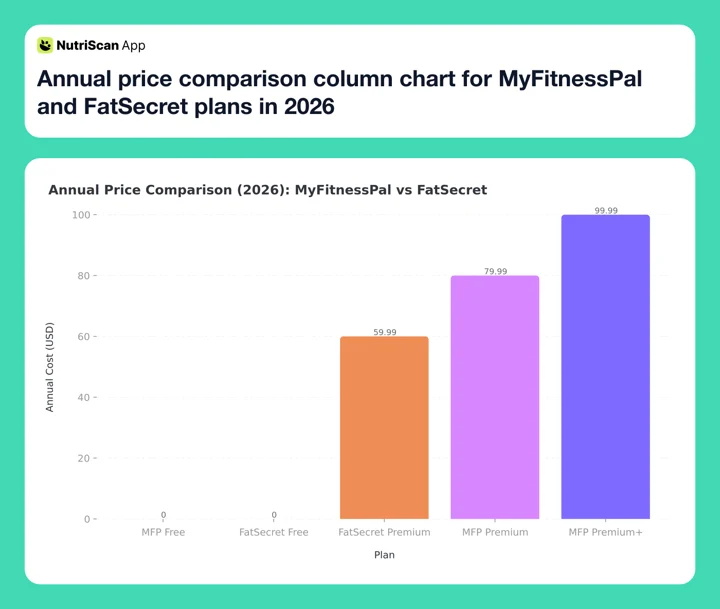 Figure 1: Annual cost ladder. FatSecret Premium is the lowest paid rung at $59.99 per year; MFP Premium+ is the highest at $99.99 per year.
Free Plan Comparison: FatSecret Wins by a Wide Margin
This is where the two apps differ most. FatSecret gives away nearly everything MyFitnessPal charges for.
What FatSecret Free Includes
- Barcode scanning - scan packaged foods and get instant nutrition data
- Full macro tracking - protein, carbs, fat, and fiber with daily targets
- Food diary with meal categories - breakfast, lunch, dinner, snacks, and custom meals
- Exercise logging - manual entry plus integration with fitness apps
- Progress tracking - weight, measurements, and goals
- Community features - forums, challenges, and food diary sharing
- Web dashboard - full-featured web app at fatsecret.com
- Recipe builder - create and save custom recipes with nutrition math
- Diet calendar - view calories consumed and burned by day and week
What MyFitnessPal Free Includes
- Basic food search and logging - manual text search for foods
- Calorie tracking - daily calorie goal with simple progress bar
- Recipe creation - build custom recipes
- Community recipes - browse recipes shared by other users
- Basic goal setting - set a weight goal and calorie target
What MyFitnessPal Free Does NOT Include
- Barcode scanning - requires Premium ($19.99/month)
- Macro tracking - protein, carbs, and fat breakdowns require Premium
- Intermittent fasting timer - Premium only
- Food insights and analysis - Premium only
- Ad-free experience - Premium only
- Web dashboard - limited features on free tier
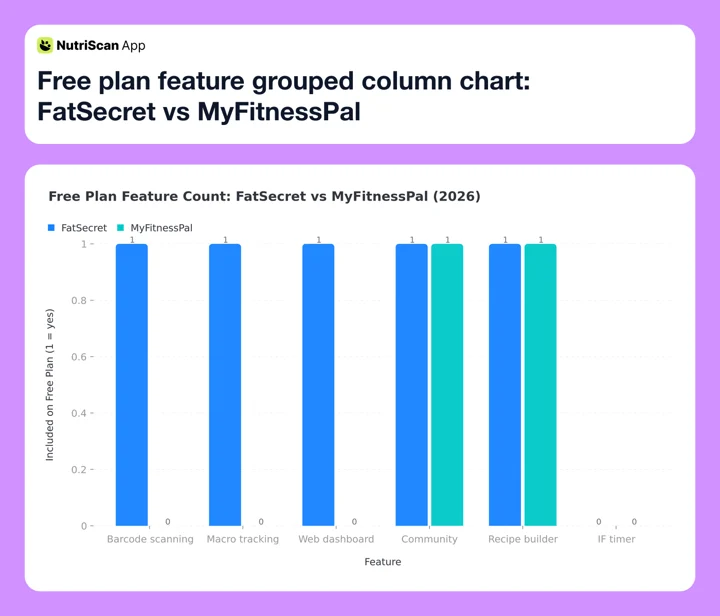 Figure 2: On the free plan, FatSecret covers barcode scanning, macros, and a web dashboard; MyFitnessPal covers community and recipes only.
The barcode scanner paywall is the single biggest difference between these two apps for free users. Barcode scanning is how most people log packaged foods quickly. A 2026 scoping review of 68 studies found that 98% of calorie tracking apps offer logging through manual entry supported by food databases, but the speed and ease of logging directly affects whether users stick with the app (Dugas et al., 2026). Scanning a barcode takes 3 seconds. Typing "Chobani Greek Yogurt Vanilla 5.3 oz" into a search bar takes 15 to 20 seconds and often returns multiple duplicate entries.
Pro tip
If a barcode paywall stops your logging streak in the first week, the app is fighting you, not helping you. Start with the free plan that does not block scanning.
Garage Gym Reviews, which tests nutrition apps with registered dietitians, gave FatSecret a 4.18 out of 5 rating and specifically praised the free version for having "a lot of features" without frequent upgrade prompts. MyFitnessPal received a higher overall rating of 4.42 but was criticized for a "costly" Premium subscription and a limited free version (Garage Gym Reviews, 2026).
Reddit users in r/CICO and r/Myfitnesspal have been vocal about the free plan limitations. One common complaint: MyFitnessPal feels spammy now, with intrusive ads including food imagery in the logging feed. FatSecret shows ads too, but multiple reviews note they are less intrusive and do not appear between food entries.
Real-World Example: Two Free Users, Two Experiences
User A uses FatSecret Free. She wakes up, scans her cereal box barcode, logs coffee manually, and checks her macro split for the morning. At lunch, she scans a pre-made salad from the grocery store. She checks the community forum for a high-protein dinner idea. She logs dinner using the recipe builder. Total time: about 5 minutes across the day.
User B uses MyFitnessPal Free. He wakes up and types "Cheerios Honey Nut 1 cup" into the search bar. Three similar entries appear with different calorie counts; he picks one and hopes it is right. At lunch, he cannot scan his sandwich wrapper, so he searches "Turkey club sandwich Panera" and scrolls through 8 entries. He gives up on logging dinner because it takes too long. Total time: about 8 minutes, and he quit before finishing.
This is not a hypothetical. The friction of manual search versus barcode scanning is why many users switch from MyFitnessPal's free plan to FatSecret. A 2025 meta-analysis of randomized controlled trials found that mobile app-based interventions significantly reduced weight, BMI, and waist circumference in adults with overweight and obesity (Li et al., 2025). The easier the logging process, the longer users stick with it.
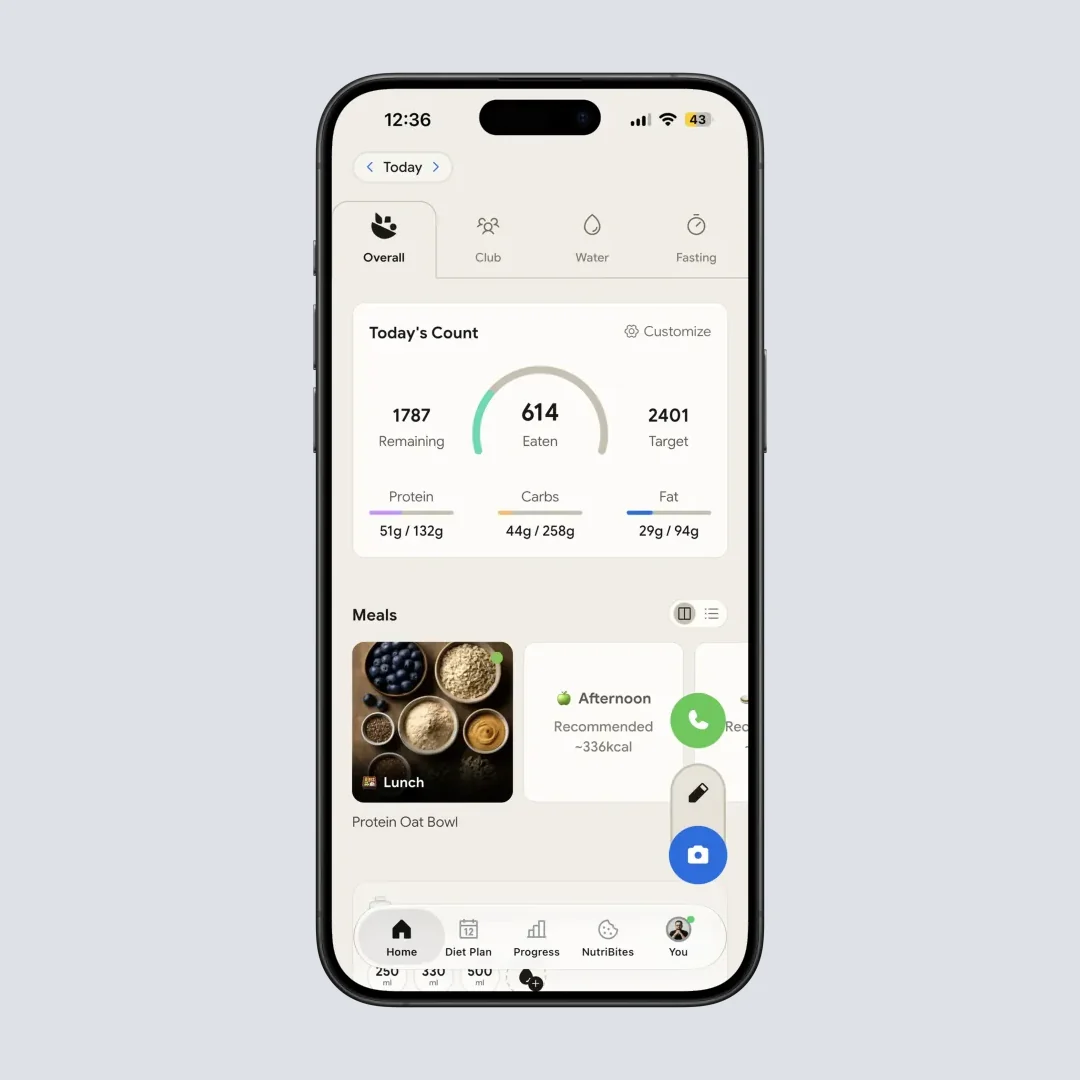
NutriScan's daily breakdown at Home - your scan history, macros, and calories all in one screen.

Paid Plan Comparison: Different Strengths
Once you start paying, the two apps go in different directions.
FatSecret Premium ($6.49/month or $59.99/year)
FatSecret Premium adds five main features to the free plan:
- Smart Food Scan - AI photo logging. Take a picture of your meal and the app estimates calories and macros. Accuracy varies, especially for mixed dishes and regional foods.
- Smart Assistant - voice logging. Say "I had two eggs and toast with butter" and the app logs it. Similar to MyFitnessPal's voice logging at a lower price point.
- Custom meal headings - rename meal slots ("Post-Workout" or "Second Breakfast"). Small but useful for non-traditional schedules.
- Ad-free experience - no banner ads or interstitial prompts.
- Dietitian-created meal plans - pre-made plans designed by registered dietitians. Template plans, not personalized.
MyFitnessPal Premium ($19.99/month or $79.99/year)
MyFitnessPal Premium adds more features, but at a higher price:
- Barcode scanning - the feature FatSecret gives away for free.
- Macro tracking and custom goals - protein, carb, and fat targets by percentage or grams.
- Intermittent fasting timer - built-in fasting window tracker.
- Food insights - analysis of eating patterns, nutrient breakdowns, and trends.
- Meal Scan - AI photo logging.
- Voice logging - "Say It" feature for hands-free food entry.
- Ad-free experience - no ads in the feed or between entries.
- Exercise calorie adjustments - more granular control over how exercise affects daily calorie targets.
MyFitnessPal Premium+ ($24.99/month or $99.99/year)
Premium+ adds everything in Premium plus:
- Meal Planner - 1,500+ recipes with auto-generated meal plans based on calorie/macro targets, diet preferences (keto, vegetarian, Mediterranean), and time/budget constraints.
- Grocery lists - automatic shopping lists from your meal plan.
- Instacart and Walmart+ integration - order ingredients directly from the app.
- Recipe search by ingredient - find recipes from what you already have.
The Meal Planner is the only feature exclusive to Premium+. It costs $20 more per year than standard Premium on the annual plan ($99.99 vs $79.99). If you meal plan weekly, $1.67 per month extra is reasonable. If not, skip it.
 The "hmm, which one fits my budget?" moment most people land on at this point.
Food Database: Bigger Is Not Always Better 📊
MyFitnessPal has the largest food database in the category with 14 million+ entries. FatSecret has 2.3 million+ human-verified entries. The size difference sounds dramatic, but it does not tell the full story.
MyFitnessPal's Database Problem
MyFitnessPal's database is crowdsourced. Any user can add a food entry. Three problems show up:
- Duplicates everywhere. Search "chicken breast" and you will find dozens of entries with different calorie counts. Some say 165 calories per serving; others say 280. Picking the wrong one throws off your day.
- Outdated entries. Manufacturers change recipes and labels. User-submitted entries from 2018 may not match the 2026 label on your shelf.
- Incorrect data. Some entries have clearly wrong macros - a banana listed at 300 calories or a salad at 50 grams of fat. There is no systematic verification.
FatSecret's Database Approach
FatSecret uses human-verified data from multiple sources including USDA, branded food databases, and manual verification. The 2.3 million entries are smaller in number but more likely to be accurate.
The tradeoff: FatSecret has more gaps. If you eat regional foods, restaurant items, or niche brands, you may add custom entries more often. MyFitnessPal's larger pool means someone has probably already added that obscure protein bar or local burrito.
Database accuracy beats database size
The 2026 Dugas et al. scoping review flagged "food database comprehensiveness" as a key driver of app usability, with limited or inaccurate databases driving dropout. A smaller verified database can produce more accurate daily totals than a larger inconsistent one (Dugas et al., 2026).
Which Database Is Better for You?
- Mostly packaged foods and common brands: MyFitnessPal's larger database means fewer custom entries.
- Want reliable macro numbers without double-checking: FatSecret's verified data gives more confidence in each entry.
- Regional or restaurant foods: Both apps will require custom entries. Neither has a strong edge.
Community and Social Features
Both apps have community features, but they work differently.
FatSecret has a built-in community with forums, challenges, and the ability to share your food diary with other users. The community is active and focused on practical food logging tips, recipes, and accountability. It is free to use.
MyFitnessPal has a large social network with friends lists, news feeds, and the ability to share diary entries. The community is bigger because of MFP's larger user base (200 million+ registered users over its lifetime vs FatSecret's 50 million+ downloads). Much of the social interaction now happens on Reddit's r/Myfitnesspal (500K+ members) rather than inside the app.
For day-to-day accountability, FatSecret's built-in community feels more integrated. For finding tips, MyFitnessPal's Reddit community is hard to beat.
Platform Availability
| Platform | MyFitnessPal | FatSecret |
|---|---|---|
| iOS | Yes | Yes |
| Android | Yes | Yes |
| Web app | Yes (limited free) | Yes (full free) |
| Apple Watch | Yes | No |
| Wear OS | No | No |
FatSecret's web app is a genuine advantage: log food from your computer at work, review your diary on a tablet, manage your account from any browser, all for free. MyFitnessPal has a web app too, but free users hit feature restrictions.
MyFitnessPal has an Apple Watch app that lets you log quick-add calories and recent meals from your wrist. FatSecret does not offer an Apple Watch app, which is a gap for wearable users.
App Store Ratings and User Sentiment
| Metric | MyFitnessPal | FatSecret |
|---|---|---|
| App Store rating | 4.6/5 | 4.7/5 |
| Google Play rating | 4.3/5 | 4.5/5 |
| Google Play reviews | 2.7M+ | 532K+ |
| Trustpilot | 1.6/5 (2,000+ reviews) | 4.0/5 (13 reviews) |
| GGR expert rating | 4.42/5 | 4.18/5 |
App Store ratings are close. FatSecret edges ahead on both iOS and Android, likely because the free plan delivers more value and generates fewer paywall complaints.
MyFitnessPal's Trustpilot score is notably low at 1.6 out of 5. Most complaints focus on subscription billing issues, difficulty canceling, and the barcode scanner paywall. FatSecret's Trustpilot sample is too small (13 reviews) to draw conclusions, but the 4.0 average is positive.
Garage Gym Reviews rates MyFitnessPal higher overall (4.42 vs 4.18) because of its larger database and feature set, but notes the free version is "quite limited" and Premium "isn't cheap" (Garage Gym Reviews, 2026).
Tips for Choosing the Right App
Seven practical tips to help you decide.
- Start with FatSecret if you want to try calorie tracking for free. Every tool you need to log food, track macros, and scan barcodes is included. Switch later if needed.
- Pick MyFitnessPal Premium if you know your macro targets and want the fastest possible logging. Barcode + Meal Scan (photo) + Say It (voice) gives three fast input methods in one app.
- Pick MyFitnessPal Premium+ only if you will use the Meal Planner. The extra $20/year is worth it if you plan weekly. If you just track, standard Premium is enough.
- Pick FatSecret Premium if you want paid features on a budget. $59.99/year for AI photo + voice + ad removal beats MFP Premium's $79.99.
- Check database coverage for your usual foods. Download both, search 10 foods you eat regularly, see which database matches your diet.
- Use the web app if you log at a desk. FatSecret's free web dashboard is genuinely useful. MyFitnessPal's free web tier is more limited.
- Consider your Apple Watch. If you log from your wrist, MyFitnessPal is your only option between these two.
How NutriScan Compares
Both MyFitnessPal and FatSecret focus on manual logging with barcode and text search as the primary input methods. NutriScan takes a different approach with AI photo scanning as the default way to log meals.
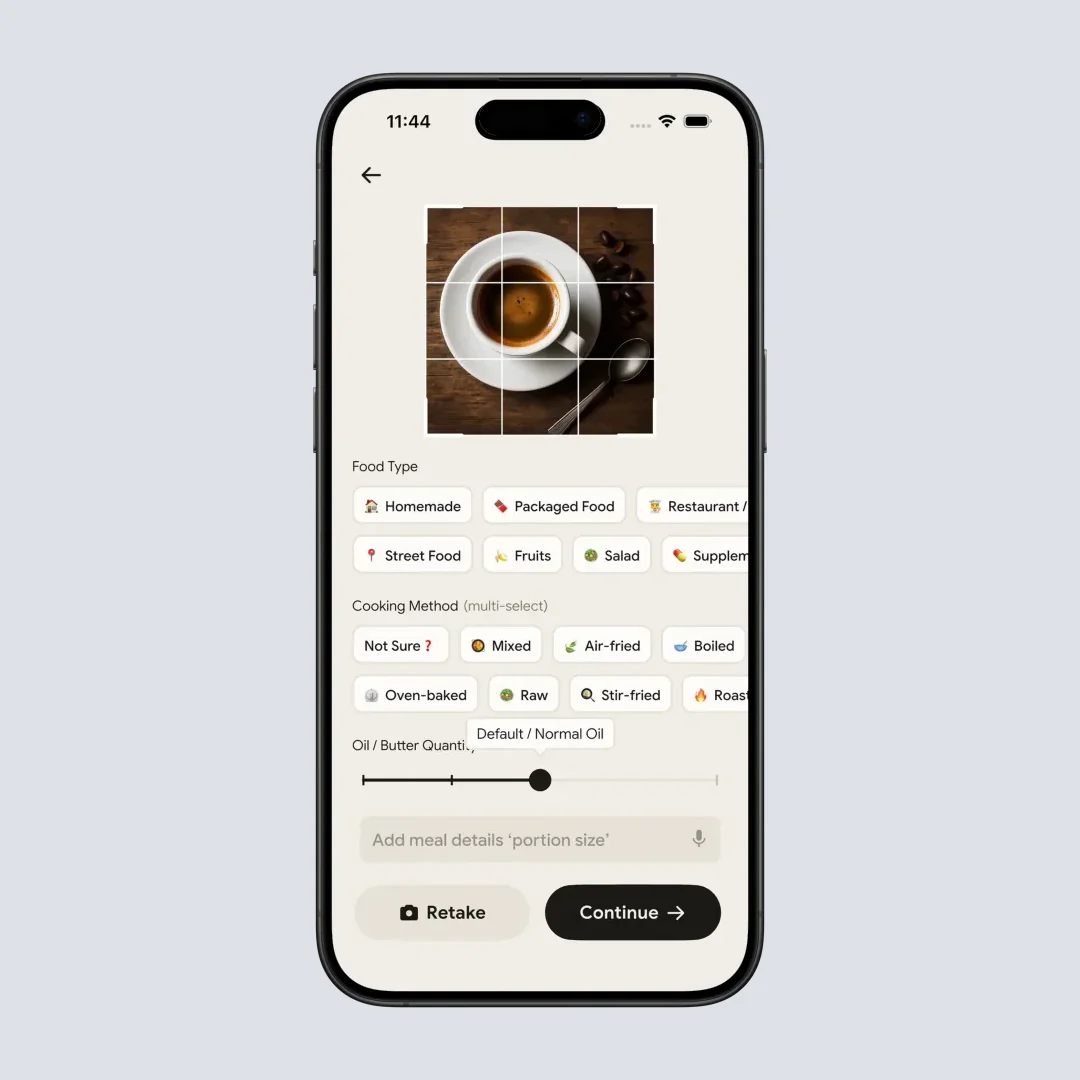
NutriScan: Home > Camera Icon > Crop Picture. Photo logging is the default flow, not a Premium add-on.
You take a photo of your plate and the app estimates calories and macros in seconds. The free plan includes 5 photo scans a week plus NutriBites AI tips, enough to test the camera on the plates a search box handles badly. If you want to compare all three options, check our NutriScan pricing guide.
For long-term macro planning, our macro calculator gives you a target before you even download a tracker.
The Switching Trick That Saves Most People 30 Minutes a Day ✨
Here is the one thing most reviews skip when they compare MyFitnessPal and FatSecret.
Most people lose 20-30 minutes a day to the wrong app, not the wrong plan. It is not about Premium vs Premium+. It is about logging friction.
The trick is a 4-step "logging audit" before you pay either app:
- Pick your top 10 foods. Write down the 10 foods you eat most often this week (cereal, yogurt, rice, chicken breast, salad mix, protein bar, fruit, coffee, snack, dinner).
- Search each in both apps. Time how long it takes to find the correct entry. Note duplicates and accuracy.
- Score on speed. App that totals under 90 seconds for 10 items wins your logging speed test.
- Score on confidence. App where you trust 8+ of 10 entries without second-guessing wins your accuracy test.
Whichever app wins both becomes your daily driver. Whichever app loses both gets uninstalled. If they split (one wins speed, one wins accuracy), stay free, use the speed winner for daily logging, and check the accuracy winner only for new foods.
Why it works: barcode scanning, database accuracy, and UI taps compound across 90 to 120 log events per week. A 5-second-per-meal savings turns into 30+ minutes saved every week. That time, not the $20-$40 price gap, is the real cost.
Step-by-Step: How to Test Both Apps in 7 Days
You do not need to pick one app today. Here is a simple way to test both and decide.
Day 1-2: Set up both apps.
- Download MyFitnessPal and FatSecret
- Enter height, weight, goal, and activity level in both
- Set the same calorie and macro targets in each
Day 3-4: Log the same meals in both apps.
- Eat your normal food and log every meal in both
- Time each logging session
- Note which database has better matches
Day 5: Compare results.
- Check if calorie and macro totals match across apps
- Look at which entries needed manual creation
- Review which interface felt faster
Day 6: Test the unique features.
- FatSecret: try the community forums and web dashboard
- MyFitnessPal: browse recipes and free features
- Note which extras you actually used
Day 7: Pick one and delete the other.
- Keep the app with less friction
- If paying, compare Premium features you actually need
- Uninstall the other to avoid decision fatigue
Research: What Makes People Stick With a Tracking App 🔬
The research on calorie tracking apps points to one consistent finding: ease of use matters more than feature count.
A 2024 Cochrane review of dietary interventions found that technology-assisted self-monitoring produced small but meaningful improvements in dietary behavior, but only when the tool was easy enough to use daily (Coventry et al., 2024). Apps that required too many taps or too much searching saw higher dropout rates within the first month.
The Dugas et al. 2026 scoping review of 68 studies confirmed this pattern. Across all studies, the top factors for app acceptability were personalization, automation (like barcode scanning), user-friendly design, and data sharing with healthcare professionals. The top barriers were technical issues, limited food databases, and the burden of manual entry (Dugas et al., 2026).
A 2025 systematic review and meta-analysis of randomized controlled trials confirmed that mobile app interventions significantly reduce weight, BMI, waist circumference, fat mass, and HbA1c in adults with overweight and obesity (Li et al., 2025). Effect sizes were modest, but the pattern was clear: daily logging, regardless of which app, beat sporadic use.
Conclusion
FatSecret offers the better free plan in 2026. Free barcode scanning, full macro tracking, a web dashboard, and community features make it a strong choice for anyone who wants to track calories without paying. MyFitnessPal offers the better paid experience, especially Premium+ with its Meal Planner, grocery lists, and delivery integrations.
If budget matters, FatSecret Premium at $59.99/year gives you AI photo scanning and voice logging for 25% less than MyFitnessPal Premium. If meal planning matters, MyFitnessPal Premium+ at $99.99/year is the only option with an integrated planner and grocery list.
The right choice depends on what you need today. Download both, run the 4-step logging audit above, and keep the one that makes daily logging feel easy. Consistency beats features every time. 🌟
If the audit sends you to MyFitnessPal, the FatSecret to MyFitnessPal switching guide covers what transfers, the paywall you are walking into, and a 7-day plan that keeps you logging through the move.
Frequently Asked Questions ❓
Q: Is FatSecret really free or does it push you to upgrade?
A: FatSecret's free plan includes barcode scanning, full macro tracking, community features, and a web dashboard. Reviewers, including Garage Gym Reviews (4.18/5), note FatSecret rarely prompts users to upgrade (GGR, 2026). Premium adds AI photo scanning, voice logging, and ad removal, but the free plan is fully functional for daily calorie tracking.
Q: Why did MyFitnessPal remove barcode scanning from the free plan?
A: MyFitnessPal moved barcode scanning behind its Premium paywall as part of a monetization shift. The change was widely criticized on Reddit and in App Store reviews. Free users can still log via text search, but scanning is limited to Premium ($19.99/month) and Premium+ ($24.99/month) subscribers.
Q: Which app has the more accurate food database?
A: Neither is perfect. MyFitnessPal has more entries (14M+) but they are crowdsourced and contain duplicates or incorrect data. FatSecret has fewer entries (2.3M+) but they are human-verified. For barcoded packaged foods both apps pull from the same product labels and accuracy is similar. The difference shows up in manual search.
Q: Can I use both apps at the same time?
A: Yes, but it is not practical long-term. Logging in both doubles your time commitment and totals will diverge because database entries differ. The 7-day test method in this guide is a better approach: use both briefly, then commit to one.
Q: Is FatSecret Premium worth the upgrade?
A: FatSecret Premium adds Smart Food Scan, Smart Assistant (voice logging), custom meal headings, and ad removal for $59.99/year. If you log mostly by barcode and text search, free is enough. If you want to snap photos of meals or use voice commands, Premium adds real time savings. See our FatSecret Premium pricing guide.
Q: Which app is better for Indian or regional foods?
A: Both struggle with regional and restaurant foods. MyFitnessPal's larger crowdsourced database has more entries for non-Western foods, but accuracy is inconsistent. For Indian foods specifically, expect to create custom entries in either app. NutriScan's photo scan handles mixed Indian plates faster than search-based logging.
Q: Does MyFitnessPal Premium+ replace a dietitian?
A: No. Premium+ gives you a meal planner with 1,500+ recipes and grocery list automation, but it does not customize plans for medical conditions like PCOS, diabetes, or pregnancy. For condition-specific planning, use a registered dietitian alongside the app.