Why Diet Plans Fail by Day 5 and What to Do Instead
 ChatGPT
  Claude
  AI Mode
  Perplexity
Diet plans fail by day 5 because they are written for an average person, not for the way you actually eat. Your plan sets breakfast at 7 AM when you wake at 8, portions that leave you hungry by 4 PM, and foods you never cook. Track one normal week first, then build the plan on those numbers.
TL;DR - Why Diet Plans Fail (And How to Fix It)
The problem: 80% of dieters quit within 30 days, because the plan they picked does not match how they actually eat
The solution: Track your meals for 7 days BEFORE starting any diet plan to understand your actual habits, triggers, and preferences
Key insight: In Kaiser Permanente's 1,685-person Weight Loss Maintenance trial, people who kept daily food records lost about twice as much weight as people who kept none
Action step: Use photo-based tracking to remove friction, find your patterns, then get a plan designed for YOU
I'm going to be honest with you.
My nutritionist gave me this beautiful 28-day meal plan. It had everything - breakfast, lunch, dinner, snacks. The macros were calculated. The portions were specified. It looked perfect on paper.
By Day 5, I was ordering pizza and wondering what went wrong.
Sound familiar?
 When Day 5 hits and willpower runs out
It took me years to see what actually went wrong: I started a 28-day plan without knowing a single number about my own week.
Let me explain why this matters so much.
Why Diet Plans Fail in the First Week
Losing the weight is rarely the problem. Keeping it is. Reviewing 29 long-term weight loss studies, Hall and Kahan report that more than half of the lost weight is back within two years, and more than 80% of it by year five.
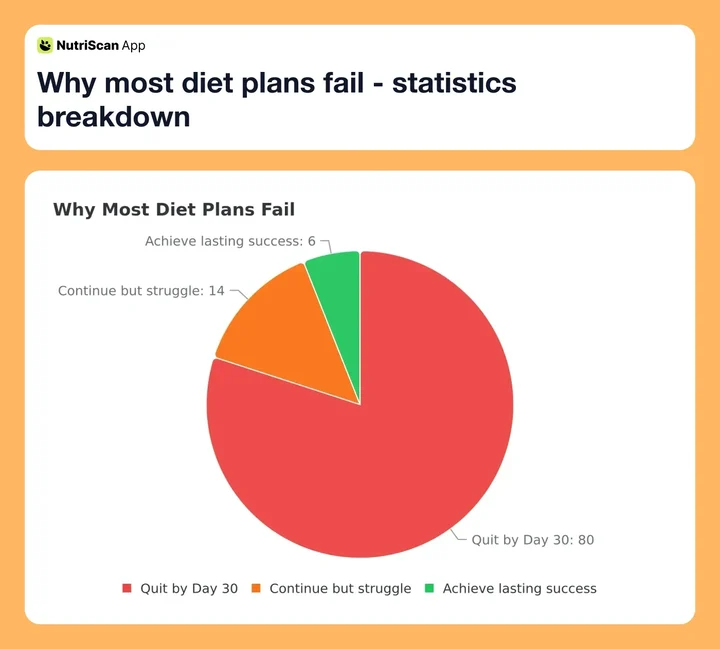 Figure 1: The harsh reality - 80% of dieters quit within 30 days
One study stood out while I was reading the research.
Kaiser Permanente's Center for Health Research ran the Weight Loss Maintenance trial with 1,685 adults across four clinical sites. Food records were the behavior that separated people. Kaiser reported that those who kept daily records lost about twice as much weight as those who kept none.
We still skip tracking and jump straight to the diet plan, because tracking feels boring. It feels like homework. It feels like punishment.
Tracking is the step that makes any diet plan work, and skipping it is what breaks day 5.
Two Ways to Start the Same Plan
The two paths below are worked examples built from the patterns described above, not individual users.
Two people start the same 28-day plan on the same day, both aiming to lose 8 kg in three months.
The first opens a calorie counting app and types every meal in by hand. Search for "aloo paratha", pick between six near-identical entries, guess the portion, estimate how much oil went into the pan. That is roughly 30 minutes a day of admin before a single thing about the food has changed. The logging is the first part to go, usually inside two weeks, and the plan follows it.
The second spends week one photographing meals and changing nothing. No restrictions, no guilt, just a record.
A week of that record usually surfaces three things the plan never asked about:
- Meal times are scattered, not the 8 AM, 1 PM and 8 PM the plan assumes.
- Portions, rice especially, are bigger on camera than they are from memory.
- There is a snack window nobody remembers, most often between 4 and 6 PM.
Now the 28-day plan can be edited to fit: breakfast at the hour it actually gets eaten, a rice portion set from the photos instead of a guess, and a planned snack in the 4 PM slot.
What separates the two paths is whether the logging survives week two. In the Kaiser trial above, the people who kept daily food records lost about twice as much weight as the people who kept none.
 Photo-based tracking removes the friction of manual logging

Why Generic Diet Plans Set You Up for Failure
Here's a fact that changed my perspective completely.
A randomized trial published in Nature Medicine in May 2024 compared a personalized dietary program with standard US government dietary advice. It ran for 18 weeks with 347 American participants.
The results? Participants on personalized diet plans lost more weight, lowered their cholesterol, and reported better mood compared to those following standard US government dietary guidelines.
The bigger finding, as King's College London reported: participants on personalized plans were twice as likely to feel less hunger and more than four times more likely to report better sleep quality and energy levels.
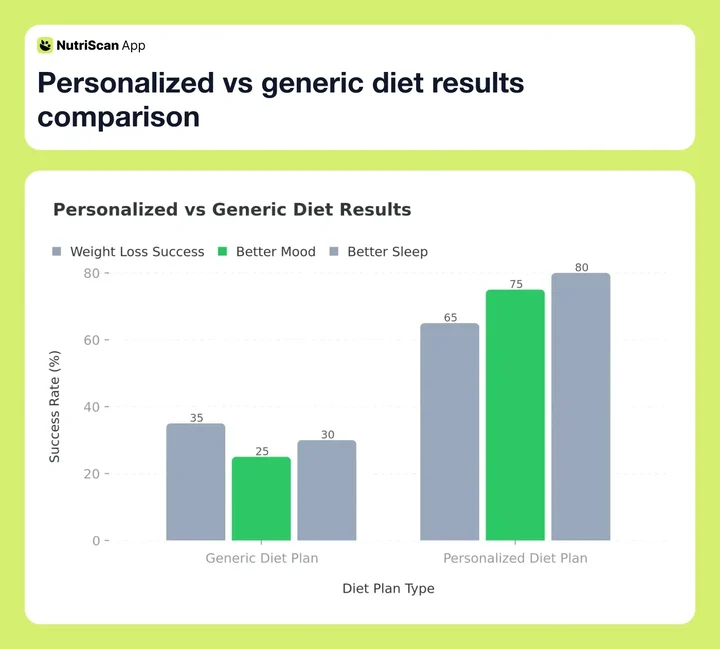 Figure 2: Personalized plans outperform generic ones across every metric
Think about what this means for your 28-day diet plan.
When your nutritionist gives you a generic 1500 calorie plan, they don't know:
- Your actual current eating patterns
- When you feel most hungry during the day
- Which foods make you feel satisfied vs still hungry
- Your regional food preferences and cooking style
- Your work schedule and stress eating triggers
A plan that skips all five is guessing at the parts that decide whether you last past day 5.
For sustainable weight management, consider our comprehensive guide to calorie tracking for a more balanced approach. We broke down the same pattern in why diet plans fail and personalization wins. If you're interested in understanding your nutritional needs better, our macro calculator can help you plan a sustainable eating strategy.
The Science Behind Tracking Success
University of Vermont researchers measured how long dietary self-monitoring actually takes. Across 142 people in a 24-week online weight control program, logging averaged 23.2 minutes a day in month 1 and 14.6 minutes a day by month 6.
What separated the people who lost weight was not minutes, it was frequency. In the same study, those who lost 10% or more of their body weight opened their food journal 2.7 times a day on average, against 1.7 times for those who lost less.
So the real cost is about 15 minutes a day, spread across the day rather than saved up for one sitting.
Most people think food tracking means hours of measuring cups, food scales, and obsessive calorie counting. That's the old way.
Modern AI-powered food tracking changes everything.
How 15,000+ People Changed Their Approach
At NutriScan, we noticed an interesting pattern among our users.
The ones who succeeded weren't the ones with the most willpower or the strictest diet plans. They were the ones who spent their first week just tracking - no judgment, no restrictions.
Here's what happens when you track your meals for just 7 days before starting any diet plan:
Day 1-2: You become aware of what you're actually eating (not what you think you're eating)
Day 3-4: You start noticing patterns - when you eat more, what triggers snacking, which meals satisfy you
Day 5-6: You begin making small adjustments naturally - not because a diet tells you to, but because awareness creates change
Day 7: You have real data about YOUR body, YOUR lifestyle, YOUR food preferences
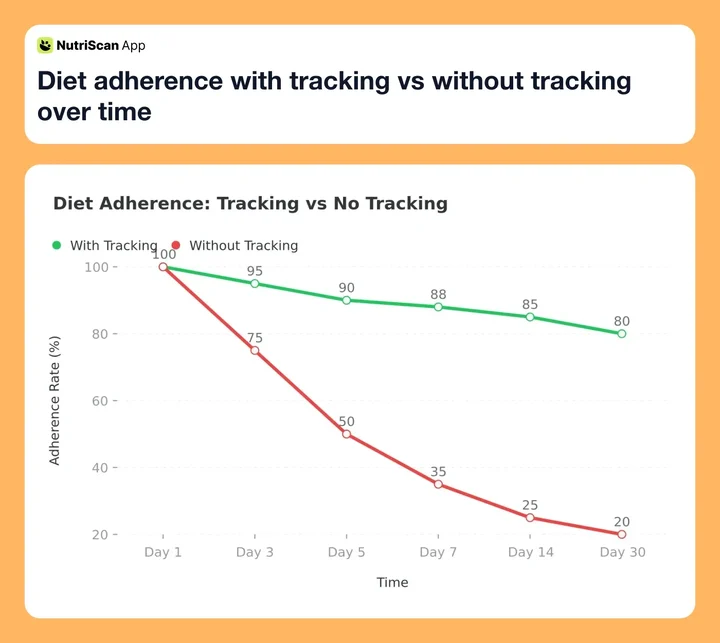 Figure 3: Tracking dramatically improves diet adherence over time
With this foundation, any diet plan becomes more effective. Because now the plan can be adjusted for YOU.
This is completely different from starting a rigid 28-day plan on Day 1 and hoping for the best.
7 Tips That Actually Work for Lasting Diet Success
Based on research and real user experiences, here are the tips that make the biggest difference:
Tip 1: Track Before You Diet
Spend at least one week simply photographing and logging what you eat. Don't change anything. Just observe. This data becomes the foundation for any diet plan that follows.
Tip 2: Use Photo-Based Tracking
In a pilot randomized trial published in the Journal of Medical Internet Research, 128 volunteers were assigned to a smartphone app, a website or a paper diary. At six months, 93% of the app group were still in the trial against 53% of the paper diary group, and they had logged their food on 92 days against 29.
Instead of typing "2 chapatis with mixed vegetable sabzi and dal," simply click a photo. Modern AI can analyze the nutritional content for you.
If logging has never stuck for you before, our roundup of the best app for beginners who hate tracking calories compares the low-effort options.
Tip 3: Focus on Patterns, Not Perfection
The National Weight Control Registry follows people who lost more than 30 pounds and kept it off for at least a year. In one analysis of registry members, between 42% and 60% kept written food records, depending on how much they exercised.
Notice what that number is not: 100%. Even among people who kept 30 pounds off for years, written records are a habit roughly half of them keep. They tracked their intake. They did not track it perfectly.
Tip 4: Match the Diet Plan to Your Existing Schedule
If your diet plan says "eat breakfast at 7 AM" but you never wake up before 8 AM, you're setting yourself up for failure on Day 1. Track your current eating schedule first, then find or adjust a diet plan that fits.
Tip 5: Get a Personalized Plan Based on Your Data
In the trial reported by King's College London, the program scored foods against each person's own blood sugar and blood fat responses, gut microbiome and health history, and it beat standard dietary guidance on weight and blood fats.
After tracking for a week, use that data to get a diet plan designed specifically for your patterns, not someone else's.
Pro Tip
NutriScan's personalized 28-day diet plans are built from your actual tracking data, food preferences, and health goals - not generic templates.
Tip 6: Track Consistently, Not Perfectly
In a year-long diabetes prevention program reported in the Journal of Diabetes Research, 45 participants were grouped by how often they logged. Only the group that logged on more than two-thirds of days lost a meaningful amount of weight, about 10 pounds. The rare and inconsistent loggers did not.
Two-thirds of days is about 5 days a week. Aim for that, not a perfect streak.
Tip 7: Review Your Data Weekly
Once a week, look at your tracking data and ask yourself:
- When did I eat most? Why?
- Which meals left me satisfied? Which left me hungry?
- Where can I make small improvements next week?
This weekly review turns data into actionable insights.
The One Habit That Can Double Your Weight Loss
Here's the simple habit that changed everything for me and thousands of others.
Track your food for 7 days before starting ANY diet plan.
That's it. No complex formulas. No expensive supplements. No extreme restrictions.
Just awareness.
Here's why this works so well:
You see reality, not assumptions - In a 1992 New England Journal of Medicine study, ten people who could not lose weight on a reported low-calorie diet underreported what they ate by 47% on average, reporting about 1,028 calories a day while measurement showed 2,081. Tracking closes that gap.
You identify YOUR triggers - Maybe you snack when stressed. Maybe you overeat at dinner because lunch was too small. You can't fix patterns you don't see.
You build the habit before you need it - When you start your diet plan, tracking is already automatic. One less thing to struggle with.
You create a baseline for comparison - How do you know if your diet is working if you don't know where you started?
You personalize automatically - Your data shows exactly what needs to change for YOUR body and YOUR lifestyle.
 Tracking works better as a tool than as a punishment
 The feeling when your diet actually works this time
Step-by-Step: The Track-First Approach to Diet Success
Here's the exact system that works based on research and real user experiences:
Step 1: Download a Photo-Based Food Tracker
Choose an app that lets you simply photograph your meals and get instant nutritional analysis. This removes the biggest barrier to tracking - the time and effort of manual logging.
With apps like NutriScan, you can click a photo and get detailed information about calories, proteins, fats, carbs, and all micronutrients within seconds.
Step 2: Track Everything for 7 Days (No Restrictions)
Eat exactly as you normally would. Click photos of every meal, snack, and drink. Don't judge yourself. Don't try to "eat better for the camera." The goal is to understand your true patterns.
Log the time of each meal. Note how you felt after eating. Did that heavy lunch make you sleepy at 3 PM? Did skipping breakfast lead to overeating at lunch? Capture all of this.
Step 3: Review Your Week and Identify Patterns
At the end of 7 days, look at your data:
- What's your average daily calorie intake?
- How are your macros distributed (protein, carbs, fat)?
- When are you eating most of your calories?
- Which meals have the best nutritional balance?
- Where are the obvious areas for improvement?
This analysis is extremely useful. It shows you YOUR reality, not someone else's assumptions about your reality.
Step 4: Set Your Goals Based on Real Data
Now you can set realistic goals. If your current average is 2,200 calories and you want to lose weight, aiming for 1,800 calories is realistic. Aiming for 1,200 calories cuts your own baseline by nearly half on day one.
Set goals that are challenging but achievable based on YOUR baseline.
Step 5: Get a Personalized Diet Plan
With your tracking data, get a diet plan that's designed for:
- Your calorie targets based on actual intake patterns
- Your preferred eating schedule (not someone else's ideal schedule)
- Your food preferences and regional cuisine
- Your specific goals (weight loss, muscle gain, diabetes management, etc.)
NutriScan creates 28-day diet plans based on your location, lifestyle, and health goals, on the Premium plan. The diet plan includes specific meal recommendations for breakfast, lunch, dinner, and snacks, customized for YOU. The NutriScan diet app page shows how the plan is built, and if you are weighing an app against a human coach, read AI diet plan generators vs a coach first.
Step 6: Continue Tracking During the Diet Plan
Keep photographing your meals even while following the diet plan. This serves two purposes:
- It keeps you accountable and aware
- It provides data on whether the plan is working for your body
If the plan calls for a specific meal but you ate something different, log what you actually ate. The data is more helpful than perfection.
Step 7: Adjust and Iterate
Every week, review your progress. Are you losing weight? Are you feeling good? Is the plan something you can maintain?
Use your tracking data to make adjustments. Maybe you need more protein at breakfast. Maybe the dinner portions are too small and you're snacking before bed. The data tells you what needs to change.
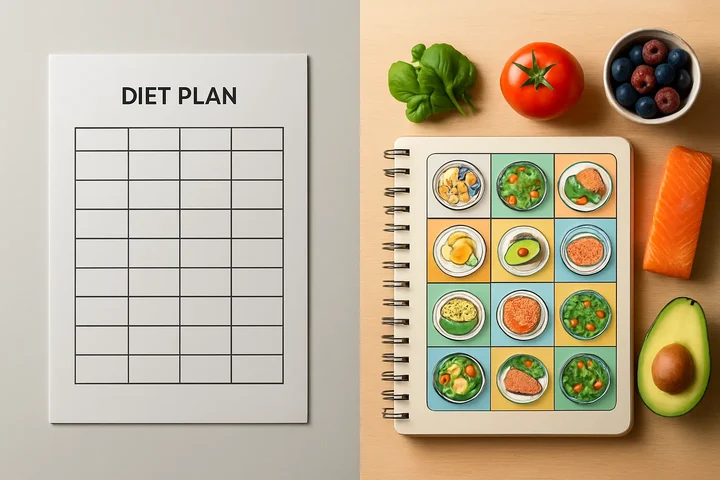 Generic plans fail because they don't account for your unique patterns

Three Tracking-First Examples
Example 1: The Working Professional
Take a typical office schedule: at the desk by 9:30 AM, canteen lunch, home after 8 PM. A week of tracking on that schedule usually surfaces one invisible line item, and it is often the 5 PM tea round. Two biscuits and a sweet chai, sometimes twice, never gets logged.
A plan built on that data puts a real snack in the 5 PM slot, roasted chana and buttermilk, so the biscuits stop being a willpower problem.
Example 2: The New Mother
Take a new mother a few months postpartum, feeding at night and sleeping in fragments. Generic plans assume three fixed meals and a full night of sleep, so they break in week one.
A week of tracking on that schedule often shows a large share of the day's calories landing between 10 PM and 2 AM during feeds. A plan built on that moves a filling dinner to 9 PM and puts a planned night snack where the junk food run used to be.
Example 3: The Diabetic Patient
Take someone managing blood sugar in Tamil Nadu, where rice is part of every meal. Generic plans say "avoid rice", which is advice nobody keeps for a month.
Logging portion sizes next to post-meal readings shows how much of the spike moves with the amount on the plate rather than with rice as such. A plan built on that keeps the rice, adjusts the portion, and adds fiber-rich accompaniments.
Important Note
If you're managing diabetes, always consult with your healthcare provider before making significant dietary changes. Our diabetes macro calculator can help you understand appropriate targets.
Why Personalized Diet Plans Work Better
Research from the Journal of Nutritional Science found that personalized diets based on individual factors result in more significant weight loss compared to generic diets.
Here's why personalization matters so much:
Metabolism Differences
Everyone's metabolism is different. What works for your friend may not work for you. Tracking your data reveals YOUR metabolic patterns - when you have energy, when you feel sluggish, how different foods affect you.
Lifestyle Factors
A diet plan designed for a homemaker won't work for someone with a high-stress corporate job. A plan for someone in Mumbai won't fit someone in Chennai. Your lifestyle, schedule, stress levels, and environment all matter.
Food Preferences
Long-term success is key. A diet plan that forces you to eat foods you hate will fail. A plan that works with your preferences - adjusting portions and combinations rather than eliminating favorite foods - has a much higher chance of success.
Health Conditions
Whether you're managing diabetes, PCOS, pregnancy, or recovering from illness, your nutritional needs are specific. Generic plans can't account for these needs. Personalized plans must.
For PCOS management, check out our PCOS macro calculator. For pregnancy nutrition, see our pregnancy macro calculator.
Frequently Asked Questions
Why do diet plans fail by day 5?
Most plans set eating times, portions and foods for an average person. By day 5 the gaps show up: a 7 AM breakfast you never eat, portions that leave you hungry at 4 PM, ingredients you do not cook. Around 80% of dieters quit within 30 days. Tracking one normal week before you start shows which parts of a plan you can actually keep, and which parts need changing before day 1.
How long should I track before starting a diet plan?
Seven days of consistent tracking is enough to see your pattern, and it has to include at least one weekend, since eating habits often differ on weekdays versus weekends. If you can track for 2 weeks, even better - but don't delay starting indefinitely. A week of data is good enough to begin.
What if I don't have time to track every meal?
In the Journal of Diabetes Research program above, the people who lost weight logged on more than two-thirds of days, roughly 5 days a week, not on all of them. Focus on your main meals - breakfast, lunch, and dinner. If you miss a snack, don't stress about it. Consistency matters more than perfection. With photo-based tracking apps like NutriScan, logging a meal takes literally 10 seconds.
Will tracking make me obsessive about food?
Tracking with no rule attached is closer to note-taking than to dieting: you photograph the meal, you eat the meal. The goal is to build enough awareness that better habits become automatic, then track less. Track closely at the start, taper as the habits form, and stop if logging starts to feel like scoring yourself.
Can I use my tracking data with any diet plan?
Yes! The data you gather about your eating patterns is useful regardless of which diet plan you follow. Whether you're doing intermittent fasting, low-carb, Mediterranean, or any other approach, knowing YOUR baseline helps you adapt any plan to YOUR reality. That said, diet plans that are built specifically from your data (like NutriScan's personalized plans) will always be more effective than adapted generic plans.
What makes NutriScan different from other calorie counting apps?
Three main differences:
Photo-based AI tracking - You don't search databases or guess portion sizes. Click a photo, get instant nutritional analysis.
Local food recognition - The AI understands regional Indian foods, home-cooked meals, and local cuisines that most international apps can't recognize.
Integrated diet planning - After tracking, you can get a personalized 28-day diet plan based on YOUR data, YOUR goals, and YOUR preferences. Most tracking apps make you find a separate diet plan elsewhere.
Where to Start This Week
Your 28-day plan did not fail for lack of willpower. It failed because you started following someone else's schedule before you knew your own.
So run this week differently. Photograph every meal for seven days, change nothing about what you eat, and note the time. On day 8, read your own numbers: average calories, snack window, real portion sizes. Then pick or build a plan that fits those numbers.
Food tracking roughly doubles weight loss in the research above. Personalized plans beat generic ones on weight, cholesterol, hunger and sleep. The whole habit costs about 15 minutes a day in the Vermont data, less with a photo-based app, and 15,000+ NutriScan users started exactly this way.
Track for seven days. Read your data. Then get a plan built for it.