Cronometer vs MacroFactor: 95 Nutrients vs Adaptive Targets
 ChatGPT
  Claude
  AI Mode
  Perplexity
Cronometer wins on nutrient depth, price, and desktop access. MacroFactor wins on adaptive targets. NutriScan publishes this post, and we make a competing app. Cronometer Gold is $59.99 a year, tracks up to 95 nutrients, and sits on top of a free tier that still gives you up to 84. MacroFactor is $71.99 a year with no free tier, and it recalculates your calories and macros every week from your own weight trend. Prices are standard US prices as of mid 2026 and change by region. Choose Cronometer if you want to see vitamins, minerals, and amino acids, or want to spend nothing. Choose MacroFactor if your next few months are a structured cut or bulk.
TL;DR - Cronometer vs MacroFactor
- Adaptive coaching winner: MacroFactor (weekly recalibrated targets)
- Micronutrient depth winner: Cronometer (up to 95 nutrients on Gold, up to 84 free, vs MacroFactor's 54 trackable items)
- Free tier winner: Cronometer (full tracking, ads) - MacroFactor has none
- Annual price winner: Cronometer Gold ($59.99/yr vs $71.99/yr)
- Data accuracy winner: Cronometer (~3.5% vs ~4.1% variance)
- Logging speed winner: MacroFactor (~35s vs ~45s per meal)
- Desktop access winner: Cronometer (full web app)
A 2025 systematic review and meta-analysis of 12 randomized controlled trials found that mobile calorie-tracking apps produce statistically significant weight loss and BMI reduction over 4 to 6 months (PMC13085986, 2025). But not every tracking app solves the same problem. MacroFactor is built for people who want their calorie and macro targets to adapt automatically as their body changes. Cronometer is built for people who want to see every vitamin, mineral, and amino acid in their diet. This guide compares both apps across pricing, features, accuracy, and real-world use so you can pick the one that fits your goals.
 Macros or micros: which side does your goal actually live on?
Cronometer vs MacroFactor at a Glance
Here is the side-by-side summary of what each app offers in 2026.
| Category | MacroFactor | Cronometer |
|---|---|---|
| Focus | Adaptive macro coaching | Full micronutrient tracking |
| Nutrients tracked | 54 trackable items | Up to 95 on Gold, up to 84 free |
| Free tier | No (7-day trial) | Yes (full tracking, ads) |
| Paid price (annual) | $71.99/yr ($5.99/mo) | $59.99/yr ($4.99/mo) |
| Paid price (monthly) | $11.99/mo | $10.99/mo |
| Adaptive TDEE | Yes (algorithm adjusts weekly) | No (static formula) |
| Coaching modes | 3 (Coached, Collaborative, Manual) | None built-in |
| AI features | Photo scan, text description, label scan | Photo Log, Voice Log, Crono Coach (Gold) |
| Food database type | Verified + community moderated | USDA + NCCDB verified |
| Data accuracy | ~4.1% variance | ~3.5% variance |
| Barcode scanner | Yes | Yes |
| Desktop version | No | Yes (web app) |
| App Store rating | 4.7/5 (12K+ reviews) | 4.7/5 (51K+ reviews) |
| Founded by | Greg Nuckols + Dr. Eric Trexler | Aaron Davidson (2011) |
| Workouts add-on | Yes ($89.99/yr bundle) | No |
Nutrient Tracking Depth: Cronometer Wins Clearly
Cronometer tracks up to 95 nutrients on Gold, and up to 84 on the free tier, pulled from seven lab-analyzed databases including the USDA National Nutrient Database and the NCCDB. That covers every essential vitamin, every major mineral, all essential amino acids, and the major fatty acid categories. A 2024 study in The Lancet Global Health found that more than 4 billion people worldwide do not consume adequate levels of iron, riboflavin, folate, and vitamin C (Beal et al., 2024). If you want to catch these gaps in your own diet, Cronometer is the only consumer app that gives you that level of visibility.
MacroFactor tracks 54 trackable items. That covers calories, protein, carbs, fat, fiber, and a selection of vitamins and minerals. For most people focused on body composition, 54 trackable items is enough. But if you follow a restrictive diet like vegan, keto, or carnivore, you may miss critical deficiencies that Cronometer would catch. B12 on a vegan diet, electrolytes on keto, and fat-soluble vitamins on carnivore are common blind spots that 54-item tracking cannot reliably flag. On keto in particular, a photo log like NutriScan shows carbs and the strongest micronutrients for the portion in front of you, which is the check that decides whether a pack goes in the cart.
Cronometer also has an "Ask the Oracle" feature that tells you which foods are the best sources of any nutrient you are low on. MacroFactor has no equivalent. For micronutrient tracking, Cronometer is the clear choice regardless of what MacroFactor does well in other areas.
Hidden cost of "enough"
A 54-item view feels complete until a blood panel disagrees. If your diet shifts seasonally, audit micronutrients at least quarterly even when your macros look fine.
MacroFactor vs Cronometer: MacroFactor Wins on Adaptive Targets
MacroFactor's adaptive TDEE (total daily energy expenditure) algorithm is its core differentiator. The app cross-references your logged calorie intake with your observed weight trend over time and recalibrates your true metabolic rate every week. Your calorie and macro targets shift automatically based on real data, not a formula you set once.
Cronometer uses a standard TDEE calculator based on height, weight, age, and activity level. It sets a fixed target that does not change unless you manually update it. If your metabolism adapts during a long cut, or if your activity level changes, you need to figure that out yourself and adjust your numbers.
In practice, MacroFactor's algorithm gets more accurate the longer you use it. The Outlift review, based on 6 years of testing and 500+ clients, confirmed that the algorithm self-corrects even when users overshoot or undershoot their targets (Outlift, 2026). One user who ate 300 calories above the app's recommendation during a bulk reported that the algorithm adjusted within a month to match his actual expenditure.
MacroFactor offers three coaching modes to match your comfort level:
- Coached - the app sets and adjusts all calorie and macro targets automatically
- Collaborative - the app suggests targets but you can override them
- Manual - you set everything yourself (useful if you work with a nutrition coach)
Cronometer has no built-in coaching. It does offer Cronometer Pro ($29.95/mo) for health professionals who want to access client data remotely, but that is a service for coaches, not a feature for regular users.
For anyone managing a multi-month bulk, cut, or body recomposition phase, MacroFactor's adaptive coaching is a meaningful advantage over Cronometer's static targets.

Food Database Accuracy: Both Are Strong, Cronometer Edges Ahead
Both apps use verified food databases, which puts them ahead of apps that rely on user-generated entries. According to independent testing from Calorie Trackers Review, Cronometer has approximately 3.5% data variance while MacroFactor has approximately 4.1% variance (Calorie Trackers Review, 2026). For comparison, MyFitnessPal has roughly 6.8% variance.
Cronometer sources its data from the USDA National Nutrient Database and the NCCDB. Every user-submitted food must be verified by Cronometer staff before it becomes publicly available. This strict moderation keeps the database clean but also means new foods take longer to appear.
MacroFactor uses a verified premium database with community moderation. Entries include detailed macronutrient breakdowns, fiber content, amino acid profiles, and micronutrients. The Outlift review noted that the international database has improved significantly since launch, now covering European, Korean, and Chinese food brands that were previously missing.
Both apps include barcode scanners, and both now have AI logging. MacroFactor added AI text description and photo scanning in recent updates. Cronometer Gold has Photo Log and Voice Log, plus Crono Coach for AI questions about your data. Neither treats photo logging as the primary input method the way a photo-first app does.
Prepackaged blind spot
MacroFactor's micronutrient data from prepackaged foods can be incomplete because manufacturers do not report every nutrient on labels. If your diet leans on packaged items, your micronutrient totals in MacroFactor may read lower than reality.
Logging Speed and Daily Workflow
Neither app is designed for raw speed. Both require manual search, select, adjust serving size, and confirm. According to Calorie Trackers Review, Cronometer averages about 45 seconds per meal entry while MacroFactor averages about 35 seconds, reflecting a cleaner interface and faster search.
MacroFactor has a few workflow advantages:
- AI text description - describe your meal in words and the app estimates the macros (useful for restaurant meals)
- AI photo scan - take a photo and let the app guess the calorie content
- Quick log - the app remembers foods you commonly eat at each meal time
- Nutrition label scanner - AI interprets the label for you
Cronometer's logging leans on search and barcode scanning, with Photo Log and Voice Log available on Gold. The interface is functional but feels older compared to MacroFactor's more modern design.
MacroFactor also uses "trend weight" instead of raw daily weight. This smooths out fluctuations from water, salt, and carb intake to give you a more accurate picture of your actual progress. Cronometer shows raw weight data unless you manually calculate trends yourself.
For daily logging comfort, MacroFactor has the edge. But if you value a desktop web app for logging at your computer, Cronometer is the only option. MacroFactor is mobile-only.
Where photo logging fits in
If manual search-and-select feels heavy, photo-based logging is worth a look. NutriScan's home dashboard shows daily macros after a single photo scan, with Indian, Western, and Asian dishes recognized natively.
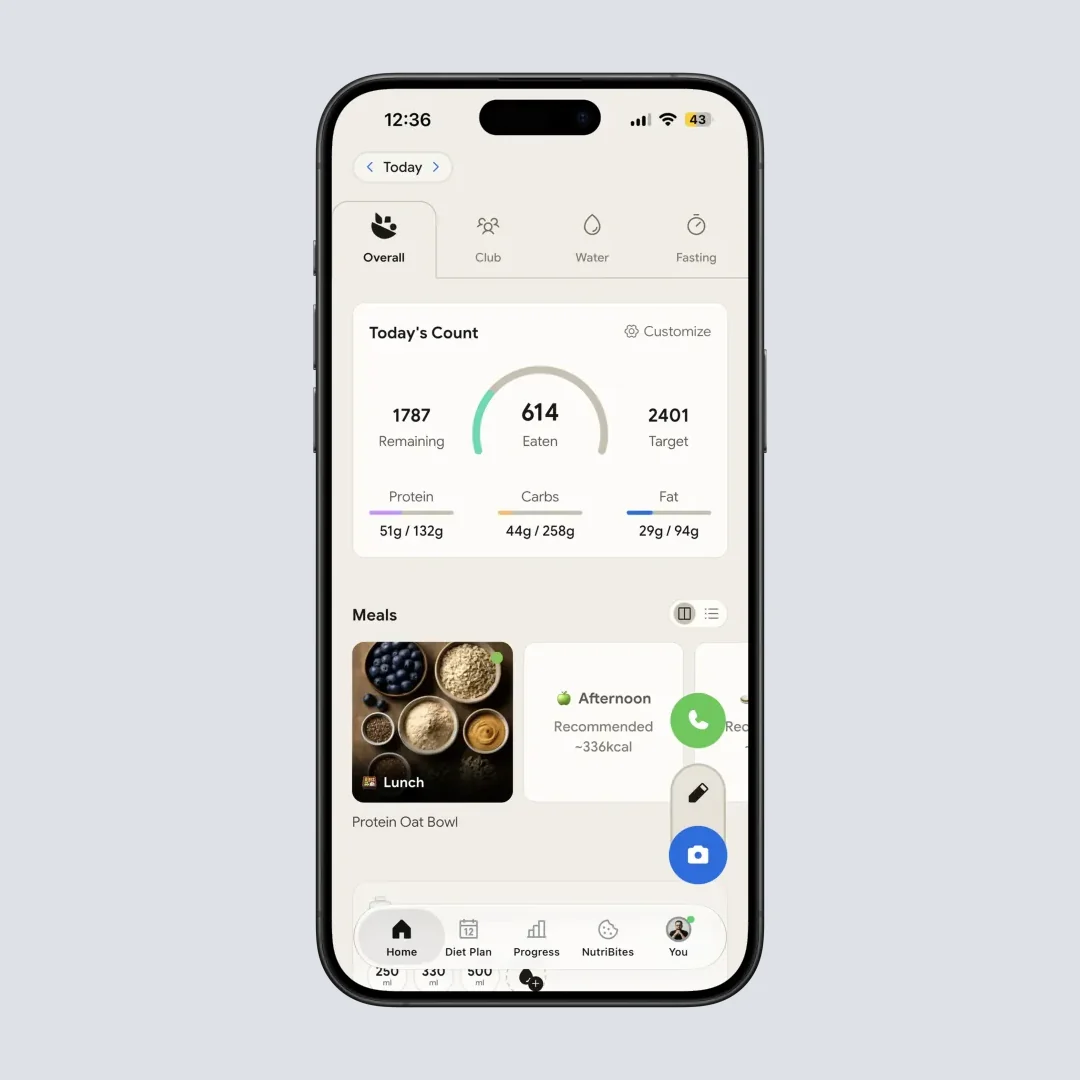
NutriScan home: daily macro and calorie roll-up from photo scans (Home > Camera Icon)
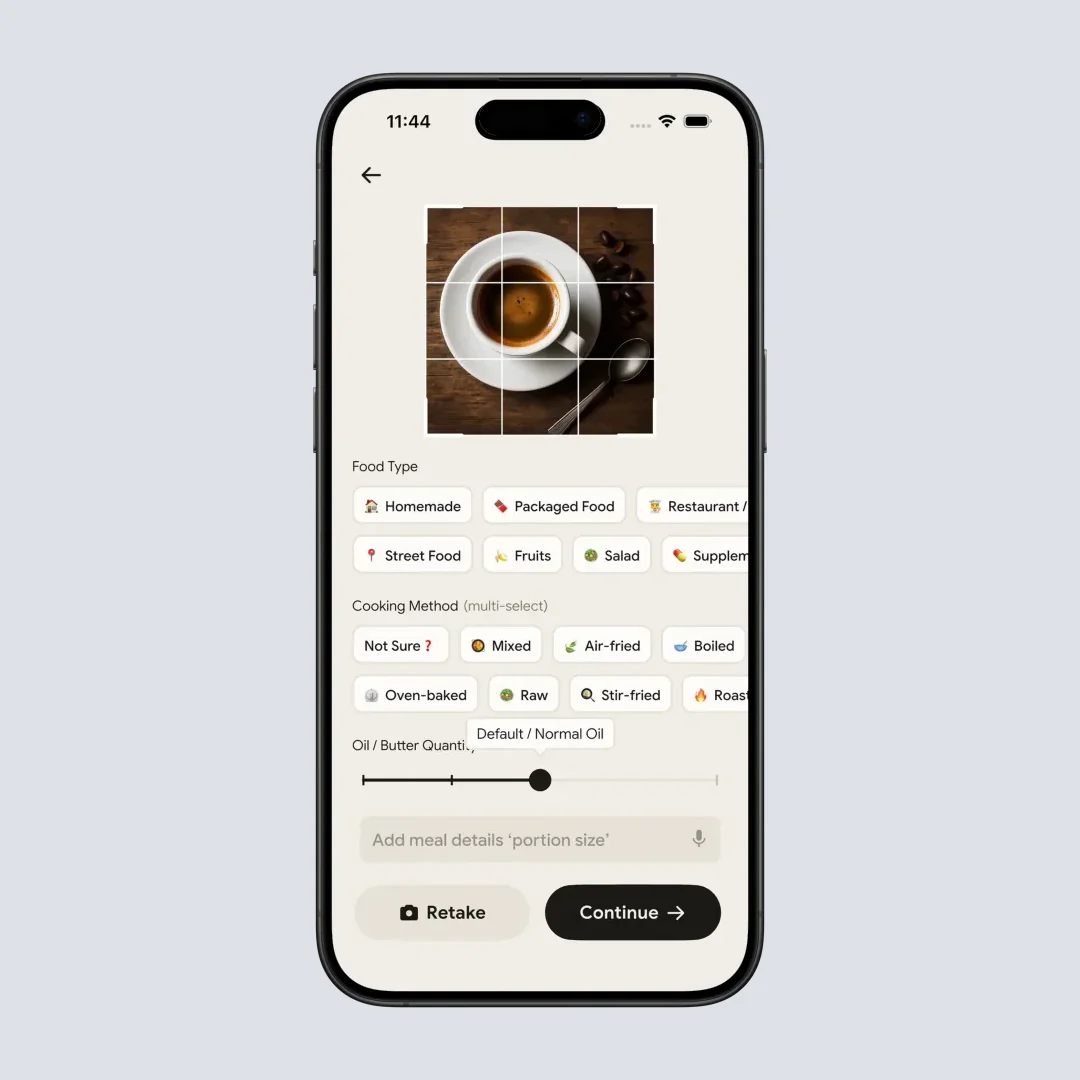
Photo scan crop screen (Home > Camera Icon > Click Picture > Crop)
Pricing: Cronometer Costs Less and Has a Free Plan
This is where Cronometer pulls ahead for budget-conscious users.
Cronometer pricing:
- Free tier: USDA-verified tracking, up to 84 nutrients, barcode scanner, a 7-day reporting window, ads included
- Gold: $4.99/mo billed annually at $59.99, or $10.99/mo month to month - raises the nutrient count to 95 and adds custom charts, trend reports, unlimited history, fasting timer, Photo Log, Voice Log, Crono Coach, custom biometrics, ad removal (Cronometer Gold)
- Pro: $29.95/mo - designed for health professionals managing clients
MacroFactor pricing:
- 7-day free trial (no ongoing free tier)
- Monthly: $11.99/mo
- 6-month: $47.99 ($7.99/mo)
- Annual: $71.99/yr ($5.99/mo)
- Bundle with Workouts: $89.99/yr
Cronometer's free tier alone is one of the best in the entire nutrition app category. You get up to 84 nutrients with USDA-verified data and the barcode scanner at zero cost. What you miss on free is the extra 11 nutrients you get on Gold, unlimited history, custom reports, advanced charts, the fasting timer, Photo Log, Voice Log, and Crono Coach.
MacroFactor costs $12 more per year than Cronometer Gold on annual plans. That premium buys you the adaptive algorithm, AI logging features, and built-in coaching. Whether that is worth $12/yr depends entirely on whether you will use the coaching features actively. We broke down both upgrades on their own in Is Cronometer Gold worth it in 2026? and Is MacroFactor worth it in 2026?.
A 2025 systematic review found that smartphone apps demonstrate modest but statistically significant effects on weight loss and BMI reduction, with the strongest results seen when users engage consistently over 4 to 6 months (PMC12093073, 2025). The app you will actually use consistently matters more than which app has the better feature list.
Real-World Examples: Who Benefits From Each App
Example 1: The bodybuilder managing a 16-week cut. Jake is a competitive natural bodybuilder preparing for a show. His metabolism adapts significantly during prolonged calorie restriction. MacroFactor's adaptive algorithm recalibrates his targets weekly, catching metabolic slowdown that a static calculator would miss. He uses the Coached mode and lets the app handle all adjustments. Cronometer would require Jake to manually track his weight trends and adjust his own targets, a process that requires nutritional expertise most people do not have.
Example 2: The vegan tracking B12 and iron. Priya follows a fully plant-based diet and wants to make sure she is getting enough B12, iron, zinc, and omega-3s without relying solely on supplements. Cronometer's 95-nutrient tracking flags her daily intake against recommended values for each micronutrient. MacroFactor's 54-item tracking would miss several of these, leaving Priya guessing about potential gaps. Cronometer is the right choice here.
Example 3: The casual tracker on a budget. David wants to lose 15 pounds and does not need coaching or detailed micronutrient data. He wants to count calories and hit a protein target. Cronometer's free tier gives him everything he needs at zero cost. MacroFactor would cost him $72/yr for features he would not use. Cronometer wins on value for this user.
Tips for Getting the Most Out of Each App
- Start with Cronometer if you are unsure. The free tier lets you try serious nutrition tracking with no financial risk. You can always switch to MacroFactor later if you decide you need adaptive coaching.
- Use MacroFactor's Collaborative mode first. Start with Collaborative instead of fully Coached. You learn how the algorithm works while keeping the ability to override suggestions that feel off.
- Log consistently for at least 2 weeks before judging either app. MacroFactor's algorithm needs about 2 weeks of data to start making accurate adjustments. Cronometer's value becomes clear once you see micronutrient patterns over a full week.
- Check your micronutrients even if you use MacroFactor. Some users run both apps for a week to get a Cronometer micronutrient snapshot, then continue with MacroFactor for daily macro coaching.
- Set a calorie floor in MacroFactor. This safety feature prevents the algorithm from recommending dangerously low targets during aggressive cuts. Cronometer has no equivalent guard rail.
- Use Cronometer's Oracle feature weekly. If Cronometer flags a nutrient gap, use Ask the Oracle to find the best food sources for that nutrient. Passive tracking turns into active diet improvement.
- Export your data before switching apps. Both apps allow data export. If you ever switch, export your food log and weight history first so you do not lose months of tracking.
 The right app fades into the background so the food choices stay in focus.
Cronometer or MacroFactor: How to Choose in Five Steps
Choosing between these two apps comes down to five questions. Answer them honestly and the right app becomes obvious.
Step 1: Define your primary goal. If body composition is the main goal (cutting, bulking, recomposition), lean toward MacroFactor. If overall nutrition quality and catching micronutrient gaps is the goal, lean toward Cronometer.
Step 2: Check your budget. If you want to spend $0, Cronometer's free tier is the answer. If you are comfortable paying about $60 to $72 per year, both apps are on the table.
Step 3: Assess your nutrition knowledge. Confident adjusting your own calorie targets from weight trend data? Cronometer's manual approach works. Want the app to handle adjustments? MacroFactor.
Step 4: Consider your diet type. Restrictive diets (vegan, keto, carnivore, elimination protocols) benefit from Cronometer's 95-nutrient tracking. Standard mixed diets work well with either app.
Step 5: Try before you commit. Cronometer is free to start. MacroFactor has a 7-day trial. Spend a week with each and see which logging experience you prefer. The app that feels less annoying daily is the one you will actually stick with.
Pro tip - use NutriScan as a third datapoint
If both apps feel like work, run NutriScan's free photo log for 3 days. You will know within a week if photo-first logging fits your routine better than search-and-select. Try the macro calculator to seed your targets before you start.

How Cronometer and MacroFactor Compare to Other Apps
Both MacroFactor and Cronometer target serious trackers, but they sit in different positions within the broader market.
| App | Annual Price | Nutrients Tracked | Adaptive Coaching | Free Tier | Best For |
|---|---|---|---|---|---|
| MacroFactor | $71.99 | 54 trackable items | Yes | No | Macro coaching, body composition |
| Cronometer | $59.99 (Gold) | Up to 95 | No | Yes | Micronutrients, health conditions |
| MyFitnessPal Premium | $79.99 | ~20 | No | Yes (limited) | Social features, large database |
| Carbon Diet Coach | $99.99 | ~15 | Yes | No | Strict macro coaching |
| Lose It Premium | $79.99 | ~15 | No | Yes | Simple weight loss |
| NutriScan Premium | Varies by region | 30+ | No | Yes | AI photo scanning, Indian food |
Standard US prices as of mid 2026 and they change by region. Lose It Premium doubled to $79.99 a year in 2026 and dropped its monthly plan (Lose It Membership Tiers and Pricing), so it is no longer the cheap entry point in this table.
MacroFactor offers the best adaptive algorithm at a lower price than Carbon ($72 vs $100/yr). Cronometer offers the deepest nutrient tracking at a lower price than MyFitnessPal Premium ($60 vs $80/yr) with far better data accuracy. If you want AI photo logging as your primary input method, neither is ideal. Apps like NutriScan focus specifically on making photo-based logging fast and accurate.
For a wider look at MacroFactor against the big trackers, read MacroFactor vs MyFitnessPal 2026 and MacroFactor vs Carbon 2026. If neither of these two apps fits, we also list the best Cronometer alternatives.
The 60-Second Decision Test That Picks For You
Use this simple test to decide in under a minute. Pick the row that describes your next 12 weeks most honestly:
- Your next 12 weeks are a structured cut or bulk ➡️ MacroFactor. The adaptive algorithm pays for itself by catching metabolic adaptation you would otherwise miss.
- You follow vegan, keto, carnivore, or any elimination protocol ➡️ Cronometer. 95-nutrient depth turns guessing into a flagged deficiency you can actually fix.
- You want to spend zero dollars this year ➡️ Cronometer free. It out-tracks most paid apps.
- You log at a desk during work ➡️ Cronometer. Web app, copy-paste, faster recipe building.
- You hate search-and-select logging ➡️ Neither, fully. Try photo-first with NutriScan for a week.
- You are not sure what your next 12 weeks look like ➡️ Start Cronometer free, add MacroFactor's 7-day trial when you commit to a phase.
Conclusion
If budget is the deciding factor, start on Cronometer's free tier. It gives you more tracking depth than most paid apps, and you can move to Gold at $59.99 a year when the extra 11 nutrients, unlimited history, and reports start to matter. If you are running structured cut and bulk phases and want the targets handled for you, MacroFactor at $71.99 a year earns the extra $12.
If manual search-and-select is the part you keep skipping, check out NutriScan and photo-log a few meals before you commit to either subscription.
Frequently Asked Questions ❓
Q: Cronometer or MacroFactor, which one is better?
A: Cronometer for most people. It tracks up to 95 nutrients on Gold at $59.99 a year, keeps a free tier with up to 84, and is the only one of the two with a desktop web app. MacroFactor is the better pick if your next few months are a structured cut or bulk, because it recalculates your calorie and macro targets every week from your weight trend instead of leaving that job to you.
Q: Is macro factor vs cronometer the same as chronometer vs macrofactor?
A: Yes. The app is spelled Cronometer, no h, and MacroFactor is one word, so searches for chronometer vs macrofactor and macro factor vs cronometer land on the same two apps compared here.
Q: Can I use MacroFactor and Cronometer together?
A: Yes, some advanced users do. The typical approach is to use MacroFactor for daily macro coaching and run Cronometer for a week every month or two to check micronutrient levels. Logging in two apps daily is unsustainable for most people, but periodic micronutrient checks in Cronometer paired with daily MacroFactor tracking is a practical hybrid approach.
Q: Which app is better for tracking a bulk or cut cycle?
A: MacroFactor. Its adaptive TDEE algorithm continuously recalibrates your calorie and macro targets based on your actual weight trend data. This accounts for metabolic adaptation during prolonged cuts and increased calorie needs during bulks. Cronometer uses fixed targets that you must adjust manually, which requires more nutritional knowledge and effort.
Q: Which app has more accurate food data?
A: Cronometer edges ahead with approximately 3.5% data variance compared to MacroFactor's 4.1% variance, according to independent testing (Calorie Trackers Review, 2026). Both are significantly more accurate than MyFitnessPal (6.8% variance). Cronometer sources from USDA and NCCDB databases with strict staff verification. MacroFactor uses a verified premium database with community moderation.
Q: Does Cronometer offer adaptive calorie targets?
A: No. Cronometer calculates your TDEE from a standard formula and sets a fixed target. You can manually adjust targets over time, but the app does not algorithmically recalibrate based on your weight trend. For users who prefer a data-rich environment with manual control, this is not a problem. For users whose calorie needs change significantly over time, MacroFactor's adaptive approach is more responsive.
Q: Which app is better for someone on a vegan, keto, or carnivore diet?
A: Cronometer. Its 95-nutrient tracking and USDA-sourced data make it excellent for identifying deficiencies common in restrictive diets. B12 on vegan diets, electrolytes on keto, and fat-soluble vitamins on carnivore are gaps that Cronometer catches reliably. MacroFactor's 54-item tracking covers macros well but does not provide the micronutrient visibility needed to safely maintain restrictive protocols long-term.
Q: Is MacroFactor worth $12 more per year than Cronometer Gold?
A: It depends on whether you will use the adaptive coaching. If you are managing body composition through structured bulk and cut cycles, the algorithm saves you the effort of manually adjusting targets and catches metabolic adaptation you might miss. If you are tracking for general health awareness or micronutrient optimization, Cronometer Gold gives you deeper data for less money. The $12 difference is small enough that the deciding factor should be which feature set matches your actual goal.
Q: Can I use either app on a desktop computer?
A: Cronometer has a full web app at cronometer.com that works on any desktop browser. MacroFactor is mobile-only with no desktop version. If you prefer logging meals from your computer, Cronometer is the only option between these two.