MacroFactor vs MyFitnessPal: Which Paid Tracker Wins?
 ChatGPT
  Claude
  AI Mode
  Perplexity
MacroFactor vs MyFitnessPal splits along two bets. MacroFactor sells one paid plan at $11.99 a month or $71.99 a year, runs a verified database of about 1.36 million search foods, tracks 54 nutrients, and rewrites your calorie target every week from your own weight and intake data. MyFitnessPal keeps a free tier, charges $19.99 a month or $79.99 a year for Premium, and holds more than 20 million entries anyone can submit. Prices are standard US prices as of mid 2026 and change by region. Track macros seriously and MacroFactor wins on data quality, logging speed, and annual price. Need free tracking or a huge international database and MyFitnessPal keeps the edge.
TL;DR - MacroFactor vs MyFitnessPal
- Database size winner: MyFitnessPal (20M+ entries vs 1.36M verified)
- Database quality winner: MacroFactor (verified entries, 54 nutrients vs 14)
- Logging speed winner: MacroFactor (50% fewer taps across all workflows)
- Coaching winner: MacroFactor (adaptive weekly targets vs static)
- Free tier winner: MyFitnessPal (MacroFactor has none)
- Annual price winner: MacroFactor ($71.99/yr vs $79.99/yr)
NutriScan publishes this post, and we make a competing app. A 2024 University of Sydney study of 18 popular nutrition apps found manual food logging overestimated energy by an average of 1,040 kJ for Western diets and underestimated it by 1,520 kJ for Asian diets (Chen et al., 2024). The database behind your tracker shapes every number you see, so that is where this comparison starts.
 Logging is only fun when it is fast, and that is exactly where these two apps diverge.
MyFitnessPal vs MacroFactor: The Full Comparison Table 📊
MyFitnessPal launched in 2009 and built the industry's largest food database. MacroFactor launched in 2021 and curates a verified one instead. The side-by-side before the detail:
| Feature | MyFitnessPal | MacroFactor |
|---|---|---|
| Monthly price | $19.99 (Premium) / $24.99 (Premium+) | $11.99 |
| Annual price | $79.99 (Premium) / $99.99 (Premium+) | $71.99 |
| Free version | Yes (with ads, limited features) | No (7-day trial only) |
| Food database size | 20M+ items (user-submitted) | 1.36M verified + 4M barcode |
| Database accuracy | Mixed (duplicates and errors) | High (human-verified entries) |
| Adaptive calorie coaching | No | Yes (weekly adjustments) |
| Nutrients tracked | 14 (6 micronutrients) | 54 |
| Barcode scanner | Premium only | Included |
| AI food logging | Meal Scan and voice (Premium) | AI Describe + label scan |
| Social features | Feed, messaging, community | None |
| Desktop version | Yes | No (mobile only) |
| App Store rating | 4.7 stars (1.7M+ reviews) | 4.7 stars (1,200+ reviews) |
| Google Play rating | 4.1 stars (2.6M+ reviews) | 4.6 stars (~1,900 reviews) |
A 2025 scoping review in JMIR mHealth and uHealth covered 68 studies on calorie counting apps and found MyFitnessPal and Lose It were the two most studied in clinical research, mostly in trials of adults with overweight or obesity (Alkhalaf et al., 2025).
How Much Does MacroFactor Cost in 2026? 💵
MacroFactor sells one paid tier, billed three ways (Outlift, 2026):
- Monthly: $11.99 per month
- 6-month: $47.99, which is $7.99 per month
- Annual: $71.99, which is $5.99 per month
A separate Workouts app costs the same and a bundle of both runs around $90 per year. There is no free version, only a 7-day trial with full access. Prices are standard US prices as of mid 2026 and change by region. Our MacroFactor free trial guide covers what happens on day 8.
How Much Does MyFitnessPal Premium Cost? 💳
MyFitnessPal runs three tiers (MyFitnessPal, 2026):
- Free: calorie and macro tracking with ads, no barcode scanning, macro targets adjustable only to the nearest 5 percent.
- Premium, $19.99/month or $79.99/year: no ads, plus barcode scanning, voice logging, Meal Scan, gram-level goals, an intermittent fasting timer, and food analysis reports.
- Premium+, $24.99/month or $99.99/year: all of Premium plus meal planning, grocery lists, 1,500+ recipes, and budget meal suggestions.
Annual Premium works out to $6.67 a month, Premium+ to $8.34. Premium comes with a 7-day trial, covered in our MyFitnessPal free trial guide.
On annual plans MacroFactor undercuts Premium by $8 and sits $28 below Premium+. Monthly it is roughly half the price. MyFitnessPal wins on price in one place only, the free tier, which strips out barcode scanning and gram-level macro control.

How to Cancel MacroFactor or MyFitnessPal Before You Are Charged 🚫
Neither app processes cancellations itself. Both subscriptions live in your app store, so cancel there at least 24 hours before day 7.
On iPhone or iPad: Settings > your name > Subscriptions > MacroFactor or MyFitnessPal > Cancel Subscription.
On Android: Google Play Store > profile icon > Payments & subscriptions > Subscriptions > the app > Cancel subscription.
You keep access until the trial runs out and your logs stay in your account. The full walkthrough is in our step-by-step MacroFactor cancellation guide.
Food Database Size: Where MyFitnessPal Wins 📚
If your worry is finding every food you eat in the search bar, MyFitnessPal has the edge. Twenty million entries covers Brazilian packaged goods, Japanese convenience store meals, and UK chain restaurant dishes without a custom entry.
MacroFactor covers most needs in the United States, Canada, the United Kingdom, Australia, and much of Western Europe. Its 1.36 million verified search entries plus 4 million barcode foods handle common groceries, restaurant chains, and fresh staples. MacroFactor's own 2024 comparison put the verified library at 1.15 million plus items, so the curated set grows roughly 200,000 foods a year (MacroFactor, 2024). Outside those markets, or on niche regional products, you will still build custom entries more often.
Custom entries are quick on both: MacroFactor scans a nutrition label to build one, MyFitnessPal takes it manually.
Food Database Quality: Where MacroFactor Wins 🔬
Any MyFitnessPal user can submit a food entry, so the database carries duplicates, incomplete entries, and outright errors. A banana can appear ten times with different calories, and "chicken breast" returns dozens of results with wildly different counts. Premium does not clean this up: free and paid users see the same entries, and the "verified" badge covers only part of the catalog.
MacroFactor reviews search entries before they go live, and its standard database carries about 26,500 micronutrient-complete common foods, a large share of them drawn from the NCC Food and Nutrient Database used in nutrition research (MacroFactor Help Center).
The difference shows up in nutrient tracking. MacroFactor tracks 54 nutrients, including all B vitamins, vitamin D, vitamin K, omega-3 fatty acids, individual amino acids, caffeine, and alcohol. MyFitnessPal tracks 14, of which only 6 are micronutrients: sodium, potassium, calcium, iron, vitamin A, and vitamin C.
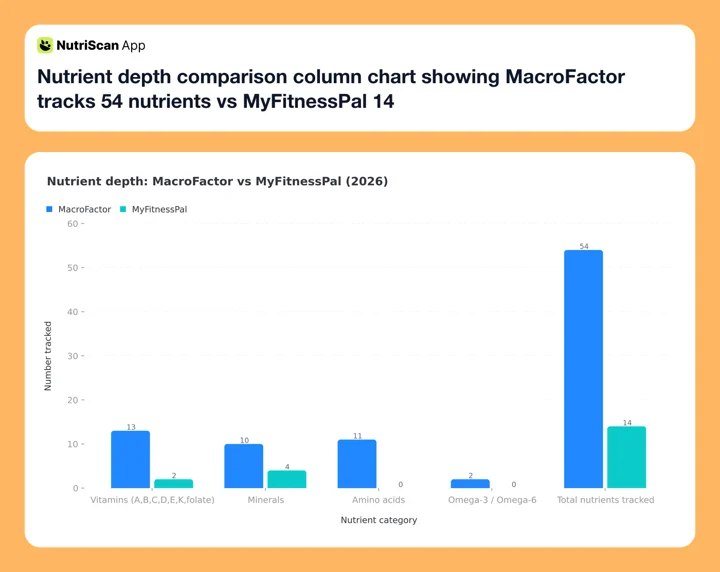 Figure 1: Nutrient depth comparison. MacroFactor tracks roughly 4x more nutrients than MyFitnessPal, including all 13 vitamins, 10 minerals, 11 amino acids, omega-3/6, caffeine, and alcohol.
A 2024 validation study in BMJ Nutrition, Prevention & Health had 37 adults and dietitians log the same meals in MyFitnessPal. Group means matched, but individual days did not: the 95% limits of agreement ran from -1,102 kcal to +1,325 kcal, and against the reference food composition tables MyFitnessPal underestimated energy, carbohydrate and fat (Banal et al., 2024). Verified databases cut that variance because the source data starts cleaner.
Heads up about user-submitted data
In MyFitnessPal, entries without a green check are anyone's guess. Look for the verified badge and skip entries with no brand name or rounded "100 kcal per serving" totals, which are flags that someone eyeballed it.
Food Logging Speed: How Fast Can You Track a Meal? ⚡
Logging speed decides whether you stick with tracking or quit in week two. MacroFactor's Food Logging Speed Index counts the discrete actions each common task takes. Across four workflows, MacroFactor needed 24 actions to MyFitnessPal's 36, a 50% difference (MacroFactor, 2026).
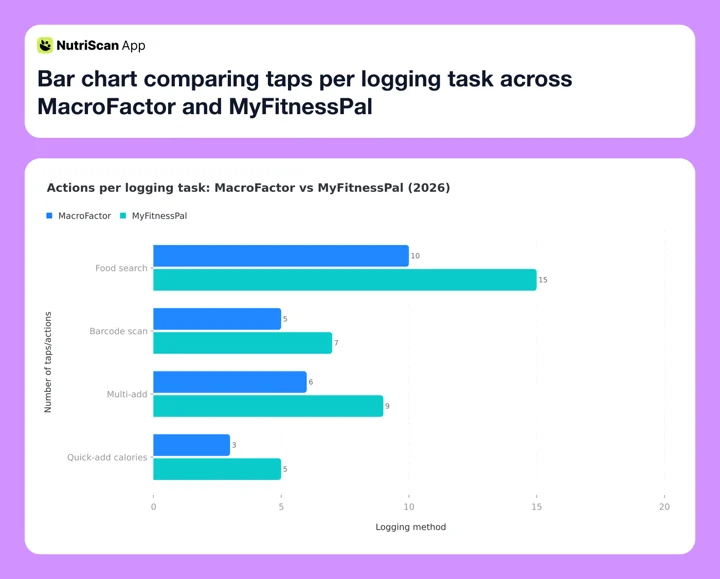 Figure 2: Across food search, barcode scan, multi-add, and quick-add calories, MyFitnessPal requires 40-67% more actions per task.
| Logging Method | MacroFactor | MyFitnessPal | Difference |
|---|---|---|---|
| Food search | 10 actions | 15 actions | 50% more in MFP |
| Barcode scan | 5 actions | 7 actions | 40% more in MFP |
| Multi-add | 6 actions | 9 actions | 50% more in MFP |
| Quick-add calories | 3 actions | 5 actions | 67% more in MFP |
| Total | 24 actions | 36 actions | 50% more in MFP |
Those taps compound. Log three meals and two snacks a day and 15 to 30 seconds per entry becomes minutes daily, hours a month. A 2025 meta-analysis of 29 randomized controlled trials found app-based dietary monitoring produced significantly greater weight loss (mean difference -1.45 kg) than controls, but only where participants logged consistently (Li et al., 2025).
MacroFactor also learns what you eat at each meal, so frequent breakfast foods float to the top after a few days. Both apps offer AI logging: Meal Scan plus voice on MyFitnessPal Premium, AI Describe plus label scanning on MacroFactor. MacroFactor breaks meals into editable ingredients, so a misidentified portion is a quick fix, and any consistent AI over- or under-estimate gets absorbed into the next weekly target update.
Pro tip
Test logging speed on breakfast in both apps. Most people eat similar breakfasts daily, so the friction difference shows up fast and predictably.
How NutriScan compares the same way 📱
NutriScan takes a third angle: AI photo scanning. Point your camera, NutriScan identifies the meal, and the macros land in your log in one screen. Misjudged portion? Tap to adjust. NutriScan Premium is about $59 a year, and the free plan gives 5 meal logs a week with no ads, enough to test the scanner on the curries, restaurant plates, and mixed bowls a food database reads worst.
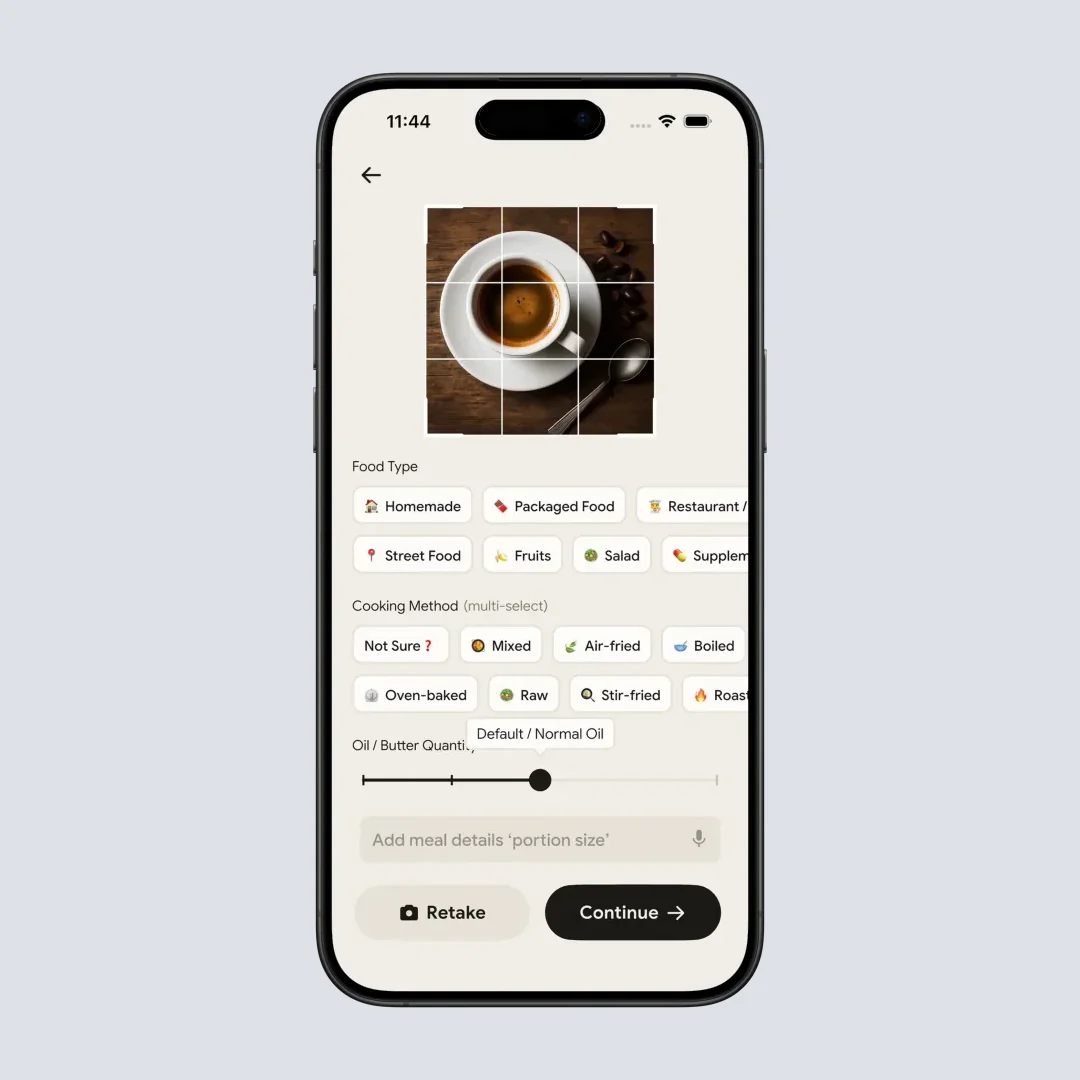
Home > Camera Icon > Crop Picture - NutriScan's one-tap AI meal scan gives photo-based logging without the database hunt.
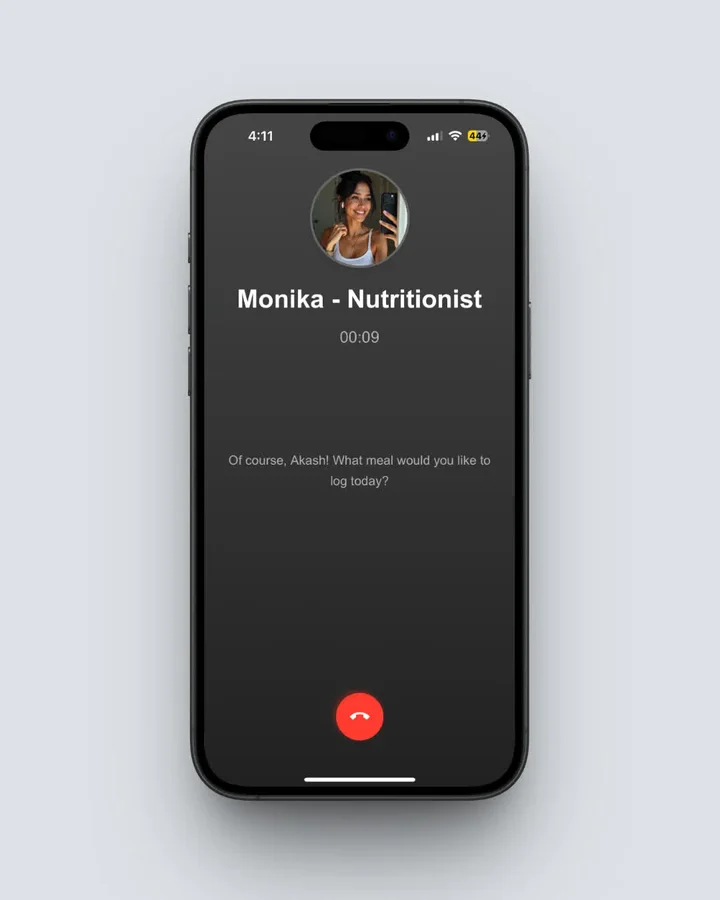 Home > Monika > Voice - the voice route mirrors MacroFactor's editable ingredient breakdown, but starts from a sentence instead of a search.
Adaptive Coaching vs Static Calorie Targets 🎯
This is where the two apps diverge most. MyFitnessPal calculates your calorie goal from age, height, weight, sex, and activity level with the Mifflin-St Jeor equation, then adds or subtracts for your goal, and that number stays put unless you change it. Energy-expenditure equations carry an average error of 300 to 350 kcal per day, and static formulas land 500 calories or more off in roughly 20% of cases (MacroFactor, 2024).
MacroFactor starts from a similar baseline, then weighs your actual weight change against your actual intake each week and recalculates your daily expenditure. Lose 0.3 kg when you targeted 0.5 kg and calories drop slightly at the next check-in. Lose too fast and they go up. A trend-weight feature smooths daily swings from sodium, water, and food volume so neither you nor the algorithm overreacts to one weigh-in (Outlift, 2026).
MacroFactor's internal data puts its expenditure estimates within 250 calories of actual for 46.7% of users and within 500 calories for 79.1% (MacroFactor, 2026).
Three coaching modes: Coached sets and adjusts every target for you, Collaborative suggests targets you can override, and Manual leaves the numbers to you, which suits anyone already working with a human coach.
MyFitnessPal has no coaching. Its exercise-calorie feature adds workout calories back to your target, and in free-living conditions 82% of wearable energy-expenditure comparisons missed the criterion measure by more than 10%, in both directions (Fuller et al., 2020). Stacked on an imprecise TDEE number, that error gets expensive.
Watch out for static targets
If your weight stalls for 2-3 weeks on MyFitnessPal, you must lower calories yourself. Many users do not, then blame the app for "not working".
Features Beyond Logging: Customization, Social, and Desktop 🧰
MacroFactor: favorites and smart history, customizable toolbar shortcuts, a nutrition label scanner, recipe explode (a saved recipe broken back into editable ingredients), a timeline food log, and dashboard and logger customization. Targets go to the gram, with protein presets (low to extra high), a weight-change rate of 0.1% to 1.5% of body weight per week, calorie distribution across training and rest days, auto-redistribution after an overshoot, and a calorie floor the algorithm never recommends going below (Goldi AI, 2026).
MyFitnessPal: a URL recipe importer, copy meals and days, widgets, a friends feed with messaging and streaks, and Meal Planner with grocery lists on Premium+. It also has a desktop web version, which MacroFactor lacks, and more integrations: Garmin, Fitbit, Apple Watch, Strava, and Withings, against Apple Health and Fitbit.
MacroFactor or MyFitnessPal: The 60-Second Fit Test ✅
Four questions. Whichever app wins three of four is your pick.
- Adjust my calories weekly, or set them myself? Adjust for me ➡️ MacroFactor. Set them myself ➡️ MyFitnessPal Premium with custom macros.
- Will I weigh in 4-5 mornings and log 5-6 days a week for 8 weeks? Yes ➡️ MacroFactor's trend-weight coaching gets clean signal. No ➡️ MyFitnessPal, since coaching on patchy data is not worth $71.99.
- Do 80% of my meals come from home cooking or major brands? Yes ➡️ MacroFactor's verified database covers you. No, lots of regional or restaurant items ➡️ MyFitnessPal's 20M+ database saves time.
- Do I need meal planning, grocery lists, desktop, or social? Yes ➡️ MyFitnessPal Premium+. None of those ➡️ MacroFactor.
Three typical cases: the powerlifter who stalls at week 8 of every cut picks MacroFactor, because the weekly check-in trims calories without him guessing. The first-time tracker eating regional Indian packaged snacks picks MyFitnessPal Free, because the database has nearly everything she eats. The two-year MFP user who tinkers with his target weekly picks MacroFactor, because the algorithm holds one plan and absorbs his noise into a trend.
Before you subscribe to either, run your stats through our free macro calculator so you know what a sane starting target looks like.
How to Test Both Apps in One Week 📋
- Start both trials the same day. MacroFactor and MyFitnessPal Premium each run 7 days, so one week covers both.
- Set identical goals, including the same calorie target, so you compare the logging experience and not the target math.
- Log the same meals in both for three days. Time yourself, count taps, note any food only one database has.
- Compare the nutrient reports and the coaching: MacroFactor's adapted expenditure estimate against MyFitnessPal's signup number.
- Use only your preferred app from day four, then cancel the other at least 24 hours before day 7, using the app store steps above.
What the Research Says About Tracking Apps 📊
A 2025 systematic review of mobile-app interventions for obesity found app-based programs beat control groups, peaking at 2.18 kg of weight loss at 3 months and tapering to 1.63 kg at 12 months (Pujia et al., 2025). Apps with personalized feedback, like MacroFactor's weekly adjustments, showed significant loss; logging-only apps did not.
A 2024 study of 53,482 app users found a dose-response link between app activity and weight loss: a 10% rise in daily usage matched an extra 0.43 to 0.69 kg over 12 to 52 weeks, and up to 50% of active users lost 5% or more (Huntriss et al., 2024). A 2025 randomized controlled trial tied higher self-monitoring adherence to the same 5% odds (Burke et al., 2025), and a 2024 Cochrane review found digital dietary interventions worked best with self-monitoring built in (Lunde et al., 2024).
On data quality, Chen et al. found MyFitnessPal identified 97% of food components in photos and Fastic 92%, yet the calorie numbers those apps generated from the same images stayed inaccurate across every app tested (Chen et al., 2024).
The Hidden Cost That Flips the Winner for Most Beginners 🧩
Here is the factor most reviews skip:
Decision fatigue from messy search results is the real reason new users quit MyFitnessPal in week two.
Search "Greek yogurt" in MyFitnessPal and you get 40+ results: 12 brands, 5 generic entries, and a long tail of user uploads at different serving sizes. Each one forces a micro-decision. Beginners log the first result, absorb errors they never see (Banal et al., 2024), and lose trust in their own numbers. Lost trust means skipped logs, and skipped logs mean abandonment.
MacroFactor's verified database collapses those 40 results into 2 or 3. Less choice means less fatigue and steadier logging, and paired with 50% fewer taps that shows up in 90-day retention, not on a feature checklist. For first-time trackers, MacroFactor wins on this alone. For experienced trackers who know which MFP entries to trust, the difference shrinks.
 The mental cost of "which entry is right?" is the silent app-killer most reviews never mention.
Conclusion: Which App Should You Pick? 🏁
MacroFactor wins on database quality, logging speed, nutrient depth, adaptive coaching, and annual price. MyFitnessPal wins on database size, international coverage, social features, desktop access, and the free tier. If you track macros seriously and want targets that move as you progress, MacroFactor is the stronger buy at $71.99 a year. If you need the widest food database, meal planning and grocery lists, or free basic tracking, MyFitnessPal still has a place.
| Category | Winner | Why |
|---|---|---|
| Database size | MyFitnessPal | 20M+ entries vs 1.36M verified |
| Database quality | MacroFactor | Verified entries, 54 nutrients vs 14 |
| Logging speed | MacroFactor | 50% fewer actions across all workflows |
| Adaptive coaching | MacroFactor | Weekly target adjustments vs static |
| Micronutrient tracking | MacroFactor | 13 vitamins, 10 minerals vs 6 micronutrients |
| Free tier | MyFitnessPal | MacroFactor has no free plan |
| Premium pricing | MacroFactor | $71.99/yr vs $79.99/yr |
| International coverage | MyFitnessPal | Broader packaged food coverage |
| Social and desktop | MyFitnessPal | Friends, community, web version |
| Analytics | MacroFactor | Weight trending, expenditure, micronutrient reports |
| Decision fatigue | MacroFactor | Verified results cut "which entry?" anxiety |
For a deeper coach-vs-tracker view, read our Carbon vs MyFitnessPal comparison, our take on whether MacroFactor is worth it, and our MyFitnessPal Premium Plus review.
If you have already decided and want the move itself, our step-by-step guide to switching from MyFitnessPal to MacroFactor covers the export, what will not import, and the three-week calibration window.
Frequently Asked Questions ❓
Q: Is MacroFactor more accurate than MyFitnessPal?
A: For food data quality, yes. MacroFactor uses verified entries from curated sources including the NCC Food and Nutrient Database, while MyFitnessPal relies on user submissions that carry duplicates and errors. In a 2024 validation study, adults and dietitians logging the same meals in MyFitnessPal agreed only within -1,102 to +1,325 kcal a day (Banal et al., 2024).
Q: How much does MacroFactor cost?
A: $11.99 per month, $47.99 for six months ($7.99 per month), or $71.99 per year ($5.99 per month). A separate Workouts app costs the same, and a bundle of both runs around $90 per year. Prices are standard US prices as of mid 2026 and change by region.
Q: How much does MyFitnessPal Premium cost?
A: Premium is $19.99 per month or $79.99 per year ($6.67 a month). Premium+ is $24.99 per month or $99.99 per year ($8.34 a month). The free tier keeps ads, no barcode scanning, and macro targets adjustable only to the nearest 5 percent.
Q: Does MacroFactor have a free version?
A: No. There is a 7-day full-access trial, then $11.99 per month, $47.99 per six months, or $71.99 per year. The founders have stated they will never offer a free tier.
Q: How do I cancel a MacroFactor or MyFitnessPal trial?
A: Through your app store, not the app. On iPhone: Settings > your name > Subscriptions > the app > Cancel Subscription. On Android: Play Store > profile icon > Payments & subscriptions > Subscriptions > the app > Cancel subscription. Do it at least 24 hours before day 7.
Q: Is MyFitnessPal Premium worth it if I already use the free version?
A: Premium adds barcode scanning, voice logging, Meal Scan, gram-level macro goals, a fasting timer, food analysis, and ad removal. If you set your own targets and tolerate ads, it mostly buys convenience. For adaptive coaching or deeper nutrient data, MacroFactor gives more for less per year.
Q: Does MyFitnessPal adjust your calories based on results?
A: No. It sets a static target from the Mifflin-St Jeor equation, so you edit the goal yourself when you stall. MacroFactor recalculates your expenditure weekly from your weight trend and intake, then moves the target for you.
Q: Which app is better for weight loss?
A: Both work. MacroFactor lowers targets automatically as you lose weight, heading off plateaus. MyFitnessPal sets a static target you update manually, and many people never do.
Q: Which app is better for muscle gain or a cut?
A: MacroFactor was built by Greg Nuckols and Dr. Eric Trexler from MASS Research Review for body-composition goals. Protein presets, a weight-change rate from 0.1% to 1.5% of body weight per week, and a calorie floor make cuts and lean bulks safer. MyFitnessPal hits the same numbers only if you manage every adjustment.
Q: Which app tracks more nutrients?
A: MacroFactor tracks 54: all B vitamins, vitamins D, E and K, folate, zinc, magnesium, selenium, omega-3s, 11 amino acids, caffeine, and alcohol. MyFitnessPal tracks 14, of which 6 are micronutrients (sodium, potassium, calcium, iron, vitamins A and C).
Q: Can I import my MyFitnessPal data into MacroFactor?
A: No, there is no direct import, so you start fresh. The expenditure algorithm calibrates within one to two weeks of consistent logging.
Q: Can I use both apps at the same time?
A: You can, but it doubles your logging. The usual workaround is meals in MyFitnessPal for the database size and daily totals in MacroFactor for the coaching.
Q: How does logging speed actually affect results?
A: A 2024 study of 53,482 users found a dose-response link between app engagement and weight loss, with a 10% rise in daily activity worth 0.43 to 0.69 kg more weight loss (Huntriss et al., 2024). MacroFactor needs about 50% fewer taps.
Q: What if I want photo scanning instead of typing?
A: Both apps offer photo scanning, but neither is reliable from images alone. NutriScan is photo-first with portion adjustments you can tap to fix, and its meal scan skips the database search entirely.