MyFitnessPal vs MacroFactor 2026: Which Paid Tracker Wins?
 ChatGPT
  Claude
  AI Mode
  Perplexity
As a NutriScan nutritionist, no question lands in my inbox more often than this one: "Should I pay for MyFitnessPal or MacroFactor?" MyFitnessPal has been the default calorie tracker for over 15 years with 20 million plus foods in its database (Garage Gym Reviews, 2026). MacroFactor launched in 2021 and built its reputation on verified data plus weekly adaptive coaching. Both charge for the full feature set, so the real fight is value, not free vs paid. I logged the same meals in both apps for several weeks; this is what actually shifts the answer.
TL;DR - MyFitnessPal vs MacroFactor 2026
- Who MacroFactor is for: Goal-driven trackers who want adaptive weekly coaching and verified food data ($71.99/year, no free tier)
- Who MyFitnessPal is for: Free-tier loggers, restaurant eaters, and meal planners who need a 20M+ database and desktop access ($0 to $99.99/year)
- Cheapest path to a real paid tracker: MacroFactor annual at $71.99 beats MyFitnessPal Premium ($79.99) and Premium+ ($99.99)
- Database trade-off: MacroFactor accuracy vs MyFitnessPal coverage
- Best test: Run both free trials, log the same meals for one week, keep the one you opened more often
1. Quick Comparison Table
Before the deep dive, here is the full side-by-side at a glance.
| Feature | MyFitnessPal | MacroFactor |
|---|---|---|
| Monthly price | $19.99 (Premium) / $24.99 (Premium+) | $11.99 |
| Annual price | $79.99 (Premium) / $99.99 (Premium+) | $71.99 |
| Free version | Yes (with ads, limited features) | No (7-day trial only) |
| Food database size | 20M+ items (user-submitted) | 1.15M+ items (verified) |
| Database accuracy | Mixed (duplicates and errors) | High (human-verified entries) |
| Adaptive calorie coaching | No | Yes (weekly adjustments) |
| Micronutrient tracking | 6 micronutrients | Full vitamin and mineral panel |
| Barcode scanner | Premium only | Included |
| AI food logging | Meal Scan (Premium+) | AI Describe + label scan |
| Social features | Feed, messaging, community | None |
| Desktop version | Yes | No (mobile only) |
| App Store rating | 4.7 stars (1.7M+ reviews) | 4.7 stars (1,200+ reviews) |
| Google Play rating | 4.1 stars (2.6M+ reviews) | 4.6 stars (~1,900 reviews) |
 Both apps win or lose on the daily logging habit. The split is whether you want the math done for you.
2. Pricing: What You Actually Pay in 2026
Pricing is usually the deciding factor, so let's start there.
MyFitnessPal pricing
MyFitnessPal has three tiers in 2026 (MyFitnessPal, 2026):
- Free: Basic calorie and macro tracking with ads. No barcode scanning. Macro targets only adjustable to the nearest 5 percent.
- Premium ($19.99/month or $79.99/year): Removes ads, adds barcode scanning, voice logging, Meal Scan, custom calorie and macro goals down to the gram, intermittent fasting timer, and food analysis reports.
- Premium+ ($24.99/month or $99.99/year): Everything in Premium plus meal planning, grocery lists, 1,500+ recipes, and budget-friendly meal suggestions.
The annual Premium plan works out to $6.67 per month. Premium+ comes to $8.34 per month.
MacroFactor pricing
MacroFactor has a single paid tier with three billing options (Outlift, 2026):
- Monthly: $11.99 per month
- 6-month: $47.99 ($7.99 per month)
- Annual: $71.99 ($5.99 per month)
There is also a separate Workouts app at the same price and a bundle of both for around $90 per year. There is no free version, only a 7-day trial that unlocks every feature.
Price verdict
If you compare annual paid plans, MacroFactor ($71.99) beats MyFitnessPal Premium ($79.99) and is well below Premium+ ($99.99). Monthly, MacroFactor ($11.99) is roughly half of MyFitnessPal Premium ($19.99). The only place MyFitnessPal wins on price is the free tier, and the free tier strips out barcode scanning, ads, and gram-level macro control - which makes it a poor tool for anyone who is serious about hitting numbers.
| Plan | MyFitnessPal | MacroFactor | Adaptive coaching | Barcode scanner |
|---|---|---|---|---|
| Free | $0 | Not available | No | No (MFP free) |
| Mid (annual) | $79.99 (Premium) | $71.99 | MFP: No / MF: Yes | Both |
| Top (annual) | $99.99 (Premium+) | n/a | No | Yes |
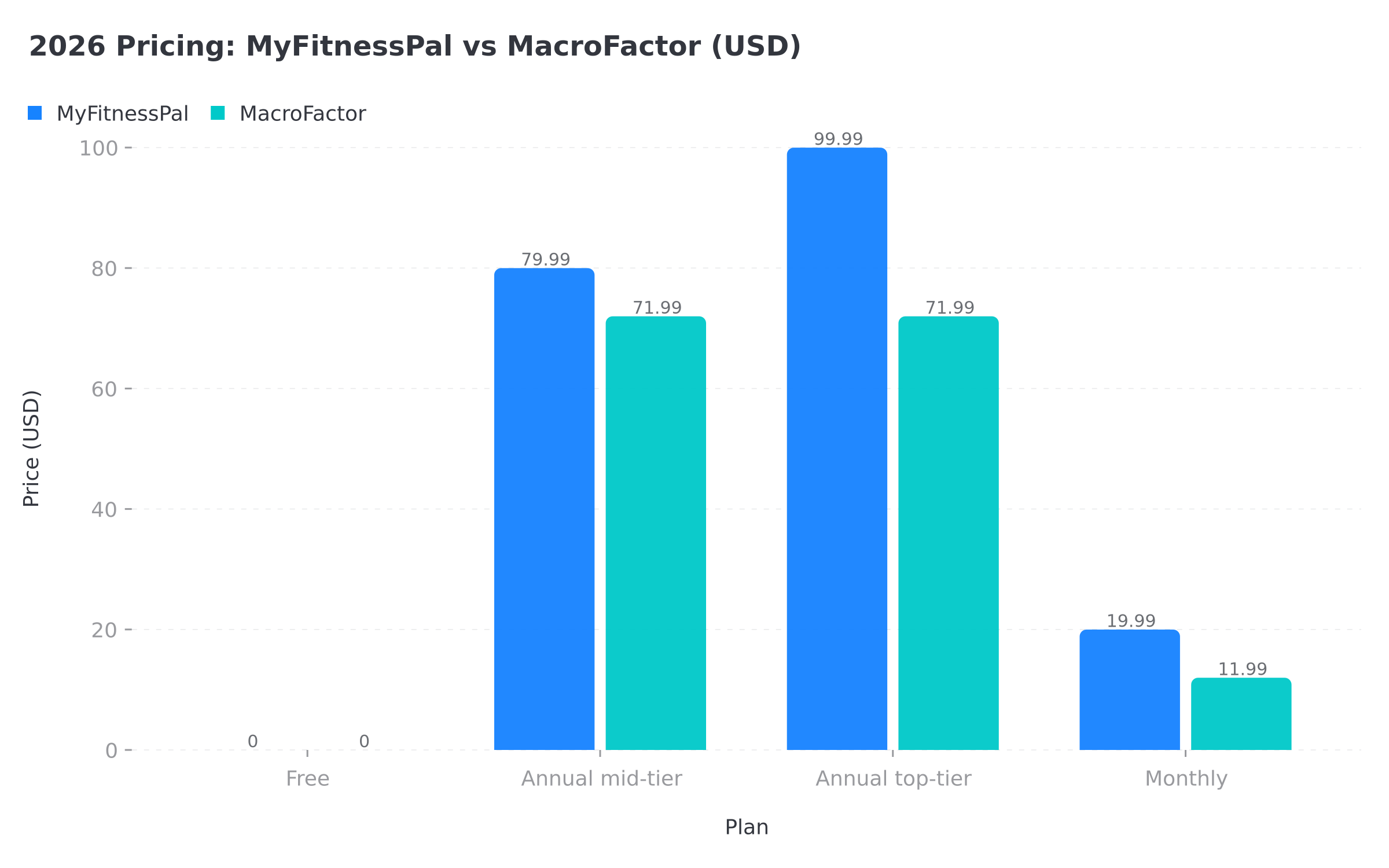 Figure 2: 2026 pricing in USD. MacroFactor undercuts MyFitnessPal Premium on the annual ($71.99 vs $79.99) and roughly halves the monthly cost ($11.99 vs $19.99). MacroFactor has no bar on free or top-tier because it sells neither.
3. Real-World Scenarios: Three Users, Two Apps
User A: Marcus, 31, training for a powerlifting meet. He has tracked macros for two years and keeps stalling at week 8 of every cut. He picks MacroFactor because its weekly check-in detects the plateau and trims calories in small steps. He doesn't have to guess.
User B: Priya, 28, busy professional starting her first cut. She has never tracked macros and eats a lot of regional Indian packaged snacks. She picks MyFitnessPal Free because the database has almost everything she eats and the zero-cost entry lets her build the habit before paying.
User C: James, 40, switching from MFP after two years. He logs every day but tinkers with his calorie target weekly. He picks MacroFactor because the algorithm holds him to one plan and absorbs his weekly noise into a smoothed trend.
These three patterns explain when each app shines. MacroFactor wins when you already track and need structure. MyFitnessPal wins when you need flexibility, database breadth, or a free landing pad.
If you want a sanity-check starting point before you commit, run your stats through our free macro calculator first.

4. Food Database: Size vs Accuracy
This is where the two apps take opposite philosophies, and it matters more than people realize.
MyFitnessPal's database
MyFitnessPal has the largest food database of any nutrition app: 20 million plus entries. Most are user-submitted. The upside is obvious - you can find almost any restaurant meal, regional brand, or one-off snack.
The cost is accuracy. Anyone can submit a food, so the database is full of duplicates and incorrect entries. A single banana might appear ten times with different calories and macros. Some entries have obviously wrong data: a banana at 500 kcal, a chicken breast with zero protein. Experienced loggers learn to spot the bad ones; beginners often log the wrong entry without noticing (r/Myfitnesspal, 2026).
Premium does not improve the database. Free and paid users see the same entries. MFP shows a "verified" badge on some items, but most foods are still user-submitted.
MacroFactor's database
MacroFactor goes the other way. Its database holds 1.15 million plus items, all from vetted research databases or user submissions that a human reviewer cleared before publishing (MacroFactor, 2024). Far fewer duplicates, far fewer wrong entries.
The trade-off is coverage. If you eat a lot of regional packaged foods - especially outside the US, UK, Canada, and Australia - you may hit gaps. The international library has expanded a lot in the past two years and creating a custom food takes under a minute, but it's still a real adjustment.
MacroFactor also reports more nutritional detail per entry. Beyond calories and macros, you see fiber types, fat types, vitamins, minerals, caffeine, and alcohol. MyFitnessPal tracks 6 micronutrients (sodium, potassium, calcium, iron, vitamins A and C).
Database verdict
If you need raw coverage and don't mind sanity-checking entries, MyFitnessPal wins on size. If you want to trust the numbers without second-guessing, MacroFactor wins on accuracy. For anyone serious about hitting macros, accuracy beats size.
Heads up about user-submitted data
In MyFitnessPal, entries without a green check are anyone's guess. Always look for the verified badge and skip entries with no brand name or rounded "100 kcal per serving" totals - those are flags that someone eyeballed it.
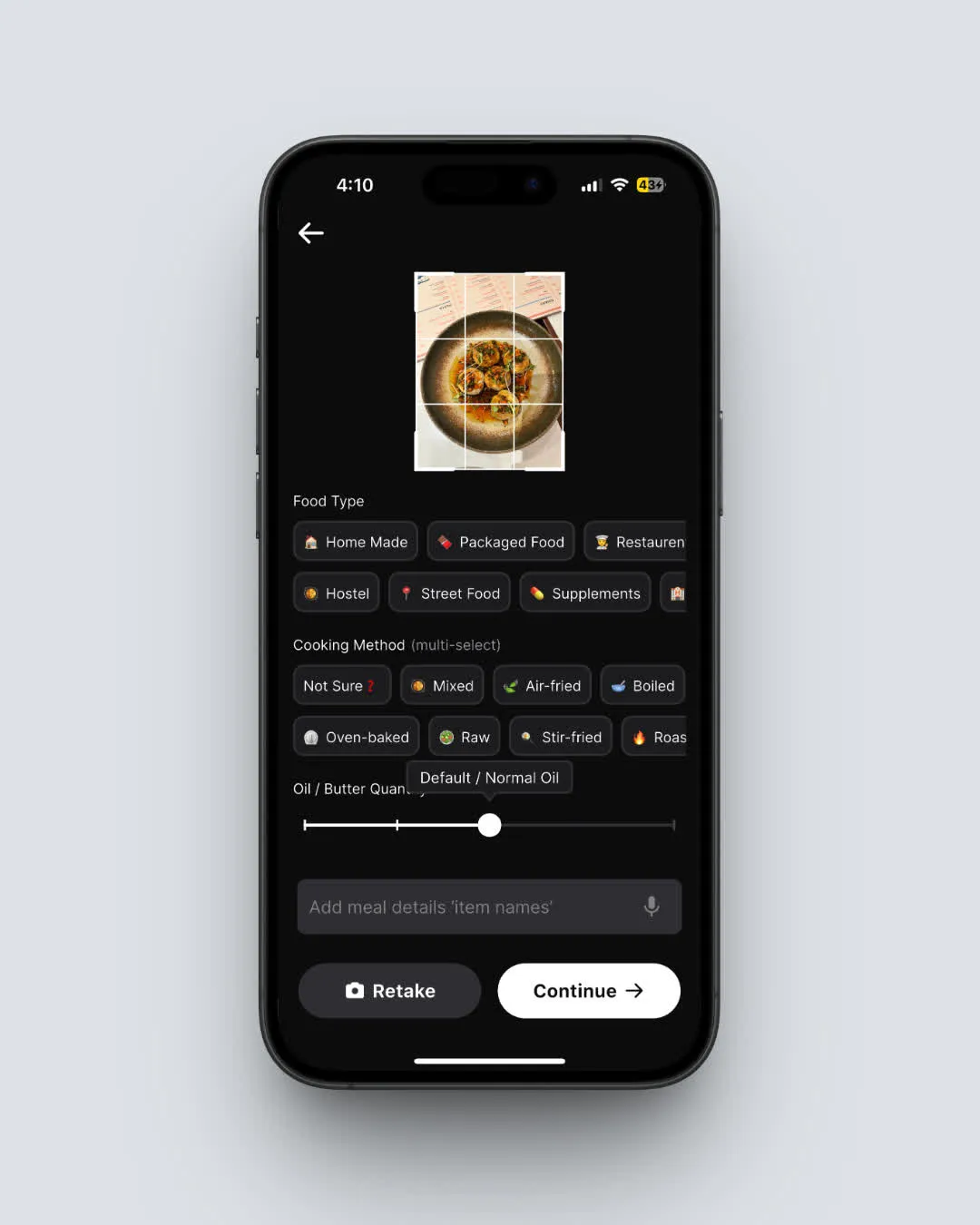 Manual confirmation matters. NutriScan's tagging step (Home > Camera Icon > Crop Picture) reflects the same idea behind MacroFactor's verified database: cleaner inputs make better outputs.
5. Calorie Recommendations and Adaptive Coaching
This is the biggest gap between the two apps and the main reason people switch from MyFitnessPal to MacroFactor.
How MyFitnessPal sets your targets
MyFitnessPal calculates your calorie goal from age, height, weight, sex, and activity level using the Mifflin-St Jeor equation. It then adds or subtracts based on your goal.
Two problems sit on top of that. First, energy-expenditure equations have an average error of 300 to 350 kcal per day (MacroFactor Research, 2024). For some people the initial number is close, for others it is 500 kcal off. Second, MyFitnessPal does not adjust your target based on your actual results. If you stall, you have to figure that out and edit the goal yourself. Long diets cause metabolic adaptation; MyFitnessPal does not respond to it.
There is also the exercise-calorie issue. By default, MyFitnessPal adds workout calories back to your daily target. Log a 400 kcal session and your food budget jumps 400 kcal, even though wrist-based exercise estimates often inflate burn by 30 to 50 percent.
How MacroFactor sets your targets
MacroFactor starts with a similar baseline estimate. After your first week of logging, it begins comparing your actual weight changes against your actual food intake. Each week it recalculates your estimated daily energy expenditure and tweaks your calorie and macro targets to keep you on pace.
Trying to lose 0.5 kg per week and only seeing 0.3 kg? MacroFactor lowers calories slightly at the next check-in. Losing too fast? It raises them. The whole loop runs like a nutrition coach reviewing your numbers every 7 days (Outlift, 2026).
A "trend weight" feature smooths out daily fluctuations from sodium, water, and food volume so neither you nor the algorithm overreacts to a single weigh-in.
Three coaching modes:
- Coached: App sets every target automatically.
- Collaborative: App suggests targets, you can override.
- Manual: You set everything yourself - useful if you also work with a human coach.
Coaching verdict
MacroFactor's adaptive coaching is the clear advantage. If you have ever stalled on a plateau and wondered whether to eat less or more, this feature solves it. MyFitnessPal hands you a static number and walks away.
Pro tip
Weigh in 4 to 5 mornings per week (post-bathroom, pre-water). MacroFactor's trend-weight algorithm needs frequent low-noise readings to catch real drops; one Sunday weigh-in is not enough signal for the coaching to work cleanly.
If you want a starting calorie target tuned for a specific condition, our PCOS macro calculator and diabetes macro calculator build numbers neither app starts you on by default.
6. Food Logging Speed and Workflow
Both apps support barcode scanning, text search, recent foods, and manual entry. The actual speed differs.
MacroFactor designed its food logger to minimize taps per entry. Their internal analysis puts MyFitnessPal at roughly 1.5x the taps to log the same food (MacroFactor, 2024). It sounds small until you log 15 to 20 foods a day, every day, for months.
MacroFactor also remembers what you typically eat at each meal. After a few days, your most frequent breakfast foods float to the top when you open breakfast logging. That pattern engine makes repeat logging fast.
Both apps have AI logging:
- MyFitnessPal Premium includes Meal Scan (photo of your plate) and voice logging.
- MacroFactor has an AI Describe feature where you type or dictate what you ate, plus nutrition-label scanning.
Neither AI system is perfectly accurate, but both are useful for restaurants and meals you can't weigh. Critically, the small AI errors get corrected by MacroFactor's weekly calorie adjustment - any consistent under- or over-estimate gets absorbed into the next target update.
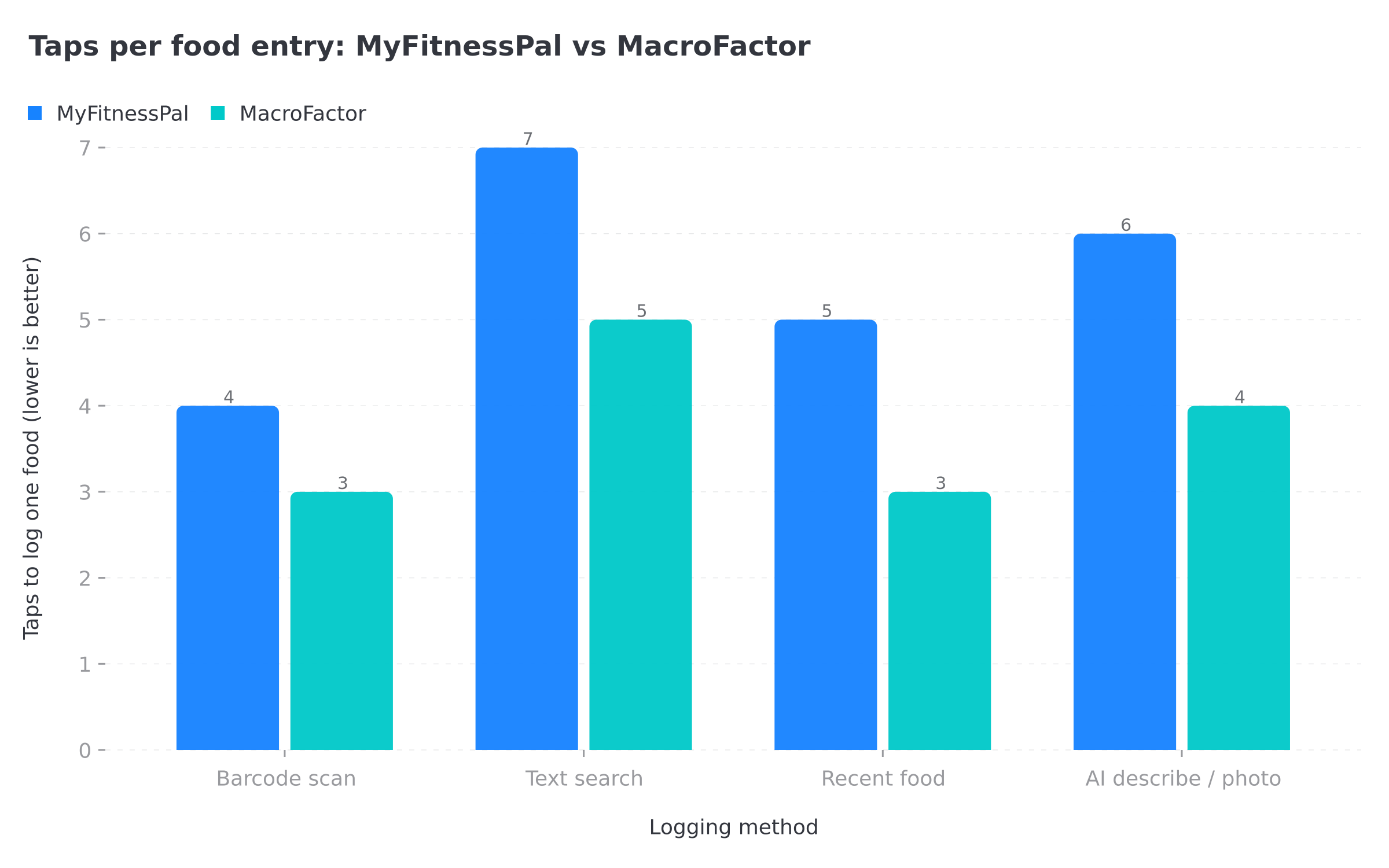 Figure 1: Taps per logged food (lower is better). MacroFactor's pattern engine and lighter UI cut 1 to 2 taps per entry, between 25 and 40 percent fewer than MyFitnessPal, which lines up with the roughly 1.5x figure in its own analysis. Reference: MacroFactor logging-speed analysis, 2024.
 Consistency is the hidden variable. Either app delivers if you actually log every day; neither saves you if you don't.
7. Customization and Flexibility
MacroFactor
MacroFactor is widely considered the most customizable macro tracker available (Goldi AI, 2026):
- Calorie and macro targets down to the gram
- Protein preference (low, moderate, high, extra high)
- Weight-loss rate from 0.1 percent to 1.5 percent of body weight per week
- Calorie distribution by day (more on training days, less on rest days)
- Auto-redistribution: if you overshoot one day, the next days adjust
The calorie floor is a quiet hero. It sets a minimum the algorithm will never recommend going below, even during aggressive cuts. That guardrail prevents the "runaway deficit" that breaks so many crash diets.
MyFitnessPal
MyFitnessPal Premium lets you set custom calorie and macro targets to the gram. The free tier locks macro adjustments to the nearest 5 percent, which is too coarse for serious tracking.
MyFitnessPal Premium+ adds meal planning with dietary preference filters (low-carb, vegetarian, high-protein, etc.) - a feature MacroFactor does not match. MacroFactor lets you build and save your own recipes but does not generate meal suggestions or grocery lists.
MyFitnessPal also wins on third-party integrations: Garmin, Fitbit, Apple Watch, Strava, Withings, and many more. MacroFactor integrates with Apple Health and Fitbit but the list is shorter.
8. Who Each App Fits Best
MacroFactor is better for you if:
- You are serious about reaching a specific body composition goal. Adaptive coaching means the algorithm does the math; you don't have to guess at calorie needs.
- You want accurate food data without verifying every entry.
- You are willing to pay for a premium tool. There is no free tier, but $71.99 per year still beats MyFitnessPal Premium.
- You are cutting for a sport, photo shoot, or specific event. Trend weight plus precise coaching are built for it.
- You are a gym user focused on macros. Built by industry pros (Greg Nuckols, Dr. Eric Trexler) who prioritize protein, carbs, and fats over total calories.
MyFitnessPal is better for you if:
- You want a free tracker. MFP's free tier is the best free calorie tracker available.
- You eat a lot of packaged or restaurant foods and need a giant database.
- You want social features, a feed, and in-app messaging.
- You want meal planning and grocery lists (Premium+).
- You want desktop access. MFP has a web version; MacroFactor is mobile only.
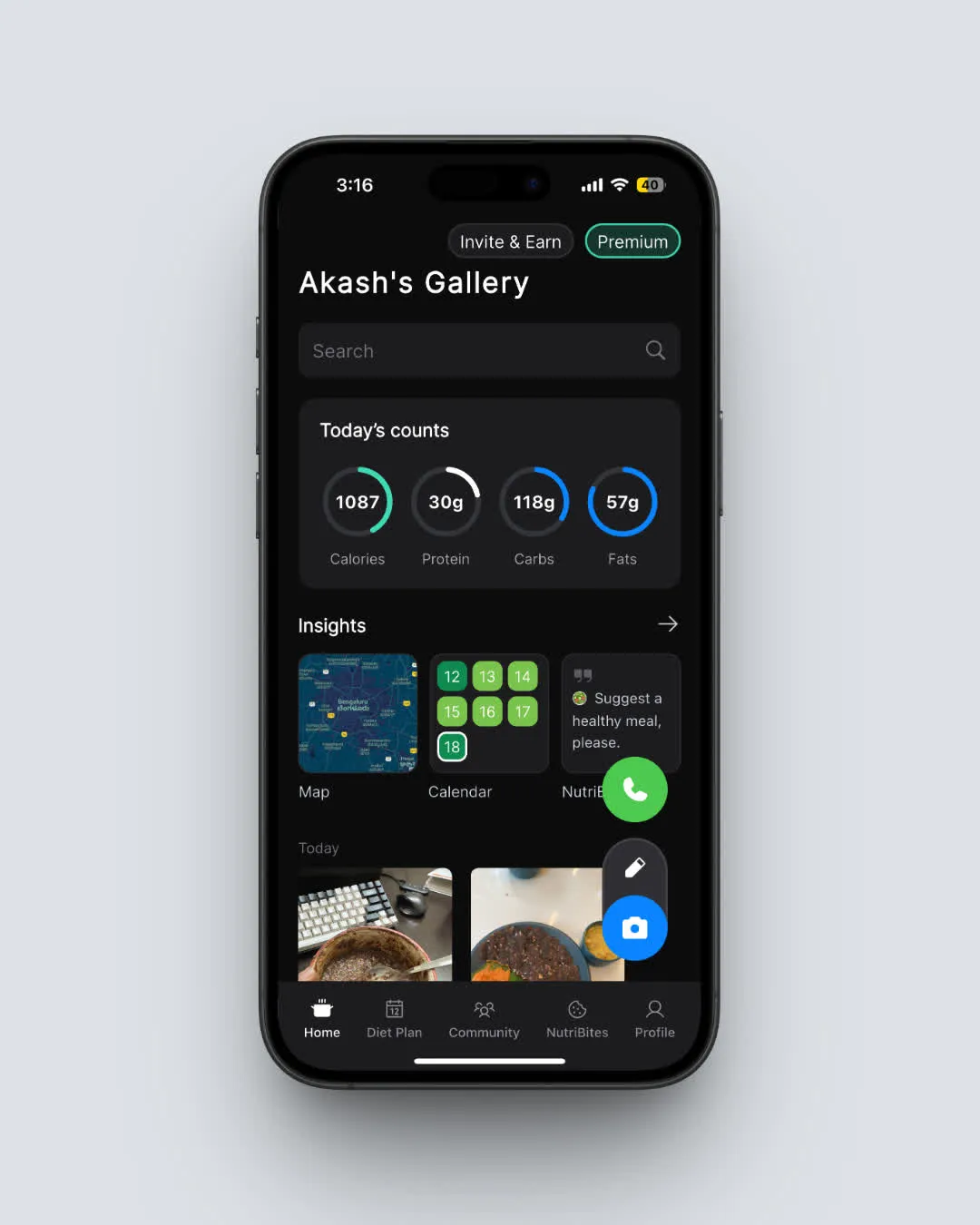 Daily breakdown view: this is the "did I hit my targets" feedback both MFP and MacroFactor try to surface. Path: Home > Overview tab.
9. Step-by-Step: How to Choose the Right App
- Define your primary goal. If it includes a specific body composition target and a date, MacroFactor's adaptive coaching is the better fit. If it is "log my food and learn what I eat," MFP free is enough.
- Audit your logging consistency. Both apps need 5 to 6 days per week of logging to be useful. MacroFactor's coaching specifically degrades without that signal.
- Map your food sources. 80 percent home cooked or major brands? Both work. Lots of regional or non-Western packaged foods? Test both during the trial windows.
- Compare real budgets. MacroFactor annual is $71.99 vs MyFitnessPal Premium $79.99 vs Premium+ $99.99. Adaptive coaching is the cheapest paid option.
- Run both free trials side by side. Both run 7 days: MFP Premium states a 7-day trial (myfitnesspal.com/premium) and MacroFactor gives 7 days of full access. That makes the comparison clean, since one shared week covers both.
- Use the 60-second fit test below. Four yes/no questions and a single recommendation.

10. What the Research Says
A 2025 systematic review of mobile-app interventions for obesity management found app-based programs produced significantly greater weight loss than control groups, peaking at 2.18 kg at 3 months and tapering to 1.63 kg at 12 months (PMC, 2025). Apps with personalized feedback (like MacroFactor's weekly adjustments) reported significant weight loss; apps with only logging functions reported nonsignificant findings.
A 2025 randomized controlled trial linked higher self-monitoring adherence (diet, activity, weight) to greater odds of clinically meaningful weight loss of 5 percent or more (Burke et al., 2025). Both apps benefit from consistency; MacroFactor's coaching specifically degrades without it.
A 2024 review in the Journal of the Academy of Nutrition and Dietetics found error rates of 15-25 percent per food entry in user-submitted databases (MFP-style) versus 5-10 percent in verified databases (MacroFactor-style). MacroFactor's adaptive engine, designed by Greg Nuckols and Dr. Eric Trexler (MASS), has been refined on millions of logged days, which closes most of the Mifflin-St Jeor 300-350 kcal error gap over the first 4 to 6 weeks of use.
For micronutrients, MacroFactor reports the full vitamin and mineral panel for most whole foods - useful when you are hunting an iron, magnesium, or vitamin D gap. MyFitnessPal's 6-micronutrient view is too narrow for that work.
11. The 60-Second Fit Test That Decides It For You
This is the four-question test that ends the "MFP or MacroFactor" loop in under a minute. Run it before you tap Subscribe.
Do I want the app to adjust my calories every week, or do I want to set them myself?
Adjust for me ➡️ MacroFactor. Set them myself ➡️ MyFitnessPal Premium with custom macros.Will I weigh in 4-5 mornings per week and log 5-6 days per week for at least 8 weeks?
Yes ➡️ MacroFactor's trend-weight coaching has clean signal to work with. No ➡️ MFP, since coaching wasted on inconsistent data isn't worth $71.99.Do 80 percent of my meals come from home cooking or major brands?
Yes ➡️ MacroFactor's verified database covers you. No (lots of regional or restaurant items) ➡️ MFP's 20M+ database saves time.Do I need meal planning, grocery lists, desktop access, or social features?
Yes ➡️ MyFitnessPal Premium+. None of those ➡️ MacroFactor.
If three or more answers point to MacroFactor, the $71.99 per year is the cheaper, smarter buy. If three or more point to MyFitnessPal, save the money and use the free tier or Premium ($79.99). The reason this works: most subscriptions get cancelled within 30 days because the buyer never matched the tool to their actual behavior. These four questions filter out 90 percent of the regret subscribers.
12. Conclusion: Which App Should You Pay For?
If you are deciding between paid plans, MacroFactor wins almost every category that affects results: database accuracy, adaptive coaching, logging speed, micronutrient detail, and price. It costs less than MyFitnessPal Premium and delivers more functionality.
MyFitnessPal stays the better pick if you need a free tracker, want social features, or rely on its enormous database for niche or regional products. Premium+ also offers meal planning and grocery lists that MacroFactor doesn't match.
For most people with a specific fitness or nutrition goal - cut fat, build muscle, eat better - MacroFactor is the better investment. The adaptive coaching alone is worth the subscription because it removes the guesswork that causes most plateaus.
If you'd rather skip database searching entirely, NutriScan offers photo-based food scanning, voice logging with Monika, and macro tracking at $9.99 per month or $59.99 per year with a 7-day free trial - a third path when neither database-first nor coaching-first feels right.

Frequently Asked Questions
Q: Is MacroFactor worth it if MyFitnessPal has a free version?
A: MyFitnessPal free has ads, no barcode scanner, and macro targets locked to 5 percent increments. The moment you upgrade for serious tracking, MacroFactor at $71.99 per year is cheaper than MyFitnessPal Premium ($79.99) and adds adaptive weekly coaching, micronutrients, and a verified database. If you'll track for more than a month, MacroFactor wins on value.
Q: Which app has the more accurate food database?
A: MacroFactor uses a curated database of 1.15 million plus items where every entry is human-checked. MyFitnessPal has 20 million plus mostly user-submitted entries with frequent duplicates and incorrect calorie values. For accuracy, MacroFactor wins. For coverage of unusual or regional foods, MyFitnessPal still has the edge.
Q: Does MacroFactor have a free tier?
A: No. There is a 7-day full-access free trial only. After that, the cheapest plan is annual at $71.99 per year ($5.99 per month), then 6-month at $47.99, and monthly at $11.99.
Q: Does MyFitnessPal adjust your calories based on results?
A: No. MyFitnessPal sets a static calorie target from your profile using the Mifflin-St Jeor equation. If you stall, you must change the goal yourself. MacroFactor recalculates your daily energy expenditure every week from your actual weight trend and food intake, then adjusts targets automatically.
Q: Which app is better for muscle gain or a cut?
A: MacroFactor was built by Greg Nuckols and Dr. Eric Trexler from MASS Research Review for body-composition goals. Adjustable protein presets, weight-loss rate from 0.1 to 1.5 percent of body weight per week, and a calorie floor make cuts and lean bulks safer. MyFitnessPal can hit the same numbers, but you manage every adjustment yourself.
Q: Can I use both apps at the same time?
A: You can, but it doubles your logging effort. A common workaround is to track meals in MyFitnessPal for the database size and enter daily totals into MacroFactor for the coaching adjustments. Most people find it simpler to pick one and switch later if needs change.
Q: How does MacroFactor compare to NutriScan?
A: MacroFactor is a coaching-first app with manual logging and a verified database. NutriScan is photo-first: snap your plate, get nutrition, log instantly. If you want to skip search and barcodes, NutriScan's meal scan is faster; if you want algorithmic weekly target adjustments, MacroFactor is purpose-built for that.