Vegetable Khichdi : calories, nutrition et bienfaits pour la santé
A traditional comfort food combining rice and lentils avec vegetables—one of India's la plupart digestible and nutrient-dense dishes, perfect for tout health goals.
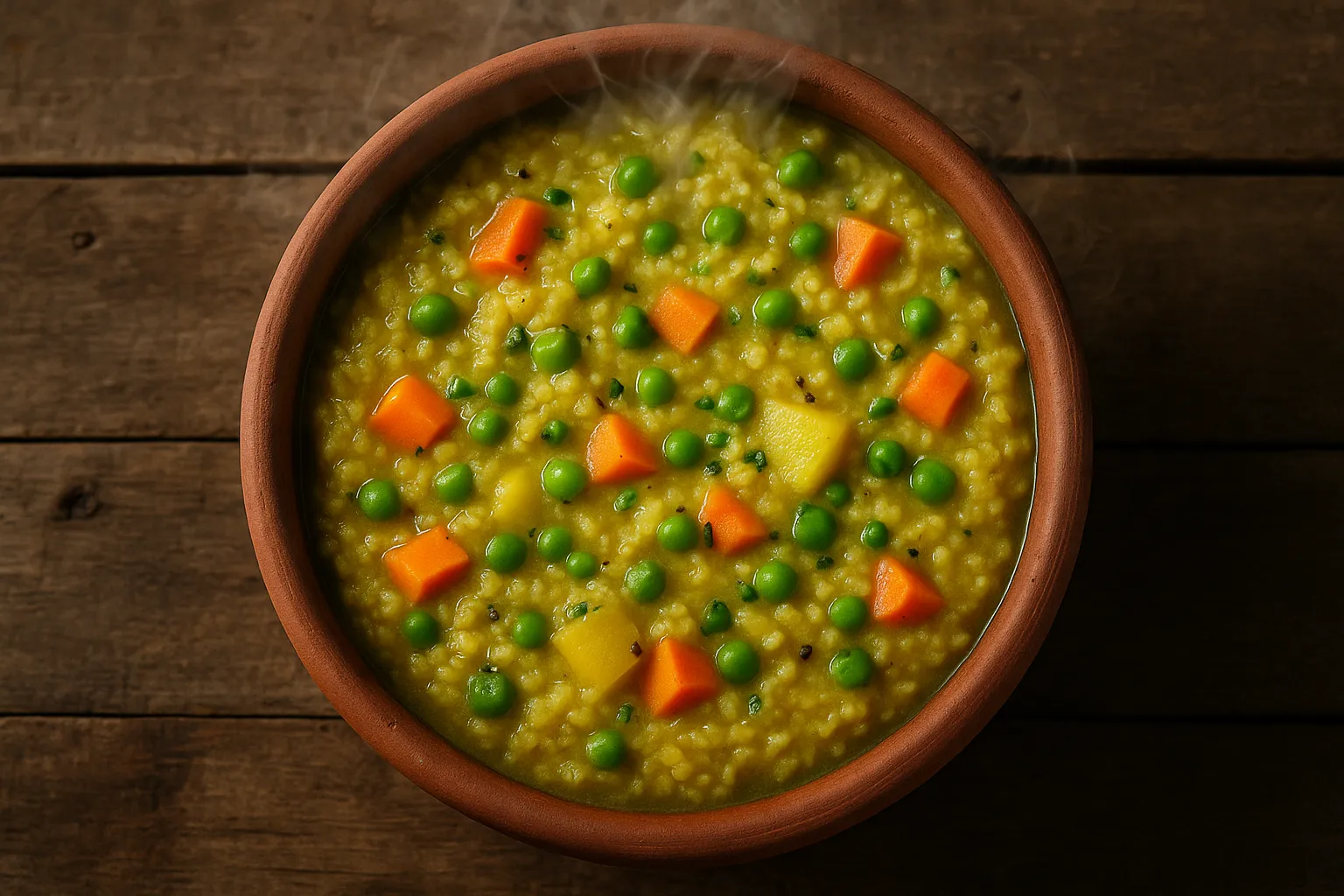
Faits Nutritionnels Rapides
Per 1 Cup Cuit Vegetable Khichdi (240g)
| Nutriment | Quantité |
|---|---|
| Calories | 150 kcal |
| Protéines | 5.2g |
| Glucides | 26g |
| Fibres | 3.8g |
| Sucres | 1.2g |
| Lipides | 2.1g |
| Fer | 2.4mg |
| Phosphorus | 165mg |
| Magnésium | 42mg |
| Potassium | 285mg |
Répartition des Macronutriments
 ChatGPT
  Claude
  AI Mode
  Perplexity
CONSEIL DU NUTRITIONNISTE
Vegetable khichdi's rice-lentil combination fournit a complete amino acid profile rare in plant-based meals. Le resistant starch in cooled khichdi améliore gut health and glycémie contrôle. Add ghee (clarified butter) for vitamine A absorption, but limite to 1 teaspoon par portion.
Idées Reçues
MYTHE #1: Khichdi est Too Heavy for Perte de Poids
RÉALITÉ: Vegetable khichdi avec 150 calories and 5.2g protéines actually soutient perte de poids. Le rice-lentil combination produces resistant starch quand cooled, quel burns 30% plus calories que regular starch pendant digestion.
MYTHE #2: Khichdi Causes Blood Sucres Spikes
RÉALITÉ: Quand prepared in 1:1 rice-lentil ratio, khichdi has a modéré glycemic index (50-60). Lentil fibres slows carb absorption, making it safer for diabetics que white rice alone.
MYTHE #3: Khichdi Lacks Nutriments
RÉALITÉ: One cup fournit 2.4mg fer (15% DV), complete protéines, 3.8g fibres, and nutriments from mixed vegetables. Ayurvedic studies show khichdi's bioavailability augmente quand ghee est added, aiding nutrient absorption.
MYTHE #4: You Must Add Ghee for Taste and Health
RÉALITÉ: Ghee adds flavor but 1 teaspoon (45 calories) est sufficient. Vegetable khichdi retains nutrition and taste avec minimal lipides. Excess ghee augmente calories and saturated lipides unnecessarily.
MYTHE #5: Khichdi est Seulement for Sick People
RÉALITÉ: Tandis que valued in Ayurveda for recovery, khichdi's balanced nutrition (complete protéines, fibres, micronutrients) makes it excellent for athletes, grossesse, perte de poids, and quotidien health maintenance.
NutriScore par Objectifs de Santé
| Objectif de Santé | NutriScore | Pourquoi ce score? |
|---|---|---|
| Perte de Poids |  | 150 calories, complete protéines, 3.8g fibres favorise fullness; resistant starch quand cooled enhances lipides burning. |
| Gain Musculaire | | 5.2g complete protéines; 1.5 cups avec yogurt curd = 15g protéines, 225 calories for post-workout recovery. |
| Gestion du Diabète |  | Moderate GI (50-60); 1:1 rice-lentil ratio; fibres controls glycémie. Meilleur served avec vegetables and curd for complete meal. |
| Gestion du SOPK | | Complete protéines aids hormonal balance; bas added sucres; fibres soutient insulin sensitivity. Pair avec non-starchy vegetables. |
| Nutrition de Grossesse | | Easy to digest pendant nausea; fer (15% DV) prévient anemia; complete protéines soutient fetal development; potassium regulates fluids. |
| Viral/Flu Recovery | | Soft texture ideal for sore throats; easily digestible; warm temperature soothes; protéines aids immune recovery; minimal irritants. |
NUTRITION PERSONNALISÉE
Track your khichdi portions and prepare variations avec NutriScan to optimize nutrition for your personal health goals!
Réponse glycémique
Vegetable khichdi's modéré glycemic index (50-60) creates a gradual glucose sanguin rise, surtout quand le 1:1 rice-lentil ratio est maintained.
Courbe de Réponse Glycémique Typique
Ce graphique montre typical glucose sanguin response for general sain individuals. Les réponses individuelles peuvent varier. Pas un conseil médical.
Comment to Optimize Blood Sucres Contrôle
- 🥄 Chill Avant Eating: Cooled khichdi develops resistant starch, reducing glycemic response by 25%
- 🥛 Pair avec Curd: Greek yogurt or Indian curd (dahi) slows carb absorption via lipides and protéines
- 🥬 Add Extra Vegetables: Non-starchy vegetables (spinach, carrots, broccoli) increase fibres and nutriments
- ⏰ Eat at Lunch: Midday consumption mieux tolerated que evening for glycémie management
Importance Culturelle
Vegetable khichdi est a cornerstone of Indian cuisine, representing simplicity, nutrition, and medicinal wisdom spanning thousands of years.
In India:
- Staple comfort food in chaque Indian household; served to children and recovering patients
- Ayurvedic medicine values khichdi as le la plupart digestible grain-legume combination (tridosha balancing)
- Regional variations: South India uses moong dal; North India uses mixed dals (masoor, tuvar); East India adds vegetables
- Festival and religious significance: khichdi given as prasad (blessed food) pendant celebrations
- Grandmother remedy for fever, digestive issues, and postpartum recovery
Global Impact:
- Growing recognition in wellness communities for digestibility and nutritional balance
- Adoption in Mediterranean and wellness diets as a complete plant-based protéines source
- Ayurvedic practitioners globally recommend khichdi for detox and reset diets
- Vegan athletes discovering rice-lentil combination as affordable complete protéines
Comparer et Remplacer
Vegetable Khichdi vs Similar Comfort Foods (Pour 100g)
| Nutriment | 🥘 Khichdi | 🍚 White Rice | 🍝 Pasta | 🥣 Oatmeal | 🍲 Lentil Soup |
|---|---|---|---|---|---|
| Calories | 63 kcal | 68 kcal | 131 kcal | 68 kcal | 35 kcal |
| Glucides | 11g | 15g | 25g | 12g | 6g |
| Fibres | 1.6g | 0.4g | 1.8g | 1.7g | 1.6g |
| Protéines | 2.2g | 1.3g | 5g | 2.4g | 2.2g |
| Lipides | 0.9g | 0.3g | 1.1g | 1.4g | 0.4g |
| Sucres | 0.5g | 0g | 0.7g | 0.4g | 0.3g |
| Idéal Pour | Complete, digestible | Quick energy | Italian meals | Breakfast | Protéines boost |
Questions Fréquentes
Est vegetable khichdi bon for perte de poids?
Yes, vegetable khichdi soutient perte de poids avec 150 calories par tasse, 5.2g complete protéines, and 3.8g fibres ce favorise fullness. Quand cooled, rice develops resistant starch (burns 30% plus calories pendant digestion). Meilleur practice: prepare avec 1 teaspoon ghee or oil maximum; add vegetables for volume sans calories.
Peut diabetics eat vegetable khichdi?
Vegetable khichdi est excellent for diabète—le 1:1 rice-lentil ratio creates a modéré glycemic index (50-60). Lentil fibres slows carb absorption, preventing glycémie spikes. Optimal serving: 1 cup avec added non-starchy vegetables and curd (dahi) to further slow glucose absorption.
Comment beaucoup protéines est in vegetable khichdi?
One cup fournit 5.2g complete protéines avec tout nine essentiel amino acids—rare in plant foods alone. Ce makes khichdi unique; combining avec yogurt (5g) or curd brings total to 10g, equivalent to one egg. Perfect for vegetarians and vegans seeking complete protéines sources.
Quoi sont le main bienfaits pour la santé of vegetable khichdi?
Key benefits: complete protéines for muscle; 3.8g fibres for digestion; 2.4mg fer (15% DV) preventing anemia; resistant starch (quand cooled) for gut health; 285mg potassium for heart function; and Ayurvedic tridosha balance promoting overall wellness.
Quand est le meilleur temps to eat vegetable khichdi?
Ideal for lunch (midday digestion strongest) or dinner (light, easily digestible). Pendant recovery from illness, khichdi's soft texture soothes digestion; warm temperature eases congestion. Post-workout avec curd/yogurt enhances muscle recovery. Éviter as late-night meal for optimal digestion.
Comment beaucoup vegetable khichdi devrait I eat per jour?
Poids loss: 1 cup quotidien (150 cal); gain musculaire: 1.5 cups avec yogurt (225 cal + 15g protéines); diabète: 1 cup avec extra vegetables; grossesse: 1.5 cups (fournit 265 calories, 8g protéines, fer); recovery: 1 cup chaque 4 hours. Track portions avec NutriScan application to match your calorie goals.


Similar Comfort Foods
4505 Chicharrones Classic Chili Salt
7 Eleven Japan Crispy Corn Cheese
Explore Plus Nutrition Tools & Resources
Alternative au plan alimentaire ChatGPT qui suit vos repas
Alternative ChatGPT coach perte de poids avec suivi
Alternative Foodvisor gratuite avec scan IA | NutriScan
App prise de poids : plan alimentaire 28 jours
Appli suivi macros qui remplit les chiffres depuis une photo
Application de jeûne intermittent : minuteur gratuit
Application Micronutriments pour Vitamines et Minéraux
Application Nutri-Score : note de chaque repas | NutriScan
Application plan alimentaire indien végé et non végé
Application plan repas prise de masse avec surplus calculé
Application suivi d'eau et de calories gratuite
Calculer les Calories des Aliments
Compteur de calories ChatGPT : alternative complète
Compteur de calories fast food qui lit le plateau
Compteur de calories gratuit avec scan photo IA | NutriScan
Compteur de Calories IA : une photo, vos macros
Compteur de Calories pour Cuisine Française - Informations Nutritionnelles Instantanées — 2026
Générateur Liste de Courses Keto
Générateur Liste de Courses Mensuelle
Jeûne intermittent femme, minuteur et suivi des repas
Nutriscan pour la Perte de Poids
Nutriscan pour le Gain de Masse Musculaire
Nutritionniste IA qui lit vos repas enregistrés
Plan alimentaire méditerranéen qui compte l'huile
Plan Alimentaire pour Hommes de 40 Ans
Plan de Régime Prise de Poids France
Plan de repas végétarien avec objectif protéines
Plan régime keto : appli 28 jours et suivi glucides
Planificateur de repas hebdomadaire avec calories