Best New Year Deals for Calorie Trackers in 2026
 ChatGPT
  Claude
  AI Mode
  Perplexity
  Photo by ThisisEngineering on Unsplash
January is the biggest month for calorie tracking apps. Downloads jump 34% above the first-half average, and in-app purchase revenue hit an all-time high of $385 million in January 2025 (Sensor Tower). That surge means one thing for you: nearly every major app runs its deepest discounts of the year during this window.
The same cycle repeats every January. Apps compete hard for new users. They drop prices, extend free trials, and push annual plans at steep discounts. If you time your purchase right, you can save 40% to 80% on a premium subscription. NutriScan publishes this post, and we make a competing app.
But not every deal is worth grabbing. Some discounts hide auto-renewing traps. Others look big on paper but apply only to plans you would never use. This guide breaks down what each major app typically offers in January, when to buy, and how to avoid wasting money on a plan you will cancel by March.
 That feeling when you find a 67% off annual plan in January
Why January Is the Cheapest Month to Subscribe 💰
The "New Year, New Me" effect is real and measurable. Health and fitness app installs begin climbing on December 26, surging 46% by January 1 (Adjust). By mid-January, the market is flooded with new users.
This creates intense competition among apps. To stand out in crowded app store search results, companies slash prices, offer extended trials, and run limited-time promotions. The result is a buyer's market that does not repeat until Black Friday in November.
Here is why January deals tend to be deeper than other months:
- Higher ad spend: Apps increase marketing budgets by 30-50% in January, and they need discounts to convert those expensive clicks into paying users.
- Annual plan push: Apps know that users acquired in January have the lowest retention rates. By Day 30, only 3% to 10% of January users remain active (Digital Yield Group). Annual plans lock in revenue upfront, so apps price them aggressively.
- Trial extensions: Some apps extend their standard 7-day trial to 14 or even 30 days in January to reduce the barrier to entry.
- "Q5" window: The period between December 26 and mid-January is called "Q5" in the app industry. Advertising costs are temporarily lower while user intent is high, so apps pass some savings to consumers.
TIP
Start monitoring prices on December 26. Many apps launch early-bird deals before the January rush hits full speed.
App-by-App Breakdown: What Usually Drops in January 📱
Prices below are standard US prices as of mid 2026 and change by region.
MyFitnessPal
| Plan | Standard Price | Typical January Deal | Savings |
|---|---|---|---|
| Premium Monthly | $19.99/mo | Rarely discounted | - |
| Premium Annual | $79.99/yr | ~$26-$40/yr | Up to 67% off |
| Premium+ Monthly | $24.99/mo | Rarely discounted | - |
| Premium+ Annual | $99.99/yr | ~$40-$60/yr | Up to 60% off |
MyFitnessPal typically runs its biggest sale around the first two weeks of January. The annual Premium plan often drops to around $26-$40, matching or beating the Black Friday price. Premium+ annual also sees steep cuts.
How to find it: Check your email if you have an existing free account. MyFitnessPal sends targeted offers to free users in early January. You can also visit myfitnesspal.com/premium for current pricing.
WARNING
The default trial starts on Premium+ ($24.99/mo), not standard Premium ($19.99/mo). Make sure you pick the tier you actually want.
Noom
| Plan | Standard Price | Typical January Deal | Savings |
|---|---|---|---|
| Monthly (auto-renew) | $70/mo | ~$17-$35/mo | Up to 75% off |
| Annual | $209/yr | ~$99-$149/yr | Up to 53% off |
| 4-Month | ~$169 | ~$99-$129 | Up to 41% off |
Noom is one of the most expensive nutrition apps, so its January discounts are some of the largest in absolute dollar terms. Coupon sites regularly show 50-80% off codes in January (Rank and Style).
How to find it: Complete the Noom quiz on noom.com. The final pricing page often shows a discounted rate during January. Promo codes from email newsletters stack with the quiz pricing.
DANGER
Noom does not offer a free plan. The 14-day trial requires payment upfront. Cancel before Day 14 to avoid charges.
YAZIO
| Plan | Standard Price | Typical January Deal | Savings |
|---|---|---|---|
| PRO Monthly | $11.90/mo | Rarely discounted | - |
| PRO 3-Month | $23.99/3mo | ~$14-$18/3mo | Up to 42% off |
| PRO Annual | $47.90/yr | ~$23.90-$28/yr | Up to 50% off |
YAZIO consistently offers some of the lowest premium pricing in the market. In January, the annual plan often drops to $23.90, making it one of the cheapest paid trackers available.
How to find it: YAZIO runs promos on its website (yazio.com/en/promo-code) with a permanent 20% off annual plan. January-specific deals appear in-app and on coupon sites. Students can get 40% off through Student Beans year-round.
WARNING
Coupon codes only work on the website (yazio.com/app/onboarding/coupon), not through the App Store or Google Play.
Lose It
| Plan | Standard Price | Typical January Deal | Savings |
|---|---|---|---|
| Premium Annual | $79.99/yr | Nothing confirmed since the price rise | - |
| Lifetime | $299.99 (free/basic) / $229.99 (current Premium) | Occasional | Varies |
Lose It doubled its Premium price to $79.99 a year (membership tiers and pricing, pricing update notice). It used to be the budget pick in this list at $39.99. It is not any more, and it now costs the same as MyFitnessPal Premium. There is no monthly Premium plan, so the annual price is the only way in. The old January banners that dropped it under $20 were discounting the old price, so treat any "50% off Lose It" claim from an earlier year as out of date.
The Lifetime plan is the one place the math can still work. At $229.99 for a current Premium member, you break even against the $79.99 annual plan in under three years.
How to find it: Check the Lose It app directly. January promotions usually appear as in-app banners during the first two weeks.
INFO
Lose It's barcode scanner (Scan It) is moving behind the Premium paywall for new accounts. If you rely on barcode scanning, the free plan may feel limited.
Lifesum
| Plan | Standard Price | Typical January Deal | Savings |
|---|---|---|---|
| 3-Month | $29.99/3mo | ~$15-$22/3mo | Up to 50% off |
| 6-Month | $49.99/6mo | ~$21-$30/6mo | Up to 58% off |
| 12-Month | $99.99/yr | ~$31-$45/yr | Up to 69% off |
Lifesum does not offer a free trial for its premium plan. Instead, it relies on deep discounts to attract January subscribers. The annual plan can drop below $35 during peak promotional periods.
Treat the table above as a range, not a price list. Lifesum runs several annual SKUs at once, and the App Store has shown $119.99, $99.99, $69.99, $44.99, $39.99 and $29.99 side by side. Check what your own account is quoted before you compare it to anything else here.
How to find it: Lifesum partners with health insurance companies (like Oscar Health) and employers (via Wellhub/Gympass) for free access. Check your employer benefits portal in January, as many companies add wellness perks at the start of the year.
WARNING
Lifesum has 5 possible purchase platforms (Apple, Google, website, Paddle, Samsung Galaxy Store). Your cancel and refund process depends on where you originally bought.
Fastic
| Plan | Standard Price | Typical January Deal | Savings |
|---|---|---|---|
| Plus Monthly | $12.99-$14.99/mo | ~$7-$10/mo | Up to 46% off |
| Plus 3-Month | $27.99-$29.99/3mo | ~$15-$20/3mo | Up to 46% off |
| Plus Annual | $39.99-$79.99/yr | ~$29-$49/yr | Up to 39% off |
Fastic's January deals are backed by its Feel Good Guarantee: a 14-day pay-upfront-then-refund policy with no usage requirements.
How to find it: Fastic runs promotions in-app and through email. The Feel Good Guarantee applies year-round, but January pricing is typically lower.
TIP
Fastic's pricing is variable. Two users may see different prices for the same plan. Check the exact amount before confirming.
Other Apps Worth Checking 🔍
| App | Standard Annual Price | Typical January Discount | Notes |
|---|---|---|---|
| Cal AI | $29.99-$49.99/yr | Dynamic pricing, varies | Hidden behind onboarding quiz |
| MacroFactor | $71.99/yr | Rarely discounted | No free tier after trial |
| Carbon | $99.99/yr | Rarely discounted | No free trial |
| Cronometer Gold | $59.99/yr (source) | Varies | Free Basic tier tracks 84 nutrients; Gold tracks 95 |
| MyNetDiary Premium | $59.99/yr | ~$39.99-$49.99/yr | Legacy PRO app has different pricing |
| FatSecret Premium | $59.99/yr (US) | ~$38.99-$49.99/yr | Pricing varies by country |
| Simple | Dynamic pricing | Variable | Commitment plans lock for 3-10 months |

The Best Deal Strategy: When to Buy and What to Pick 🎯
Step 1: Start looking on December 26
The "Q5" window (December 26 to mid-January) is when deals first appear. Some apps launch early-bird pricing before the January rush.
Step 2: Compare annual vs monthly savings
Annual plans save 50-79% compared to monthly billing across most apps. Here is how the math works for the biggest savers:
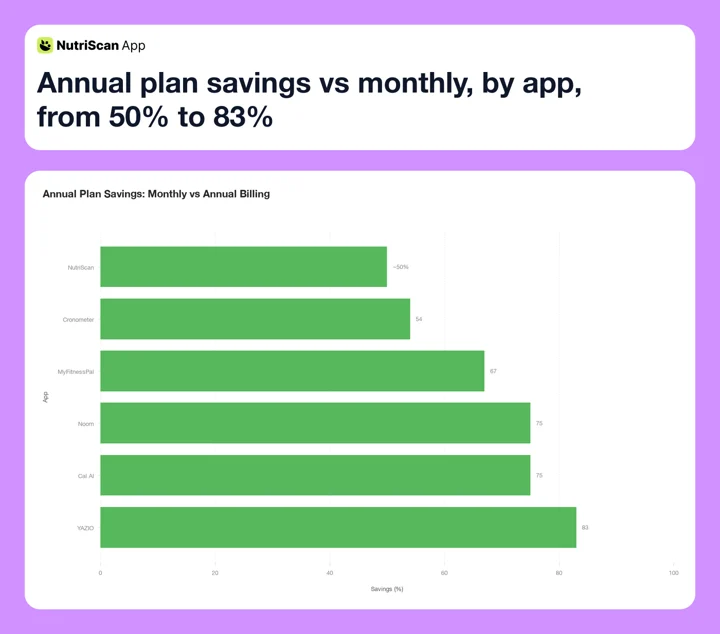 Figure 1: Percentage saved by paying annually instead of monthly. YAZIO saves the most at 83 percent, then Cal AI and Noom at 75, MyFitnessPal at 67, and Cronometer at 54. NutriScan and Lose It are not in the chart because neither is compared monthly against annual.
| App | Monthly Cost | Annual Cost | Monthly Equivalent | Savings |
|---|---|---|---|---|
| Cal AI | $9.99/mo | $29.99/yr | $2.50/mo | 75% |
| YAZIO | $11.90/mo | $23.90/yr (promo) | $1.99/mo | 83% |
| Lose It | N/A (annual only) | $79.99/yr | $6.67/mo | - |
| NutriScan | yearly (weekly in some regions) | about $59/yr | n/a | n/a |
| Cronometer Gold | $10.99/mo | $59.99/yr | $5.00/mo | 54% |
| MyFitnessPal Premium | $19.99/mo | $79.99/yr | $6.67/mo | 67% |
| Noom | $70/mo | $209/yr | $17.42/mo | 75% |
Step 3: Use the free trial first
Most apps offer a 7-day free trial on annual plans. Start the trial in early January, test the app for 5-6 days, and only convert if you like it. Set a reminder on Day 5 to decide.
TIP
Use your phone's built-in reminder or calendar app to set a trial expiration alert. Missing the cancel window by even one day triggers a full charge.
Step 4: Check employer and insurance benefits
Many employers add wellness app perks in January. Lifesum partners with Oscar Health and Wellhub. Lose It is FSA/HSA eligible. MyFitnessPal is also FSA/HSA eligible. Check your benefits portal before paying out of pocket.
Step 5: Pick the right plan length
A 2024 analysis of subscription behavior found that annual plan retention (33%) is nearly double monthly plan retention (17%) (RevenueCat). Annual plans are not just cheaper - they also make you more likely to stick with tracking. If you are unsure what your daily targets should be, try the online macro calculator before committing to any app.
 When you realize YAZIO costs less than $0.07 per day on an annual plan
Real-World January Deal Examples 💡
To show how much you can actually save, here are three scenarios based on real pricing from recent January promotions:
Scenario 1: The Budget Tracker
Sarah wants the cheapest possible premium tracker. She grabs YAZIO PRO at $23.90/yr during a January promo. That is $0.07 per day. She gets calorie tracking, fasting timer, meal plans, and recipe access. Without the deal, the same plan costs $47.90/yr ($0.13/day). Savings: $24/yr.
Scenario 2: The Feature Maximizer
David wants meal planning, grocery lists, and barcode scanning. He picks MyFitnessPal Premium+ at $40/yr during a January sale (down from $99.99/yr). He gets meal plans with 1,500+ recipes, Instacart and Walmart+ grocery sync, and advanced nutrient reports. Savings: $60/yr.
Scenario 3: The Long-Term Investor
Maria is tired of annual renewals. She is already a Lose It Premium member, so the Lifetime plan costs her $229.99 instead of the $299.99 a free account pays. Against the $79.99 annual plan she breaks even in under three years, and after that she pays nothing. Savings: $70 off the list Lifetime price, then no future charges.
INFO
Each of these deals was available during recent January windows. The key is knowing which app fits your tracking style before the deals go live.
5 Common January Deal Mistakes (and How to Avoid Them) ⚠️
1. Buying before testing Most apps offer a free trial. Use it. Do not let a countdown timer pressure you into paying before you have logged at least 10 meals.
2. Forgetting to cancel the trial
 Photo by Mind Mobs on Unsplash
Set a calendar reminder for 1-2 days before your trial ends. If you bought through the App Store, go to Settings ➡️ Apple ID ➡️ Subscriptions. On Android, go to Google Play ➡️ Payments & Subscriptions.
3. Stacking subscriptions Do not subscribe to multiple apps at once. Pick one, use it for 30 days, and switch only if it does not fit. Health and fitness apps generated over $5 billion in revenue in 2024 partly because users forget about overlapping subscriptions (Business of Apps).
4. Choosing monthly when annual is cheaper Monthly plans almost always cost 2-4x more per month than annual plans. If you plan to track for more than 3 months, annual is the better deal.
5. Ignoring the cancel path Before you buy, check how to cancel. Some apps have simple in-app cancel buttons. Others require going through Apple, Google, or even PayPal. Know your path before you need it.
How to Know If a January Deal Is Actually Good 🔎
Not every "50% off" banner means a genuine discount.
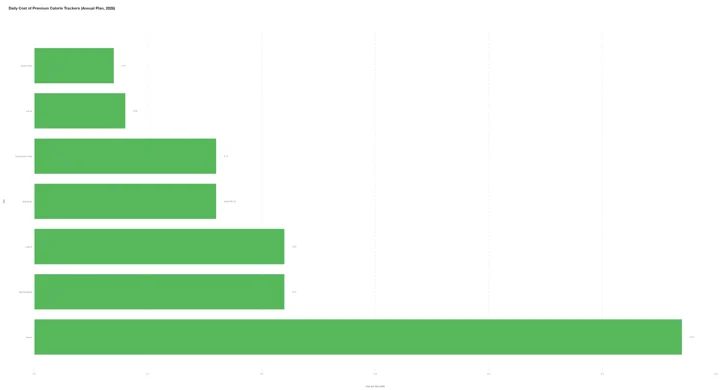 Figure 2: Daily cost of premium calorie trackers when billed annually. Anything under $0.15/day is a strong deal, which covers YAZIO PRO and Cal AI. NutriScan lands just above at about $0.16 a day. Lose It and MyFitnessPal both land at $0.22 a day now that Lose It Premium is $79.99 a year.
Here is a quick checklist:
- Compare to the standard annual price, not the monthly price. Many coupon sites advertise "67% off" which is just the normal annual-vs-monthly savings, not a special deal.
- Check the per-day cost. Any premium tracker under $0.15/day ($54.75/yr) is a solid deal. Under $0.10/day ($36.50/yr) is excellent.
- Look for the actual dollar amount. Percentage discounts can be misleading when applied to different base prices.
- Verify on the official app or website. Third-party coupon sites often list expired codes or redirect to standard pricing.
TIP
The per-day cost is the fastest way to compare across apps. Divide the annual price by 365 and compare. Anything under $0.15/day is a strong deal.

What the Research Says About January App Engagement 📊
A 2025 industry analysis found that Health and Fitness apps see D1 retention rates of approximately 23%. By Day 30, retention drops to 3-10% (Digital Yield Group). This means that for every 100 users who download a calorie tracker in January, fewer than 10 are still using it by February.
The pattern is consistent year after year. January installs are 34% higher than the first-half average, but by April, installs drop 20% and by May they fall 44%. Sessions follow the same curve.
Research on mHealth app engagement confirms that the biggest predictor of long-term use is not the app itself but the user's pre-existing motivation level (Kwon et al., 2022). Users who download an app as a "symbolic act of change" tend to abandon it quickly. Users who have a specific goal (lose 5 kg, hit 120g protein daily, prepare for a marathon) are far more likely to stay.
A 2023 study on fitness app user behavior found that habit formation requires consistent engagement over 2-3 weeks, and apps that reduce friction through features like photo logging, voice input, or one-tap repeat meals show higher retention (Guo et al., 2022).
Conclusion
The best January deal is the one you will actually use past February. Before you grab the cheapest annual plan, ask yourself three questions:
- Have I used the free trial for at least 5 days?
- Does this app match how I want to log food (photo, barcode, manual, voice)?
- Am I buying because the price is good or because the app is good?
If you are looking for a calorie tracker that keeps logging simple with photo scanning and does not lock basic features behind a paywall, NutriScan offers a free plan with 5 photo scans per week and NutriBites AI. Premium is about $59 a year.
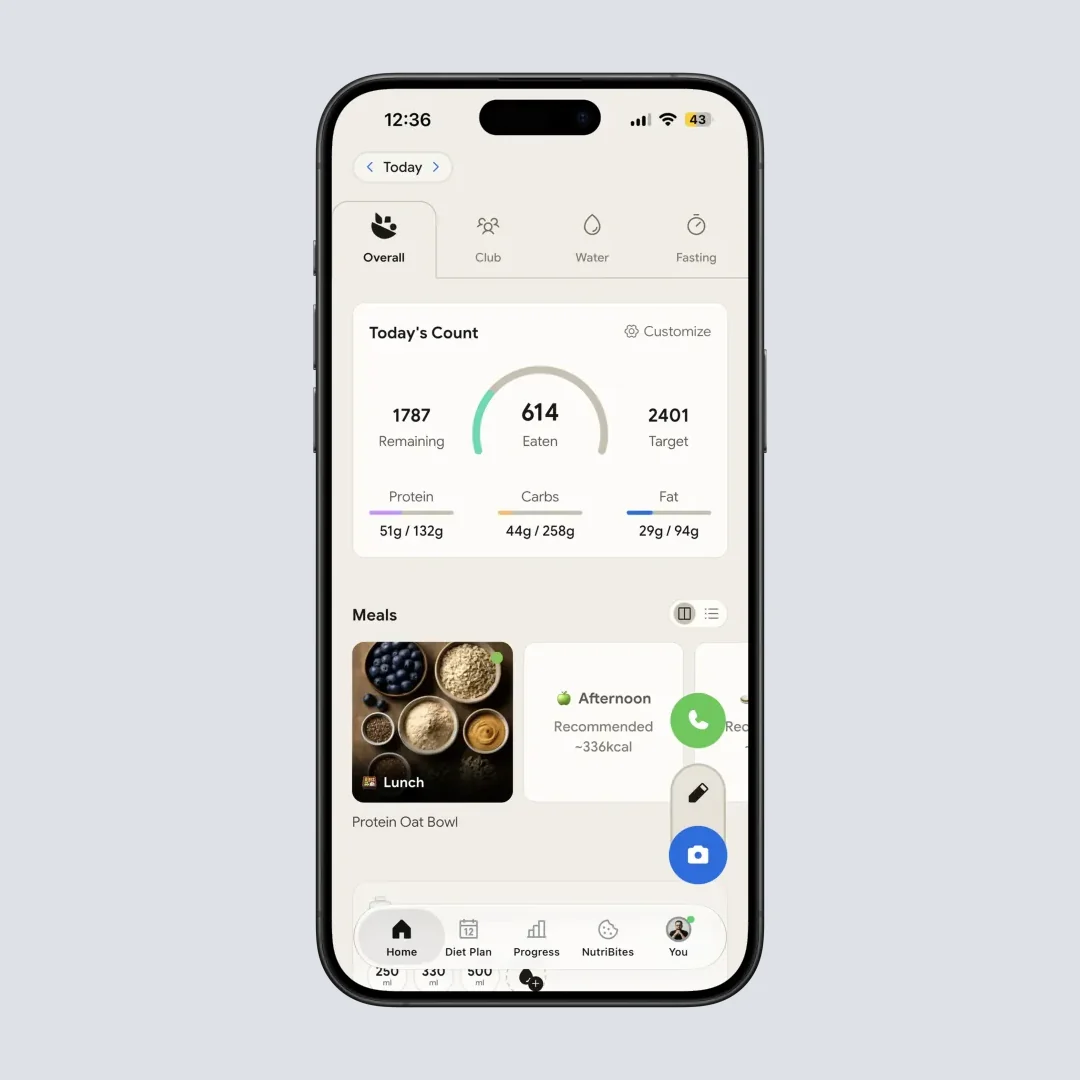
NutriScan home page - daily nutrition tracking with calorie, protein, carbs, and fat breakdown (@Path: Home)
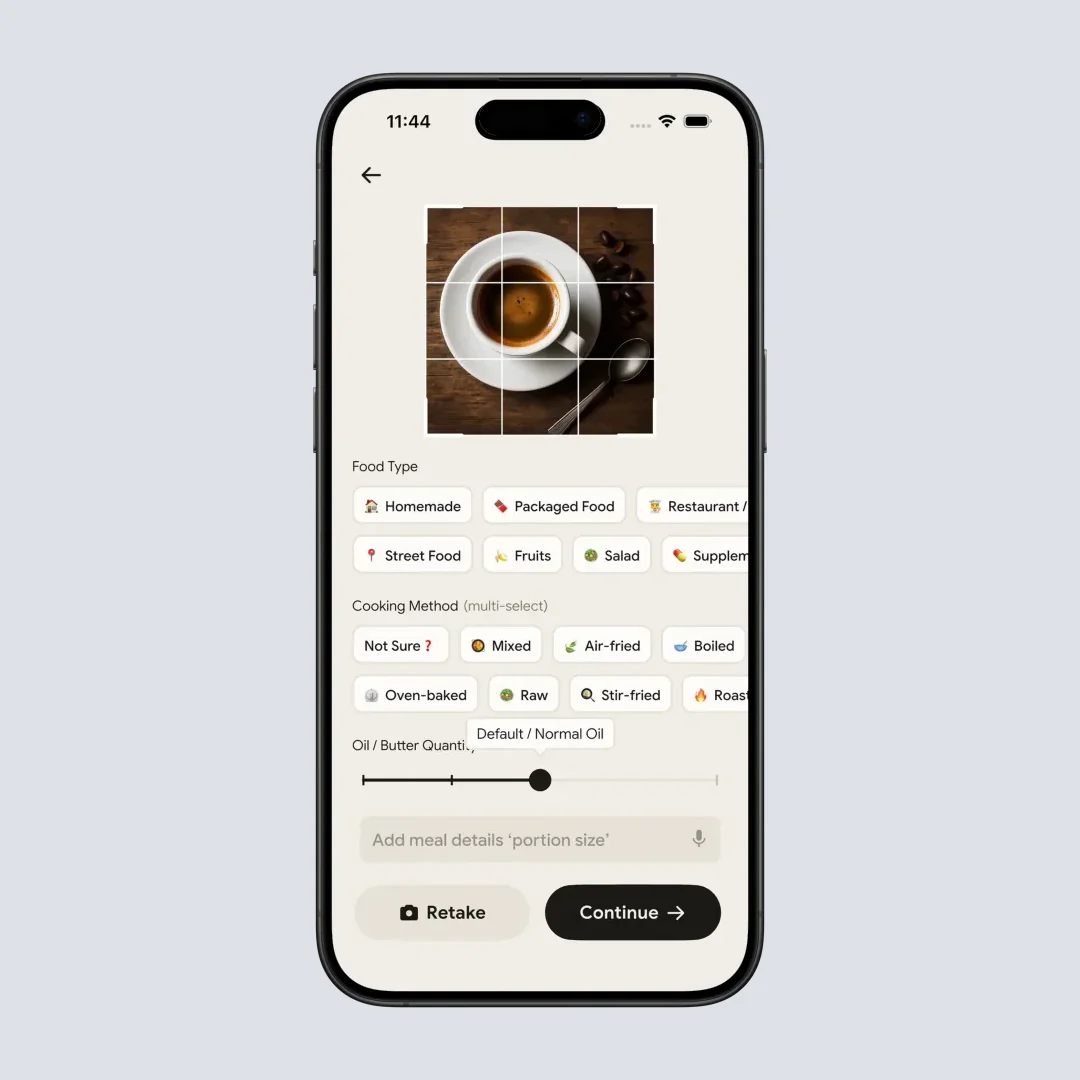
NutriScan AI meal scanning - snap a photo, select food type and cooking method, get instant nutrition data (@Path: Home > Camera Icon > Crop Picture)
January deals come and go. The right app stays with you all year.
Frequently Asked Questions ❓
Q: When do calorie tracker apps run their biggest sales?
A: January (first two weeks) and Black Friday/Cyber Monday (late November) are the two peak discount windows. Some apps also run smaller promotions in August-September for back-to-school.
Q: Is it better to buy monthly or annual?
A: Annual is almost always cheaper. Across 15 major apps, annual plans save 44-83% compared to monthly billing. RevenueCat data also shows annual subscribers retain at nearly double the rate of monthly subscribers (33% vs 17%).
Q: Can I get a refund if I buy a January deal and stop using the app?
A: Refund policies vary by app and purchase platform. Apple offers case-by-case refunds through reportaproblem.apple.com. Google Play has a 48-hour auto-refund window. Fastic has a 14-day Feel Good Guarantee. Most other apps push refund requests to Apple or Google.
Q: Do January deals apply to existing subscribers?
A: Usually no. Most January promotions target new subscribers or users on the free plan. If you already have an active subscription, you typically cannot switch to a promotional rate until your current plan expires.
Q: Which calorie tracker has the best free plan?
A: FatSecret offers the most generous free plan with unlimited tracking, barcode scanning, and community features. NutriScan offers 5 free AI photo scans per week plus NutriBites AI on the free plan. Cronometer Basic provides unlimited free tracking with ads. MyFitnessPal's free plan now locks the barcode scanner behind Premium.
Q: Should I wait for Black Friday instead of buying in January?
A: January and Black Friday discounts are usually similar in size (40-67% off annual plans). The difference is timing. If you are motivated now and want to start tracking in January, do not wait 11 months for a deal that may save you only $5-$10 more. The cost of delaying your health goals is higher than the cost of a slightly smaller discount.
Q: How do I know which app is right for me before buying?
A: Start with the free plan or trial of 2-3 apps. Log your meals for 3-5 days in each. Pay attention to how fast you can log a meal, whether the food database has the foods you eat, and whether the app gives you useful feedback. The app that feels easiest to use daily is the one worth paying for. You can also try NutriScan's online macro calculator to see what your daily targets should look like before committing to any app.