TDEE Calculator
Enter your sex, age, height, weight and activity level. You get your BMR, your TDEE, and the maintenance calories that hold your weight where it is, plus what the number becomes at every activity level and on a cut or a bulk.
Your maintenance calories
2,556calories a day
Eat around this to hold your current weight.
Your TDEE at every activity level
| Activity level | Multiplier | calories a day |
|---|---|---|
| Sedentary | 1.2 | 1,979 |
| Lightly active | 1.375 | 2,267 |
| Moderately active | 1.55 | 2,556 |
| Very active | 1.725 | 2,844 |
| Extra active | 1.9 | 3,133 |
An estimate from the Mifflin-St Jeor equation. Track for two weeks and adjust from what the scale actually does.
How the number is worked out
Your BMR, or basal metabolic rate, is what your body spends at complete rest. The calculator uses the Mifflin-St Jeor equation from 1990, which is still the closest fit for healthy adults. For men it is 10 times weight in kg, plus 6.25 times height in cm, minus 5 times age, plus 5. For women the last term is minus 161 instead of plus 5.
Your TDEE, or total daily energy expenditure, is that BMR multiplied by an activity factor: 1.2 for a desk job with no exercise, 1.375 for light exercise one to three days a week, 1.55 for moderate exercise three to five days, 1.725 for hard training most days, and 1.9 for physical work or twice-daily training. The result panel shows all five so you can see what a change in habits is worth.
A 30 year old man at 70 kg and 175 cm has a BMR of about 1,649. Moderately active, his TDEE is 2,556 calories a day. A cut at 20 percent below that is 2,045, a bulk at 10 percent above is 2,812.
TDEE for weight loss
Your TDEE is the ceiling you subtract from. Eat 500 a day under it and you lose roughly half a kilogram of fat a week. Going deeper than 20 to 25 percent below rarely pays off, because hunger and fatigue climb faster than the extra loss. Recalculate every 4 to 5 kg, since a lighter body burns less and a deficit slowly turns into maintenance. The weight loss calculator does that arithmetic against a date.
TDEE for women
The equation is the same, with minus 161 at the end instead of plus 5. A 30 year old woman at 65 kg and 165 cm gets a BMR of 1,370 and a moderately active TDEE of 2,124. Water weight moves by 1 to 2 kg across a cycle, so compare weekly averages rather than single mornings when judging whether the number is right.
TDEE and your daily steps
Your steps are already inside the activity multiplier. Under 5,000 a day is sedentary, 7,500 to 10,000 with some training is moderate, and 12,500 or more is very active. Adding a watch reading on top of your TDEE counts the same walk twice, which is how people quietly eat 400 calories over every day. If you want a single workout priced on its own, use the calories burned calculator.
Track it in NutriScan
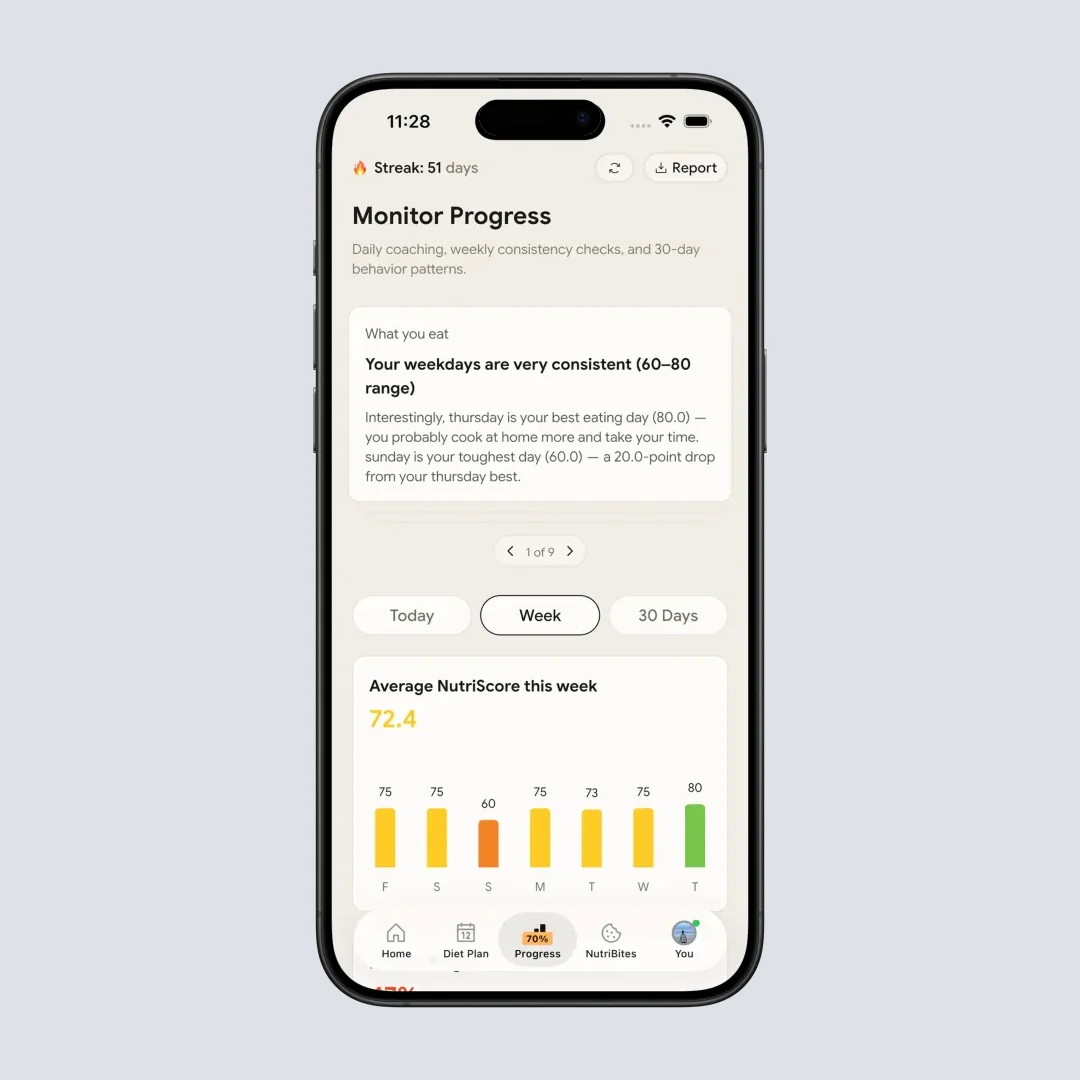
Knowing your maintenance number is the easy half. NutriScan logs a meal from a photo, your voice, a barcode or a typed line, and shows calories and macros against the target you set here. The home screen shows what is left of the day before dinner, when it still changes what you order.
The free plan gives you 5 photo scans a week plus water tracking and the fasting timer. Premium removes the scan cap and costs about $59 a year.
Frequently asked questions
What is TDEE?
TDEE stands for total daily energy expenditure: every calorie your body spends in 24 hours. It covers your resting metabolism, digestion, walking around and training. Eat at your TDEE and your weight holds steady, which is why TDEE and maintenance calories mean the same thing.
How accurate is a TDEE calculator?
The Mifflin-St Jeor equation lands within roughly 10 percent for most adults. The activity multiplier adds the real uncertainty, since two people who both call themselves moderately active can differ by 300 calories. Use the number as a starting point, then weigh yourself for two weeks and adjust by 100 to 200 calories.
What is the difference between BMR and TDEE?
BMR is what you would burn lying still all day, around 60 to 70 percent of your total. TDEE is BMR multiplied by an activity factor from 1.2 to 1.9. Never eat at your BMR: it leaves nothing for movement or digestion.
Should I recalculate my TDEE as I lose weight?
Yes. A smaller body burns fewer calories, so recalculate every 4 to 5 kg of change. A 10 kg loss typically drops TDEE by 100 to 150 calories a day, which is often why progress stalls.
Does the calculator count my steps or workouts twice?
No. The activity multiplier already includes your daily steps and training. Do not add exercise calories from a watch on top of your TDEE, or you will overshoot. If you want a per-session figure instead, use the calories burned calculator.
Related calculators
Your inputs are saved between these pages, so each one opens with your numbers filled in.
- Weight loss calculator for a daily target and a projected date for a goal weight
- Weight gain calculator for the surplus and timeline of a lean bulk
- Protein intake calculator for daily grams and a per-meal split
- Calories burned calculator for one workout or a day of steps
- AI calorie counter app for how photo, voice, barcode and text logging works