Oreo Matcha Sandwich Biscuits (UK/Asia): Calories, Nutrition and Health Benefits
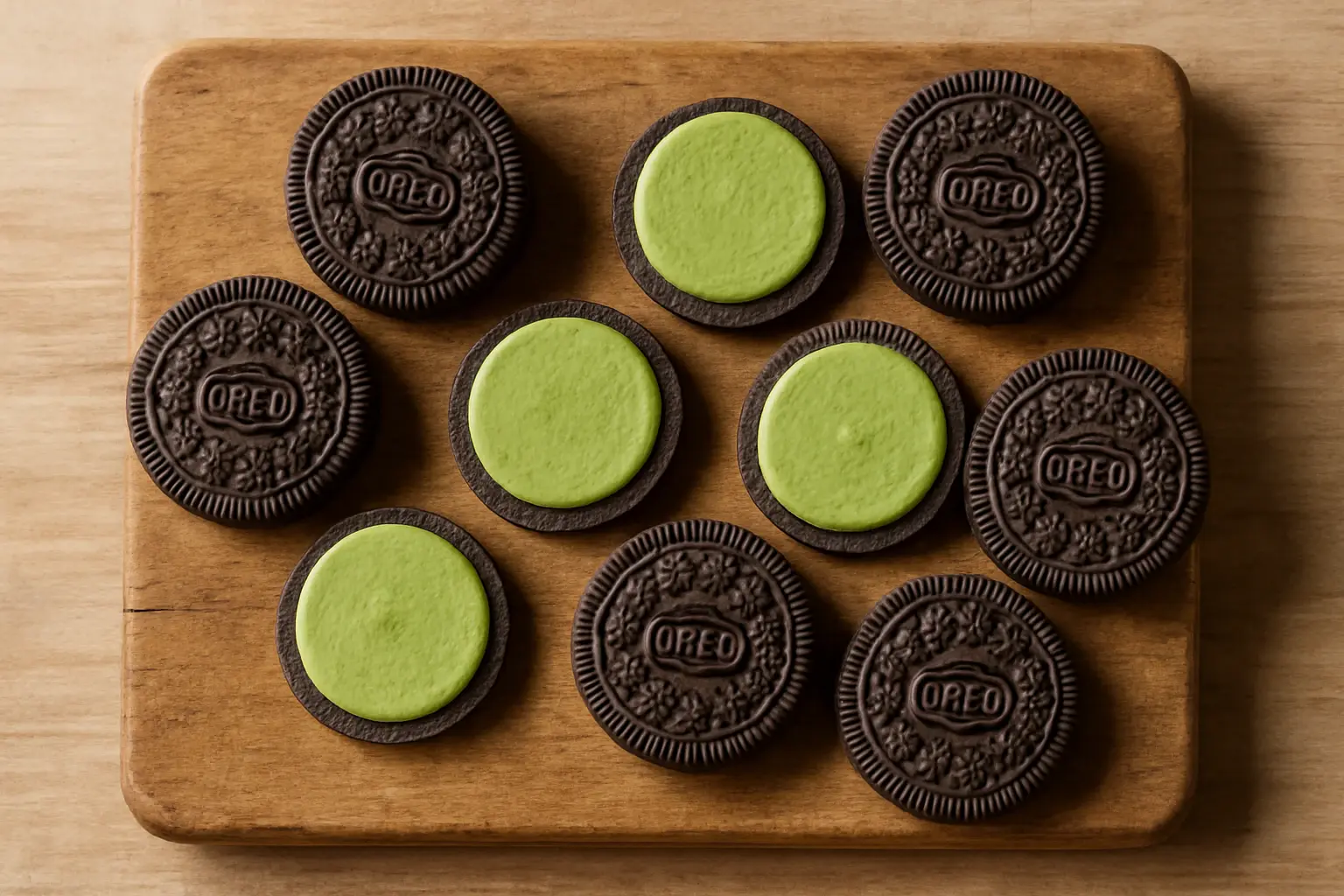
Oreo Matcha Sandwich Biscuits are a limited-edition UK/Asia variant of the classic Oreo, filled with green tea–flavoured cream. Each 5-biscuit serving (≈48.5g) delivers 235 calories, 32.9g carbs, and 10.2g fat — consistent with ultra-processed sandwich biscuits. The matcha content is 1% green tea powder by weight, providing negligible EGCG. Best treated as an occasional treat rather than a nutritious snack.
Quick Nutrition Facts
Per 5 biscuits
| Nutrient | Amount |
|---|---|
| Calories | 235 kcal |
| Protein | 2.3g |
| Carbohydrates | 32.9g |
| Fiber | 0.7g |
| Sugars | 15.8g |
| Fat | 10.2g |
| Sodium | 175 mg |
Macronutrient Breakdown
 ChatGPT
  Claude
  AI Mode
  Perplexity
NUTRITIONIST'S INSIGHT
The matcha branding creates a halo effect, but at 1% green tea powder the EGCG content is estimated at under 35mg per whole 97g pack — far below the 200–400mg per dose studied for metabolic benefits. Nutritionally, this is a standard high-sugar, refined-carb biscuit (Nutri-Score E). The saturated fat (≈4.7g/serving) represents about 24% of the UK daily limit. Enjoy as a treat in controlled portions, and don't rely on any matcha health narrative.
Myth Busters
MYTH #1: The matcha in Oreo Matcha makes it a healthier biscuit option.
TRUTH: Matcha is listed at only 1% in the ingredients. That delivers roughly 34mg of EGCG across the entire 97g pack — about 1/10th of a dose studied for health effects. The product's Nutri-Score remains E (high sugar, ultra-processed). The matcha is flavouring, not a health ingredient. Green Tea Catechins and Their Antioxidant Properties — PMC; Ultra-Processed Foods and Health Risks — Harvard T.H. Chan School of Public Health
MYTH #2: Oreo Matcha has less sugar than regular Oreos because matcha is bitter.
TRUTH: Oreo Matcha contains approximately 32.6g sugar per 100g, comparable to or higher than classic Oreos (~37g/100g in some markets). The bitter matcha note comes from the cocoa and green tea combination, not from reduced sugar. Both variants are high-sugar products. Oreo Green Tea Ice Cream Flavor — OpenFoodFacts; Oreo Matcha Ice Cream Cookies — Tradewinds Oriental Shop UK
MYTH #3: These are authentic Japanese matcha biscuits.
TRUTH: Oreo Matcha is produced in China by Mondelez International for East Asian and diaspora markets. It is not a Japanese confectionery product. It uses green tea powder, not ceremonial-grade matcha, and is sold in the UK primarily through Asian specialty shops and grey-import channels. Oreo Matcha Ice Cream Cookies — Sous Chef UK; Ultra-Processed Foods and Health Risks — Harvard T.H. Chan School of Public Health
MYTH #4: A few biscuits won't significantly impact blood sugar.
TRUTH: With 32.9g of carbs and under 1g of fiber per 5-biscuit serving, net carbs are approximately 32g — enough to cause a substantial postprandial glucose spike in most people. The refined wheat flour base has a glycemic index estimated around 70–75, comparable to white bread. Glycemic Index of Biscuits and Cookies — University of Sydney GI Database; Added Sugar and Cardiovascular Risk — American Heart Association
MYTH #5: Sandwich biscuits labelled 'green tea' are suitable for diabetics as a lower-GI snack.
TRUTH: No meaningful GI reduction comes from 1% green tea powder. Meaningful GI suppression from matcha catechins requires significantly larger doses than those found in a biscuit. Diabetics and those managing blood sugar should treat these biscuits the same as any high-GI refined-flour confection. Green Tea Catechins and Their Antioxidant Properties — PMC; Glycemic Index of Biscuits and Cookies — University of Sydney GI Database
NutriScore by Health Goals
| Health Goal | NutriScore | Why This Score? |
|---|---|---|
| Weight Loss |  | 235 calories per 5-biscuit serving with minimal protein (2.3g) and fiber (0.7g) means poor satiety per calorie. Easy to eat multiple servings without feeling full. Oreo Green Tea Ice Cream Flavor — OpenFoodFacts; Ultra-Processed Foods and Health Risks — Harvard T.H. Chan School of Public Health |
| Muscle Building |  | Only 2.3g protein per serving. Provides essentially no contribution toward the 20–40g per meal target needed to stimulate muscle protein synthesis. Oreo Green Tea Ice Cream Flavor — OpenFoodFacts |
| Heart Health | | ~4.7g saturated fat and ~175mg sodium per serving. Nutri-Score E. Regular consumption of ultra-processed, high-sugar foods is linked to increased cardiovascular risk. Ultra-Processed Foods and Health Risks — Harvard T.H. Chan School of Public Health; Added Sugar and Cardiovascular Risk — American Heart Association |
| Diabetes Management | | ~32g net carbs and GI estimated at 70–75 make this a high glycemic load food. The matcha content does not meaningfully lower the glucose response. Not suitable for blood sugar management. Glycemic Index of Biscuits and Cookies — University of Sydney GI Database; Added Sugar and Cardiovascular Risk — American Heart Association |
| Athletic Performance |  | High carbohydrate content can serve as quick-energy fuel before light activity. However, high sugar and low protein/electrolyte content make better sports snacks readily available. Oreo Green Tea Ice Cream Flavor — OpenFoodFacts; Glycemic Index of Biscuits and Cookies — University of Sydney GI Database |
| Gut Health | | Under 1g fiber per serving. Contains emulsifiers (soy lecithin) and sweeteners (sorbitol, erythritol), which at higher intakes can disrupt gut microbiome balance or cause digestive discomfort. Oreo Matcha Ice Cream Cookies — Sous Chef UK; Ultra-Processed Foods and Health Risks — Harvard T.H. Chan School of Public Health |
| Pregnancy & Prenatal |  | High sugar and ultra-processed classification make this unsuitable as a regular snack during pregnancy. Occasional treat is acceptable. Contains gluten, soy, and milk allergens — relevant for sensitivity screening. Ultra-Processed Foods and Health Risks — Harvard T.H. Chan School of Public Health; Added Sugar and Cardiovascular Risk — American Heart Association |
PERSONALIZED NUTRITION
Track your meals with NutriScan for personalized NutriScores based on your specific health goals!
Blood Sugar Response to Oreo Matcha Sandwich Biscuits (UK/Asia)
Understanding how Oreo Matcha Sandwich Biscuits (UK/Asia) affects blood glucose can help with timing and meal pairing. Glycemic Index of Biscuits and Cookies — University of Sydney GI Database; Added Sugar and Cardiovascular Risk — American Heart Association
Typical Glucose Response Curve
**Not medical advice**
How to flatten the spike
- Keep the portion to the labelled serving and avoid eating straight from the bag or tray.
- Pair it with a protein or fibre source, such as Greek yogurt, eggs, lentils, beans, salad, or edamame, when you want steadier appetite and glucose control.
- Avoid pairing it with sugary drinks; choose water, unsweetened tea, or coffee so the snack does not become a larger sugar load.
Cultural Significance
Oreo Matcha was developed by Mondelez International for East Asian markets — particularly China and Japan — where green tea flavouring carries deep cultural resonance in confectionery and desserts. It arrived in the UK through Asian grocery channels and specialty importers (Sous Chef, Tradewinds, Yau Bros), tapping into the matcha premiumisation trend driven by bubble tea culture, K-pop food content, and the UK's growing Asian diaspora. The product functions as a cultural bridge snack: familiar Oreo format with a distinctly Asian palate cue. The global matcha biscuit market was valued at approximately $940M in 2023. In the UK, it remains a specialty import rather than a mainstream supermarket product.
Compare & Substitute
Oreo Matcha Sandwich Biscuits (UK/Asia) vs Similar Foods
| Nutrient | Plain rice cakes | Matcha-flavoured dark chocolate (70%+) | Lotus Biscoff (1–2 biscuits) | Homemade matcha shortbread |
|---|---|---|---|---|
| Calories | 110 kcal | 105 kcal | 150 kcal | 150 kcal |
| Protein | 2g | 2g | 2g | 2g |
| Carbohydrates | 24g | 8g | 23g | 23g |
| Fat | 1g | 8g | 6g | 6g |
Frequently Asked Questions
How many calories are in one Oreo Matcha biscuit?
Approximately 47 calories per single biscuit (97g pack / 10 biscuits = 9.7g each × 4.85 kcal/g). A typical 5-biscuit serving is about 235 calories.
Does Oreo Matcha have real matcha in it?
Yes — the ingredients list green tea powder at 1% by weight. However, this is a very small amount and primarily serves as flavouring. The quantity of active catechins (EGCG) is negligible compared to matcha tea or matcha supplements.
Is Oreo Matcha gluten-free?
No. Wheat flour is the primary ingredient (~70% of the biscuit). It also contains soy and milk allergens. Not suitable for coeliacs or those with gluten sensitivity.
Where can I buy Oreo Matcha biscuits in the UK?
Oreo Matcha is not currently available in mainstream UK supermarkets such as Tesco or Sainsbury's (they carry other Oreo variants). It is available at UK Asian specialty shops including Tradewinds Oriental Shop, Sous Chef, and some Yau Bros locations. It can also be found online via Amazon UK marketplace sellers.
How does Oreo Matcha compare to regular Oreos nutritionally?
Per 100g, Oreo Matcha (485 kcal, 21g fat, 33g sugar) is broadly similar to Classic Oreos (~480 kcal, 20g fat, 37g sugar). Classic Oreos tend to have slightly more sugar; Oreo Matcha may have marginally more fat from the cream filling formulation. Both are Nutri-Score E ultra-processed biscuits.
Are Oreo Matcha biscuits vegan?
No. The ingredients include whey powder (milk derivative). Classic Oreos are not certified vegan in Europe either. This matcha variant is not suitable for vegans.




Similar Nutritious Foods
4505 Chicharrones Classic Chili Salt
7 Eleven Japan Crispy Corn Cheese
Explore More Tools
AI Calorie Counter App - Snap a Photo, Get Macros
AI Nutritionist App That Reads Your Logged Meals
Best Protein Supplements for Women
Bulking Meal Plan App That Sets Your Surplus
ChatGPT Calorie Counter Alternative That Keeps the Total
ChatGPT Diet Plan Alternative That Tracks What You Eat
ChatGPT Weight Loss Coach Alternative With a Food Log
Fast Food Calorie Counter App That Reads the Tray
Free Calorie Tracker App with AI Photo Scans | NutriScan
Indian Diet Plan App With Veg and Non Veg Meals
Indian Food Calorie Calculator - Get Instant Nutrition Facts for Desi Meals — 2026
Intermittent Fasting for Women, Timer and Meal Log App
Intermittent Fasting Tracker App - Free Fasting Timer
Macro Tracker App That Fills the Numbers From a Photo
Mediterranean Diet Meal Plan App That Counts the Oil
Micronutrient Tracker App for Vitamins and Minerals
MyFitnessPal Alternative That Stays Free | NutriScan
NutriScore App: A Free Grade on Every Meal | NutriScan
Nutrition Label Scanner App for the Amount You Ate
Second Trimester Protein Guide
Vegetarian Meal Plan App With a Protein Target
Voice Calorie Counter - Speak to Track Meals Hands-Free
Water and Calorie Tracker App - Free Water Log