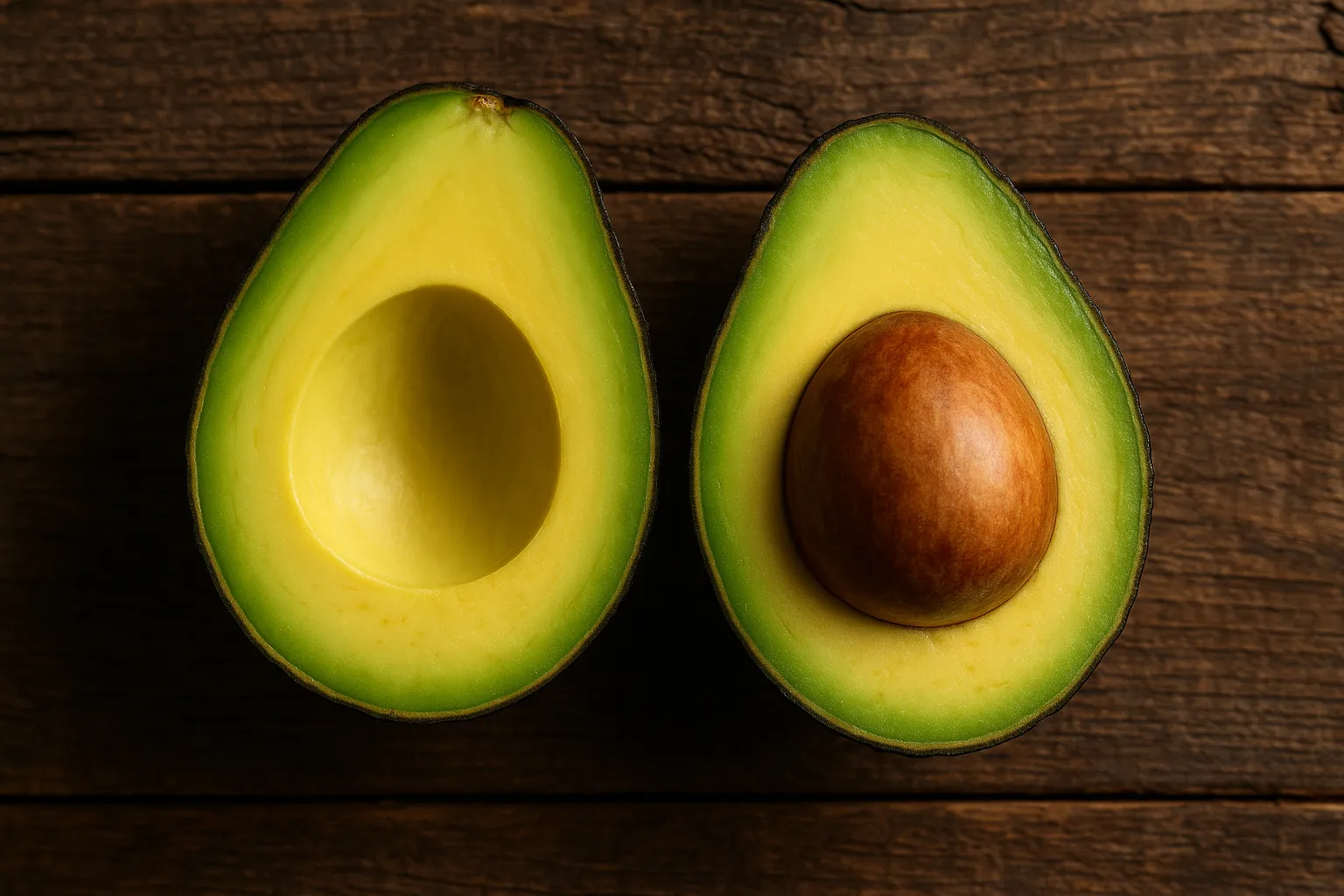
Avocado Calories: 160 per 100g (Half a Large Avocado)
Nature's butter packed with heart-healthy fats, fiber, and essential nutrients—the ultimate portion-controlled superfood.
Quick Nutrition Facts
Per 100g (about half a large avocado)
| Nutrient | Amount |
|---|---|
| Calories | 160 kcal |
| Protein | 2g |
| Carbohydrates | 8.5g |
| Fiber | 6.7g |
| Sugars | 0.7g |
| Fat | 15g |
| Potassium | 485mg |
| Vitamin K | 21mcg |
| Folate | 81mcg |
| Vitamin C | 10mg |
Macronutrient Breakdown
 ChatGPT
  Claude
  AI Mode
  Perplexity
NUTRITIONIST INSIGHT
Half an avocado provides 27% of your daily fiber needs and heart-healthy monounsaturated fats that enhance absorption of fat-soluble vitamins A, D, E, and K from other foods. The portion paradox: despite 160 calories per half, avocados increase satiety by 23% and reduce hunger for 3-6 hours.
How Many Calories Are in an Avocado by Portion
One avocado is not one number. USDA lists 160 calories per 100 g of edible flesh, so what you log depends entirely on how much flesh ends up in the bowl. The weights below are USDA's own portion weights for raw avocado, all commercial varieties.
| Portion | Edible weight | Calories |
|---|---|---|
| 1 standard serving, about one-third of a medium fruit | 50 g | 80 kcal |
| Half a large avocado | 100 g | 160 kcal |
| 1 cup, sliced | 146 g | 234 kcal |
| 1 cup, cubed | 150 g | 240 kcal |
| 1 medium avocado, flesh only | 201 g | 322 kcal |
| 1 cup, mashed | 230 g | 368 kcal |
Two things move the number. Fat does most of the work: 15 g per 100 g, about 85% of the calories, which is why avocado sits far above every other fruit. Portion size does the rest, and that is where home logging goes wrong. Scooping a whole medium fruit onto toast is 322 calories before the bread, roughly four times the 80-calorie serving printed on the label.
Restaurant guacamole adds more on top, because most recipes carry oil, sour cream, or extra salt. The numbers are on the guacamole calories page, and eggs are worth checking if you pair avocado toast with protein.
Myth Busters
MYTH #1: Avocados Cause Weight Gain
TRUTH: Avocados support weight loss despite being calorie-dense. Daily consumption as part of a hypocaloric diet supported weight loss in 12-week trials. The fat-fiber combination increases satiety mediated by PYY hormone, reducing overall calorie intake. Key: portion control—stick to 1/4-1/2 avocado per serving.
MYTH #2: The Healthy Fat Paradox—You Can Eat Unlimited Amounts
TRUTH: While avocados contain beneficial monounsaturated fats, a whole avocado has 320 calories and 30g fat. The "healthy fat" label leads to overeating. Studies show benefits at 1/2 avocado daily (160 cal), not 2-3 whole avocados (640-960 cal). Portion awareness is critical.
MYTH #3: Avocados Are Too High in Calories for Weight Loss
TRUTH: Calorie density doesn't equal weight gain. Avocado consumption increases meal satisfaction and reduces hunger for 5+ hours, leading to lower total calorie intake. The 6.7g fiber and healthy fats create sustained fullness that prevents snacking.
MYTH #4: Diabetics Should Avoid Avocados Due to Fat Content
TRUTH: Avocados are excellent for diabetics. Consumption reduces type 2 diabetes risk by 25% and improves HbA1c, fasting glucose, and postprandial insulin in those with T2D. Very low glycemic index (GI ~15) and monounsaturated fats improve insulin sensitivity.
MYTH #5: All the Nutrition Is in the Green Flesh Only
TRUTH: While most nutrients are in the flesh, the darker green area closest to the skin has higher antioxidant concentration. Don't scrape too conservatively. However, the pit and skin are not edible despite viral claims—they contain compounds that can be toxic.
MYTH #6: Avocados Have No Protein, So They're Not Filling
TRUTH: While low in protein (2g per half), avocados achieve satiety through fiber (6.7g) and monounsaturated fats (10g) that slow gastric emptying. Research shows hunger suppression enhanced by 23% vs control meals. Pair with protein for optimal fullness.
NutriScore by Health Goals
| Health Goal | NutriScore | Why This Score? |
|---|---|---|
| Weight Loss |  | 160 cal per half, 6.7g fiber increases satiety 23%, reduces hunger 5+ hours. Stick to 1/4-1/2 per day. |
| Muscle Gain |  | Only 2g protein per half. Provides healthy fats for hormone production and calorie surplus. Pair with high-protein foods. |
| Diabetes Management |  | Reduces T2D risk 25%, improves HbA1c and fasting glucose. Very low GI (~15), monounsaturated fats improve insulin sensitivity. |
| PCOS Management | | Healthy fats support hormone balance, low glycemic impact stabilizes insulin. Limit to 1/2 avocado daily for calorie control. |
| Pregnancy Nutrition | | Rich in folate (81mcg, 20% DV) essential for fetal neural development. Healthy fats support brain growth. Safe 1/2-1 whole avocado daily. |
| Viral/Flu Recovery | | Easy to digest, vitamin C for immunity, potassium for hydration. Gentle on stomach but calorie-dense—adjust portions during low activity. |
PERSONALIZED NUTRITION
Track your meals with NutriScan for personalized NutriScores based on your specific health goals!
Blood Sugar Response to Avocado
Understanding how avocados affect blood glucose helps optimize their use for diabetes management and weight control.
Typical Glucose Response Curve
*This chart shows typical blood glucose response for general healthy individuals. Individual responses may vary. Not medical advice.*
Why Avocados Have Minimal Blood Sugar Impact
Avocados have a very low glycemic index (~15) and contain only 0.7g sugar per half. The high fat (15g) and fiber (6.7g) content dramatically slows glucose absorption:
- 🥚 Add to eggs or omelets - Protein + fat combination for zero glucose spike
- 🥗 Include in salads - Enhances fat-soluble vitamin (A, D, E, K) absorption from vegetables
- 🍞 Pair with whole grain toast - Fat slows carb digestion, reduces GI by 30-40%
- 🌯 Add to protein wraps - Creates sustained energy without blood sugar roller coaster
Research shows avocado consumption improves HbA1c and reduces fasting glucose in people with type 2 diabetes.
Cultural Significance
Avocados (Persea americana) originated in south-central Mexico 7,000-5,000 years ago and were cultivated by the Aztecs who called them "ahuacatl."
Global Impact:
- Mexico produces 30% of world's avocados (2.4+ million tons annually)
- "Avocado toast" phenomenon started in Australia 2010s, became global millennial symbol
- Hass variety (95% of US avocados) invented by Rudolph Hass in California, 1930s
- Super Bowl Sunday drives largest US avocado consumption spike (139+ million avocados)
In India:
- Growing cultivation in Karnataka, Tamil Nadu, Kerala (tropical varieties)
- Used in smoothies, salads, and fusion dishes blending with traditional cuisine
- Increasing urban popularity driven by health awareness and Western food trends
Sustainability Concerns:
- High water usage (70 gallons per avocado) creates environmental pressure
- "Green gold" nickname due to economic value and illegal farming issues in Mexico
Compare & Substitute
Avocado vs Similar Foods (Per 100g)
| Nutrient | 🥑 Avocado | 🥥 Coconut Meat | 🫒 Olives | 🌰 Almonds |
|---|---|---|---|---|
| Calories | 160 kcal | 354 kcal | 115 kcal | 579 kcal |
| Carbs | 8.5g | 15.2g | 6.3g | 21.6g |
| Fiber | 6.7g | 9g | 3.2g | 12.5g |
| Protein | 2g | 3.3g | 0.8g | 21.2g |
| Fat | 15g (MUFA-rich) | 33.5g (saturated) | 10.7g (MUFA-rich) | 49.9g (MUFA + PUFA) |
| Potassium | 485mg | 356mg | 8mg | 705mg |
| Folate | 81mcg | 26mcg | 0mcg | 50mcg |
| Best For | Heart health, weight loss | Quick energy, keto | Mediterranean flavor, keto | Protein, vitamin E, heart health |
Frequently Asked Questions
Are avocados good for weight loss?
Yes, avocados support weight loss despite 160 calories per half. Research shows daily avocado consumption as part of a hypocaloric diet supported weight loss and altered gut microbiota beneficially.
Key mechanisms: 6.7g fiber increases satiety by 23%; fat-fiber combination enhances PYY hormone release; hunger reduced for 5+ hours post-consumption.
Best practices: Limit to 1/4-1/2 avocado per meal; track portions as 160 cal per half; pair with protein and vegetables, not as unlimited "healthy fat."
Can diabetics eat avocados?
Absolutely—avocados are one of the best foods for diabetics. Consumption reduces type 2 diabetes risk by 25% (31% in those with prediabetes).
Benefits for diabetics: Very low GI (~15); improves HbA1c and fasting glucose levels; monounsaturated fats enhance insulin sensitivity; only 0.7g sugar per half.
Optimal use: 1/2 avocado with protein-rich breakfast; add to salads with lean protein; use instead of saturated fats like butter or cheese. Monitor blood sugar response initially.
How much avocado should I eat per day?
General guidelines:
- 1/2 avocado (100g, 160 cal) - Optimal for most adults, weight loss goals
- 1/4 avocado (50g, 80 cal) - Strict calorie deficit, flavoring dishes
- 1 whole avocado (200g, 320 cal) - Athletes, muscle gain, pregnancy, high activity
Avoid excess: More than 1 whole avocado daily can lead to calorie surplus (640+ cal from 2 avocados), despite health benefits. The portion paradox is real—track intake with NutriScan app.
What are the main health benefits of avocados?
Evidence-based benefits:
- Cardiovascular Health: Reduces total cholesterol and LDL-C in people with hypercholesterolemia; 10g monounsaturated fats per half
- Weight Management: Increases satiety, doesn't negatively impact body weight despite calorie density
- Diabetes Prevention: 25% reduced risk of developing type 2 diabetes
- Nutrient Absorption: Enhances fat-soluble vitamin (A, D, E, K) absorption by 2.6-15x
- Digestive Health: 6.7g fiber (27% DV) supports regular bowel movements and gut microbiota
- Pregnancy Support: 81mcg folate (20% DV) essential for fetal neural tube development
Do avocados cause weight gain?
No, when eaten in appropriate portions. Research shows avocado consumption doesn't negatively impact body weight and may support weight management through satiety mechanisms.
The portion paradox explained:
- Half avocado (160 cal) with 6.7g fiber reduces hunger and overall calorie intake
- Whole avocado (320 cal) daily within calorie budget won't cause gain
- 2-3 whole avocados daily (640-960 cal) can easily create surplus leading to gain
Key insight: It's not the avocado—it's eating unlimited amounts under "healthy fat" assumption. Track portions diligently.
Are avocados high in protein?
No, avocados are not a protein source. Half an avocado contains only 2g protein (4% of daily needs). They are primarily a healthy fat source (15g per half, 19% DV).
For adequate protein, pair avocados with:
- Eggs (6g protein per egg)
- Greek yogurt (15-20g per cup)
- Chicken breast (31g per 100g)
- Legumes (15-18g per cup cooked)
Avocados complement high-protein foods by providing healthy fats, fiber, and enhanced nutrient absorption—not by contributing protein themselves.
How many calories in an avocado, per half and per whole fruit?
Calorie breakdown by portion:
- 1/4 avocado (50g): ~80 calories
- 1/2 avocado (100g): ~160 calories
- 1 whole medium avocado (200g): ~320 calories
- 1 whole large avocado (250g): ~400 calories
Common pitfall: Restaurant portions often use 1-1.5 whole avocados in dishes like avocado toast (320-480 cal from avocado alone before bread, toppings). Home portions should be 1/4-1/2 for weight management.
When is the best time to eat avocado?
Depends on your goal:
- Weight Loss: Breakfast or lunch (enhances satiety for 5+ hours, reduces afternoon snacking). Avoid at dinner if calorie-dense.
- Diabetes: Any meal paired with protein (slows glucose absorption). Morning with eggs ideal.
- Muscle Gain: Post-workout with protein (provides calories, healthy fats for hormone production).
- Pregnancy: Any time (folate absorption constant throughout day).
Pro tip: Adding 1/2 avocado to breakfast increases satiety by 23% and reduces hunger for 5 hours compared to iso-caloric low-fat meal.




Similar Nutritious Foods
4505 Chicharrones Classic Chili Salt
7 Eleven Japan Crispy Corn Cheese
Explore More Nutrition Tools & Resources
AI Calorie Counter App - Snap a Photo, Get Macros
AI Nutritionist App That Reads Your Logged Meals
Best Protein Supplements for Women
Bulking Meal Plan App That Sets Your Surplus
ChatGPT Calorie Counter Alternative That Keeps the Total
ChatGPT Diet Plan Alternative That Tracks What You Eat
ChatGPT Weight Loss Coach Alternative With a Food Log
Fast Food Calorie Counter App That Reads the Tray
Free Calorie Tracker App with AI Photo Scans | NutriScan
Indian Diet Plan App With Veg and Non Veg Meals
Indian Food Calorie Calculator - Get Instant Nutrition Facts for Desi Meals — 2026
Intermittent Fasting for Women, Timer and Meal Log App
Intermittent Fasting Tracker App - Free Fasting Timer
Macro Tracker App That Fills the Numbers From a Photo
Mediterranean Diet Meal Plan App That Counts the Oil
Micronutrient Tracker App for Vitamins and Minerals
MyFitnessPal Alternative That Stays Free | NutriScan
NutriScore App: A Free Grade on Every Meal | NutriScan
Nutrition Label Scanner App for the Amount You Ate
Second Trimester Protein Guide
Vegetarian Meal Plan App With a Protein Target
Voice Calorie Counter - Speak to Track Meals Hands-Free
Water and Calorie Tracker App - Free Water Log