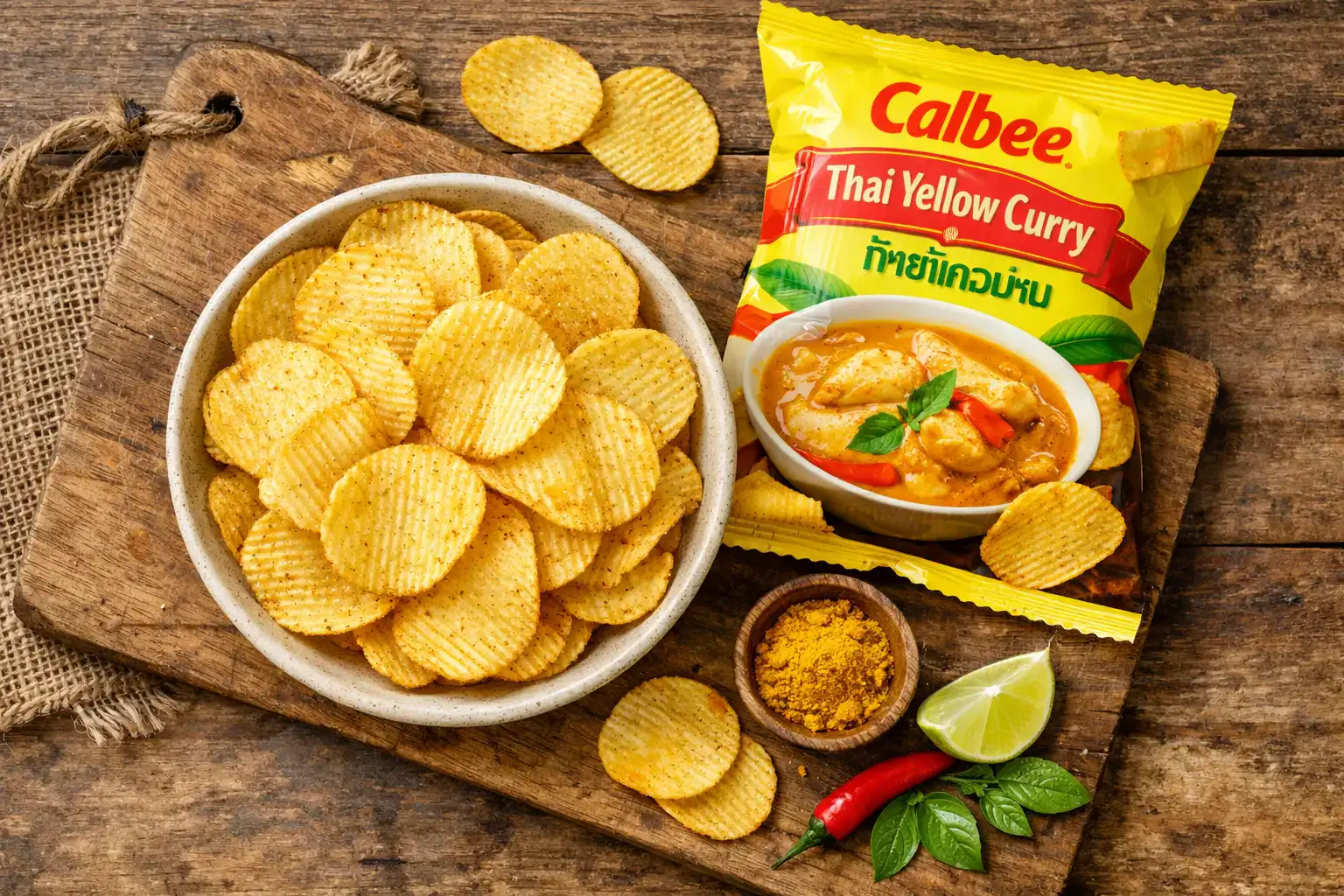
Calbee Thai Yellow Curry Chips: Calories, Nutrition and Health Facts
Southeast Asian curry-flavored potato chips with turmeric, chili, and lime - 150 calories per 12-chip serving with lower sodium than most competitors.
Quick Nutrition Facts
Per 12 Chips (28g Serving)
| Nutrient | Amount |
|---|---|
| Calories | 150 kcal |
| Protein | 2g |
| Carbohydrates | 14g |
| Fiber | 2g |
| Sugars | 1g |
| Fat | 10g |
| Saturated Fat | 1g |
| Sodium | 120mg |
| Potassium | 310mg |
| Iron | 0.5mg |
Macronutrient Breakdown
 ChatGPT
  Claude
  AI Mode
  Perplexity
NUTRITIONIST INSIGHT
At 150 calories and 10g fat per 28g serving, Calbee Thai Yellow Curry chips get 60% of calories from fat. The turmeric in the curry seasoning contains curcumin, a bioactive compound with anti-inflammatory properties. With only 120mg sodium per serving, these are notably lower-sodium than many conventional chips.
Myth Busters
MYTH #1: All Curry-Flavored Chips Are High in Sodium
TRUTH: Calbee Thai Yellow Curry chips contain just 120mg sodium per serving (5% DV) - significantly less than Lay's Classic (170mg) or Calbee Umami Salt (500mg). Harvard recommends staying under 2,300mg sodium daily for heart health, and these chips leave plenty of room.
MYTH #2: Potato Chips Always Cause Blood Sugar Spikes
TRUTH: Research shows potato chips have a moderate glycemic index (~60) due to fat content slowing starch digestion. Chips actually produce a lower glycemic response than plain boiled or baked potatoes (GI 80-90).
MYTH #3: Turmeric in Chips Provides Health Benefits
TRUTH: While turmeric contains curcumin with documented anti-inflammatory properties, the amount in chip seasoning is negligible. Therapeutic doses require 500-2,000mg curcumin daily - far more than trace amounts in seasoning blends.
MYTH #4: Vegetarian Chips Are Automatically Healthier
TRUTH: Calbee Thai Yellow Curry chips are vegetarian, dairy-free, and nut-free, but they're still a fried snack with 10g fat per serving. Being plant-based doesn't exempt a food from being calorie-dense or nutrient-poor - portion control still matters.
MYTH #5: Acrylamide in Chips Causes Cancer
TRUTH: While acrylamide forms when starchy foods are fried above 121C, large-scale epidemiological studies have not found a consistent link between dietary acrylamide from chips and increased cancer risk in adults. Moderation remains the sensible approach.
NutriScore by Health Goals
| Health Goal | NutriScore | Why This Score? |
|---|---|---|
| Weight Loss |  | 150 calories and 10g fat per small 28g serving adds up fast. High energy density (536 kcal/100g) makes portion control critical. Limit to 1 serving max. |
| Muscle Gain |  | Only 2g protein per serving - poor protein source. Carbs (14g) provide some energy, but better post-workout options exist. Use as occasional treat only. |
| Diabetes Management | | Fat content moderates acute blood sugar spikes compared to low-fat snacks, but 14g carbs still impact glucose management. Limit to half-serving with protein. |
| PCOS Management | | Processed carbs can worsen insulin resistance. Lower sodium (120mg) is a plus, but occasional small portions only, paired with fiber-rich foods. |
| Pregnancy Nutrition | | Minimal vitamins/minerals for fetal development. ACOG recommends nutrient-dense foods during pregnancy. Choose nutrient-rich snacks instead. |
| Viral/Flu Recovery | | Easily digestible carbs for quick energy and potassium (310mg) supports electrolyte balance. However, low in immune-supporting vitamins C and D. |
PERSONALIZED NUTRITION
Track your meals with NutriScan for personalized NutriScores based on your specific health goals!
Blood Sugar Response to Calbee Thai Yellow Curry Chips
Understanding how these curry-flavored chips affect your blood glucose helps you make informed snacking decisions - especially important for diabetes management.
Typical Glucose Response Curve
This chart shows typical blood glucose response for general healthy individuals. Individual responses may vary. Not medical advice.
How to Flatten the Spike
Pairing chips with protein or fiber slows glucose absorption and reduces the peak blood sugar level:
- Edamame or hummus - Adds plant protein and fiber alongside chips
- Greek yogurt dip with herbs - Provides protein and probiotics
- Fresh vegetable sticks (carrots, cucumber, bell pepper) - Adds fiber and volume with minimal calories
- A handful of cashews or almonds - Healthy fats and protein extend satiety
This combination not only reduces the glucose spike but also helps you feel fuller, naturally limiting chip consumption.
Cultural Significance
Calbee, founded in Hiroshima in 1949, is Japan's largest snack food company. The Thai Yellow Curry flavor reflects the growing global fusion food trend.
Thai Cuisine Roots:
- Yellow curry (kaeng kari) is one of Thailand's mildest curries, influenced by Indian cuisine
- Key ingredients include turmeric, cumin, lemongrass, and coconut milk
- Thai curry paste traditions date back centuries, blending Southeast Asian and Indian spice cultures
- Yellow curry is popular across Thailand's southern regions and tourist areas
Global Snack Fusion:
- Calbee's Asian Style line launched to bridge Japanese snack craftsmanship with global flavors
- Southeast Asian flavors (Thai curry, Indonesian satay) are among the fastest-growing snack trends worldwide
- The vegetarian and allergen-friendly formulation makes this accessible across dietary preferences
Compare & Substitute
Calbee Thai Yellow Curry vs Similar Snacks (Per 28g Serving)
| Nutrient | Calbee Thai Curry | Lay's Classic | Calbee Umami Salt | Popcorn (Air-Popped) |
|---|---|---|---|---|
| Calories | 150 kcal | 160 kcal | 150 kcal | 110 kcal |
| Carbs | 14g | 15g | 14g | 22g |
| Fiber | 2g | 1g | 1g | 4g |
| Protein | 2g | 2g | 2g | 3g |
| Fat | 10g | 10g | 10g | 1g |
| Sodium | 120mg | 170mg | 500mg | 1mg |
| Sugar | 1g | 1g | 0g | 0g |
| Best For | Low-sodium curry craving | Classic salty snack | Umami flavor craving | High-fiber, low-fat |
Frequently Asked Questions
How many calories are in Calbee Thai Yellow Curry chips?
150 calories per 12-chip serving (28g). Per 100g, they contain approximately 536 calories - comparable to most standard potato chips. A full 6oz (170g) bag contains approximately 900 calories total, or about 6 servings.
Portion tip: Pre-portion into 28g amounts to avoid eating the full bag. Curry-flavored chips can be particularly moreish due to the complex spice profile.
Are Calbee Thai Yellow Curry chips spicy?
Calbee Thai Yellow Curry chips have a mild-to-moderate warmth from chili pepper and Thai curry spices, balanced by zesty lime and aromatic turmeric. They are not intensely spicy compared to hot chili or Sichuan varieties.
Heat level: Roughly a 2-3 out of 10 on a spice scale - accessible for most palates, including those sensitive to heat.
Can diabetics eat Calbee Thai Yellow Curry chips?
Diabetics should limit these chips to occasional small portions. The 10g fat per serving moderates blood sugar spikes compared to lower-fat snacks.
Tips for diabetics:
- Limit to half a serving (7 chips / 14g = ~75 calories)
- Always pair with protein (Greek yogurt dip, cheese, edamame)
- Monitor blood sugar 2 hours after eating
- The lower sodium (120mg) is better for cardiovascular health than many chip alternatives
What are the main ingredients?
Potatoes, vegetable oil (canola, safflower and/or sunflower oil), Thai Yellow Curry Seasoning (sugar, salt, chili pepper, maltodextrin, spices, brown sugar, onion powder, garlic powder, turmeric, lime juice powder, dehydrated parsley, citric acid, natural flavors, extractive of turmeric), and rosemary extract for freshness.
The chips are vegetarian, free from dairy, wheat, peanuts, and tree nuts. Manufactured on shared equipment with crustacean shellfish, fish, milk, and sesame.
How do these compare to regular potato chips?
Calbee Thai Yellow Curry chips have notable advantages: lower sodium (120mg vs 170mg for Lay's Classic, 500mg for Calbee Umami Salt), 0g trans fat, and use canola/safflower/sunflower oil rather than palm oil.
Drawbacks: Same calories (150/serving) and fat content (10g) as standard chips. The curry seasoning adds 1g sugar per serving from brown sugar and sugar in the blend.
Are these chips suitable during pregnancy?
These chips are not recommended as a regular pregnancy snack due to minimal nutritional value (low in folate, iron, calcium). However, the lower sodium (120mg) is preferable to higher-sodium alternatives. Occasional consumption in small amounts is generally safe, but nutrient-dense options (fruit, nuts, yogurt) are better choices during pregnancy.


Similar Nutritious Foods
4505 Chicharrones Classic Chili Salt
7 Eleven Japan Crispy Corn Cheese
Explore More Nutrition Tools & Resources
AI Calorie Counter App - Snap a Photo, Get Macros
AI Nutritionist App That Reads Your Logged Meals
Best Protein Supplements for Women
Bulking Meal Plan App That Sets Your Surplus
ChatGPT Calorie Counter Alternative That Keeps the Total
ChatGPT Diet Plan Alternative That Tracks What You Eat
ChatGPT Weight Loss Coach Alternative With a Food Log
Fast Food Calorie Counter App That Reads the Tray
Free Calorie Tracker App with AI Photo Scans | NutriScan
Indian Diet Plan App With Veg and Non Veg Meals
Indian Food Calorie Calculator - Get Instant Nutrition Facts for Desi Meals — 2026
Intermittent Fasting for Women, Timer and Meal Log App
Intermittent Fasting Tracker App - Free Fasting Timer
Macro Tracker App That Fills the Numbers From a Photo
Mediterranean Diet Meal Plan App That Counts the Oil
Micronutrient Tracker App for Vitamins and Minerals
MyFitnessPal Alternative That Stays Free | NutriScan
NutriScore App: A Free Grade on Every Meal | NutriScan
Nutrition Label Scanner App for the Amount You Ate
Second Trimester Protein Guide
Vegetarian Meal Plan App With a Protein Target
Voice Calorie Counter - Speak to Track Meals Hands-Free
Water and Calorie Tracker App - Free Water Log