Does Coffee Break a Fast? Black, Cream and Sweeteners
 ChatGPT
  Claude
  AI Mode
  Perplexity
TL;DR - Coffee during a fasting window
• The number: a plain 8 ounce cup of black coffee is 2 calories, too little to count as food in any fasting protocol.
• What ends it: cream at 52 calories a tablespoon, sugar at 48, and most sugar free creamers at 10 to 35.
• Milk depends on your goal: 9 calories a tablespoon is a rounding error for weight loss and a real problem for a strict autophagy fast.
• Blood work is the hard rule: water only for at least 8 hours, black coffee included.
• The sequence: name your reason ➡️ set the window ➡️ measure what you pour ➡️ track the hours.
A plain 8 ounce cup of black coffee contains 2 calories, and that number settles most of this question before we start (Harvard T.H. Chan School of Public Health). It is one of the most common intermittent fasting questions, usually asked by someone at a coffee machine deciding whether their 16 hour window just ended. NutriScan publishes this post and makes a calorie tracking app.
Black coffee does not break a fast. What you put in it does, and the honest answer changes with why you are fasting. A fast for weight loss, a fast for autophagy, and a fast before a blood draw hold three different definitions of "broken," and a splash of milk that is irrelevant to one can invalidate another.
IMPORTANT
Your fasting coffee plan at a glance.
A quick roadmap so you can settle this before your next cup.
⏱️ Progress 0/4 • ~0 minutes in • Keep going
⏳ Step 1: Count what is actually in the cup
⏳ Step 2: Match strictness to your reason for fasting
⏳ Step 3: Set the window and the coffee rule together
🔍 The one thing in the cup that is working in your favor (revealed near the end)
Three Mornings, Three Different Answers ☕
The same cup gets three verdicts depending on the goal.
Example one: a 68 kg woman fasting 16:8 to lose weight. She drinks black coffee at 7 a.m. and eats at noon. Her fast is intact by any reasonable standard, and a tablespoon of whole milk at 9 calories is roughly half a percent of an 1,800 calorie day. Her result depends on what she eats between noon and 8 p.m. Swap the milk for cream at 52 calories a tablespoon, pour three tablespoons twice a morning, and she has added over 300 calories a day to a plan built on eating less (Harvard T.H. Chan School of Public Health).
Example two: a 75 kg man doing a 24 hour fast for the metabolic effects. He wants ketones up and nutrient sensing down. Black coffee helps here: caffeine given to healthy adults raised ketone production by 88% at 2.5 mg per kg and 116% at 5.0 mg per kg (Vandenberghe et al., 2017). The milk is what he skips, because protein is the input he wants at zero.
Example three: anyone with a lab slip for a fasting glucose or lipid panel. Here the definition is procedural, not metabolic. The instruction for a fasting blood glucose test is no eating or drinking except water for at least 8 hours (MedlinePlus, National Library of Medicine). Coffee is a drink. The 2 calories are not the issue; the rule is.

Milk clouding through coffee in close up, which is the moment the calorie count stops being zero.
What Black Coffee Actually Costs You 📊
Coffee itself is close to nothing. The additions are where the calories live, and the table uses per tablespoon figures from the Harvard T.H. Chan School of Public Health.
| What goes in the cup | Calories | Verdict for a fast |
|---|---|---|
| Nothing, 8 oz black brewed coffee | 2 | Does not break it |
| 1 tbsp whole milk | 9 | Negligible for weight loss, ends a strict fast |
| 1 tbsp cream | 52 | Breaks it |
| 1 tbsp sugar | 48 | Breaks it |
| 1 packet stevia or sucralose | Near zero | No measurable glucose rise |
| Sugar free flavored syrup | Often 0 to 15, check label | Usually fine |
| Sugar free coffee creamer | Often 10 to 35, check label | Usually breaks it |
Plotted next to each other, the four common additions make the gap obvious: cream is 26 times the calorie load of the coffee it goes into, and sugar is not far behind.
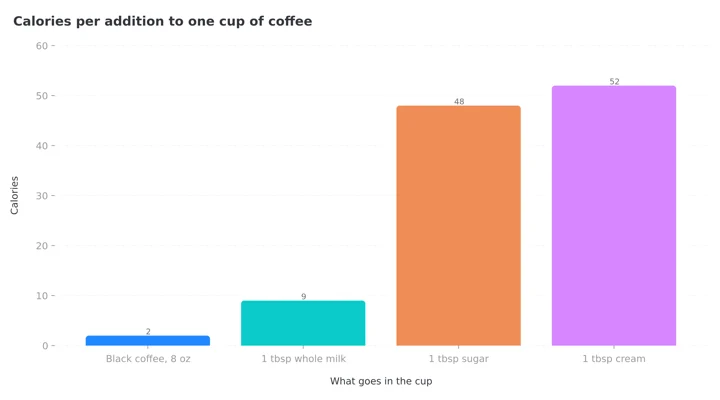
Figure 1: The coffee costs 2 calories. Cream and sugar cost 25 times more, per tablespoon, before you count how many you pour.
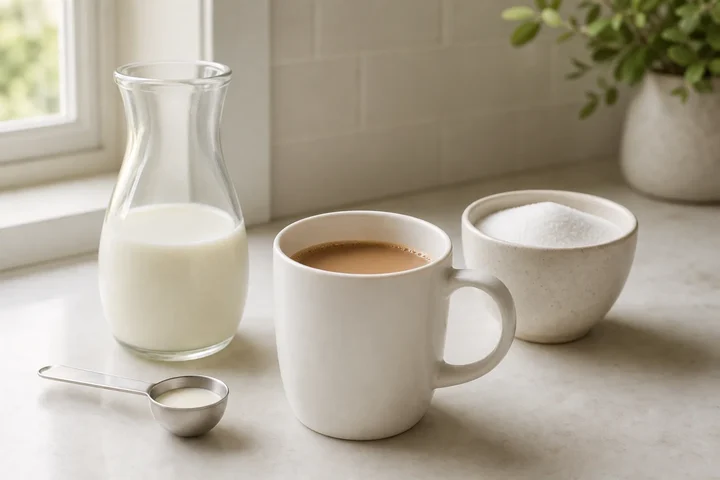
A measured tablespoon turns an unknown pour into a number you can budget for.
On caffeine: an 8 ounce brewed cup carries about 95 mg, and the Dietary Guidelines for Americans put moderate intake at roughly 400 mg a day, or 3 to 5 cups. Fasting does not change that ceiling, though caffeine does hit harder on an empty stomach. For the full breakdown of a plain cup, see our black coffee nutrition page and coffee.
IMPORTANT
Checkpoint: here's where you are right now.
Quick status update so you always know the next best move.
⏱️ Progress 1/4 • ~1 minute in • Keep going
✅ Step 1: Count what is actually in the cup (done)
👉 Step 2: Match strictness to your reason for fasting (you're here)
⏳ Step 3: Set the window and the coffee rule together
🧩 The one thing in the cup that is working in your favor (coming soon)
Coffee and Autophagy: What the Evidence Says 🔬
Autophagy is why many people fast at all, and why this question gets heated. The concern is that anything with calories switches on nutrient sensing pathways such as mTORC1 and shuts autophagy down.
Coffee does the opposite, at least in mice. In a 2014 study, both caffeinated and decaffeinated coffee rapidly triggered autophagy in mice, with increased autophagic flux in liver, muscle, and heart within 1 to 4 hours, alongside inhibition of mTORC1 activity and global protein deacetylation (Pietrocola et al., 2014). The authors credited coffee polyphenols rather than caffeine, since decaf worked just as well.
Two cautions before you treat that as settled. It is a mouse study, and no human trial has measured autophagic flux in tissue after a cup of coffee. The fair statement is that black coffee is very unlikely to suppress autophagy and may support it, which is a weaker claim than the internet usually makes.
What does interrupt an autophagy fast is protein. Milk, cream, and creamer all deliver amino acids, the classic mTORC1 signal. If autophagy is the goal, the coffee stays black, and fat free or lactose free milk is no exception: removing fat or splitting lactose leaves the protein.
Decaf counts
The 2014 mouse work found decaffeinated coffee triggered autophagy as strongly as caffeinated, because the credit went to polyphenols rather than caffeine. If caffeine keeps you awake or spikes your heart rate, decaf in the afternoon costs you nothing on this front.
Fasting and Ketosis: The Timeline ⏱️
Fasting and ketosis get used as if they were one word. Fasting is what you do; ketosis is one thing your metabolism may do in response. You can fast 14 hours and stay almost entirely on glucose, which is fasting without ketosis and is completely normal. You can also be in deep ketosis all week on a ketogenic diet while eating three meals a day.
The link between them is glycogen. The point at which liver glycogen runs down and fatty acids get mobilized is called the metabolic switch, and it typically arrives beyond 12 hours after your last food (Anton et al., 2018). Timing swings widely with your last meal, your training, and your usual carbohydrate intake.
| Hours since last food | Main fuel | What you tend to notice |
|---|---|---|
| 0 to 4 | Food you just ate | Nothing unusual |
| 4 to 12 | Liver glycogen | Normal hunger waves |
| 12 to 18 | Glycogen low, fatty acids rising | Hunger comes and goes, appetite drops |
| 18 to 24 | Fat and rising ketones | Steadier energy, sometimes headache |
| 24 to 48 | Ketones a major fuel | Clearer head for some, irritable for others |
| 48+ | Deep ketosis | Medical supervision territory |
Water fasting and ketosis go together because water fasting removes all fuel input, so ketones climb faster than on a time restricted schedule. Dry fasting removes fluids as well and does raise ketones, but dehydration is a real risk and there is no good evidence the added stress buys anything. I do not recommend it. For a first-hand account of the longer end, read what a 36 hour water fast actually feels like, and for the food side of a low carb window our keto diet plan covers the shopping.
Coffee Before Blood Work: The One Firm Rule 🩺
Fasting for a blood test is a laboratory instruction, not a metabolic goal, and the reference values your results are compared against were built on patients who followed it.
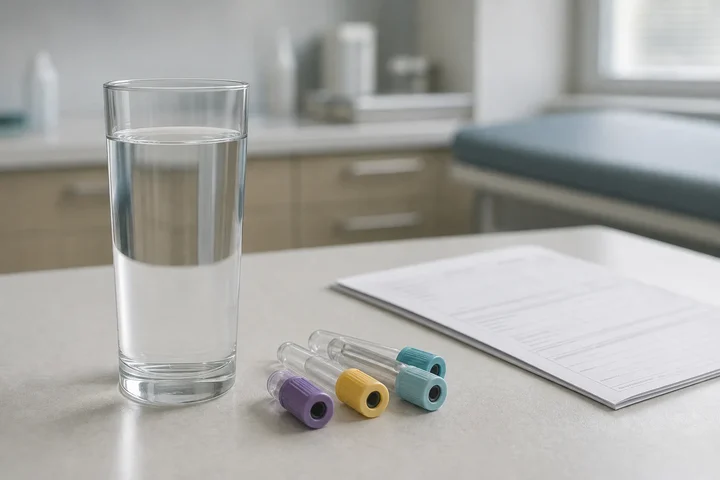
Before a fasting draw the permitted list is one item long, and coffee is not on it.
MedlinePlus, from the US National Library of Medicine, defines a fasting blood glucose test as measuring glucose after you fast, meaning no eating or drinking except water, for at least 8 hours. For a cholesterol panel where fasting is requested, the window is 9 to 12 hours (MedlinePlus). Black coffee is a drink and it is not water, so caffeine breaks a fast for blood work in the only sense that matters: your lab says it does.
Lipid panels are moving the other way. A 2016 joint consensus statement from the European Atherosclerosis Society and the European Federation of Clinical Chemistry and Laboratory Medicine recommends routine use of non-fasting lipid profiles, reserving fasting samples for cases such as non-fasting triglycerides above 5 mmol/L, or 440 mg/dL (Nordestgaard et al., 2016). You may not need to fast for a cholesterol test at all. Ask when you book, and if they say fast, drink water only.

Someone pouring and drinking plain water at a table, which is the whole permitted menu on the morning of a fasting draw.
Do not self-manage a fast around medication or a medical condition
If you take insulin, a sulfonylurea, or blood pressure medication, skipping food and adding caffeine can drop blood sugar or raise heart rate in ways a healthy person does not experience. Pregnant and breastfeeding women, anyone with a history of disordered eating, and anyone under a doctor's care for a metabolic condition should agree the plan with their clinician before fasting at all.
IMPORTANT
Checkpoint: midway progress update.
You're halfway, and the decisions get easier from here.
⏱️ Progress 2/4 • ~2 minutes in • Keep going
✅ Step 1: Count what is actually in the cup (done)
✅ Step 2: Match strictness to your reason for fasting (done)
👉 Step 3: Set the window and the coffee rule together (current)
⏳ The one thing in the cup that is working in your favor (next)
Sweeteners, Creamers and the Zero Calorie Question 🍶
Sugar free is a labeling claim about sugar, not a promise about calories, and that gap is where most of the confusion lives.
The sweeteners themselves come out clean. A systematic review and meta-analysis of 29 randomized controlled trials with 741 participants, covering aspartame, saccharin, steviosides, and sucralose, found that consuming them did not increase blood glucose, with concentrations declining gradually over the observation period (Nichol et al., 2018). So coffee with stevia or with Splenda does not break a fast on any glucose based definition.
Sugar free coffee creamer is the one that catches people. A creamer has to make coffee look like a latte, and that requires fat. Sugar free versions of products like Coffee Mate are built on oil plus milk solids, so a tablespoon lands in the 10 to 35 calorie range with a little protein alongside. That is a small amount of food, which is why it barely matters for weight loss and matters a lot for an autophagy fast.
The rule that resolves all of it: turn the bottle around. If the panel shows calories per serving above zero, it is food, and the only remaining question is whether your goal cares about a small amount of food. For weight loss, mostly no. For a strict fast, yes. If you want coffee as part of a meal instead of part of a fast, protein coffee is the better route, and it belongs firmly in your eating window.
Five Rules for Coffee During a Fast ✅
- Drink it black, or measure what you add. A measuring spoon turns an unknown pour into 9 calories you can account for.
- Match strictness to your goal. Weight loss tolerates a splash of milk; an autophagy fast does not. Pick one definition and stay with it.
- Cap the caffeine near 400 mg a day. That is 3 to 5 brewed cups, easy to exceed when coffee is standing in for breakfast.
- Keep salt and water beside the coffee. Caffeine is mildly diuretic and long fasts already shed fluid and sodium. Most fasting headaches are really dehydration.
- Do not fast through blood work. Water only for 8 hours, and skip the coffee, even black.

How to Set Up Your Fasting Coffee Routine 📋
- Write down why you are fasting. Weight loss, metabolic health, or a lab appointment. Everything downstream follows from this one line, and most arguments about coffee are two people answering different questions.
- Set the window and the coffee rule together. For example: fast 8 p.m. to noon, black coffee from 7 a.m., nothing else until noon. A rule you can recite is a rule you keep.
- Audit what you add. For three mornings, measure your normal pour into a tablespoon first. Most people find their splash is three to five tablespoons.
- Do the daily math. Multiply that amount by cups per day. At 52 calories a tablespoon for cream, the total often exceeds the deficit the fast was creating.
- Cut in one step. Go from cream to measured milk, or milk to black, and hold it two weeks. Taste adaptation takes about that long.
- Track the window, not the coffee. Elapsed hours and your weekly calorie total are the two numbers that move the scale. Log your first meal time daily and read the pattern weekly. A fasting tracker does this for you, and there is a version tuned for cycle-aware fasting schedules if hormonal timing matters.
- Recalculate every few months. As you lose weight your calorie needs fall, so run the numbers again with a TDEE calculator instead of assuming the original target still fits.
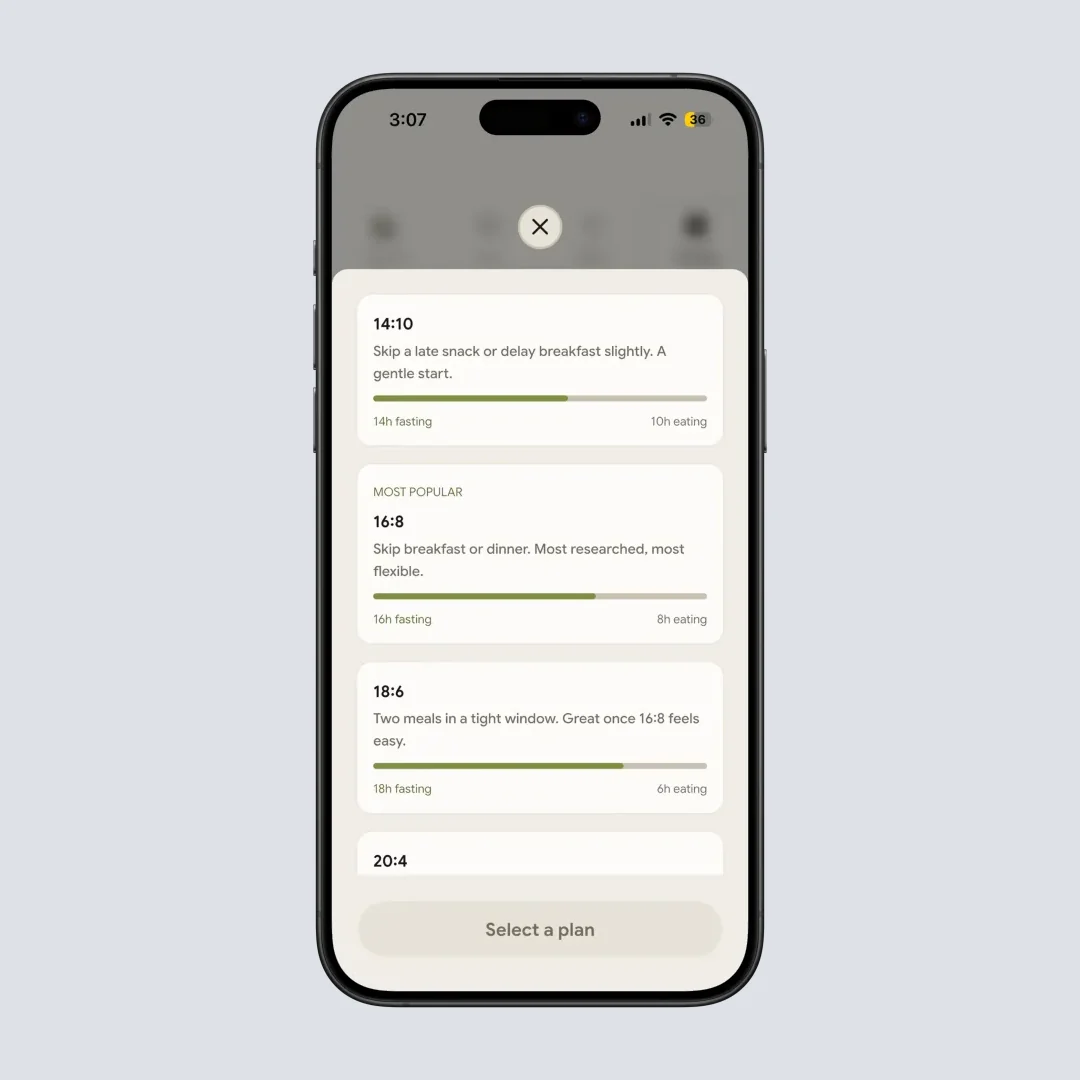
Picking a schedule in Home > Fasting, which is where the elapsed hours from step 6 get logged.
IMPORTANT
Checkpoint: final stretch before the reveal.
One last nudge, the reveal is next.
⏱️ Progress 3/4 • ~3 minutes in • Keep going
✅ Step 1: Count what is actually in the cup
✅ Step 2: Match strictness to your reason for fasting
✅ Step 3: Set the window and the coffee rule together
✨ The one thing in the cup that is working in your favor (about to reveal)
The One Thing in the Cup That Helps 🔥
Every rule above treats coffee as something to keep neutral. The evidence says it is better than neutral, and that is the part most fasting advice leaves out.
Start with ketones. When healthy adults were given caffeine and then measured, ketone production rose 88% at a dose of 2.5 mg per kg of body weight and 116% at 5.0 mg per kg, driven by a rise in plasma free fatty acids (Vandenberghe et al., 2017). For a 70 kg adult, 2.5 mg per kg is about 175 mg, or two brewed cups. That is not a hack, it is roughly what a normal morning already delivers.
The weight side points the same direction. A meta-analysis of 13 randomized controlled trials in 606 people found that each doubling of caffeine intake was associated with roughly 22% greater weight reduction, 17% greater BMI reduction, and 28% greater fat mass reduction, although heterogeneity across the trials was high (Tabrizi et al., 2019).
Put the two together and the cup does three things during a fast: it costs 2 calories, it does not appear to suppress autophagy, and it raises the same fuel your fast is trying to reach. The only way to lose that is to pour something into it.
The Verdict 🏁
Black coffee does not break a fast. At 2 calories a cup it is not food by any working definition, it does not appear to suppress autophagy, and it raises ketone production rather than blunting it. If you are fasting for weight loss or metabolic health, drink it.
The exceptions are short. Anything with calories in the cup ends a strict autophagy fast, because amino acids are exactly the signal such a fast avoids. Sugar free creamers are food despite the label. And before a fasting blood test, the definition is the laboratory's: water only, for the hours they specify.
If you want the food side handled with the same precision as the coffee side, NutriScan photographs a meal and logs it in seconds, with 5 scans a week on the free plan and unlimited scans on Premium at about $59 a year. Still choosing tools? Our comparison of the best apps that pair a fasting timer with a food log covers the field.
IMPORTANT
Recap: everything you settled this round.
You finished the run, so save this for the next time someone argues about it.
⏱️ Progress 4/4 • ~4 minutes in • Nicely done
✅ Step 1: Black coffee is 2 calories, milk 9, sugar 48, cream 52
✅ Step 2: Weight loss tolerates a measured splash, a strict fast and a lab draw do not
✅ Step 3: Window plus coffee rule, written as one line you can recite
✅ The one thing in the cup that is working in your favor: caffeine raised ketone production 88% to 116% (revealed)
Frequently Asked Questions ❓
Do you break a fast by drinking coffee?
Not if it is black. An 8 ounce cup of plain brewed coffee carries about 2 calories, far too little to register as a meal in any fasting protocol (Harvard T.H. Chan School of Public Health). Coffee only breaks a fast once you add something to it: cream, milk, sugar, honey, or a flavored creamer.
Does coffee with milk break a fast in the morning?
A tablespoon of whole milk adds about 9 calories, small enough that most protocols ignore it. The problem is that milk is poured rather than measured, so a splash is often four or five tablespoons. Coffee with fat free milk and coffee with lactose free milk behave the same way: removing fat or splitting lactose leaves the sugar and protein intact.
Does sugar free Coffee Mate or a sugar free creamer break a fast?
Usually yes. Sugar free creamers are labeled for their sugar content, not their calorie content, and most are built on oil plus milk solids, so a serving carries fat and a little protein. Read the panel. If the serving has calories, it is food, and food ends a strict fast even though it barely dents a weight loss one.
Does coffee break a fast under Catholic fasting rules?
That depends on which fast, and the answer comes from church guidance rather than nutrition science. The Lenten fast limits the quantity of food rather than banning drinks, so coffee is generally treated as permitted. The Eucharistic fast is stricter and allows only water and medicine in the hour beforehand. Ask your own parish, since practice varies.
Does freeze dried coffee break a fast?
No. Freeze dried and spray dried instant granules are brewed coffee with the water removed, so a cup made from a teaspoon lands in the same negligible calorie range as a brewed cup. The exception is 2 in 1 and 3 in 1 sachets, which include sugar and creamer.
Can an app tell me when I am in ketosis?
A fasting app tracks elapsed hours and estimates where you sit on the fuel curve, which is useful for consistency. It cannot measure ketones. For an actual number you need a blood ketone meter, and for most weight loss goals the elapsed hours and your weekly calorie total matter more than the reading. To see the deficit side in numbers, run it through a weight loss calculator.