How Much Weight Loss Is Too Fast? A Safe Rate Guide
 ChatGPT
  Claude
  AI Mode
  Perplexity
TL;DR - How fast weight loss should actually go
• Safe ceiling: about 0.5 to 1% of your current body weight per week for most adults • The number to hold: the CDC puts the sustainable range at 1 to 2 pounds a week • Week one lies: the first drop is water, so judge from week two on a seven day average • The sequence: find your weekly number ➡️ protect muscle with protein and lifting ➡️ plan maintenance before you start • Warning signs: hair shedding, missed periods, feeling cold, workouts getting worse
The CDC puts the safe range at about 1 to 2 pounds a week, and says people losing at that gradual pace are more likely to keep the weight off than people who lose it quicker (CDC, 2025). As a nutritionist on the team behind NutriScan, a photo based food logging app, I get this question from two opposite directions. Half the people asking want permission to go faster. The other half already went faster and are frightened by what the scale is doing.
This guide gives you a number to hold onto, explains what breaks when you exceed it, and covers the situations people are actually in: a week before an event, no gym, a GLP-1 prescription, a thyroid diagnosis, or a teenager in the house. Every rate here is a ceiling, not a target.
IMPORTANT
Your safe weight loss plan at a glance.
A quick roadmap so you can act on this today.
⏱️ Progress 0/4 • ~0 minutes in • Keep going
⏳ Step 1: Find your own weekly number
⏳ Step 2: Protect the muscle while you lose
⏳ Step 3: Handle your situation, from no gym to a GLP-1 script
🔍 The 200 person trial that breaks the slow and steady rule (revealed near the end)
How Much Weight Loss Is Too Fast: The Safe Rate Per Week 📉
The usable rule is percentage based, not pound based. About 0.5 to 1% of current body weight per week is the range where most of the loss is fat and most of it survives the following year. A 130 kg man losing 1.3 kg a week is doing something completely different from a 55 kg woman losing the same 1.3 kg.
| Body weight | Sensible weekly loss (0.5 to 1%) | Getting too fast | Rough daily deficit |
|---|---|---|---|
| 55 kg (121 lb) | 0.3 to 0.55 kg | above 0.7 kg | 300 to 500 kcal |
| 70 kg (154 lb) | 0.35 to 0.7 kg | above 0.9 kg | 400 to 600 kcal |
| 85 kg (187 lb) | 0.4 to 0.85 kg | above 1.1 kg | 500 to 700 kcal |
| 100 kg (220 lb) | 0.5 to 1.0 kg | above 1.3 kg | 550 to 800 kcal |
| 120 kg (265 lb) | 0.6 to 1.2 kg | above 1.6 kg | 600 to 900 kcal |
Plotted side by side, the gap between the sensible ceiling and the too fast line widens with body weight, which is why one universal "2 pounds a week" rule fits nobody.
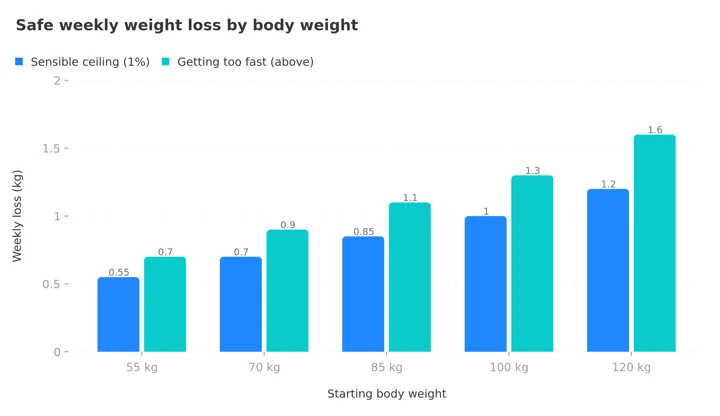
Figure 1: A 120 kg body can lose 1.2 kg in a week and still be inside the safe band. At 55 kg the same 1.2 kg is well past it.
Week one is always the fastest, because stored carbohydrate holds several times its own weight in water. That is not fat and it does not repeat. For your own starting point, run your maintenance through a TDEE calculator and then a weight loss calculator.

A single morning weigh-in is mostly hydration. The seven day average is the number that means something.
Two People Losing Too Fast: What Actually Happened 🧍
Take a 70 kg woman with a wedding in five weeks. She cuts to 1,100 calories, adds an hour of daily cardio, and loses 4 kg in twelve days. Weeks three and four the scale stops, her period is late, and she is cold all the time. That is not a broken metabolism, it is an aggressive deficit plus water retention from training stress hiding the fat loss underneath. Her fix: 1,550 calories, keep the walks, drop two cardio sessions, accept 0.5 kg a week.
Take a 95 kg man with no gym time. He eats 1,600 calories of rice and chicken, does no resistance training, and loses 11 kg in ten weeks. His waistband is looser, but his arms look thinner and he struggles to carry shopping upstairs. He lost at almost 1.2% a week with no protein target and no lifting, so a real share of that 11 kg was lean tissue he now has to rebuild.
What Rapid Weight Loss Costs You ⚠️
Muscle is the headline cost. Fat and lean tissue both come off in a deficit, and the steeper the deficit and the lower the protein, the larger the lean share. That matters beyond appearance: less muscle means lower resting energy expenditure, so regained weight lands on a body burning fewer calories than before.

Two short resistance sessions a week and enough protein are what decide how much of the loss is fat.
Gallstones are the underrated cost. The National Institute of Diabetes and Digestive and Kidney Diseases lists fast weight loss among the situations that raise gallstone risk (NIDDK). In the Melbourne rate-of-loss trial, one participant in the rapid arm developed cholecystitis and needed surgery (Purcell et al., 2014).
When to stop and call a doctor
Severe upper right abdominal pain after eating, yellowing of the eyes or skin, fainting, or a heart rhythm that feels wrong all need same-day medical attention during a diet. So does weight that keeps falling after you deliberately eat more. Unexplained weight loss is a symptom to investigate, not a result to celebrate.
Then the ordinary list: hair shedding two to three months after a very low intake period, irregular periods, feeling cold, poor sleep, irritability, and worsening workouts. Loose skin is partly a rate question too, since a slower descent gives connective tissue more time.
IMPORTANT
Checkpoint: here's where you are right now.
Quick status update so you always know the next best move.
⏱️ Progress 1/4 • ~1 minute in • Keep going
✅ Step 1: Find your own weekly number (done)
👉 Step 2: Protect the muscle while you lose (you're here)
⏳ Step 3: Handle your situation, from no gym to a GLP-1 script
🧩 The 200 person trial that breaks the slow and steady rule (coming soon)

Can You Lose Weight in a Week? What Is Real and What Is Water 💧
Yes, and the honest breakdown is this. In seven days of a solid deficit, most adults lose 0.3 to 0.7 kg of actual fat. Anything above that is water, glycogen, and digestive tract contents. Cut refined carbohydrates and salt sharply and 1 to 3 kg of water can go in a few days, then one large restaurant meal brings a kilogram straight back. Fasting for three days moves the scale several kilograms and almost none of it is fat.
If you have exactly one week: hold a 500 calorie deficit, get protein to 1.6 g per kg, walk 8,000 to 10,000 steps daily, keep sodium moderate, and sleep. Expect 1 to 2 kg on the scale, maybe half a kilogram of it fat. A structured week for beginners is in this calorie deficit diet chart.
How Fast Is Too Fast on Ozempic, Wegovy, Mounjaro, and Zepbound 💉
The trial numbers are slower than the internet suggests. In STEP 1, adults on once weekly semaglutide 2.4 mg lost a mean 14.9% of body weight over 68 weeks, against 2.4% on placebo (Wilding et al., 2021). In SURMOUNT-1, tirzepatide 15 mg produced a mean 20.9% reduction over 72 weeks (Jastreboff et al., 2022).
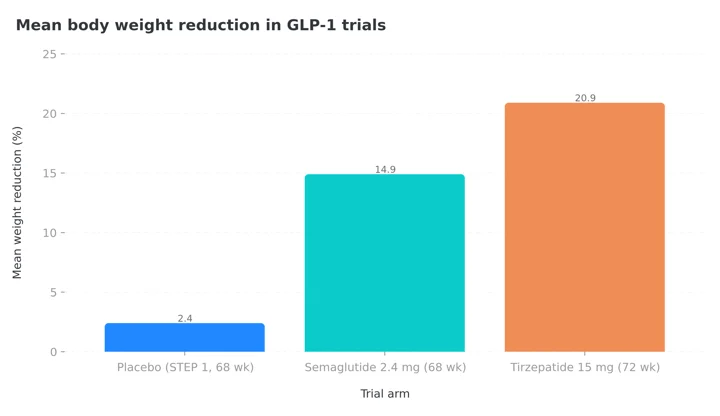
Figure 2: Spread across 68 and 72 week treatment periods, even the largest of these numbers works out to roughly 0.3% of body weight per week.
So the "too fast" line does not move because a drug is involved. Losing more than about 1 to 1.5% of body weight per week on any GLP-1 receptor agonist is worth raising with your prescriber, and so is missing your protein target because food is unappealing. Appetite suppression is the mechanism, so the usual guardrails matter more: protein first at every meal, resistance training twice a week, fluids.
One piece of good news on composition: a meta-analysis of 35 randomized trials found GLP-1 analogs reduced visceral, subcutaneous, liver, and epicardial fat depots (Akoumianakis et al., 2023). This GLP-1 friendly eating guide covers portions and protein targets.
Visceral Fat vs Subcutaneous Fat: Which One You Are Losing 🔬
Belly fat is two different tissues with the same postcode. Subcutaneous fat sits between skin and abdominal muscle, is the fat you can pinch, and is metabolically quiet. Visceral fat sits deeper, around the liver, pancreas, and intestines, and carries the association with insulin resistance and cardiovascular risk.
| Visceral fat | Subcutaneous fat | |
|---|---|---|
| Location | Around abdominal organs | Under the skin, all over |
| Can you pinch it | No | Yes |
| Metabolic risk | Higher | Lower |
| Typical response to a deficit | Tends to move early | Tends to be more stubborn |
| How it is measured | Waist circumference, DXA, MRI | Skinfolds, DXA |
Visceral fat generally responds early in a deficit, which is why blood markers can improve before your reflection does. Bioimpedance "visceral fat level" readings are an estimate, not a measurement.
Breakfast, Appetite, and Eating Less Without Suffering 🍳
Skipping breakfast is neither a trick nor a sin. A 2019 BMJ systematic review of randomized trials found a small weight difference of 0.44 kg favoring participants who skipped breakfast, and higher total daily energy intake among those who ate it (Sievert et al., 2019). If skipping it means eating 1,200 calories between 6pm and midnight, eat breakfast.
Children are the exception. Regular breakfast supports concentration through the school day and carries calcium, iron, and fiber that kids often miss otherwise, so it is not a habit to trim in a growing child.
For appetite itself, the levers that work without a prescription are dull and reliable: protein at 1.6 to 2.2 g per kg across meals, fiber at 25 to 35 g a day from vegetables, lentils, and whole grains, water before meals, seven to nine hours of sleep, and zero calories from drinks. Eggs at breakfast and Greek yogurt as a snack are the two swaps that change hunger fastest for most people I work with.
IMPORTANT
Checkpoint: midway progress update.
You're halfway, and the decisions get easier from here.
⏱️ Progress 2/4 • ~2 minutes in • Keep going
✅ Step 1: Find your own weekly number (done)
✅ Step 2: Protect the muscle while you lose (done)
👉 Step 3: Handle your situation, from no gym to a GLP-1 script (current)
⏳ The 200 person trial that breaks the slow and steady rule (next)
How to Lose Weight Fast at Home Without Exercise 🏠
You can lose fat with no gym, no equipment, and no membership, because the deficit is created in the kitchen. Exercise protects muscle, mood, and heart health, but it is not the entry requirement. The free, at home version, portable to any cuisine:
- Build every plate the same way. Half vegetables, a palm of protein, a fist of starch, a thumb of fat. This works with dal, rice and sabzi as easily as with chicken and potatoes.
- Fix the drinks first. Sweetened tea, juice, and soda are the fastest calories to remove and the least missed.
- Walk. Thirty to sixty minutes a day adds several hundred calories and needs nothing you do not own.
- Cook one protein in bulk. Chicken breast, paneer, eggs, tofu, or dal in the fridge removes the decision that ends most diets.
- Log for two weeks. Not forever. Two honest weeks tell you where your calories are, and almost nobody guesses right.
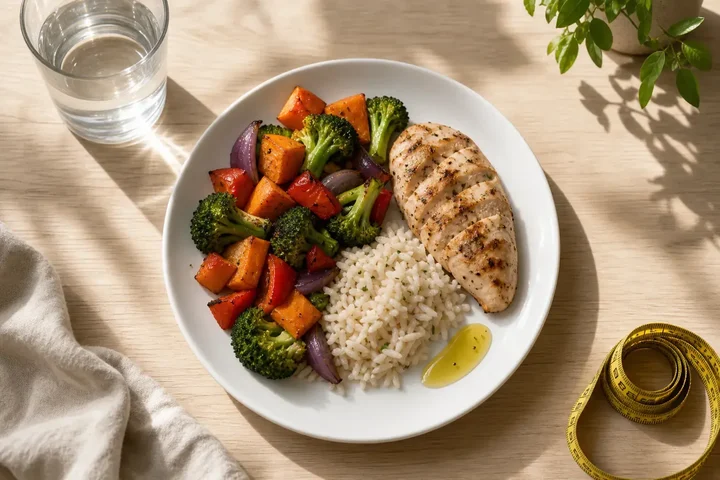
The plate rule does the same job as a calorie count for most people, without the arithmetic.
Start with one rule, not ten
When motivation is low, pick the drinks and change nothing else for two weeks. Sweetened drinks are usually the largest block of calories you can remove without feeling deprived, and an early result on the scale makes the next rule easy to add.
On the shortcuts: no strong human evidence shows apple cider vinegar removes belly or visceral fat, and undiluted it damages tooth enamel. Detox drinks, hypnosis audio, and 30 day countdown apps all work through the same mechanism, which is eating less.
7 Tips to Lose Fast Without Losing Muscle ✅
- Set the deficit as a percentage. 0.5 to 1% of body weight per week. Recalculate it every month as you get lighter.
- Protein first, every meal. 1.6 to 2.2 g per kg per day. Use a protein intake calculator to fix your number instead of estimating.
- Lift something twice a week. Bodyweight squats, push-ups, and a resistance band count. The stimulus tells your body to keep the muscle.
- Keep fiber high. 25 to 35 g a day keeps you full while food volume drops.
- Weigh daily, judge weekly. Use the seven day average. Single mornings are mostly water.
- Take a maintenance week every six to eight weeks. Eat at maintenance, keep training, let hunger recover, then resume.
- Do not chase week one. It is water. If weeks two through five run above 1% a week, eat more.

Bodyweight squats with no equipment are enough of a signal to keep muscle while you are eating less.

Your 6-Step Safe Fast-Start Plan 🗺️
- Measure the starting line. Weight, waist at the navel, one photo. Waist tells you about visceral fat in a way the scale cannot.
- Find maintenance calories. Estimate with a calculator, then eat that for a week and see whether the scale held. Real maintenance is what the scale says, not the formula.
- Subtract the right amount. Take 15 to 20% off maintenance, usually 350 to 700 calories, which lands inside the safe rate.
- Set protein and fiber first. Both in grams. Fill the remaining calories with foods you actually like.
- Add two movement habits. A daily walk target and two short resistance sessions. Nothing else is required.
- Review on day 21. Average the last seven mornings against the first seven. Below 0.5% a week, cut 150 calories. Above 1%, add 200 back. Otherwise change nothing.
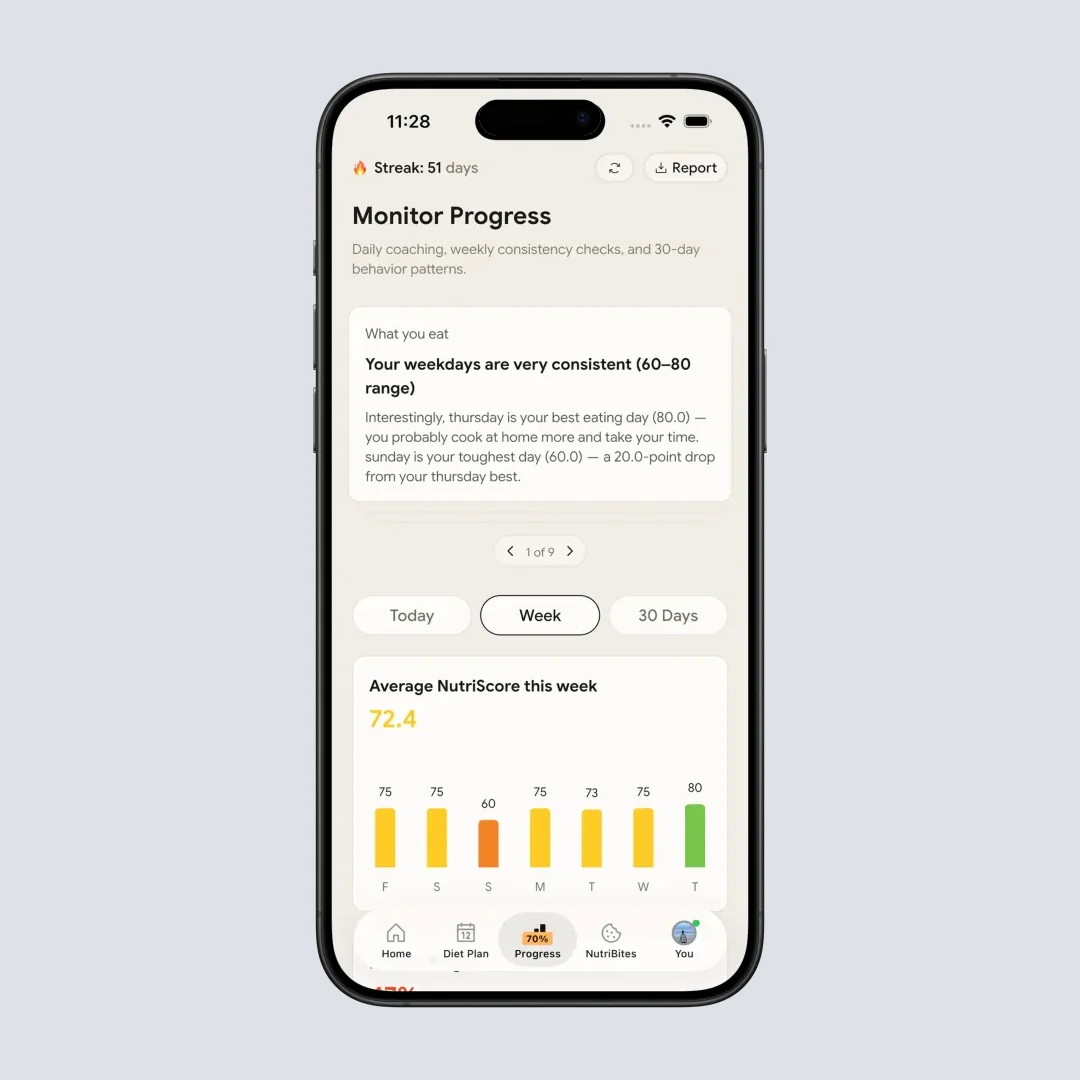
Premium's Progress tab shows this weekly view (In app: Home > Progress tab > Week). Free users can do the same day 21 check manually with a notes app and last week's scan history.
Special Cases: Teens, Kids, Thyroid, and No Gallbladder 🩺
Teens and children. For most kids carrying extra weight, the goal is holding weight steady while height increases, not losing. Any deliberate plan for a 12 or 14 year old belongs with a pediatrician. Our teen weight loss guide covers a safe approach.
Hypothyroidism. An underactive thyroid lowers resting energy expenditure, so the same diet loses slower and it is easy to conclude nothing works. Fix the medication dose first, then apply the same percentage rule and expect the low end.
No gallbladder. After a cholecystectomy bile drips continuously instead of arriving in a bolus, so very large or fatty meals can cause loose stools. Fat is not banned; spread it across smaller meals.
Pets. Cats have a stricter limit than ours, roughly 0.5 to 2% of body weight per week under supervision, because fast loss can trigger hepatic lipidosis, a serious liver condition. Any feline diet plan goes through a veterinarian.
IMPORTANT
Checkpoint: final stretch before the reveal.
One last nudge, the reveal is next.
⏱️ Progress 3/4 • ~3 minutes in • Keep going
✅ Step 1: Find your own weekly number
✅ Step 2: Protect the muscle while you lose
✅ Step 3: Handle your situation, from no gym to a GLP-1 script
✨ The 200 person trial that breaks the slow and steady rule (about to reveal)
The 200 Person Trial That Breaks the Slow and Steady Rule 📚
Here is the finding that surprises everyone who has been told to go slow. Researchers randomized 200 adults with obesity to a 12 week rapid program or a 36 week gradual one, both aiming at the same 15% loss. More people succeeded on the fast plan: 81% of the rapid group reached at least 12.5% loss, against 50% of the gradual group. Then, after 144 weeks of maintenance, regain was effectively identical, 71.2% in the gradual arm versus 70.5% in the rapid arm (Purcell et al., 2014).
Speed neither protected nor sabotaged the long term result. Maintenance failed both groups equally, which is worth remembering the next time someone tells you slow loss is the kind that sticks.
What speed does change is composition, and protein and training decide that. In a four week trial at a 40% energy deficit, young men on 2.4 g of protein per kg with resistance and interval training gained 1.2 kg of lean mass and lost 4.8 kg of fat, while a matched group on 1.2 g per kg gained 0.1 kg lean and lost 3.5 kg (Longland et al., 2016). Same deficit, different bodies at the end.
So a faster pace is not automatically dangerous. It turns dangerous when it is bought by cutting protein and dropping training.
Losing Weight Fast Without Losing What Matters 🚀
The number worth remembering is 1% of body weight per week. Below it you are almost certainly fine. Above it for more than two or three weeks, check your protein, your training, and whether you have a plan for the month after the deficit ends. Speed is not the enemy. An unplanned finish is.
The habit that survives every scenario here is knowing what you actually ate, because a wrong estimate turns a sensible deficit into a reckless one. If you want that step to take seconds, NutriScan reads a meal from a photo, and the free plan covers 5 scans a week if you just want to check your guesses.
If a fast start has ended in quitting before, how to stay consistent on a diet shows why a smaller deficit is easier to keep.
IMPORTANT
Recap: everything you completed this round.
You finished the run, so save this for the next time the scale moves fast.
⏱️ Progress 4/4 • ~4 minutes in • Nicely done
✅ Step 1: Find your own weekly number, 0.5 to 1% of body weight
✅ Step 2: Protect the muscle with 1.6 to 2.2 g of protein per kg and two lifting sessions
✅ Step 3: Handle your situation, from no gym to a GLP-1 script
✅ The 200 person trial that breaks the slow and steady rule (revealed)
Frequently Asked Questions ❓
How much weight loss is considered rapid?
Anything above roughly 1% of your body weight per week, held for more than two or three weeks. The CDC calls gradual loss of about 1 to 2 pounds a week the pattern people are most likely to keep off (CDC, 2025). One fast week after a holiday is not rapid weight loss. Four fast weeks in a row is.
Is it better to eat breakfast or skip it?
For adult weight loss it does not decide the outcome. The 2019 BMJ meta-analysis found a small weight difference of 0.44 kg favoring people who skipped breakfast, and higher total daily energy intake in the breakfast groups (Sievert et al., 2019). Children are a separate case: regular breakfast supports school-day concentration and intake of key nutrients, so it is not a habit to cut in kids.
How much weight loss is too fast on Mounjaro, Wegovy, or Zepbound?
Slower than most people expect. Semaglutide 2.4 mg produced a mean 14.9% reduction over 68 weeks and tirzepatide 15 mg produced 20.9% over 72 weeks, both around 0.2 to 0.3% of body weight per week. Dropping more than about 1.5% a week, or missing protein because of nausea, is a conversation with your prescriber, not a win.
How do you lose weight without losing muscle or loose skin?
Slow the rate and lift something. In a four week trial at a 40% energy deficit, men eating 2.4 g of protein per kg with resistance and interval training gained 1.2 kg of lean mass and lost 4.8 kg of fat, against 0.1 kg lean and 3.5 kg fat in a 1.2 g per kg group (Longland et al., 2016). Loose skin depends mostly on how much weight, how long you carried it, and your age.
Which is the best free weight loss app?
The one you will still open in week six. Judge a free tracker on two things: taps needed to log a normal meal, and whether its database holds the foods you actually eat, including regional and home-cooked dishes.