Weight Loss After 45: Why It Stalls and What Works
 ChatGPT
 Claude
 AI Mode
 Perplexity
IMPORTANT
Your weight loss after 45 plan at a glance.
⏱️ Progress 0/4 • ~0 minutes in • Keep going
⏳ Step 1: What actually changed
⏳ Step 2: Protein and strength training
⏳ Step 3: Fast meals with calories
🔍 The 3-day check that shows where the calories hide (revealed near the end)
Short answer. After 45 you are most likely not fighting a broken metabolism. Research on energy expenditure across the life course found that, adjusted for body size, daily calorie burn stays stable from about age 20 to 60. What shifts is muscle (you lose about 0.4% to 0.5% a year without training), daily movement, sleep and, for women, hormones. The fix is 100 to 135 g of protein a day for an 185 lb (84 kg) adult, two or three strength sessions a week, and a calorie gap of about 300 to 500 per day.
TL;DR
- Metabolism: daily calorie burn stays stable from about age 20 to 60, so muscle, movement and sleep are the levers.
- Protein: 100 to 135 g a day for an 185 lb (84 kg) adult.
- Strength and deficit: two or three strength sessions a week and a calorie gap of about 300 to 500 per day.
- Calories: at 185 lb most people land between 1,500 and 1,900.
Work out your own starting number here, then read on for the reasons and the meals.
Your maintenance calories
2,556calories a day
Eat around this to hold your current weight.
Your TDEE at every activity level
| Activity level | Multiplier | calories a day |
|---|---|---|
| Sedentary | 1.2 | 1,979 |
| Lightly active | 1.375 | 2,267 |
| Moderately active | 1.55 | 2,556 |
| Very active | 1.725 | 2,844 |
| Extra active | 1.9 | 3,133 |
An estimate from the Mifflin-St Jeor equation. Track for two weeks and adjust from what the scale actually does.
If you want the same math with sex-specific notes, the TDEE calculator and the protein intake calculator give you the full breakdown.
Why weight loss feels harder after 45
You are not imagining it, but the cause is rarely "my metabolism died." Four things change at once, and each one is small.
- Less muscle. Muscle burns more calories at rest than fat does, and it also decides how much you can lift, walk and move without noticing.
- Less unplanned movement. Desk jobs, long hours and tired evenings cut steps and fidgeting. That drop is easy to miss because nobody logs it.
- Worse sleep. Hot nights, stress and early waking all push appetite up and recovery down.
- Hormone shifts. For women, the menopause transition changes where fat goes and how much lean mass you keep. For men, the change is slower and usually gentler.
The good news is that all four respond to habits. Here is what the research says about each.

Leg strength work needs no gym: a wall sit is one way to start the 2 days a week of strength training.
Does metabolism really slow down at 45?
Mostly no. The Science study from 2021 used the doubly labeled water method, which is the gold standard for measuring calories burned in real life. It covered people from 8 days to 95 years old. Expenditure, adjusted for fat-free mass, stayed stable in adulthood from 20 to 60, even during pregnancy, and only declined after that.
So a 45-year-old and a 25-year-old of the same size and muscle burn about the same. If the scale moves differently, look at muscle, movement, sleep and intake, not at a number on a birthday cake.
TIP
Ask "what changed in the last 5 years?" before "what is wrong with me?" Fewer steps, a new job, less sleep or a heavier snack habit usually explain more than age does.

Muscle loss, the quiet change
Muscle mass falls with age, and the loss speeds up if you stop training. A quantitative review of studies reported a median loss of 0.47% a year in men and 0.37% a year in women. Strength drops faster than size. Over 10 years that adds up to roughly 4% to 5% of your muscle, and much of the strength you use every day.
Dieting makes it worse when you do nothing else. A systematic review of 52 studies in people aged 50 and over found that 81% of the diet-only groups lost at least 15% of their lost weight as fat-free mass. Among diet-plus-exercise groups, that figure fell to 39%, and most of that exercise was aerobic. Strength work is the part you add on purpose.
IMPORTANT
Checkpoint: you have the reasons.
⏱️ Progress 1/4 • ~3 minutes in • Keep going
✅ Step 1: What actually changed
👉 Step 2: Protein and strength training (you're here)
⏳ Step 3: Fast meals with calories
🧩 The 3-day check (coming soon)
Menopause, sleep and stress
If you are in perimenopause or past menopause, the NHS lists weight gain around the stomach and upper body as a common symptom, next to sleep problems and night sweats. In the SWAN cohort, which followed women with body scans, the rate of fat gain doubled at the start of the menopause transition and lean mass declined. Gains and losses continued until about 2 years after the final period, then leveled off. Total scale weight did not jump; the mix changed, with more fat and less muscle.
That is why a woman can weigh the same and fit her clothes differently. It also means strength training and protein matter more in this window, not less. If you have severe symptoms or are considering hormone therapy, talk to your doctor. Our menopause calorie calculator gives a starting target.
Sleep is the other lever. In a small crossover trial of 10 adults with an average age of 41, 5.5 hours of sleep instead of 8.5 hours cut the share of weight lost as fat by 55% over 14 days of calorie restriction, and fat-free mass loss rose by 60%. The sample is tiny and short, so treat it as a strong hint, not a rule. Still, if you work long hours, guarding 7 hours of sleep is worth as much as any meal change.
Protein: how much you need
Protein protects muscle while you eat less. Three sources help set a practical range:
- The PROT-AGE position paper on adults over 65 recommends at least 1.0 to 1.2 g per kg a day, and 1.2 g per kg or more for people who exercise.
- A meta-analysis of 49 trials with 1,863 people found no extra muscle gain from training once total protein passed about 1.6 g per kg a day.
- Both point to a working range of 1.2 to 1.6 g per kg (0.5 to 0.7 g per lb) while dieting and lifting. That range is our reading of these papers, not a fixed rule.
For 185 lb (84 kg), that is 100 to 135 g a day. Spread it over three or four meals at 25 to 40 g each. If you have kidney disease, check with your doctor before raising protein.
Our guide on how much protein you need per day goes deeper on per-kg math.
Strength training that fits long workdays
The CDC says adults need at least 2 days a week of muscle-strengthening activity plus 150 minutes of moderate activity. For fat loss with muscle kept, aim for the upper end of that.
A plan that works for a 12-hour day:
| Day | Session | Time |
|---|---|---|
| Mon | Squat or leg press, push-up or chest press, row | 30 min |
| Wed | Romanian deadlift, overhead press, lat pulldown or band pull | 30 min |
| Fri | Repeat Monday, add 1 rep or a little weight | 30 min |
| Daily | Walk 20 to 30 minutes after a meal | 20 to 30 min |
Do 2 or 3 sets of 8 to 12 reps, leave 1 or 2 reps in reserve, and add weight when the last set feels easy. Start lighter if you are new or have joint pain, and ask your doctor if you have a heart, blood pressure or joint condition. The NHS strength exercise guide lists home options with no gym.
WARNING
Start lighter if you are new or have joint pain, and ask your doctor if you have a heart, blood pressure or joint condition.
What to eat: your calorie and protein target
Your target depends on sex, height and activity, so use the calculator above. As a guide, a 52-year-old at 185 lb with a desk job usually lands between 1,500 and 1,900 calories for steady loss, with the lower end for a shorter woman and the upper end for a taller man. Take your TDEE and subtract 300 to 500.
Start at your target, hold it for 2 weeks and adjust by 100 to 150 calories if the scale does not move. Pace matters less than keeping the protein.
Fast, easy meals for long workdays
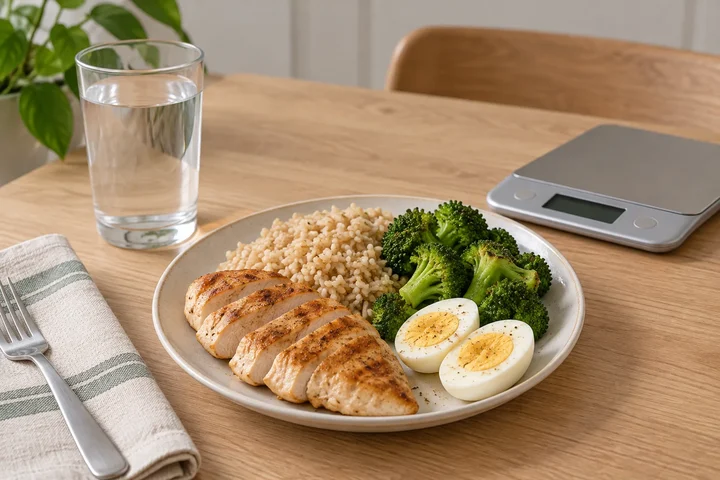
Each meal below takes 10 minutes or less, uses ingredients from a normal grocery run and has 25 g of protein or more. Numbers come from our food pages on eggs, Greek yogurt, cottage cheese, rotisserie chicken, shrimp and tuna.
| Meal | What goes in | kcal | Protein |
|---|---|---|---|
| Egg scramble | 3 eggs, 1 slice whole wheat toast, 100 g (3.5 oz) spinach, 1 tsp olive oil | 345 | 25 g |
| Tuna bean bowl | 100 g tuna, 1/2 cup canned beans, 100 g bell pepper, 1 tbsp olive oil | 403 | 38 g |
| Turkey wrap plate | 4 oz (112 g) deli turkey, 2 slices whole wheat bread, 100 g spinach | 279 | 27 g |
| Cottage cheese plate | 1 cup cottage cheese, 1 banana | 327 | 26 g |
| Whey shake | 1 scoop whey in water, 1 banana | 225 | 25 g |
| Shrimp stir fry | 150 g (5.3 oz) cooked shrimp, 150 g broccoli, 1 tbsp olive oil, 1 cup brown rice | 538 | 45 g |
Canned tuna varies by brand and packing liquid, so check the label. Shrimp from frozen cooks in 4 minutes in a hot pan.
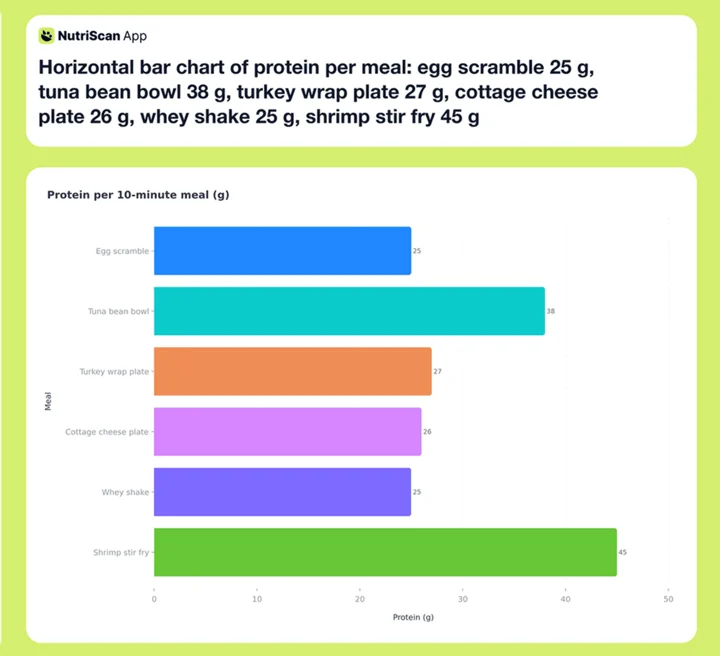
Figure 1: Every meal clears 25 g of protein. The shrimp stir fry leads at 45 g and the tuna bean bowl follows at 38 g.
One full day, about 1,590 calories and 150 g protein
| Meal | Food | kcal | Protein |
|---|---|---|---|
| Breakfast | 250 g nonfat Greek yogurt, 1 banana, 1 oz (28 g) almonds | 416 | 33 g |
| Lunch | 150 g rotisserie chicken (skin off), 1 cup cooked brown rice, 100 g bell pepper, 100 g spinach | 557 | 46 g |
| Snack | 1/2 cup cottage cheese | 111 | 13 g |
| Dinner | 150 g cooked shrimp, 1 cup shelled edamame, 150 g broccoli, 1 tbsp olive oil | 508 | 59 g |
| Total | 1,592 | 150 g |
That is 1.8 g per kg for an 84 kg person, near the top of the range. If your target is lower, drop the cottage cheese snack and you land at about 1,480 calories and 137 g. If it is higher, add a second cup of rice or another tablespoon of olive oil.
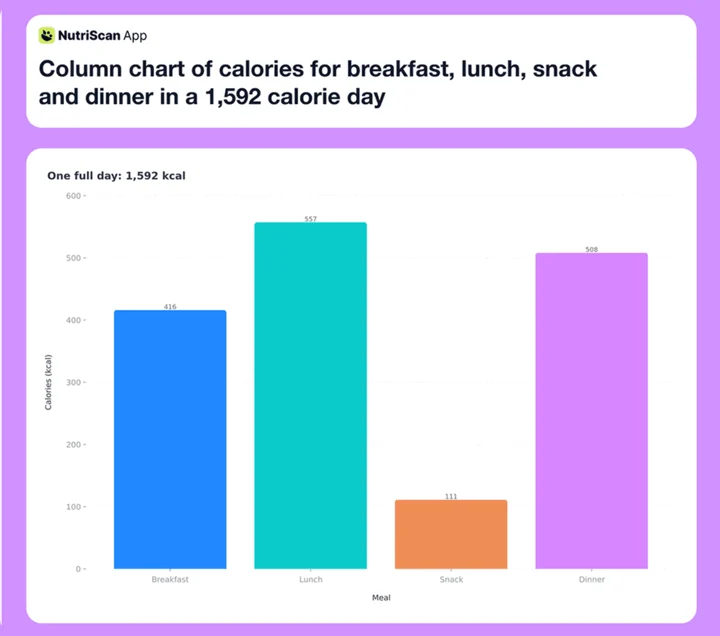
Figure 2: Lunch carries the most calories at 557 kcal, then dinner at 508, breakfast at 416 and the snack at 111, for 1,592 kcal across the day.
TIP
Cook once, eat twice. A rotisserie chicken from the store gives you 3 lunches. Buy microwave brown rice pouches and frozen broccoli, and the lunch above takes 4 minutes.

Meal prep in 30 minutes on Sunday
You do not need a spreadsheet. Do four things and you have most of the week covered:
- Pull the meat off one rotisserie chicken and split it into 3 boxes.
- Hard-boil 6 eggs for grab-and-go protein.
- Portion Greek yogurt into 4 containers with a banana beside each.
- Wash and bag spinach and bell pepper.
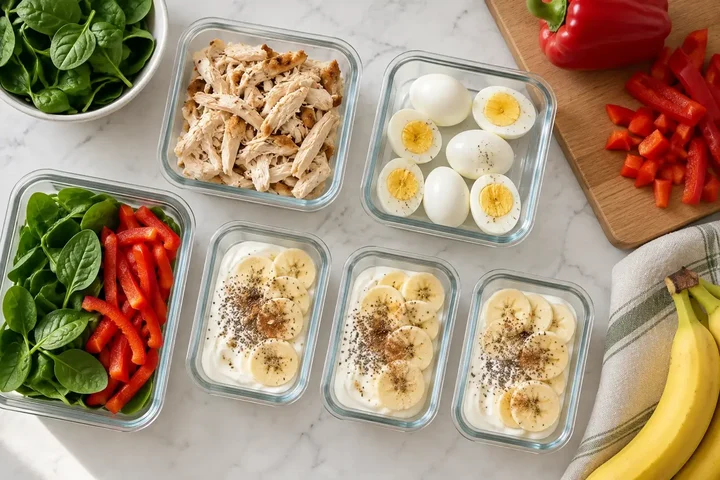
Dinner stays fresh because shrimp, tofu and eggs cook in minutes. If a day goes wrong and you land at a drive-through, pick grilled chicken, skip the sugary drink and add a side salad, then keep the next meal on plan. Our high-protein meal plan with no shakes has more combinations if you want variety.

Sunday prep goes faster when the chopping is done in one batch.
IMPORTANT
Checkpoint: final stretch before the reveal.
⏱️ Progress 3/4 • ~7 minutes in • Keep going
✅ Steps 1 and 2
✅ Step 3: Fast meals with calories
✨ The 3-day check (about to reveal)
The 3-day check that finds the missing calories
Here is the reveal. When someone says "I eat the same as before and gain weight," the usual gap is portions and extras, not hormones. Oils, dressings, drinks, nibbles while cooking and weekend meals add 200 to 400 calories without feeling like meals.
The check is simple. For 3 normal days (2 weekdays and 1 weekend day), write down everything you eat and drink, including the bites. Compare the total with your TDEE from the calculator. If the log is close to your TDEE, you have found why the scale is flat. Then trim the biggest extra, not the whole meal.
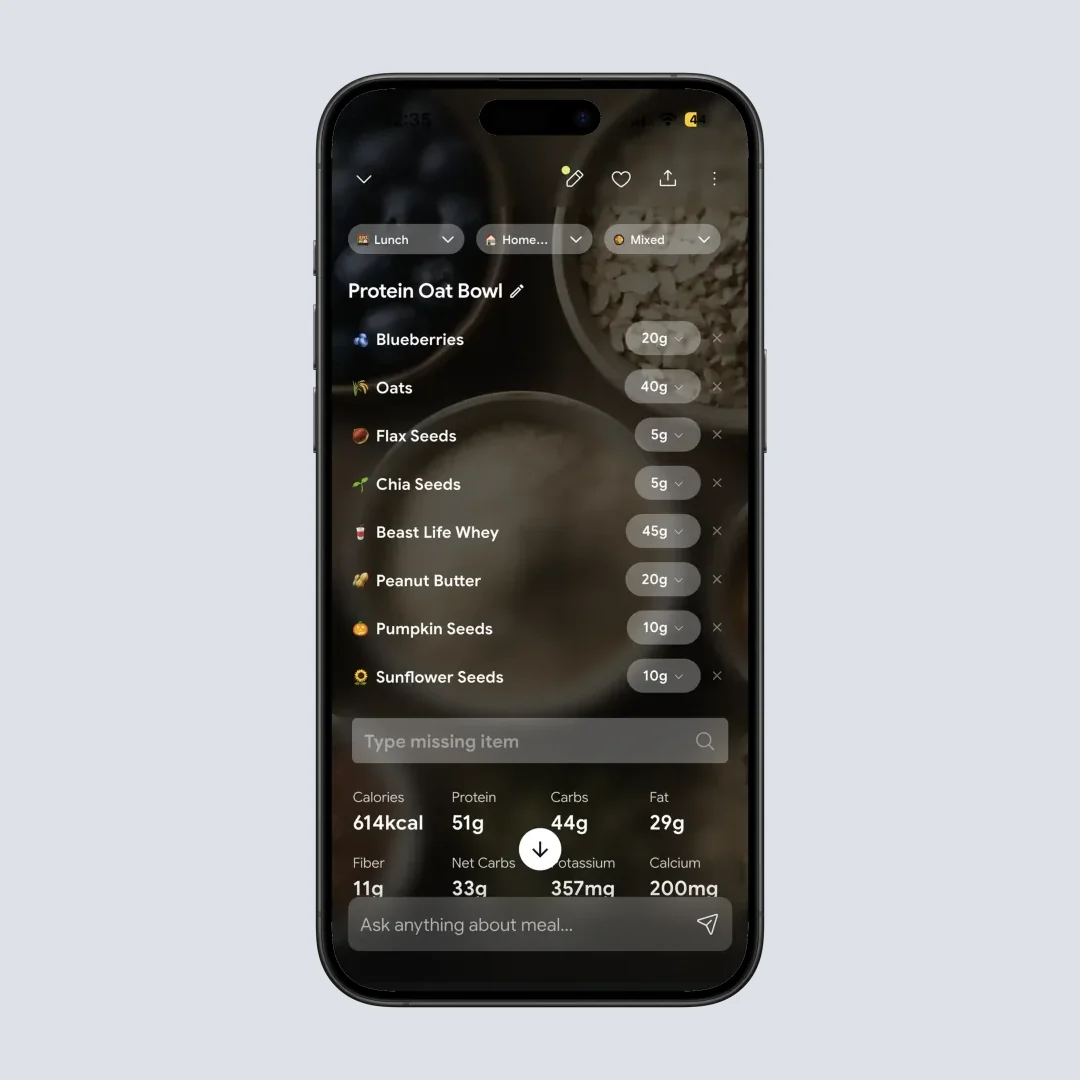
Weighing every portion is tiring on long workdays. A photo log is faster: NutriScan estimates calories and macros from a meal photo. The Free plan includes 5 photo scans a week, and Premium is about $59 a year for unlimited scans. Use your scans on the meals you are unsure about, like takeout, and eyeball the rest. See the meal scan guide for how it works.
Common mistakes after 45
- Cutting calories too hard. Eating far below your target with low protein costs muscle and energy.
- Only doing cardio. Walking helps, but it does not replace lifting.
- Skipping breakfast protein. A yogurt bowl at 33 g sets up the day.
- Ignoring sleep. In the trial above, short sleep blunted fat loss on the same diet.
- Judging by the scale alone. Track waist, strength and photos too, because muscle gain can hide fat loss.
Frequently asked questions
Why is it harder to lose weight after 45?
Less muscle, fewer daily steps, worse sleep and, for women, menopause-related shifts add up. Metabolic rate itself stays fairly stable until about 60, so the habits are the lever.
How many calories should a 52-year-old eat to lose weight?
It depends on sex, height and activity. At 185 lb, most people land between 1,500 and 1,900 calories. Use the calculator above, subtract 300 to 500 from your TDEE and review after 2 weeks.
How much protein do I need to keep muscle while losing weight?
A working range is 1.2 to 1.6 g per kg a day. For 185 lb that is about 100 to 135 g. Check with your doctor first if you have kidney disease.
Do I need to lift weights?
Yes, at least 2 days a week, per the CDC. Strength work is the main tool that keeps muscle while the scale goes down.
What are the fastest meals for a long workday?
Egg scramble, tuna bean bowl, Greek yogurt with fruit, cottage cheese, rotisserie chicken with rice and frozen shrimp stir fry. All take 10 minutes or less.
Does menopause stop weight loss?
No, but it shifts fat toward the middle and lean mass down. Protein, strength training and sleep help. Talk to your doctor about symptoms or hormone therapy.
IMPORTANT
Recap: everything you completed.
⏱️ Progress 4/4 • ~9 minutes in • Nicely done
✅ What changed ✅ Protein and strength ✅ Fast meals ✅ The 3-day check
This post is general guidance, not medical advice. If you have diabetes, heart, kidney or thyroid conditions, take medication or are pregnant, talk to your doctor before changing your diet or training.