Pre-Wedding Weight Loss Diet: 30-Day Transformation
 ChatGPT
  Claude
  AI Mode
  Perplexity
Four weeks before a wedding, almost everyone wants the same thing. They want to look like themselves - only a little tighter. A little less puffy in the face. A flatter stomach under the lehenga or the suit jacket. They do not want a new body. They want the body they already have to show up, on time, on the day, in front of every relative they have ever met.
As a NutriScan nutritionist, I have walked through this 30-day window with brides, grooms, mothers of the bride, and best men for the last two years. Almost all of them arrive with the same plan in their head: eat as little as possible, train twice a day, and hope. That plan does work, in the loosest sense. It also costs you sleep, muscle, mood, and skin - and it puts the weight back on during the honeymoon. The plan in this guide is different. It is built around the simple truth that a calm, protein-led 30 days will leave you looking better in the photos than a panicked 30 days ever will.
CDC's guidance is a gradual, steady pace of about 1 to 2 pounds a week, which it says is more likely to stay off than faster loss (CDC Steps for Losing Weight, updated January 2025). That is total scale weight, not pure fat, so 30 days at that pace is roughly 4 to 8 pounds on the scale and only part of it is fat. Some of the first week's drop is water. That is the window we are working in.
IMPORTANT
Your 30-day wedding transformation plan at a glance.
A quick roadmap so you can act fast - and keep reading for the one habit that changes everything.
⏱️ Progress 0/4 • ~0 minutes in • Keep going
⏳ Week 1: De-Bloat Phase (drop the puff in 7 days)
⏳ Week 2: Calorie Deficit and Protein Lock
⏳ Week 3: Muscle Protection Mode
⏳ Week 4: Wedding-Day Taper
🔍 The one tracking habit that makes every wedding photo look better (revealed near the end)
TL;DR - Pre-Wedding Weight Loss: 30-Day Guide
- Who it is for: Brides, grooms, and wedding party members with 30 days who want visible results without crash dieting
- Realistic target: 4-8 lbs on the scale over 30 days, at the 1-2 lbs a week pace CDC calls gradual and steady. Part of the first week's drop is water, which CDC does not put a number on
- The key levers: 500-calorie daily deficit, 1.6-2.0 g protein/kg bodyweight, 3 lifts/week, 7 or more hours of sleep
- The mistake to avoid: Chasing a crash number, or cutting all carbs in week 4
- The one tool: NutriScan photo logging - the specific habit that makes tracking stick for Indian mixed-plate meals
What 30 Days Can Actually Do
Before we talk about food, let us draw the line in the sand.
A steady loss rate is 1 to 2 pounds (0.5 to 1 kg) per week. NIH's News in Health bulletin says to eat about 500 fewer calories per day than you burn, which should get you to about one pound per week (NIH News in Health, December 2022). The NHLBI obesity guide says the same thing from the clinical side: a 500 to 1,000 kcal/day energy deficit producing 1 to 2 pounds per week (NHLBI Practical Guide). Two things to know about that guide before you lean on it: it dates from 2000, and it is written for patients with a BMI of 25 or higher working with a clinician, not for a general reader.
What that means in plain numbers for a 30-day window:
- 4 to 8 pounds on the scale if you keep a clean 500 to 750 calorie daily deficit. Only part of that is fat
- Some of week one's drop is water, mostly from cutting sodium, alcohol, and refined carbs. How much varies a lot person to person and CDC does not publish a figure for it
- Visibly tighter waist and face by week 3, even if the scale moves slower than you want
What 30 days cannot do:
- Burn 15 to 20 pounds of fat without medical supervision. Those numbers trade muscle and water for a short-term scale win
- Erase a long history of low protein and low movement in one month
- Build new muscle on top of a deep deficit. You can protect what you have, but not add
A 2017 randomized trial by Ashtary-Larky and colleagues put 42 people through the same 5% weight loss over either 5 weeks or 15 weeks (Int J Endocrinol Metab, 2017). Body composition came out more favorable after the slow loss, with a bigger drop in fat mass and in waist and hip circumference, while the rapid group lost more lean body mass, total body water and resting metabolic rate. The trial is small and its metabolic markers actually favoured the fast group, so read it for the body-composition point only. That point is enough: the bride who loses 6 pounds steadily looks better in a fitted blouse than the bride who loses 12 pounds in panic and shows up with hollow cheeks.
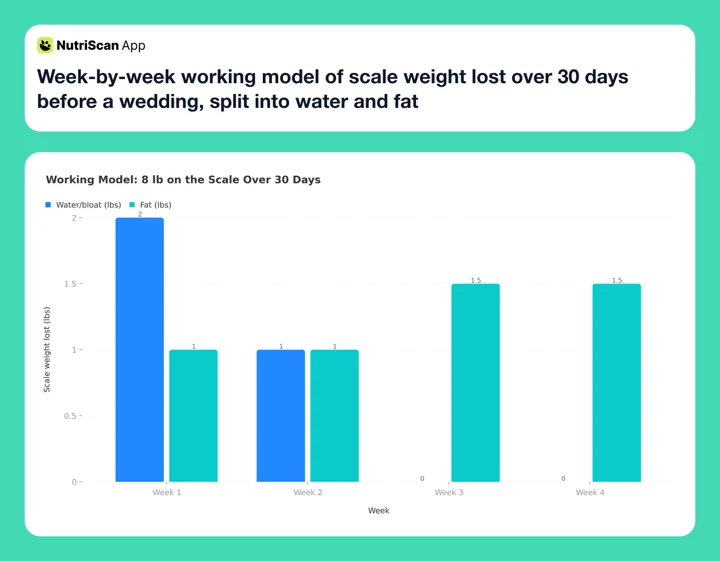 Figure 1: The plan's working model, not a published figure. Water comes off fast in week 1, then fat loss carries weeks 2 to 4. The four weeks add up to 8 pounds on the scale, the top of the 4 to 8 band.
Set Honest Expectations
If someone promises 15 pounds in 30 days without a medical team, they are selling a dehydration plan. The mirror will give you back those pounds at the wedding buffet. Stick to 4 to 8 pounds on the scale and arrive glowing.
IMPORTANT
Checkpoint: here's where you are right now.
Quick status update so you always know the next best move.
⏱️ Progress 1/4 • ~1 minute in • Keep going
✅ What 30 days can and cannot do (done)
👉 The calorie math and protein targets (you're here)
⏳ Your 4-week structure and meal map
🧩 The tracking habit that changes everything (coming soon)
The Calorie Math, Done Honestly 🔢
Online calculators will hand a 28-year-old bride a number like 1,200 calories. That is a real clinical target, not a fad number: the NHLBI obesity guide recommends 1,000 to 1,200 kcal a day for most women and 1,200 to 1,600 for men, and sets its own floor much lower, at 800 kcal a day, all of it under a clinician's supervision (NHLBI Practical Guide). What makes it a poor fit for a 30-day wedding window is not safety in the abstract. It is that a deficit that deep is hard to hold alongside 1.6 to 2 g/kg of protein, three lifting sessions and wedding-season eating, and the evidence on rapid loss favors a gentler rate for body composition.
Here is a more workable range. Maintenance follows the federal reference table, deficit is maintenance minus 500:
| Profile | Maintenance | Deficit target (maintenance minus 500) |
|---|---|---|
| Sedentary bride, 25-35, 55-70 kg | 1,800-2,000 cal | 1,300-1,500 cal |
| Moderately active bride, desk job, 25-35, 55-70 kg | 2,000-2,200 cal | 1,500-1,700 cal |
| Sedentary groom, 25-35, 70-85 kg | 2,400-2,600 cal | 1,900-2,100 cal |
| Active groom, weight training, 25-35, 70-90 kg | 2,600-3,000 cal | 2,100-2,500 cal |
Maintenance estimates follow Appendix 2 of the Dietary Guidelines for Americans, "Estimated Calorie Needs per Day, by Age, Sex, and Physical Activity Level" (USDA/HHS, 2020-2025). Its reference woman is 5'4" and 126 lb and its reference man is 5'10" and 154 lb, so taller or heavier people need more than the table says. These are working bands for the weight ranges named, not a personal prescription. If you want a lower target than this, set it with your own clinician rather than an online calculator.
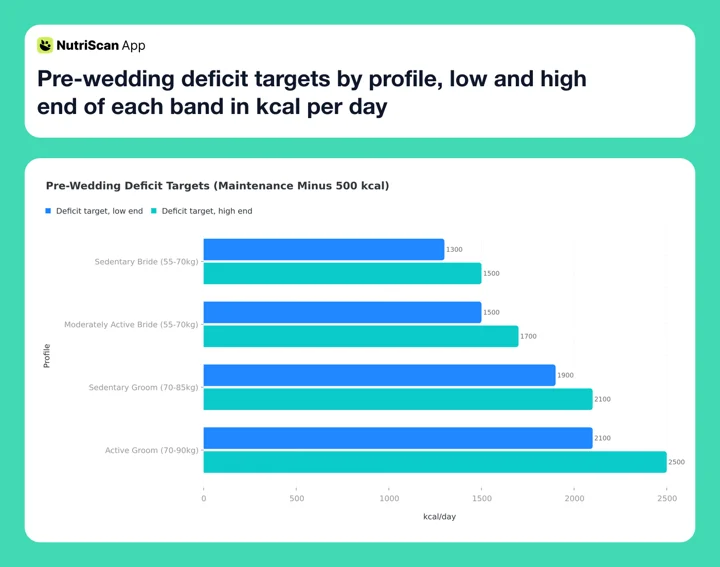 Figure 2: The deficit column from the table above, drawn out. Each band is that profile's maintenance estimate minus 500 calories.
Protein is the lever that decides what kind of weight you actually lose. Kokura and colleagues (2024, Clinical Nutrition ESPEN, 28 trials) found higher protein intake significantly prevents muscle mass decline in adults with overweight or obesity who are losing weight, with a standardised mean difference of 0.75 (95% CI 0.41 to 1.10), though it did not protect strength or physical function (PubMed 39002131). That review puts its thresholds at above 1.3 g/kg a day for muscle gain and below 1.0 g/kg for a higher risk of decline. For the 30-day window, aim for 1.6 to 2.0 grams per kilogram of bodyweight, which is the range Nunes and colleagues arrived at in their 2022 meta-analysis of protein and lean mass (PubMed 35187864).
- A 60 kg bride: 96-120 g protein daily
- An 80 kg groom: 128-160 g protein daily
Carbs and fat fill the rest of the calorie budget. Do not drop either to zero. Keto in the final 30 days is a common mistake. Muscle stores glycogen with roughly three times its weight in water (Muscle glycogen and body hydration status, 2023), so stripping carbs empties the muscle you want full for photos and the water held with it. Low-carb diets also take time to adapt to, and the last four weeks before a wedding is a bad time to run that experiment.
Calculate Your Personal Numbers
For a precise macro target based on your height, weight, age, and goal, use our free online macro calculator. It takes under 2 minutes and gives you a number you can actually work with. If you want a ready-made deficit layout to compare against, the Indian calorie deficit diet chart for beginners walks through one.
 Three lifting sessions a week. Non-negotiable. This is what keeps the shape in fitted outfits.
The 4-Week Structure: What Each Week Is Actually For 📅
The 30 days are not one long diet. They are four separate jobs that stack. Each week has a different primary goal - and understanding why each week exists keeps you on track when energy dips and the wedding chaos peaks.
IMPORTANT
Checkpoint: midway progress update.
You're halfway through - decisions get easier from here.
⏱️ Progress 2/4 • ~2 minutes in • Keep going
✅ What 30 days can do (done)
✅ Calorie math and protein targets (done)
👉 Your 4-week structure and meal map (current)
⏳ The tracking habit that holds this plan together (next - keep going)
Week 1: De-Bloat and Reset
Cut alcohol, fried food, refined sugar, and sodium bombs you eat out of habit - chips, salted nuts, takeaway curry, soy-heavy dressings, processed meats. Drink to thirst and pale urine; the reference figures are about 2.7 liters of total water a day for women and 3.7 for men, food included, and normal hydration holds across a wide range of intakes (National Academies, Dietary Reference Intakes for Water). This week is where most people see a water-weight drop, mostly from the face and lower belly. How much varies person to person. You will often look different by day 7 even before fat loss starts.
Week 1 Priority Foods
Focus on: cucumbers, tomatoes, leafy greens, lemon water, dal, plain Greek yogurt, grilled chicken, boiled eggs. High satiety, low sodium, naturally anti-inflammatory.
The primary goal here is not fat loss - it is undoing the bloat that hides the shape you already have.
Week 2: Lock the Calorie Deficit
Now that the bloat is gone, settle into the calorie band from the table above. Three real meals, one or two protein-led snacks, no liquid calories. Strength training 3 days a week. Walking 7,000 to 10,000 steps daily, a common working target rather than a guideline figure. At a 500 calorie deficit the scale should start moving here at about a pound a week.
This is also the week where tracking gets serious. Eyeballing portions works for simple meals. It fails on mixed Indian plates - the dal, the rice, the sabzi, the roti. Week 2 is where people who track properly pull ahead of people who guess.
The Research on Combined Diet and Exercise
A 2024 meta-analysis by Rotunda and colleagues in CDC's journal Preventing Chronic Disease pooled 14 randomized trials of combined nutrition and activity programs lasting six months or less, and found a mean weight difference of −2.59 kg against controls (95% CI −3.47 to −1.72) (Preventing Chronic Disease, 2024). The shortest programs it looked at ran under 13 weeks, so a four-week window sits below anything that review tested. Treat 30 days as tighter than the evidence base, which is exactly why the plan has to be consistent rather than extreme.
Week 3: Tighten and Protect Muscle
This is the harder week mentally. Energy can dip. Hold protein high. Add an extra rest day if sleep is suffering. Switch from daily weigh-ins to weekly photos in the same outfit, same light, same time. The number is noisy. The mirror tells the truer story.
Week 4: Taper, Hydrate, Sleep
In the final 7 days, stop chasing fat loss and start optimizing how you look on the day. Salt comes down further. Hydration stays steady, drink to thirst as usual, and do not try to manipulate water in the 24 hours before the function. There is no published protocol for a pre-event water taper and it is a physique-contest trick, not a health practice. Sleep becomes the priority over extra workouts.
A rested, hydrated face on camera is worth more than one more hour at the gym in week 4. Early weeks do move fastest: Mayo Clinic's own two-week "Lose It!" phase is built to drop up to 6 to 10 pounds by changing habits, against 1 to 2 pounds a week for the rest of its program (Mayo Clinic Diet). Nothing published says the face tightens before the scale moves, so treat that as an observation from the chair, not a finding.
A Sample 30-Day Meal Map 🍱
Pick one breakfast, one lunch, one snack, and one dinner per day. Rotate so you do not bore yourself into cheating on day 12.
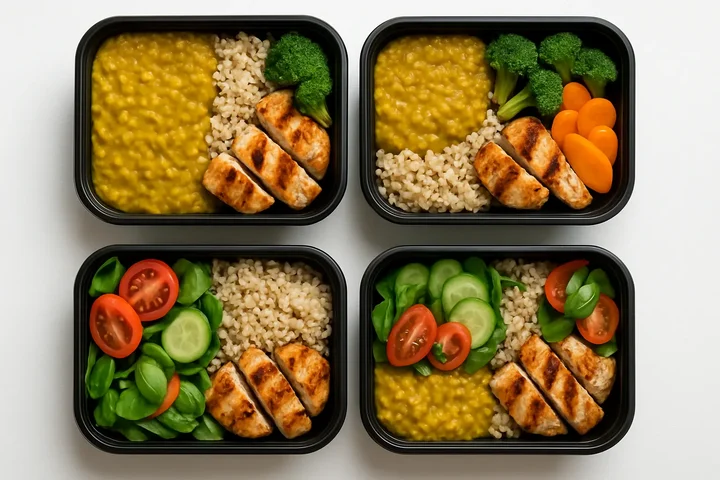 A typical week 2-3 meal prep layout. Four containers a day. Dal, protein, complex carb, and vegetables.
Breakfast Options (350-450 calories, 25-35g protein)
Indian:
- 3 egg whites and 1 whole egg bhurji with 1 multigrain roti and cucumber on the side
- 2 moong dal chillas with paneer filling and mint chutney
- Oats cooked in skim milk with 1 scoop whey and a small banana
Global:
- Greek yogurt bowl (200 g) with berries, 1 tbsp chia, and a small drizzle of honey
- 2 eggs on 1 slice whole grain toast with avocado and black coffee
- Protein smoothie: 1 scoop whey, 200 ml skim milk, half a banana, spinach
Lunch Options (450-550 calories, 35-45g protein)
Indian:
- Grilled chicken or tofu (150 g) with 1 cup brown rice or 2 small rotis, dal, sabzi, and salad
- Rajma with 1 katori brown rice and a large kachumber
- Paneer (100 g) and chana salad with lemon
Global:
- Grilled chicken breast (150 g) with quinoa (1 cup cooked) and roasted vegetables
- Salmon poke bowl with brown rice and edamame
- Large chickpea and feta salad with olive oil and lemon
Afternoon Snack (150-200 calories, 15-20g protein)
- 1 cup low-fat Greek yogurt with cinnamon
- A boiled egg and 10 almonds
- 1 scoop whey in water and an apple
- 100 g paneer cubes with chaat masala and lemon
Dinner Options (400-500 calories, 30-40g protein)
Indian:
- Fish curry (no cream) with 1 small bowl jeera rice and bhindi or palak on the side
- Chicken tikka (150 g) with a large green salad and 1 roti
- Mixed dal with 1 katori curd and a vegetable sabzi
Global:
- Stir-fried tofu or shrimp with broccoli, peppers, and a small portion of rice noodles
- Turkey lettuce wrap with hummus and roasted sweet potato
- Grilled white fish with steamed greens and a small baked potato
What the Four Occasions Add Up To
One of each lands you at 1,350 to 1,700 calories and 105 to 140 g of protein a day. That covers both bride bands in the table. It does not reach either groom band, and it misses the 80 kg groom's 128 to 160 g protein target at the low end. Grooms: add a second protein snack and larger portions of the carb at lunch and dinner until you hit your own number.
Drinks
Water, black coffee, plain green tea, herbal tea. No alcohol. No sugary drinks. No wellness juice cleanses. Liquid calories are the silent killer of every wedding diet I have seen fail.
Cut the Alcohol
Alcohol adds calories without nutrients and disrupts sleep, which is the part that shows on camera (NIAAA, Alcohol's Effects on the Body). It also lowers the resistance that keeps you from finishing the mithai box at 1 a.m. Cut it for the 30 days if you can. If that is not realistic with the functions already in the calendar, cut it for the last two weeks. The face-bloat effect is something practitioners see rather than something the literature measures.
 Healthy food does not have to taste like a compromise. The meal map above has options for every craving.
Still with me? The tracking habit that separates good results from wedding-photo magic is just a couple sections away.
7 Practical Tips That Actually Work 💡
Most pre-wedding diet advice fails because it ignores the real life of a bride or groom in the final month. Family is in town. Outfit trials run long. There is a sangeet, a mehendi, an engagement party. Here are the tips that survive contact with that schedule.
Plan around the events, not against them. Pick the 3 functions you will eat freely at and stay tight on the other days. Trying to be perfect every single day for 30 days is how people break and binge.
Front-load protein. Get 30 to 40 grams of protein in by 11 a.m. It cuts afternoon cravings and protects muscle. Mayo Clinic Press looked at the 30-30-30 trend in 2023 and said flatly that it has not been studied rigorously (Mayo Clinic Press, 2023). What it does back is the narrower piece this tip rests on: some research suggests at least 30 grams of protein at breakfast, in solid food, helps with fullness.
Lift heavy 3 times a week. Compound moves only: squats, deadlifts, rows, push-ups, presses. This is the single biggest protector of the lean, toned look you actually want in photos. In a meta-analysis of older adults on calorie restriction, resistance training offset 93.5% of the lean body mass that dieting alone took off (PMC5946208).
Walk every day. Aim for 7,000 to 10,000 steps, a common working target rather than a guideline number. A 30-minute walk after lunch and another after dinner is more sustainable than one long workout and tends to lower post-meal blood sugar, which is what a 30-minute postprandial walk was measured to do across meals of different carbohydrate content (PMC8912639).
Sleep 7 or more hours, the CDC recommendation for adults 18 to 60 (CDC, About Sleep). It matters more than an extra gym hour because of what it does to the composition of what you lose. In a crossover trial with identical calorie restriction, people sleeping 5.5 hours lost the same total weight as those sleeping 8.5 hours, but far less of it as fat and more as lean tissue (Nedeltcheva et al., 2010).
Borrow the shape of DASH for week 1. DASH is a blood-pressure plan, not a de-bloat protocol, but its shape is worth copying: heavy on vegetables, fruit and low-fat dairy, sodium held under 2,300 mg a day, sweets and sugar-sweetened drinks limited (Mayo Clinic DASH sample menus). Note that its own sample days run 229 to 290 g of carbohydrate, so do not read it as a low-carb template.
Track only the inputs you can control. Calories in, protein in, water in, steps, sleep. Stop tracking the scale daily after week 2. The number is noisy.
IMPORTANT
Checkpoint: final stretch before the reveal.
One last nudge - the habit reveal is next.
⏱️ Progress 3/4 • ~3 minutes in • Keep going
✅ What 30 days can do
✅ Calorie math and protein targets
✅ Your 4-week structure and full meal map
✨ The tracking habit that makes wedding photos shine (about to reveal)
Want a Full Diet Plan Built Around Your Goal?
Read our NutriScan diet plan guide for a deeper framework that pairs well with any 30-day window. For snack ideas that fit the protein targets above, see our high protein snacks guide.
Step-by-Step: How to Start This Plan in 24 Hours
If the wedding is now 30 days away, do not wait for Monday. Start tonight.
Step 1: Weigh in and photograph yourself. Same light, same outfit, front and side. Save it. This is your week 0 baseline.
Step 2: Calculate your calorie band. Use the table above. Write down the number and your daily protein target.
Step 3: Empty the kitchen of trigger food. Chips, sweets, leftover wedding card-box mithai, packaged juice. If it is not in the house, you will not eat it at 11 p.m. while finalizing the seating chart.
Step 4: Build a 3-day grocery list. Fresh produce, eggs, chicken or paneer or tofu, Greek yogurt, oats, brown rice, lentils. Re-shop every 3 days so vegetables stay fresh.
Step 5: Schedule your training. Three lifts and four walking days, on the calendar, named, time-blocked. Treat them like dress fittings: non-negotiable.
Step 6: Set a sleep alarm. Not a wake-up alarm. A wind-down alarm 90 minutes before bedtime, aiming at 7 or more hours. This is the cheapest lever you have in the last 30 days.
Step 7: Log your first meal. Open NutriScan ➡️ take a photo of your meal ➡️ let the app estimate the macros. You do not need to manually calculate dal chawal or sabzi. One tap per meal, done.
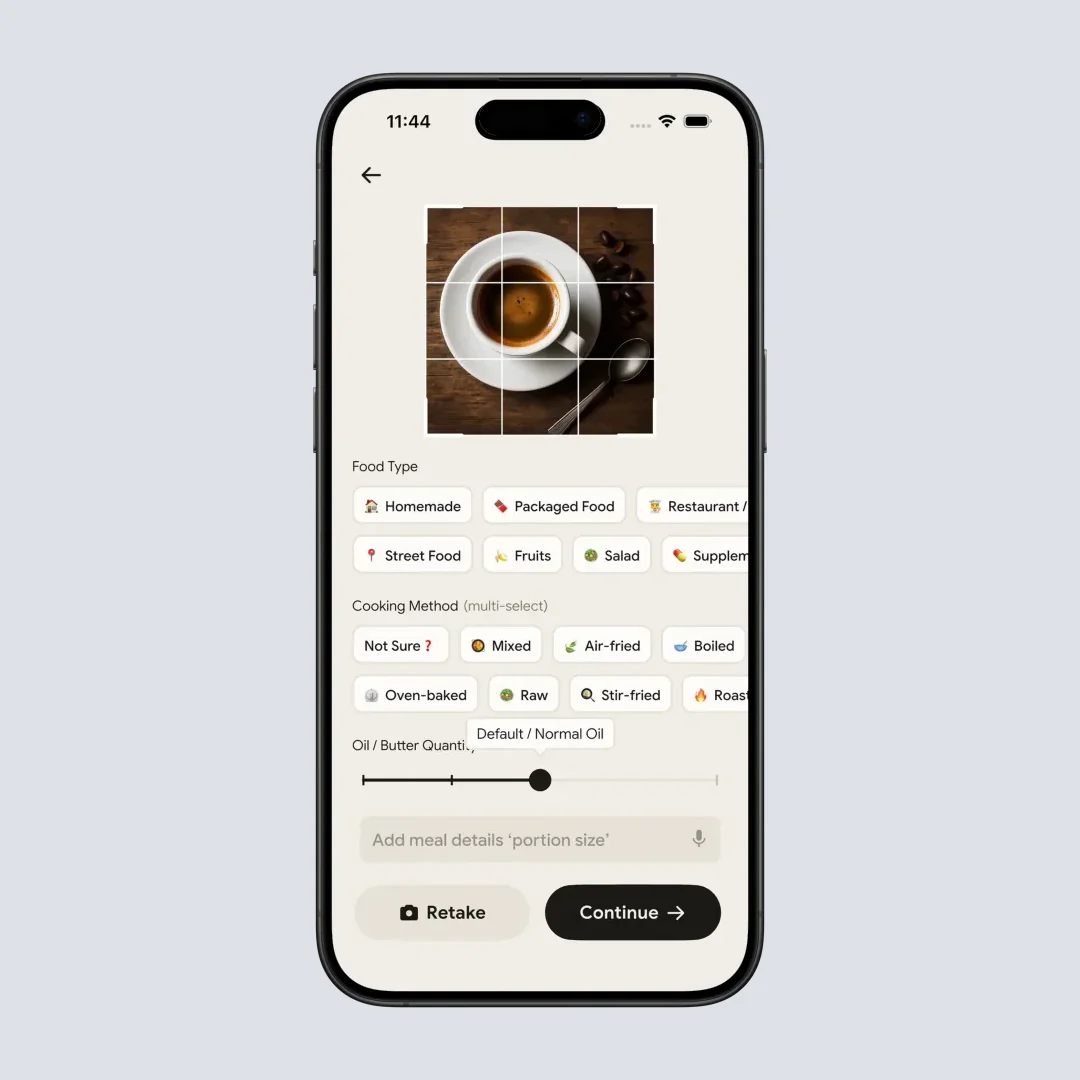
Home > Camera Icon > Crop Picture - NutriScan's meal scan identifies your food so you do not have to guess macros for mixed plates.
That is your launch. Done in one evening.

Common Mistakes That Sabotage the 30 Days ❌
I have watched these patterns play out almost every wedding season. Avoid them.
Skipping breakfast to save calories. It pushes hunger to 4 p.m. and 9 p.m., when you have the least control over food choices.
Going zero-carb. Carbs in the final week refill muscle glycogen and the water stored with it, which is why fitted outfits sit better on a fed muscle than a flat one. Cut them down, do not erase them.
A juice cleanse in week 4. This dehydrates you, drops blood sugar, and makes the day-of face look gaunt, not glowing.
Doubling up on cardio. Extra cardio in a deficit eats into recovery, and recovery is what lets you keep lifting three times a week. The lifting is the part protecting your shape.
Weighing daily and panicking. The scale moves in jagged steps because of water, salt, and your menstrual cycle. Weekly photos tell the truer story.
Cutting fat too low. Mayo Clinic's own plan lists healthy fats, olive oil, avocado, nuts and nut butters, among the five habits to start (Mayo Clinic Diet). Ghee in moderation and fatty fish stay in too. Cutting fat to the floor to buy calories usually costs you satiety and makes the plan harder to hold.
The habit that ties this all together - and the one that actually makes the difference between decent results and photos you want to frame - is right here.
The Habit That Makes Every Wedding Photo Look Better ✨
Here it is: consistent photo-based food logging, specifically for mixed Indian meals.
Most 30-day plans break down in week 2 for one reason: calorie tracking fails on Indian food. You cannot manually enter dal-chawal-sabzi-papad-salad into a basic calorie counter with any accuracy. The guesses are too wide. Brides and grooms either give up tracking or stress-count every grain of rice - and both paths derail the plan.
The NutriScan approach is that you do not type, you photograph. Open the app ➡️ snap your plate ➡️ the app identifies and estimates your meal's macros - including the sabzi, the quantity of rice, the amount of dal. You review, adjust if needed, and move on. One tap per meal instead of 20 minutes of manual entry.
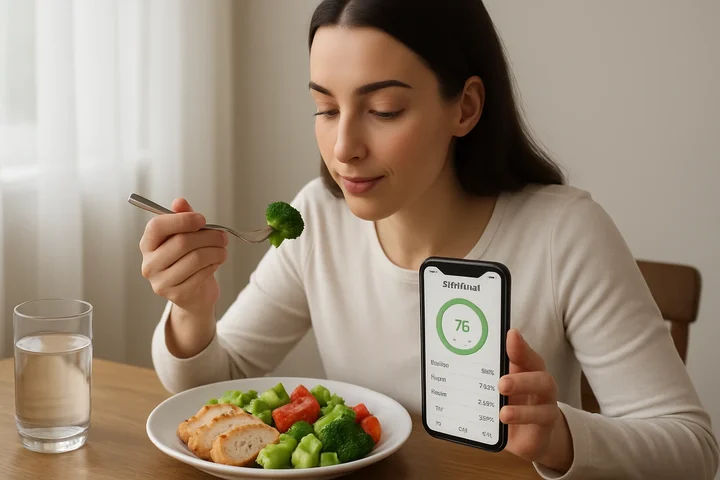 NutriScan's photo logging handles the estimation so you stay consistent without obsessing over every gram.
This matters for 30-day plans specifically because:
- Consistency beats precision. A rough log every day tells you more about your week than a perfect log three days out of seven, because the days you skip are usually the days that moved the number.
- Indian plates are high-volume and variable. A katori of dal and a katori of rajma look similar in size but have very different protein content. The app catches this. Your guess usually does not.
- Stress tracking is the enemy of wedding prep. Tomiyama and colleagues found calorie monitoring raised perceived stress and calorie restriction raised cortisol in a three-week study of dieting women (Tomiyama et al., 2010). Tracking is not the problem. A tracking method with friction in it is one more stressor in a month that already has plenty, so keep it to a 30-second habit.
The people in my experience who got the best photos were not the ones who ate the least. They were the ones who tracked most consistently, stayed in their calorie band on most days, and slept seven or more hours every night.
For a deeper look at how NutriScan's meal scanning works, see our meal scan guide.
Start with This Habit Tonight
Download NutriScan ➡️ take a photo of your dinner tonight ➡️ let it estimate your macros. Start there. After 3 days, the habit is automatic. The same app carries the rest of the 30-day plan too: a NutriScore band on every meal, a fasting timer if you use one, Monika the voice AI nutritionist for the questions you would otherwise google at midnight, and a 28-day personalized diet plan on Premium.
Conclusion: The Calm Plan Wins the Wedding
The 30-day pre-wedding diet that works is the calm one. Five clean days a week, three real meals, one or two protein snacks, three lifts, daily walks, and seven or more hours of sleep. That is the plan.
You can track all of it - including the messy mixed-plate dinners of the engagement week - with NutriScan's photo logging. Aim for the deficit band that matches your profile in the table above, which runs from 1,300 calories for a sedentary bride to 2,500 for an active groom, plus 1.6 to 2 g/kg protein, 7,000 or more steps, and seven or more hours of sleep. Do that for 4 weeks and the photos take care of themselves.
The body you want for your wedding is not a new body. It is a slightly leaner, slightly more rested, slightly more confident version of the one you already have. Thirty calm days is enough to find it.
IMPORTANT
Recap: everything you covered this read.
You finished the run - save this for reference.
⏱️ Progress 4/4 • ~4 minutes in • Nicely done
✅ What 30 days can and cannot do
✅ Calorie math and protein targets
✅ Your 4-week structure and full meal map
✅ The NutriScan photo-logging habit (revealed)
FAQ
Q: How much weight can I realistically lose in 30 days before a wedding?
CDC's guidance is a gradual, steady pace of about 1 to 2 pounds a week, which it says is more likely to stay off than faster loss (CDC Steps for Losing Weight, updated January 2025). That is total scale weight, not pure fat, so 30 days at that pace is roughly 4 to 8 pounds on the scale and only part of it is fat. Some of the first week's drop is water, which varies a lot person to person and is not a figure CDC publishes. Anything advertised as a 15 to 20 pound drop in 4 weeks is usually selling muscle loss, dehydration, or a rebound.
Q: Is it safe to eat 1,200 calories per day for the full 30 days?
1,200 calories is a real clinical target, not a fad number. NHLBI's obesity guide recommends 1,000 to 1,200 kcal a day for most women and 1,200 to 1,600 for men, under a clinician's supervision (NHLBI Practical Guide). What makes it a poor fit for a 30-day wedding window is that a deficit that deep is hard to hold alongside 1.6 to 2 g/kg of protein, three lifting sessions and wedding-season eating. NIH's working figure is about 500 fewer calories a day than you burn (NIH News in Health, December 2022). What that lands at in absolute calories depends on your own maintenance level, so use the bands in the table above or NIH's Body Weight Planner rather than a single number, and set anything lower with your own clinician.
Q: Should I cut carbs completely in the last 2 weeks before the wedding?
No. Muscle stores glycogen with roughly three times its weight in water (Muscle glycogen and body hydration status, 2023), so cutting carbs to zero empties the muscle and the water held with it, and refeeding carbs in the final week refills both. Keep complex carbs (brown rice, oats, lentils, whole grain roti) in the plan and only reduce refined carbs and added sugar. Mayo Clinic's DASH pages are a fair reference for the sugar side of that, since DASH limits sweets and sugar-sweetened drinks (Mayo Clinic DASH sample menus). Do not read DASH as a low-carb plan; its own sample days run 229 to 290 g of carbohydrate.
Q: How much protein should I eat each day on a 30-day wedding diet?
Aim for 1.6 to 2.0 grams per kilogram of bodyweight. A 60 kg bride needs 96 to 120 grams. An 80 kg groom needs 128 to 160 grams. Kokura's 2024 meta-analysis found intakes above 1.3 g/kg a day are associated with muscle mass gain during weight loss and intakes below 1.0 g/kg with a higher risk of decline, so 1.6 to 2.0 g/kg sits above the threshold that review identified (PubMed 39002131); the 1.6 g/kg figure itself comes from Nunes and colleagues, 2022 (PubMed 35187864). Spread protein across 3 meals and 1 snack so each meal carries 25 to 40 g.
Q: Should I do cardio or weights to look better on the wedding day?
Both, but weights are non-negotiable. Three full-body lifting sessions per week protect the muscle and shape that make fitted outfits hang well. In one meta-analysis of calorie-restricted older adults, resistance training offset 93.5% of the lean body mass that dieting alone took off (PMC5946208). Daily walking handles the rest. Long daily cardio without lifting tends to leave you smaller but softer, which is not what most brides and grooms are after for photos.
Q: What is the single most important thing in the final week before a wedding?
Sleep and water, in that order. Cut alcohol for the 30 days if you can, or at least the final two weeks (NIAAA, Alcohol's Effects on the Body). Drink to thirst and pale urine and keep it steady through the last week, rather than manipulating water in the 24 hours before the function; there is no published protocol for a pre-event taper. And sleep 7 or more hours a night, the CDC recommendation for adults 18 to 60 (CDC, About Sleep). These three habits do more for the wedding photo than any extra hour at the gym in week 4.