Weight Loss Diet for Sedentary Lifestyle: Desk Job Plan
 ChatGPT
  Claude
  AI Mode
  Perplexity
A weight loss diet for a sedentary lifestyle starts with one number: your TDEE at the 1.2 sedentary multiplier, minus 400 to 600 kcal. For most desk workers that lands between 1,300 and 1,700 kcal a day, with 1.4 to 1.6 g of protein per kg of bodyweight to protect muscle, four anchored meals, 7,000 to 8,000 steps, and two strength sessions a week. Sitting for nine hours caps your non-exercise burn at roughly 700 kcal a day, so food has to carry more of the deficit than it would for an active person. Below you get the calorie math, the protein targets, the three office snack traps, and a 7-day plan around 1,600 kcal.
TL;DR - Desk Job Weight Loss Plan
- Root cause: NEAT collapse - a sedentary job caps non-exercise burn at roughly 700 kcal a day
- Calorie target: TDEE x 1.2 (sedentary multiplier), then subtract 400-600 kcal for a safe cut
- Protein floor: 1.4-1.6 g per kg bodyweight, the practical target for holding muscle on a cut
- Movement floor: 7,000-8,000 steps + 2 x weekly strength sessions
- Tracking hack: One 10-second photo per meal beats manual logging every time
The weight creep nobody warned you about in your 20s and 30s is the desk-job creep. Five days a week, you sit for nine hours, take three flights of stairs by accident, and finish the day with a snack drawer that has quietly replaced lunch. The scale moves up by a kilo every three months. Nothing about your meals feels excessive - you do not eat fast food - and yet your jeans keep getting tighter.
The cause is rarely gluttony. It is the silent collapse of non-exercise activity thermogenesis, the drift of high-calorie snacks into your workday, and the slow loss of muscle mass that comes from sitting for ninety percent of your waking hours.
Fixing it takes three things: a calorie target tuned to a sedentary day, a protein floor that protects muscle, and a small set of movement habits that bring back the calories your chair has stolen. No gym membership, no 1,200-calorie crash plan, no career change.
IMPORTANT
Your desk job weight loss plan at a glance.
A quick roadmap so you can act fast.
⏱️ Progress 0/4 - ~0 minutes in - Keep going
⏳ Step 1: Calculate your sedentary TDEE (your real number)
⏳ Step 2: Hit your protein floor (no muscle loss on a cut)
⏳ Step 3: Break the 3 office snack traps and movement blocks
🔍 The one tracking habit that makes desk cuts stick without willpower (revealed near the end)
Why Desk Jobs Quietly Cause Weight Gain 📉
A 2002 review by James Levine in Best Practice & Research Clinical Endocrinology & Metabolism defines non-exercise activity thermogenesis, or NEAT, as the energy you burn doing everything except formal exercise: walking to the printer, fidgeting, climbing stairs, even standing on a phone call (Levine 2002, PubMed 12468415). NEAT is the most variable slice of daily burn. Endotext puts the spread at up to 2,000 calories a day between two people of similar size, lean body mass and sex (NEAT in Human Energy Homeostasis, NCBI Bookshelf).
A desk job sits at the bottom of that spread. A 2022 review of workplace NEAT puts the average maximum in a sedentary job at about 700 kcal a day, which is why small increments spread across a long workday are the only practical lever you have (NEAT in the workplace, PubMed 36388282). That same review looked at standing desks, walking workstations, seated pedal units and gym balls as chair replacements. A 25-person crossover trial published in Workplace Health & Safety found that light treadmill walking during work raised physical activity and produced a leaner body composition (Malaeb et al., PubMed 30370831).
Three things change once your job becomes sedentary:
- Daily step counts fall, and 7,000 a day is the threshold worth defending: in 2,110 CARDIA adults followed a mean of 10.8 years, people clearing 7,000 steps had 50 to 70 percent lower mortality risk (Paluch et al. 2021, PubMed 34477847).
- Snack drift fills the gap left by skipped or rushed meals.
- Muscle mass falls progressively from around age 40, roughly 8 percent per decade to age 70, and about 1 to 2 percent a year after 50 if you do not train (Kim & Choi 2013, PMC3780834).
Each of these by itself is small. Stacked over years, they explain why someone gains ten kilos without changing a single recipe at home.
 That slow scale creep is NEAT collapse in action - and it is completely reversible with the right desk-day structure
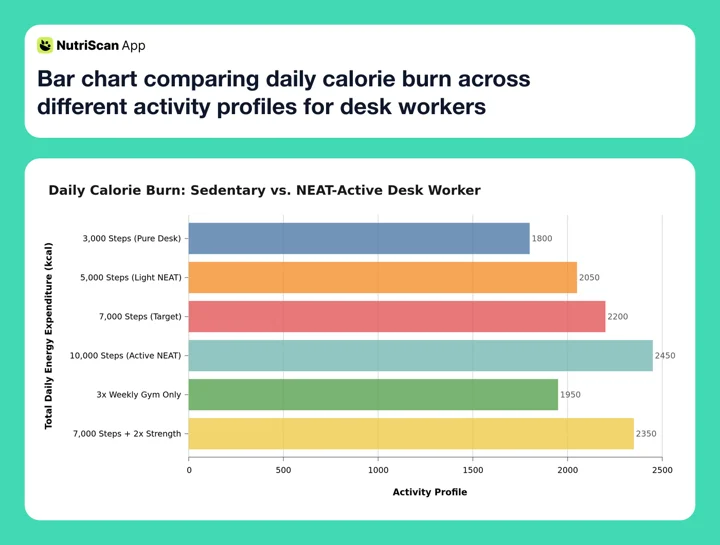 Figure 1: Illustrative estimates, not measured values. The shape is what matters: rebuilding steps across the workday moves the daily total more than three gym sessions bolted onto an otherwise sedentary week
Calorie Math for a Sedentary Worker 🔢
Before you cut food, you need a number. The Mifflin-St Jeor equation gives a clean estimate of basal metabolic rate, then you multiply by an activity factor to find total daily energy expenditure (TDEE). It is the equation registered dietitians reach for: a 2005 review in the Journal of the American Dietetic Association found it the most reliable of the common formulas, and the Academy of Nutrition and Dietetics Evidence Analysis Library recommends it (Frankenfield et al. 2005, PubMed 15883556, Academy EAL). For a sedentary office worker, that activity factor is 1.2.
Quick formula:
- Men: BMR = (10 x weight kg) + (6.25 x height cm) - (5 x age) + 5
- Women: BMR = (10 x weight kg) + (6.25 x height cm) - (5 x age) - 161
- Sedentary TDEE = BMR x 1.2
Worked example - 30-year-old man, 85 kg, 180 cm, desk job: BMR = 1,830. TDEE = 2,196 kcal. A 500 kcal cut sits near 1,700 kcal per day.
Worked example - 28-year-old woman, 65 kg, 165 cm, same job: BMR = 1,380. TDEE = 1,656 kcal. A 300 kcal cut sits near 1,350 kcal per day.
Height moves these numbers a lot, so the table states it. Run your own rather than borrowing the closest row. If you want the same math laid out as a day-by-day chart, our calorie deficit diet chart for beginners walks through a full week of meals at a set target.
| Profile | Sedentary TDEE | Cut Target |
|---|---|---|
| Man, 80 kg, 30, 178 cm | 2,120 kcal | 1,620 kcal |
| Man, 90 kg, 35, 178 cm | 2,210 kcal | 1,710 kcal |
| Woman, 60 kg, 28, 160 cm | 1,560 kcal | 1,260 kcal |
| Woman, 70 kg, 35, 168 cm | 1,700 kcal | 1,400 kcal |
Mayo Clinic puts a 500-calorie daily cut at about half a pound to a pound a week, roughly 0.2 to 0.45 kg, and notes the old rule that 500 calories a day always equals a pound a week overstates what people actually lose (Mayo Clinic counting calories). Bigger cuts look faster on paper and are the main reason desk workers quit by week three. If a deeper cut would drop you under about 1,200 kcal a day, that belongs with a clinician, not a blog post.
Use a Macro Calculator
Not sure about your exact numbers? Our online macro calculator runs the Mifflin-St Jeor formula with your exact stats and gives you a personalized calorie and protein target in seconds - no spreadsheet needed.
IMPORTANT
Checkpoint: here's where you are right now.
Quick status update so you always know the next best move.
⏱️ Progress 1/4 - ~1 minute in - Keep going
✅ Step 1: Sedentary TDEE calculated (done)
👉 Step 2: Protein floor (you're here)
⏳ Step 3: Break the snack traps and add NEAT
🧩 The tracking habit that makes it stick (coming soon)

Protein: The One Macro Desk Workers Skip 💪
If a sedentary worker eats too little protein, the body burns muscle alongside fat during a calorie deficit. That is the single biggest mistake desk workers make. Less muscle further drops your BMR, which makes the next round of fat loss harder - and so the cycle continues. Harvard's Nutrition Source puts the floor at 0.8 g per kg a day and notes that needs vary with age and activity, and that the source of the protein matters as much as the amount (Harvard Nutrition Source: protein).
That floor is for maintenance, not for cutting. Aim for 1.4-1.6 grams of protein per kilogram of body weight while you are in a deficit, the bottom of the 1.4-2.0 g/kg band the International Society of Sports Nutrition recommends for building and holding muscle (Jäger et al. 2017, PubMed 28642676). For an 80 kg man, that is 112-128 grams. Spread it across four anchors so each carries 25-35 grams.
| Food | Serving | Protein |
|---|---|---|
| Greek yogurt (plain) | 200 g | 18 g |
| Eggs | 3 large | 18 g |
| Cottage cheese | 150 g | 17 g |
| Chicken breast (cooked) | 120 g | 36 g |
| Tuna (canned, in water) | 1 can (140 g) | 28 g |
| Tofu (firm) | 150 g | 18 g (varies by brand) |
| Whey protein | 1 scoop (30 g) | 24 g |
| Lentils (cooked) | 1 cup | 18 g |
| Edamame | 1 cup | 17 g |
A simple rule keeps you on target: every meal must show a palm-sized protein source first, before any rice, bread, or pasta hits the plate.
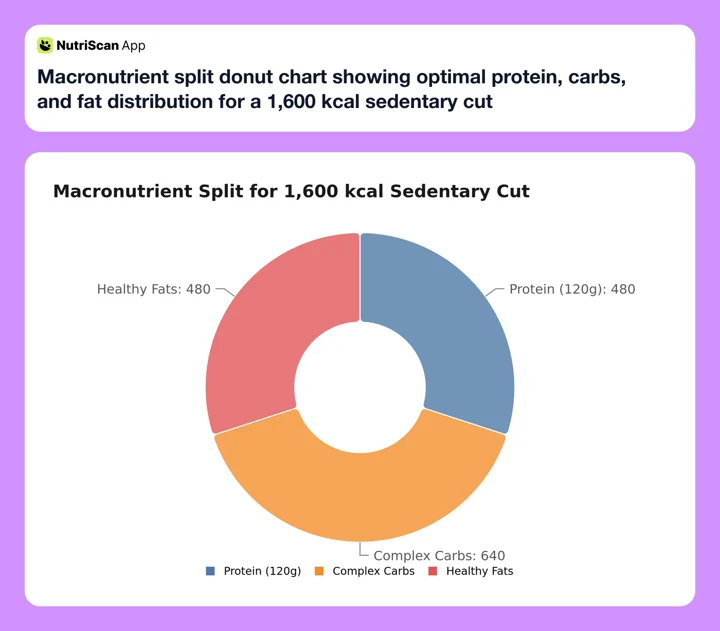 Figure 2: 30% of calories from protein on a 1,600 kcal cut. US adults average about 16%, so this is a real change, not a rounding adjustment (USDA FSRG, Protein Intake of Adults)
Volume, Fiber, and the Half-Plate Rule 🥗
Sedentary cuts feel hardest in the second hour after lunch. The two levers that fix this are food volume and fiber. A 1,500-kcal day made of protein bars and white rice leaves you starving by 4 PM. The same calories in chicken, lentils, vegetables, and fruit feels like twice as much food. Mayo Clinic calls this energy density: foods with high water and fiber content give you volume and weight without the calories, and fiber also takes longer to digest, so you stay full longer (Mayo Clinic: feel full on fewer calories).
Use a half-plate rule for lunch and dinner:
- Half the plate: non-starchy vegetables (salad, sauteed greens, broccoli, peppers, cucumber, carrots)
- One quarter: protein anchor
- One quarter: a smart carb (rice, quinoa, sweet potato, beans, whole-wheat pasta)
- One tablespoon of fat (olive oil, avocado, nuts, seeds)
This one rule cuts the calorie cost of a lunch without cutting the amount of food on the plate. No app needed.
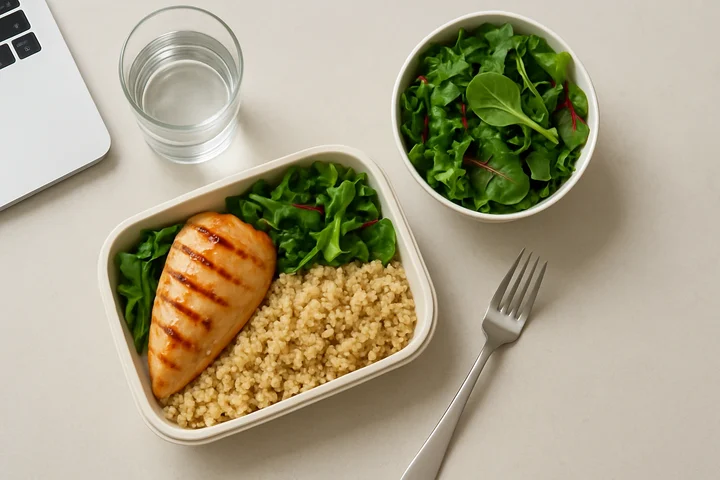 A half-plate of vegetables + protein anchor + smart carb - a lot of food for the calories, which is the whole point
The Three Snack Traps That Wreck Office Calorie Budgets ⚠️
A sedentary fat-loss plan dies on three quiet rocks: liquid calories, shared office food, and stress eating. Each one is forgettable on its own. Together they are the difference between a deficit day and a maintenance day.
Liquid calories. A flavored latte, a bottled juice, a sweetened iced tea, and a sports drink can stack to 600-900 calories - the size of a full meal - with zero satiety. Switch to black coffee, plain tea, sparkling water, or a sugar-free electrolyte drink. Save sweet drinks for one specific moment per week so they stop being a habit.
Shared office snacks. Birthday cakes, leftover muffins, pizza Fridays, festival sweets. Willpower is the wrong tool here. Keep a personal protein snack stash in your drawer or fridge: a protein bar, a tub of Greek yogurt, a hard-boiled egg, and a small bag of unsalted nuts. Our high-protein snacks guide has more options that survive a desk drawer.
Stress eating. People with a stronger cortisol response to stress eat more high-sugar, high-fat food, both in the lab and in daily life (Yau & Potenza, Minerva Endocrinologica 2013). The cleanest pattern interrupt is a five-minute walk away from your desk, followed by a glass of water and a piece of protein. If after that you still want the cookie, eat one and move on. The goal is to break the auto-reach, not ban dessert.
Pro Tip: The Desk Drawer Protein Stash
Keep this in your desk drawer: 2 protein bars, 10 small packets of almonds (15g each), 2 cans of tuna, and a tub of whey. This is your insurance policy against 4 PM vending machine disasters - costs less than a daily coffee.
Watch the Liquid Calorie Trap
A daily flavored latte at 250 kcal is about 91,000 kcal a year. On the old linear rule of 7,700 kcal per kilo that reads as 12 kg of fat, though Mayo Clinic notes real-world loss runs smaller than the linear rule predicts (Mayo Clinic counting calories). Switching four out of five workdays to black coffee costs no willpower and changes the weekly total more than most food swaps.
IMPORTANT
Checkpoint: midway progress update.
You are halfway - decisions get easier here.
⏱️ Progress 2/4 - ~2 minutes in - Keep going
✅ Step 1: Sedentary TDEE calculated (done)
✅ Step 2: Protein floor locked in (done)
👉 Step 3: Snack traps + movement habits (current)
⏳ The tracking habit that makes it all stick (next)
A 7-Day Sedentary Meal Plan (Around 1,600 kcal) 📋
This template lands near 1,600 kcal a day, fits a 70 kg desk worker on a moderate cut, and can be scaled by 200 kcal in either direction. Every meal lists a protein anchor first. If cooking on weeknights is the blocker, the 7-day meal prep plan for busy professionals batches most of this into one Sunday block.
Monday
- Breakfast: 3-egg veggie omelet, one slice of whole-grain toast, black coffee. (380 kcal, 24g P)
- Lunch: Grilled chicken salad bowl with quinoa, mixed greens, cucumber, olive oil. (520 kcal, 38g P)
- Snack: Greek yogurt with a handful of blueberries. (180 kcal, 18g P)
- Dinner: Baked salmon, roasted broccoli, half a sweet potato. (520 kcal, 32g P)
Tuesday
- Breakfast: Cottage cheese bowl with sliced banana and a tablespoon of peanut butter. (350 kcal, 22g P)
- Lunch: Tuna and white-bean salad over romaine, lemon-olive oil dressing. (480 kcal, 35g P)
- Snack: Greek yogurt with one chopped apple. (220 kcal, 18g P)
- Dinner: Stir-fried tofu with mixed vegetables, half a cup of brown rice. (550 kcal, 28g P)
Wednesday
- Breakfast: Whey-protein oatmeal with berries and chia seeds. (400 kcal, 30g P)
- Lunch: Chicken wrap (whole-wheat tortilla, grilled chicken, hummus, salad). (500 kcal, 38g P)
- Snack: Hard-boiled eggs (2) and carrot sticks. (180 kcal, 13g P)
- Dinner: Lean beef stir-fry with peppers and onions, half a cup of basmati rice. (550 kcal, 38g P)
Thursday
- Breakfast: Greek yogurt parfait with granola and strawberries. (380 kcal, 24g P)
- Lunch: Lentil and chicken soup, side salad with vinaigrette. (450 kcal, 32g P)
- Snack: Cottage cheese with cucumber slices. (160 kcal, 16g P)
- Dinner: Baked white fish, sauteed spinach, quinoa. (520 kcal, 35g P)
Friday
- Breakfast: 3-egg scramble with smoked salmon and tomatoes. (400 kcal, 30g P)
- Lunch: Shrimp poke bowl with edamame, brown rice, avocado. (550 kcal, 36g P)
- Snack: Protein bar (clean ingredient label). (200 kcal, 18g P)
- Dinner: Turkey chili with kidney beans, side of greens. (500 kcal, 36g P)
Saturday
- Breakfast: Protein pancakes with Greek yogurt and berries. (420 kcal, 32g P)
- Lunch: Grilled chicken sandwich on whole-grain bread, side salad. (520 kcal, 36g P)
- Snack: 30g whey shake with water. (130 kcal, 24g P)
- Dinner: Thin-crust pizza with chicken and vegetables, big salad. (550 kcal, 28g P)
Sunday
- Breakfast: Avocado toast with two poached eggs. (430 kcal, 22g P)
- Lunch: Roasted chicken with sweet potato and roasted vegetables. (550 kcal, 38g P)
- Snack: Greek yogurt with a drizzle of honey. (180 kcal, 18g P)
- Dinner: Lentil salad with feta and olive oil. (450 kcal, 24g P)
Add the meals up and the week runs 1,510-1,650 kcal a day, averaging about 1,600, with 102-120g of protein, averaging about 112. Hydration target: 2-3 liters of water, plus black coffee or tea before noon if you tolerate caffeine.
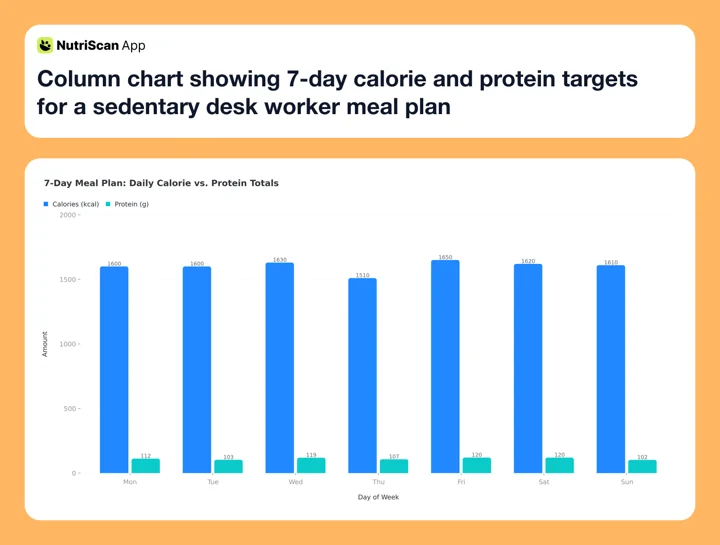 Figure 3: Every day clears 100g of protein, which is what stops a sedentary cut from eating muscle. Bars are the totals of the meals listed above
Movement Habits That Replace Lost NEAT 🚶
Diet alone fights the desk job. Diet plus three small movement habits beats it. None of these require gym time.
Walk during meetings. Audio-only meetings are an easy 1,500-3,000 step bonus. On standard activity-compendium values, half an hour at a slow indoor pace is on the order of 70-100 calories above sitting. Treat that as an estimate, not a measurement.
The 90-minute rule. Set a timer. Every 90 minutes, stand for two minutes, walk a lap of the office, refill your water, and stretch your hip flexors. Long sitting leaves hips stiff and glutes underused, which is why a lap of the office and a hip-flexor stretch are worth the two minutes.
Two strength sessions per week. Twenty to thirty minutes of resistance training, even with bodyweight or resistance bands, protects muscle during a deficit. Three exercises per session is enough: a squat or split squat, a push (push-up or dumbbell press), and a pull (band row or inverted row). Two days a week is also the muscle-strengthening floor in the US Physical Activity Guidelines (CDC adult activity guidelines). A palm-sized protein source at every meal is the nutrition half of the same advice (Mayo Clinic Press, Aging Forward transcript).
Step floor. Aim for 7,000-8,000 steps a day, broken into a morning walk, a lunch walk, and an evening walk. Lifting a 3,000-step day to 8,000 steps is roughly 250-350 extra calories for a 70-80 kg adult on standard step-energetics estimates, a real share of the deficit before any food change.
 A 10-minute walking break every 90 minutes adds 1,500-2,000 steps to your day without touching your schedule or calendar
 Two strength sessions a week is the muscle-strengthening floor in the US Physical Activity Guidelines, and it is the part of a sedentary cut that protects lean mass

Common Mistakes Desk Workers Make on a Cut 🚫
Four mistakes show up over and over in sedentary fat-loss attempts.
Skipping breakfast then snacking all afternoon. The total calorie count looks fine on paper, but the protein distribution is broken and afternoon hunger guarantees a 300-calorie 4 PM mistake. Eat a 350-450 kcal breakfast with 25g protein, every workday.
Underestimating cooking oils. A tablespoon of olive oil is 120 calories. Two tablespoons in a salad and another tablespoon at dinner is 360 invisible calories. Measure oil for two weeks until your eye learns the dose.
Cutting too hard. A 30-year-old man trying to live on 1,200 kcal at a desk job will quit by week three. The honest cut is 400-600 kcal below TDEE, not 1,000.
Tracking nothing. Eyeballing intake works for highly experienced eaters and fails for everyone else for the first few months. A simple logging habit closes the gap.
Avoid the Aggressive Cut Trap
Larger cuts typically cost more lean mass and are much harder to hold. Metabolic adaptation and hunger both work against you, and the CDC links gradual loss, about 1 to 2 pounds a week, to keeping the weight off (CDC: losing weight). A 400-600 kcal deficit is the range most desk workers can actually hold for twelve weeks. Never drop below about 1,200 kcal a day without a clinician.
IMPORTANT
Checkpoint: final stretch before the reveal.
One last nudge - the reveal is next.
⏱️ Progress 3/4 - ~3 minutes in - Keep going
✅ Step 1: TDEE calculated (done)
✅ Step 2: Protein floor locked in (done)
✅ Step 3: Snack traps broken + NEAT habits added (done)
✨ The one tracking habit that makes it all stick (about to reveal)
Tools and Tracking That Fit a Desk Schedule 📱
A sustainable sedentary cut needs three tools: a calorie target, a protein target, and a way to log without friction. Manual entry burns out fast. The fix is a fast-logging stack:
- Step counter: Whatever phone or watch you already own. Set the daily step goal to 8,000 and let it nag you.
- Weekly weigh-in: Same morning, same conditions, once per week. Daily scale is noise. Weekly is signal.
- Photo logger: Snap a photo of the plate, confirm portions, save.
Here is the habit that finally makes desk cuts stick for the long term.
NutriScan reduces your entire lunch log to a 10-second photo. You tap the camera icon on the Home screen, point it at your meal, and get a calorie and macro breakdown instantly - no typing, no searching, no app-switching during your 30-minute lunch break. The AI identifies the food from the photo, you confirm the portions, and you're done. For office food, the app even has a dedicated "Office" food type tag in the crop screen so you get more accurate estimates for typical workplace meals. You can also tag cooking methods - Deep-fried, Stir-fried, Grilled, Steamed - which matters when you're trying to hit a calorie target from a canteen or work cafeteria.
If you sit all day and need a plan built around your exact goal, the NutriScan diet plan builder generates a personalized sedentary-cut target with macros rather than a generic number. The calorie deficit diet page covers how the app sets and holds that target day to day.
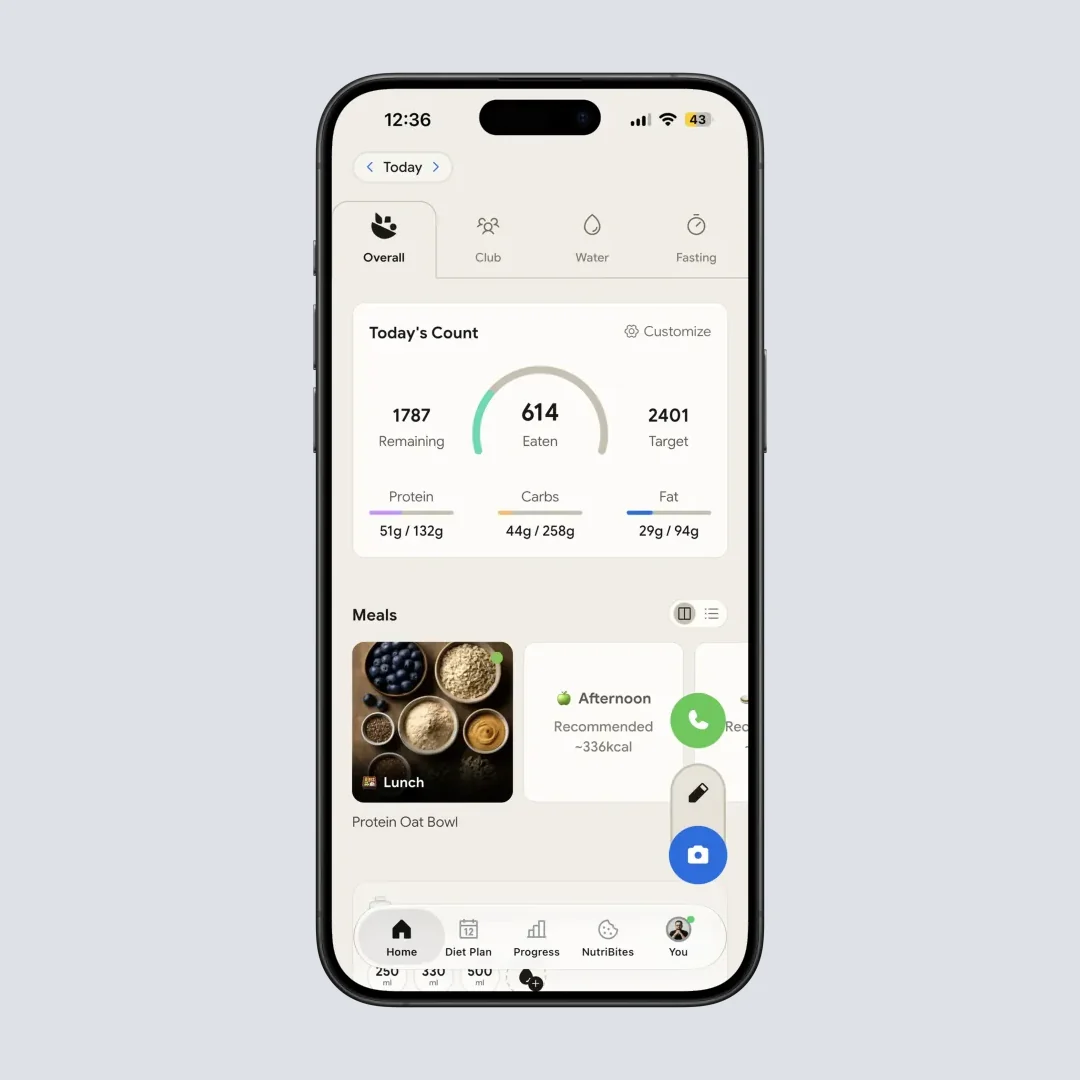
NutriScan Home Page - your daily calories, protein, carbs, and fat at a glance with progress rings (Home > Overview)
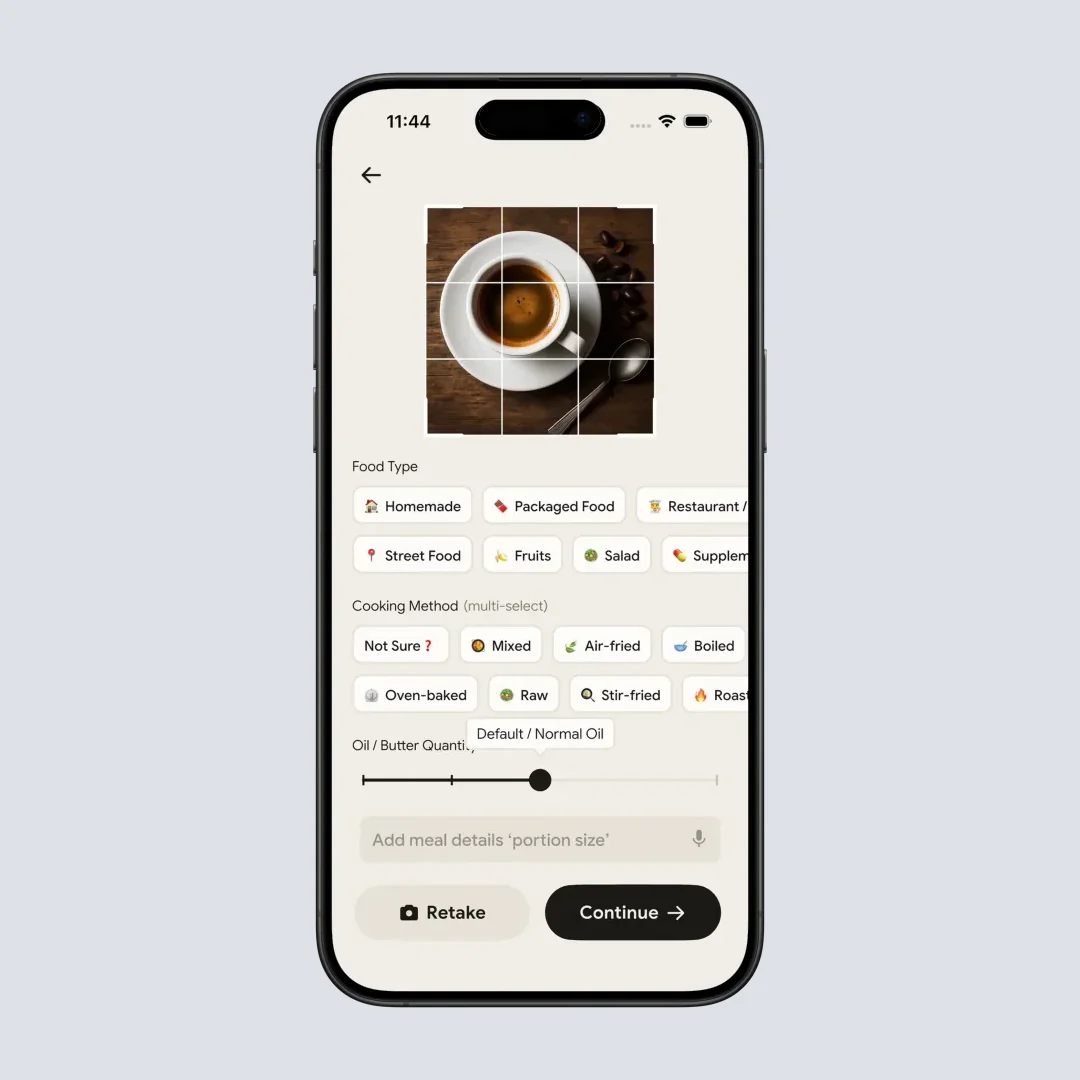
Photo-log any office meal in 10 seconds - tap camera icon, point at your food, select "Office" tag, confirm (Home > Camera Icon > Click Picture)
If you skip apps entirely, the half-plate rule plus a written protein target on a sticky note works. The point is to never rely on memory after a long workday.
IMPORTANT
Recap: everything you completed this round.
You finished the run - save this for next time.
⏱️ Progress 4/4 - ~4 minutes in - Nicely done
✅ Step 1: TDEE calculated (done)
✅ Step 2: Protein floor locked in (done)
✅ Step 3: Snack traps broken + NEAT habits added (done)
✅ The tracking habit that sticks: 10-second photo logging with NutriScan (revealed)
Frequently Asked Questions ❓
Q: Is a sedentary deficit possible without exercise?
A: Yes. The calorie deficit is what drives fat loss. The two strength sessions and the 7,000 step floor mainly protect muscle and make the deficit easier to hold, which is why they are protective rather than the engine.
Q: Why am I gaining weight even at 1,500 kcal?
A: The most common reasons are underreporting (forgotten oils, drinks, bites), water retention from a high-sodium week, and a slower-than-estimated TDEE because of low NEAT. Track strictly for two weeks, including every drink. If the number is honest and the scale still rises, drop the target by another 200 kcal and recheck.
Q: Should I eat carbs at night if I sit all day?
A: Yes. Total daily intake matters more than meal timing, so a carb dinner with rice or sweet potato is fine as long as the day's calories still fit. The night-carb fear is folklore.
Q: What about intermittent fasting for desk jobs?
A: A fixed eating window is a simple way to cut evening grazing, and most of its benefit comes from eating less overall rather than from the window itself. A 16:8 window can be tougher to combine with morning meetings. NutriScan's fasting timer is free on both plans and starts at 14:10, so start there and only narrow it if you find it easy.
Q: Can I drink alcohol on a sedentary cut?
A: Yes, with limits. Two drinks per week, in a meal that already fits the calorie target, fits a sustainable plan. Daily wine adds 800-1,200 kcal weekly, which is a quarter to a third of the week's 500-kcal-a-day deficit gone.
Q: How long before I see results?
A: On Mayo Clinic's band, a 500-kcal deficit is about 0.2 to 0.45 kg a week (Mayo Clinic counting calories). You will notice energy improvements and waist changes in the first two weeks before the scale moves significantly. Hold the plan for six weeks before evaluating.
Start Your Sedentary Cut This Week 🎯
A weight loss diet for a sedentary lifestyle runs on a small, repeatable structure: a calorie target 400 to 600 kcal under TDEE, 1.4 to 1.6 g/kg of protein, four anchored meals built on the half-plate rule, two strength sessions a week, and a step floor. Hold that for twelve weeks and Mayo Clinic's band puts you somewhere around 2.5 to 5 kg down, without going hungry and without buying a single piece of gym equipment.
Pick one piece to start before Monday: run your numbers through the online macro calculator, stock the desk drawer, or set the step goal to 8,000. Your desk day only changes when you replace one part of the default, and the scale usually answers within two weeks.
For more support on building the right macro targets for your exact goal, explore our guide to understanding your nutrition score and our PCOS macro calculator if hormonal factors are part of your picture.