7-Day Weight Loss Meal Prep for Busy Professionals (2026)
 ChatGPT
  Claude
  AI Mode
  Perplexity
Ever opened your fridge at 8 p.m. after a nine-hour workday and ordered delivery because cooking felt impossible? That gap - between hunger and real food - is where every weight loss plan dies.
TL;DR - 7-Day Meal Prep Plan for Busy Professionals
- Who it's for: Office workers, shift workers, hybrid workers who want sustainable fat loss without daily cooking
- Core approach: One 90-minute Sunday prep block ➡️ 5 days of ready-to-eat meals ➡️ a sample 1,600 kcal, 130 g protein day you scale to your own numbers
- Key result: NHANES data puts frequent home cooks about 137 calories a day below people who mostly eat out, on less sugar and less fat
- Grocery cost: $35-55 per week (vs $80-140 for office lunches + delivery). Rough mid-2026 US estimates, not survey figures
- App tip: Scan a prepped container once in NutriScan, then copy that entry each time the same meal comes round
The reason most weight loss plans collapse on a Wednesday has nothing to do with willpower. It has to do with a 7 p.m. Slack ping, a cold fridge, and a phone full of delivery icons. When you cook three meals from scratch every weekday after a nine-hour shift, the math stops working in week two. The plan that does work is the one you already finished cooking on Sunday - portioned, labeled, and waiting in the fridge before Monday morning even starts.
A 2015 analysis of 9,569 US adults in the National Health and Nutrition Examination Survey (Wolfson and Bleich, Public Health Nutrition) found that people in households where someone cooks dinner 6 to 7 nights a week eat a measurably healthier diet than low-frequency cookers, whether or not they are trying to lose weight (Is cooking at home associated with better diet quality or weight-loss intention?, PMC8728746). A 2020 culinary-medicine column in the American Journal of Lifestyle Medicine went further in its title, calling home meal preparation "a powerful medical intervention", and links home cooking to a lower risk of type 2 diabetes and other chronic disease (Home Meal Preparation, PMC7232892). This guide turns those findings into a 7-day plan you can actually cook on a Sunday afternoon.
IMPORTANT
Your 7-day meal prep roadmap at a glance.
A quick map so you can jump to what you need.
⏱️ Progress 0/4 - ~0 minutes in - Keep going
⏳ Step 1: Why meal prep beats any diet for working people
⏳ Step 2: Three real professional schedules
⏳ Step 3: What the science actually says
⏳ Step 4: The 6 rules that make prep stick for months
🔍 The one 15-minute Saturday habit that cuts Sunday prep down to size (revealed near the end)
Why Meal Prep Beats Dieting for Working People 🏆
Most diet failures share one trigger: the gap between when you get hungry and when food appears. A long meeting, a missed lunch, a delayed train, and you arrive home at 8 p.m. ravenous. In that moment, willpower loses to whatever takes the shortest path from couch to plate. Meal prep deletes that gap. Food is already cooked, already weighed, already sitting at the front of the fridge. Your decision shrinks from "what should I eat" to "which container do I grab."
A 2021 retrospective analysis of 1,740 adults with obesity using the Foodsmart meal-planning platform found that 22.4 percent sustained weight loss over a median 25 months, and that improvement in diet quality was the strongest predictor of who kept it off (Hu et al., Nutrition Journal, PMC7818217). Read it with the usual caveat: it is a company-run analysis of the company's own users. The mechanism it points at is simple enough. When you cook in batches, you control three things at once that restaurants and delivery apps quietly take away from you:
- Portion size: You weigh rice once, on Sunday, instead of guessing eight times during the week.
- Oil and sugar: A restaurant adds two tablespoons of butter to "your" stir-fry. You add one teaspoon of olive oil because you can see the whole bottle.
- Protein floor: The takeout meals in the comparison below land at roughly 12 to 22 grams of protein. Build the same plate yourself and 35 to 45 grams is straightforward at the same calorie count.
A 2025 narrative review in Nutrients found that higher protein intake protects lean mass during a calorie deficit (older adults eating 1.4 g/kg/day lost less lean mass than those on 0.8 g/kg/day), and that adherence, supported by habits like meal planning, cooking in advance and shopping lists, is what most separates people who keep weight off from those who regain (Dietary and Behavioral Strategies for Weight Loss and Weight Loss Maintenance, PMC12787890).
 One 90-minute cooking block on Sunday eliminates 14+ food decisions from your week.
IMPORTANT
Checkpoint: Step 1 done.
Quick status - here is where you are in the plan.
⏱️ Progress 1/4 - ~1 minute in - Keep going
✅ Step 1: Why meal prep beats any diet (done)
👉 Step 2: Three real professional schedules (you're here)
⏳ Step 3: What the science says
⏳ Step 4: The 6 rules that make prep stick
🧩 The Saturday habit (coming soon)
Real Schedules: Three Professional Meal Prep Systems 📅
Meal prep is not one method. It is a frame you adapt to your week. Here are three composite schedules, built from the patterns we see most often rather than from any one person's logs.
The 9-to-6 Office Worker (Composite Example)
Take a standard office day: leave home at 8:15 a.m., back at 7 p.m. The old pattern is a soggy cafeteria lunch, chai biscuits at 4 p.m., and delivery at 8 p.m. The prep block that replaces it runs Sunday from 4 to 6 p.m.: two protein bases (grilled chicken, chana masala), three carb bases (brown rice, roti, sweet potato), and two veg bases (sauteed greens, raita). Each day is a five-minute mix from those building blocks, with no meal kits and no separate weekday cooking.
The Hybrid Worker (Composite Example)
Take a hybrid week: home Mondays and Wednesdays, office Tuesdays, Thursdays, Fridays. Prep splits in two here, Sunday for office days (portable, no reheat smell) and Wednesday evening for home days (fresh salads, soups, omelettes). Set the target at 1,800 kcal a day and 140 g of protein for someone lifting three mornings a week. The split-prep system means nothing gets old by Friday.
The Shift Rotation Nurse (Composite Example)
Take a 12-hour shift rotation, three days on, four off, with no fixed mealtimes. Prep leans on grab-and-eat options: hard-boiled eggs, Greek yogurt cups, chickpea wraps. The cooking block lands on the first off-day, not Sunday. The change that makes it work is treating snacks as planned mini-meals rather than unplanned slips.
Key Insight
The day you prep matters less than the act of prepping. Pick the day that fits your job, not the influencer template.
Now look at what meal prep does to the macro that matters most while you are losing fat: protein. The chart below compares example meals, a typical delivery order against the batch-cooked version of the same plate.
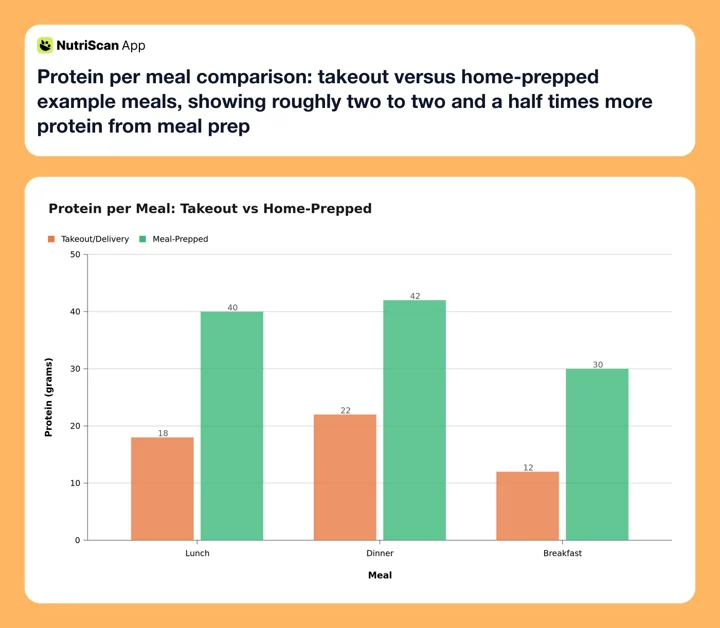 Figure 1: Home-prepped versions of the same meals carry roughly two to two and a half times the protein, which is what drives satiety and lean-mass retention during fat loss. These are illustrative example meals, not survey averages.
IMPORTANT
Checkpoint: halfway through the roadmap.
You're halfway - the practical part starts here.
⏱️ Progress 2/4 - ~2 minutes in - Keep going
✅ Step 1: Why meal prep beats any diet (done)
✅ Step 2: Three real professional schedules (done)
👉 Step 3: What the science says (current)
⏳ Step 4: The 6 rules that make prep stick
⏳ The Saturday habit (next)

What the Research Actually Says 🔬
The evidence behind meal prep is unusually consistent across study types.
The 2015 NHANES analysis of 9,569 adults found that people in households cooking dinner 6 to 7 nights a week consumed about 137 fewer calories per day (a 573 kJ gap), 16 grams less sugar, and 5 grams less fat than households cooking 0 to 1 nights (Wolfson and Bleich, PMC8728746). Multiply 137 calories by 7 days and you have a 959 kcal weekly gap, which works out to about 0.12 kg of fat a week using the usual 7,700 kcal per kg estimate. Treat that as a rough direction of travel, not a schedule. A fixed calories-per-kilogram rule overstates what actually happens over months, which is why NIH built a Body Weight Planner that models the curve instead.
A 2025 crossover trial published in Nature Medicine put 55 UK adults through two 8-week diets, one minimally processed and one ultra-processed, both built to meet national healthy-eating guidance. Both arms lost weight. The minimally processed arm lost about twice as much (2.1 percent of body weight against 1.1 percent) and ate roughly 327 fewer calories a day, despite both groups being told to eat to satisfaction (Dicken et al., Nature Medicine 2025). When you prep your own food, you are not just controlling calories. You are removing the engineered hyper-palatability that quietly drives over-eating.
A 2024 meta-analysis of 10 randomized controlled trials (n=1,254) in people with pre-diabetes found that adding commercial meal replacements to a weight-loss plan produced a small extra loss of about 1.4 kg over a food-based diet, at low to moderate certainty (Noronha et al., Obesity Reviews, PubMed 38693302). That effect comes from a portion someone decided in advance, which is exactly what a labeled container gives you for the price of the groceries.
Internal Macro Calculator
Want to know your exact calorie target before you start? Use the NutriScan macro calculator to get personalized numbers based on your height, weight, goal, and activity level. If you are new to counting calories, the calorie deficit diet chart for beginners walks through the basics.
Tips and Tricks: The 6 Rules That Make Prep Stick 💡
These are the rules that fix the specific reasons meal prep usually breaks down by week three.
1. Prep components, not finished dishes. A "prepped meal" should be three or four building blocks, not a sealed lasagna. Cook a batch of grain, a batch of protein, and a batch of vegetable. Mix daily. This kills food fatigue, the silent killer of week-two prep. The Mayo Clinic Diet, Mayo's commercial subscription program rather than its medical guidance, recommends the same batch-cooking approach: grill chicken for the week, chop vegetables in bulk, label containers by day (Beginner-friendly weight loss program with meal planning, Mayo Clinic Diet 2025).
2. Hit the protein floor before anything else. Set protein first, then build carbs and fats around it. A 2018 meta-analysis in the British Journal of Sports Medicine found no further training-related lean-mass gains above about 1.6 g of protein per kilogram of body weight a day, which makes it a sensible ceiling to aim at while losing fat and lifting (Morton et al., PMID 28698222). In practice that is 30 to 40 g at each of three meals plus a protein-containing snack. If you need snack ideas that hit that number, see our high-protein snacks guide. Use the NutriScan diet plan guide to build your personal protein target.
3. Batch-cook only what survives 5 days in the fridge. Grilled chicken, lentils, roasted sweet potato, sauteed greens, hard-boiled eggs: yes. Salad with dressing already mixed in, fried fish, anything with avocado already cut: no. Store dressings and sauces separately in 60 ml jars and add them in the morning.
4. Use a 3-2-1 container rule. Each lunch and dinner box gets 3 parts vegetable, 2 parts protein, 1 part starch by volume. This eliminates measuring during a busy weekday morning and is the simplest visual macro tool that works long-term.
Pro Tip: Vary Sauces, Not Bases
The same chicken-rice-greens becomes five completely different meals with five 60 ml sauce jars: lemon-tahini Monday, gochujang Tuesday, salsa verde Wednesday, peanut-lime Thursday, mustard-yogurt Friday. Ten minutes of sauce prep rescues an entire week.
5. Pre-portion snacks into single-serve bags. A 180 g bag of almonds is about 1,040 kcal you will absolutely eat in two sittings (USDA puts almonds at 579 kcal per 100 g). Six 30 g zip-lock bags is about 175 kcal each, exactly when you want one. Same nuts. Different outcome.
6. Cook the worst part first. Whatever step you hate most (chopping onions, cleaning chicken, washing greens) goes first while motivation is highest. The dish you enjoy assembling goes last. This is the single biggest reason prep blocks fail: people save the boring step for the end and quit at hour two.
IMPORTANT
Checkpoint: final stretch before the reveal.
One section left - then the Saturday habit that changes everything.
⏱️ Progress 3/4 - ~3 minutes in - Keep going
✅ Step 1: Why meal prep beats any diet (done)
✅ Step 2: Three real professional schedules (done)
✅ Step 3: What the science says (done)
✨ The Saturday 15-minute habit (about to reveal)
The 90-Minute Sunday Prep Block (Step-by-Step) ⏱️
You've read why it works and the six rules. Here is the exact sequence for your first Sunday. Total active time: 90 minutes. Total food: roughly 11 work meals plus daily breakfasts and snacks.
But first - the thing nobody talks about.
The Saturday 15-Minute Habit That Makes Sunday Easy
Almost every failed prep block fails on Saturday, not Sunday. People show up to cook on Sunday and spend the first 40 minutes wandering a supermarket, buying things they already own, and forgetting ingredients. By the time they start cooking it is 2 p.m. and they are already behind.
The fix takes 15 minutes on Saturday: decide your two protein bases, two carb bases, and two veg bases for the week, write the grocery list once, and order online or do one supermarket run. Nothing else. When you walk into Sunday's session with ingredients washed, trimmed, and staged, the 90-minute block runs at a relaxed pace instead of a panic.
This is the single habit that separates people who prep consistently for months from those who quit in week three. Prep starts on Saturday, not Sunday.
The Full Sunday Sequence
Step 1 - Pre-heat and prep stations (5 minutes). Pre-heat the oven to 200 C. Boil a kettle. Set out a large sheet pan, two saucepans, one chopping board for veg, one for raw protein. Wash all greens at once and spin-dry.
Step 2 - Roast protein and vegetables together (45 minutes, mostly hands-off). Toss diced sweet potato, chickpeas, and bell peppers in 1 tbsp olive oil, salt, paprika, and cumin. Roast 35 minutes. In the same pan, add chicken thighs (boneless, skinless) for the last 18 minutes. Cook to an internal temperature of 74 C, which is the FoodSafety.gov minimum for all poultry.
Step 3 - Cook grains and lentils in parallel (25 minutes). While the oven runs, simmer 1.5 cups of brown rice in 3 cups water (25 minutes), and cook 1 cup red lentils in 2.5 cups water with 1 tsp turmeric (15 minutes). Boil 6 eggs in a third pot for 9 minutes, then ice-bath. Three things cooking at once is the 90-minute secret: the oven, the stovetop grains, and the stovetop eggs run simultaneously.
Step 4 - Quick veg base (10 minutes). Saute 400 g of spinach, garlic, and ginger in 1 tsp olive oil for 4 minutes. Set aside. Make a yogurt-cucumber raita or a lemon-tahini sauce and store in 60 ml jars.
Step 5 - Portion into containers (15 minutes). Use 5 lunch containers and 5 dinner containers. Apply the 3-2-1 rule. Label lids with day and meal using a marker on masking tape (peels off cleanly). Place Monday and Tuesday at the front of the fridge. Freeze Thursday and Friday lunches, always: they sit past the 3-to-4-day refrigerated window no matter how cold your fridge runs.
Step 6 - Snack assembly (5 minutes). Six 30 g bags of almonds, five Greek yogurt cups (170 g, 0 percent fat) with a teaspoon of honey, five fruit servings (apple, pear, or banana). Done.
You now have 5 lunches, 5 dinners, 5 snacks, and 5 breakfasts (oats plus berries plus protein powder, mixed each morning) waiting for the week.
Common Mistake
Do not try to run Steps 2, 3, and 4 sequentially. The parallel method (oven + two stovetop pots running simultaneously) is what keeps the total time under 90 minutes. Running them one after another adds 45 minutes and kills the habit.
IMPORTANT
Recap: your full roadmap completed.
You finished the plan - save this page for next Sunday.
⏱️ Progress 4/4 - ~4 minutes in - Nicely done
✅ Step 1: Why meal prep beats any diet
✅ Step 2: Three real professional schedules
✅ Step 3: What the science says
✅ The Saturday 15-minute habit (revealed - prep starts on Saturday, not Sunday)
The Full 7-Day Calorie Template 📊
The template below runs about 1,600 kcal and 130 g of protein, which lands near a 0.5 kg per week loss for a moderately active adult of average size. Your own target depends on height, weight, sex and activity, so run it through the macro calculator rather than adopting 1,600 as a given. CDC puts a sustainable rate at about 0.5 to 1 kg a week, and says people who lose at that pace are the ones more likely to keep it off. If your calculated target lands well below this template, talk to a clinician before cutting further.
| Day | Breakfast | Lunch | Snack | Dinner | Total kcal |
|---|---|---|---|---|---|
| Mon | Oats, berries, whey (380) | Chicken, rice, peppers (520) | Yogurt + apple (220) | Lentil soup, roti, raita (480) | 1,600 |
| Tue | Eggs, toast, tomato (390) | Chickpea bowl, sweet potato (510) | Almonds, pear (250) | Chicken, greens, rice (450) | 1,600 |
| Wed | Greek yogurt, granola, berries (370) | Lentil dal, brown rice, cucumber (520) | Boiled egg, fruit (190) | Chicken stir-fry, veggies (520) | 1,600 |
| Thu | Oats, banana, peanut butter (400) | Chicken wrap, side salad (530) | Yogurt + nuts (240) | Chickpea curry, rice, raita (430) | 1,600 |
| Fri | Veggie omelette, toast (380) | Sweet potato, chicken, greens (510) | Apple + cheese (220) | Lentil soup, roti, salad (490) | 1,600 |
| Sat | Pancakes, berries, yogurt (440) | Eat out flexibly (600) | Coffee, almonds (180) | Grilled fish, vegetables (380) | 1,600 |
| Sun | Brunch eggs, fruit, toast (500) | Light salad, chickpeas (380) | Yogurt + berries (200) | Roast chicken, sweet potato, greens (520) | 1,600 |
Saturday lunch is intentionally flexible. The Mayo Clinic Diet's own beginner guidance says to allow room for treats in moderation so you do not feel deprived, and a planned flexible meal is easier to hold to than a perfect week you abandon on day nine. One restaurant lunch will not derail this template.
The chart below shows how each day's calories stack across meal types when following this template:
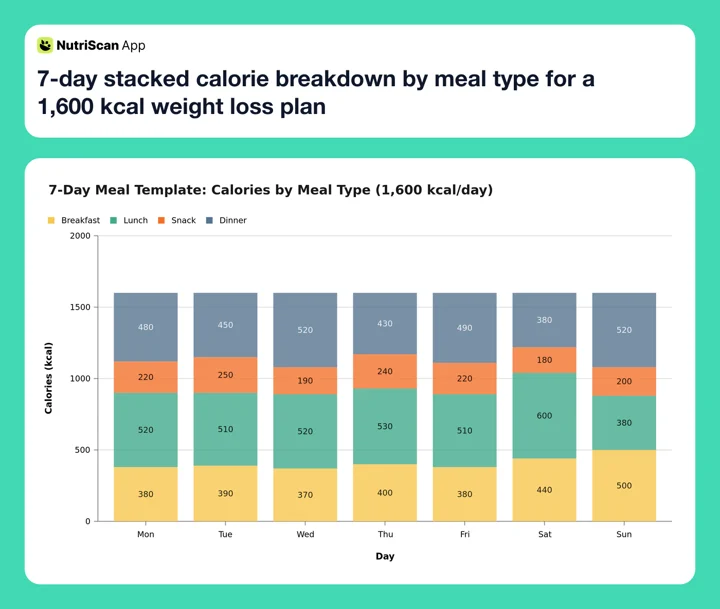 Figure 2: Calories hold at 1,600 across all seven days. Weekday lunch is the anchor meal at 510 to 530 kcal, with Saturday lunch left flexible at 600, and snacks are the smallest block at 180 to 250 kcal.
One-week grocery list for one adult (roughly $35-55, or Rs 1,200-2,400 in India). These are rough US and Indian metro estimates as of mid 2026 and vary by city and store:
- 1 kg chicken thighs or breast
- 6 eggs plus 1 dozen for breakfasts
- 500 g Greek yogurt
- 1 kg sweet potato
- 500 g brown rice
- 250 g red lentils
- 400 g chickpeas (canned or cooked)
- 500 g spinach
- 4 bell peppers
- 6 apples or pears
- 1 jar peanut butter
- 200 g almonds (six 30 g snack bags plus the Tuesday and Saturday servings)
- Oats, whey or plant protein, basic spices
Track Your Meals With NutriScan
Scan each prepped container once with the NutriScan app, then copy that entry every time the same meal comes round instead of re-scanning it. Use the meal scan guide to log your Sunday batch in a couple of minutes.

Tracking Your Prep With NutriScan 📱
Once your containers are portioned and labeled, scanning them takes under a minute per meal. NutriScan's AI identifies the food from a photo and estimates the macros even for home-cooked combinations.
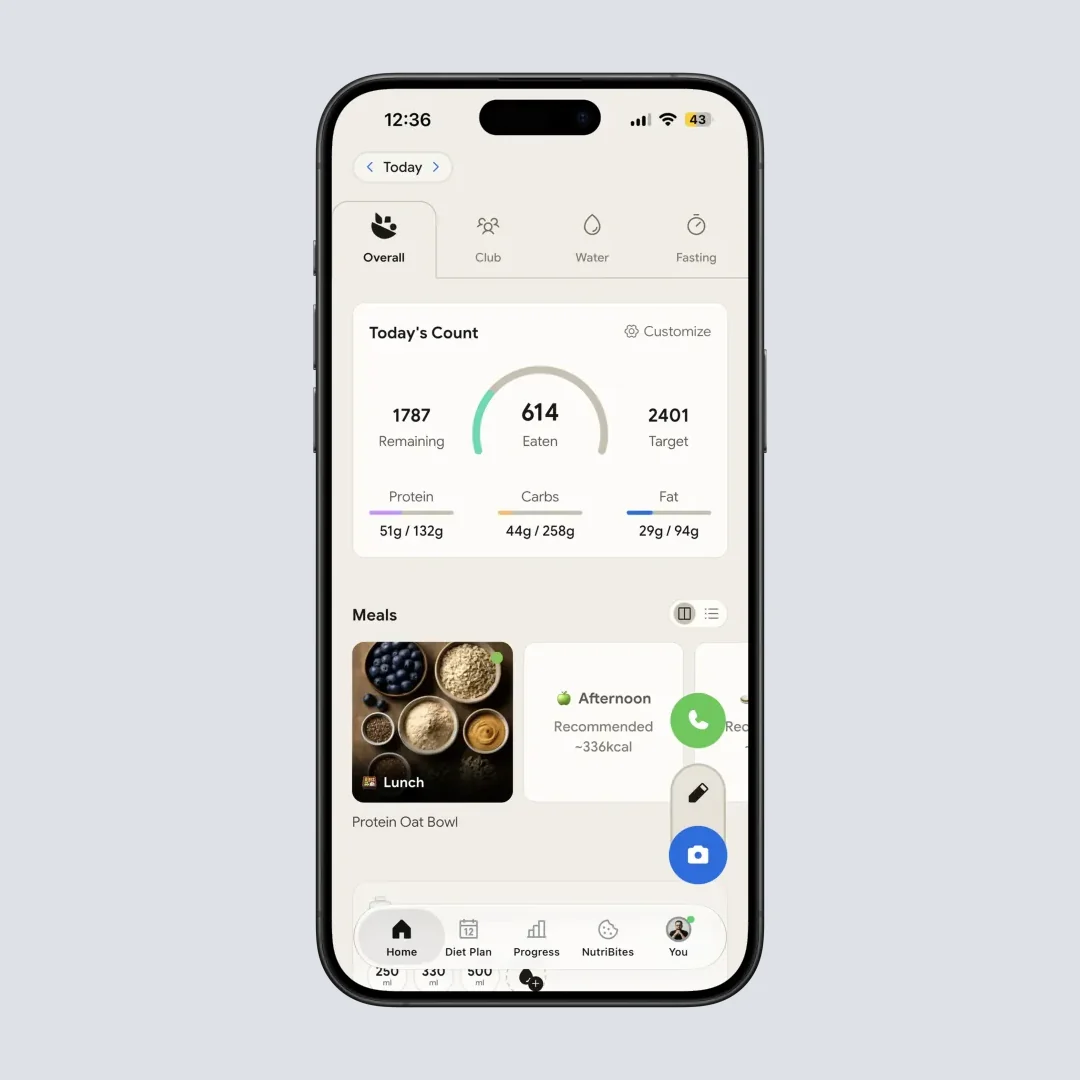
NutriScan Home - track today's calories, protein, carbs, and fat at a glance. The daily nutrition card updates with every logged meal.
For meal prep specifically, the home page nutrition card shows your running total as you log each container. If you hit your protein target by lunch, the card confirms it in real time - no spreadsheet needed. Use the NutriScan insights guide to review your weekly patterns after the first prep cycle.
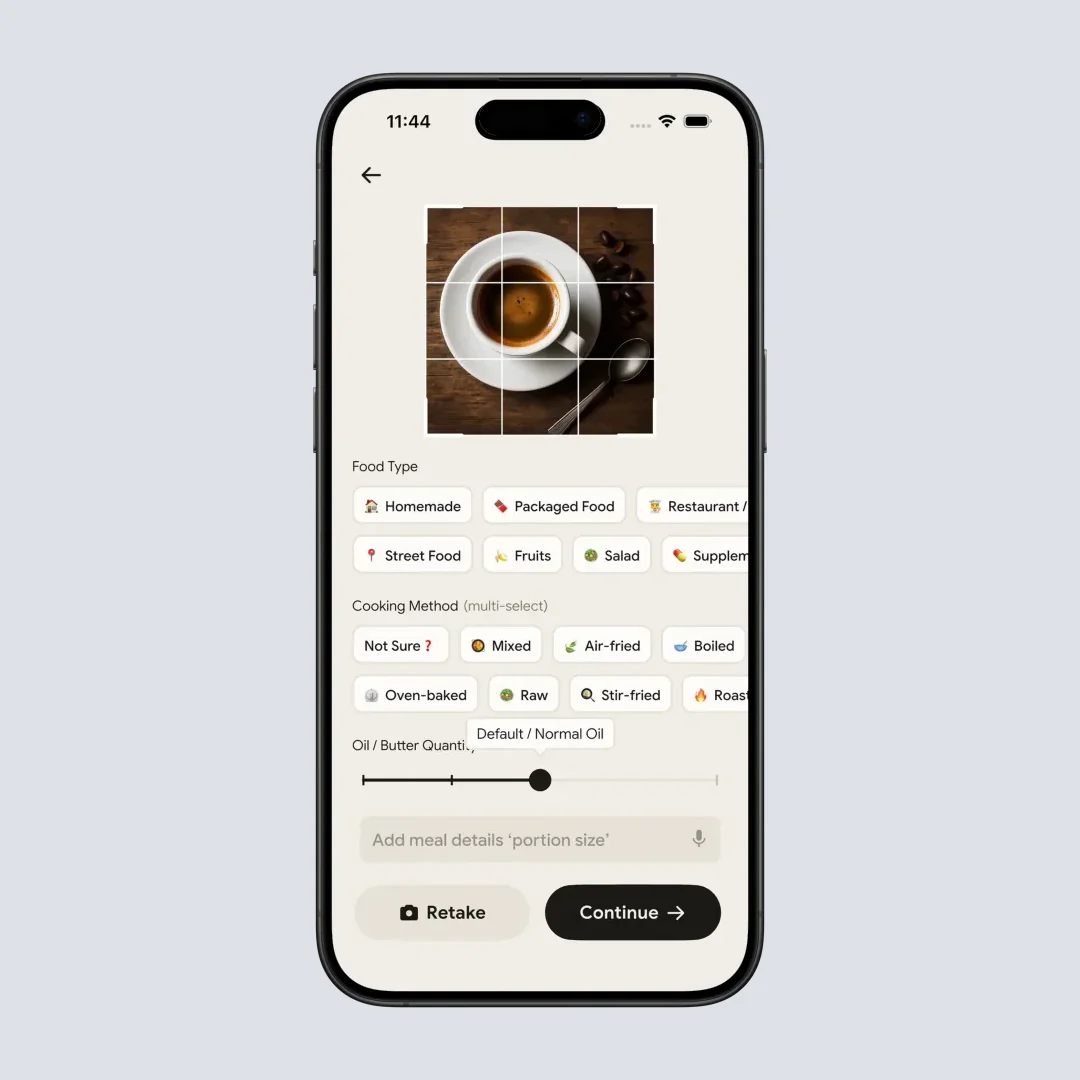
Home > Camera icon > Crop and scan - takes under 20 seconds to log a full prepped container.
Common Meal Prep Mistakes to Avoid ⚠️
Even good prep plans get derailed by the same handful of mistakes. Watching for these in your first month saves weeks of stalled progress.
Cooking too much variety in week one. New preppers try seven different cuisines on day one and burn out by Wednesday. Start with three repeating templates and expand only after a full month of consistency.
Under-seasoning the bulk batches. Plain chicken and plain rice get boring fast. Season generously: one teaspoon of salt per 500 g of protein, plus aromatic spices (cumin, paprika, garlic, ginger) before cooking, not after.
Skipping protein at breakfast. NHANES per-meal figures put US adults at roughly 12 to 16 g of protein at breakfast and 30 to 45 g at dinner, which leaves most of the day's protein until the evening (per-meal NHANES intakes, PMC5872778). Front-load 30 g at breakfast (Greek yogurt, eggs, whey shake) and the evening plate has less work to do.
Storing in oversized containers. A 1-liter tub of stew encourages two-portion eating. Use single-serve 500 ml containers so the portion is decided before hunger arrives.
Treating Saturday as a free-for-all. A planned flexible meal is fine. An unplanned 2,500 kcal weekend day undoes Monday through Friday. Keep one meal flexible, not the whole day.
Quitting after one bad week. In our own experience running this plan, week three is where the novelty has worn off and the scale has not caught up yet, and it is the most common place people stop. Treat that week as the test, not the verdict.
The Week 3 Wall
Week 3 is when meal prep feels most tedious and results feel slowest. This is normal, and it is an observation from running the plan rather than a published finding. Push through and week 4 tends to run itself.
 Consistency beats perfection every single week. One bad meal does not break a good plan.
Frequently Asked Questions ❓
Q: How long does prepped food actually stay safe in the fridge? A: FoodSafety.gov's cold-storage chart gives cooked meat, poultry and vegetable-based leftovers 3 to 4 days in a fridge at 4 C or below, and hard-cooked eggs a full week. Thursday and Friday meals fall outside that window from a Sunday prep, so freeze them on Sunday and move them to the fridge on Wednesday night. Cut fruit and washed greens degrade fastest, so store those whole and prep on the morning of use.
Q: I work 11-hour shifts. When should I cook? A: Pick your slowest day, not necessarily Sunday. Many shift workers prep on their first off-day. What matters is that the day is fixed and repeatable, so the shopping and cooking stop competing for a slot each week. Nobody has run a study comparing prep days, so treat this as practical advice rather than a research finding.
Q: Can I lose weight on meal prep without counting calories? A: Portion control gets you most of the way there, if your boxes follow the 3-2-1 rule and your protein floor is met at every meal. In the 2025 Nature Medicine crossover trial, the minimally processed arm ate roughly 327 fewer calories a day and lost about twice as much weight as the ultra-processed arm, with neither group counting anything (Dicken et al., Nature Medicine 2025). Counting accelerates results, but prep alone does most of the work.
Q: How do I avoid getting bored of the same meals? A: Vary sauces and spice mixes, not base ingredients. Same chicken plus rice plus greens becomes lemon-tahini Monday, gochujang Tuesday, salsa verde Wednesday, peanut-lime Thursday, mustard-yogurt Friday. Five sauces in 60 ml jars takes 10 minutes and rescues an entire week of repetition.
Q: Will eating cold prepped food slow my metabolism or hurt digestion? A: No. In a 2015 trial, rice cooled at 4 C for 24 hours and then reheated carried more resistant starch and produced a significantly lower glycemic response than freshly cooked rice (Sonia et al., PMID 26693746). Resistant starch also feeds gut bacteria. One thing worth compensating for: vitamin C in leafy greens drops sharply within the first few days of refrigerated storage, with mature spinach losing around 80 percent by day 3 (Dewhirst et al. 2017, PMC5441274), so add a fresh fruit serving.
Q: Is meal prep cheaper than eating out? A: Almost always. A week of office lunches plus two delivery dinners tends to run $80 to $140 in US cities and Rs 2,500 to Rs 4,500 in Indian metros. The grocery list above runs $35 to $55 or Rs 1,200 to Rs 2,400 for the same number of meals. Depending on where you live and what you order, that is roughly a third to three quarters off your food spend. These are rough US and Indian metro estimates as of mid 2026, not survey figures.
Conclusion
The shortest version of this plan is one sentence: pick a 90-minute block once a week, cook five components, and let your future self assemble.
Weight loss for a busy professional is not won at the gym at 6 a.m. It is won on a Sunday at 4 p.m., when you make the next 120 hours of meals impossible to mess up. The reason this works for people who have failed at every other diet is that it removes the weakest link - decision-making at the end of a long day. When food is already in the fridge, weighed and labeled, the calorie target hits itself.
And remember the Saturday habit: those 15 minutes of planning the night before are what turn a chaotic Sunday sprint into a smooth Sunday session. Prep starts on Saturday.
Track your calorie targets and protein floors with NutriScan, the AI nutrition app that reads home-cooked meals from a photo and lets you copy an earlier meal instead of logging the same container five times. The first prep block is the hardest. By week three, it will feel shorter than ordering dinner.