Indian Calorie Deficit Diet Chart for Beginners (2026)
 ChatGPT
  Claude
  AI Mode
  Perplexity
What if the weight loss chart you actually stick to is the one built on dal, roti, and your own kitchen? 🍛
TL;DR - Indian Calorie Deficit Chart for Beginners
• Who it's for: Beginners who eat from an Indian kitchen and want a realistic 400-600 kcal deficit without giving up dal, roti, or rice
• The core method: Half plate vegetables ➡️ quarter plate protein (dal, paneer, eggs, chicken) ➡️ quarter plate carbs ➡️ curd or buttermilk on the side
• The numbers: Women start at 1,500-1,700 kcal, men at 1,800-2,100 kcal; protein at 1.4-1.6 g per kg body weight
• What's inside: A full 7-day chart (1,500-1,600 kcal) with veg and non-veg swaps, honest katori-level portion anchors, and three worked examples
• Expected pace: 0.4-0.8 kg per week in month one, slowing to 0.3-0.5 kg per week after
The first time I sat with a new client who wanted to lose weight, she opened her phone and showed me four screenshots. A 1,200 calorie chart from a US blog. A keto chart from a YouTube reel. A "GM diet" chart from a forwarded WhatsApp PDF. And one of her mother's handwritten notes on a steel dabba lid. None of them mentioned dal. None of them mentioned roti. None of them asked how many people she cooked for, or whether her kitchen made one sabzi or three. She was trying to follow a foreign chart in an Indian kitchen, and she was already losing.
As a NutriScan nutritionist, I have walked dozens of beginners through this exact moment. A calorie deficit is not a Western idea, and it does not need a foreign food list to work. The Indian Council of Medical Research's National Institute of Nutrition released a revised Dietary Guidelines for Indians in May 2024, and its core message is simple: build the plate around our own foods, balance cereals with dals and vegetables, and respect the body's real energy need (ICMR-NIN Dietary Guidelines for Indians, 2024). This guide turns that message into a real chart you can eat from this week.
IMPORTANT
Your Indian calorie deficit plan at a glance.
A quick roadmap so you can act fast.
⏱️ Progress 0/4 • ~0 minutes in • Keep going
⏳ Step 1: Find your honest calorie number
⏳ Step 2: Build the deficit plate + protein
⏳ Step 3: Eat from the 7-day chart
🔍 The 300 kcal mistake that erases the whole deficit (revealed near the end)
What "Calorie Deficit" Actually Means in an Indian Kitchen 🍛
A calorie deficit is the gap between what your body burns in a day and what you eat. Eat less than you burn, and the body uses stored fat to fill the gap. That is the entire mechanism. There is no secret food, no fat burning chai, no need to drop rice forever.
The Centers for Disease Control and Prevention recommends a gradual rate of 1 to 2 pounds (about 0.5 to 1 kg) per week for safer, more durable weight loss (CDC Steps for Losing Weight, 2024). Mayo Clinic puts the math at burning roughly 500 to 750 more calories than you eat per day to land in that range (Mayo Clinic Weight Loss).
For an Indian beginner, those numbers translate into very ordinary moves:
- Eat one less roti than you used to at dinner.
- Replace the second cup of rice with a katori of sabzi.
- Stop the 4 pm biscuit habit.
- Walk 30 minutes most evenings.
That is often the full 500 calorie shift, before any chart begins. The chart in this article is for the next layer, when you want a clean structure to follow.
 The deficit starts in your own kitchen, not in an imported food list
Step 1: Find Your Honest Calorie Number 🔢
Free online calculators hand a 30 year old Indian woman a number like 1,200 and a 35 year old Indian man a number like 1,800. Please do not eat at the bottom of those numbers for weeks. The 2020 RDA brief from the National Institute of Nutrition sets the reference adult Indian woman at about 2,130 kcal per day for sedentary work and the reference adult Indian man at about 2,710 kcal per day, with higher values for moderate and heavy work (NIN Brief Note on Nutrient Requirements).
A safer starting calorie chart for a first-time deficit:
| Profile | Maintenance (kcal) | Deficit target (kcal) |
|---|---|---|
| Sedentary woman, 25-40, 55-70 kg | 1,800-2,100 | 1,500-1,700 |
| Active woman (desk job + 8,000 steps), 25-40, 55-75 kg | 2,000-2,300 | 1,600-1,800 |
| Sedentary man, 25-45, 70-85 kg | 2,200-2,600 | 1,800-2,100 |
| Active man (daily walks or gym), 25-45, 75-90 kg | 2,500-2,900 | 2,100-2,400 |
Start higher, not lower
If you are 10 kg or more over your healthy weight, start at the upper end. The body responds better to a 400 to 600 calorie gap than an 800 calorie crash. A review in PMC notes that very low calorie diets without exercise tend to strip lean mass and rebound, while moderate deficits with movement protect muscle and results hold up better (Janssen et al., 2023).
If you want your exact protein, carb, and fat split for your number, our macro calculator does the math in under a minute.
IMPORTANT
Checkpoint: here's where you are right now.
Quick status update so you always know the next best move.
⏱️ Progress 1/4 • ~1 minute in • Keep going
✅ Calorie number (done)
👉 Deficit plate + protein (you're here)
⏳ 7-day chart
🧩 The 300 kcal mistake (coming soon)

Step 2: The Beginner's Calorie Deficit Plate (Indian Edition) 🥗
Forget weighing 17 ingredients per meal. The plate model below works in any Indian kitchen, vegetarian or not.
- Half plate: vegetables. Cooked sabzi, salad, palak, lauki, bhindi, beans, gobi, mixed greens.
- One quarter plate: dal, paneer, eggs, fish, chicken, soya, sprouts, curd, or tofu. This is your protein corner. Beginners under-eat here almost every time.
- One quarter plate: carb. Rice, roti, paratha (no extra ghee), dosa, idli, poha, upma, or millets like jowar, bajra, ragi.
- Side: one small katori of curd or buttermilk, with one fruit at a different time of day.
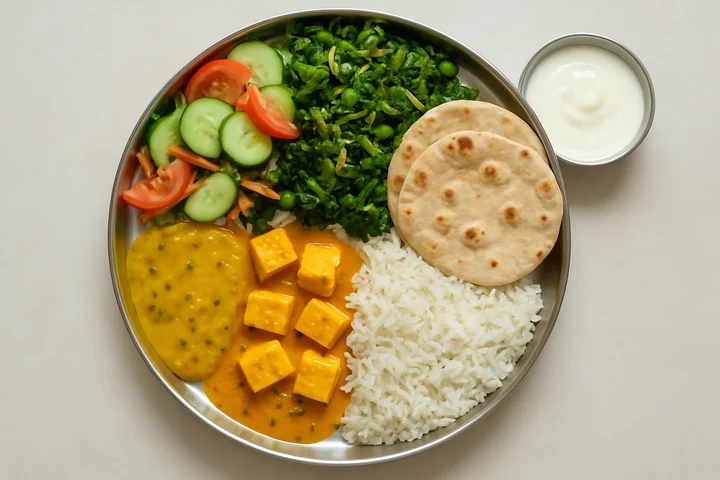 The beginner's deficit plate: half vegetables, one quarter protein, one quarter carbs, curd on the side
A typical 1,600 calorie Indian woman's lunch on this plate:
- 1 cup palak sabzi (around 120 kcal)
- 1 katori dal (around 150 kcal)
- 2 small phulkas (around 160 kcal)
- 1/2 cup curd (around 60 kcal)
- 1/2 cucumber and 1 carrot salad (around 30 kcal)
Total: roughly 520 kcal, with about 22 g protein and 10 g fiber. That is the engine of the chart, and you can repeat it five days a week without boredom by changing the sabzi and dal alone.
Let the app do the portion math
Eyeballing a katori is the hardest part of week one. NutriScan can scan your plate from a photo (@Path: Home > Camera Icon > Click Picture), estimate portions, and log calories and protein automatically.
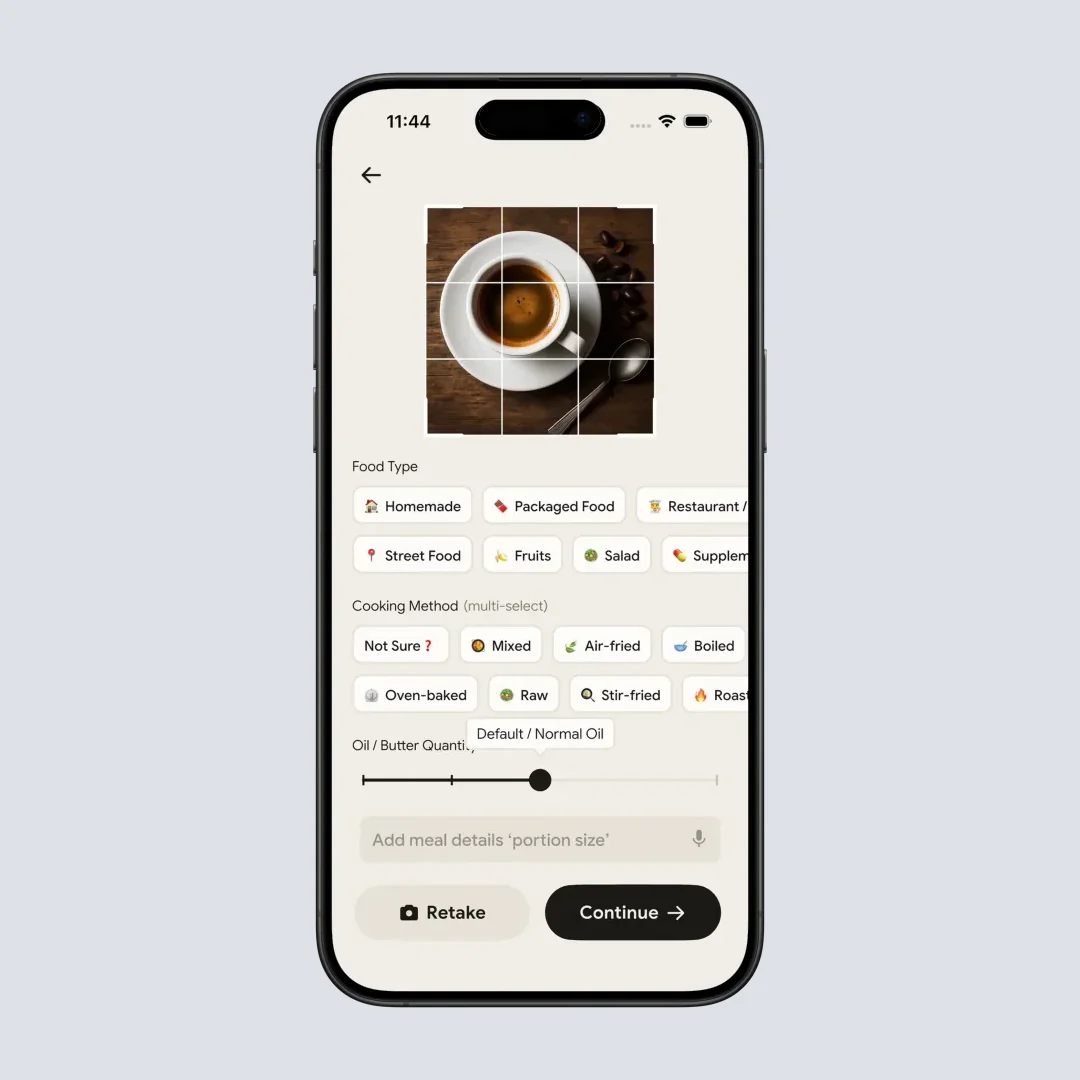
Scan your dal-roti plate in seconds: Home > Camera Icon > Click Picture > Crop Picture
Step 3: Get Protein Right (the Most Skipped Step) 💪
Protein is the first thing beginners drop and the last thing they count, and a deficit without enough of it costs muscle along with fat. A 2022 meta-analysis in PMC found that combining protein intake of about 1.6 g per kg body weight with resistance training improved lean mass and reduced fat mass during energy restriction (Nunes et al., 2022).
A friendly Indian translation:
- 60 kg woman: target 75 to 95 g protein per day.
- 70 kg woman or 70 kg man: target 90 to 110 g per day.
- 85 kg man: target 110 to 130 g per day.
How to actually hit it from Indian food, in real katori sizes (Figure 1 ranks the dense sources first):
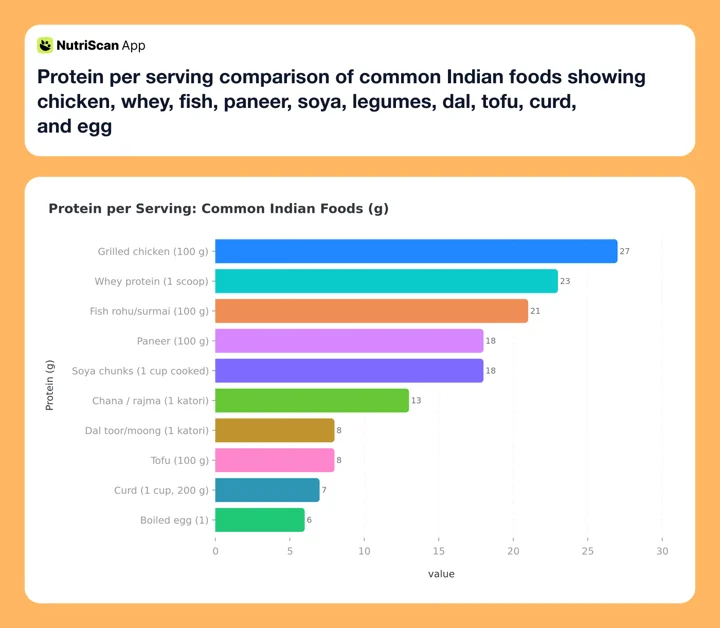 Figure 1: Protein per serving from common Indian foods - build meals from the top half of this chart
- 1 katori dal (toor, moong, masoor): 7 to 9 g
- 1 katori chana or rajma: 12 to 15 g
- 100 g paneer: 18 g
- 100 g tofu: 8 g
- 1 cup curd (200 g): 7 g
- 1 boiled egg: 6 g
- 100 g grilled chicken: 27 g
- 100 g fish (rohu, surmai, tilapia): 20 to 22 g
- 1 cup soya chunks (cooked): 18 g
- 1 scoop whey protein: 22 to 25 g
A beginner who eats two katoris of dal, one paneer or paneer-substitute meal, two cups of curd, and either eggs or soya at one meal will sit close to target without thinking. Protein is what stops the deficit from feeling like punishment.
IMPORTANT
Checkpoint: midway progress update.
You're halfway - decisions get easier here.
⏱️ Progress 2/4 • ~3 minutes in • Keep going
✅ Calorie number (done)
✅ Deficit plate + protein (done)
👉 7-day chart (current)
⏳ The 300 kcal mistake (next)
Step 4: The 7 Day Calorie Deficit Chart (1,500 to 1,600 kcal, Indian Edition) 📅
This is a vegetarian-first chart, with non-veg swaps under each day. Portions are for a beginner around 60 to 70 kg targeting a 400 to 500 kcal daily gap. Adjust roti or rice down for smaller bodies, up for larger. Figure 2 shows how each day's budget splits across the five meals.
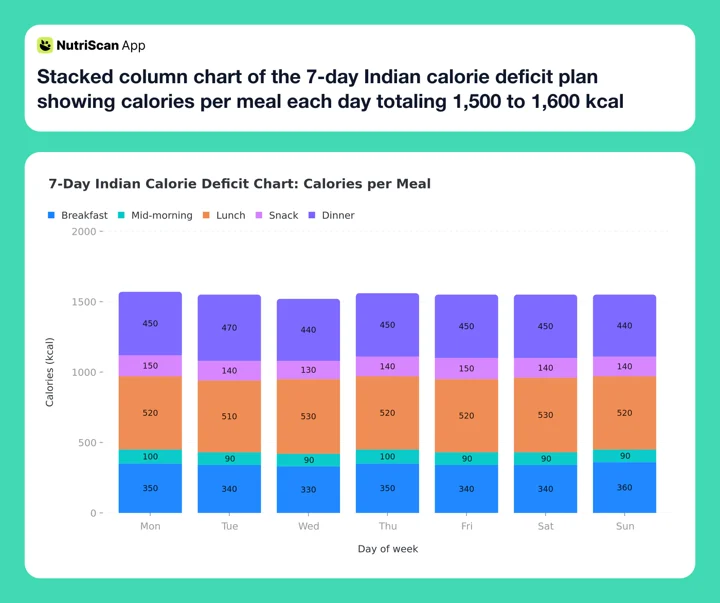 Figure 2: How the daily 1,500-1,600 kcal budget splits across five meals - lunch and dinner carry the load, snacks stay light
Day 1 (Monday)
- Breakfast (350 kcal): 2 vegetable besan chillas, 1 cup curd, 1 cup chai with toned milk, no sugar. Non-veg swap: 2 egg omelette with onion, tomato, 1 multigrain toast.
- Mid-morning (100 kcal): 1 apple.
- Lunch (520 kcal): 1 katori dal, 1 cup palak paneer (50 g paneer), 2 phulkas, salad.
- Snack (150 kcal): 1 cup buttermilk, 10 roasted chana.
- Dinner (450 kcal): 1 katori mixed veg sabzi, 1 katori rajma, 1 phulka, salad. Non-veg swap: 100 g grilled chicken, 1 katori sabzi, 1 phulka.
Day 2 (Tuesday)
- Breakfast (340 kcal): 2 idlis with 1 cup sambhar and small bowl coconut chutney (light). Non-veg swap: same, add 1 boiled egg.
- Mid-morning (90 kcal): 1 small banana.
- Lunch (510 kcal): 1 cup curd rice with tempering, 1 katori moong dal, salad.
- Snack (140 kcal): Sprouts chaat (1 cup) with lemon and onion.
- Dinner (470 kcal): 1 cup tofu bhurji or paneer bhurji, 2 phulkas, salad. Non-veg swap: 100 g fish curry, 2 phulkas, salad.
Day 3 (Wednesday)
- Breakfast (330 kcal): 1 cup vegetable poha with peanuts, 1 cup chai. Non-veg swap: add 1 boiled egg.
- Mid-morning (90 kcal): 1 pear.
- Lunch (530 kcal): 1 cup brown rice, 1 katori chole, 1/2 cup raita, salad.
- Snack (130 kcal): Handful (20 g) almonds and walnuts.
- Dinner (440 kcal): 1 katori lauki dal, 2 phulkas, 1 katori bhindi sabzi. Non-veg swap: 100 g grilled chicken tikka, 1 phulka, salad.
Day 4 (Thursday)
- Breakfast (350 kcal): 2 moong dal cheelas with 1/2 cup curd, 1 cup chai. Non-veg swap: 2 eggs scrambled with veggies, 1 toast.
- Mid-morning (100 kcal): 1 orange.
- Lunch (520 kcal): 1 katori dal, 1 katori soya chunks curry, 2 phulkas, salad.
- Snack (140 kcal): 1 cup chai with toned milk, 2 marie biscuits or 1 small fruit.
- Dinner (450 kcal): 1 cup vegetable khichdi with 1 cup curd, salad. Non-veg swap: 100 g fish, 1 cup khichdi, salad.
Four days down, three to go. Still building to that 300 kcal mistake - it hides inside meals exactly like these.
Day 5 (Friday)
- Breakfast (340 kcal): 2 ragi dosas with chutney. Non-veg swap: 1 dosa, 1 egg bhurji.
- Mid-morning (90 kcal): 1 guava.
- Lunch (520 kcal): 1 katori rajma, 1 cup rice, 1/2 cup curd, salad.
- Snack (150 kcal): Roasted makhana 1 cup with mild salt.
- Dinner (450 kcal): 1 cup paneer bhurji (60 g paneer), 2 phulkas, salad. Non-veg swap: 100 g grilled chicken breast, salad, 1 phulka.
Day 6 (Saturday)
- Breakfast (340 kcal): 1 stuffed methi paratha (no extra ghee on top) with 1/2 cup curd. Non-veg swap: same, with 1 boiled egg.
- Mid-morning (90 kcal): 1 apple.
- Lunch (530 kcal): 1 cup jeera rice, 1 katori dal tadka, 1 cup mix veg sabzi, salad.
- Snack (140 kcal): 1 cup buttermilk, 1 small fruit.
- Dinner (450 kcal): Restaurant or home cooked treat meal. Pick 1 protein (paneer tikka, dal makhani, grilled chicken), 1 roti, and skip the dessert and naan. Non-veg swap: same rules.
Day 7 (Sunday)
- Breakfast (360 kcal): 1 cup vegetable upma with peanuts and curry leaves. Non-veg swap: 2 eggs with veggies, 1 toast.
- Mid-morning (90 kcal): 1 cup watermelon or papaya.
- Lunch (520 kcal): 1 katori chana masala, 1 cup rice, salad, 1/2 cup curd.
- Snack (140 kcal): 1 cup masala chai and 1 small fruit.
- Dinner (440 kcal): 1 cup mixed dal, 2 phulkas, lauki sabzi. Non-veg swap: 100 g chicken curry, 1 phulka, salad.
Daily totals land in the 1,500 to 1,640 range. If you weigh in heavier, add 1 phulka at lunch and dinner, or a 100 g curd serving, to push to 1,800 kcal.
Want this chart personalized?
NutriScan's Diet Plan builds a 28-day plan around your weight, food preferences, and budget, with a grocery list included (@Path: Home > Bottom Nav Diet Plan). If you prefer a women-specific or men-specific plan first, read our vegetarian weight loss diet for Indian women or weight loss diet plan for Indian men in their 30s.
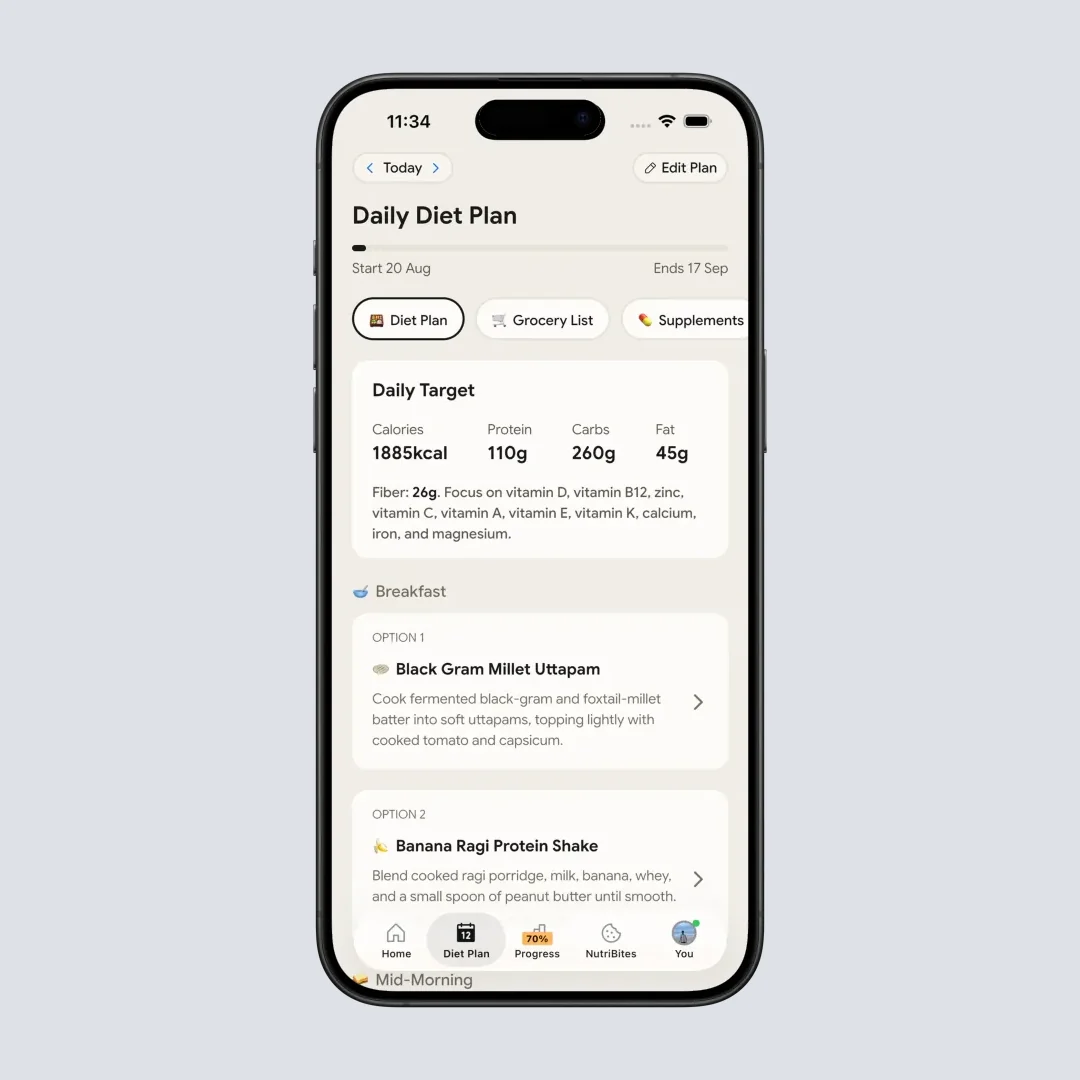
A personalized 28-day plan with macros and grocery list: Home > Bottom Nav Diet Plan
IMPORTANT
Checkpoint: final stretch before the reveal.
One last nudge - the reveal is next.
⏱️ Progress 3/4 • ~5 minutes in • Keep going
✅ Calorie number
✅ Deficit plate + protein
✅ 7-day chart
✨ The 300 kcal mistake (about to reveal)
Step 5: The 300 kcal Mistake That Erases the Whole Deficit ⚖️
You have been patient. Here it is: two extra rotis and one extra spoon of ghee add about 300 kcal to a single meal. That is the entire daily deficit gone before dessert, on a day when you technically "followed the chart." It is not the biryani or the wedding buffet that stalls most beginners. It is the quiet refill ➡️ the extra roti ➡️ the generous ghee hand, repeated twice a day.
Calorie counts only work when portion sizes are honest. A "katori" in one home is 150 ml. In another it is 250 ml. The PMC 2024 comparison of dietary guidelines across countries calls portion realism the single biggest gap between published charts and what households actually eat (Manoj et al., 2025).
Use these honest anchors:
| Food | Honest portion | Calories |
|---|---|---|
| 1 phulka (small, 6 inch, no ghee) | 1 piece | 70-80 kcal |
| 1 large roti (8 inch, light ghee) | 1 piece | 120-140 kcal |
| 1 stuffed paratha (aloo or paneer) | 1 piece | 220-280 kcal |
| Cooked white rice | 1 cup | 200-220 kcal |
| Cooked brown rice | 1 cup | 215 kcal (3.5 g fiber) |
| Dal (medium thickness) | 1 katori (150 ml) | 130-160 kcal |
| Sabzi (light oil) | 1 katori | 90-130 kcal |
| Curd (low fat) | 1 cup (200 g) | 100 kcal |
| Curd (full fat) | 1 cup (200 g) | 150 kcal |
| Ghee or oil | 2 tsp per dish | 80-90 kcal |
This is why the anchors above matter more than any superfood list. Beat the 300 kcal mistake and the chart does the rest.
Three Example Schedules the Chart Has to Survive 🧑🤝🧑
These are composite examples, not case studies. They show how the chart bends around three common schedules.
The weekend biryani schedule. Take a 32 year old software engineer at 71 kg: two cups of sugared chai a day, late biryani dinners on Saturdays. Saturday biryani stays. Monday to Friday runs on the chart above, chai drops to one cup with no sugar, and a 30 minute walk goes in after dinner. Nothing else in the kitchen changes.
The long client lunch. Take a 41 year old in sales at 92 kg, eating out with clients most weekdays. Add an egg breakfast, use the 2,200 kcal row on the male chart, and hold protein near 120 g a day. The usual butter chicken stays on the table, ordered with one roti and salad instead of naan and a second helping of rice.
The shared kitchen. Take two people cooking from one pot, a woman and her mother-in-law, both wanting to lose weight without separate meals. Keep the kitchen exactly as it is and change only the plate ratios: half vegetables, one quarter dal or paneer, one quarter rice or roti. No separate cooking, no second menu.
In all three, the pace to expect is the CDC range at the top of this article, not a dramatic drop.
 A chart you can keep is a chart that survives Saturday, the client lunch, and the shared kitchen
Tips and Tricks That Save the Chart on Real Days 💡
- Pre-cook two dals on Sunday. A weekday dal habit is what keeps protein at 80 g.
- Buy frozen vegetables. Bhindi, beans, peas, mixed veg. They save a "skip the sabzi" night.
- Pre-portion rice. Cook 1 cup at lunch, not 3. Refill is a chart killer.
- Cut chai sugar in half this week, then half again next week. Cold turkey rarely lasts.
- Bring your own snack to the office. Roasted chana, fruit, curd cup. The vending machine is the enemy of any chart.
- Drink 2 to 3 liters of water. Thirst often shows up as evening hunger.
- Weigh on the same weekday morning, not daily. Daily weights mislead beginners.

Step-by-Step: How to Start This Week 🚀
- Day 0 (today): Pick a sedentary or active row from the calorie table and write your number on a sticky note on the fridge.
- Day 1: Eat from Day 1 of the chart. Track protein katoris, not full calorie counting yet.
- Day 3: Add a 20 minute walk after dinner.
- Day 5: Cut chai sugar by half. Add one curd or buttermilk cup daily.
- Day 7: Weigh on the same scale, same time as Day 1. Note the number, do not react.
- Week 2: Repeat. Add a second walk if energy allows.
- Week 4: Re-check the scale and waist. If both moved, hold the plan. If neither moved in 3 weeks, drop 100 to 200 kcal or add 2,000 daily steps.
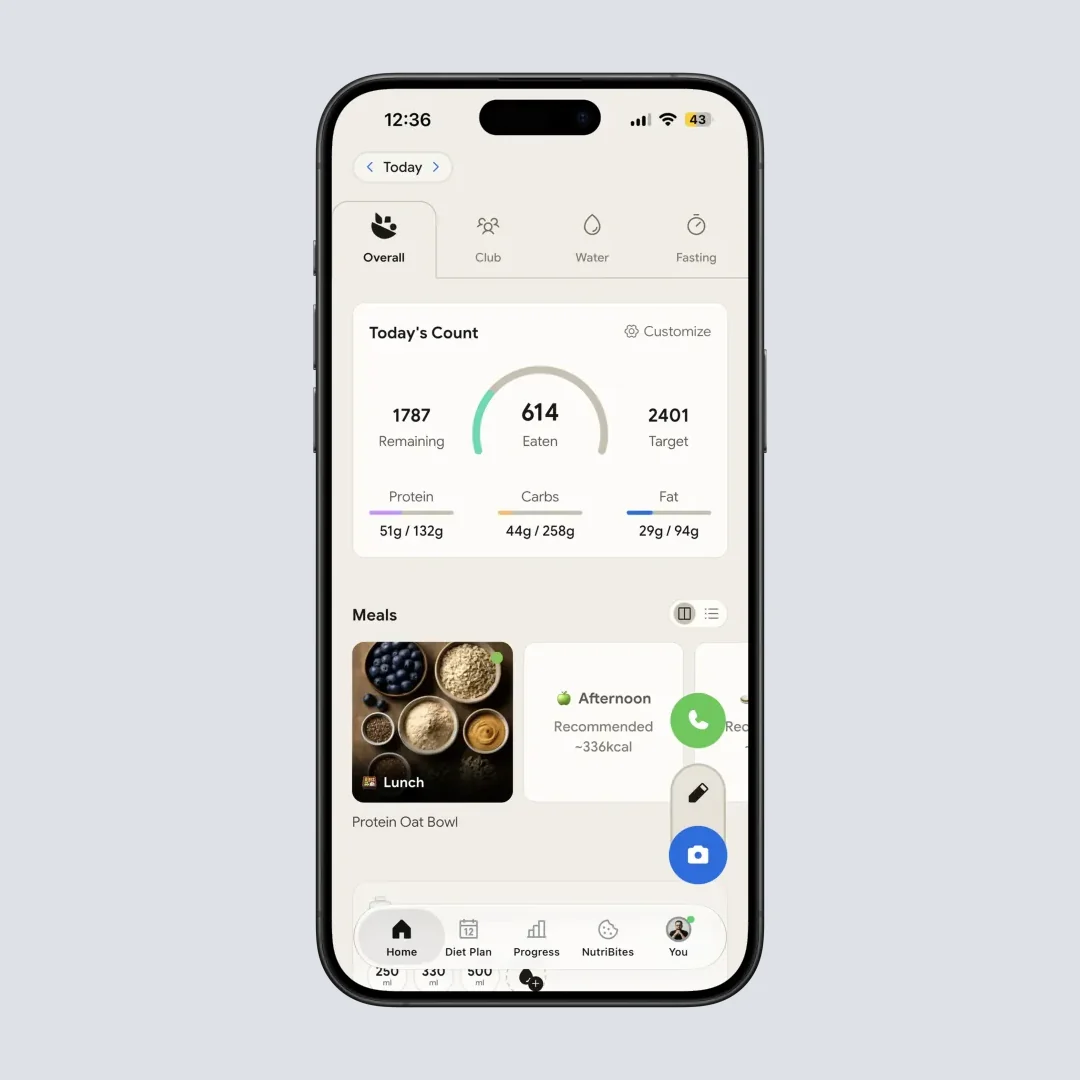
Your daily calorie and macro count at a glance on the NutriScan home screen
What Research Says About Slow Indian-Style Deficits 🔬
A 2024 paper in PMC reviewed the May 2024 ICMR-NIN dietary guidelines against ten other national guidelines and noted that the Indian recommendations now place a stronger emphasis on legumes, pulses, and traditional cereal-pulse combinations for both protein quality and cardio-metabolic health (Manoj et al., 2025). The same review highlighted that pairings like dal-rice, dal-roti, and curd-paratha already supply complementary amino acids that beginners do not need to engineer separately.
That matters for deficit dieting because a chart built on dal, roti, and curd is not a "compromise" version of a Western plan. It is a complete protein delivery system that costs less, takes less time, and runs on what your kitchen already has. If a foreign plan has failed you before, our piece on why "proven" weight loss advice damages Indian bodies explains the mismatch in depth.
A 2022 meta-analysis showed that protein at 1.6 g per kg combined with resistance training delivers the largest gain in lean mass and largest fall in fat mass during a deficit (Nunes et al., 2022). Resistance training for an Indian beginner can be as simple as bodyweight squats, push-ups against a wall, and a 5 kg dumbbell at home. You do not need a gym for the first 12 weeks.
Conclusion: Build the Plate, Trust the Math ✅
IMPORTANT
Recap: everything you completed this round.
You finished the run - save this for next time.
⏱️ Progress 4/4 • ~7 minutes in • Nicely done
✅ Calorie number
✅ Deficit plate + protein
✅ 7-day chart
✅ The 300 kcal mistake (revealed)
A calorie deficit chart only works when you can eat from it on a normal Tuesday at home. The Indian chart above gives you that. Plate ratios, real katori sizes, honest calorie counts on roti and rice, and a protein target you can hit from dal, paneer, eggs, fish, or chicken.
The deeper truth is that you do not need to fight Indian food to lose weight. You need to portion it, balance the plate, protect protein, and stay in the chart for long enough to see the result. Walk every day, sleep 7 hours, and let week 12 do what week 1 cannot.
If you want a hands-free way to keep this chart honest, NutriScan can scan your dal-rice plate, estimate the katori size, log the calories, and remind you when your daily protein is short. It will not replace your kitchen sense. It will protect it on long days. Download NutriScan and scan your first plate today.
FAQ ❓
1. Is a 1,200 calorie diet safe for an Indian woman who wants to lose weight fast?
For most adult Indian women, a sustained 1,200 calorie target is below the maintenance baseline cited in the 2020 ICMR-NIN reference values and tends to under-deliver protein, iron, and B12 (NIN Brief Note). 1,500 to 1,700 kcal with adequate protein is usually a safer starting point and works better over 12 weeks.
2. Can I eat rice every day and still lose weight?
Yes. Rice is not the problem. Portion is. One cup of cooked rice (200 to 220 kcal) fits inside a 500 kcal lunch easily when paired with dal, sabzi, and curd. Beginners gain weight from 3-cup rice servings and ghee on top, not from rice as a category.
3. How much protein should a vegetarian Indian beginner aim for in a deficit?
Around 1.4 to 1.6 g per kg body weight per day, mostly from dal, paneer, curd, soya, and sprouts. A 60 kg woman should target 80 to 95 g. The 2022 PMC meta-analysis on protein and resistance training supports this range for muscle protection during weight loss (Nunes et al., 2022).
4. Do I need to give up chai, sugar, and ghee?
No. Cap chai to two cups, halve the sugar weekly, and keep ghee at 1 to 2 teaspoons per meal. The Mayo Clinic note on weight loss is clear that small, repeatable cuts beat dramatic eliminations (Mayo Clinic).
5. How fast will I lose weight on this Indian chart?
If you stay in a 400 to 600 kcal deficit, walk daily, and hit protein, expect 0.4 to 0.8 kg per week in the first month, and 0.3 to 0.5 kg per week after. That matches the CDC's gradual loss guidance, which is the rate most likely to hold for years rather than weeks (CDC, 2024).