Weight Loss Diet Plan for Indian Men in Their 30s (2026)
 ChatGPT
  Claude
  AI Mode
  Perplexity
As a NutriScan nutritionist, the men I see most are not college kids and not retirees. They are 31 to 39, married or about to be, ten to fifteen kilos heavier than at their wedding, working a desk job, and sleeping six hours. The number on the weighing machine started moving in one direction around 32, and it has not stopped.
The ICMR-INDIAB-21 dietary profiles paper puts national prevalence at 28.6 percent for generalized obesity and 39.5 percent for abdominal obesity (Anjana et al., Nature Medicine 31:3813-3824, 2025). The companion ICMR-INDIAB-23 study found a high prevalence of metabolic obesity, where BMI looks normal but the waistline and blood markers do not (Indian J Med Res, PMC12550443).
This guide gives you a concrete weight loss diet plan for Indian men in their 30s: calorie math, a protein target you can actually hit on roti and dal, real weekday menus for vegetarian and non-vegetarian eaters, and one swap most men completely overlook.
IMPORTANT
Your weight loss plan at a glance.
A quick roadmap so you can act fast.
⏱️ Progress 0/4 - ~0 minutes in - Keep going
⏳ Why Your 30s Are the Fat-Gain Decade
⏳ Calorie Math: Your Real Daily Target (not the generic formula)
⏳ Protein: The One Macro Most Indian Men Get Wrong
⏳ Real Weekday Meal Plans at About 2,000 kcal (Veg and Non-Veg)
🔍 The Rs.11-a-Serve Protein Most Indian Men Skip (revealed near the end)
 The first step is eating smarter - not eating less of everything.
Why Fat Creeps On in Your 30s 🔥
Your metabolism is not the problem. Pontzer and colleagues measured total and basal energy expenditure across the human lifespan, adjusted for fat-free mass, and found both hold steady from age 20 to 60, declining only after that (Science 373:808-812, 2021). A 34-year-old does not burn meaningfully less at rest than he did at 24.
Two things do change. Your daily steps fall as the desk job, long commute, and family duties replace evening cricket. And your evening calories go up because work dinners, weekend biryani, and late-night chai with parathas creep in.
That is enough for a 200 to 400 calorie surplus most days. At 7,700 kcal per kilo of body fat, that is a fifth to a third of a kilo a week, even though no single meal feels excessive. The carriers are the ones India's own dietary guidelines name first: refined cereals, added sugar and visible cooking fat (ICMR-NIN 2024).
The fix is not crash dieting. It is a steady deficit of around 500 calories a day, the size the AHA/ACC/TOS obesity guideline works from (Jensen et al., Circulation 129:S102), a little smaller if you are training hard, paired with enough protein to protect muscle.
IMPORTANT
Checkpoint: here's where you are right now.
You now know the two forces working against you after 30, and the one that is not.
⏱️ Progress 1/4 - ~1 minute in - Keep going
✅ Why Your 30s Are the Fat-Gain Decade (done)
👉 Calorie Math: Your Real Daily Target (you're here)
⏳ Protein: The One Macro Most Indian Men Get Wrong
⏳ Real Weekday Meal Plans at About 2,000 kcal (Veg and Non-Veg)
🧩 The Rs.11-a-Serve Protein Swap (coming soon)
Calorie Math for an Indian Man in His 30s 🔢
Before plans, numbers. The kcal-per-kilo shortcuts below are a starting estimate, not a validated formula. Replace them with your own logged numbers after two weeks.
| Activity Level | Daily Maintenance | Cutting Target |
|---|---|---|
| Sedentary desk job, no workouts | 25 kcal/kg body weight | Maintenance minus 500 |
| Light activity, 2 to 3 walks/week | 28 kcal/kg | Maintenance minus 500 |
| Active, 4 to 5 gym sessions/week | 32 kcal/kg | Maintenance minus 400 |
For an 80 kg man at 34 with a desk job and no workouts, maintenance lands near 2,000 kcal and the cutting target is about 1,500 kcal per day. For an 80 kg man who lifts four times a week, maintenance is closer to 2,560 kcal and the cut sits at about 2,160 kcal.
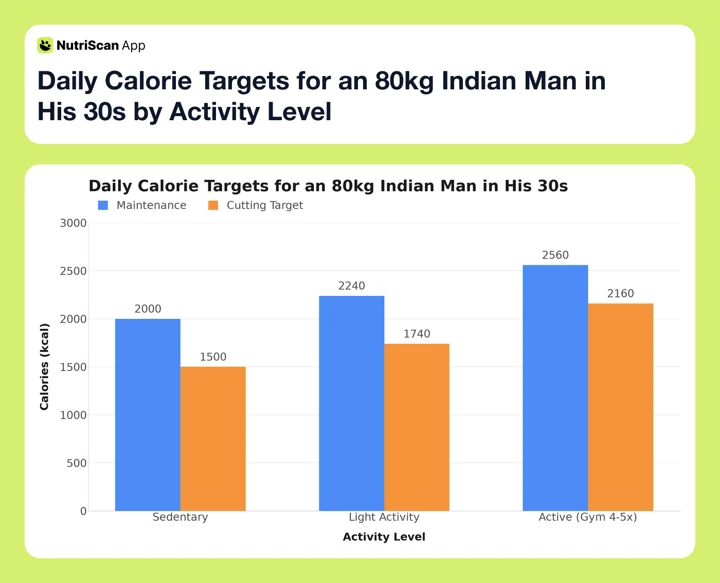 Figure 1: Maintenance vs cutting calorie targets across three activity levels for an 80 kg Indian man in his 30s.
WARNING
The 1,200 calorie plans that flood Indian Pinterest are the level clinical guidelines prescribe for women, not men. The same guideline puts men at 1,500 to 1,800 kcal a day, adjusted for body weight (Jensen et al., 2013 AHA/ACC/TOS obesity guideline). Below that range is a decision for a doctor or a registered dietitian to make with you, not one to copy off a pin.
Use the NutriScan macro calculator to get your personal calorie and macro targets in under two minutes based on your real weight, height, age, and activity level.
IMPORTANT
Checkpoint: midway progress update.
You have your calorie number. Now let's fix the macro most Indian men miss.
⏱️ Progress 2/4 - ~2 minutes in - Keep going
✅ Why Your 30s Are the Fat-Gain Decade (done)
✅ Calorie Math: Your Real Daily Target (done)
👉 Protein: The One Macro Most Indian Men Get Wrong (current)
⏳ Real Weekday Meal Plans at About 2,000 kcal (Veg and Non-Veg)
🧩 The Rs.11-a-Serve Protein Swap (coming soon)

Protein: The One Macro Most Indian Men Get Wrong 🥩
The single biggest mistake in an Indian fat-loss diet is low protein. The 2020 comparison of Indian household diets against the EAT-Lancet reference diet found that across every income group, Indians take far more of their calories from cereals and far fewer from protein foods than the reference (Sharma et al., BMC Public Health 20:812). Added fat is the one place Indians sit below the reference, so cereals and protein are where the gap actually is.
Aim for 1.6 grams of protein per kilo of body weight, or 128 grams a day for an 80 kg man. That is not a floor, it is where the benefit plateaus: Morton's meta-regression found lean-mass gains stopped improving past 1.62 g/kg/day (Br J Sports Med, PMID 28698222). Spread it across four meals at 30 to 35 grams each. For a ranked list of cheap anchors, see our 25 low-calorie, high-protein Indian foods.
Here is how common Indian protein anchors actually stack up:
| Food | Serving | Protein |
|---|---|---|
| Toned milk | 250 ml | 8 g |
| Curd | 1 cup (200 g) | 7 g |
| Paneer | 100 g | 18 g |
| Whole moong dal (cooked) | 1 katori (150 g) | 9 g |
| Rajma (cooked) | 1 katori | 8 g |
| Soya chunks (cooked) | 50 g dry | 26 g |
| Egg (whole) | 1 | 6 g |
| Chicken breast | 100 g cooked | 31 g |
| Fish - rohu, grilled | 100 g | 22 g |
| Whey protein scoop | 30 g | 24 g |
Paneer from ICMR-NIN IFCT 2017. The moong, rajma and rohu rows are converted from IFCT raw-weight values at typical cooked portions, so treat those three as estimates. Milk and curd from pack declarations; egg, chicken and whey from USDA FoodData Central; soya chunks from the Nutrela pack label.
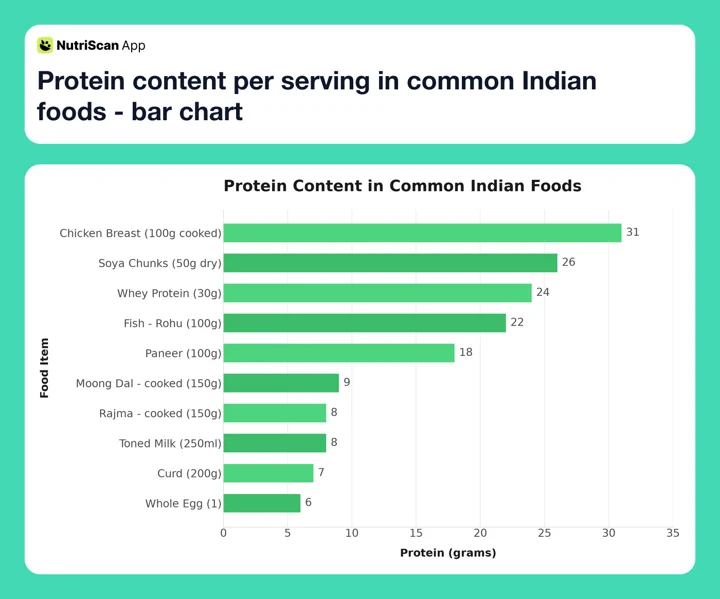 Figure 2: Protein content per serving for common Indian protein foods. Chicken, soya chunks, whey, and fish lead the chart.
TIP
Three rotis and a bowl of dal carry roughly 20 grams of protein. Against a 128 gram target that is about a sixth of your day, not a third. The fix is two protein anchor foods per meal. Pair dal with paneer, curd, soya chunks, eggs, or chicken at every plate.
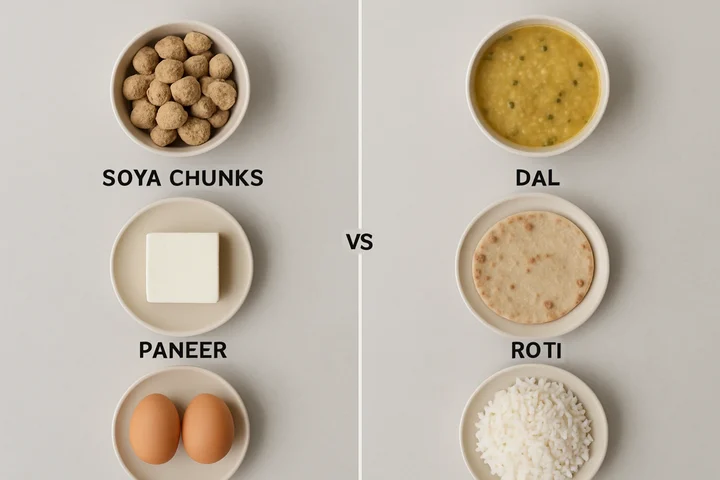 Swap one carb-heavy item per meal for a protein anchor. Small shifts, big difference over 30 days.
IMPORTANT
Checkpoint: final stretch before the reveal.
Protein picture is clear. Now see what it looks like on a real Indian plate.
⏱️ Progress 3/4 - ~3 minutes in - Keep going
✅ Why Your 30s Are the Fat-Gain Decade
✅ Calorie Math: Your Real Daily Target
✅ Protein: The One Macro Most Indian Men Get Wrong
✨ The Rs.11-a-Serve Protein Swap (about to reveal)
Real Weekday Meal Plans at About 2,000 kcal 🍽️
Vegetarian Plan
This day totals about 2,000 kcal: roughly 119 g protein, 250 g carbs, 55 g fat. That is a cutting day for an 80 kg vegetarian man who trains four times a week, and a maintenance day for one who sits at a desk. If you are in the second group, use the 1,700 kcal version below, which matches the light-activity cutting target. Non-vegetarians who want a full week of menus can pair this with the non-veg weight loss diet plan for India.
6:30 AM - Pre-workout or wake-up Black coffee or green tea, 5 soaked almonds, 2 walnut halves Calories: 90 - Protein: 3 g
8:00 AM - Breakfast 2 besan cheelas with grated paneer (60 g) and onions, 1 cup low-fat curd Calories: 480 - Protein: 32 g
11:30 AM - Mid-morning 1 apple or 1 small bowl papaya, 30 g whey protein in 200 ml water Calories: 200 - Protein: 25 g
2:00 PM - Lunch 2 multigrain rotis (no ghee), 1 katori dal (whole moong or chana), 1 katori paneer bhurji (80 g paneer), salad (cucumber, onion, tomato, lemon) Calories: 600 - Protein: 32 g
5:30 PM - Evening 1 cup masala chai with toned milk (no sugar), 1 small bowl roasted chana (30 g) Calories: 180 - Protein: 9 g
8:30 PM - Dinner 1 small bowl brown rice or 1 jowar roti, 1 katori rajma or chole, 1 katori sauteed palak or bhindi (1 tsp oil) Calories: 450 - Protein: 18 g
Daily total: ~2,000 kcal, 119 g protein. (90 + 480 + 200 + 600 + 180 + 450 kcal; 3 + 32 + 25 + 32 + 9 + 18 g protein.)
To drop to about 1,700 kcal: cut one roti at lunch, drop the evening chana to 15 g, swap the brown rice for 1 jowar roti, and skip the nuts at 6:30. That takes roughly 290 kcal off and leaves you at about 110 g protein.
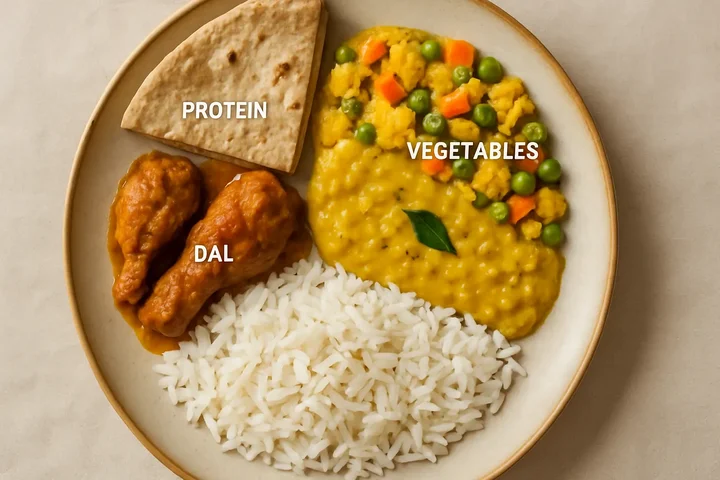 A balanced Indian plate: at least one protein anchor (paneer, curd, or dal + soya) with every main meal.
Non-Vegetarian Plan
Same target, more flexible protein.
8:00 AM - Breakfast 3 boiled egg whites and 2 whole eggs scrambled with onion and tomato, 2 slices brown bread, 1 cup black coffee Calories: 420 - Protein: 30 g
11:30 AM - Mid-morning 1 banana or 1 orange, 200 ml toned milk with 1 tsp peanut butter Calories: 230 - Protein: 10 g
2:00 PM - Lunch 100 g grilled chicken breast (tandoori marinade, no cream), 2 multigrain rotis, 1 katori dal, salad with lemon Calories: 620 - Protein: 48 g
5:30 PM - Evening 30 g whey protein in water, 1 small handful (20 g) roasted peanuts Calories: 230 - Protein: 30 g
8:30 PM - Dinner 100 g grilled fish (rohu, surmai, or tilapia), 1 small bowl brown rice or 2 phulka rotis, 1 katori mixed sabzi (lauki, beans, carrot), 1 cup curd Calories: 530 - Protein: 38 g
Daily total: ~2,030 kcal, 156 g protein.
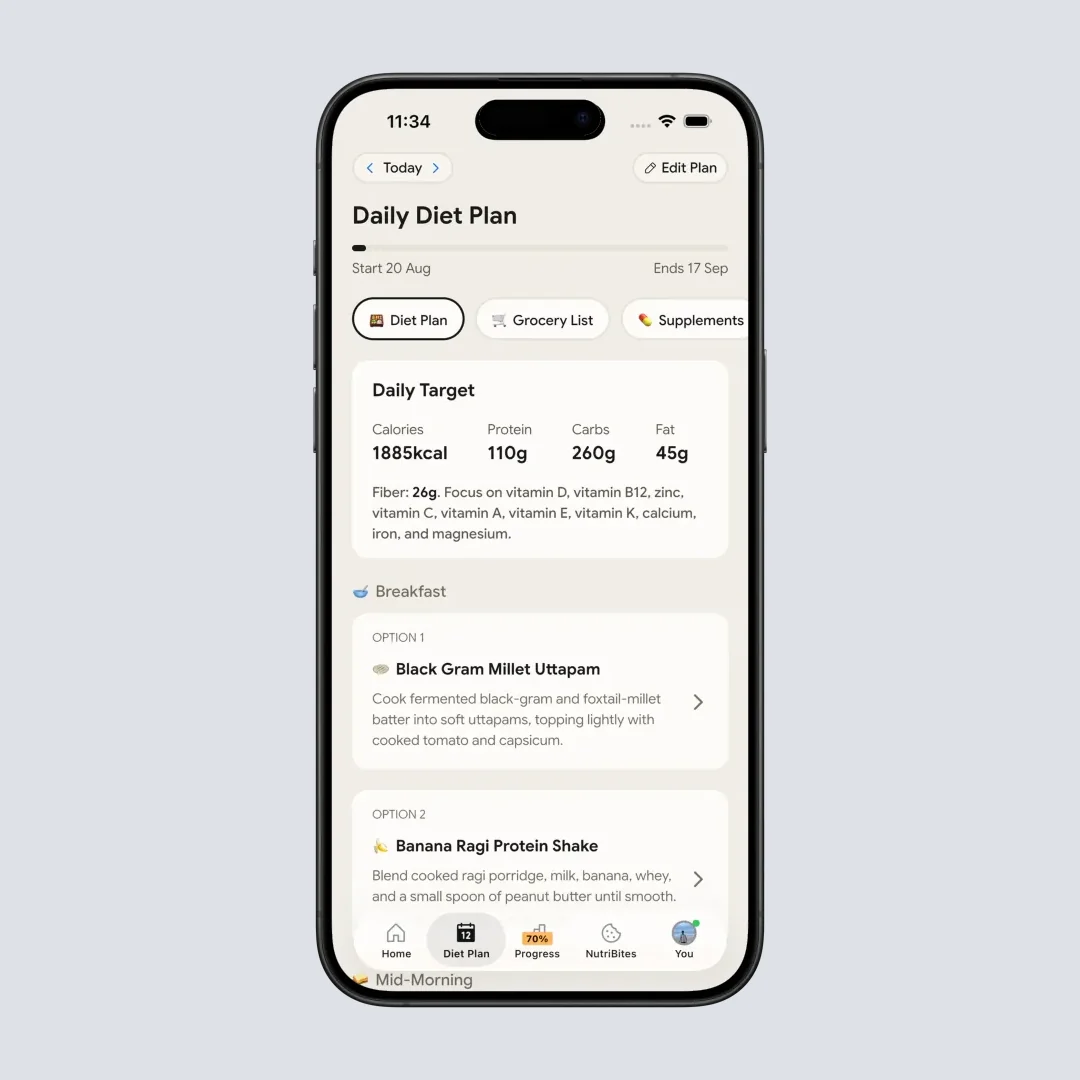
Build and track your meal plan on NutriScan. The Diet Plan tab shows your macros and today's meal targets, and the 28-day personalized plan is a Premium feature. [Home > Diet Plan]
INFO
Use the NutriScan diet plan guide to create a custom plan based on your goal weight, activity level, and food preference (veg, non-veg, or vegan).
The Rs.11-a-Serve Protein Most Indian Men Skip ✨
You have been patient. This one is for anyone who does not want to buy a whey tub, which runs roughly Rs.2,000 to Rs.5,000 per kilo in India as of August 2026 depending on brand (MuscleBlaze lists 1 kg whey at Rs.3,899, imported labels run higher), about a month at one scoop a day.
Soya chunks.
Not glamorous. Not trending on Instagram. But gram for gram, one of the cheapest complete proteins on an Indian shelf.
50 g of dry chunks gives you 26 g of protein, almost as much as a 30 g scoop of whey, because the pack label reads about 53 percent protein by weight. A 200 g Nutrela pack was Rs.45 on Swiggy Instamart on 7 August 2026 and covers four servings, so about Rs.11 a serve. Grocery prices move week to week, so treat that as a checkpoint, not a constant.
Why most men skip it: they grew up eating it as a dry-curry filler and never realized it carries all nine essential amino acids. Across soy foods, mean DIAAS is about 85, with soymilk at 91 and soy protein concentrate at 88 (van den Berg et al., PMC9552267). That review measures soy products only, so it tells you soy is a strong plant protein, not where it ranks against chicken. Rajgira, quinoa and buckwheat are complete too, they are just not what most people cook on a Tuesday.
How to Use Soya Chunks for Fat Loss
- Soak 50 g dry chunks in hot water for 10 minutes ➡️ squeeze out the water ➡️ add to bhurji, sabzi, or dal
- Pressure-cook with rajma for a high-protein combi-dal (26 g from the chunks plus 8 g from a katori of rajma, so 34 g per bowl)
- Marinate and air-fry with tandoori spices for a 26 g protein snack at roughly 170 kcal, before the marinade
TIP
For vegetarians and vegans who struggle to hit 1.6 g/kg protein, soya chunks are the single most important swap. Adding 50 g of chunks to one meal a day puts another 26 g of protein into your total, a fifth of a 128 g target, for roughly Rs.11.
 The soya swap costs about Rs.45 a pack. The results cost nothing except consistency.
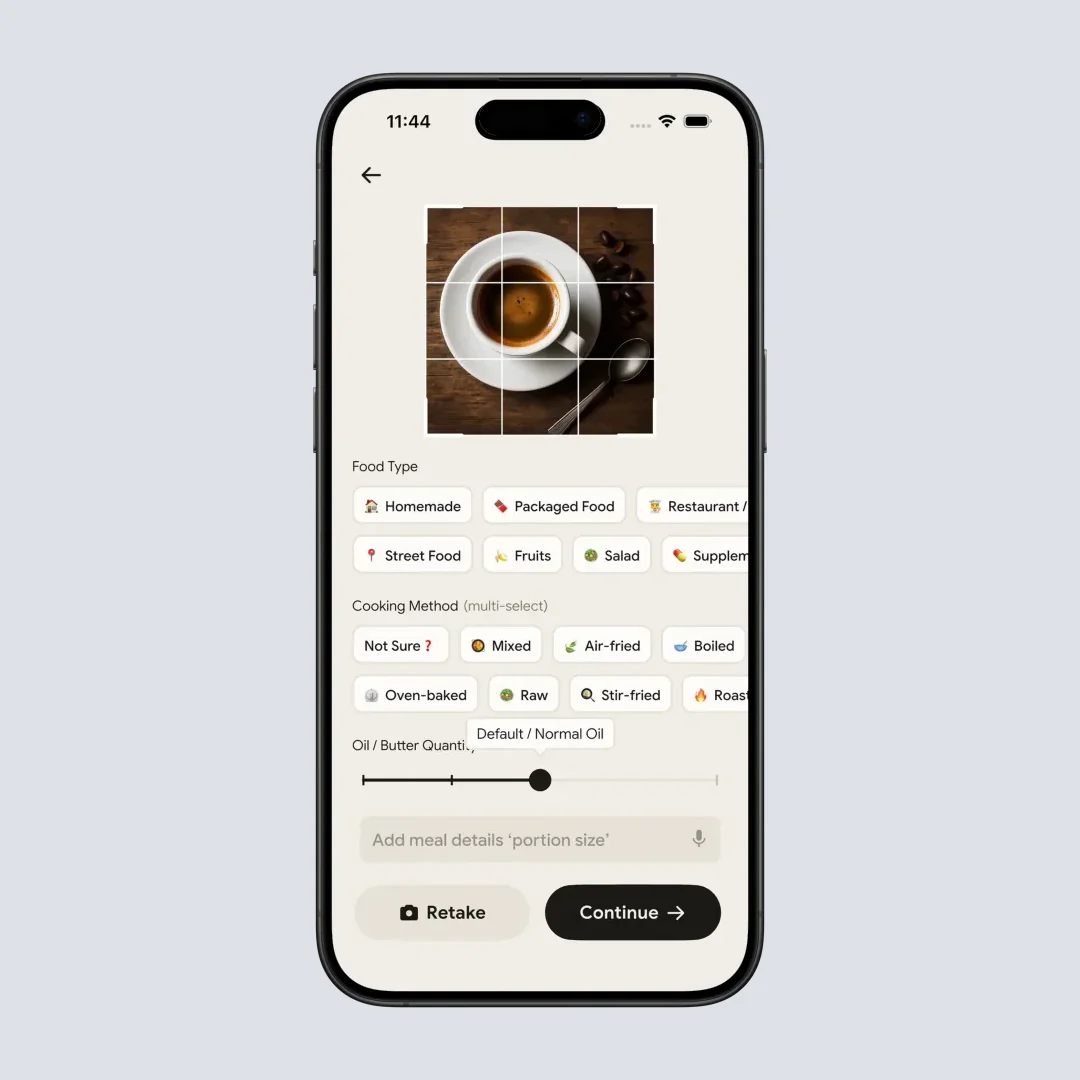
Scan any meal including soya chunk dishes to log calories and protein instantly. [Home > Camera Icon > Crop Screen]
Tips Indian Men Actually Need (Not the Generic List) 💡
A 35-year-old with a Hyderabad office, a Mumbai commute, or a Bengaluru WFH setup falls into the same traps. These seven tips are for those traps.
Treat dal as a side, not a protein source. A katori of dal is 8 to 9 grams of protein, roughly a quarter of the 30 to 35 grams that plate should carry. Pair it with curd, paneer, soya chunks, eggs, or chicken every meal.
Pre-decide the office lunch. The dabba decision at 1 pm is the single biggest driver of weekday weight gain. Fix a default: 1 dal, 1 sabzi, 1 protein, 2 rotis, salad. No biryani by default.
Drink your tea or coffee without sugar by default. Two teaspoons of sugar is about 32 kcal, so six cups carry roughly 190 kcal a day. Drop it and you save about 5,700 kcal a month, around 0.75 kg of fat at 7,700 kcal per kilo. The milk and tea stay, only the sugar goes.
Keep the oil at the low end of the guideline, about 4 teaspoons a day. ICMR-NIN sets visible cooking fat at 20 to 50 g, or 4 to 10 teaspoons by calorie need (Dietary Guidelines for Indians 2024). No national survey publishes what urban kitchens actually pour, so do not guess: measure the day's oil into a small bowl in the morning and cook only from that bowl.
Front-load protein at breakfast. Indian breakfasts skew carb-heavy: poha, paratha, idli, upma. Add 2 eggs, 100 g paneer, or a whey shake to whatever you eat. A protein anchor at breakfast plus a soya swap at one other meal is what moves most men from roughly a third of their target to most of it.
Walk after every main meal, not before. Short walking breaks that interrupt sitting lower post-meal glucose compared with staying seated (Buffey et al., PMC9325803). A 10 to 15 minute walk burns roughly 40 to 60 kcal, so three a day is 120 to 180 kcal.
Plan the Saturday cheat meal, do not improvise it. Five weekdays at minus 500 is a 2,500 kcal deficit, so a planned 1,000 kcal Saturday still leaves the week at minus 1,500. An unplanned weekend, biryani lunch, snacks, dinner out, Sunday brunch, can run 1,500 to 2,500 kcal over and cancel all five days.

A Step-by-Step Way to Start This Week 📅
Most Indian men in their 30s do not need a new diet. They need a clean way to begin one.
Step 1, Day 1 to 2: Measure your baseline. Weigh yourself first thing in the morning, after the bathroom, before water. Note your waist at the navel. Take a front and side photo in the same light. These three numbers are your baseline.
Step 2, Day 2 to 3: Log everything you currently eat for two days. Do not change a thing. Log every chai, every biscuit, every spoon of ghee. The number you find is your real maintenance - not the textbook one. This is the most under-used step in any Indian diet program.
Step 3, Day 4: Set your calorie target. Subtract 500 from your real maintenance. Round to the nearest 50. That is your daily ceiling.
Step 4, Day 5 to 6: Build your protein anchor list. Pick 4 high-protein foods you actually like: eggs, paneer, curd, soya chunks, chicken, fish, whey, rajma, chana. Buy a week of these on Day 5. Cook anchor foods first on Day 6 so you have grab-and-go options.
Step 5, Day 7 onward: Eat the plan, weigh once a week. Do not weigh daily. Day-to-day weight moves with water and salt, not fat. Track the same-day-of-week reading at the same time, in the same clothes, after the same bathroom routine. The trend line over 4 weeks is your real progress.
INFO
Use NutriScan Insights to track your weekly weight trend and see how your nutrition directly affects your progress over time. The app auto-generates progress charts from your meal logs - no spreadsheets needed.
What the Research Says About Indian Diets and Fat Loss 📊
Three papers anchor this plan. None of them studies men in their 30s specifically, so read them as evidence about Indian diets, not about your decade.
The ICMR-INDIAB-21 analysis in Nature Medicine describes Indian diets as high in low-quality carbohydrate (white rice, milled whole grains, added sugar), high in saturated fat, and low in protein (Anjana et al., Nat Med 31:3813-3824, 2025). Adults in the highest refined-cereal group were 18 to 25 percent more likely to have type 2 diabetes, prediabetes, general obesity or abdominal obesity than those in the lowest, and the highest total-carbohydrate group carried an odds ratio of 1.15 for abdominal obesity (95% CI 1.01 to 1.30). When the authors modelled swapping carbohydrate calories for plant, dairy, egg or fish protein, the odds of diabetes and prediabetes fell.
The 2020 EAT-Lancet comparison puts numbers on the gap (Sharma et al., BMC Public Health 20:812): Indian households take 47 percent of calories from cereals against 32 percent in the reference diet, and 7 percent from protein foods against 29 percent. Even the richest 5 percent eat less than half the reference diet's protein calories. Cut one roti, add one protein anchor, and your plate moves toward the benchmark without changing taste or culture.
ICMR-INDIAB-23 measured metabolically obese non-obese adults, where BMI sits below the obesity cutoff but two or more metabolic-syndrome markers do not, at 43.3 percent nationally (95% CI 42.6 to 44), 39.6 percent urban and 46 percent rural (Indian J Med Res, PMC12550443). More than a third of adults aged 20 to 29 already have it. Do not let a normal BMI tell you that you are fine. Waist under 90 cm matters more, the WHO Asia-Pacific cutoff for men that both papers use.
WARNING
Metabolic obesity is common among Indian adults even at a "normal" BMI, and prevalence climbs with age. Always track waist circumference alongside weight, because a shrinking waist at stable weight still means real fat loss.
Frequently Asked Questions ❓
Q1. How many calories should an Indian man in his 30s eat to lose weight?
Clinical guidelines prescribe 1,500 to 1,800 kcal a day for men, adjusted for body weight (2013 AHA/ACC/TOS obesity guideline). For most desk-job men weighing 70 to 90 kg that band is the right place to start; active gym-goers at the same weight sit higher, roughly 1,800 to 2,500 kcal by the activity table above. Going below that range is a call to make with a doctor or a registered dietitian, not off a blog.
Q2. Can I lose weight on a pure vegetarian Indian diet?
Yes, and many men do. The thing to get right is protein, around 1.6 g per kg of body weight. Build the day around paneer, curd, dal, soya chunks, whole grains, and a whey shake. Vegan men should add tofu, peanuts, and a soy or pea protein powder.
Q3. Is rice or roti worse for weight loss?
Neither, in equal calories. A small katori of cooked rice, around 85 g, is about 110 kcal; a phulka from 25 to 30 g of atta is about 80 to 105 kcal (ICMR-NIN). Close enough to be interchangeable. The trap is portion creep with rice and ghee with roti. Pick whichever you measure more accurately.
Q4. How long will it take to lose 10 kg?
A 500 kcal daily deficit is 3,500 kcal a week, about 0.45 kg at 7,700 kcal per kilo of fat. Ten kilos needs 77,000 kcal, roughly five months. Expect it to slow rather than run flat: as you get lighter, maintenance falls and the same 500 kcal buys less. Patience past month 3 is what separates the men who keep it off.
Q5. Do I need a cheat day?
You do not need it, but a planned one helps long-term adherence. One meal - not a full day - sized at roughly 1,000 kcal fits inside a weekly deficit and protects you from the all-or-nothing weekend that derails most plans.
Q6. What is the best app to track an Indian diet for weight loss?
NutriScan is a global food app whose scanner reads Indian plates as readily as any other: roti, dal, sabzi, biryani, poha, dosa and regional dishes go in by camera, no database search per plate. You also get a NutriScore on every meal, Monika the voice AI nutritionist, an intermittent fasting timer, and a 28-day personalized diet plan on Premium. Free gives you 5 scans and 4 Monika calls a week.
Conclusion: A Plan That Survives Real Indian Life 🎯
A weight loss diet plan for an Indian man in his 30s is not a screenshot of a 1,200 kcal menu. It is a 1,500 to 2,500 kcal blueprint that respects three things at once: your real maintenance, a 1.6 g per kg protein target, and the cultural reality that dal, roti, sabzi, curd, and a Sunday biryani are not going anywhere.
The calorie math, the protein target, the soya chunk swap, and the seven-day kickoff are the whole plan. There is nothing else to buy and nothing to give up permanently.
Track your meals, your protein, and your weekly weigh-in with NutriScan. Photo logging closes the gap between what you think you ate and what your plate actually held, which is the gap most people never see.
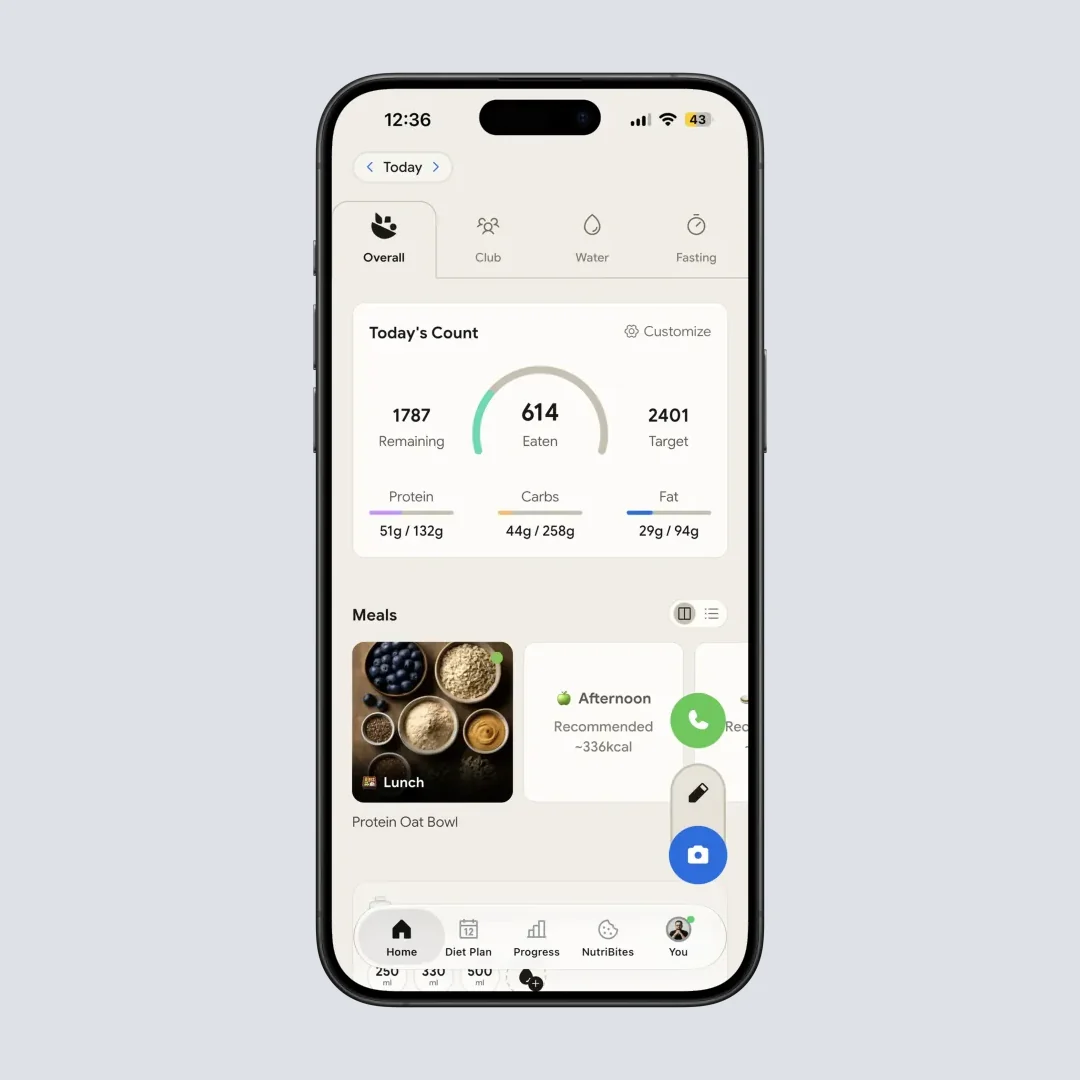
Track every roti, dal, and sabzi on NutriScan - photo-log any Indian meal in seconds. [Home > Nutrition Card]
IMPORTANT
Recap: everything you completed this round.
You finished the full plan - save this for your first week.
⏱️ Progress 4/4 - ~5 minutes in - Nicely done
✅ Why Your 30s Are the Fat-Gain Decade
✅ Calorie Math: Your Real Daily Target
✅ Protein: The One Macro Most Indian Men Get Wrong
✅ Real Weekday Meal Plans at About 2,000 kcal (Veg and Non-Veg)
✅ The Rs.11-a-Serve Protein Swap, soya chunks, your new best friend
Ready to start? Download NutriScan and scan your first meal today. At a 500 kcal daily deficit, 10 kg is about five months of arithmetic. The only variable is whether you start this week or next.