Vegetarian Weight Loss Diet for Indian Women 2026
 ChatGPT
  Claude
  AI Mode
  Perplexity
The reason most Indian vegetarian women stall on weight loss is rarely willpower. It is the protein gap, the iron gap, and a lunch plate where rice or roti takes most of the room.
TL;DR - Vegetarian Indian Weight Loss at a Glance
- Core problem: ICMR-NIN's balanced-diet plan for a sedentary 55 kg woman delivers about 57 g of crude protein a day, and that is the recommended plate, not the average one
- The number: 1.2 to 1.6 g per kg protects muscle in a deficit, so 66 to 88 g at 55 kg and 72 to 96 g at 60 kg
- The fix: Anchor every meal with paneer, tofu, dal, soya or curd, then add carbs around that
- The plan: a 7-day Indian-kitchen chart targeting 1,400 kcal, landing at 1,340-1,430 a day with 71-80 g protein
- Who it works for: Women 20-50, vegetarian or lacto-ovo, 55-75 kg, targeting 0.4-0.6 kg loss/week
- PCOS note: Lower the carb ratio at lunch and dinner for faster results
Talk to your doctor first
General nutrition information, not medical advice. If you are pregnant, on medication, or managing PCOS, thyroid disease, diabetes, or a known iron or B12 deficiency, get this cleared by a doctor or dietitian before you cut calories.
IMPORTANT
Your Indian veg weight loss plan at a glance.
A quick roadmap so you can act fast.
⏱️ Progress 0/4 • ~0 of 16 minutes • Keep going
⏳ Step 1: Fix the protein gap
⏳ Step 2: Close the iron and B12 wall
⏳ Step 3: Follow the 7-day 1,400 kcal chart
⏳ Step 4: Add 5 scale-moving habits
🔍 The plate-building order that fixes everything (revealed near the end)
The same Indian veg plate turns up over and over: heavy on cereal, light on pulses, short on the protein that holds muscle in a deficit. The patterns repeat, so the fixes do too.
Why Indian Vegetarian Women Hit a Protein and Iron Wall 🧱
The ICMR-NIN 2024 Dietary Guidelines for Indians name the problem directly: "due to the limited availability and high cost of pulses and meat, a significant proportion of the Indian population relies heavily on cereals, resulting in poor intake of essential macronutrients... and micronutrients" (ICMR-NIN Dietary Guidelines for Indians, 2024). The plate is filling but thin on the nutrients that protect muscle and energy in a calorie deficit.
Anaemia is the second wall. Analysis of National Family Health Survey rounds 4 and 5 found anaemia among Indian women of reproductive age rose from 53 percent to 57 percent (Let et al., BMC Public Health, 2024). Vegetarian diets carry only non-heme iron, and the NIH Office of Dietary Supplements puts iron bioavailability at 5 to 12 percent from vegetarian diets against 14 to 18 percent from mixed diets, which is why it sets the iron requirement for vegetarians 1.8 times higher (NIH ODS, Iron). A weight loss plan that ignores iron tends to produce fatigue, hair fall, and stalled workouts.
The third wall is muscle loss. Kokura and colleagues pooled 47 randomized trials and found higher protein significantly prevented muscle mass decline in people losing weight, across the 28 trials that measured it. Their thresholds: above 1.3 g per kg a day is expected to build muscle, below 1.0 g per kg raises the risk of losing it (Kokura et al., Clinical Nutrition ESPEN, 2024). Strength and physical function showed no significant benefit, so protein protects the tissue, not automatically the performance.
 The goal: lose fat, keep muscle. That needs more protein than most Indian veg plates currently deliver.
The Protein Number You Are Aiming For 🎯
ICMR-NIN sets the basic protein RDA for Indian adults at 0.83 grams per kilogram of body weight per day, roughly 50 grams for a 60 kg woman (ICMR-NIN, 2024). That number prevents deficiency. ICMR-NIN publishes no separate protein target for people in a calorie deficit, so the working band has to come from the weight-loss trials.
Those trials point to 1.2 to 1.6 grams per kilogram, which is 72 to 96 grams for a 60 kg woman. Kokura's risk line sits at 1.0 g per kg (2024), and a 12-week trial in 126 older women found 1.2 beat 0.8 on muscle mass, handgrip and knee flexion (Ishaq et al., Frontiers in Nutrition, 2025). For scale, ICMR-NIN's balanced-diet food groups for a sedentary 55 kg woman deliver about 57 grams, and that is the recommended plate rather than the typical one.
A practical protein split for a 60 kg woman on 1,400 kcal:
| Meal | Protein Target | Example |
|---|---|---|
| Breakfast | 18 to 22 g | Besan chilla + 50 g paneer + curd |
| Lunch | 22 to 28 g | 2 katoris dal + sabzi + small carb |
| Snack | 10 to 15 g | Roasted chana + Greek yogurt |
| Dinner | 18 to 22 g | Tofu/paneer + vegetable + 1 phulka |
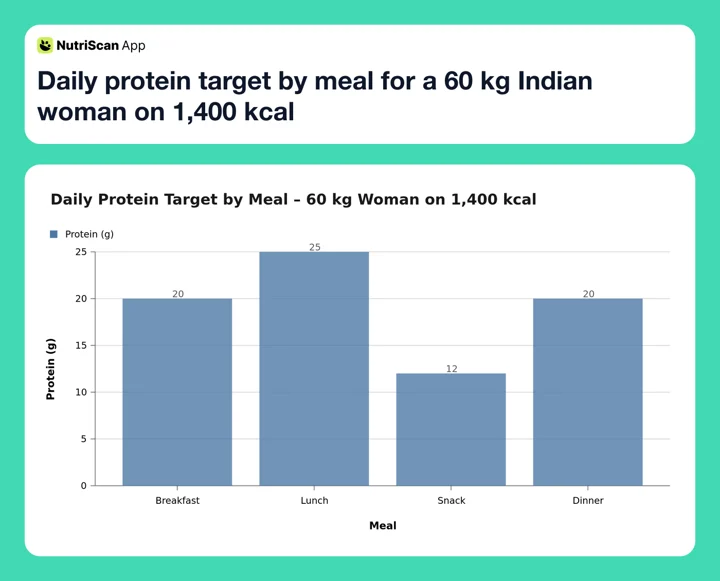 Figure 1: Protein across four meals for a 60 kg woman on 1,400 kcal. Lunch carries the most at 25 g, the snack the least at 12 g, for a day total of 77 g. Spreading it beats back-loading it at dinner.
IMPORTANT
Checkpoint: here's where you are right now.
Quick status update so you always know the next best move.
⏱️ Progress 1/4 • ~3 of 16 minutes • Keep going
✅ Step 1: Fixed the protein gap (done)
👉 Step 2: Closing the iron and B12 wall (you're here)
⏳ Step 3: The 7-day 1,400 kcal chart
⏳ Step 4: 5 scale-moving habits
🧩 The plate-building order (coming soon)

The Best Vegetarian Protein Sources in an Indian Kitchen 🥘
Not all veg protein is equal. Here are the ones that earn a daily slot:
| Food | Protein (g/100g) | Calories | Best Use |
|---|---|---|---|
| Soya chunks (dry) | 52 | 345 kcal | Curry, pulao |
| Peanuts | 26 | 567 kcal | Chutney, small portions |
| Roasted chana | 22 | 364 kcal | Snack, trail mix |
| Sattu | 20 | 350 kcal | Sharbat, paratha stuffing |
| Paneer (full-fat) | 18 | 265 kcal | Bhurji, tikka, sabzi |
| Firm tofu | 17 | 144 kcal | Lower-calorie paneer swap |
| Greek yogurt | 10 | 60 kcal | Breakfast base, raita |
| Rajma (cooked) | 9 | 130 kcal | Rajma chawal |
| Moong dal (cooked) | 8 | 120 kcal | Dal tadka, chilla |
Indian items come from ICMR-NIN's Indian Food Composition Tables 2017, the reference set behind the 2024 guidelines. Tofu is USDA FoodData Central's firm calcium-set record, 17.3 g and 144 kcal. Check the pack: nigari-set and silken tofu run nearer 8 to 9 g and 75 kcal.
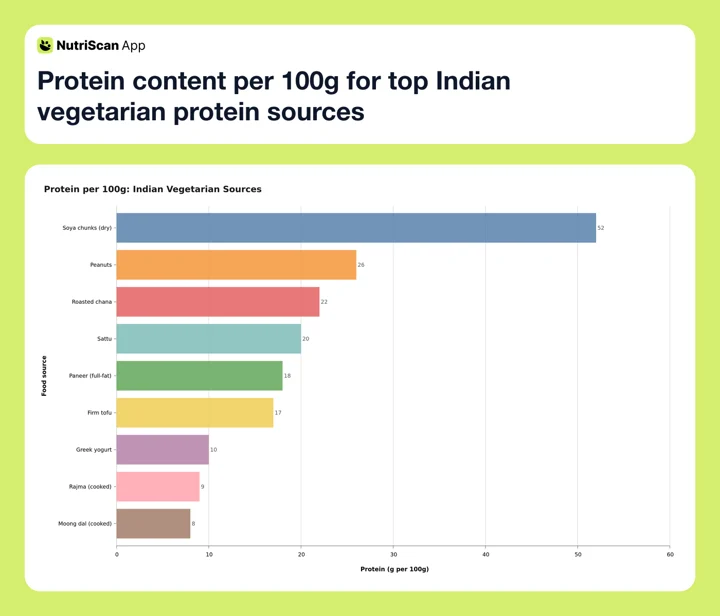 Figure 2: Protein per 100 g, same nine foods as the table. Soya chunks lead on paper; paneer, chana and tofu survive daily Indian cooking.
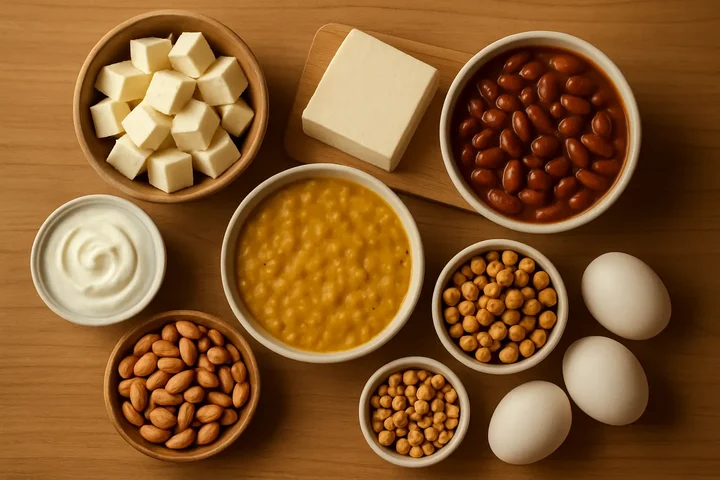 The Indian kitchen already has everything you need - the plate just needs to be built around these, not around roti
Foods that look healthy but underperform on protein per calorie: poha (3 g per katori), upma (4 g), idli (2 g per piece), plain dosa (3 g), khichdi without a heavy dal ratio (5 to 6 g). They are fine as carriers, not as the protein anchor.
Quick 5-Minute Protein Boost
Add 25 g of dry soya chunks to any curry, pulao, or stir-fry. They expand to 3x volume, contribute 13 g protein, and take on the flavor of whatever spice they cook in. This single swap lifts most Indian lunches from 15 g to 28 g protein.
Closing the Iron and B12 Gaps 🩸
Iron is the quiet reason vegetarian weight loss feels harder than it should. The fixes are kitchen-level, not pill-level.
- Pair iron foods with vitamin C. Spinach, methi, chana, rajma and jaggery deliver non-heme iron. Ascorbic acid enhances its absorption (NIH ODS, Iron), so squeeze lemon on dal or eat amla, tomato, capsicum or guava alongside. No reliable multiplier is published, so treat it as a habit, not a dose.
- Keep tea and coffee away from iron-heavy meals. ODS lists polyphenols among the inhibitors of non-heme iron, and names spinach as a good source held back by them. Move the second chai to mid-morning.
- Cook in cast iron occasionally. A kadhai can add iron, most of it in acidic dishes like sambar. The amount varies, so count it as a bonus, not part of the plan.
- Add B12 daily. Natural B12 comes only from animal foods; the RDA for adult women is 2.4 mcg. Milk, curd and paneer cover lacto-vegetarians. Vegans need fortified foods or a supplement (NIH ODS, Vitamin B12), and the dose is a doctor's call.
Iron Deficiency Check
WHO puts the anaemia cutoff for non-pregnant women aged 15 to 65 at haemoglobin below 120 g/L, that is 12 g/dL (WHO, 2024). Below that line, treat it before you start a deficit. Iron-deficient weight loss produces fatigue, hair fall and stalled results.
IMPORTANT
Checkpoint: midway progress update.
You're halfway - decisions get easier here.
⏱️ Progress 2/4 • ~6 of 16 minutes • Keep going
✅ Step 1: Fixed the protein gap (done)
✅ Step 2: Closed iron and B12 wall (done)
👉 Step 3: The 7-day 1,400 kcal chart (current)
⏳ Step 4: 5 scale-moving habits
⏳ The plate-building order (next)
The 7-Day 1,400 kcal Indian Vegetarian Meal Chart 📋
Built for a 55 to 65 kg woman aiming for 0.4 to 0.6 kg of loss per week. It targets 1,400 kcal, lands between 1,340 and 1,430 on the day, and carries 71 to 80 grams of protein. At 60 kg that is the floor of the 1.2 to 1.6 g per kg band, so add a 25 g scoop of plant protein or 50 g of paneer if you train hard, and 200 kcal on top if you are over 70 kg.
Day 1
- Breakfast: 2 besan chillas + mint chutney + 50 g paneer cubes + chai without sugar (~380 kcal, 22 g protein)
- Lunch: 1 katori moong dal + 1 phulka + palak paneer (75 g paneer) + 1 katori curd + cucumber salad (~480 kcal, 28 g protein)
- Snack: 1 fistful roasted chana + 1 apple (~180 kcal, 8 g protein)
- Dinner: Tofu bhurji (100 g tofu) + 1 katori vegetable sabzi + 1 phulka (~360 kcal, 22 g protein)
Day 2
- Breakfast: Greek yogurt bowl 150 g + 1 tbsp chia + 1 tbsp peanuts + half banana (~320 kcal, 18 g protein)
- Lunch: 1 katori rajma + 0.5 katori brown rice + tomato-onion salad with lemon + 1 katori curd (~510 kcal, 24 g protein)
- Snack: Sattu sharbat with lemon and salt, 30 g sattu + 1 fistful peanuts (~220 kcal, 11 g protein)
- Dinner: Paneer tikka 75 g + grilled vegetables + 1 phulka (~370 kcal, 24 g protein)
Day 3
- Breakfast: Vegetable oats upma with 25 g soya chunks + chai (~340 kcal, 16 g protein)
- Lunch: 1 katori toor dal + 1 katori bhindi sabzi + 1 phulka + 0.5 katori brown rice + curd (~470 kcal, 22 g protein)
- Snack: Buttermilk + 1 fistful roasted chana + 1 fistful peanuts (~240 kcal, 13 g protein)
- Dinner: Mixed dal khichdi (moong + masoor, heavy dal ratio) + 1 katori curd (~380 kcal, 20 g protein)
Day 4
- Breakfast: 2 idlis + sambar with extra toor dal + small coconut chutney + 1 boiled egg, or 50 g paneer if you skip eggs (~360 kcal, 18 g protein)
- Lunch: Chana masala 1 katori + 1 phulka + 1 katori curd + carrot salad (~480 kcal, 24 g protein)
- Snack: Greek yogurt 100 g with cinnamon + 1 fistful roasted chana (~150 kcal, 15 g protein)
- Dinner: Palak tofu 100 g + 1 phulka + sauteed beans (~380 kcal, 22 g protein)
Day 5
- Breakfast: Paneer paratha (1 paratha, 50 g paneer stuffing, minimal oil) + curd (~380 kcal, 20 g protein)
- Lunch: Curd rice 0.5 katori + 150 g curd + roasted moong sprinkle + tomato salad + side dal sambar (~420 kcal, 18 g protein)
- Snack: 1 fistful roasted chana + 100 g Greek yogurt + 1 tbsp peanuts + green tea (~200 kcal, 17 g protein)
- Dinner: Soya chunk curry, 35 g dry soya expanded + 1 phulka + sauteed lauki (~340 kcal, 22 g protein)
Day 6
- Breakfast: 2 moong dal chillas + mint chutney + 1 boiled egg, or 50 g paneer if you skip eggs (~340 kcal, 22 g protein)
- Lunch: Mixed veg paneer pulao 75 g paneer + 0.5 katori brown rice + raita (~510 kcal, 26 g protein)
- Snack: Apple with 1 tbsp peanut butter (~180 kcal, 6 g protein)
- Dinner: Dal tadka (toor + chana dal) + 1 phulka + bhindi (~380 kcal, 20 g protein)
Day 7
- Breakfast: Vegetable poha + 50 g paneer cubes mixed in + sprouts side (~340 kcal, 18 g protein)
- Lunch: Lobia curry 1 katori + 1 phulka + cucumber salad + curd (~470 kcal, 24 g protein)
- Snack: Hung curd dip with carrot and capsicum sticks (~150 kcal, 10 g protein)
- Dinner: Vegetable and paneer khichdi (heavy paneer ratio) + curd (~400 kcal, 22 g protein)
Add the days up: 1,340 to 1,430 kcal, averaging about 1,390, with 71 to 80 grams of protein averaging 76. Two meals carry an egg and both list a paneer swap if you are pure vegetarian.
IMPORTANT
Checkpoint: final stretch before the reveal.
One last nudge - the reveal is next.
⏱️ Progress 3/4 • ~11 of 16 minutes • Keep going
✅ Step 1: Fixed the protein gap
✅ Step 2: Closed iron and B12 wall
✅ Step 3: The 7-day 1,400 kcal chart
✨ The plate-building order that fixes everything (about to reveal)
5 Habits That Move the Number on the Scale ⚖️
Five habits that do more for the scale than another tweak to the meal chart:
- Sleep hits the scale harder than you think. Indian women in caregiver roles often run on 5 to 6 hours, and short sleep tends to leave you hungrier the next day. Aim for 7 hours, even if it means a non-negotiable phone-off rule.
- Drink your calories carefully. A glass of fresh juice is 150 to 180 kcal and leaves you no fuller. Switch to whole fruit. Sugar in chai adds up too: one teaspoon is about 4 g and 16 kcal, so two cups a day is 32 kcal a day and roughly 11,700 kcal over a year.
- Walk after dinner, even 15 minutes. Light post-meal walking is the cheapest habit on this list and the one women stick with, because it needs no kit and no gym slot.
- Strength train twice a week. Two 30-minute sessions, even bodyweight squats, lunges, push-ups and band rows, tell the body to keep muscle while calories are down. Calorie restriction alone carries a real risk of skeletal muscle loss, and protein plus resistance work is the standard defense (McCarthy and Berg, Nutrients, 2021).
- Log your meals for the first two weeks. NutriScan reads portions and macros off a photo, it does not weigh anything. Five free scans a week, aimed at the plates you genuinely cannot estimate; type or speak the rest in.
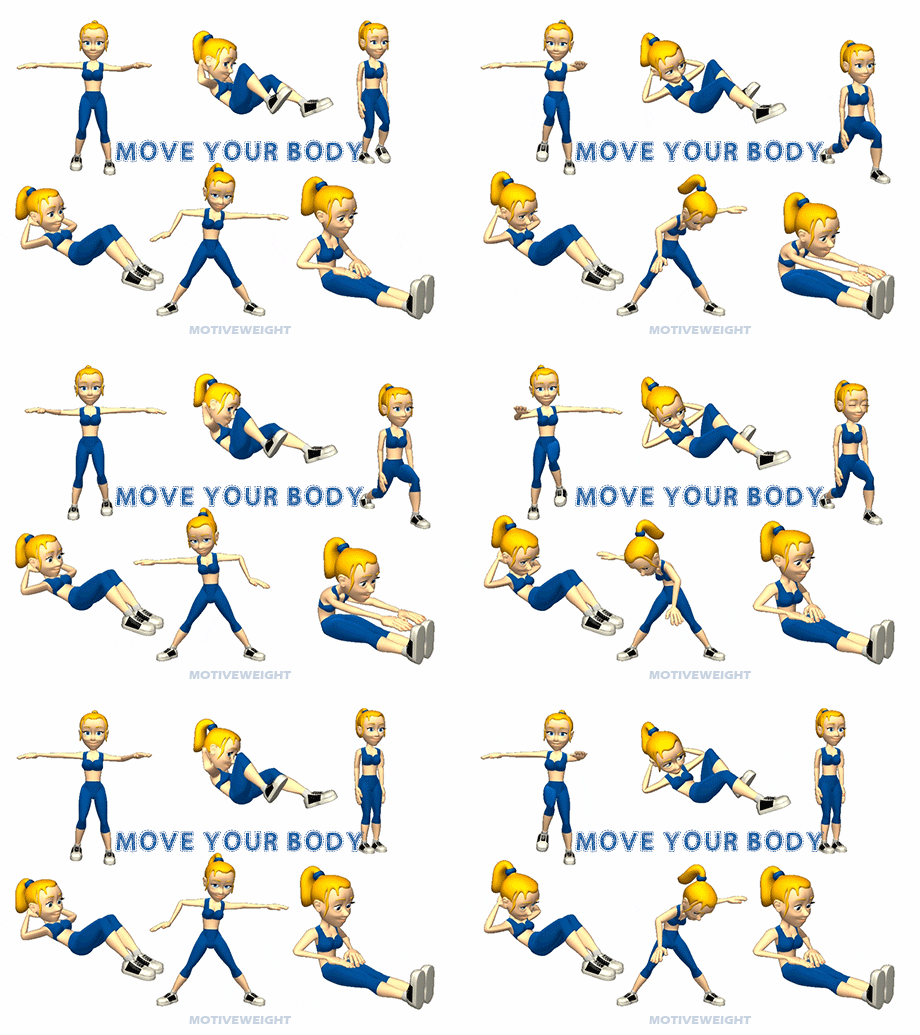 Strength training twice a week is the habit most women skip - and the one that separates fat loss from just weight loss
Track Your Indian Meals with NutriScan
Home > Camera Icon > Click Picture estimates a dish's macros from the photo. Set the food type, cooking method and oil level first, because a no-oil dal and a tadka dal are not the same meal. Free covers 5 scans a week, so spend them on the mixed bowls and restaurant plates a database cannot read, and use text entry, voice input or copy-an-earlier-meal for the repeats. Free also includes the NutriScore band, the full micronutrient breakdown, the fasting timer and 4 weekly calls with Monika. Premium removes the scan cap and adds the 28-day personalized diet plan.
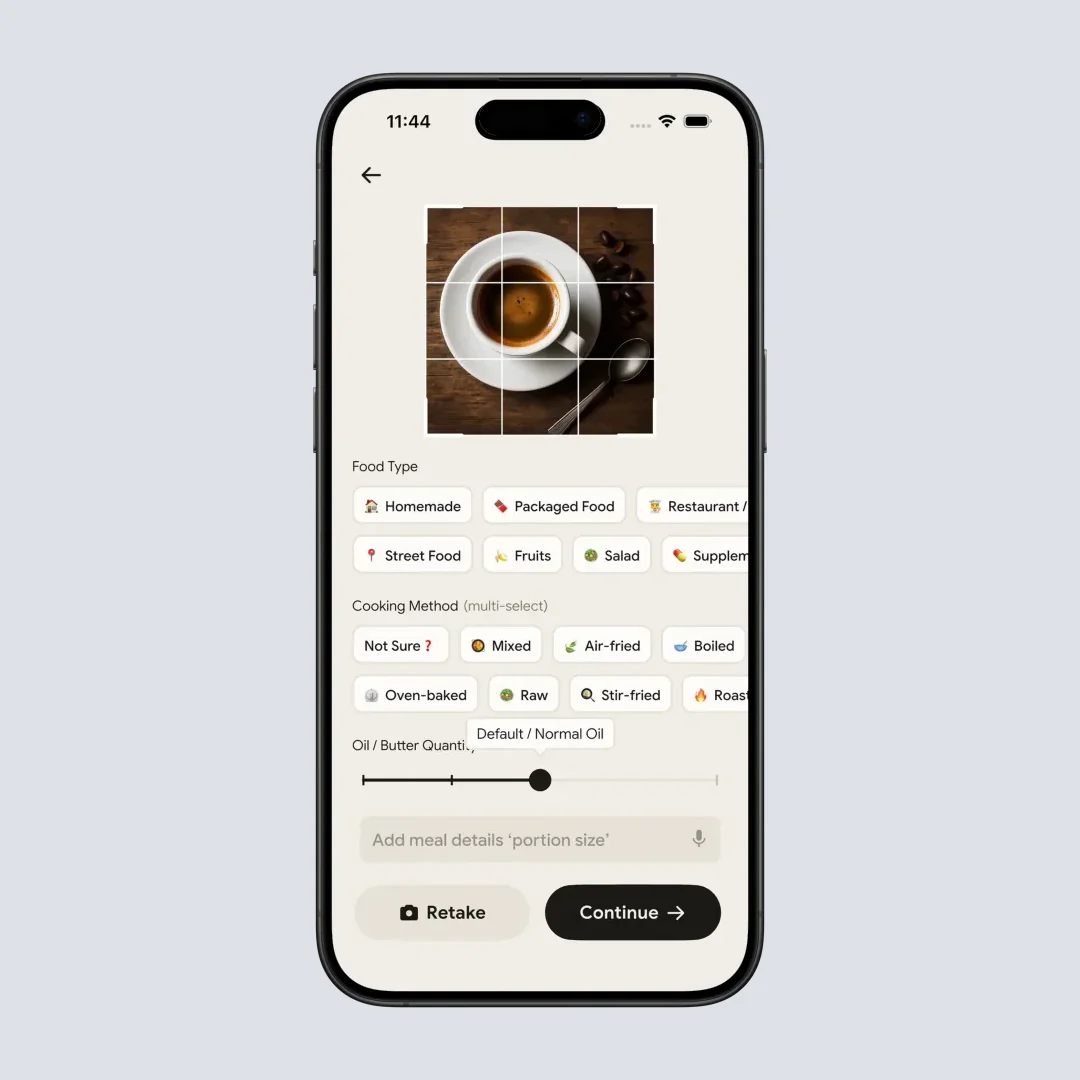
NutriScan Crop Screen (Home > Camera Icon > Click Picture) - select food type, cooking method, and oil level before scanning for accurate macros
What the Research Says About Veg Diets and Weight Loss 🔬
Kokura's 2024 meta-analysis pooled 47 randomized trials in adults with overweight or obesity, 28 of which measured muscle mass (Clinical Nutrition ESPEN). Two things it did not find, and that this post will not claim: no significant effect on strength or physical function, and no reported difference between women and men.
On the vegetarian question itself, a meta-analysis of nine randomized trials in 1,628 people with overweight or obesity found vegetarian diets reduced weight and blood glucose against omnivorous diets, though not blood pressure, with the evidence rated mostly very low quality (Melgar et al., International Journal of Obesity, 2023). Read that as permission, not a promise. A vegetarian plate is not a handicap for fat loss, and not a shortcut either.
For Indian women specifically, ICMR-NIN's 2024 balanced-diet table for a sedentary 55 kg woman sets 60 g of pulses and beans, 100 g of green leafy vegetables, 200 g of other vegetables, 300 ml of milk or curd and 190 g of cereals a day; moderately active women get 90 g of pulses (Table 1.6). Most plans undershoot the pulses and the greens, the two lines that lift protein, iron and folate at the lowest calorie cost.
A Quick Word on PCOS, Periods, and Perimenopause 🌸
If you have PCOS, the same vegetarian plan works (see the 7-day anti-inflammatory PCOS meal plan for a dedicated version) but you will get faster results by lowering the carb ratio at lunch and dinner. Replace one phulka with extra dal or paneer. Keep fruit to one serving and prefer berries, guava, or apple over banana and mango. No published macro split for PCOS is worth copying, and the fixed ratios circulating on Indian diet blogs are not backed by a guideline. Run your own weight, goal and activity through the PCOS macro calculator, then shift a few percent of carbohydrate into protein and watch four weeks.
In your late 30s or 40s, sit at the upper end of the band, 1.4 to 1.6 g per kg, and add resistance training twice weekly. Calcium matters more here: the NIH RDA is 1,000 mg a day up to 50 and 1,200 mg after (NIH ODS). The milk and curd in this chart get most women close.
If you have heavy periods, your iron loss is higher. Add an extra leafy green serving and a vitamin C source at every lunch. Check haemoglobin before starting any deficit - iron-deficient weight loss does not work.
PCOS Plate Swaps for Each Meal (click to expand)
For each meal in the 7-day chart, make these adjustments:
- Replace 1 phulka with 50 g extra paneer or an extra katori of dal
- Replace banana or mango in snacks with guava, apple, or a small bowl of berries
- Reduce rice portions to 0.25 katori or swap with cauliflower rice
- Add 1 tsp flaxseed powder to yogurt or chilla batter daily, which is a genuine plant source of ALA omega-3
- Cinnamon in curd or tea is a fine flavor swap for sugar, but the evidence that it moves insulin sensitivity is thin, so do not count on it
The Plate-Building Order That Changes Everything ✨
You have been patient. Here is what most diet plans get backwards.
Most plans tell you to decide calories first, then fill in the plate. That leaves protein as whatever is left over, and on a dal-roti-sabzi lunch built that way it lands around 14 to 18 grams.
The correct order:
- Decide the protein anchor first. Choose one: paneer (75-100 g), tofu (100 g), cooked dal (2 katoris), soya chunks (25 g dry), or Greek yogurt (200 g). This locks in 18 to 25 grams.
- Add one vegetable second. Sabzi, salad, or greens. This locks in fiber and micronutrients.
- Add carbs last, in proportion to what is left. One phulka or half a katori of rice. Not the other way around.
This single shift - protein first, carbs last - changes the plate from 70 percent carb to 40 to 45 percent carb without eliminating anything. No tracking required once you internalize the order.
Protein and fiber fill you up first, so serving them first is what stops the roti count creeping. This is a sequencing habit, not a measured intervention, so the number it produces is whatever your own plate produces.
The shorthand: pick protein ➡️ add vegetable ➡️ fill with carb. In that order, every meal, every day.
Use NutriScan to Check the Order Is Working
Scan one rebuilt plate (Home > Camera Icon > Click Picture) and the macro breakdown tells you what the protein anchor actually delivered, usually less than it looked. Five free scans a week is enough to test the order on your five hardest meals rather than all 28. NutriBites answers questions off your own meal timeline afterwards.
IMPORTANT
Recap: everything you completed this round.
You finished the run - save this for next time.
⏱️ Progress 4/4 • ~15 of 16 minutes • Nicely done
✅ Step 1: Fixed the protein gap - aim for 1.2-1.6 g/kg bodyweight
✅ Step 2: Closed iron and B12 wall - lemon on dal, cast iron, curd daily
✅ Step 3: 7-day chart - 1,340 to 1,430 kcal, 71 to 80 g protein, Indian-kitchen meals
✅ Step 4: 5 scale-moving habits - sleep, walk, lift, track, cut liquid calories
✅ The plate-building order: protein first ➡️ vegetable ➡️ carb last (revealed)
How To Start This Plan This Week 📝
- Weigh yourself once. Same time, same clothes, no shoes. This is your baseline. Do not weigh again for seven days.
- Pick three breakfasts from the chart you can cook on a workday. Rotate them. Decision fatigue at 7 a.m. is the reason most diets fail by Wednesday.
- Stock the fridge. Paneer, tofu, curd, two cooked dals in jars, washed and chopped vegetables, boiled chickpeas, peanuts and roasted chana in a jar on the counter.
- Log your meals for the first two weeks in NutriScan. Five free photo scans a week, aimed at the mixed bowls and restaurant plates; text or voice entry for the repeats. For a plan built on your own numbers instead of this chart, that is the 28-day personalized diet plan on Premium.
- Add 7,000 to 8,000 steps a day plus two strength sessions. This is the floor, not the ceiling.
For personalized macros based on your weight, goal, and activity level, use the macro calculator or read the diet plan guide to build a version of this plan specific to your numbers.
Conclusion 🎯
A vegetarian Indian weight loss plan for women comes down to hitting 1.2 to 1.6 grams of protein per kilogram of body weight, fixing the iron and B12 gaps, sleeping seven hours, walking after meals, and building the plate in one order: protein first, vegetable second, carbs last. Cutting roti and skipping dinner are not on that list.
The 7-day chart runs 1,340 to 1,430 kcal a day and 71 to 80 grams of protein, on meals you already know how to cook. Spend your 5 free NutriScan scans a week on the plates you cannot estimate, check what the protein anchor really delivered, and adjust. After a fortnight the order becomes muscle memory.
Frequently Asked Questions ❓
Q: How much weight can I lose in a month on a vegetarian Indian diet?
A: 0.4 to 0.6 kg per week, which is 1.7 to 2.6 kg per month. Faster usually means muscle loss. The 500 to 750 kcal daily deficit quoted everywhere comes from the 2013 AHA/ACC/TOS obesity guideline, not from ICMR-NIN, which publishes no deficit target for weight reduction.
Q: Can I lose weight on Indian vegetarian food without paneer?
A: Yes. Replace paneer with tofu, dals, soya chunks, sprouts, and Greek yogurt. The protein math still works as long as you anchor every meal with one of these.
Q: Is a 1,200 kcal diet safe for Indian women?
A: For most women above 55 kg it is too low. ICMR-NIN's balanced-diet food groups for a sedentary 55 kg woman add up to about 1,660 kcal and 57 g of crude protein, so 1,200 cuts iron, calcium and B12 before it cuts much fat. 1,400 to 1,500 is easier to hold.
Q: Will I lose weight if I cut rice or roti completely?
A: You can, but it usually backfires. Carbs are not the problem, excess calories are. Half a katori of rice or one phulka per meal fits inside almost every workable Indian veg deficit plan.
Q: What is the best Indian breakfast for weight loss?
A: Besan chilla with paneer or curd, moong dal chilla with 50 g paneer or a boiled egg, or Greek yogurt with chia seeds and peanuts. All three land at 18 to 22 grams of protein and keep you full until lunch.
Q: Should I take a protein powder?
A: Optional, not required. If you cannot hit 70 grams from food, a 25-gram scoop of plant protein adds the gap with 100 kcal. Pick an Indian brand with third-party testing and no added sugar.
Q: How is this plan different for PCOS?
A: Lower the carb share, raise the protein share. Replace one phulka with extra dal or paneer, keep fruit to one low-GI serving, and use the PCOS calculator for your own numbers rather than a fixed ratio off a diet blog.