Calorie Deficit but Not Losing Weight? The Real Reasons
 ChatGPT
  Claude
  AI Mode
  Perplexity
TL;DR - Calorie deficit but the scale will not move
• Most common cause: the food log, not the metabolism. In one study, 26.4% of women underreported their intake. • Key number: 0.5 to 1 kg a week is the NHS target and the honest ceiling for most deficits. • Under three weeks flat: almost always water. Use a seven-day weight average, not one morning. • Over a month flat: intake crept up, expenditure came down, or both. • Do this: rebuild the baseline ➡️ log seven honest days ➡️ recalculate maintenance at today's weight.
Here is a number that reframes most stalled weight loss: in a study of 91 Japanese women with obesity, 26.4% were classified as underreporters of their own energy intake, meaning the food they wrote down and the food they ate were two different quantities (Yoshinaga et al., 2023). Those women were not lying. Reporting food accurately is genuinely hard, and the gap grows quietly over weeks. NutriScan publishes this post and makes a calorie tracking app.
That is one reason a deficit stops producing loss, and not the only one. Water shifts, a shrinking body, a falling step count, a medication and a menstrual cycle all pull the same way. This guide covers what a 200, 1000 or 1200 calorie deficit should deliver, and what to check before you cut anything further.
IMPORTANT
Your stalled deficit plan at a glance.
A quick roadmap so you can act fast.
⏱️ Progress 0/4 • ~0 minutes in • Keep going
⏳ Step 1: Rebuild the baseline with a seven-day weight average
⏳ Step 2: Log seven honest days, oils and drinks included
⏳ Step 3: Recalculate maintenance at your current weight
🔍 The two-week move that restarts a stalled deficit (revealed near the end)
Three Stalls That Look Like Failure and Are Not 🍽️
Take a 68 kg woman eating what she believes is 1,500 calories a day. Her scale sat flat for nine days, then dropped 1.4 kg in two mornings. Nothing about her fat loss changed on those two days. She had started a strength routine, and the extra glycogen and fluid her muscles held masked a steady loss until it released at once.
Take a 95 kg man three months into a 500 calorie deficit. The first six weeks moved fast, then stopped, and his food has not changed. He has: 7 kg lighter, he burns less at rest and less per step, so the deficit he calculated in June is much smaller in September. He has to recalculate, not try harder.
Take a woman four months postpartum, breastfeeding and eating 1,600 calories. Her needs went up, not down, so 1,600 sits near her maintenance and the deficit exists only on paper.
All three are common, and only one calls for cutting calories.

One morning on a dial scale carries water, food in transit and glycogen along with fat, which is why a single reading says so little.
Calories In vs Calories Out: What the Phrase Actually Means ⚖️
Calories in versus calories out means body weight changes when the energy you take in differs from the energy you spend. The phrase gets called debunked, and what deserves the criticism is the assumption underneath it: that both sides are fixed numbers you can read off a label and a treadmill display.
Calories out has four moving parts: resting metabolism, the cost of digesting food, planned exercise, and everything else you do while awake. Every one of them changes while you diet. Mayo Clinic describes the mechanism plainly: as you lose weight you lose some muscle along with fat, metabolism declines, and a plateau arrives when the calories you burn equal the calories you eat (Mayo Clinic, 2024).

Oil poured rather than measured is the most common way a logged 1,500 calorie day becomes an eaten 1,800.
Calories in has the same problem in reverse: oil poured rather than measured, a restaurant portion 40% larger than the database version, a handful of nuts nobody logged. Both figures have to be estimated honestly, and the NIH Body Weight Planner says so on its own results page: people often underestimate how much they eat.
IMPORTANT
Checkpoint: here's where you are right now.
Quick status update so you always know the next best move.
⏱️ Progress 1/4 • ~1 minute in • Keep going
✅ Step 1 (done)
👉 Step 2 (you're here)
⏳ Step 3
🧩 The two-week move that restarts a stalled deficit (coming soon)

What the Research Says About Deficits That Stop Working 🔬
Three findings explain most long stalls.
First, adaptation is real and it lasts. Fourteen participants from a televised weight loss competition were followed for six years. At the end of the 30-week contest, resting metabolic rate had fallen by 610 calories a day. Six years later, after most participants had regained weight, resting metabolic rate was still 704 calories a day below baseline, with metabolic adaptation of about 499 calories a day beyond what body composition and age predicted (Fothergill et al., 2016).
Second, adaptation is not permanent. Drug-free physique athletes on a 23-week contest diet showed reductions in resting energy expenditure once adjusted for lean and fat mass, plus falling leptin and T3, and those changes moved back toward baseline during recovery (Isola et al., 2023).
Third, honest reporting is the weakest link. In the study of women with obesity above, an intake-to-metabolic-rate ratio combined with blood ketone levels estimated 26.4% as underreporters and a further 12.1% as energy-restricted reporters, whose logs were low because their eating had been erratic. That is roughly two in five food records that do not describe an ordinary week.
The Deficit Math: 200, 1000 and 1200 Calories a Day 📉
The classic estimate uses about 7,700 calories per kilogram of fat tissue, or 3,500 per pound. It is arithmetic, not a prediction, and it flatters the early weeks. Here is what it produces, with a realistic column beside it.
| Daily deficit | Weekly energy gap | Textbook loss per week | Typical real loss per week |
|---|---|---|---|
| 200 calories | 1,400 calories | About 0.18 kg (0.4 lb) | 0.1 to 0.2 kg, easily hidden by water |
| 500 calories | 3,500 calories | About 0.45 kg (1 lb) | 0.3 to 0.5 kg, sustainable for most |
| 1,000 calories | 7,000 calories | About 0.9 kg (2 lb) | 0.5 to 0.8 kg, hard to hold past 8 weeks |
| 1,200 calories | 8,400 calories | About 1.1 kg (2.4 lb) | Rarely achieved, usually a smaller real deficit |
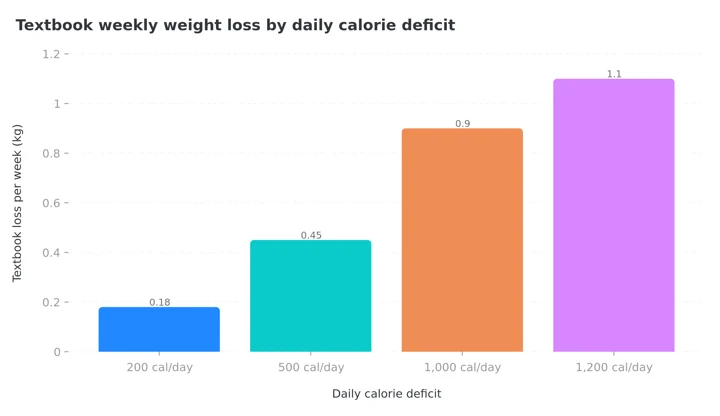
Figure 1: The textbook column of the table above. Doubling the deficit from 500 to 1,000 calories lifts predicted loss from 0.45 kg to 0.9 kg a week, and real results sit under that line.
A 1200 calorie deficit per day is a large ask. For many adults, especially smaller women, 1,200 calories is close to the entire resting requirement, so a true 1200 calorie deficit means eating almost nothing or pairing hard restriction with hours of exercise. Most people searching for a 1200 calorie deficit diet mean a 1,200 calorie intake, which is a different thing. Mayo Clinic advises against cutting intake below 1,200 calories a day, because constant hunger raises the odds of overeating later.
Over time, that arithmetic decays. Two weeks at a 1200 calorie deficit looks like 2.2 kg on paper, much of it water and gut contents. A month reads as 4.6 kg and lands nearer 3 kg. Three months would predict 13 kg and almost never delivers, because expenditure falls with body mass and adherence slips in month two. The NHS target for weight loss is 0.5 to 1 kg a week, which is the honest range these numbers collapse into (NHS, 2026).
If you want your own numbers rather than a table, run them through the weight loss calculator and then check the maintenance figure it is built on with the TDEE calculator.
Does It Matter Where Your Calories Come From? 🥗
For scale weight over a year, the macronutrient split matters far less than the internet suggests. The DIETFITS trial randomized 609 adults with a BMI of 28 to 40 to a healthy low-fat or a healthy low-carbohydrate diet for 12 months. Twelve-month weight change was 5.3 kg lost on low fat and 6.0 kg lost on low carbohydrate, a difference of 0.7 kg that was not statistically significant, and neither genotype pattern nor insulin secretion predicted who did better on which (Gardner et al., 2018).
Where calories come from decides how full you feel, how much muscle you keep, and how easy the deficit is to hold. Protein and fiber slow the return of hunger and cost more energy to digest. Liquid calories arrive without any of that. A 400 calorie plate of chicken, lentils and vegetables and a 400 calorie pastry both count as 400 calories, and only one stops you raiding the cupboard at four o'clock. Setting a protein floor first is the change that makes a deficit survivable, and the protein intake calculator gives you a target.
IMPORTANT
Checkpoint: midway progress update.
You're halfway - decisions get easier here.
⏱️ Progress 2/4 • ~2 minutes in • Keep going
✅ Step 1 (done)
✅ Step 2 (done)
👉 Step 3 (current)
⏳ The two-week move that restarts a stalled deficit (next)
Eating Under 1500, Under 1200 and Under 1000 Calories 🍚
What happens if you eat 1500 calories a day depends entirely on your maintenance number, and that is why the same question gets ten contradictory answers online.
- Maintenance 2,100. Eating 1,500 is a 600 calorie deficit, near 0.5 kg a week early on, slowing by month two.
- Maintenance 1,700. Eating 1,500 is a 200 calorie deficit, near 0.2 kg a week, invisible under normal water fluctuation for days at a time.
- Maintenance 1,450. Eating 1,500 is a 50 calorie surplus. Nothing is broken. The number is simply wrong for that body.
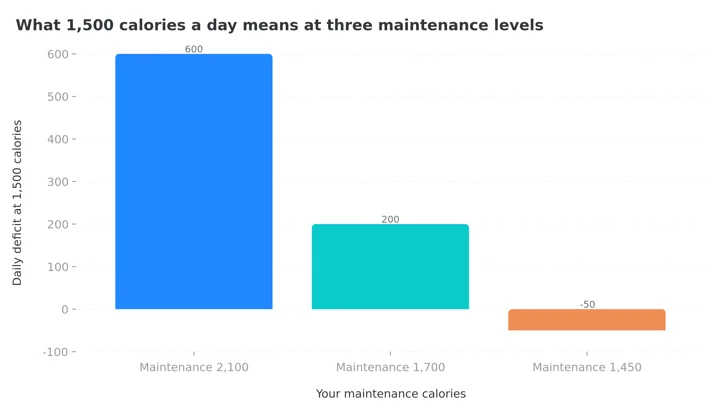
Figure 2: The same 1,500 calorie day is a strong deficit, a barely visible one, or a small surplus, depending on the maintenance number behind it.
Exercise raises maintenance, so it deepens the deficit, but only by the amount actually burned, which is usually far less than a fitness tracker claims. Your maintenance figure already includes some of that activity, so count exercise once, not twice.
Eating less than 1000 calories a day is a different category. It belongs under medical supervision, and it makes protein, iron, calcium and B12 shortfalls likely rather than possible. A week of it usually produces a fast scale drop that is mostly glycogen and water. A month of it tends to produce muscle loss, poor sleep, cold hands, and a rebound driven by hunger rather than willpower.
Very low intakes are a medical decision
On appetite-suppressing GLP-1 medications such as Mounjaro, Ozempic or Wegovy, intake can fall below 1,000 calories with no hunger signal to warn you. Log a normal week, show your prescriber the real number, and ask what floor is right for you before cutting further. For structured support around these medications, see our review of GLP-1 support programs.
How to eat under 1200 calories a day, if a clinician has set that target, comes down to density. The plate template below works as a 1200 calorie deficit meal plan skeleton or simply as a lower-calorie day, and it adapts to local staples anywhere.
| Meal | Structure | Why it holds |
|---|---|---|
| Breakfast | Protein source plus fruit, no liquid calories | Sets the protein floor before the day gets busy |
| Lunch | Palm of protein, half the plate vegetables, a fist of starch | Volume and fiber for the long afternoon |
| Snack | Single protein-led item, portioned onto a plate | Removes the untracked handful |
| Dinner | Same shape as lunch, fats measured rather than poured | Oil is the most common silent 200 calories |
Period, Postpartum, Perimenopause and Breastfeeding 🌙
Being in a calorie deficit but not losing weight as a female often has a timing explanation rather than a metabolic one.
On your period. Fluid retention across the luteal phase and into menstruation can add enough water to mask a week of fat loss. Measure the same phase of one cycle against the same phase of the next rather than cutting further.
Postpartum. Sleep loss, fluid changes and a body still repairing blunt the scale in the early months. Slow is correct here.
Breastfeeding. Milk production raises energy needs. CDC guidance recommends an additional 330 to 400 kilocalories a day for well nourished breastfeeding mothers compared with what they consumed before pregnancy (CDC, 2026). If you set a deficit against your pre-pregnancy maintenance and ignored that addition, the deficit is smaller than you think or absent entirely.
Perimenopause. Weight gain often begins a few years before menopause and continues at about 1.5 pounds, or 0.7 kg, each year through the fifties, and maintaining weight in your fifties may take roughly 200 fewer calories a day than it did in your thirties and forties (Mayo Clinic, 2026). A deficit that worked at 38 can be maintenance at 48 without a single habit changing. Hormone-driven stalls also show up in PCOS, covered in our guide to breaking a PCOS weight loss plateau and in the PCOS macro calculator, which sets targets around insulin resistance rather than calories alone.
Seven Fixes When the Scale Will Not Move 🔧
- Weigh food for two weeks, then go back to estimating. Portion drift is the most common cause of a vanished deficit.
- Log the weekend the same way you log Tuesday. Two untracked days at plus 800 calories erase a 500 calorie deficit built over five days.
- Recalculate maintenance every 5 kg lost. A lighter body needs fewer calories. The deficit you set in month one is smaller in month three.
- Set a protein floor before you cut anything. Protein protects lean mass, and lean mass keeps expenditure up. If most of your calories land after dinner, see .
- Watch steps, not just workouts. Daily movement drops quietly during a deficit, and a step target holds up the part of expenditure nobody tracks.
- Take a diet break of one to two weeks at maintenance. Eat at maintenance deliberately, keep training, then return to the deficit.
- Measure your waist and take photos monthly. In a calorie deficit but not losing belly fat is usually a measurement problem. The abdomen changes late, and the scale cannot tell fat from water.
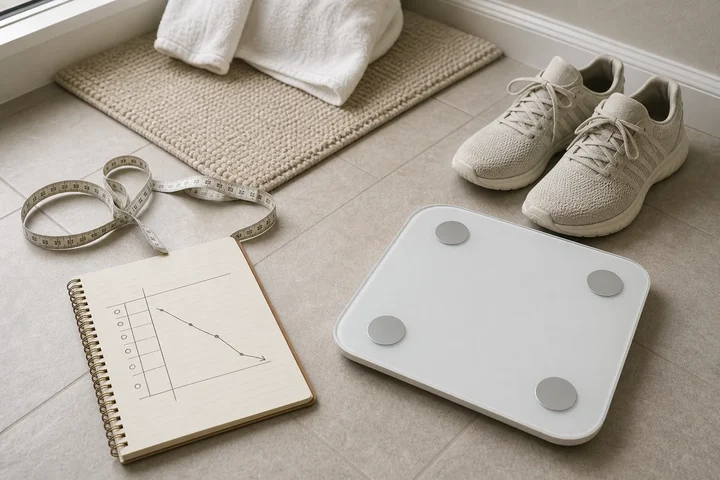
A tape measure and a monthly photo catch what a flat scale hides.
Log the oil, not just the meal
Cooking fat is the line item that disappears most often. A tablespoon of oil is roughly 120 calories, so two poured tablespoons a day is a 240 calorie gap that reads as a broken metabolism.

Manual logging with an oil level setting: Home > Pencil icon > Write About Meal.
IMPORTANT
Checkpoint: final stretch before the reveal.
One last nudge - the reveal is next.
⏱️ Progress 3/4 • ~3 minutes in • Keep going
✅ Step 1
✅ Step 2
✅ Step 3
✨ The two-week move that restarts a stalled deficit (about to reveal)

A Five-Step Plateau Audit You Can Run This Week 🧭
- Rebuild the baseline. Weigh yourself at the same time, in the same clothes, seven mornings in a row, and use the average. One reading tells you almost nothing.
- Log seven honest days, including oils and drinks. Weigh what you can, and do not change your eating while you do it. You are measuring the current state, not fixing it.
- Compare the log to a fresh maintenance estimate. Use your current weight. If the difference is under 200 calories, you no longer have a meaningful deficit.
- Check the non-food variables. Short sleep, a new medication, a new training block, a cycle phase or a salty week each move the scale without moving fat.
- Change one thing and hold it for three weeks. Add 2,000 daily steps, or remove 200 calories, or add 20 g of protein, then read the trend. Changing three things at once means you learn nothing.
Why Two Weeks at Maintenance Restarts a Stalled Deficit ✨
Here is the part promised at the top. When a deficit stops working, the move with the best evidence behind it is eating more, on purpose, for one to two weeks.
The physique athletes in the Isola study were measured before their 23-week contest diet, one week out from the stage, and 23 weeks into recovery. At the end of the diet, resting energy expenditure was suppressed even after adjusting for lean and fat mass, with leptin and T3 down alongside it. As intake returned to maintenance, those markers moved back toward baseline. The suppression tracked the deficit rather than becoming a fixed setting.
That is why a planned maintenance break beats another cut. Two weeks at your current maintenance, training unchanged, lets appetite hormones and daily movement recover and gives you a clean number to restart from. Fothergill's six-year figure of about 499 calories a day of adaptation is what happens when a large deficit runs unbroken for years with regain on top. A short break costs two weeks of loss and buys back the machinery that produces it.

Keep training through a maintenance break. Resistance work protects the lean mass holding your expenditure up.
The Deficit Is Not Broken, the Estimate Is 🚀
Nearly every stalled deficit comes down to one of two gaps: the food you logged is not the food you ate, or the maintenance number you subtracted from belongs to a body you no longer have. Neither needs eating under 1,000 calories to fix.
Give yourself three weeks of honest data before changing anything, and recalculate rather than restrict. If logging is where it falls apart, photo-based logging removes the step people skip: with NutriScan you snap the plate instead of searching a database, with 5 free scans a week and unlimited scans on Premium for about $59 a year. Whatever you use, our calorie deficit diet guide lays out a structured plan.
If you keep quitting before three weeks are up, how to stay consistent on a diet covers the habits that keep a deficit going. If restaurant lunches are where the numbers drift, eating out on a calorie budget has chain orders under 550 calories and a sit-down playbook.
IMPORTANT
Recap: everything you completed this round.
You finished the run - save this for next time.
⏱️ Progress 4/4 • ~4 minutes in • Nicely done
✅ Step 1: seven-day weight average rebuilt
✅ Step 2: seven honest days logged, oils and drinks included
✅ Step 3: maintenance recalculated at today's weight
✅ The two-week maintenance break that restarts a stalled deficit (revealed)
Frequently Asked Questions ❓
What does calories in vs calories out actually mean?
It means body weight changes when the energy you eat differs from the energy you spend. The phrase gets called debunked, but what fails is the assumption that both sides are fixed and measurable. Calories out includes resting metabolism, digestion, exercise and everyday movement, and all four move while you diet.
How much weight will I lose in a 1000 or 1200 calorie deficit?
On the classic arithmetic, 1,000 calories a day is about 7,000 a week, near 0.9 kg of fat tissue, and 1,200 a day is about 8,400 a week, near 1.1 kg. A 200 calorie deficit works out near 0.18 kg a week. Real results run lower, so the NHS range of 0.5 to 1 kg a week is the useful target.
Does it matter where your calories come from for weight loss?
For scale weight over a year, less than people expect. In DIETFITS, 609 adults on a healthy low-fat or healthy low-carbohydrate diet lost 5.3 kg and 6.0 kg, a difference of 0.7 kg that was not significant. Food source still decides hunger and muscle retention, so it decides whether you can hold the deficit at all.
Can I keep a calorie deficit while breastfeeding or postpartum?
Milk production raises energy needs, and CDC guidance recommends an extra 330 to 400 kilocalories a day for well nourished breastfeeding mothers. That sits on top of maintenance, so any deficit should be small, gradual and agreed with your clinician.
Why has my calorie deficit stopped working after two or three months?
A smaller body needs fewer calories, and resting energy expenditure falls further than body size alone predicts. Six years after a large weight loss, one follow-up study found metabolic adaptation of about 499 calories a day beyond what body composition and age predicted. The deficit you set months ago is no longer the deficit you have.
Is eating less than 1000 calories a day safe on Mounjaro, Ozempic or Wegovy?
Appetite suppression can push intake very low without any hunger signal, which makes protein and micronutrient shortfalls easy to miss. Very low intakes are a medical decision. Log a normal week, show your prescriber the real number, and ask what floor is right for you.