How to Stay Consistent on a Diet (When You Keep Quitting)
 ChatGPT
 Claude
 AI Mode
 Perplexity
People quit diets because the plan asks for too much, too fast, with no room for a normal week. In a 160-person trial of four popular diets, only 50 to 65% of participants finished one year, and weight loss tracked how closely people stuck to the plan (r = 0.60), not which diet they picked (r = 0.07). The habits that keep people going are a deficit of about 250 to 500 calories a day, a planned flexible day, logging what you eat every day, and a short reset routine for the day it goes wrong.
Here is what this guide covers, in order:
- Why most diets fall apart early
- Why adherence beats diet type
- A smaller deficit you can live with
- Planned flexibility, with real numbers
- Habits and daily tracking
- What to do after a bad day
- The one reset that matters more than any rule (revealed near the end)
TL;DR
• Why you quit: an aggressive start, rigid rules, and one slip read as total failure.
• What works: a 250 to 500 calorie deficit, a small planned allowance, daily logging, and a fixed bad-day routine.
• What the data says: adherence predicts weight loss better than diet type, and missing a single day of a habit did not materially change habit formation.
• Safety note: if you have diabetes, an eating disorder history, or take medication, talk to your doctor before changing how you eat.
Why diets get abandoned in the first two weeks
Nobody has a clean number for "week one" specifically. Trials measure dropout over months, and a systematic review of 61 studies found no consistent set of predictors, only that psychological and behavioral factors showed up more often than age or background (Moroshko et al., 2011). What the research does show is a clear pattern in how plans are built and how people respond when they slip.
Three things repeat across the evidence:
- The start is the hardest effort. In the Boston trial of Atkins, Ornish, Weight Watchers and Zone, participants gave 2 months of maximum effort, then chose their own level of adherence. Overall adherence was low, and only 50 to 65% of people completed the year (Dansinger et al., 2005).
- Early lapses are normal. Adults in the first 14 days of a lifestyle program reported dietary lapses often enough that researchers could study how they reacted to them. People with lower self-efficacy and more negative self-regard lapsed more often (Schumacher et al., 2018).
- A lapse hurts twice. It adds calories, and it demoralizes. Researchers at Drexel University describe demoralization as sometimes leading people to abandon weight control goals altogether (Hagerman et al., 2023).
So the "I keep starting and quitting after a week" pattern is less a character flaw than a design problem. A plan that cannot absorb one bad Tuesday will not last until the fourth Tuesday.

A diet plan has to survive an ordinary morning, not just a motivated Monday.
Adherence beats the diet you pick
The same Boston trial found the type of diet had no relationship to weight loss at one year (r = 0.07), while self-reported adherence did (r = 0.60). That finding is why "which diet is best" is usually the wrong question for a person who keeps quitting.
A second study, the A TO Z trial, split women into the most and least adherent thirds within each diet. On Atkins, the most adherent third lost 8.3 kg (18.3 lb) over 12 months and the least adherent third lost 1.9 kg (4.2 lb) (Alhassan et al., 2008). Same diet, very different results, and the gap was how closely people followed it.
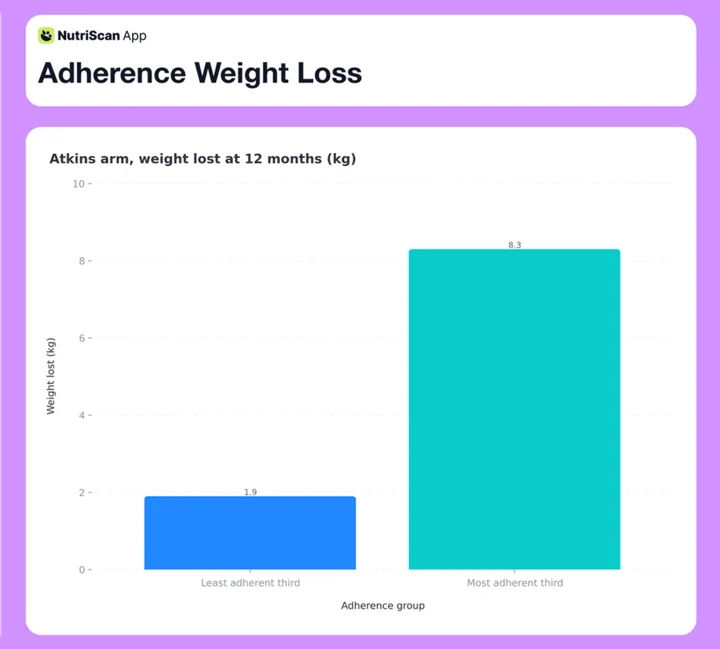
Figure 2: Same diet, different adherence. The most adherent third lost 8.3 kg (18.3 lb) and the least adherent third lost 1.9 kg (4.2 lb).
The practical reading: pick the plan you can repeat on an ordinary, stressful, mediocre week, then make it smaller until you can.

Step 1: Shrink the deficit until it feels boring
A big cut gives fast numbers in week one and a miserable week three. The CDC describes a gradual, steady pace of about 1 to 2 pounds (0.5 to 0.9 kg) a week as the rate at which people are more likely to keep weight off (CDC).
Here is what different deficits look like for someone whose maintenance is about 2,200 calories a day. The weekly loss column uses the old 3,500 calories per pound rule of thumb, which is rough and tends to overstate loss over time.
| Daily deficit | Daily target | Rough loss per week | How it usually feels |
|---|---|---|---|
| 250 kcal | 1,950 kcal | about 0.5 lb (0.2 kg) | Barely noticeable |
| 500 kcal | 1,700 kcal | about 1 lb (0.45 kg) | Manageable with planning |
| 750 kcal | 1,450 kcal | about 1.5 lb (0.7 kg) | Hungry by evening for many people |
| 1,000 kcal | 1,200 kcal | about 2 lb (0.9 kg) | Hard to repeat for weeks |
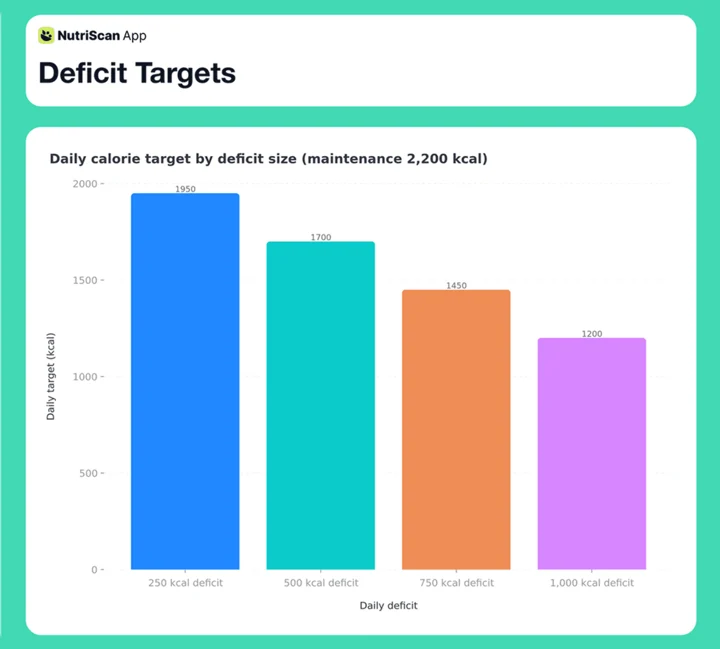
Figure 1: From a 2,200 calorie maintenance, a 250 calorie deficit leaves 1,950 calories a day and a 1,000 calorie deficit leaves 1,200.
One honest caveat: smaller is not proven to reduce regain. A trial of 204 adults with obesity compared a 12-week rapid program to a 36-week gradual one. Both groups regained about 71% of the lost weight within 144 weeks (71.2% versus 70.5%), though only 50% of the gradual group reached the loss target in the allocated time versus 81% of the rapid group (Purcell et al., 2014). Nobody is promising a small deficit prevents regain.
The argument for starting small is about the first month. A 250 to 500 calorie cut leaves you less hungry, less irritable and less likely to start negotiating with yourself at 9 p.m. If you stall at the 500 level, our guide on how much weight loss is too fast covers when speeding up is reasonable. To set your own number, use the online calorie calculator.
Judge the deficit by how you feel and how well you follow it, not by the scale in week one.
Step 2: Plan your flexibility before you need it
Rigid rules break on contact with a birthday dinner. Research on dietary restraint separates rigid control (all-or-nothing rules) from flexible control (a loose framework with room to adjust). In a study of 106 women in a commercial slimming program, flexible restraint was associated with more weight lost and better maintenance, while rigid restraint was associated with less weight lost (Westenhoefer et al., 2013).
Flexibility has a limit, though. Among 1,429 members of the National Weight Control Registry, people who ate the same way all week were about 1.5 times more likely to keep their weight within 5 pounds (2.3 kg) over the next year than people who dieted strictly on weekdays only (OR 1.58, 95% CI 1.2 to 2.2) (Gorin et al., 2004).
Put those two results together and you get a simple rule: build flexibility into the budget, and keep the gap between normal days and flexible days small.
| Pattern | Mon to Fri | Sat and Sun | Weekly total |
|---|---|---|---|
| Flat 1,800 target | 1,800 x 5 = 9,000 | 1,800 x 2 = 3,600 | 12,600 kcal |
| Planned flexibility | 1,750 x 5 = 8,750 | 1,925 x 2 = 3,850 | 12,600 kcal |
Both rows hit the same weekly number. The second just moves 175 calories a day from weekdays to weekend days, which is roughly a drink and a side at dinner.
A daily allowance works too. Put a 140 to 170 calorie treat in the plan every day: a half-cup serving of ice cream is 137 calories on our ice cream nutrition page, and an ounce (28 g) of dark chocolate is about 167 calories at the 598 calories per 100 g listed on the dark chocolate page. A treat you planned cannot count as a failure.

A planned treat sits inside the day's budget, so it cannot count as a failure.
Step 3: Treat consistency as a routine, not a mood
Motivation is high in week one and low in week three, so rely on routine. A study of 82 volunteers who picked a daily eating, drinking or activity habit tied to a fixed cue (for example, "after breakfast") found the time to reach a plateau of automaticity ranged from 18 to 254 days. Missing one opportunity did not materially affect the process (Lally et al., 2010).
Two takeaways from that range. First, it can take a long time, so a month without feeling automatic is not a sign you are failing. Second, one missed day does not reset the clock.
Cues that work for eating habits:
- Log breakfast right after you eat it, before you leave the table.
- Pack tomorrow's lunch while you clean up dinner.
- Put the same two or three default breakfasts on repeat so you decide less.

A Sunday prep block removes most weekday decisions.
If you plan meals in batches, the 7-day weight loss meal prep guide walks through a Sunday prep block that removes most weekday decisions.

Packing tomorrow's lunch while you clean up dinner keeps weekday decisions small.
Step 4: Track every day, and let a streak do the nagging
Self-monitoring is the habit with the most support behind it. A systematic review of 22 studies found a significant association between self-monitoring and weight loss, although the authors rated the evidence as weak because of study design limits (Burke et al., 2011).
How much tracking is enough? In a 24-week online program with 142 adults, people spent 23.2 minutes a day logging in month 1 and 14.6 minutes by month 6. Those who lost 5% or more opened their food journal 2.4 times a day compared with 1.6 times for those who lost less (Harvey et al., 2019). The time required fell while the frequency still mattered.
A streak helps because it makes the next log entry the only goal. Keep the rule small: log something every day, even an estimate, even on a day you ate badly. A rough entry keeps the streak and the information.
TIP
Log something every day, even an estimate. A rough entry keeps the streak alive and keeps the information, and a streak you protect is easier to keep than one you restart.
Logging is where many people stall because weighing every ingredient is a chore. NutriScan lets you log a meal from a photo, which helps when you are eating out or cooking without a scale. The Free plan includes 5 photo scans a week, and Premium is about $59 a year with unlimited scans. NutriScan's own reported accuracy for calories is 95%, and a photo estimate is still an estimate, so treat it as a close guide.
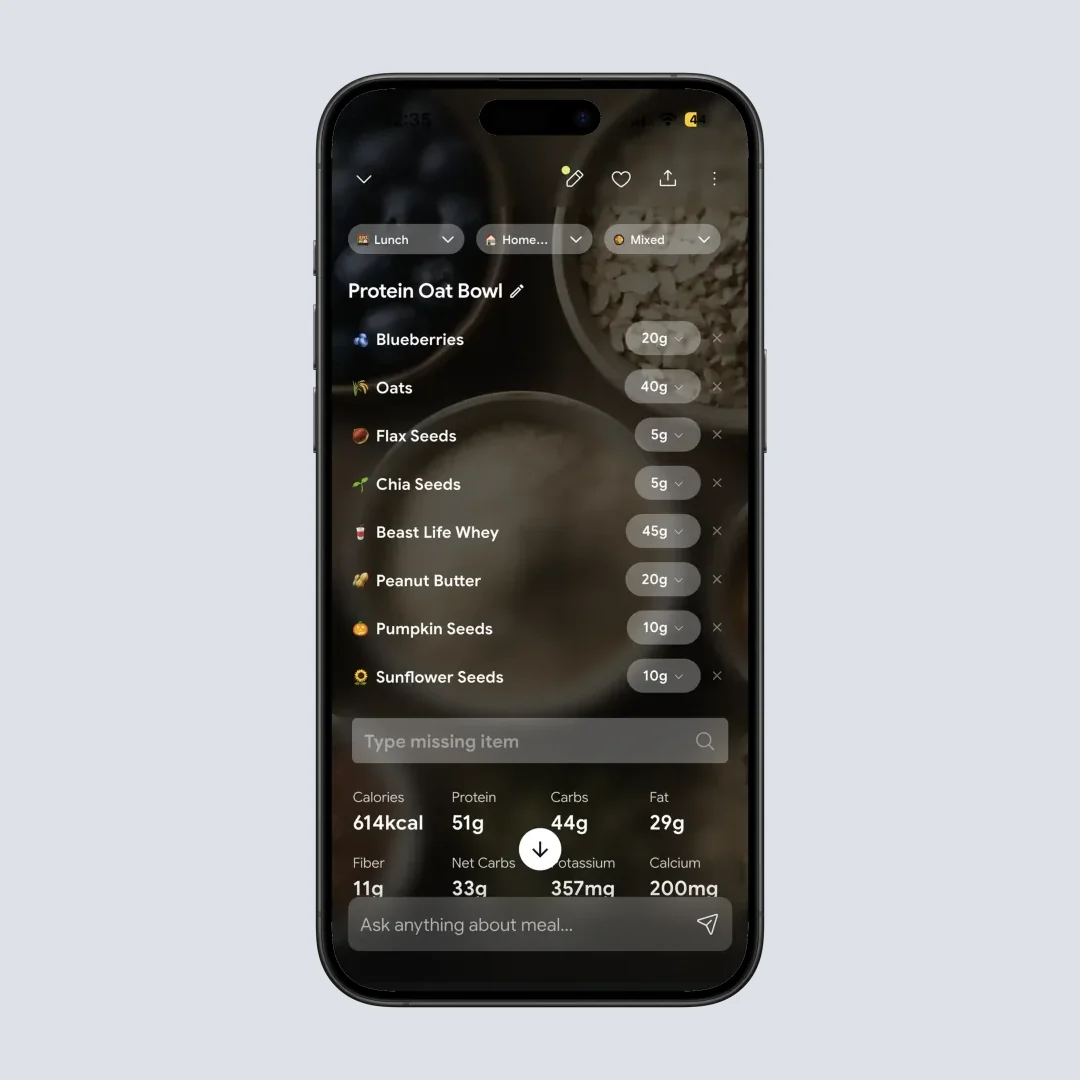
A logged meal broken down per ingredient, with calories and macros below.
What to do after a bad day
This is the point where most diets end, so have a script ready before it happens. The CDC says occasional setbacks happen and are expected, and advises getting back on track as quickly as possible (CDC).
- Do the math once. Say you ate 2,800 calories on a day planned for 1,800. That is 1,000 extra calories. Spread over a week it is about 143 calories a day, or roughly 0.3 lb (0.13 kg) on the rough 3,500 rule. It is a small dent, not a lost month.
- Eat your next planned meal at the normal time. Skipping meals to compensate tends to set up the next binge.
- Log the bad day anyway. An honest entry protects the streak and shows you what happened.
- Use self-kindness, on purpose. In a study of 140 adults in a behavioral weight loss trial, higher self-kindness after a lapse went with greater perceived control over eating in the following hours. Self-compassion did not predict fewer lapses later that day, so do not expect it to be a trick (Hagerman et al., 2023).
- Write down the trigger in one line. "Skipped lunch, then ordered pizza at 8 p.m." is a fixable pattern.
Here is the reset that matters most, as promised: the next meal. The goal is not to earn back the calories, it is to make the next decision a normal one. If a takeout meal started the spiral, our post on a calorie deficit that is not working covers the logging drift that often hides behind a "good" week.
A realistic first 14 days
Use this as a template, not a rule:
| Days | Focus | Target |
|---|---|---|
| 1 to 3 | Log everything, change nothing | Three days of honest entries |
| 4 to 7 | Set a 250 to 500 kcal deficit | Hit the number on 5 of 7 days |
| 8 to 10 | Add one planned treat | 140 to 170 kcal, logged |
| 11 to 14 | Test your bad-day script | Next meal on schedule, day logged |
Success in week two is a 14-day log, not a number on the scale.

Mistakes that restart the quit cycle
- Starting on a Monday with a big cut. Begin with logging only, then add the deficit.
- Banning foods. A banned food becomes the one you think about all day.
- Weighing yourself daily and reading it as a verdict. Daily weight moves with water. Look at the weekly trend.
- Skipping the log after a slip. The gap becomes a week.
- Copying someone else's calorie number. Use your own maintenance estimate.
When to talk to your doctor
WARNING
Talk to your doctor before cutting calories if you have diabetes or take glucose-lowering medication, are pregnant or breastfeeding, have a history of disordered eating, or take medication that your weight or food intake affects.
Repeated cycles of strict restriction followed by loss of control can be a sign worth raising with a professional. The NHS also notes that if you have struggled with weight loss before, you are not alone, and that small realistic changes are the place to start (NHS).
Frequently asked questions
Why do I keep quitting diets after a week?
The usual cause is a plan that asks for too much at once: a big calorie cut, banned foods and no room for a normal week. In a 160-person trial, only 50 to 65% of people completed one year on any of four popular diets (Dansinger et al., 2005). Set a smaller deficit, plan for one imperfect day, and the plan survives contact with real life.
How long does it take to build a diet habit?
It varies a lot. In a study of 82 volunteers building a daily habit, the time to reach a plateau of automaticity ranged from 18 to 254 days, and missing one day did not materially change the process (Lally et al., 2010). Expect weeks, not days, and keep going after a miss.
Does tracking food really help you stay on a diet?
In reviews of behavioral weight loss studies, more tracking goes with more weight loss, though the evidence is observational and has limits (Burke et al., 2011). In one 24-week program, people who lost 5% or more opened their food journal 2.4 times a day versus 1.6 for those who lost less (Harvey et al., 2019).
Is a cheat day a good idea?
A fixed, small, planned allowance works better than a free-for-all. People who ate the same way all week were about 1.5 times more likely to keep their weight within 5 pounds over the next year than those who dieted strictly on weekdays only (Gorin et al., 2004). Keep the gap between your normal days and your flexible days small.
What should I do the day after I overeat?
Eat your next planned meal at the normal time, do not skip meals to make up for it, and log the day. One day at 1,000 extra calories adds about 143 calories a day when spread over a week.
Recap: what to do this week
IMPORTANT
Everything in this guide in four lines.
✅ Pick a 250 to 500 calorie deficit you can repeat, not the biggest one you can survive
✅ Budget a small planned treat and keep weekend and weekday targets close
✅ Log every day, even roughly, and protect the streak
✅ After a bad day, eat the next planned meal on time and log it (revealed)
Start with 14 days of logging and one planned treat. If you want a number to aim at, set it with the online calorie calculator, and come back to this page the next time a Tuesday goes sideways.