Teen Weight Loss: Healthy Diet Guide for 15-18 Year Olds
 ChatGPT
  Claude
  AI Mode
  Perplexity
Teen weight loss between 15 and 18 works best as recomposition: build muscle, drop body fat slowly, and let the scale be your doctor's job rather than yours.
TL;DR - Teen Weight Loss Guide (15-18 Year Olds)
Who it's for: Teens 15-18 who want to improve body composition safely, with a parent or doctor in the loop
Core approach: Recomposition over weight loss. Build muscle and lower body fat using protein, strength training, walking, and sleep
Key habits: Protein at every meal ➡️ Plate model (no calorie counting) ➡️ Lift 2-3x/week ➡️ 60 minutes of movement a day ➡️ 8-10 hours of sleep
Safety first: Talk to a doctor before starting. The AAP 2023 guidelines anchor all treatment to BMI percentile for age and sex, not raw BMI
Timeline: Months, not weeks. What the scale does is something your doctor reads against your growth chart, not something a guide can predict
This is a guide, not medical advice
Everything here is general information for healthy teenagers. The protein, training and sleep numbers all change if you have a medical condition, take medication, or are recovering from an eating disorder. Take this article to a doctor and let them adapt it to you.
If you are 15 to 18, you are not done growing. Your bones, brain, hormones, and muscles are still wiring themselves into the adult version of you, and crash dieting now is the move most likely to backfire. In a study of more than 15,000 children aged 9 to 14 followed for three years, the dieters gained more weight than matched non-dieters, and the same position statement flags growth deceleration, iron and calcium deficiency, and disordered-eating risk when energy intake drops during adolescence (Dieting in adolescence, Canadian Paediatric Society, Paediatr Child Health 2004).
This guide is built around a quieter goal: better body composition, more strength, more energy, and a slow drop in body fat that holds. We will cover protein, sleep, lifting, walking, plate building, and what your parents and doctor should be involved in.
I am writing this from the NutriScan team. Teenagers are the readers we are most cautious about, so this guide points you at a doctor more often than at our app.
IMPORTANT
Your teen recomposition plan at a glance.
A quick roadmap so you know exactly where this guide is going.
⏱️ Progress 0/3 - ~0 minutes in - Keep going
⏳ Step 1: Talk to your doctor first (the step most skip)
⏳ Step 2: Eat protein at every meal + build the plate model
⏳ Step 3: Lift twice a week and move 60 minutes a day
🔍 The habit most teen guides bury in a footnote, revealed near the end
Step Zero: Talk to a Doctor Before You Change Anything 🩺
This is not a formality. Three things have to be ruled in or out before any plan starts:
- Your growth chart and BMI percentile, the only weight metric that means anything at your age. Adult BMI categories do not apply to a 16 year old. The American Academy of Pediatrics 2023 guidelines anchor every treatment decision to BMI percentile for age and sex, not raw BMI (AAP Clinical Practice Guideline, Pediatrics 2023).
- Whether a thyroid issue, PCOS, insulin resistance, or a medication side effect is moving the scale independent of food. These are common, treatable, and change the plan completely.
- Whether your eating, mood, or body image patterns put you at higher risk for disordered eating. A doctor screens for this in five minutes. A blog post cannot.
AAP guidance is clear that comprehensive treatment for adolescents with obesity should include nutrition support, physical activity, behavioral therapy, and in select cases medication or referral, all coordinated by a clinician (AAP Executive Summary, Pediatrics, 2023). Your job is to bring an adult into the loop.
If any of these apply, talk to the doctor before reading further
- You have ever skipped meals to lose weight, vomited after eating, or used laxatives
- You exercise when injured or sick because of guilt about food
- You feel out of control around food more than once a week
How to Lose Weight Safely as a Teenager: Recomposition First 💪
"Lose weight" is the wrong target for a 15 to 18 year old in almost every case. The right one is recomposition, building muscle while slowly lowering body fat. The scale may barely move for months while your jeans fit better and your energy comes back. That is the win.
You are still growing, so meeting your energy needs matters more than cutting them. A review of young athlete nutrition sets out what happens when they are not met: low energy availability sits at the center of Relative Energy Deficiency in Sport, whose features include menstrual dysfunction, low bone mineral density, weaker muscles, less endurance and a poorer response to training (Nutritional Recommendations for the Young Athlete, J Pediatr Soc North Am 2024;5(1):599).
So the framing for the rest of this guide is simple: eat enough, eat well, lift, walk, sleep, repeat. The fat loss is the byproduct.
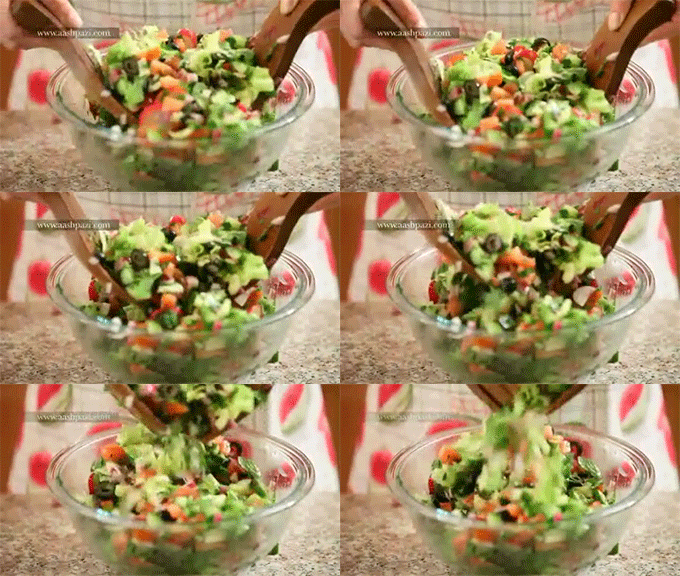 Eating well does not mean eating boring.
How Much Protein Should a Teenager Eat a Day? 🥚
Protein is the most under-eaten macro in the teen diet, and it is the one that protects muscle while you slowly lose fat. The baseline RDA from the Academy of Nutrition and Dietetics is 46 grams per day for teenage girls and 52 grams per day for teenage boys - but they flag that active and growing teens often need more (Eatright.org, How Teen Athletes Can Build Muscles with Protein).
For a teen who lifts or plays a sport, the practical target is higher. The young athlete review puts it at roughly 1.5 g of protein per kg of body weight per day, assuming total energy requirements are already satisfied (J Pediatr Soc North Am 2024;5(1):599), and UPMC HealthBeat gives the range as 1.2 to 1.5 g/kg (UPMC, How Much Protein Do Young Athletes Really Need?). Both numbers describe adolescent athletes. If you are not training regularly, the RDA above is your reference point.
For a 60 kg (132 lb) active teen, 1.2 to 1.5 g/kg works out to 72 to 90 grams of protein per day:
| Meal | Example | Protein |
|---|---|---|
| Breakfast | 2 eggs + glass of milk, or Greek yogurt with peanut butter + banana | 20-25 g |
| Lunch | Chicken or paneer wrap, dal + rice + curd, or tuna sandwich | 25-30 g |
| Snack | Roasted chana, string cheese, or protein shake with milk | 10-12 g |
| Dinner | Palm-sized fish or chicken, tofu or paneer cubes, or rajma with rice | 20-23 g |
For snack ideas that carry real protein, our high-protein snacks guide has options that work for a school bag.
You do not need protein powders to hit these numbers. The same review says adolescents commonly eat past their protein requirement already and does not recommend shakes. If you use one, pick a basic whey or pea protein, and only after a parent and ideally a dietitian have signed off.
Working out a personal target is a job for a parent or a clinician, not something to do alone at 16. If one of them wants to do the arithmetic with you, the NutriScan macro calculator takes age, weight, and activity level.
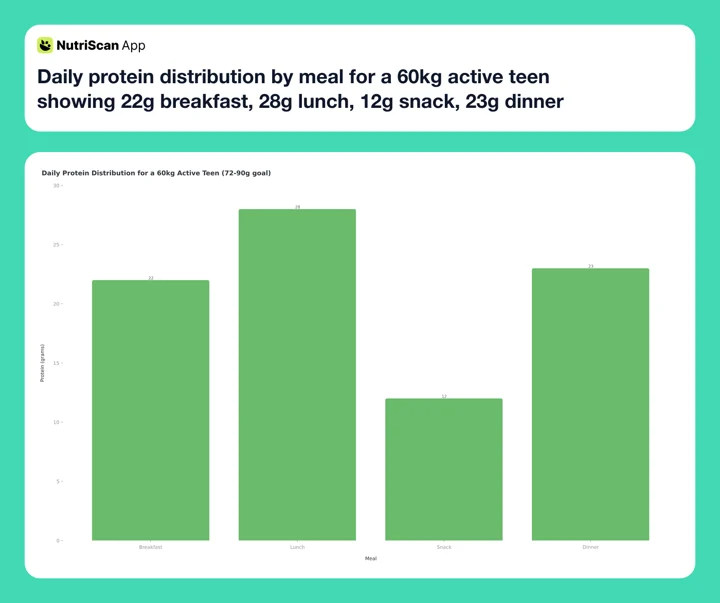 Figure 1: Protein spread across the day for a 60 kg active teen. The total of 85g lands at 1.4g/kg, with no supplements.

A Healthy Diet for Teenagers: The Plate Model, No Calorie Counting 🍽️
Calorie counting is a tool that is too sharp for most teens. That is our editorial position, and here is what sits behind it: in an NHANES analysis of 6,117 children and adolescents, the ones motivated by teasing were more likely to try to lose weight through unhealthy behaviors such as skipping meals (Behaviors and Motivations for Weight Loss in Children and Adolescents, Obesity 2015). A daily number on a screen is one more way to make food feel like a test you can fail. The replacement is the plate model.
For every main meal, build the plate in this order:
- Half the plate is vegetables, fruit, or salad. Cooked or raw, oil is fine, salt is fine. The goal is volume and fiber.
- One quarter is a protein anchor - eggs, fish, chicken, paneer, tofu, soya chunks, lentils, rajma, chana, or Greek yogurt.
- One quarter is a slow carb - roti, brown rice, oats, quinoa, sweet potato, or whole-wheat pasta. A fist-sized amount, not a mountain.
- A small amount of healthy fat - a drizzle of olive oil, half an avocado, a handful of nuts, or the fat that came with the protein.
Drink water with the meal. One can of soda often carries 150 calories from sugar, and the NIDDK teen guide advises keeping added sugars under 10% of daily calories. Its suggested first step is small: replace some of your sugar-sweetened drinks with water, keep that going for a while, then cut out the rest (NIDDK, Take Charge of Your Health: A Guide for Teenagers).
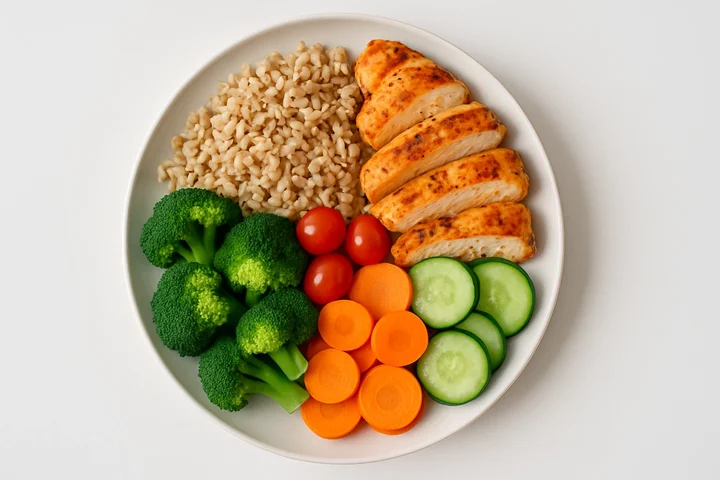 The plate model: half vegetables, a quarter protein, a quarter slow carbs. No measuring.
This single rule replaces calorie counting
"Half the plate = vegetables. Quarter = protein. Quarter = slow carb." You are deciding the shape of the plate, not the grams.
Strength Training Is the Real Engine 🏋️
If you only have bandwidth to add one habit, make it strength training. Two to three supervised sessions a week is the dose the National Strength and Conditioning Association supports. How fast anything changes varies, and that part is a conversation for your doctor, not a promise a guide can make.
The myth that lifting "stunts growth" was retired by sports medicine a long time ago. The NSCA position statement says there is no detrimental effect of resistance training on linear growth in children and adolescents, that injury to growth cartilage has not been reported in any prospective youth study, and that there is no minimum age requirement as long as the participant can follow coaching instructions (NSCA Youth Resistance Training position statement, 2009). It is a 2009 document, and no newer NSCA version has been published.
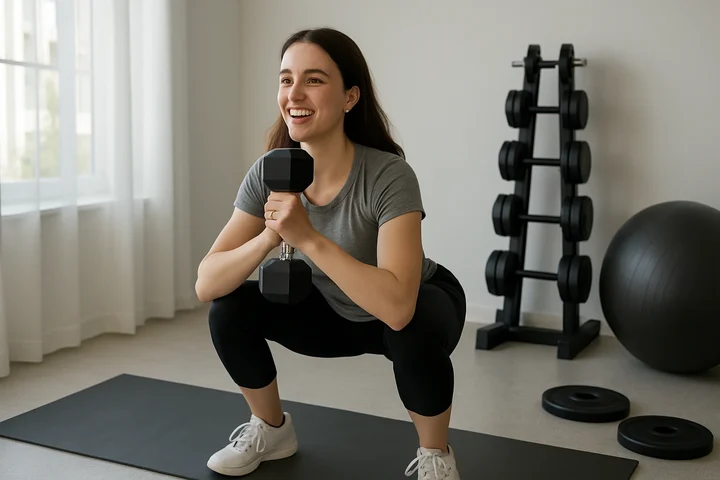 Two to three supervised sessions a week, form ahead of load.
A starter weekly plan if you have never lifted:
| Day | Activity | Details |
|---|---|---|
| Day 1 | Strength A | Goblet squat, push-up (knee version fine), dumbbell row, plank - 3x8-10 each |
| Day 2 | Light cardio | Walking, cycling, or sport at a conversational pace - 45-60 min |
| Day 3 | Strength B | Romanian deadlift, dumbbell shoulder press, lat pulldown or assisted pull-up, reverse lunge - 3x8-10 |
| Day 4 | Walk or rest | Active recovery |
| Day 5 | Strength A | Repeat Day 1 with slightly heavier weights |
| Day 6 | Fun activity | Sport, dance, swim, hike |
| Day 7 | Rest | Full recovery |
What you eat after a session matters less than most lifting content claims, and our muscle recovery nutrition guide covers the parts that hold up. The first month is about learning movements. Add weight slowly. Form before load, every time. If your school has a PE teacher who lifts, ask them to watch your squat once. Three sessions with a certified trainer who has worked with teens is money well spent.
Walking Is the Quiet Half of the Plan 🚶
The other half of the movement picture is the ordinary walking you do outside the gym, and the published target is not a step count. The NIDDK teen guide points to the physical activity guidelines: at least 60 minutes of activity every day, plus muscle-strengthening activity such as weightlifting or push-ups on at least 3 days a week and bone-strengthening activity such as running or jumping on at least 3 days a week (NIDDK, Take Charge of Your Health: A Guide for Teenagers). Your lifting sessions cover part of that. Walking covers the rest.
Practical ways to add movement without calling it exercise:
- Walk to school or get off the bus one stop early
- Take a 15-minute walk after dinner with a parent, sibling, or pet
- Stand up and walk for two minutes every hour you are studying or gaming
- Take phone calls walking around the room
The after-dinner walk is the easiest habit here to keep
Fifteen minutes is roughly 1,500 steps, it needs no kit, and it is time with your family. That is the whole pitch.
You do not have to "earn" food with steps. That framing pulls you back into the calorie-counting trap. Walking is about feeling better and giving the strength training somewhere to land.
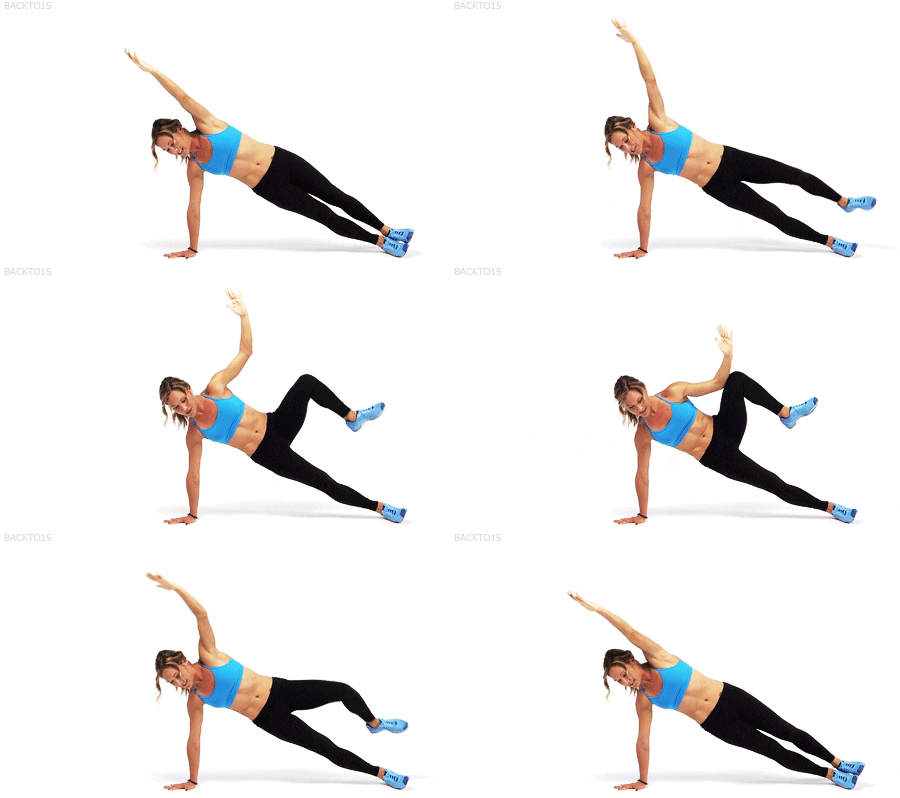 The guideline is 60 minutes of movement a day, and walking gets you most of the way there.
Sleep, Phones, and the Habit Most Guides Bury in a Footnote 😴
Here it is. The habit that gets one line in most teen health guides and deserves a section.
The NIDDK teen guide is direct: teens should aim for 8 to 10 hours of sleep each night (NIDDK, Take Charge of Your Health: A Guide for Teenagers). Short sleep makes every other habit here harder to hold, and what you eat in the evening feeds back into it, which our sleep and food guide goes through. Cooking is harder, lifting is harder, and the 4 pm reach for whatever is nearest is much easier.
The biggest sleep lever at this age is the phone, because phones in the bedroom cost teens sleep. Three rules that work in real homes:
- Phones charge in the kitchen, not the bedroom, on school nights.
- No screens 30 minutes before sleep. Read, stretch, or talk to family.
- Wake at the same time every day, weekends included, within an hour. The body clock cannot calibrate when wake time swings by three.
Sleep is the hardest habit to fix and the one that holds up the rest
If you can only fix one thing this month, fix this one. Every other habit in this guide is easier to hold when you are rested.
What Parents Should Actually Do (and Not Do) 👨👩👧
Parents: your role is real, and it is mostly about the home environment. A 2025 scoping review concluded that balanced parenting shapes children's eating behavior and self-regulation and lowers the risk of obesity and related problems including eating disorders (Maia et al., Children 2025;12(2):203).
Things that help:
- Stock the kitchen so the easy options are also the good ones: cut fruit, boiled eggs, Greek yogurt, hummus and carrots, roasted chana, peanut butter and bananas
- Eat dinner together at least four nights a week without screens
- Cook one new high-protein recipe a week and let your teen pick
- Do the after-dinner walk together. It is a conversation, not a cardio session
- Let them learn to cook two or three meals before they leave for college
Things that backfire:
- Commenting on their body, their clothes, or what is on their plate. Parental criticism of a child's weight, pressure to diet, and parents dieting themselves are all associated with more dieting and more extreme weight-control behavior (Canadian Paediatric Society, Paediatr Child Health 2004)
- Putting only the teen on a "diet" while the rest of the family eats differently. The whole house eats the same way or this fails
- Using food as reward or punishment
- Buying scales or body fat calipers, or weighing them weekly. Once a month at the doctor is plenty
The hardest part for most parents is staying quiet about the scale. Stay quiet. The work is in the kitchen and the calendar, not the commentary.
Red Flags That Mean Stop and Get Help 🚨
Some signs are not normal teenage moodiness. Pause the plan and call a doctor or therapist if you see:
- Skipping meals on purpose, hiding food, or eating in secret
- Vomiting after meals, using laxatives, or talking about being "too full" to function
- Exercising when sick, injured, or exhausted because of guilt
- Cutting out entire food groups - carbs, fats, dinners - without medical reason
- Periods stopping or becoming very irregular in girls who were previously regular
- Mood, sleep, or schoolwork falling off in the same window as weight changes
- Talking about weight or food more than once or twice a day
Disordered eating is not a diet that went too far
It is a separate medical condition with its own treatment. If any of the above appear, the food plan stops and a doctor or therapist starts. Earlier caught, better outcome.
How NutriScan Fits (and Where We Tell Teens to Step Away) 📱
Most calorie-tracking apps are too aggressive a tool for a 15 to 18 year old. Daily targets, gamified deficits, and streaks can push a teenager into the patterns this guide is trying to avoid.
That includes ours. NutriScan has one meal view and it shows numbers: scan a meal and you get a NutriScore band, calories, protein, carbs, fat, and the full micronutrient breakdown, free on every plan. No setting hides the calorie figure. If you are 15 to 18 with nobody clinical steering, use the plate model in this guide instead of an app.
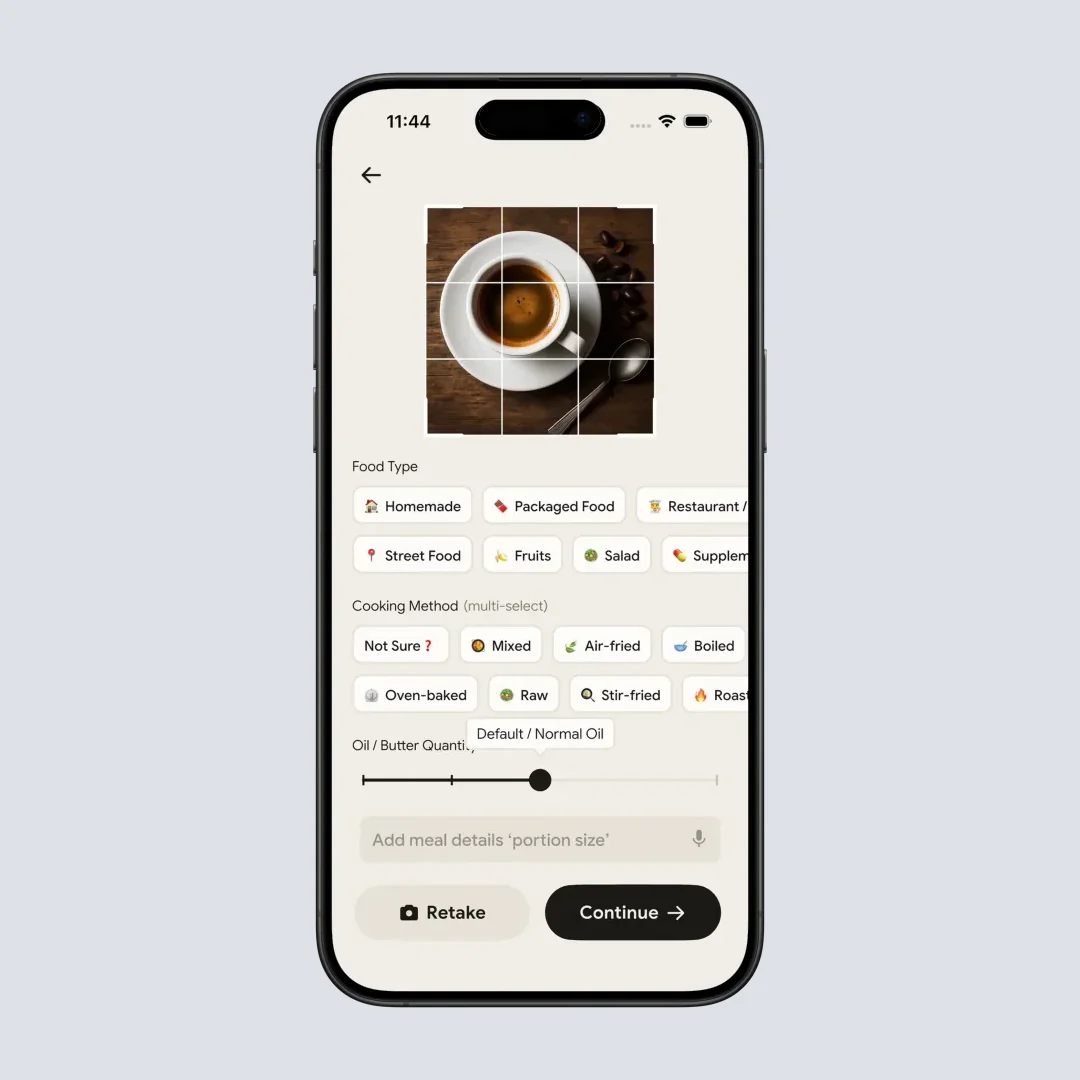
NutriScan's meal scan (Home > Camera Icon > Click Picture) returns a NutriScore band, calories, macros, and micronutrients for the plate. The numbers are always on screen.
Worth saying out loud to this age group: our terms set the minimum signup age at 18 in India, 16 in the European Economic Area, and 13 in the US and most other regions, and anyone under the age of majority needs a parent or guardian to accept the terms for them. If an app is part of this at all, a parent is already in the conversation.
If your doctor has given you a calorie or macro target as part of a treatment plan, tracking it in an app is reasonable, because a clinician is steering. If nobody clinical is in the loop, skip apps. The plate model and the strength plan above are enough on their own.
For what the app does show, see the NutriScan meal scan guide and the insights dashboard guide. Older teens training with a coach, and adults reading over their shoulder, can see how we frame the same numbers for muscle gain.
A Realistic Three-Month Picture 📅
Here is what three months can look like for a 16 year old starting from scratch. There is no weight column, on purpose: how your weight moves is something your doctor reads against your growth chart, not something a blog post can predict.
| Month | What changes |
|---|---|
| Month 1 | Sleep moves from 6 to 8 hours. Daily movement goes from almost none to close to an hour. Protein at every meal becomes the rule. Two strength sessions a week. Energy and mood lift noticeably. |
| Month 2 | Three strength sessions per week. The weight on the bar goes up, because early progress in a new lifter is mostly learning the movement. The post-dinner walk is a habit. The family eats dinner together more often. |
| Month 3 | Visible muscle in shoulders, arms, and legs. Clothes fit differently. Your doctor has a growth chart, a BMI percentile, and labs to read the real progress from. |
That pace is slow on purpose. The alternative is self-directed dieting, and in that three-year study of 15,000 children the dieters gained more weight than matched non-dieters, not less (Canadian Paediatric Society, 2004). A quiet plan like this one gets you into your twenties with strength you did not have before.
Frequently Asked Questions ❓
Should a 15 year old count calories? Almost never without clinical supervision. The plate model and the protein-at-every-meal rule get you most of the way there, with far less risk of food rules and shame.
Is intermittent fasting safe for teens? Not something to start on your own. A 2024 scoping review of fasting in youth found the adolescent trials ran in clinical settings, and flags harms including a study linking low-carbohydrate and intermittent fasting diets to increased disordered eating (Bakhsh et al., 2024). On breakfast, a 2024 review reports mixed results for skipping it in children and adolescents (Svendsen et al., 2024). This one goes to your doctor.
Is creatine safe for a 17 year old who lifts? The American Academy of Pediatrics tells pediatricians to discourage teenagers from using creatine or testosterone boosters (AAP, Dietary Supplements and Young Teens, Pediatrics 2017). The young athlete review adds that most supplements have never been studied in a pediatric population, so long-term safety is largely unknown (J Pediatr Soc North Am 2024;5(1):599). Do not start it on your own. Raise it with your doctor.
How much protein does a teenage girl need a day? The Academy of Nutrition and Dietetics baseline RDA is 46 grams a day for teenage girls and 52 grams for teenage boys, and it notes that active, growing teens often need more (Eatright.org). Teens who lift or play a sport land nearer 1.2 to 1.5 g per kg of body weight.
Can a vegetarian or vegan teen follow this plan? Yes, with more attention to protein quality, vitamin B12, iron, and calcium. The plate model is the same. Protein anchors shift to dal, paneer, tofu, soya chunks, Greek yogurt, eggs (if lacto-ovo), and a B12 supplement for vegans on a doctor's recommendation, because only animal foods carry B12 naturally (NIH Office of Dietary Supplements, Vitamin B12).
What if my teen plays a sport and is already lean but wants to "look more cut"? That is usually a body image conversation, not a nutrition one, and a doctor plus a sports dietitian is the first stop. Cutting hard in season pushes toward low energy availability, whose features include higher injury risk, weaker muscles, less endurance and a poorer training response, with weight-class and aesthetic sports at highest risk (J Pediatr Soc North Am 2024;5(1):599).
How often should we weigh in? Once a month at most, ideally at a doctor's office. Frequent self-weighing in adolescents is associated with poorer body image, more depressive symptoms and more unhealthy weight-control behavior (Quick et al., 2013; Pacanowski et al., 2015).
Start Here: The One-Line Version ✅
If you remember nothing else:
Eat protein at every meal. Lift twice a week. Move for an hour a day. Sleep 8 to 10 hours. Put a parent and a doctor in the loop.
None of that needs an app, and for most 15 to 18 year olds we would rather you ran it on paper.
Parents: if you want to see what your family's plates actually contain, NutriScan's free tier gives you 5 meal scans a week, each returning a NutriScore band, calories, macros and micronutrients. Five a week is not daily logging, and for this age group that is the point. Use it on the meals you are unsure about, then take what you see to your teen's doctor.