Best Noom Med Alternatives 2026 (GLP-1 Support Programs)
 ChatGPT
  Claude
  AI Mode
  Perplexity
 Noom Med runs $179 to $299 a month at the ongoing rate with compounded medication included, about $2,150 to $3,600 a year. Trimi lists $99 for semaglutide and $125 for tirzepatide on annual billing, and membership-only routes like Ro and Hims & Hers start at $39 for the first month, then $74 to $149. NutriScan is the food layer rather than a prescription, with 5 AI photo scans a week free and unlimited scans at about $59 a year.
Last verified: August 23, 2026
| Program | Published monthly price | Medication included |
|---|---|---|
| Noom Med, Microdose GLP-1Rx | $49 first four-week supply, then $179 | Yes, compounded |
| Noom Med, GLP-1Rx and Plus | $129-$149 to start, then $249-$299 | Yes, compounded |
| Trimi | $99 semaglutide, $125 tirzepatide (annual billing) | Yes, compounded |
| Ro | $39 first month, then $74 on annual prepay | No, membership only |
| NutriScan (food layer) | Free plan, or about $59/yr | No |
In the STEP 1 trial, adults on weekly semaglutide lost 14.9% of their body weight on average over 68 weeks, against 2.4% on placebo (Wilding et al., NEJM 2021). The medication does most of that work. What the food and habit layer around it decides is how much of the result survives after the prescription ends, and that part is on you no matter which provider writes it.
As a NutriScan nutritionist, I get asked about Noom Med often. It pairs a GLP-1 prescription with Noom's behavior-change app, which is a sensible idea on paper. The questions worth asking are what the bundle costs and what is actually inside it.
Prices below are standard US prices as of mid 2026 and change by region.
Noom's pricing page publishes a ladder, not one number. Microdose GLP-1Rx is $49 for the first four-week supply, then $179 a month billed quarterly. GLP-1Rx is $129 to start, then $249 a month. GLP-1Rx Plus, the tirzepatide tier, is $149 to start, then $299 a month. Those three rates are all-inclusive: clinical care, medication and the app. Noom also sells a telehealth tier for branded medication at $39 then $99 a month where the drug is not included, and a metformin tier at $69 then $99. The page notes that this pricing applies to new accounts from July 27, 2026.
Two things Noom does not lead with matter more than the sticker price. The GLP-1Rx and Microdose tiers dispense compounded semaglutide and tirzepatide, which Noom discloses in a footnote: the compounded semaglutide it sells "is produced in an FDA-registered facility but has not been reviewed by the FDA for safety, efficacy, or quality" (Noom microdose page). And the program is not available in all 50 states, because state compounding rules differ.
This guide covers the best Noom Med alternatives, organized by what you actually want next: cheaper medication access, stronger human coaching, big-brand telehealth, or a food-tracking layer you can pair with any prescription.
TL;DR - Best Noom Med Alternatives 2026
• Who it's for: GLP-1 users (or soon-to-be) who want to lower cost, unbundle the app, or add a food layer to any prescription
• The baseline: Noom Med is $179 to $299 a month at the ongoing rate with compounded medication included, about $2,150 to $3,600 a year, less in year one because the first supply is discounted
• The cheap route is not as cheap as it was: Forbes Health puts all-in compounded programs at $178 to $394 a month including membership, level with Noom's microdose tier rather than far below it. Brand-name self-pay has fallen to $149-$399 for Wegovy and $299-$449 for Zepbound
• What the food layer is for: habits worth having on their own terms. The trial evidence says weight returns after stopping regardless, so treat a tracker as useful, not as insurance
• Safety note: GLP-1s are prescription drugs. Pricing and availability vary by country, and nothing here is medical advice. Always work with a licensed clinician
IMPORTANT
Your Noom Med alternatives plan at a glance.
A quick roadmap so you can pick fast and not overpay.
⏱️ Progress 0/4 • ~0 minutes in • Keep going
⏳ Step 1: Know why you are really switching
⏳ Step 2: Compare the 2026 alternatives side by side
⏳ Step 3: Match the program to your real need and true cost
🔍 What the food layer can and cannot do for you (revealed near the end)
One note before we start. GLP-1 medications are prescription drugs, telehealth availability and pricing vary by country, and nothing here is medical advice. Always work with a licensed clinician.
Why People Look for Noom Med Alternatives
Noom Med is not a bad program. But three reasons drive most of the searches for something else.
Cost. At $179 to $299 a month with compounded medication included, Noom Med sits in the middle of GLP-1 telehealth pricing, not at the top. Over a year at the ongoing rates that is roughly $2,150 to $3,600, and a little less in year one because the first supply is discounted. Forbes Health's August 2026 round-up puts the cheapest all-in compounded program at $178 a month including membership (Forbes Health, audited 4 August 2026), a dollar under Noom's microdose tier, so the saving is worth having at Noom's higher tiers and close to nothing at its lowest. If you want the full pricing breakdown, see our Noom Med pricing guide for 2026.
The bundle. Noom Med ties the medication to the Noom app. If you like the medication access but not the daily lessons, or you already use a different food tracker, you are still paying for both. Many people want to choose their medication provider and their habit layer separately.
The price gap between approved and compounded has closed. This used to be the whole argument for leaving, and it has weakened badly. Novo Nordisk sells Wegovy direct for $149 to $399 a month depending on dose and offer, with a standard self-pay rate of $349 (NovoCare Pharmacy), and Lilly sells single-dose-vial Zepbound at $299 to $449 (LillyDirect). Against all-in compounded programs at $178 to $394, the cash difference is now often under $100 a month, and sometimes nothing. The choice between an FDA-approved product and a compounded copy is mostly a regulatory and safety question now, not a budget one.
 Price every program on its all-in monthly cost, once membership, medication and lab fees are all in the same number.
One caution before the comparisons, because this is the claim most GLP-1 articles overstate. A 2025 meta-analysis of 33 randomised trials and 12,028 participants found that adding a GLP-1 receptor agonist to lifestyle modification produced 7.13 kg more weight loss than lifestyle plus placebo (Chu et al., eClinicalMedicine 2025). Lifestyle support sat in both arms, so it measures what the drug adds to a program, not what a program adds to the drug. Whether the second is true, the authors write, "remains inconclusive".
IMPORTANT
Checkpoint: you know why you are switching.
Quick status update so you always know the next best move.
⏱️ Progress 1/4 • ~1 minute in • Keep going
✅ Step 1: Know why you are switching (done)
👉 Step 2: Compare the 2026 alternatives (you are here)
⏳ Step 3: Match the program to your need
🧩 What the food layer can and cannot do (coming soon)
Three Situations: What the Money Buys
These are worked examples built from the pricing and trade-offs described above, not individual users.
The cost-cutter. Someone on a stable microdose of compounded semaglutide who does not need much hand-holding, paying Noom Med $179 a month mostly for medication they now understand well. Trimi publishes $99 a month for compounded semaglutide on annual billing (trytrimi.com), so moving saves about $80 a month. Both are compounded, so this is not a trade of the approved drug for a copy; it is the same category at a lower price with less program around it. What you give up is the Noom app, some clinical contact, and the freedom to walk away mid-year if you prepay.
The coaching-seeker. Someone who has tried medication before and regained the weight after stopping. Here the habit work matters more than shaving $50 off the prescription, so structured coaching beats a bare refill. A program that bundles behavioral coaching or licensed-dietitian access is worth more than the cheapest possible pill.
The protein-tracker. Someone whose appetite dropped sharply on a GLP-1. Eating far less is the point, but it also carries a risk of losing muscle and missing protein without attention. The priority is a fast way to log small, frequent meals and watch protein. The medication provider barely matters here; the food layer is the whole game.
Most people are some mix of these three. Knowing which one you are tells you which alternative fits.
The Best Noom Med Alternatives at a Glance
Here is how the main 2026 options compare. Prices are standard US prices as of mid 2026 and change by region. The column that trips people up is the third one, because half of these programs price the membership and the medication separately and the other half do not.
| Program | Published monthly price | Medication included? | Coaching / app |
|---|---|---|---|
| Noom Med, Microdose GLP-1Rx | $49 first four-week supply, then $179 | Yes, compounded | Noom app included |
| Noom Med, GLP-1Rx and GLP-1Rx Plus | $129-$149 to start, then $249-$299 | Yes, compounded | Noom app included |
| Trimi | $99 semaglutide, $125 tirzepatide, annual billing | Yes, compounded | Minimal |
| Ivim Health | $75-$249 compounded | Yes, compounded | Insurance concierge, clinical support |
| Henry Meds | Not published on any page I could reach | Unclear | Unclear |
| Ro | $39 first month, then $74 on annual prepay or $149 monthly; all-in from $298 | No, membership only | Light support |
| Hims & Hers | $39 first month, then $149; all-in $298-$2,048 | No, membership only | Light support |
| Found | $169-$239 compounded on a 12-month plan; $149-$449 brand | Yes, in the quoted rate | Coaching included |
| WeightWatchers MED+ | $25 first month, then $74 (12-month) or $84 (6-month); all-in $273-$423 | No, stated explicitly | Points system, lifestyle programs |
| Calibrate | From $199 a month | Prescribed, sourced separately | 1:1 video coaching, structured lessons |
| Brand-name self-pay (Wegovy, Zepbound) | Wegovy $149-$399, standard $349; Zepbound $299-$449 | Yes, FDA-approved | None |
| Food-tracking layer (NutriScan, Cronometer) | Free, or about $59/yr either way | No | App, no medication |
The all-in totals for Ro, Hims and WeightWatchers come from Forbes Health, audited 4 August 2026; the compounded and brand-name ranges for Ivim, Hims and Found come from U.S. News, updated 20 July 2026. Henry Meds advertises heavily but publishes no price on any page reachable from its site, so I have left the cell blank rather than guess. The food-layer row is the part most people underestimate, so I will come back to it.
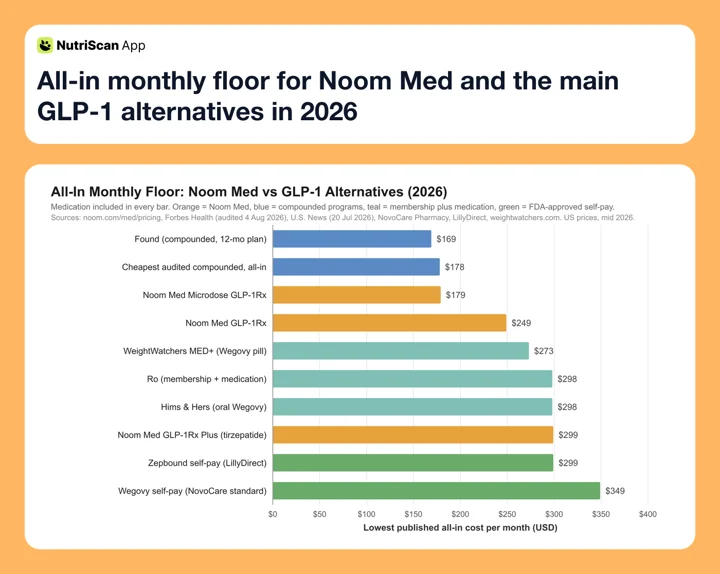 Figure 1: All-in monthly floor, medication included, for the routes where an all-in figure is published. The spread is narrow. Everything here lands between about $169 and $349 a month, which is the real headline.
Stories and Facts: How GLP-1 Programs Actually Differ
The medications themselves are similar across providers. Most prescribe semaglutide (the molecule in Wegovy and Ozempic) or tirzepatide (the molecule in Zepbound and Mounjaro). In STEP 1, weekly semaglutide produced a mean 14.9% body-weight reduction at 68 weeks, and 50.5% of the semaglutide group reached 15% or more against 4.9% on placebo (Wilding et al., NEJM 2021). SURMOUNT-1, a 72-week trial of tirzepatide at 5, 10 and 15 mg, produced larger reductions (Jastreboff et al., NEJM 2022), up to about 22.5% at 72 weeks. A 2025 review puts the typical range across these agents at 15% to 25% of body weight after about a year (Reiss et al., Biomolecules 2025).
So what separates one program from another is not usually the drug. It is four things:
Brand versus compounded. Brand-name GLP-1s are FDA-approved, and self-pay prices have come down a long way: $149 to $399 a month for Wegovy direct from Novo Nordisk, $299 to $449 for Zepbound from Lilly. Compounded versions are not FDA-approved, do not go through the FDA's premarket review for safety, effectiveness and quality, and may not contain the same active ingredient. The FDA states that the salt forms some compounders sell, semaglutide sodium and semaglutide acetate, "are different active ingredients than are used in the approved drugs", and that it has received multiple reports of adverse events, some requiring hospitalisation, tied to dosing errors with compounded injectable semaglutide (FDA). The access rules have already tightened, too. The shortages ended in December 2024 and February 2025, the enforcement discretion that let pharmacies compound copies at scale ended in 2025, and as of April 2026 the FDA tolerates essentially-a-copy compounding only where a compounder "fills four or fewer prescriptions of that compounded drug product during a calendar month" (FDA). Ask any compounded provider how it is supplying you under those rules.
Membership fees. Several providers advertise a low medication price, then add a separate monthly membership, and three of them do not include the medication at all. Ro's membership is $74 to $149 with the drug priced on top, Hims's is $149, and WeightWatchers MED+ says outright that "cost of GLP-1 medications not included". Forbes puts the all-in totals at $298 for Ro, $298 to $2,048 for Hims and $273 to $423 for WeightWatchers. Compare all-in numbers or you will price a membership against a full program and think you found a bargain.
Coaching depth. Found bundles "personalized lifestyle, nutritional and behavioral coaching" with medication access (U.S. News). WeightWatchers MED+ pairs prescribing with its Points system and lifestyle programs (WeightWatchers). Ivim Health is better supported than its price suggests, singled out by U.S. News for insurance concierge and clinical support. Trimi is the genuinely light one, a low-cost platform routing to a prescriber network. Noom Med sits in the middle, with its app doing the coaching. For a deeper look at that trade-off, read is Noom Med worth it in 2026.
Contracts. Several of the cheaper headline rates are term rates. Found's $169 to $239 is on a 12-month plan, WeightWatchers MED+ sells only 6-month and 12-month terms, and Ro's $74 requires prepaying a year against $149 month to month. Even the flat-priced providers are not all walk-away: Henry's own FAQ warns that on a multi-month plan "you may be required to pay out the rest of your balance". Read the term before the price.
One fact that does not get enough attention: what happens when you stop. In the trial literature, weight comes back. Reiss and colleagues put it plainly, attempts to stop these drugs and hold the loss were "largely unsuccessful", and "when switched to placebo there was invariably weight regain" (Biomolecules 2025). A 2025 systematic review found about two-thirds of semaglutide weight loss regained after withdrawal, and concluded that durability "often depends on continued treatment" (Shah et al., Cureus 2025). Neither paper shows that behavioural work prevents that regain, so the honest version of the argument is narrower than the one most GLP-1 articles make: build the food and habit layer because eating well and holding muscle are worth it in their own right, and plan any taper with your prescriber rather than with a tracker.
IMPORTANT
Checkpoint: midway progress update.
You are halfway. The decisions get easier from here.
⏱️ Progress 2/4 • ~2 minutes in • Keep going
✅ Step 1: Know why you are switching (done)
✅ Step 2: Compare the alternatives (done)
👉 Step 3: Match the program to your need (current)
⏳ What the food layer can and cannot do (next)
Tips and Tricks for Choosing a Noom Med Alternative
Here are the rules I give people weighing their options.
1. Calculate the true monthly cost. Add medication price plus any membership plus any required lab or consult fees, and check first whether the membership includes the drug at all. Compare that single number across programs, not the headline price.
2. Match the program to your real need. If you mostly need a refill, buy the safest medication you can afford and add a food app. If you need accountability, pay for coaching. Do not pay coaching prices for a refill you could get cheaper, and now that brand-name cash prices have fallen, price the approved product before you assume compounded is the budget move.
3. Verify the pharmacy, and know what licensure covers. For compounded GLP-1s, a trustworthy provider names its pharmacy partners and lets you check their licensure. If a provider will not tell you where the medication is made, treat that as a warning sign. Read "licensed" carefully, though: state pharmacy licensure is not FDA approval, and the FDA does not review compounded drugs for safety, effectiveness or quality before they reach you.
4. Protect your protein. Appetite drops sharply on GLP-1s, and some of the weight lost is lean mass. In the STEP 1 body-composition substudy, total lean body mass fell 9.7%, though lean mass as a share of total body mass rose by 3.0 percentage points (NEJM substudy analysis); in the SURMOUNT-1 substudy about 25% of the weight lost was lean mass (Look et al., 2025). Body composition does not fall apart, but absolute muscle is worth defending. The Reiss review's advice is the standard one: resistance exercise and higher protein intake (Biomolecules 2025). Our free online macro calculator gives you a protein target to aim for.
5. Plan for the off-ramp early. Decide now what your maintenance habits will be when you taper or stop, and decide it with your prescriber, since the trial evidence points to continued treatment rather than habits as what holds the loss. The habits are still worth building. They are just not a guarantee.
6. Keep the food log simple. On suppressed appetite, you eat smaller, more frequent meals. A logging method that takes ten seconds beats a detailed one you abandon by week three.
7. Do not skip the clinician conversation. Side effects, dose changes, and drug interactions are real. The cheapest program is not worth it if the medical oversight is thin.
Protect muscle while appetite is low
On a GLP-1, the danger is not eating too much. It is eating too little protein. Set a daily protein target, lift a few times a week, and log intake so you can see the low days coming. This is general guidance, not a prescription; your clinician sets your targets.
Step-by-Step: How to Switch From Noom Med
If you decide to leave, here is a clean way to do it without a gap in care or a surprise charge.
Step 1: Confirm your current dose and supply. Note your exact medication, dose, and how many weeks you have left. You will need this for any new provider's intake.
Step 2: Talk to a clinician about continuity. Whether you switch providers or stay on the same molecule, get medical sign-off on continuing your dose. Do not let your supply lapse mid-course without a plan.
Step 3: Price the true monthly cost of two or three alternatives. Use the table above as a starting point, then confirm live prices. Add membership and fees, and check whether the medication is included. Pick based on the all-in number and the coaching level you need.
Step 4: Set up your food and habit layer first. Before you cancel anything, install your food tracker and log a few days. Starting the habit while you still have structure makes the transition smoother.
Step 5: Cancel Noom Med correctly. Noom's terms require cancelling "prior to 11:59 p.m. Eastern time on the day before your next recurring billing date", through the Noom app, the Subscription Portal at account.noom.com, or the store you bought through. In Noom's own words, "uninstalling the app will not cancel your subscription". One Med-specific limit matters more here than it does on Noom Weight: refunds may be available within 14 days of your first charge, but not once a prescription has been written or a clinical visit has taken place (Noom refund policy). Confirm the cancellation in writing and note when access ends.
Step 6: Track protein and weight weekly. For the first month on the new setup, watch protein intake and weigh in on a consistent schedule. This catches muscle loss or stalls early, while they are easy to fix.
IMPORTANT
Checkpoint: final stretch before the reveal.
One last nudge. The honest read on the food layer is next.
⏱️ Progress 3/4 • ~3 minutes in • Keep going
✅ Step 1: Know why you are switching
✅ Step 2: Compare the alternatives
✅ Step 3: Match the program to your need
✨ What the food layer can and cannot do (about to reveal)
The Reveal: What the Food Layer Can and Cannot Do
You have been patient through the price tables and the provider names. Here is the part most people skip: the food and habit layer. I want to be careful about what I claim for it, because this is where GLP-1 articles reach past their evidence.
What the research shows is an association, and a strong one. A 2025 retrospective analysis of 57,975 people using one commercial GLP-1 platform in the UK found that the users who engaged with the app lost 9% of body weight at three months against 5.9% for those who did not, and 11.53% against 8% at five months, both differences significant at P<.001 (Johnson et al., J Med Internet Res 2025). Two caveats you should weigh: everyone in it was already on the platform, so it compares engaged users with disengaged ones rather than app with no app, and three of the six authors work for the company that runs the platform. Engagement predicted the outcome. Nobody has shown it caused it.
From the clinical side, the 33-trial meta-analysis cited earlier measures the drug's contribution on top of lifestyle support, not the other way round (Chu et al., eClinicalMedicine 2025). So the fair summary is that people who engage do better, and that no randomised trial has tested whether adding a food app to a prescription is what makes the difference.
 Lower appetite makes new eating habits easier to practice. Whether they hold your weight after you stop is a separate question, and the trials are not encouraging.
The long-term reviews are the sobering counterweight, and they cut against the comfortable version of this argument. Regain after stopping is the rule in the trial data, and both reviews attribute durability to staying on the drug rather than to habits (Reiss et al., 2025; Shah et al., 2025). A tracker is not insurance against that. Treat obesity treatment as long-term care, and treat the stopping decision as your prescriber's call, not your app's.
So here is the honest case for a food app next to any GLP-1 program. It does not prescribe anything and it does not promise to hold your weight after you stop. What it does is tell you whether you are hitting your protein, eating enough overall on low-appetite days, and getting your micronutrients while your total intake is low. Those are worth knowing on their own terms. That role is the same whether your prescription comes from Noom Med, Ro, Found, or a compounded provider.
Where NutriScan Fits
NutriScan is not a GLP-1 provider and does not sell medication. It is the food-tracking layer you pair with whatever medical program you choose. For GLP-1 users, that role is specific and useful: photo logging makes it fast to record the smaller, more frequent meals that come with reduced appetite, and the macro view helps you keep protein high enough to protect muscle while you lose fat.
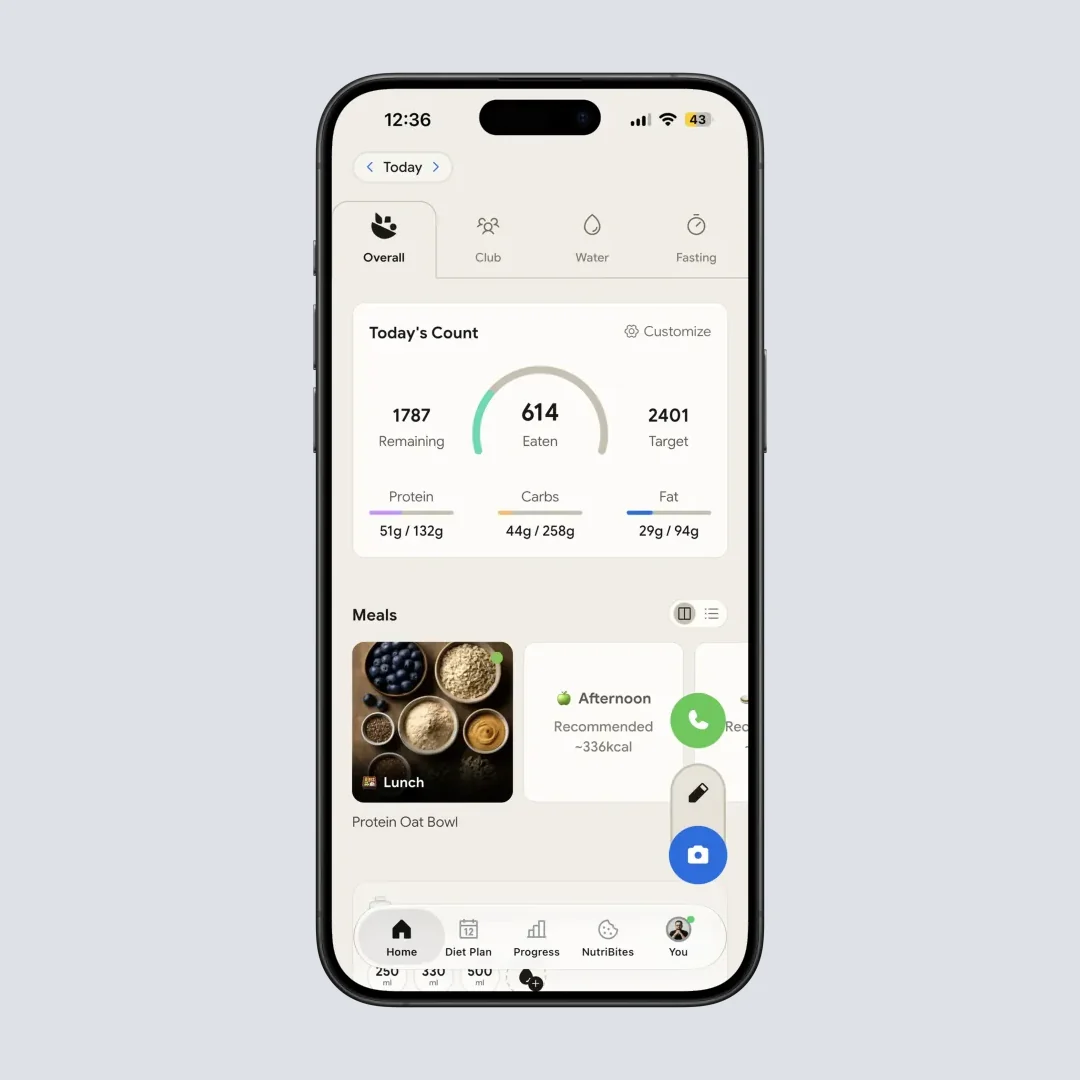
Home > daily breakdown: your calories, protein, and micronutrients at a glance, so low-appetite days do not become very-low-protein days.
Five free photo scans a week is enough to test the scanner on the meals that usually break a food database, your curries, your restaurant plates, your mixed bowls, before you decide whether it is worth paying for. Micronutrients come with every meal on the free plan, which matters when your total intake is low. So do NutriScore on each meal, the intermittent fasting timer, and four Monika voice calls a week, Monika being the voice AI nutritionist you can talk to instead of typing. NutriBites, the built-in AI chat, answers questions about your meal timeline, protein targets, or meal swaps.
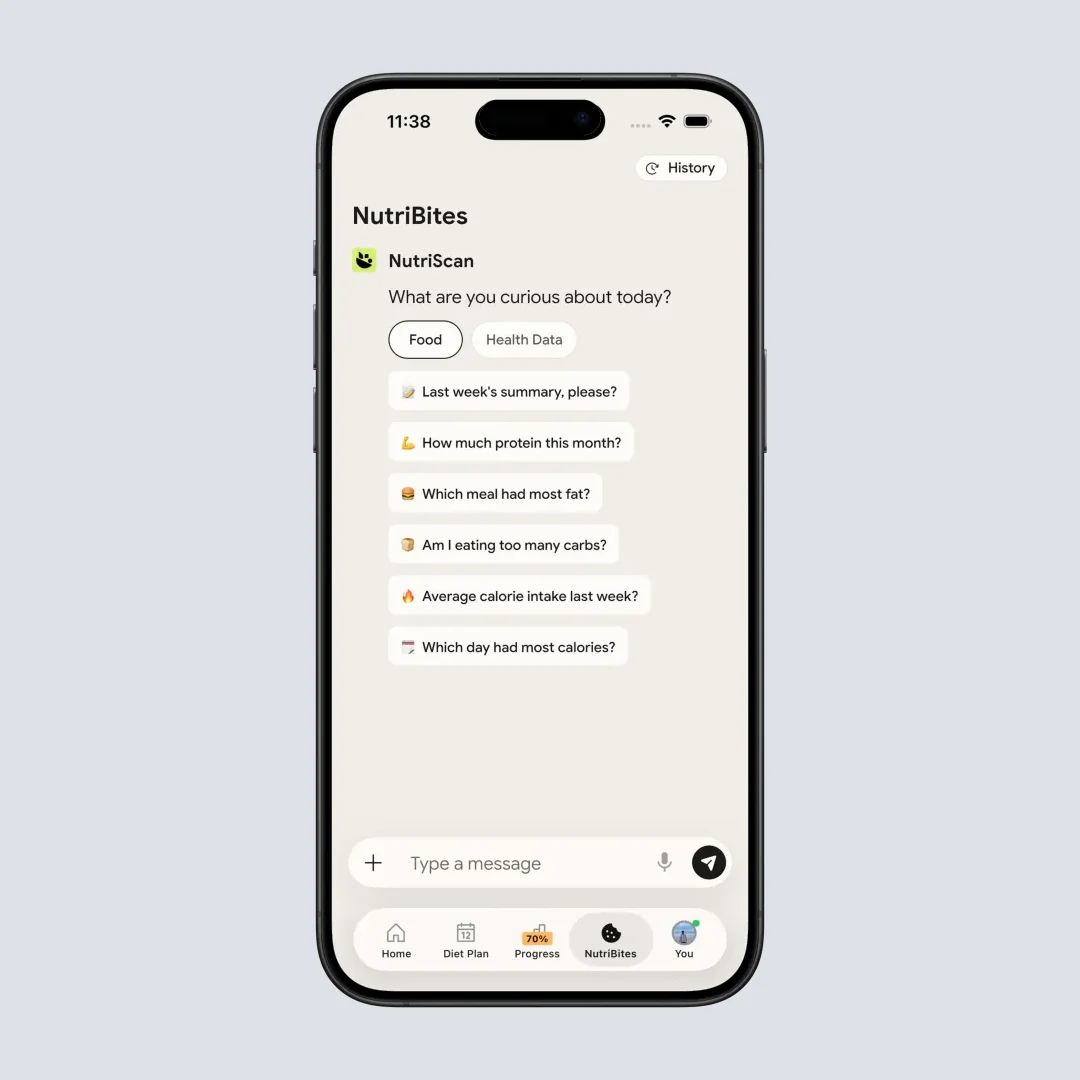
Home > Bottom Nav > NutriBites: ask questions about your logged meals and get pattern-level insights.
If you want unlimited scans and unlimited Monika calls, plus the 28-day personalized diet plan, weekly meal-plan suggestions and a goal-based grocery list, Premium is about $59 a year in the US, a fraction of any GLP-1 program, and it works alongside all of them. Every new account gets a 7-day Premium trial; it starts through your app store, and whether a card is collected depends on your platform and region. Curious how to eat on a GLP-1? Our Ozempic diet plan guide pairs well with any of the programs above.
Conclusion
Noom Med is a reasonable bundle. At $179 to $299 a month with compounded medication included it is also not the outlier it looks like: the cheapest all-in compounded program Forbes could find is $178, and brand-name self-pay starts at $299. The spread across this whole market is now roughly $169 to $349 a month, so the decision is less about price than the search results suggest.
That makes the useful question a different one. Pick your provider by what you actually need: a low flat rate with a light program (Trimi, Ivim), big-brand telehealth with a membership priced separately from the drug (Ro, Hims), built-in coaching (Found, WeightWatchers MED+), or an FDA-approved product bought at the manufacturer's cash price. Then add a tracker, not because it will keep the weight off after you stop, but because knowing your protein and your micronutrients on a low-appetite day is worth knowing. And whatever you choose, make the medication decision with a licensed clinician.
IMPORTANT
Recap: everything you worked through.
You finished the run. Save this for when you compare providers.
⏱️ Progress 4/4 • ~4 minutes in • Nicely done
✅ Step 1: Know why you are switching
✅ Step 2: Compare the alternatives
✅ Step 3: Match the program to your need
✅ What the food layer can and cannot do (revealed): it is worth building, and it is not insurance against regain
Track your meals and protein on any GLP-1 program with NutriScan - 5 free photo scans a week, no subscription needed.
Frequently Asked Questions ❓
Q: How much does Noom Med cost in 2026?
A: Noom publishes a ladder rather than one price (noom.com/med/pricing): Microdose GLP-1Rx at $49 for the first four-week supply then $179 a month billed quarterly, GLP-1Rx at $129 then $249, and GLP-1Rx Plus, the tirzepatide tier, at $149 then $299. Those rates include clinical care, compounded medication and the app, so at the ongoing rates that is about $2,150 to $3,600 a year, less in year one. A telehealth-only tier runs $39 then $99 a month without the medication. New pricing applies to new accounts from July 27, 2026, and the program is not available in all 50 states.
Q: What is the cheapest Noom Med alternative?
A: Less of a saving than it used to be. Forbes Health's August 2026 round-up puts all-in compounded programs at $178 to $394 a month including membership (Forbes Health), so the cheapest all-in compounded route is level with Noom's $179 microdose tier rather than far below it. Found publishes $169 to $239 a month for compounded medication on a 12-month plan and Trimi publishes $99 a month for compounded semaglutide on annual billing, both below Noom. The trap is the membership: Ro, Hims and WeightWatchers all price the drug separately from the membership, so their headline numbers are not comparable to Noom's.
Q: Are compounded GLP-1 medications safe?
A: The FDA's position is that compounded drugs are not FDA-approved and do not go through its premarket review for safety, effectiveness and quality. It also says the salt forms some compounders sell, semaglutide sodium and semaglutide acetate, "are different active ingredients than are used in the approved drugs", and it has received multiple reports of adverse events, some requiring hospitalisation, linked to dosing errors with compounded injectable semaglutide (FDA). State pharmacy licensure is not the same thing as FDA approval. The shortages that made large-scale compounding lawful are over, and the enforcement discretion behind it ended in 2025 (FDA), so ask any provider how it is supplying you now. Discuss the trade-offs with a licensed clinician before starting.
Q: Do I need a coaching app if I am taking a GLP-1?
A: The evidence points that way without proving it. A 2025 retrospective analysis of 57,975 people on one commercial GLP-1 platform found engaged users lost 11.53% of body weight at five months against 8% for the users who did not engage (Johnson et al., 2025), but it compared engaged with disengaged users of the same platform, not app against no app, and three of its six authors work for that platform. A 2025 meta-analysis of 33 randomised trials found that adding a GLP-1 receptor agonist to lifestyle modification produced 7.13 kg more weight loss than lifestyle plus placebo (Chu et al., 2025), which measures the drug's contribution, not the app's. You do not have to use Noom's app specifically, and no trial shows a food app causes better results.
Q: Will I regain the weight if I stop the medication?
A: Usually, yes. A 2025 review reports that attempts to stop these drugs and maintain the loss were "largely unsuccessful", with "invariably weight regain" on switching to placebo (Reiss et al., 2025), and a 2025 systematic review found about two-thirds of semaglutide weight loss regained after withdrawal, concluding that durability "often depends on continued treatment" (Shah et al., 2025). Neither paper shows that habits prevent it. Build the eating and activity habits anyway, they are worth having, and make any decision to stop or taper with your prescriber.
Q: How do I keep my muscle while losing weight on a GLP-1?
A: Prioritize protein and resistance exercise. Some of the weight lost on these medications is lean mass: the STEP 1 substudy recorded a 9.7% fall in total lean body mass, with lean mass rising 3.0 percentage points as a share of total body mass (substudy analysis), and SURMOUNT-1 recorded about 25% of the weight lost as lean mass (Look et al., 2025). The standard advice in the Reiss review is resistance exercise plus higher protein intake (Biomolecules 2025). Track your intake so low-appetite days do not become very-low-protein days, and set your targets with your clinician.