Noom Med Reviews: Is It Legit and Worth the Cost?
 ChatGPT
  Claude
  AI Mode
  Perplexity
  Photo by Farhad Ibrahimzade on Unsplash
Noom Med reviews tend to split the same way: readers like the coaching and hate the billing. Here is our read, with every price taken off Noom's own page. Noom Med pairs a GLP-1 prescription with behavioral coaching and food tracking. The program fee is $39 to $149 to get started, then $99 to $299 a month depending on the tier. Prices are standard US prices as of mid 2026 and change by region. It is a real telehealth service with licensed clinicians, and its GLP-1Rx tiers ship compounded medication the FDA has not reviewed. Worth paying for if you will use the coaching, overpriced if you only want the prescription.
The medications themselves are not in doubt. In a 2025 systematic review, Moiz and colleagues found that tirzepatide at 15 mg once weekly produced weight loss of up to 17.8% (95% CI 16.3% to 19.3%) against placebo after 72 weeks of therapy (Ann Intern Med, PubMed). The real question is whether Noom Med is the right way to get them.
This guide breaks down what you actually pay, what you get for the money, and who benefits most from combining GLP-1 drugs with Noom's coaching platform. Noom changed its Med pricing for new accounts on 27 July 2026, so every figure here is read off Noom's own pricing page rather than a review site.
Is Noom Med Legit? What the Program Actually Is 💊
Noom Med is the medical weight loss arm of the Noom app. It connects you with licensed clinicians through telehealth (Noom). If you qualify, a provider prescribes a GLP-1 medication and you get access to Noom's coaching ecosystem. The legitimacy question comes up a lot, so to answer it plainly: this is a real service run by a real company with real prescribers, and the things people complain about are the refund policy, the quarterly auto-renewal, and the compounded medication on the GLP-1Rx tiers. All three are covered below.
In 2026 Noom Med lists six programs, each targeting a different budget and medical need (Noom pricing). Noom's own summary of what the plans share is narrower than the marketing suggests: most plans include full access to the behavior-change program, 1:1 coaching, and clinical care with ongoing oversight. Forbes Health's longer list, a dedicated coach, a personalized curriculum of mini-courses, a workout video library, macronutrient tracking and community access, still describes the app you get (Forbes Health, published 24 October 2025, last modified 21 April 2026). Noom also now markets a Muscle Defense program alongside the medication tiers.
Forbes Health gave Noom Med a 3.9 out of 5 rating in that October 2025 review, singling out its user-friendly website and additional weight loss support resources. Worth knowing before you weigh that score: every price in the same review predates Noom's July 2026 repricing.
 Weighing the costs vs benefits of Noom Med? Let's break down every plan.
Noom Med Pricing: Every Plan Compared 💰
Here is what each Noom Med program costs in 2026, read off Noom's own pricing page on 7 August 2026. Prices are standard US prices as of mid 2026 and change by region. Noom does not use the word "trial" anywhere on that page. What it sells is a discounted first term, roughly a 3-week subscription plus a 4-week medication supply, and then a quarterly bill.
| Program | To get started | Ongoing | Medication |
|---|---|---|---|
| GLP-1Rx Program Telehealth for Branded Med | $39 | $99/mo, billed quarterly | Not included |
| Weight Loss Pill (Metformin) | $69 | $99/mo, billed quarterly | Included |
| Proactive Health GLP-1Rx Program | $149 every 4 weeks | $149 every 4 weeks | Included |
| Microdose GLP-1Rx Program | $49 (list $79) | $179/mo, billed quarterly | Included, compounded |
| GLP-1Rx Program | $129 | $249/mo, billed quarterly | Included, compounded |
| GLP-1Rx Plus (tirzepatide) | $149 | $299/mo, billed quarterly | Included, compounded |
Noom also names a fifth compounded product, Microdose GLP-1Rx Plus, on its Noom Med page, a low-dose tirzepatide. It carries no price of its own on the pricing page, so ask at checkout which tier it bills under.
Two details in that table are easy to skim past.
Proactive Health is billed every 4 weeks, not monthly. Noom prints a 15-week first term and 16-week renewals. Thirteen payments a year at $149 is $1,937, not the $1,788 you get by multiplying by 12.
The compounded tiers dispense a product the FDA has not reviewed. Noom footnotes this itself: "Compounded medications, if prescribed, are not reviewed by FDA for safety, efficacy or quality. No affiliation with Novo Nordisk, Inc., the only US source of FDA-approved semaglutide."
What each tier actually ships also differs. The compounded tiers mail the medication to your door. The branded-meds tier writes a prescription for Wegovy or Zepbound that you fill at your own pharmacy, which is why it is the only tier where your drug coverage does anything. Proactive Health pairs a microdose GLP-1 with lab work and biomarker feedback.
On geography, Noom's own pages say only that the programs are "not available in all 50 US states" and point you at the eligibility quiz. Forbes Health reported in October 2025 that the compounded plans were unavailable in Alabama, Louisiana and Mississippi, and the branded-meds telehealth plan in Alabama and Virginia. Since every price in that same review has since gone stale, treat the state list as dated rather than current, and check the quiz.
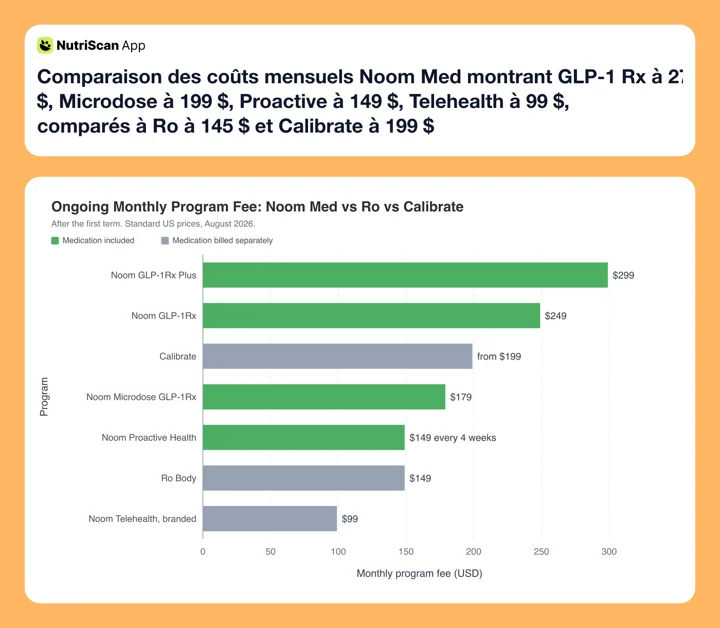 Figure 1: Ongoing monthly program fees after the first term. Green bars include the medication (compounded, on the Noom GLP-1 tiers), grey bars do not. Standard US prices, August 2026.
TIP
The branded meds tier has the cheapest program fee at $39 to start then $99 a month, but the drug is billed separately. That used to be a decisive argument for going compounded instead. It is not any more. Self-pay brand prices have fallen hard: NovoCare sells Wegovy direct at $149 to $399 and LillyDirect sells Zepbound at $299 to $449. Against $179 to $299 a month for a compounded tier, the gap is small, and the branded route gets you an FDA-approved product.
Noom Tirzepatide Reviews: Which GLP-1s Noom Prescribes 💉
Tirzepatide is the drug most readers are here for, and Noom prescribes it two ways: branded Zepbound or Mounjaro that you fill at your own pharmacy, or compounded tirzepatide shipped to your door on GLP-1Rx Plus. Noom's medication menu is longer than it used to be. It now lists Wegovy, Zepbound, Mounjaro, Ozempic, generic liraglutide, the Wegovy pill, Foundayo (orforglipron), metformin and compounded semaglutide and tirzepatide (Noom). The three that matter most for a weight-loss decision:
Wegovy (semaglutide) - FDA-approved for chronic weight management in adults with a BMI of 30 or more, or 27 or more with at least one weight-related condition. It also carries an FDA approval to reduce the risk of cardiovascular death, heart attack and stroke, but only in adults who already have established cardiovascular disease plus obesity or overweight (FDA).
Zepbound (tirzepatide) - A dual agonist that targets both GLP-1 and GIP receptors. FDA-approved for chronic weight management and, separately, for moderate-to-severe obstructive sleep apnea in adults with obesity (FDA). This is the drug behind the 17.8% figure in Moiz and colleagues' review.
Compounded semaglutide and tirzepatide - Prepared by compounding pharmacies and not FDA approved. The FDA does not review compounded drugs for safety, effectiveness or quality before they are marketed, and it is blunt about the equivalence claim you will see elsewhere: salt forms sold by compounders, semaglutide sodium and semaglutide acetate, "are different active ingredients than are used in the approved drugs." The same page lists "the compounded drug is the same as an FDA-approved drug" as a telehealth red flag (FDA, last modified 15 June 2026).
DANGER
As of 31 May 2026 the FDA had received more than 990 adverse-event reports for compounded semaglutide and more than 730 for compounded tirzepatide, including dosing errors that required hospitalization (FDA). If you take a compounded tier, have the clinician walk you through the dose in the units printed on your syringe before your first injection.
WARNING
Noom Med providers can also prescribe Ozempic and metformin off-label for weight loss. Noom states it plainly in its own footers: "Metformin is not FDA-approved for weight loss" and "Ozempic and Mounjaro are not FDA-approved to treat obesity or for weight loss" (Noom).

What You Get Beyond the Medication 🎯
This is where Noom Med tries to stand out. The food-logging layer is the real differentiator, and it is worth being precise about what it is not. Ro, the obvious comparison, is not a bare prescription pipe: its Body membership advertises 1:1 health coaching, unlimited provider messaging, and side effect and titration support (Ro). What Ro does not have is a food tracker; it logs weight and doses.
Most Noom Med plans include:
- A dedicated coach who checks in regularly and answers questions about your treatment plan
- Short daily lessons built on the psychology-based, CBT-influenced curriculum that Noom Weight uses. Noom does not publish a lesson length; its line is that "how much time you spend on each lesson is up to you"
- Macronutrient and food tracking through the Noom app with the color-coded food system
- A workout video library with exercises sorted by fitness level
- Community access to other Noom members going through similar programs
- Clinical care and ongoing oversight to discuss medication dosing, side effects, and adjustments
Karakasis and colleagues ran a 2025 network meta-analysis on body composition and found that the most potent GLP-1 receptor agonists, tirzepatide and semaglutide, produce the greatest weight loss but are among the least effective at preserving lean mass, with lean mass making up roughly 25% of the total weight lost (Metabolism, PubMed). That is an argument for structured support during dose increases: protein, resistance training, and someone to talk to when appetite drops off a cliff.
Noom claims users on Noom Med lose 37% more weight than people taking a GLP-1 without Noom (Noom). Read the footnote before you weigh it heavily. The figure comes from a January 2026 internal analysis of 14,203 Noom GLP-1Rx members, and the comparison is between high and low app engagement inside Noom's own membership, grouped by quantile of app opens, not between coached and uncoached patients. Noom says outright that "this association does not imply causation." It is a company statistic about engagement, not evidence that the coaching caused the difference.
Noom GLP-1 Reviews: What Real Users Report 📊
Results vary. What follows is worth reading as marketing, because that is what it is: Noom publishes customer stories on its own blog, with no control group, no denominator and no peer review.
Kelsey lost 18 pounds in 11 weeks on the Microdose GLP-1 program, in a story Noom published in December 2025. She described her weight loss as "steady" and valued the lower side effect profile of the microdose approach (Noom).
Angelia lost 25 pounds in 14 weeks on Noom Med after struggling with weight gain for nearly a decade (Noom).
Noom's own cohort number is the more useful one, and it is smaller than either story. On its pricing page Noom reports average weight loss of 13 pounds from self-reported data on 1,185 Noom Med users prescribed compounded GLP-1s, and notes that the headline figures it markets represent the top 25th percentile of that data (Noom pricing).
Forbes Health recorded a Trustpilot rating of 4.2 for Noom when it checked on 6 October 2025, and quoted a reviewer it names as Mary: "I just started the GLP-1 program. So far, they offer lots of support, answer all my questions quickly and the meds show up on time. They aren't the cheapest program out there but are very helpful and supportive" (Forbes Health). Trustpilot scores move, so check the live page rather than trusting a ten-month-old read.
Reddit threads are more mixed, and we have not verified individual posts. The recurring complaint is billing and cancellation, which Noom's own refund policy explains: once a prescription is written, the money is gone. Others praise the coaching content but want faster medication management.
INFO
Interested in how regular Noom compares? Read our full breakdown: Is Noom Worth It in 2026? Honest Review. For Noom Med pricing details without the review, see Noom GLP-1 Cost: $179 to $299 a Month. If you want to see the same numbers next to the other GLP-1 programs, we ranked them in Best Noom Med Alternatives.
Who Noom Med Is Best For 🎯
Noom Med works well for a specific type of person. Here is who benefits most:
DANGER
Some people must not take these drugs at all, and this is not a preference question. The Wegovy label carries a boxed warning for the risk of thyroid C-cell tumors and contraindicates the drug in anyone with a personal or family history of medullary thyroid carcinoma (MTC) or with multiple endocrine neoplasia syndrome type 2 (MEN 2) (FDA prescribing information). Acute pancreatitis has been observed with GLP-1 receptor agonists, and the FDA advises stopping treatment if pancreatitis is suspected (FDA). Endocrinologists quoted by Forbes Health also urge caution with a history of pancreatitis and with active gastrointestinal disease such as gastroparesis or chronic diarrhea. Raise all of this with the prescribing clinician before you pay for anything.
Good fit if you:
- Qualify for GLP-1 medication. The Wegovy label covers adults and patients aged 12 and older with obesity, and adults with overweight plus at least one weight-related comorbid condition (FDA), which is commonly read as a BMI of 30 or more, or 27 or more with a weight-related condition. BMI is a screening threshold, not a guarantee of approval, and Noom says eligibility also turns on medical history and state of residence
- Want behavioral coaching alongside medication, not just a prescription
- Prefer a structured program with lessons, food logging, and community support
- Have tried medication alone and struggled with side effects or regain
- Are comfortable taking a compounded product that the FDA has not reviewed, shipped to your door
Not a good fit if you:
- Want the absolute cheapest program fee. Noom's own branded-meds tier is the cheapest thing on this page at $39 then $99 a month, and it is cheaper than Ro's $149 monthly membership. Neither includes the drug
- Already have strong nutrition habits and just need the drug
- Want an FDA-approved product on the compounded tiers. Only the branded-meds tier gets you one
- Live in a state Noom does not serve. Noom publishes no list, only "not available in all 50 US states"; the Alabama, Louisiana, Mississippi and Virginia restrictions come from a Forbes Health review dated October 2025, so check Noom's eligibility quiz rather than that list
How Noom Med Compares to Alternatives 🔄
The GLP-1 telehealth space has gotten crowded. Here is how Noom Med stacks up. Prices are standard US prices as of mid 2026 and change by region, and each figure comes from the vendor's own page.
| Feature | Noom Med | Ro | Calibrate |
|---|---|---|---|
| To get started | $39-$149 | $39 first month | Not published as a separate fee |
| Ongoing program fee | $99-$299/mo | $149/mo, or from $74/mo prepaid annually | From $199/mo |
| Medication included | Compounded on the GLP-1Rx tiers, not on branded telehealth | No, on any plan | No |
| Prescribes compounded GLP-1s | Yes | No, FDA-approved brands only | No, explicitly refuses |
| Behavioral coaching | Yes, coach plus CBT-influenced lessons | Yes, 1:1 health coaching and unlimited provider messaging | Yes, 1:1 video coaching with a coach and a clinician |
| Food tracking app | Yes | No, weight and dose logging only | No |
| Insurance support | Program fee never covered; drug coverage possible on the branded tier | Dedicated insurance concierge that files the paperwork | Dedicated insurance navigation team |
| Community features | Yes | Not published on ro.co/weight-loss | Not published on joincalibrate.com |
Ro costs $39 for the first month, then $149 a month, or as low as $74 a month if you prepay annually, and the medication is billed separately on every plan (Ro). Two things it does that Noom does not: it prescribes only FDA-approved branded GLP-1s, no compounded, and it runs an insurance concierge that submits prior authorization paperwork on your behalf. If your plan might cover the drug, that concierge is worth more than any app feature on this page.
Calibrate starts at $199 a month and does not include medication (Calibrate). It runs 1:1 video coaching plus clinician visits, lab work and a comprehensive health intake, and its own insurance navigation team, which it says typically lands members at "around $25/month or less" for the drug after any deductible (Calibrate). It also refuses to prescribe compounded GLP-1s outright, which matters if you are reading this page to decide between compounded and branded.
Noom Med is the strongest choice if you want the food-logging and lessons layer bundled with the prescription. On program fee alone it is not the expensive option any more: its branded-meds tier at $99 a month undercuts Ro's $149 monthly membership and Calibrate's $199, and only its compounded tiers sit above them.
WARNING
Ranking "insurance support" across these three is our editorial read, not a measured comparison. Ro and Calibrate both run named insurance teams. Noom's own position is narrower and worth stating plainly: insurance never covers the Noom program fee on any plan, only the medication on the branded tier.
Step-by-Step: How to Decide If Noom Med Is Right for You 🧭
Follow these steps before signing up:
Step 1: Check your eligibility. The Wegovy label covers adults and patients aged 12 and older with obesity, and adults with overweight plus at least one weight-related comorbid condition (FDA), read in practice as a BMI of 30 or more, or 27 or more with a weight-related condition. That is a screening threshold, not an approval. Noom's own answer is that eligibility also depends on medical history and state of residence. Use a macro calculator to understand your baseline, then take the question to a clinician.
Step 2: Call your insurance provider. Ask if they cover GLP-1 medications (Wegovy, Zepbound). Be clear about what coverage can and cannot do here: Noom states that insurance does not cover the Noom program itself on any plan, so the only line item coverage touches is the drug on the branded-meds tier. Noom publishes a GLP-1 insurance checker if you want a starting point before the call.
Step 3: Compare your monthly budget. If insurance covers the medication, the branded-meds tier at $39 to start then $99 a month is the cheapest program fee here. If it does not, price the compounded tiers ($179 to $299 a month, medication included) against self-pay brand prices, which now run roughly $149 to $399 for Wegovy and $299 to $449 for Zepbound through the manufacturers' own pharmacies. The gap is much smaller than it was a year ago.
Step 4: Assess your coaching needs. If you already track food, exercise regularly, and understand nutrition basics, you may not need the full Noom ecosystem. A simpler telehealth service could save money, and a plain tracker such as NutriScan for weight loss covers the logging part.
Step 5: Understand what the first term actually is. Noom does not sell a trial. It sells a discounted first term, roughly a 3-week subscription plus a 4-week medication supply, from $39 to $149 depending on program, and then bills quarterly. Refunds close the moment a prescription is written, or on the branded-meds tier the moment a clinical visit happens (Noom refund policy). Decide before you pay, not during.
Step 6: Set a review date. Mark your calendar for 12 weeks in. Review your weight trend, side effects, coaching engagement, and budget. Decide whether to continue, switch plans, or try an alternative.
The Side Effects Question ⚠️
GLP-1 medications come with real side effects, and the numbers are not small. In Moiz and colleagues' 2025 systematic review, adverse events were mostly gastrointestinal, occurring in 47% to 84% of participants on the drugs against 13% to 63% on placebo, most commonly nausea, vomiting, diarrhea and constipation (Ann Intern Med, PubMed).
WARNING
Noom Med's coaching is designed to help manage these side effects through dietary adjustments. The microdose program targets people who want a gentler experience. If nausea is your main worry, the Microdose GLP-1Rx Program at $49 to start then $179 a month may be worth the trade-off of slower weight loss. The dose decision is the prescriber's, not a checkout choice, and Noom's own reported average for compounded GLP-1 users is 13 pounds.

What About Long-Term Value? 📈
Here is the honest math for year one, program fees only, using the discounted first term and then the ongoing rate.
- GLP-1Rx Program: $129 plus eleven months at $249 is $2,868 (about $2,988 in a steady-state year)
- Microdose GLP-1Rx Program: $49 plus eleven months at $179 is $2,018 (about $2,148 steady state)
- Proactive Health GLP-1Rx Program: thirteen payments a year at $149 is $1,937
- Telehealth for Branded Med: $39 plus eleven months at $99 is $1,128, and the medication is on top
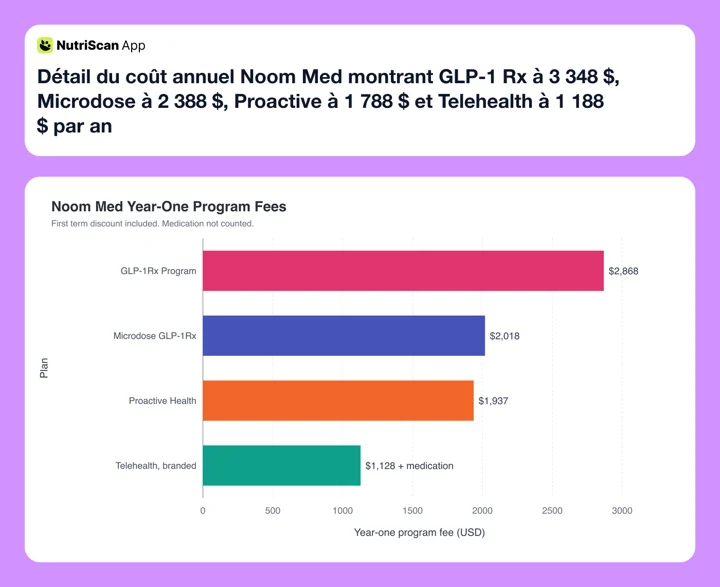 Figure 2: Year-one program fees across Noom Med plans, first term discount included. Medication is extra on the telehealth tier. Proactive Health is billed every 4 weeks, so it is 13 payments, not 12.
GLP-1 medications are not a one-time fix, and the evidence on stopping is unambiguous. In the STEP 1 trial extension, Wilding and colleagues found that participants regained about two-thirds of their lost weight in the year after stopping semaglutide, and that the cardiometabolic improvements largely reverted with it. Their conclusion was that ongoing treatment is required to maintain the result (Diabetes Obes Metab, PubMed). Two caveats the paper carries and marketing does not: the extension followed 327 of the 1,961 randomized participants, and the authors call every extension analysis exploratory. The behavioral coaching Noom provides is meant to build habits that outlast the drug. Nobody has shown that it prevents regain, so treat it as a reason to build habits, not as insurance.
The psychology-based approach uses cognitive behavioral therapy (CBT) techniques to help you identify triggers, build awareness around eating patterns, and create sustainable routines. This is different from programs that only hand you a pill and a meal plan.
Here is the one question that determines if Noom Med is worth your money: Will you actually use the coaching? If you skip the courses and ignore the coach, you are overpaying for a medication delivery service. If you engage fully - log meals, complete lessons, message your coach - the behavioral support adds real value that cheaper programs do not provide.
If you use Noom Med for 6-12 months to build habits and then transition to Noom Weight (an annual plan is $209, about $17 a month, and medication is not included) for ongoing tracking, the total cost becomes more reasonable over time (Noom plan pricing; Noom notes your price may vary with promotions or whether you sign up in the app or on the web). Think of it as an intensive phase followed by a maintenance phase, similar to how a dietitian might structure a coaching engagement.
 That feeling when you find the right GLP-1 program for your budget and goals.
Tips for Getting the Most Out of Noom Med 💡
Log your meals daily. The food tracking data helps your coach give better advice and helps you see patterns in how food affects your energy and side effects.
Complete the lessons. They are short daily lessons built on CBT principles, and Noom's line is that how much time you spend on each one is up to you. Skipping them means you are paying for coaching you are not using.
Message your coach with specific questions. Do not just check in. Ask about side effect management, protein targets on GLP-1, and meal timing around doses. Our Ozempic diet plan guide has the eating side of that in more detail.
Track your weight weekly, not daily. Day-to-day readings bounce for reasons that have nothing to do with fat loss. A weekly trend is the useful signal.
Use the community board. Other Noom Med users share meal ideas that work on GLP-1 (small portions, high protein, low nausea triggers). This is genuinely helpful advice from people in the same situation.
Protect muscle, and set the target with your clinician. Rapid weight loss on a GLP-1 costs lean mass, roughly a quarter of what you lose (Karakasis and colleagues, 2025). An expert consensus panel suggests 1.2 to 1.5 g of protein per kg of body weight a day during the weight-loss phase, paired with resistance training, and notes in the same table that high protein alone does not build muscle (Obesity Pillars). That is a consensus range, not an FDA or NIH target. Agree your actual number with your Noom clinician, and lift.
Set your review date before the first bill, not after. Refunds close once a prescription is written. Decide up front what you need to see by week 12 to keep paying, and put it in the calendar.
TIP
For food and nutrition tracking beyond any GLP-1 program, NutriScan gives every meal a NutriScore and tracks protein, fiber, calories and micronutrients, with no cap on how far back your meal history goes. Monika, the voice AI nutritionist, takes 4 calls a week on the free plan and unlimited calls on Premium, and the intermittent fasting timer is free on both. Free includes 5 meal scans a week; Premium lifts that cap and adds the 28-day personalized diet plan and weekly meal-plan suggestions. Use it alongside Noom Med or any other program.
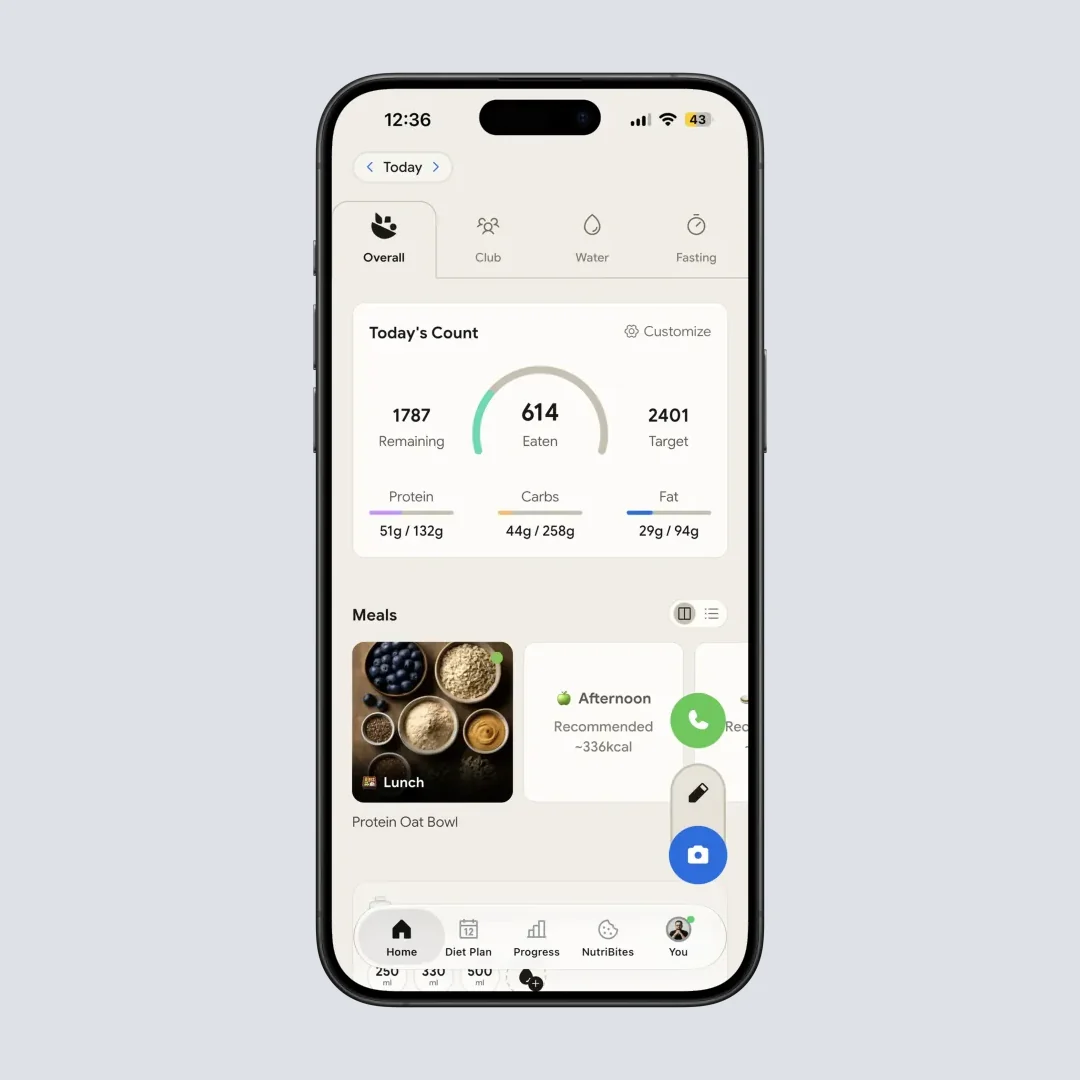
NutriScan's daily nutrition dashboard tracks your macros alongside any GLP-1 program (Home > Overview)
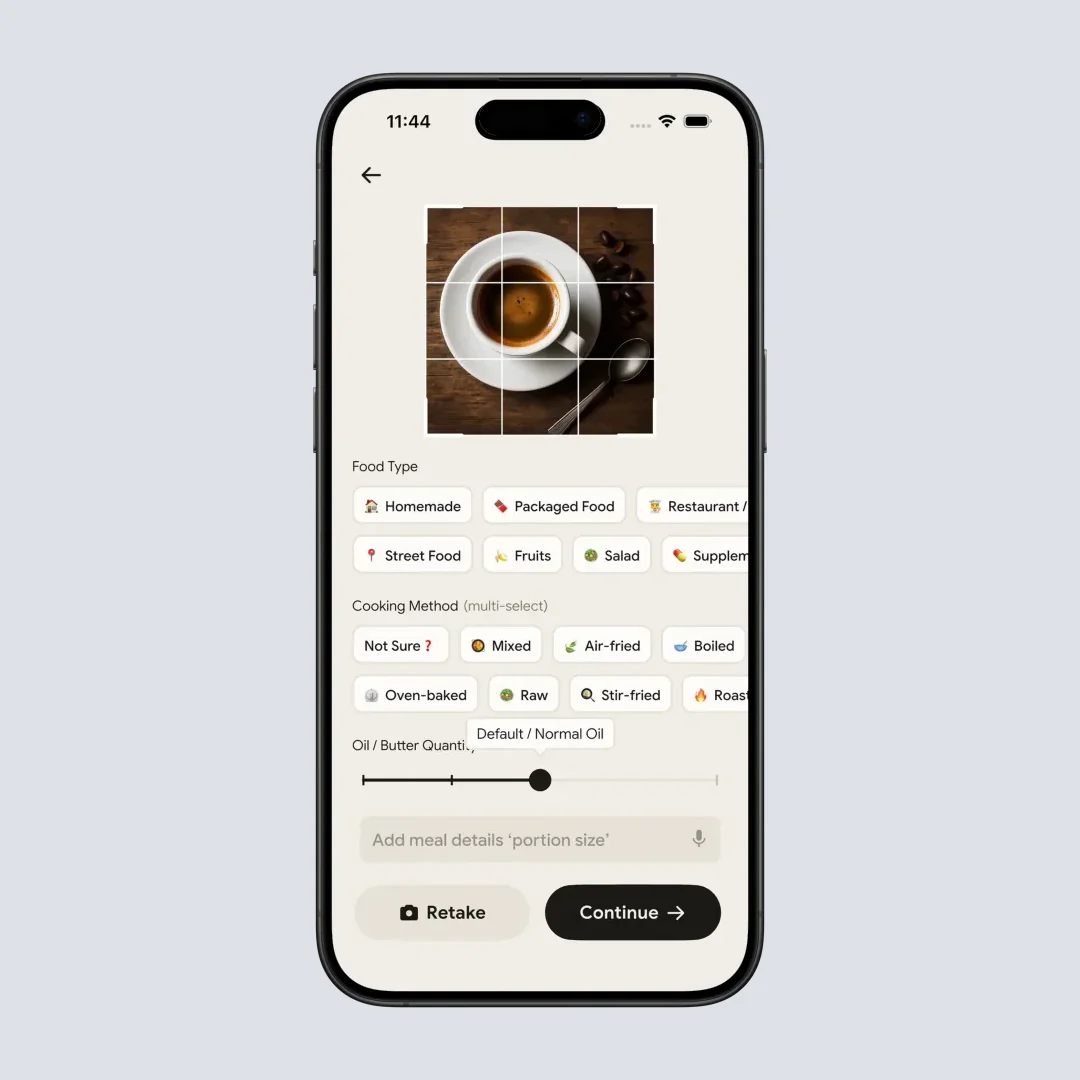
Snap a photo of your meal and NutriScan instantly analyzes the nutrition (Home > Camera Icon > Crop Picture)
Conclusion
Noom Med is worth it in 2026 if you want medication plus structured behavioral support and you will actually use both. The coaching, food tracking, and community features add real value for people who need guidance alongside their GLP-1 prescription. If you only want cheap access to a prescription, the cheapest program fee on this page is Noom's own branded-meds tier at $39 to start then $99 a month, below Ro's $149 monthly membership and Calibrate's $199 (Ro, Calibrate). None of those three include the drug, so compare the medication cost separately.
The best approach is to treat the discounted first term as your test window, engage fully with the coaching, and evaluate at the 12-week mark. Track your meals, complete the lessons, and talk to your coach. Refunds close once a prescription is written, so decide what you need to see before you pay, not after.
For food and nutrition tracking beyond any GLP-1 program, NutriScan scores every meal with NutriScore and tracks protein, fiber, calories and micronutrients. Five free meal scans a week, unlimited on Premium.
Frequently Asked Questions
Q: Is Noom Med legit?
A: Yes. Licensed clinicians review your intake and prescribe if you qualify, and the program is sold by Noom Inc., the company behind the Noom weight app. The complaints in Noom Med reviews are about money and medication sourcing, not fake providers: refunds close the moment a prescription is written (Noom refund policy), billing is quarterly and auto-renewing, and the GLP-1Rx tiers dispense compounded semaglutide or tirzepatide that the FDA has not reviewed for safety, efficacy or quality.
Q: Does Noom Med prescribe tirzepatide?
A: Yes, two ways. Noom clinicians can prescribe branded tirzepatide, Zepbound or Mounjaro, which you fill at your own pharmacy on the Telehealth for Branded Med tier at $39 to start then $99 a month. Or you take compounded tirzepatide shipped to your door on GLP-1Rx Plus at $149 to start then $299 a month (Noom pricing). Compounded tirzepatide is not FDA approved. Prices are standard US prices as of mid 2026 and change by region.
Q: How much does Noom Med cost per month in 2026?
A: Noom Med runs $99 to $299 a month after the first term, and $39 to $149 to get started, depending on the program (Noom pricing). The Telehealth for Branded Med tier is $39 to start then $99/mo billed quarterly and does not include the medication. The GLP-1Rx Program with compounded medication included is $129 to start then $249/mo billed quarterly, and GLP-1Rx Plus with compounded tirzepatide is $149 then $299/mo. Prices are standard US prices as of mid 2026 and change by region.
Q: Does Noom Med accept insurance?
A: Insurance does not cover the Noom program fee on any plan (Noom pricing FAQ). Insurance may cover the medication on the Telehealth for Branded Med tier, because you fill that prescription at your own pharmacy where your coverage applies. Noom cannot guarantee coverage because plans vary widely. Run Noom's GLP-1 insurance checker and call your insurer before signing up.
Q: Is the Noom Med microdose program effective?
A: Noom markets the microdose program as steady weight loss with fewer side effects than the standard GLP-1 dose. The published numbers are Noom's own: it reports average weight loss of 13 pounds from self-reported data on 1,185 Noom Med users prescribed compounded GLP-1s (Noom pricing). There is no independent trial of the microdose program. The approach suits people who want a gentler start or are sensitive to gastrointestinal side effects, and the dose decision belongs to the prescribing clinician.
Q: Can I cancel Noom Med anytime?
A: Most Noom Med plans bill quarterly and auto-renew; Proactive Health runs a 15-week first term and 16-week renewals. Refunds close as soon as a prescription is written, or on the branded-meds plan as soon as a clinical visit has happened, and renewal charges are never refundable (Noom refund policy). Cancel in the Subscription Portal before your renewal date.
Q: How does Noom Med compare to just getting a GLP-1 prescription from my doctor?
A: A doctor's prescription may be cheaper if your insurance covers the medication. Noom Med adds coaching, food tracking, community support, and regular check-ins that most primary care providers do not offer. The value depends on whether you need that extra structure to stay consistent.