Weight Loss Meal Plan for Women Over 30: 7-Day Protein Plan
 ChatGPT
  Claude
  AI Mode
  Perplexity
A weight loss meal plan for women over 30 has to do two jobs at once: run a calorie deficit and protect the muscle you start losing around age 30. The targets in this guide are 1,500 to 1,950 calories a day, which is a 300 to 350 calorie deficit from your true maintenance, and 1.6 to 2.0 g of protein per kilogram of goal body weight, so 96 to 120 g a day if your goal weight is 60 kg. Every plate is half vegetables, a quarter protein, a quarter smart carbs, one thumb of fat, plus two strength sessions a week. The full 7-day plan, with gram weights and daily totals, is below.
The hardest part of losing weight in your 30s is not the food. It is the quiet realization that the body you fed at 25 is gone. The same takeout dinner that used to slide off you is now sitting on your hips for a week. The same gym class that used to leave you lean now leaves you sore and the scale unchanged. Nothing has gone wrong with you. Something has changed inside you, and the meal plan that worked in your 20s is the wrong tool for the body you have now.
As a NutriScan nutritionist, I have spent the last two years watching women in their 30s try every clever app trick to get the old results back. The ones who succeed all do roughly the same thing: they stop chasing the lowest possible calorie number, and they start building meals around protein, fiber, and the muscle they are quietly losing whether they notice it or not. Mayo Clinic endocrinologist Dr. Daniela Hurtado Andrade put the timeline plainly in a December 2025 briefing: "Around age 30, your muscle mass starts decreasing gradually as part of the natural aging process, and this is exacerbated in midlife due to menopause" (Mayo Clinic News Network, 2025).
This guide is the meal plan I wish more women got in their first GP visit at 32. It is built for real life: a job, a partner, maybe small kids, very little time, and a body that is changing under you. There is a full 7-day plan inside.
TL;DR - Weight Loss Meal Plan for Women Over 30
- Calories: 300-350 daily deficit from your true maintenance (usually 1,500-1,950 cal/day)
- Protein: 1.6-2.0 g per kg of goal body weight - that is 96-120 g/day for a 60 kg goal weight
- Plate template: half veggies, quarter protein, quarter smart carbs, one thumb fat
- Movement: 2 strength sessions and a 10-15 min walk after dinner most days
- Tracking: Pre-log tomorrow's meals in NutriScan tonight, so the plan is set before you are hungry
IMPORTANT
Your weight loss plan for women after 30 at a glance.
Four steps plus one tracking habit. A roadmap so you can act fast.
⏱️ Progress 0/4 - ~0 minutes in - Keep going
⏳ Step 1: Understand why your 30s body is different
⏳ Step 2: Get your calorie and protein targets right
⏳ Step 3: Build every meal with the plate template
⏳ Step 4: Follow the 7-day meal plan
🔍 The 2-minute daily habit that keeps most people on plan (revealed near the end)
Why Weight Loss Is Different After 30
Three things shift in your 30s, and they stack.
The first is muscle. Mayo Clinic puts the start of the gradual decline around age 30, and inactive adults lose roughly 3 to 8 percent of their skeletal muscle mass per decade (Westcott, PubMed 2012). Muscle is the most metabolically active tissue you own, so as it falls, your resting metabolic rate falls with it. A 2024 systematic review and meta-analysis in Clinical Nutrition ESPEN (Kokura et al.) found that protein intakes above 1.3 g/kg/day were associated with muscle mass gain, while intakes below 1.0 g/kg/day carried a higher risk of muscle mass decline (Enhanced protein intake on maintaining muscle mass, PubMed 2024).
The second is hormones. Your estrogen, progesterone, and insulin sensitivity are no longer in the calm state of your early 20s. Dr. Hurtado Andrade's point above is the shape of it: the muscle decline that starts around 30 gets worse in midlife because of menopause (Mayo Clinic News Network, 2025). Cleveland Clinic clinicians describe the same picture: genetics, metabolism, and hormonal fluctuations combine to make weight loss harder for women than for men of the same age (Cleveland Clinic, 2024).
The third is movement. According to the CDC, only about 23 percent of women aged 35 to 49 meet the recommended 150 minutes of moderate exercise plus two strength sessions per week (Harvard Health, 2025). Most women do not move less because they got lazy. They move less because work got busier, kids arrived, and the casual movement of their 20s quietly disappeared. If your day is mostly chair time, the weight loss diet for a sedentary desk job covers how to set the deficit when you barely stand up.
The plan in this guide pushes back against all three.
 Strength training twice a week protects the muscle your metabolism depends on - and it does not require a gym
Why this plan is not a 1,200-calorie plan
Generic "women's diet plans" usually land on 1,200-1,400 calories, and 1,200-1,500 is the range clinical obesity guidelines prescribe for women (2013 AHA/ACC/TOS guideline). It is not a dangerous number. It is a tight one: at 1,200 calories the protein floor below is hard to hit and there is little fuel left for strength work. This plan uses a smaller deficit so the protein and the lifting both fit.
IMPORTANT
Checkpoint: Step 1 complete.
You understand why weight loss after 30 works differently. Time to get your numbers right.
⏱️ Progress 1/4 - ~1 minute in - Keep going
✅ Step 1: Why your 30s body is different (done)
👉 Step 2: Calorie and protein targets (you're here)
⏳ Step 3: Plate template
⏳ Step 4: 7-day meal plan
🧩 The 2-minute daily habit (coming soon)
How Many Calories Should a Woman Over 30 Eat to Lose Weight?
Here is a more honest calorie range than you will find on most diet sites. These numbers are for women aged 30 to 40, weighing 60 to 75 kg.
| Activity Level | Maintenance | Safe Deficit | Weekly Loss |
|---|---|---|---|
| Sedentary (desk job, little exercise) | 1,800-2,000 cal | 1,500-1,700 cal | 0.25-0.3 kg |
| Active (desk job + 3x/week exercise) | 2,000-2,300 cal | 1,700-1,950 cal | 0.25-0.3 kg |
| Very Active (physical job or 5x/week) | 2,300-2,600 cal | 2,000-2,250 cal | 0.25-0.3 kg |
Every row above is a 300 to 350 calorie daily deficit. At the usual 7,700 calories per kilogram of body fat, that works out to roughly 0.25 to 0.3 kg a week. It is slower than the numbers most diet sites print, and that is the point: it is the pace that keeps muscle. Dr. Hurtado Andrade explained why losing muscle costs you later: "One of the reasons why we hit a plateau when we are losing weight is because we are losing muscle mass and our metabolism slows down" (Mayo Clinic News Network, 2025). Eat enough to keep the muscle, and the plateau gets pushed out by months.
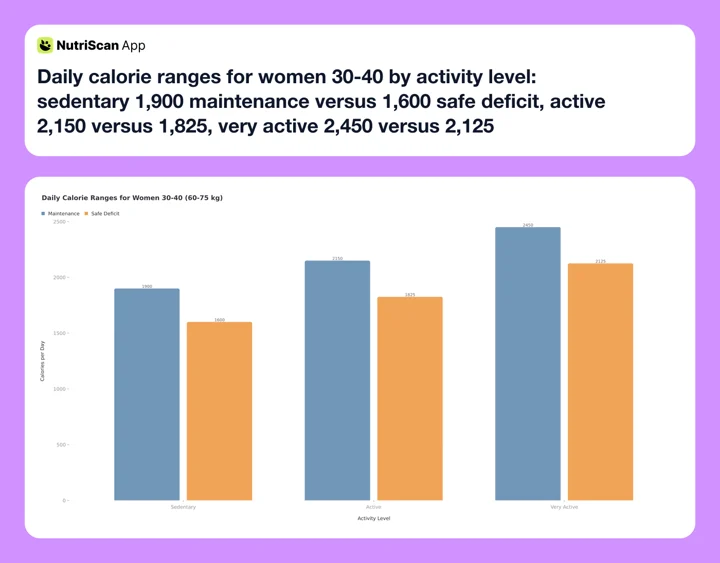 Figure 1: Your deficit zone by activity level. Each bar is the midpoint of its range in the table above, so the gaps run 300 to 325 calories a day. This plan sits at or above roughly 1,500 calories, which leaves more room for protein and for training than the 1,200-1,500 range clinical guidelines use, not because 1,400 is a danger line.
Find your exact number in 2 minutes
The NutriScan Macro Calculator calculates your maintenance calories based on weight, height, age, and activity level, then sets your safe deficit target automatically. For how the deficit works day to day, see the calorie deficit diet guide.
The single most powerful number on your plate is not calories. It is protein.

Protein Floor: How Much Women Over 30 Really Need
Harvard Health recommends at least 70 grams of protein per day for women who are training, and spreading protein across every meal is the right way to hit it (Harvard Health). For a woman actively losing weight, the floor is higher: 1.6 to 2.0 grams of protein per kilogram of goal body weight per day.
For a woman whose goal weight is 60 kg, that is 96 to 120 grams of protein daily. Split across four to five eating windows, that lands at roughly 20 to 30 grams per meal or snack.
Why this matters: the same 2024 systematic review and meta-analysis found higher protein intakes tracked with muscle mass gain and low intakes with muscle mass decline, across 28 trials and 1,989 participants (SMD 0.75; 95% CI 0.41 to 1.10; p < 0.001) (Enhanced protein intake, PubMed 2024). You are not just losing weight. You are choosing what kind of weight to lose.
Easy real-food protein sources for a busy week. Values are from USDA FoodData Central.
| Food | Serving | Protein |
|---|---|---|
| Chicken breast, cooked | 100g | 31g |
| Cottage cheese, low fat | 1 cup (226g) | 28g |
| Tofu, firm | 1 cup (250g) | 25-30g |
| Whey or pea protein powder | 1 scoop | 20-25g |
| Tinned tuna, in water, drained | 1 small tin (~110g) | 19-25g, higher for albacore |
| Lentils, cooked | 1 cup | 18g |
| Greek yogurt, plain 5% fat | 170g | 15g, 17g if nonfat |
| Eggs, whole | 1 egg | 6g |
Snacks are where most women in their 30s lose the protein race, so keep a short list you can reach for without cooking. The complete guide to high protein snacks has options sorted by grams per serving.
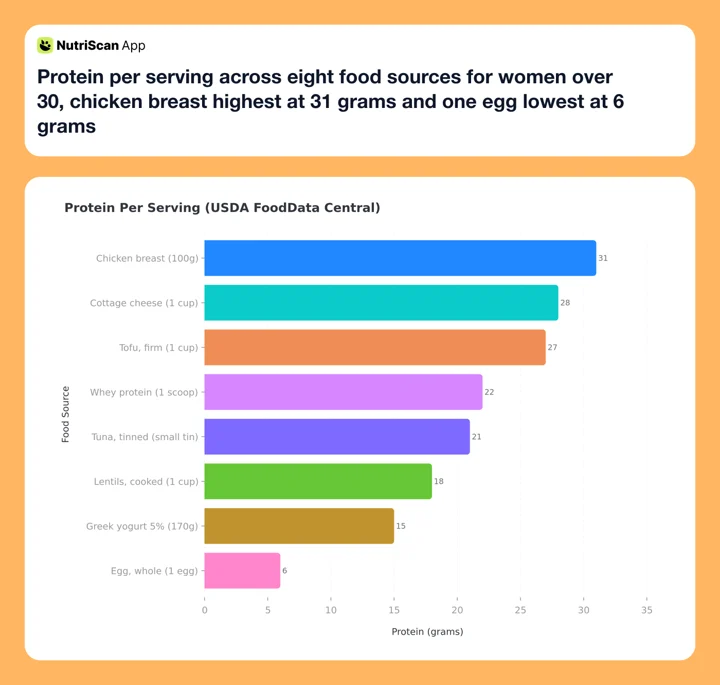 Figure 2: Chicken, cottage cheese, and tofu are your highest-yield protein sources per serving. Build each meal around one of these.
If you are tracking with the NutriScan app, the easiest first habit is to log a protein source first at every meal, then build the rest of the plate around it.
IMPORTANT
Checkpoint: Steps 1 and 2 done.
You have your calorie range and protein target. Time to learn the plate template.
⏱️ Progress 2/4 - ~2 minutes in - Keep going
✅ Step 1: Why your 30s body is different
✅ Step 2: Calorie and protein targets (done)
👉 Step 3: Plate template (you're here)
⏳ Step 4: 7-day meal plan
🧩 The 2-minute daily habit (coming soon)
The Plate Template (Use This at Every Meal)
Stop counting individual macros at every meal. Use a plate shape instead. It survives takeout, restaurants, and chaotic Tuesday nights.
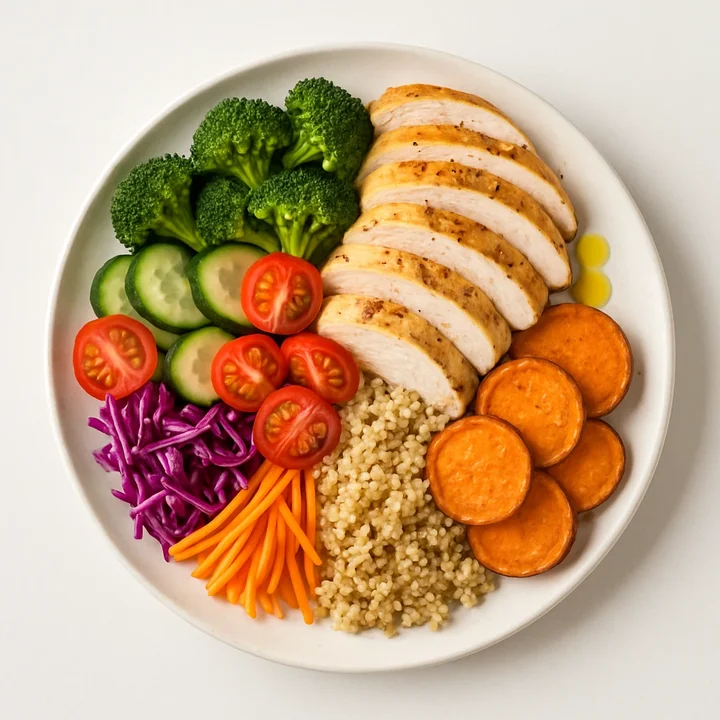 The plate template: half non-starchy vegetables, quarter protein, quarter smart carbs, one thumb of fat. This shape works everywhere.
Here is the breakdown:
- Half the plate: non-starchy vegetables. Salad, sauteed greens, roasted broccoli, peppers, cucumber, tomato, mushrooms, zucchini.
- One quarter: a protein source from the list above, roughly the size of your palm.
- One quarter: a smart carb. Quinoa, brown rice, sweet potato, beans, lentils, oats, whole grain pasta.
- One thumb: a fat source. Olive oil, avocado, nuts, seeds, butter, cheese.
This template lands most women between 400 and 550 calories per meal with 25 to 35 g of protein and 8 to 12 g of fiber. Three of these plus two protein snacks of 150 to 200 calories each lands you between roughly 1,500 and 2,000 calories, which is the deficit band in the table above.
It works at restaurants too
Order grilled protein the size of your palm, a vegetable side, and share the starch. You never need to ask for a nutrition menu or feel self-conscious about eating differently.
The 7-Day Weight Loss Meal Plan for Women Over 30
Every protein item below carries a gram weight, because a plan you cannot add up is not a plan. The totals under each day are estimates built from those weights using USDA values, rounded to the nearest 10 calories and 5 grams of protein. Your own cooking oil and portion sizes will move them, which is exactly why you should log the days you follow. Swap any meal for another in the same row if you do not like it.
What this plan delivers
- Daily calories: 1,560-1,760 kcal, averaging about 1,650
- Protein: 108-123 g/day, at or just above the 96-120 g target for a 60 kg goal weight
- No day drops below 1,550 calories
- Day 6 includes a flex dinner for real-life situations
- Vegetarian swaps noted at the end
Day 1
- Breakfast: 2 eggs scrambled with spinach and 30 g feta, 1 slice whole grain toast, 1 small apple
- Snack: 170 g plain Greek yogurt with a tablespoon of almond butter
- Lunch: 120 g grilled chicken breast on mixed greens, cucumber, cherry tomato, half an avocado, 1 tbsp olive oil and lemon
- Snack: 20 g almonds and an orange
- Dinner: 120 g baked salmon, roasted broccoli, half a cup of quinoa
Day 1 total: about 1,760 kcal and 120 g protein.
Day 2
- Breakfast: 1 cup (226 g) cottage cheese with sliced strawberries, a tablespoon of pumpkin seeds, and a teaspoon of honey
- Snack: A boiled egg and a pear
- Lunch: Lentil and vegetable soup made with 1 cup cooked lentils, plus a slice of sourdough
- Snack: 1 scoop whey protein blended with frozen berries and a splash of milk
- Dinner: 200 g firm tofu stir-fried with peppers, snap peas, ginger, 1 tbsp oil, and half a cup of brown rice
Day 2 total: about 1,610 kcal and 120 g protein.
Day 3
- Breakfast: Overnight oats with 50 g oats, 200 ml milk, chia seeds, half a scoop of protein powder, and blueberries
- Snack: Carrot sticks with 3 tablespoons of hummus
- Lunch: 100 g drained tinned tuna with 130 g chickpeas, red onion, parsley, and 1 tbsp olive oil on arugula
- Snack: A small piece of dark chocolate and a clementine
- Dinner: 150 g turkey meatballs with marinara, zucchini noodles, and a small side of pasta
Day 3 total: about 1,640 kcal and 110 g protein.
Day 4
- Breakfast: Smoothie with 170 g Greek yogurt, banana, spinach, a tablespoon of peanut butter, and half a scoop of protein powder
- Snack: 2 rye crackers with 100 g cottage cheese and tomato
- Lunch: 120 g leftover turkey meatballs over a big green salad
- Snack: A small apple and 10 almonds
- Dinner: 120 g sheet pan chicken thigh with sweet potato wedges, roasted Brussels sprouts, and 1 tbsp oil
Day 4 total: about 1,580 kcal and 115 g protein.
Day 5
- Breakfast: Vegetable omelet with 3 eggs, mushrooms, and 25 g goat cheese, plus half a grapefruit
- Snack: 170 g Greek yogurt with a teaspoon of honey and 15 g walnuts
- Lunch: 100 g leftover chicken thigh on a quinoa bowl with greens and 1 tbsp dressing
- Snack: A protein bar with at least 15 g protein and under 8 g of sugar
- Dinner: 120 g shrimp on 2 corn tortillas with cabbage slaw and 50 g avocado
Day 5 total: about 1,700 kcal and 120 g protein.
Day 6 (Flex Day)
- Breakfast: 1 thick slice of sourdough with 80 g avocado, 2 poached eggs, and chili flakes
- Snack: A latte and a small piece of fruit
- Lunch: Big chopped salad with 100 g grilled chicken, 80 g beans, corn, and a light vinaigrette
- Snack: Cheese stick and a handful of grapes
- Dinner: Eat out. Order grilled protein the size of your palm (about 120 g), a vegetable side, and one shared starch. One glass of wine if you want it.
Day 6 total: about 1,710 kcal and 115 g protein, wine included.
Day 7
- Breakfast: High-protein pancakes made with 40 g oats, 100 g cottage cheese, 2 eggs, and half a banana, with berries
- Snack: 100 g shelled edamame, lightly salted
- Lunch: 150 g cooked lentils with roasted vegetables, 30 g feta, and lemon dressing
- Snack: Sliced bell pepper and a hard-boiled egg
- Dinner: 150 g pan-seared cod, 150 g mashed white beans with garlic and 1 tbsp olive oil, and a green salad
Day 7 total: about 1,560 kcal and 115 g protein.
For vegetarians and vegans
Swap chicken and fish for tofu, tempeh, paneer, or extra legumes plus a daily protein shake. The protein targets still work - you may need to be slightly more intentional about hitting 25g per sitting. Lentils, chickpeas, and Greek yogurt are your most efficient plant-protein sources.
IMPORTANT
Checkpoint: 3 of 4 steps done.
You have the 7-day meal plan. One section left before the big reveal.
⏱️ Progress 3/4 - ~3 minutes in - Keep going
✅ Step 1: Why your 30s body is different
✅ Step 2: Calorie and protein targets
✅ Step 3: Plate template
👉 Step 4: 7-day meal plan (done)
✨ The 2-minute daily habit (about to reveal)
Daily Habits That Move the Scale for Women Over 30
A short list of habits that work better than any "secret food" you will find online.
- Eat protein and vegetables before the carbs at every meal. Randomized crossover trials show that eating order cuts the post-meal glucose and insulin rise and keeps people fuller afterwards (meal-sequence trial, PMC 2024).
- Walk after dinner. A meta-analysis of light-intensity walking after eating found it significantly blunted the post-meal glucose rise compared with sitting (Buffey et al., Sports Medicine 2022). Ten to fifteen minutes is enough, and it burns roughly 40 to 60 calories on top.
- Lift two times a week, minimum. A 2012 review of resistance-training trials reported that ten weeks of basic strength work may raise resting metabolic rate by about 7 percent and add roughly 1.4 kg of lean weight (Westcott, PubMed 2012). You do not need a gym. Two dumbbells, squats, rows, presses, hip hinges.
- Refuel with about 20 g of protein within 30 to 45 minutes of a workout, and pair it with a carb if your next meal is more than an hour or two away (Harvard Health).
- Sleep 7 to 8 hours. Short sleep tends to raise hunger and push intake up the next day. The landmark trial found lower leptin, higher ghrelin and more appetite on restricted sleep, though it studied young men and later trials have been mixed (Spiegel et al., PubMed 2004).
- Plan one weekly grocery shop and one batch cook. Most women fall off their plan on Wednesday because the fridge is empty, not because willpower failed. The 7-day meal prep plan for busy professionals has a Sunday batch-cook order that fits a working week.
- Stop weighing yourself daily. Once a week, same day, same time. Fluid shifts and your cycle move the scale on their own, with no change in body fat, which is why one weekly reading beats seven daily ones.
 Consistent effort compounds. The results after 8-12 weeks reward every habit on this list.
The 2-Minute Daily Habit That Keeps Most People on Plan
You have been patient. Here it is.
In the coaching conversations I have had with women in their 30s, one habit comes up again and again among the ones who hit their protein target most weeks. It is not willpower. It is not a complicated meal prep routine. It is this:
Pre-log your meals the night before.
Spend two minutes in the NutriScan app before bed, entering what you plan to eat the next day. Log breakfast, lunch, dinner, and two snacks. Check that protein is above your floor. Adjust one item if needed. Then close the app.
Retroactive logging is a record of what already happened. Pre-logging is a plan with feedback built in, and it gives you the one chance to fix a short protein day while you can still do something about it.
Here is how to do it:
- Open NutriScan ➡️ tap the + icon on the Home screen
- Log tomorrow's planned meals by typing them in, using voice input, or copying a meal you already logged
- Check your daily protein total in the macro ring on the Home screen
- If protein is short, swap one snack for a 25g protein option
- Save. In the morning, your meals are already logged and waiting.
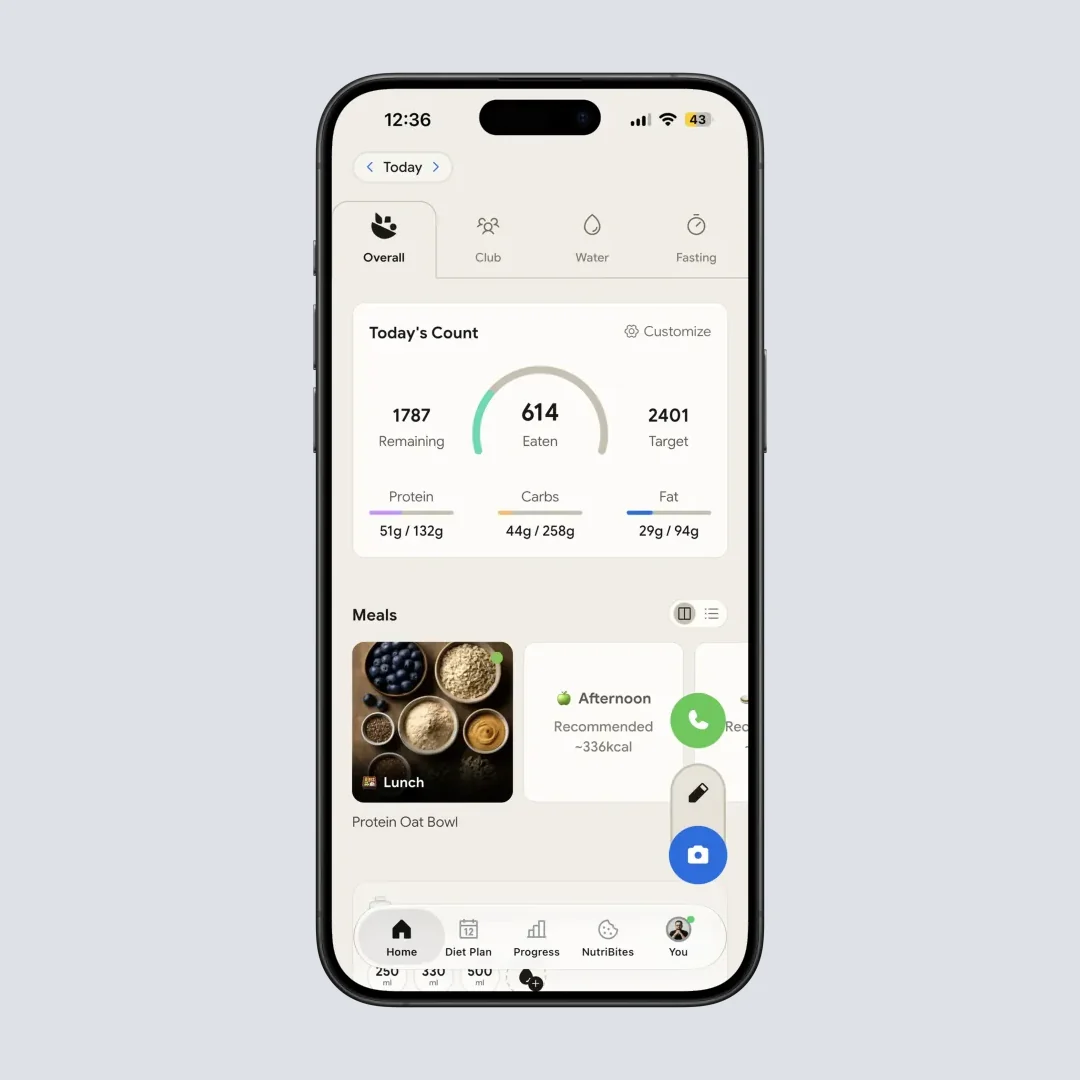
Home screen: Daily macro ring shows protein, carbs, and fat at a glance. Pre-log tonight and check that protein ring is on track before bed.
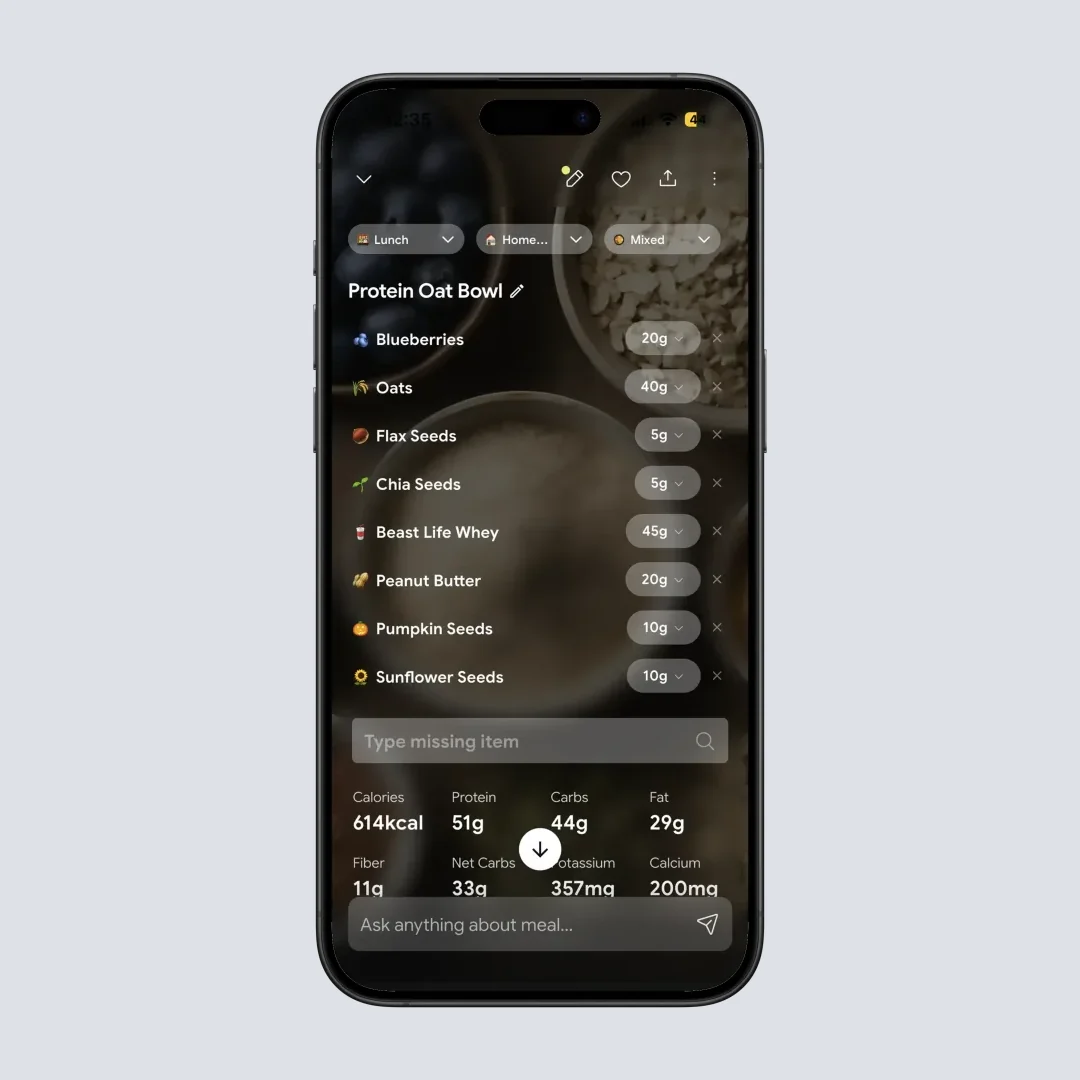
Nutrition Details: See exactly how each meal contributes to your daily protein target. Tap any meal to review and adjust.
The reason pre-logging works is psychological. When you log retroactively, you are rationalizing choices you already made. When you log prospectively, you are designing choices before your tired, hungry self has to make them. By 8 pm, most women are 14 hours into their day and do not have the cognitive bandwidth to calculate whether the evening snack fits. Pre-logging handles that for them.
Start tonight
Open NutriScan, go to tomorrow's date, and log your three meals and two snacks. It takes under 2 minutes and it is the most useful thing you can do right now.

A 5-Step Starter Guide for Week One
If you want a concrete first move, do exactly these five things in order. Do not skip ahead.
- Day 1, morning: Buy a kitchen scale, a 1L water bottle, and one week of groceries from the plan above.
- Day 1, evening: Log everything you eat for one full day in NutriScan without changing the food yet. The point is to see the honest baseline.
- Day 2: Calculate your protein target (goal weight in kg times 1.6, then times 2.0, for your daily range in grams). Write it on a sticky note on the fridge.
- Day 3: Add a 25g protein source to every meal and snack. Do not cut anything else yet.
- Day 4 onward: Use the plate template. Keep protein high, fill half the plate with vegetables, and add a 10 to 15 minute walk after dinner.
By the end of week one, you will have a real-data baseline, a protein target you trust, and a plate shape you can use for the next twelve months.
What the Research Says About Weight Loss After 30
A few findings from the literature that should change how you plan meals.
Protein dose matters more in a deficit. The 2024 Clinical Nutrition ESPEN systematic review and meta-analysis found intakes above 1.3 g/kg/day were associated with muscle mass gain, and intakes below 1.0 g/kg/day with a higher risk of muscle mass decline, pooled across 28 trials and 1,989 participants (Kokura et al., 2024). The review looked at muscle mass, strength and physical function, not kidney outcomes, so it says nothing either way about high-protein safety.
Inactivity may predict midlife belly fat better than menopause does. Harvard Health, quoting Dana-Farber dietitian Hillary Wright, reports that research suggests inactivity predicts weight gain and abdominal obesity better than aging or menopause does (Harvard Health, 2025). That is good news. The lever you can pull is large.
Metabolic adaptations defend the old weight. The 2024 "Beyond Calories" narrative review in the International Journal of Molecular Sciences maps the pushback during calorie restriction in adults: leptin falls in proportion to fat loss, ghrelin rises, and resting metabolic rate drops as the body conserves energy (Theodorakis et al., 2024). My own read on what to do about it, and this part is a recommendation rather than a finding from that paper: take the smaller deficit, because it is the one you can hold for months.
Strength training is not optional after 30. The classic resistance training review is still the cleanest summary: ten weeks of basic strength work may add 1.4 kg of lean mass, raise resting metabolic rate about 7 percent, and cut 1.8 kg of fat (Westcott, PubMed 2012). It is a 2012 narrative review rather than a fresh trial, but the direction has held up. That metabolic bump is what your 20-year-old self had for free. Your 35-year-old self has to earn it back through lifting.
Muscle loss is what slows the calorie burn. Mayo Clinic notes that losing muscle slows how quickly the body burns calories, which makes a healthy weight harder to hold (Mayo Clinic, belly fat). In practice that is why the eating pattern that held you steady at 25 can start adding weight a decade later.
IMPORTANT
Recap: everything you completed.
Save this for the next time you need a reset.
⏱️ Progress 4/4 - ~5 minutes in - Nicely done
✅ Step 1: Why your 30s body is different
✅ Step 2: Calorie and protein targets
✅ Step 3: Plate template
✅ Step 4: 7-day meal plan
✅ The 2-minute pre-logging habit (revealed)
Conclusion
Weight loss after 30 is not a punishment for getting older. It is a different operating system. The rules that ran your 20s - low calories and lots of cardio - will burn the very muscle that protects your metabolism for the next thirty years. The rules that work now are simpler and kinder: a moderate deficit, a protein target of 96 to 120 g for a 60 kg goal weight, three plate-templated meals, two strength sessions a week, and a walk on most days.
Pick one habit from week one and start tonight. Track honestly for four weeks with the NutriScan app or whichever tool you trust. Look at the data. Adjust one variable. Keep going. The women who succeed for six months are not the ones with the perfect plan. They are the ones who kept the plan small enough to do on a bad week.
You do not need a new body. You need the muscle, the protein, and the patience to let a slower body do its work.
Start tracking your meals free on NutriScan
Frequently Asked Questions
How many calories should a woman over 30 eat to lose weight?
Most women in their 30s lose weight steadily on 1,500 to 1,950 calories per day, depending on activity. Aim for a 300 to 350 calorie deficit from your true maintenance, not a generic low number. Clinical obesity guidelines prescribe 1,200 to 1,500 calories a day for women (2013 AHA/ACC/TOS guideline); this plan sits above that range so there is room for protein and for strength work. Use the NutriScan macro calculator to find your exact target.
How much protein do women in their 30s need to lose fat?
Aim for 1.6 to 2.0 g of protein per kg of goal body weight per day, split across 4 to 5 meals or snacks. For a 60 kg goal weight that is 96 to 120 g daily, or roughly 20 to 30 g per sitting. A 2024 systematic review and meta-analysis in Clinical Nutrition ESPEN linked intakes above 1.3 g/kg/day to muscle mass gain and intakes below 1.0 g/kg/day to a higher risk of muscle mass decline (Kokura et al., 2024).
Why is it harder to lose weight after 30 than in my 20s?
Three reasons stack: muscle mass declines gradually from around age 30, and in inactive adults that costs about 3 to 8 percent per decade (Westcott, PubMed 2012); hormonal shifts change appetite and fat storage; and most women move less than they used to. Strength training plus a protein-first meal plan pushes back on all three.
Should I do intermittent fasting in my 30s?
It can work, but it is not required. Two randomized trials found time-restricted eating was no better for weight loss than eating across the day at the same calorie intake (Lowe et al., JAMA Internal Medicine 2020; Liu et al., NEJM 2022), so the main mechanism looks like calorie reduction rather than the window itself, though a 2025 meta-analysis reports some effect even under matched calories (Fernandes-Alves et al., 2026). If you fast, hit the same 96 to 120 g protein target inside your eating window and lift at least twice a week.
Does carb cutting help women lose belly fat after 30?
Cutting refined carbs (sugar, white bread, sweet drinks) helps. Cutting all carbs usually just cuts total calories, and going very low on both calories and carbohydrate for a long stretch is what disrupts thyroid and menstrual function. Keep smart carbs such as oats, beans, quinoa, sweet potato, and fruit, and trim added sugar instead.
How long until I see results on this meal plan?
The first week or two usually shows a quick drop that is mostly glycogen and water rather than fat. After that, the deficit in the table above works out to roughly 0.25 to 0.3 kg a week. Photos and waist measurements every 4 weeks tell a truer story than the daily scale, since muscle gain can mask some of the scale movement.
Is this meal plan suitable for perimenopause?
Yes. The protein-first approach specifically addresses the muscle loss that accelerates in perimenopause. If you are already in perimenopause, sit at the top of the protein range (2.0 g/kg of goal body weight) and treat strength work as the priority: two sessions a week minimum, three if you can fit them. Cleveland Clinic's guidance is at least twice a week for 20 to 30 minutes (Cleveland Clinic, 2024). The PCOS macro calculator is also useful if you have insulin resistance, and if the scale has stopped moving for months, read how to break a PCOS weight loss plateau.