How Much Protein Per Day You Actually Need
 ChatGPT
  Claude
  AI Mode
  Perplexity
TL;DR - How much protein per day
• The floor: 0.8 grams per kilogram of body weight, a deficiency minimum rather than a target.
• The key number: gains in fat-free mass stop improving past about 1.62 grams per kilogram a day.
• Your goal range: 1.2 to 1.6 g/kg for general health, 1.6 to 2.0 for muscle gain, 1.6 to 2.2 while losing fat.
• The routine: set one target number ➡️ divide by four ➡️ give every slot a real food.
• On a GLP-1 medication: 1.2 to 1.6 g/kg of current weight, plus resistance training twice a week.
The official floor is 0.8 grams of protein per kilogram of body weight per day, the National Academy of Medicine's minimum for adults, or about 50 grams for a 140 pound person and 70 grams for a 200 pound person (Harvard Nutrition Source). As a NutriScan nutritionist, I have watched that single number cause more confusion than any other figure in nutrition, because people read it as a target when it was designed as a floor.
An RDA answers one question: how little can most healthy people eat without slipping into deficiency? So there are two numbers to find, the floor and the goal. This guide gives you both, plus a chart by body weight, the evidence behind each range, what protein looks like on a GLP-1 medication like Mounjaro or Zepbound, and an honest account of what happens at the top end.
IMPORTANT
Your protein plan at a glance.
A quick roadmap so you can act fast.
⏱️ Progress 0/4 • ~0 minutes in • Keep going
⏳ Step 1: Find your floor and your goal number
⏳ Step 2: Read your row in the by-weight chart
⏳ Step 3: Build the day as four feedings
🔍 The protein risk that 28 trials could not find (revealed near the end)
Four People, Four Very Different Numbers 👥
Take a 60 kg woman, 34, who walks a lot and lifts twice a week. Her floor is 48 grams. Her practical target is 1.2 to 1.6 grams per kilogram, so 72 to 96 grams a day.
Take a 90 kg man, 28, lifting four days a week to add muscle. His useful ceiling sits near 1.6 grams per kilogram, or 144 grams. Going to 180 costs money without adding muscle.
Take a 70 kg woman, 41, in a 500 calorie deficit, losing fat without losing the muscle she built. She needs the highest relative intake of the four: 1.6 to 2.2 grams per kilogram, or 112 to 154 grams a day.
Take a 75 kg man, 68, recovering from a knee replacement. His need goes up, because older bodies pull less anabolic signal from the same meal: 1.2 to 1.5 grams per kilogram, or 90 to 113 grams.
Four answers between 48 and 154 grams. What moves the number most is what you are asking your body to do this month.

One hard-boiled egg is 6.3 grams, which is why breakfast is usually the meal doing the least work.
What the Evidence Actually Says 📚
Four findings do most of the work here, and they are worth knowing by name.
The muscle ceiling sits near 1.6 g/kg. A meta-analysis of 49 studies with 1863 participants found protein supplementation added to resistance training increased fat-free mass, strength and muscle fiber size, and that intakes beyond about 1.62 grams per kilogram per day produced no further gains in fat-free mass (Morton et al., 2018).
The working range is 1.4 to 2.0 g/kg. The International Society of Sports Nutrition position stand puts daily intake at 1.4 to 2.0 grams per kilogram for most exercising people, and recommends about 0.25 grams per kilogram per meal, or 20 to 40 grams, every 3 to 4 hours (Jäger et al., 2017).
Protein protects muscle while you lose weight. A meta-analysis of 24 trials in 1063 people compared energy-restricted higher-protein diets with standard-protein diets at matched calories and fat. The higher-protein arm lost 0.79 kg more body weight and 0.87 kg more fat mass, and preserved 0.43 kg more fat-free mass (Wycherley et al., 2012).
Older adults need more, not less. PROT-AGE recommends at least 1.0 to 1.2 grams per kilogram per day for people over 65, 1.2 or more for those exercising, and 1.2 to 1.5 during acute or chronic illness (Bauer et al., 2013). One exception in that paper matters: people with an estimated GFR under 30 who are not on dialysis may need to limit protein.
IMPORTANT
Checkpoint: here's where you are right now.
Quick status update so you always know the next best move.
⏱️ Progress 1/4 • ~1 minute in • Keep going
✅ Step 1: Floor and goal number (done)
👉 Step 2 (you're here): read your row in the chart
⏳ Step 3: Build the day as four feedings
🧩 The protein risk that 28 trials could not find (coming soon)

Protein Per Day Chart by Body Weight and Goal 📊
Find your weight, then read across to the column matching what you are doing right now. All figures are grams of protein per day.
| Body weight | Floor (0.8 g/kg) | General health and activity (1.2 to 1.6) | Muscle gain with training (1.6 to 2.0) | Fat loss, keeping muscle (1.6 to 2.2) |
|---|---|---|---|---|
| 50 kg (110 lb) | 40 g | 60 to 80 g | 80 to 100 g | 80 to 110 g |
| 60 kg (132 lb) | 48 g | 72 to 96 g | 96 to 120 g | 96 to 132 g |
| 70 kg (154 lb) | 56 g | 84 to 112 g | 112 to 140 g | 112 to 154 g |
| 80 kg (176 lb) | 64 g | 96 to 128 g | 128 to 160 g | 128 to 176 g |
| 90 kg (198 lb) | 72 g | 108 to 144 g | 144 to 180 g | 144 to 198 g |
| 100 kg (220 lb) | 80 g | 120 to 160 g | 160 to 200 g | 160 to 220 g |
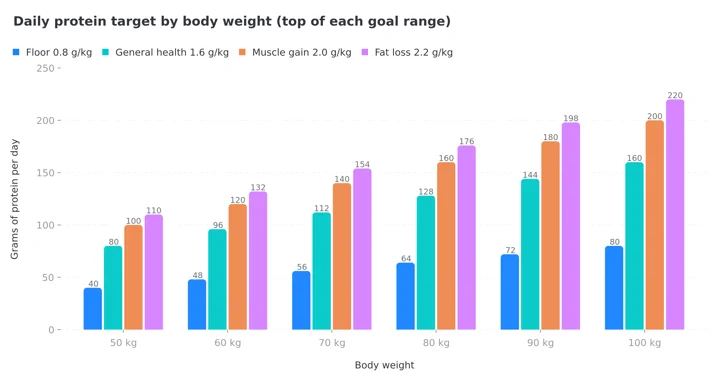
Figure 1: the top of each goal range next to the floor, straight from the table above. At every weight the fat-loss target is close to triple the deficiency minimum.
If you carry a lot of body fat, use a weight near the top of a healthy range for your height rather than your scale weight, since fat tissue does not need feeding. Sex gets no column of its own. In absolute grams the National Academies figure is 56 grams a day for adult men and 46 for women (National Academies DRI tables).
For children it is set in grams per day: 13 for ages 1 to 3, 19 for ages 4 to 8, 34 for ages 9 to 13, and 52 for boys and 46 for girls aged 14 to 18. Adult goals should never be scaled onto a child. The protein intake calculator does the arithmetic, and the TDEE calculator gives the calorie budget it fits inside.
Muscle Gain, Weight Loss, and Doing Both at Once 💪
For muscle growth, protein is permissive and training is causal. Resistance training creates the demand; protein supplies the material. Feed 1.6 to 2.0 grams per kilogram and train hard, and you are at the useful end of the evidence. Feed 3 grams and skip training, and you get an expensive diet with no new muscle.
For fat loss, protein does three jobs. It keeps you fuller per calorie, it costs more energy to digest than carbohydrate or fat, and it signals your body to spare muscle while the deficit runs. That is why the fat-loss column is the highest in the chart.
Body recomposition, doing both at once, is realistic for beginners and for anyone carrying meaningful body fat: a modest deficit, 1.6 to 2.2 grams per kilogram, and resistance training two to four times a week. Simply holding the muscle you have is cheaper, around 1.2 grams per kilogram with two sessions a week.

Two lifting sessions a week turns the protein into muscle instead of into calories.
IMPORTANT
Checkpoint: midway progress update.
You're halfway, and the decisions get easier here.
⏱️ Progress 2/4 • ~2 minutes in • Keep going
✅ Step 1: Floor and goal number (done)
✅ Step 2: Your row in the chart (done)
👉 Step 3 (current): build the day as four feedings
⏳ The protein risk that 28 trials could not find (next)
Protein on Mounjaro, Zepbound, Wegovy and Other GLP-1 Medications 💉
A 2025 network meta-analysis of 22 randomized trials in 2258 participants found that with GLP-1 receptor agonists, lean mass accounted for roughly 25% of the total weight lost, and that tirzepatide at 15 mg weekly and semaglutide at 2.4 mg weekly, the most effective agents for weight and fat loss, were among the least effective at preserving lean mass (Karakasis et al., 2025).
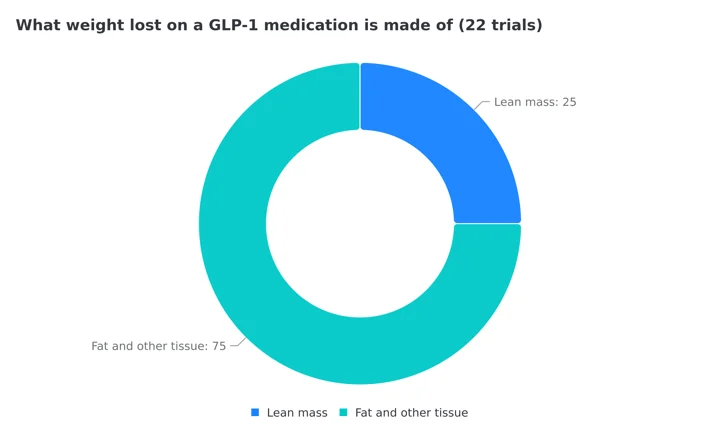
Figure 2: a quarter of the weight lost across those 22 trials was lean tissue. Losing that fast, in your fifties, is worth acting on.
My target on these medications is 1.2 to 1.6 grams per kilogram of current body weight, plus resistance training twice a week. The difficulty is not the target, it is the appetite suppression that makes 120 grams of protein feel like a chore. Three habits work:
- Eat protein first at every meal, before the vegetables or the starch, because the first few bites are the ones you reliably finish.
- Use liquid and soft protein when solid food is unappealing: Greek yogurt, milk, cottage cheese, a whey or soy shake, lentil soup.
- Split the target across four small feedings instead of three meals.
If nausea keeps you under your floor for more than a couple of weeks, that is a conversation with your prescriber.
How Much Protein Is in the Foods People Ask About 🍎
Almost every "how much protein does X have" search splits into two groups: foods that carry real protein, and foods people hope carry protein. Values are per 100 grams from USDA FoodData Central.
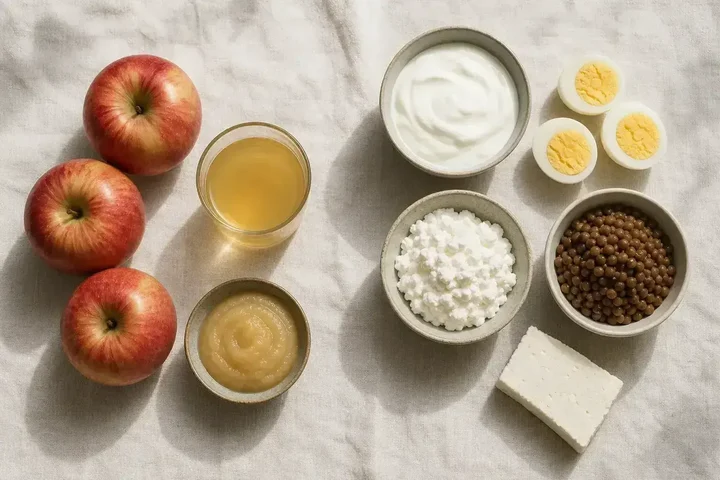
The left half of this table is roughly one gram of protein in total. The right half is over fifty.
| Food (per 100 g) | Protein | Notes |
|---|---|---|
| Apple, raw with skin | 0.26 g | About 0.5 g in a medium 182 g apple |
| Applesauce, unsweetened | 0.17 g | Slices and pie filling track the fruit |
| Apple and grape juice blend | 0.16 g | Juicing removes most of the little there was |
| Oats, cooked with water | 2.54 g | Instant cinnamon-and-spice oatmeal: 2.37 g |
| Peanut butter, smooth | 22.2 g | All the protein in "apple and peanut butter" |
| Egg, whole, raw | 12.6 g | 6.3 g in a large 50 g egg, free range or not |
| Greek yogurt, plain, lowfat | 9.95 g | Fat-free runs slightly higher |
| Cottage cheese, 1% milkfat | 12.4 g | Fat-free again marginally higher |
| Milk, nonfat (skim) | 3.43 g | Whole milk 3.27 g; lactose-free matches its parent milk |
| Lentils, cooked (dal) | 9.02 g | Thin dal delivers less, being mostly water |
| Paneer | 18 g | Like firm tofu at roughly double the calories |
Three patterns sit inside that table. Removing fat concentrates protein, so fat-free milk, Greek yogurt and cottage cheese carry slightly more per 100 grams than their full-fat versions. Free-range and caged eggs have identical protein, and lactose-free milk is ordinary milk with the lactose broken down. And processing fruit never adds protein: slices, applesauce, juice and pie all inherit the fruit's near-zero value.
Average intakes in grain-and-pulse eating patterns often sit near 0.8 to 1.0 g/kg: above the floor, under the chart ranges. If your day is rice or roti with a little dal or curd, the fix is portion size. A cup of curd, a serving of paneer or tofu, eggs at breakfast and a bigger scoop of dal moves most people 30 to 40 grams a day.
Five Habits That Make the Target Easy to Hit 🥚
- Anchor breakfast at 25 to 30 grams. Most people eat 5 to 10 grams at breakfast and try to make up 60 at dinner. Three eggs, a cup of Greek yogurt, or a cup of cottage cheese fixes the worst meal of the day.
- Spread it every 3 to 4 hours. The ISSN position stand recommends roughly 0.25 grams per kilogram per dose, evenly distributed (Jäger et al., 2017). Four servings of 35 grams beats one of 140.
- Add protein to what you already eat. Yogurt into the oatmeal, an extra egg in the fried rice, paneer or tofu into the curry. Adding beats replacing, because nothing has to taste different.
- Do not fear the pre-sleep serving. 30 to 40 grams of casein-rich food such as cottage cheese or milk before bed raises overnight muscle protein synthesis without blocking fat breakdown (Jäger et al., 2017).
- Keep fiber in step. Push fruit, vegetables and legumes up whenever you push protein up. It prevents most of the digestive complaints people blame on protein.
Push fiber up with protein
Constipation on a high-protein diet is almost always a fiber problem, since the extra protein displaces fruit, vegetables, beans and whole grains. Getting 25 to 35 grams of fiber a day fixes it without touching your protein target.
For portable options between meals, this guide to high-protein snacks covers what travels well.
How to Build a Day That Hits Your Number ✅
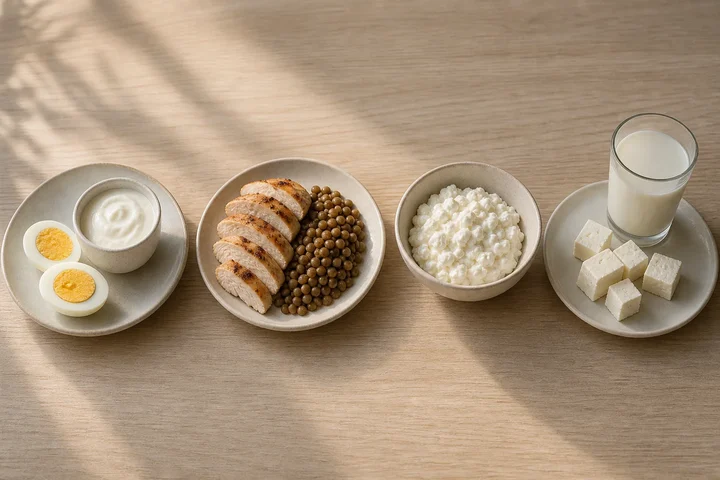
Four feedings of about 30 grams each, what a 120 gram target looks like on plates.
- Set your target. Multiply your body weight in kilograms by the range matching your goal in the chart. Write down one number, not a range, so it is checkable.
- Divide by four. That is your per-meal dose, including one snack. A 120 gram target becomes four servings of 30 grams, the size the muscle-building response is built around.
- Assign a real food to each slot. "More protein" is not a plan. "Two eggs and yogurt, chicken and dal, cottage cheese, paneer and beans" is.
- Track for exactly two weeks. Two weeks of honest logging teaches you what 30 grams looks like on a plate, and then you can estimate. Most people find they were 30 to 50 grams short every day.
- Fix the smallest meal first. Whichever slot is lowest, usually breakfast or the afternoon snack, is where the easiest 20 grams lives.
- Recheck when the goal changes. A new deficit, a lifting program, a GLP-1 medication, turning 65, or surgery all move the target. Nothing else does.
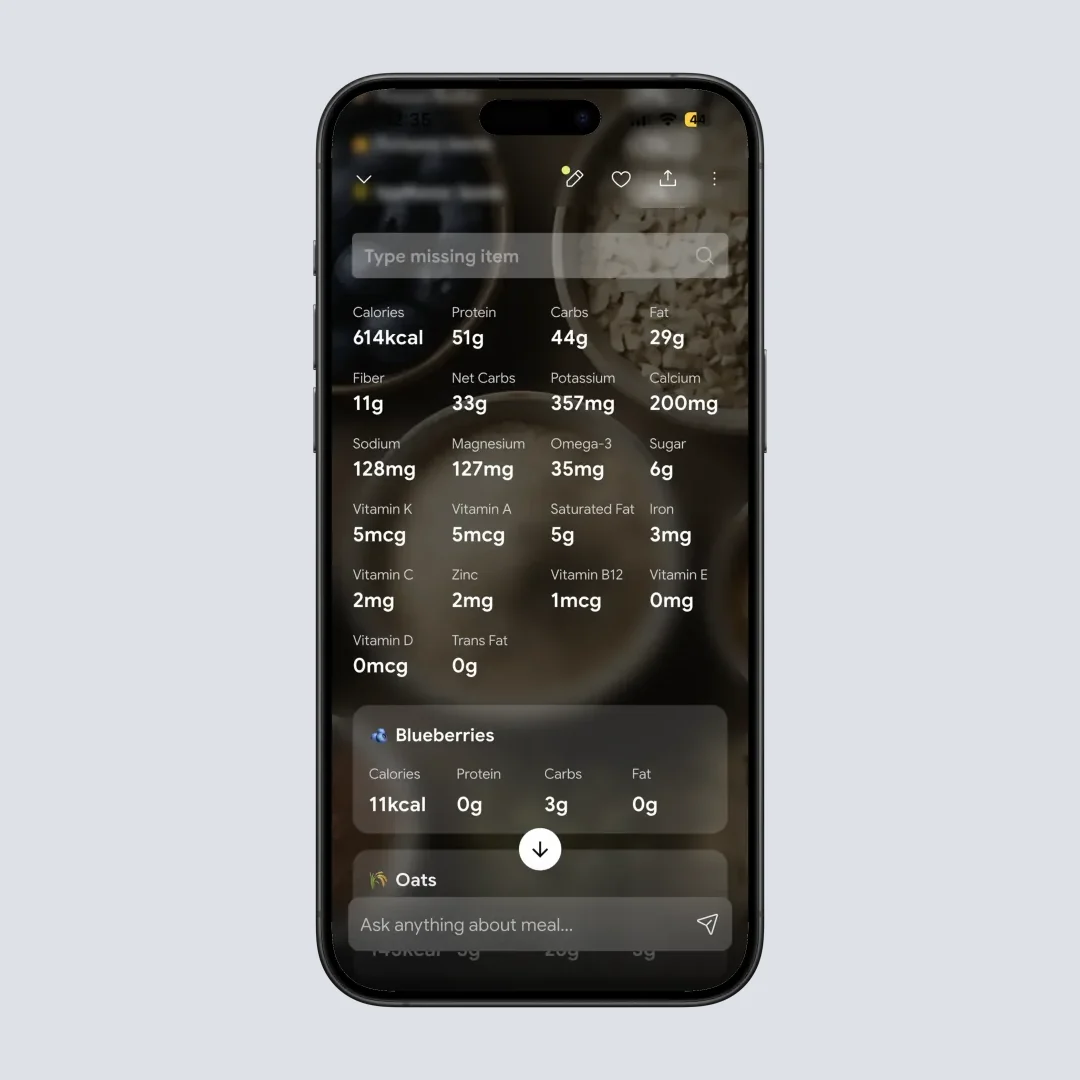
Meals tab ➡️ tap a logged meal ➡️ nutrition breakdown, which is where a per-meal number is easiest to read.
To see where your days land before changing anything, this comparison of protein tracking apps covers the tools that count macros without becoming a second job.
IMPORTANT
Checkpoint: final stretch before the reveal.
One last nudge, the reveal is next.
⏱️ Progress 3/4 • ~3 minutes in • Keep going
✅ Step 1: Floor and goal number
✅ Step 2: Your row in the chart
✅ Step 3: The day built as four feedings
✨ The protein risk that 28 trials could not find (about to reveal)
The Protein Risk That 28 Trials Could Not Find 🔬
The warning attached to high-protein eating is nearly always the same one: it wrecks your kidneys.
A meta-analysis of 28 trials with 1358 participants compared higher-protein intakes, at least 1.5 g/kg or 100 grams a day, with normal or lower ones. Post-intervention glomerular filtration rate ran slightly higher on more protein, but the change in GFR did not differ between diets, and the authors concluded higher intakes do not harm kidney function in healthy adults (Devries et al., 2018). A higher filtration rate is kidneys working, not kidneys failing.
Existing kidney disease is a different situation. Protein restriction is part of care in chronic kidney disease, and PROT-AGE draws the line at an estimated GFR under 30 for people not on dialysis (Bauer et al., 2013). If you have a diagnosis, your target comes from your nephrologist.
Two other complaints are real but misfiled. Constipation is the fiber problem covered above. Reduced appetite is the mechanism rather than a side effect, which helps in a deficit and works against you if you are trying to gain weight. High protein in a blood test points to dehydration, infection or inflammation rather than to steak.
So is 250 grams a day bad? For a healthy adult the safety evidence above still applies, but it is pointless for most people. At 1.6 g/kg, 250 grams suits someone around 156 kg; at 80 kg you are 100 grams past the point where extra protein adds muscle.
Two groups this does not cover
The kidney evidence above is for healthy adults only. If you have chronic kidney disease, an estimated GFR under 30, liver disease, or you are pregnant, your protein target should come from your own clinician. The same goes for anyone on a medication that changes appetite or kidney function.
The Verdict 🏁
Multiply your weight in kilograms by 1.2 for the health minimum with a margin, by 1.6 if you are training for muscle, and by up to 2.2 if you are losing weight and want to keep the muscle you have. Above about 1.6 g/kg the muscle-building returns flatten (Morton et al., 2018), and below 0.8 g/kg you are under the floor.
Distribution is the part most people miss. One 120 gram dinner is not the same as four 30 gram feedings, and breakfast is where most of the shortfall lives.
IMPORTANT
Recap: everything you completed this round.
You finished the run, so save this for next time.
⏱️ Progress 4/4 • ~4 minutes in • Nicely done
✅ Step 1: Floor 0.8 g/kg, goal 1.2 to 2.2 g/kg depending on what you are doing
✅ Step 2: Your row in the chart, plus 1.2 to 1.6 g/kg on a GLP-1 medication
✅ Step 3: Four feedings of about 0.25 g/kg, every 3 to 4 hours
✅ The protein risk 28 trials could not find: no change in GFR in healthy adults (revealed)
Knowing your number is the easy half. Seeing what you actually ate is the half that changes behavior. If photographing a plate is more likely to stick than typing every ingredient, NutriScan is free to try, with five photo meal scans a week on the free plan and unlimited scans on Premium at about $59 a year.
Frequently Asked Questions ❓
How much protein should I eat in a day to lose weight?
In a calorie deficit, aim for 1.6 to 2.2 grams per kilogram of current body weight. A 70 kg woman lands at 112 to 154 grams a day, a 90 kg man at 144 to 198. Energy-restricted higher-protein diets kept about 0.43 kg more fat-free mass than standard-protein diets over roughly 12 weeks (Wycherley et al., 2012).
How many grams of protein do I need for muscle gain?
A meta-analysis of 49 studies found gains in fat-free mass stopped improving past about 1.62 grams per kilogram per day, and the ISSN recommends 1.4 to 2.0 grams per kilogram for exercising adults. Training is what turns that protein into muscle (Morton et al., 2018).
How much protein should I eat with Mounjaro, Zepbound or Wegovy?
Aim for 1.2 to 1.6 grams per kilogram of current body weight, split across the meals you can manage. Lean mass accounted for roughly 25% of total weight lost across 22 trials of GLP-1 receptor agonists, so protein plus resistance training is the countermeasure (Karakasis et al., 2025).
How much protein does an apple have?
Almost none. USDA lists raw apples with skin at 0.26 grams per 100 grams, so a medium 182 gram apple gives about half a gram. Apple with peanut butter is a protein snack because of the peanut butter, at 22.2 grams per 100 grams.
How much protein per day for women over 50?
At least 1.0 to 1.2 grams per kilogram, rising to 1.2 or more if you exercise and 1.2 to 1.5 during illness or recovery. Muscle loss speeds up after menopause, and protein plus resistance training slows it (Bauer et al., 2013).
How much protein per day for kids?
13 grams a day for ages 1 to 3, 19 for ages 4 to 8, 34 for ages 9 to 13, and 52 for boys and 46 for girls aged 14 to 18. Most children on mixed diets already exceed this, so adult targets should not be scaled onto a child, a toddler, or a baby (National Academies DRI tables).