How Much Sodium Per Day? Limits, Labels and 17 Foods
 ChatGPT
 Claude
 AI Mode
 Perplexity
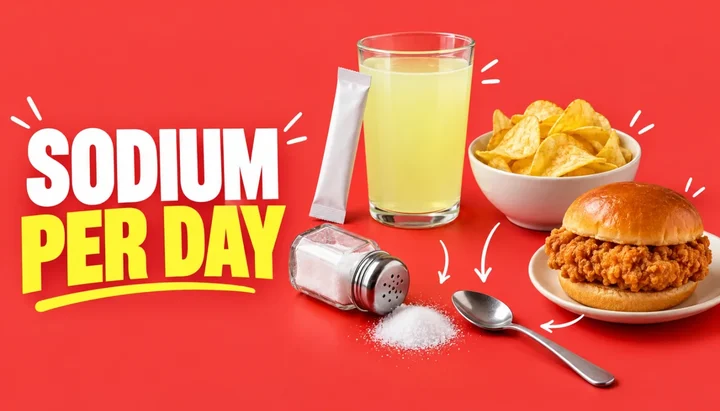
The FDA sets the Daily Value for sodium at less than 2,300 mg a day, about 1 teaspoon of table salt. The American Heart Association names 1,500 mg as the optimal goal for most adults, and the World Health Organization recommends less than 2,000 mg. One stick of Liquid I.V. uses 500 mg of that.
Sources checked on October 11, 2026: the FDA, American Heart Association and WHO pages linked above, brand nutrition pages from Liquid I.V., McDonald's, KFC, Popeyes and Lay's, and USDA FoodData Central. Percentages are our own arithmetic from those figures.
Summary
- Daily limits: less than 2,300 mg (FDA Daily Value), no more than 1,500 mg as an optimal goal (American Heart Association), less than 2,000 mg (WHO).
- On a label: the FDA counts 5% of the Daily Value or less per serving as low and 20% or more as high. "Low sodium" on the pack means 140 mg or less per serving.
- Liquid I.V.: one stick of Hydration Multiplier has 500 mg of sodium, 22% of the Daily Value.
- Restaurant food: a KFC Famous Bowl has 2,160 mg and a Popeyes chicken breast 1,780 mg, per each chain's own nutrition guide.
- Where it comes from: the FDA says over 70% of the sodium Americans eat comes from packaged and prepared foods.
How much sodium should you have per day?
Three agencies publish a number for adults, and they sit between 1,500 and 2,300 mg a day. The FDA's figure is the one printed on US food labels. The FDA also reports that Americans eat about 3,400 mg a day on average, and the WHO puts the global adult average at 4,278 mg in 2021.
| Agency | Sodium per day for adults | In salt |
|---|---|---|
| FDA Daily Value | Less than 2,300 mg | About 1 teaspoon of table salt |
| American Heart Association | No more than 2,300 mg, optimal goal no more than 1,500 mg | Not stated |
| World Health Organization | Less than 2,000 mg | Less than 5 g, just under a teaspoon |
The FDA adds that recommended limits for children under 14 are lower. The American Heart Association says its 1,500 mg goal may not apply to people who lose large amounts of sodium in sweat, such as competitive athletes and workers exposed to major heat stress, or to people whose healthcare team has told them otherwise.

Is sodium the same as salt?
No. Table salt is sodium chloride, and sodium is one of the two elements in it. The WHO gives the conversion as 400 mg of sodium in every gram of salt, so its 5 g salt limit equals 2,000 mg of sodium. Nutrition Facts labels in the US list sodium, in milligrams.
The sodium line also counts sodium from other ingredients. The FDA names monosodium glutamate (MSG), baking soda, sodium nitrite and sodium benzoate.
How do you read sodium on a nutrition label?
Read three things in order: the serving size, the milligrams of sodium and the % Daily Value. The FDA gives a general guide that 5% DV or less of sodium per serving is low and 20% DV or more is high. Against the 2,300 mg Daily Value, that works out to 115 mg and 460 mg.
Front-of-pack claims have fixed meanings under the same FDA guide:
| Claim on the pack | What it means |
|---|---|
| Salt/sodium-free | Less than 5 mg of sodium per serving |
| Very low sodium | 35 mg or less per serving |
| Low sodium | 140 mg or less per serving |
| Reduced sodium | At least 25% less than the regular product |
| Light in sodium or lightly salted | At least 50% less than the regular product |
| No-salt-added or unsalted | No salt added in processing, may still contain sodium |
The number is for one serving. Eat 3 oz from a bag that lists 1 oz and you eat three times the sodium shown. Our guide to reading a nutrition label covers the rest of the panel.
How much sodium is in Liquid I.V.?
One stick of Liquid I.V. Hydration Multiplier has 500 mg of sodium, which the Nutrition Facts panel on Liquid I.V.'s wholesale product page lists as 22% of the Daily Value. The same panel shows 370 mg of potassium, 11 g of added sugar and 45 calories, and the page says to mix one stick into 16 ounces of water.
Measured against the other two limits, one stick is 25% of the WHO's 2,000 mg and 33% of the American Heart Association's 1,500 mg goal. Two sticks in a day add 1,000 mg, or 43% of the Daily Value, before you have eaten anything. Liquid I.V.'s own article on sodium says the Sugar-Free version also carries about 500 mg per serving.
By the FDA's 20% guide, a stick is a high-sodium serving. The full panel is on our Liquid I.V. Hydration Multiplier page.
Do you need the sodium in an electrolyte drink?
It depends on how much you sweat. The FDA describes sodium as needed "in relatively small amounts (provided that substantial sweating does not occur)", and the American Heart Association says the body needs less than 500 mg a day to function. Heavy sweating from long exercise or hot work is the case both agencies set apart.
For a day at a desk, the 500 mg in a stick counts toward your limit the same way the sodium in a sandwich does. Liquid I.V. states that "anyone advised to limit sodium should follow their doctor's guidance."
How much sodium is in common foods?
Each share is the sodium in one serving divided by the FDA's 2,300 mg Daily Value and by the American Heart Association's 1,500 mg goal.
| Food | Serving | Sodium | Share of 2,300 mg | Share of 1,500 mg | Source |
|---|---|---|---|---|---|
| Himalayan salt | 1 teaspoon (6 g) | 2,280 mg | 99% | 152% | NutriScan food page |
| KFC Famous Bowl | 1 bowl | 2,160 mg | 94% | 144% | KFC |
| Popeyes chicken breast | 1 piece | 1,780 mg | 77% | 119% | Popeyes |
| Popeyes Classic Chicken Sandwich | 1 sandwich | 1,440 mg | 63% | 96% | Popeyes |
| Pho | 1 bowl (600 g) | 1,200 mg | 52% | 80% | NutriScan food page |
| KFC Original Recipe chicken breast | 1 piece | 1,190 mg | 52% | 79% | KFC |
| Pad thai | 1 serving (250 g) | 800 mg | 35% | 53% | NutriScan food page |
| McDonald's Egg McMuffin | 1 sandwich | 770 mg | 33% | 51% | McDonald's |
| Smoked salmon | 3 oz (85 g) | 571 mg | 25% | 38% | USDA FDC 173687 |
| McDonald's McChicken | 1 sandwich | 560 mg | 24% | 37% | McDonald's |
| Liquid I.V. Hydration Multiplier | 1 stick in 16 oz water | 500 mg | 22% | 33% | Liquid I.V. |
| Kimchi | 100 g | 498 mg | 22% | 33% | USDA FDC 170392 |
| Tamales | 1 tamal (166 g) | 427 mg | 19% | 28% | NutriScan food page |
| Takis Fuego | 1 oz (28 g) | 390 mg | 17% | 26% | NutriScan food page |
| Salsa | 1/2 cup (125 g) | 320 mg | 14% | 21% | NutriScan food page |
| McDonald's fries | 1 medium | 260 mg | 11% | 17% | McDonald's |
| Lay's Classic | 1 oz (28 g, about 15 chips) | 140 mg | 6% | 9% | Lay's |
Brand rows use the brand's own published figure, checked on October 11, 2026, and it can differ from the figure on the linked food page. Smoked salmon is our arithmetic from USDA's 672 mg per 100 g. Rows marked "NutriScan food page" use the number on the linked page; restaurant pho, pad thai, tamales and salsa vary by recipe. Where our nutrition numbers come from is on the NutriScan data sources page.
A teaspoon of Himalayan salt lands within 20 mg of the FDA's whole-day limit, close to the FDA's figure for table salt. One KFC Famous Bowl is 94% of it. A single Popeyes chicken breast is 119% of the American Heart Association's goal.
Which foods count as high in sodium?
By the FDA's guide, any serving with 20% DV or more, which is 460 mg, is high. Twelve of the 17 rows above cross that line, including kimchi at 498 mg per 100 g and the McChicken at 560 mg. Only Lay's Classic, at 140 mg per ounce, meets the FDA's "low sodium" cutoff.
Where does most sodium come from?
Mostly from food that was salted before it reached you. The FDA says over 70% of dietary sodium comes from packaged and prepared foods rather than salt added at the stove or the table. It cites the CDC's finding that about 40% of the sodium Americans eat comes from nine food groups:
- Deli meat sandwiches
- Pizza
- Burritos and tacos
- Soups
- Savory snacks such as chips, crackers and popcorn
- Poultry
- Pasta mixed dishes
- Burgers
- Egg dishes and omelets
How do you cut sodium without counting every milligram?
Start with the biggest single servings, because one swap there moves the total more than many small ones. These steps come from the FDA's list of ten tips on the page linked above.
- Compare labels within a category. The FDA notes that sodium varies a lot between similar foods, and the table shows it: Takis Fuego at 390 mg per ounce against Lay's Classic at 140 mg.
- Rinse canned beans, tuna and vegetables. The FDA says this removes some of the sodium.
- Shrink the portion when eating out. Half a Famous Bowl is 1,080 mg.
The American Heart Association says that for most people, cutting 1,000 mg a day can improve blood pressure.
How do you track sodium in NutriScan?
NutriScan estimates sodium for every meal you log, next to calories and macros. On a meal's Nutrition Details page, sodium sits in the nutrient grid, and "Show More" lists every micronutrient with a card per item, so you can see which food on the plate brought the sodium.
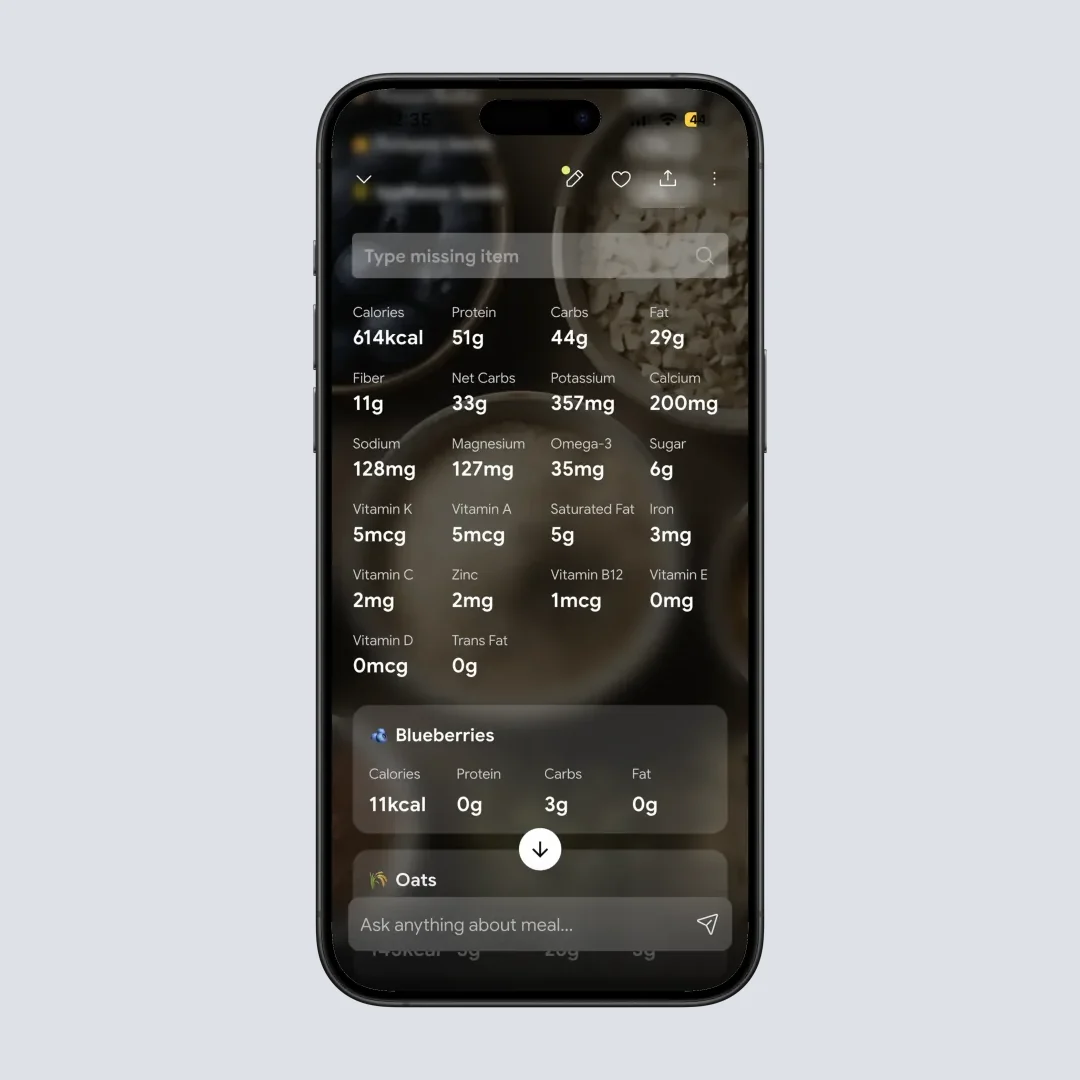
Nutrition Details for a logged meal. Sodium appears in the grid with the other micronutrients, and each food has its own card below.
To see a running total for the day, open Profile > Customize Home and pin Sodium under "Macros in Today's Count". You can pin up to 6 of 18 nutrients there. The free plan includes 5 scans a week. Sodium from a photo is an estimate, since a camera cannot see how much salt went into a dish, so type the label figure in with Edit Macros when you have the pack in hand. For apps that go deeper on minerals and vitamins, see our comparison of the best apps for micronutrient tracking, and the online calorie calculator gives you a daily calorie target to set sodium against.
If you have high blood pressure, kidney disease or heart failure
This article is general information. The limits above are population guidance from the FDA, the American Heart Association and the WHO. If you have a medical condition or take medication that affects fluid or sodium balance, your target comes from your doctor or dietitian.
What else do people ask about sodium?
How much sodium should you have per day?
The FDA sets the Daily Value for sodium at less than 2,300 mg a day, which is about 1 teaspoon of table salt. The American Heart Association gives the same 2,300 mg ceiling and an optimal goal of no more than 1,500 mg for most adults. The World Health Organization recommends less than 2,000 mg. Your own target comes from your doctor if you have a medical condition.
How much sodium is in Liquid I.V.?
One stick of Liquid I.V. Hydration Multiplier has 500 mg of sodium, listed as 22% of the Daily Value on the brand's Nutrition Facts panel. That is 25% of the WHO's 2,000 mg limit and 33% of the American Heart Association's 1,500 mg goal. Liquid I.V. says its Sugar-Free version also carries about 500 mg.
Is Liquid I.V. high in sodium?
By the FDA's label guide, yes. The FDA counts 20% of the Daily Value or more per serving as high, and one stick is 22%. Two sticks in a day add 1,000 mg, which is 43% of the 2,300 mg Daily Value before any food. Liquid I.V. states that anyone advised to limit sodium should follow their doctor's guidance.
Is kimchi high in sodium?
A 100 g serving is. USDA FoodData Central lists kimchi at 498 mg of sodium per 100 g, which is 22% of the 2,300 mg Daily Value, and the FDA counts 20% or more per serving as high. A smaller spoonful on the side of a meal carries proportionally less.
How much sodium is in a teaspoon of salt?
About 2,300 mg. The FDA describes its 2,300 mg daily limit as equal to about 1 teaspoon of table salt. The WHO's converter gives 400 mg of sodium for every gram of salt, so 5 g of salt is 2,000 mg of sodium.