Calories vs kcal and How to Read a Nutrition Label
 ChatGPT
  Claude
  AI Mode
  Perplexity
TL;DR - Calories vs kcal on a Food Label
• Same unit: On any food package, 1 Calorie = 1 kcal. The lowercase small calorie belongs to physics, never to labels.
• Key number: In a survey of 992 US adults, average label comprehension was 81.4%, and the 2016 redesign did not improve it.
• The real trap: Every number on the panel describes one serving of the printed size, not the package and not your bowl.
• How to read one: Serving size ➡️ servings per container ➡️ calorie line ➡️ % DV ➡️ your actual portion.
• US vs UK: Same unit, different basis. Convert both to per 100 g before you compare two products.
In a 2019 survey of 992 US adults, average objective comprehension of the Nutrition Facts label was 81.4%, and the 2016 redesign did not significantly improve it (Kim et al., 2021). Roughly one answer in five was wrong, and the questions people missed most often were about sugars. Label reading is not obvious, and nobody teaches it.
Two questions come up more than any others. What is the difference between calories and kcal, and why does the number on the box never match the number in my head? The first has a short answer. The second has a useful one. NutriScan publishes this post and makes a calorie tracking app.
Short answer: on food packaging, calories and kcal are the same unit. Every other confusion on the panel comes from the basis: per serving, per container, or per 100 grams.
IMPORTANT
Your label reading plan at a glance.
Three things to settle, then one number that will not behave.
⏱️ Progress 0/4 • ~0 minutes in • Keep going
⏳ Step 1: Why calories, Calories, kcal and kilojoules are one number in three costumes
⏳ Step 2: What per serving and Amount Per Serving actually change
⏳ Step 3: Reading a full panel in seven moves, US or UK
🔍 Why your watch and your food diary never agree (revealed near the end)
Calories, Calories and kcal Are One Number in Three Costumes 🔤
Physics has two calories. The small calorie, lowercase c, raises one gram of water by one degree Celsius. The large calorie, capital C, is a thousand of those, and it is also called the kilocalorie, abbreviated kcal.
Food labels use the large one. Always. A US label that says "Calories 230" and a UK label that says "230 kcal" describe an identical amount of energy. The word "kcalories" in an older textbook is the same number again, an older written form that survives in print.
So the rules are short. Write kcal if you want to be precise, calories if you are writing for a US audience; nobody in food will read "cal" as the physics small calorie. The difference between calories and Calories only matters in a chemistry lab, where the capital letter is doing real work.
Kilojoules are the genuinely different unit. One kilocalorie is about 4.2 kilojoules, which is why the NHS lists an average woman's daily energy as around 2,000 calories or 8,400 kilojoules and an average man's as 2,500 calories or 10,500 kilojoules (NHS Eatwell Guide). If a label shows both, you only need to read one.
 Milk going into a jar of oats: the unit on the box is settled, the amount in the jar is the part you decide.
IMPORTANT
Checkpoint: here's where you are right now.
The unit question is done. The arithmetic question is next.
⏱️ Progress 1/4 • ~1 minute in • Keep going
✅ Step 1: units settled, calories and kcal are the same on food (done)
👉 Step 2: per serving, per container, per 100 g (you're here)
⏳ Step 3: reading a full panel in seven moves
🧩 Why your watch and your food diary never agree (coming soon)
Two Labels, Two Traps: Worked Examples 🥣
Both examples below are illustrations, not real products.
Example 1, the cereal box. The panel reads "8 servings per container", "Serving size 3/4 cup (40 g)", "Calories 150". You pour a normal breakfast, weigh it out of curiosity, and the bowl holds 90 g. That is 2.25 servings, so breakfast is 338 calories, not 150. Nothing on the box is wrong. The serving size was a measuring standard, and your bowl was not.
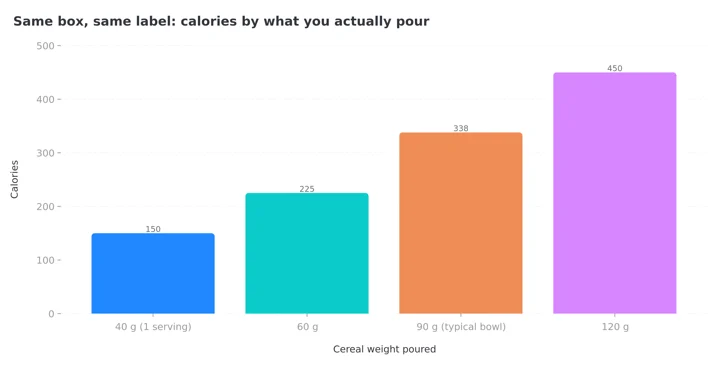 Figure 1: One label, four breakfasts. The 90 g bowl most people pour carries 338 calories, more than double the printed serving.
Example 2, the juice carton. A 500 ml bottle labeled in the UK style shows "Energy 188 kJ / 45 kcal per 100 ml" plus a column for the 250 ml glass. Drink the bottle and you have taken in 225 kcal, and you will still eat breakfast. Typical figures for common drinks are on our pages for orange juice and cola.
 The back of the box answers a different question from the front of the box.
The lesson from both: a calorie number is only as useful as the amount it is attached to. Read the basis before you read the number. For food with no label, see how to count calories without weighing food.
What the Labeling Rules Actually Say 📋
The number on the box is calculated, not measured on your specific box. Under US regulations, manufacturers may compute calories using the general factors of 4, 4 and 9 calories per gram for protein, total carbohydrate and total fat, with separate values for sugar alcohols such as erythritol at 0 (21 CFR 101.9).
The same rule then rounds the result. Calories are "expressed to the nearest 5-calorie increment up to and including 50 calories, and 10-calorie increment above 50 calories, except that amounts less than 5 calories may be expressed as zero."
Two consequences follow. A product labeled 0 calories can legally hold up to 4.9 per serving, which matters if you drink six a day. And a 340 on the panel could be a computed 336 or 344, so treating label calories as exact to the digit is precision the rule never promised.
Read the % DV column as a ranking, not a budget
The FDA's guide says 5% DV or less of a nutrient per serving is low and 20% DV or more is high, with percentages based on 2,000 calories a day (FDA nutrition label guide). If your target is 1,600 or 2,800, that column still sorts foods against each other. It just does not budget your day.
"Per Serving" and "Amount Per Serving": The Two Lines Most Errors Come From 🍽️
Every number below the calorie line describes one serving. That is what "Amount Per Serving" means as a header and what "kcal per serving" means on a UK panel. The panel is a rate, not a total.
The FDA is explicit that a serving size "is not a recommendation of how much you should eat or drink." It is a standardized reference amount so two brands of yogurt compare on the same basis. Your portion is your business. The multiplication step is where people lose track:
| What the label says | What it means | What you owe yourself |
|---|---|---|
| Serving size 3/4 cup (40 g) | The basis for every number below | Weigh or measure once to calibrate your eye |
| 8 servings per container | The package holds 8 of those | Multiply if you eat from the package |
| Amount Per Serving, Calories 150 | 150 calories in 40 g | 90 g eaten means 338 calories |
| 45 kcal per 100 ml | Energy density, not a portion | Multiply by your actual volume |
| % DV based on 2,000 calories | A ranking scale, not your budget | Use 5% low and 20% high as the read |
One case does the multiplication for you. If a package holds between 200% and 300% of the standard reference amount, US rules require two columns, one per serving and one per container, so a 20 oz bottle or a large muffin shows both. Outside that window the total is yours to calculate, and our online calorie calculator checks the arithmetic against a target.
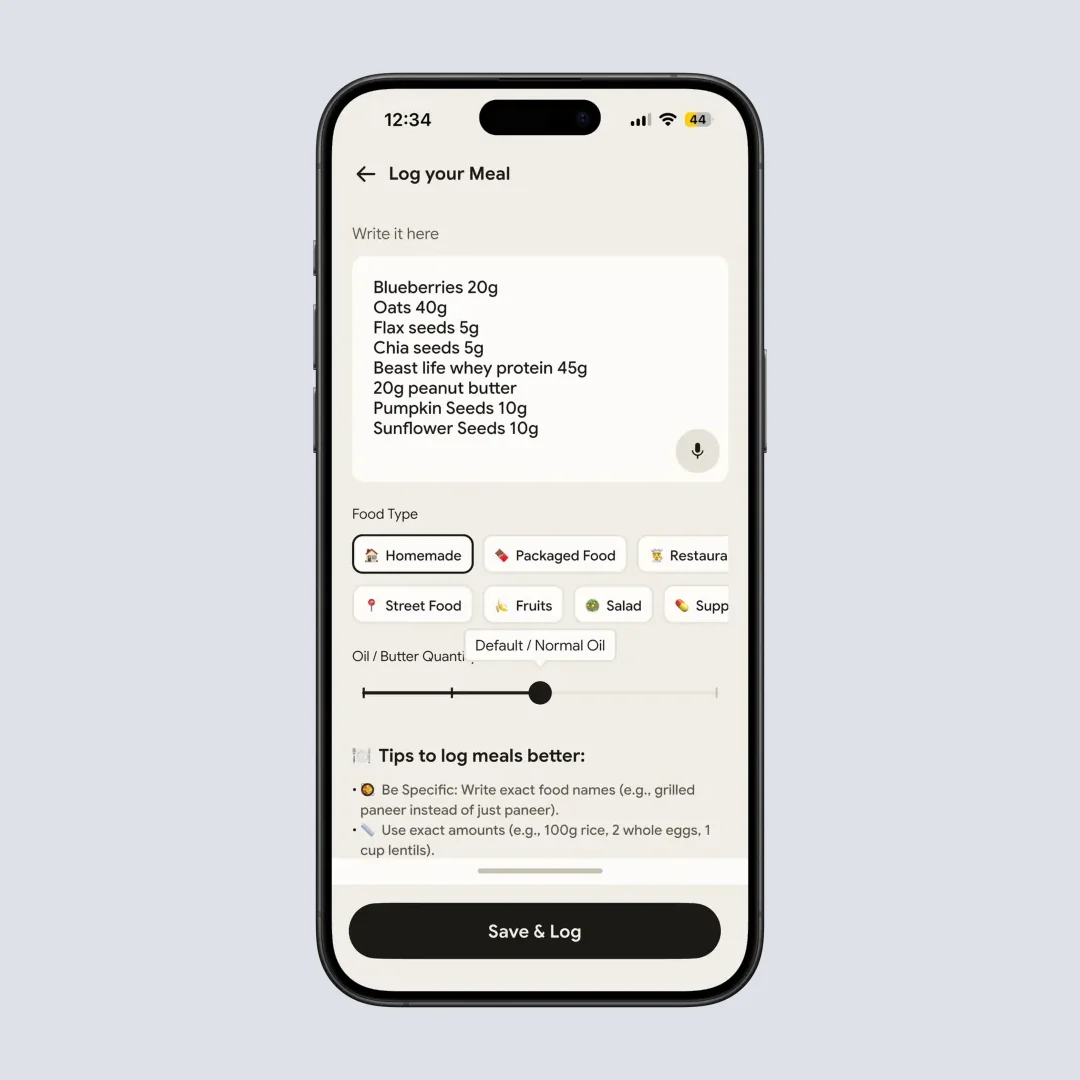
Logging by weight rather than by "one bowl" is the same multiplication, done once and saved.
IMPORTANT
Checkpoint: midway progress update.
You're halfway. The rest is reading panels quickly and knowing what to distrust.
⏱️ Progress 2/4 • ~2 minutes in • Keep going
✅ Step 1: units settled (done)
✅ Step 2: per serving, per container, per 100 g (done)
👉 Step 3: reading a full panel in seven moves (current)
⏳ Why your watch and your food diary never agree (next)
American Calories vs UK Calories: Same Unit, Different Panel 🌍
There is no such thing as an American calorie or a British calorie. The unit is identical. How the panel presents it differs, and that is enough to make the same food look different.
| US Nutrition Facts | UK and EU nutrition panel | |
|---|---|---|
| Energy units | Calories, kilojoules optional | Kilojoules and kilocalories, both required |
| Default basis | Per serving, plus servings per container | Per 100 g or per 100 ml, portion column optional |
| Serving definition | Standardized reference amount set by regulation | Manufacturer's stated portion |
| Front of pack | Voluntary | Color-coded high, medium and low panel widely used |
| Reference intake | 2,000 calories a day | 2,000 kcal / 8,400 kJ for an average adult |
UK and EU panels must carry "the amount of energy in kilojoules (kJ) and kilocalories (kcal)" per 100 g or per 100 ml, sometimes with a per portion column (NHS food labels). That default is the better system for comparing products: it removes the manufacturer's choice of portion from the comparison.
British front-of-pack panels publish thresholds you can apply anywhere. Per 100 g, the NHS treats more than 17.5 g of fat, 5 g of saturated fat, 22.5 g of sugars or 1.5 g of salt as high, and 3 g of fat, 1.5 g of saturated fat, 5 g of sugars or 0.3 g of salt or less as low.
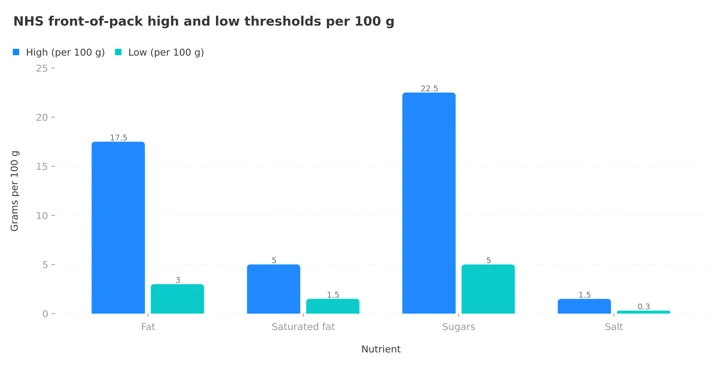 Figure 2: Sugars carry the widest band, 5 g low against 22.5 g high per 100 g, which is why the sugar line separates products faster than any other row.
Those four pairs work on a US label too, once you convert the serving to 100 g.
Do Drink Calories Count the Same as Food Calories? 🥤
Energetically, yes. A hundred calories of juice and a hundred calories of oats deliver the same energy. Behaviorally they differ.
Reviews of sugar sweetened beverages point to the same mechanism: reduced satiety, and incomplete compensatory reduction in energy intake at meals after liquid calories are consumed (Calcaterra et al., 2023). A 225 calorie glass of juice does not remove 225 calories of appetite later. It mostly adds.
 A poured glass of juice: the line most food diaries forget, because nobody thinks of a drink as a portion.
The health signal points the same way. A BMJ umbrella review of 73 published meta-analysis reports found that each 250 ml per day increment of sugar sweetened beverage consumption was associated with a 17% higher risk of coronary heart disease and a 4% higher risk of all-cause mortality, and recommended keeping free sugars below 25 g a day (Huang et al., 2023).
Drink calories are not worse calories. They are the easiest calories in your day to miss, because most people log meals and forget beverages.
Very low intakes need a clinician, not a smaller number
Label reading is a tool for accuracy, not for cutting harder. If you are already eating well below your needs, losing weight without trying, or you have a history of disordered eating, more precise calorie arithmetic is the wrong fix. Talk to a doctor or a registered dietitian before you lower your intake further.
Five Habits That Make Label Reading Faster ✅
- Read the serving size before the calorie number. It is one line higher on the panel and it changes the meaning of everything below it.
- Weigh three foods you eat often, once. Cereal, pasta and nut butter surprise people most. After a week your eye is calibrated and you can stop.
- Convert everything to per 100 g when comparing two products. It is the only fair comparison, and it is the UK default for exactly that reason.
- Log drinks first. Beverages carry no chewing, little satiety and are the most commonly forgotten line in a food diary.
- Treat any label number as plus or minus a rounding step. The rules round to the nearest 5 or 10 calories, so chasing single digits is chasing noise.
How to Read a Nutrition Facts Label in Seven Steps 📝
- Start at the serving size and servings per container. Note both. If you plan to eat the whole package, multiply everything by the second number before you read further.
- Read the calorie line as a rate. "Amount Per Serving, Calories 150" means 150 calories in one stated serving. Write down the number for the portion you will actually eat.
- Check whether it is a dual-column label. If the panel shows per serving and per container side by side, the arithmetic is done for you; take the column that matches your intention.
- Scan the % DV column for anything at or above 20%. That is the label telling you this food is a meaningful contributor of that nutrient, good or bad.
- Look at added sugars separately from total sugars. This is the pair that label comprehension research finds people get wrong most often, and the two lines answer different questions.
- Compare on the same basis. Two brands, both converted to per 100 g, is a real comparison. Two different serving sizes is not.
- Sanity-check against your own target. A 2,000 calorie reference is a printing convention. Your number comes from your body and your activity, not the box.
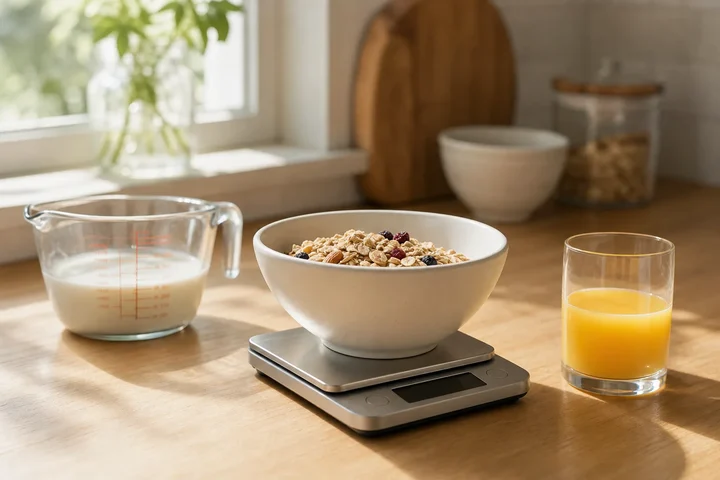 Step 1 in practice: the scale turns "one bowl" into a number the panel can actually answer.
IMPORTANT
Checkpoint: final stretch before the reveal.
Three steps done. One number is still lying to you.
⏱️ Progress 3/4 • ~3 minutes in • Keep going
✅ Step 1: units settled
✅ Step 2: per serving, per container, per 100 g
✅ Step 3: seven moves through a panel
✨ Why your watch and your food diary never agree (about to reveal)
Why Your Watch and Your Food Diary Never Agree ⌚
Here is the answer, and it is not the one most people expect. The disagreement is not a unit problem. Your watch and your cereal box both count kilocalories, so calories versus kilocalories on an Apple Watch is a naming difference, not a math one. The disagreement is an accuracy problem, and it sits almost entirely on the watch's side.
A 2025 meta-analysis of 56 studies, covering 71 effect sizes for energy expenditure, found that every subgroup for Apple Watch energy expenditure exceeded the 10% error threshold used to judge validity, while heart rate stayed inside it (Choe and Kang, 2025). Not most subgroups. Every one. Steps and heart rate are dependable; the calories-out figure is an estimate with a wide margin, and no amount of careful label reading on the food side closes a gap that opens on the hardware side.
That reframes the calories in versus calories out question. The NHS states it simply: to stay at around the same weight, the calories your body uses should be the same as the calories you eat and drink, and you gain weight if you consistently take in more than you use (NHS, Understanding calories). Energy balance holds. It is the measurement of both sides that is loose, and the two sides are not equally loose.
"Calories out" does not stay still either. A review of metabolic adaptation describes the body's biological drive to regain lost mass, and notes that weight loss does not always follow a linear path even when the intervention is calculated with precise tools (Martínez-Gómez and Roberts, 2022). So trust the panel for the intake side, recalculate expenditure every few weeks with a TDEE calculator, and adjust from what the scale actually did rather than from what the ring closed.
What the Research Says About Label Literacy 🔬
The evidence has a consistent shape: people can read labels, and they still misjudge portions. Comparing the original and updated US labels, 992 adults scored an average of 81.4% on objective comprehension, the redesign produced no significant improvement, and total and added sugars gave participants the most trouble (Kim et al., 2021). The authors conclude that consumers may benefit from education on using the new label rather than from further redesign. The panel format is not the obstacle; the arithmetic between the panel and your bowl is.
For a longer look at why the calorie number alone is a thin measure of a meal, see tracking calories vs overall nutrition, and for how automated logging compares with writing it down, counting calories with AI and simply writing it down.
The Short Version 🎯
Calories and kcal are the same unit on any food package, kilojoules are the same energy in a different scale, and there is no American calorie or British calorie. The differences are presentation: per serving in the US, per 100 g in the UK. Read the basis, do the multiplication, and the rest is portion honesty.
If the arithmetic is the part you keep skipping, a nutrition label scanner does it for you: point your phone at the panel, tell it the portion you are actually eating, and it handles the serving-size math. NutriScan is free to start with 5 photo scans a week, and Premium removes the limit for about $59 a year.
IMPORTANT
Recap: everything you completed this round.
You finished the run. Save this for the next confusing panel.
⏱️ Progress 4/4 • ~4 minutes in • Nicely done
✅ Step 1: calories, Calories and kcal are one unit on food; kilojoules are the same energy at 4.2 kJ per kcal
✅ Step 2: the panel is a rate per serving, and serving size is a reference amount, not advice
✅ Step 3: seven moves through any panel, US or UK, compared at per 100 g
✅ Why your watch and your food diary never agree (revealed): every Apple Watch energy subgroup missed the 10% validity threshold
Frequently Asked Questions ❓
Are calories and kcal the same thing?
On food packaging, yes. One food Calorie equals one kilocalorie, so 250 calories and 250 kcal describe the same amount of energy. The confusion comes from physics, where a small calorie is one thousandth of that. Food labeling never uses the small calorie, so a panel that says calories and a panel that says kcal are directly comparable.
What does per serving mean in nutrition facts?
It means every number in the panel describes one serving of the size printed at the top, not the whole package. The FDA states that the serving size "is not a recommendation of how much you should eat or drink" (FDA). Multiply by servings per container to get the package total.
What does amount per serving mean in calories?
Amount Per Serving is the header sitting above the calorie line and every nutrient row beneath it, and it tells you the figures apply to a single serving. If a package holds 2.5 servings at 230 calories each, the package is 575 calories, and the label will not print that total unless the package size triggers the dual-column rule.
Why does my Apple Watch show calories when my food label shows kcal?
Same unit, different label. Wearables display food Calories, which are kilocalories, so they sit on the same scale as your food diary. Accuracy is the separate issue: a meta-analysis of 56 studies found every subgroup for Apple Watch energy expenditure exceeded the 10% error threshold used for validity, while heart rate stayed inside it (Choe and Kang, 2025).
Are drink calories the same as food calories?
The energy is identical, the appetite response is not. Reviews of sugar sweetened beverages describe reduced satiety and incomplete compensation at later meals as the leading mechanism linking liquid sugar to weight gain, which means drink calories tend to add to your intake rather than displace part of it.
Are bad calories better than no calories?
For most people, yes. Chronically eating far too little is a bigger problem than eating something imperfect, and a very low intake tends to cost muscle, energy and adherence. The more useful question is whether the day as a whole meets your protein, fiber and micronutrient needs. If you are undereating, or have a history of disordered eating, talk to a clinician rather than cutting further.