Added Sugar vs Total Sugar: Calories and Daily Limits
 ChatGPT
 Claude
 AI Mode
 Perplexity
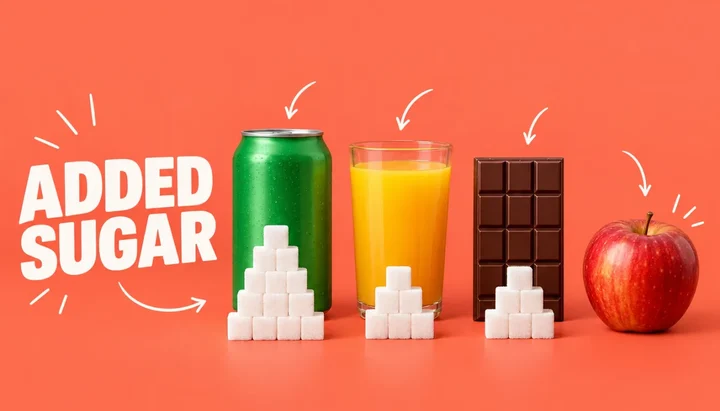
Granulated sugar has 16 calories per teaspoon (4.2 g) and 387 calories per 100 g, according to USDA FoodData Central. A US Nutrition Facts label splits sugar into two lines, total sugars and added sugars, and every published daily limit applies to the added kind.
Sources checked on October 11, 2026: USDA FoodData Central (FDC 169655, 168833, 169656), the FDA page on added sugars, the American Heart Association, the WHO sugars guideline announcement and the Dietary Guidelines for Americans, 2025-2030. Sugar in each drink and snack comes from its NutriScan food page.
Summary
- Calories: sugar has 3.87 calories per gram. A teaspoon has 16, a tablespoon about 49, a cube about 9 and 100 g has 387 (USDA).
- Total sugars count everything, including the sugar naturally in milk and fruit. Added sugars count what was put in. The FDA sets a Daily Value for added sugars only.
- Limits: FDA Daily Value 50 g a day. American Heart Association 36 g for men and 25 g for women. WHO under 10% of energy from free sugars.
- One can can use most of a day. A 12 fl oz Sprite has 38 g of added sugar, 76% of the FDA Daily Value and more than either AHA limit.
- Fruit is counted differently. A medium apple has 19 g of sugar and none of it is added.
How many calories are in sugar?
USDA FoodData Central lists granulated sugar at 387 calories and 99.98 g of carbohydrate per 100 g, with no protein and no fat. That is 3.87 calories per gram.
| Measure | Weight | Calories |
|---|---|---|
| 1 gram | 1 g | 3.87 |
| 1 cube | 2.3 g | 9 |
| 1 packet | 2.8 g | 11 |
| 1 teaspoon | 4.2 g | 16 |
| 1 tablespoon (3 teaspoons) | 12.6 g | 49 |
| 100 grams | 100 g | 387 |
| 1 cup | 200 g | 774 |
Weights and the per 100 g energy value are from USDA FoodData Central, Sugars, granulated (FDC 169655). Calories per measure are weight x 3.87, rounded. USDA lists no tablespoon weight, so that row is three teaspoons.
Labels round carbohydrate to 4 calories per gram. The FDA uses that rounding when it equates 50 g of added sugars with 200 calories.
Brown and powdered sugar are close to the same. USDA lists brown sugar at 380 calories per 100 g and powdered sugar at 389. A packed teaspoon of brown sugar weighs 4.6 g, so it has about 17 calories. Honey is denser: one tablespoon weighs 21 g and has 64 calories on our food page.
The full nutrition profile is on our sugar page.

What is the difference between total sugars and added sugars?
Total sugars are every gram of sugar in the product. Added sugars are a subset. The FDA defines them as sugars added during processing (such as sucrose or dextrose), foods packaged as sweeteners (such as table sugar), sugars from syrups and honey, and sugars from concentrated fruit or vegetable juices.
The label shows the relationship with one word. Under "Total Sugars" it reads "Includes Xg Added Sugars". The FDA's own example is a sweetened yogurt with 15 g of total sugars that includes 7 g of added sugars. The other 8 g were in the milk to begin with.
There is no Daily Value for total sugars. The FDA says "no recommendation has been made for the total amount to eat in a day." Added sugars do have one, 50 g, and the FDA reads the percentage this way:
| % Daily Value per serving | Added sugars | FDA reading |
|---|---|---|
| 5% or less | 2.5 g or less | Low |
| 20% or more | 10 g or more | High |
Gram figures are 5% and 20% of the 50 g Daily Value.
Outside the US the term changes. The WHO uses "free sugars", which covers sugars added by the manufacturer, cook or consumer plus "sugars naturally present in honey, syrups, fruit juices and fruit juice concentrates." So a glass of orange juice, at 21 g of sugar per 240 ml, counts toward the WHO limit. The sugar in whole fruit and plain milk counts toward neither.
For the rest of the label, see our guide to reading a nutrition label.
How much added sugar can you have in a day?
Four bodies publish a number, and they do not agree. All four address added or free sugars.
| Source | Limit | In grams |
|---|---|---|
| FDA Daily Value | Reference amount for a 2,000 calorie diet | 50 g a day |
| American Heart Association | Below 6% of calories | 36 g (9 teaspoons) for men, 25 g (6 teaspoons) for women |
| WHO, strong recommendation | Free sugars under 10% of total energy | 50 g on 2,000 calories |
| WHO, conditional recommendation | Free sugars under 5% of total energy | roughly 25 g (6 teaspoons) |
| Dietary Guidelines for Americans, 2025-2030 | No amount recommended | No more than 10 g in one meal |
The 50 g WHO figure is our arithmetic: 10% of 2,000 calories is 200 calories, at 4 calories per gram.
The Daily Value on the label is built on a limit of less than 10% of calories. The 2025-2030 edition of the Dietary Guidelines goes further. It states that "no amount of added sugars or non-nutritive sweeteners is recommended or considered part of a healthy or nutritious diet" and that "one meal should contain no more than 10 grams of added sugars."
For scale, the American Heart Association reports that people aged 2 and older get about 12% to 13% of their daily calories from added sugars, roughly double its 6% line.
If you have diabetes or another condition
These are population-level figures. Your own carbohydrate and sugar targets come from your doctor or dietitian, and they take priority over any number in this article.
How much sugar is in common drinks and snacks?
Sugar-sweetened beverages are the largest single source. The American Heart Association attributes about 24% of added sugars in the US diet to soft drinks, fruit drinks, sports drinks and energy drinks, and about 19% to desserts and sweet snacks.
The table uses the serving and sugar figure on each linked NutriScan food page. Teaspoons are grams divided by 4.2, the USDA weight of a teaspoon of granulated sugar.
| Food or drink | Serving | Total sugars | Teaspoons | Added sugars |
|---|---|---|---|---|
| Starbucks white chocolate mocha | Grande, 16 fl oz, 2% milk and whipped cream | 46 g | 11.0 | n/s |
| Sprite | 12 fl oz can (355 ml) | 38 g | 9.0 | 38 g |
| Acai bowl | 1 bowl (350 g) | 38 g | 9.0 | 15 g |
| Coca-Cola | 330 ml can | 35 g | 8.3 | n/s |
| Starbucks caramel macchiato | Grande, 16 fl oz, 2% milk | 33 g | 7.9 | n/s |
| Snickers | 1 bar (52.7 g) | 28 g | 6.7 | n/s |
| Red Bull | 250 ml can | 27 g | 6.4 | 27 g |
| Dairy Milk chocolate | 1 bar (45 g) | 24.8 g | 5.9 | n/s |
| Starbucks Strawberry Acai Refresher | Grande, 16 fl oz, water base | 21 g | 5.0 | 11 g |
| Orange juice | 1 glass (240 ml) | 21 g | 5.0 | n/s |
| Apple | 1 medium (182 g) | 19 g | 4.5 | 0 g |
| Honey | 1 tablespoon (21 g) | 17.2 g | 4.1 | 17.2 g |
| Sugar donut | 1 glazed donut (55 g) | 17 g | 4.0 | 15 to 17 g |
| Sweet lassi | 200 ml glass | 17 g | 4.0 | n/s |
| KitKat 4 finger | 1 bar (45 g) | 16 g | 3.8 | 16 g |
| Green grapes | 100 g, about 1 cup | 15.5 g | 3.7 | 0 g |
| Banana | 1 medium (118 g) | 14.4 g | 3.4 | 0 g |
| Vanilla ice cream | 1/2 cup (66 g) | 14 g | 3.3 | n/s |
| Dragon fruit | 1 cup diced (136 g) | 8 g | 1.9 | 0 g |
| Greek yogurt, plain nonfat | 100 g | 3.6 g | 0.9 | 0 g |
| Oreo Zero Sugar | 3 cookies (33 g) | n/s | n/s | under 1 g |
| Soju | 50 ml shot | 0 g | 0 | 0 g |
| Iced americano | 100 ml | 0 g | 0 | 0 g |
n/s means the food page does not state that figure. Added sugars are shown where the food page gives them. Whole fruit and plain yogurt are 0 g under the FDA definition, and honey counts in full because the FDA lists it as an added sugar. Where our nutrition numbers come from is on the NutriScan data sources page.
A can of Sprite and a can of Red Bull are all added sugar. The Sprite alone is 76% of the FDA Daily Value and passes both American Heart Association limits. The AHA's own figure for a 12 ounce soda is 10 teaspoons, or 42 g.
Milk drinks are a mix. The 33 g in a caramel macchiato includes lactose from the milk, which the FDA does not count as added, plus syrup, which it does.
The apple and the acai bowl show why the split matters. An apple's 19 g is all naturally present. The acai bowl has the same total as the Sprite, and 15 g of it is added.
Where does added sugar hide on an ingredient list?
Look for the word "sugar" or "syrup", or a name ending in "-ose". That is the rule of thumb in the Dietary Guidelines for Americans, 2025-2030, which lists high-fructose corn syrup, agave syrup, rice syrup, dextrose, maltose, cane sugar, turbinado sugar, fruit juice concentrate, honey and molasses among the names.
Savory foods carry it too. The WHO notes that one tablespoon of ketchup contains around 4 g of free sugars, about one teaspoon. Our ketchup page lists 22 g of sugar per 100 g.

Is the sugar in fruit the same as added sugar?
On the label it is counted separately. The FDA states that added sugars "do not include naturally occurring sugars that are found in milk, fruits, and vegetables." The WHO guideline leaves out the sugars in fresh fruits and vegetables and in milk "because there is no reported evidence of adverse effects of consuming these sugars."
The American Heart Association gives the reason in terms of speed. An apple contains fiber, so its sugar is absorbed more slowly than the sugar in a regular soda. Our explainer on glycemic index and glycemic load covers how that speed is measured.
How do you track sugar without doing the math?
Read the "Includes Added Sugars" line first, then check the serving size against what you will eat.
NutriScan does the adding up. On the camera, switch the Food / Label toggle to Label, photograph the nutrition panel and choose how much you had: Full Pack, Grams/ml or By Serving. For a plate of food, scan it in Food mode. Either way the meal's Nutrition Details page lists Sugar alongside calories and macros.
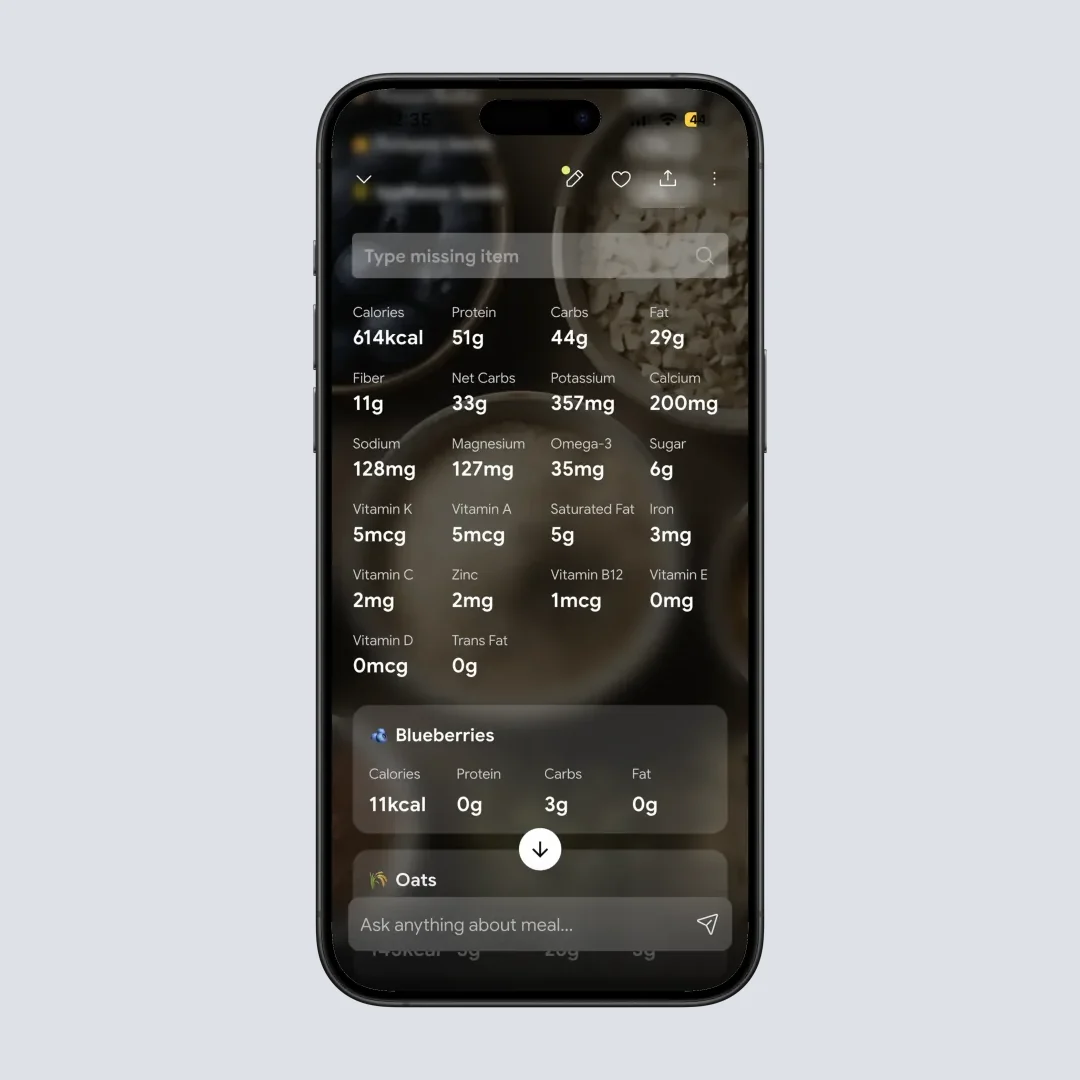
Nutrition Details for a logged meal. Sugar appears with the other nutrients for the portion you ate.
To keep the daily figure in view, open Customize Home and pin Sugar to Today's Count. You can pin up to 6 nutrients there. The free plan includes 5 scans a week. The meal scan guide walks through the camera, and the online calorie calculator gives you a daily calorie target to set the sugar figure against.
What else do people ask about sugar?
How many calories are in a teaspoon of sugar?
One teaspoon of granulated sugar weighs 4.2 g and has 16 calories, according to USDA FoodData Central. A tablespoon is three teaspoons, so 12.6 g and about 49 calories. A sugar cube of 2.3 g has about 9 calories. All of it is carbohydrate. Sugar has no protein and no fat.
How many calories are in 100 g of sugar?
100 g of granulated sugar has 387 calories in USDA FoodData Central, which is 3.87 calories per gram. Brown sugar has 380 calories per 100 g and powdered sugar has 389. Nutrition labels round carbohydrate to 4 calories per gram, which is why the FDA equates 50 g of added sugars with 200 calories.
What is the difference between total sugars and added sugars?
Total sugars on a US Nutrition Facts label count every sugar in the product, including the sugar naturally present in milk and fruit. Added sugars are the part put in during processing, plus table sugar, syrups, honey and sugars from concentrated fruit or vegetable juices. The FDA sets a Daily Value for added sugars only.
How much added sugar a day is too much?
It depends on which body you ask. The FDA Daily Value is 50 g a day on a 2,000 calorie diet. The American Heart Association advises no more than 36 g a day for men and 25 g for women. The WHO recommends keeping free sugars under 10% of energy intake, and says under 5%, roughly 25 g, would bring additional benefits. Individual targets come from your clinician.
How much sugar is in a can of Sprite?
A 12 fl oz (355 ml) can of Sprite has 38 g of sugar and 140 calories on the NutriScan Sprite page, and all of it is added sugar. At 4.2 g per teaspoon that is about 9 teaspoons, or 76% of the FDA Daily Value of 50 g.
Does the sugar in fruit count as added sugar?
No. The FDA says added sugars do not include naturally occurring sugars found in milk, fruits and vegetables, and the WHO guideline on free sugars does not cover the sugars in fresh fruit either. Fruit juice is treated differently: the WHO counts the sugars naturally present in fruit juices and juice concentrates as free sugars.