Protein Per 100 g vs Per Serving: Dry, Raw and Cooked
 ChatGPT
 Claude
 AI Mode
 Perplexity
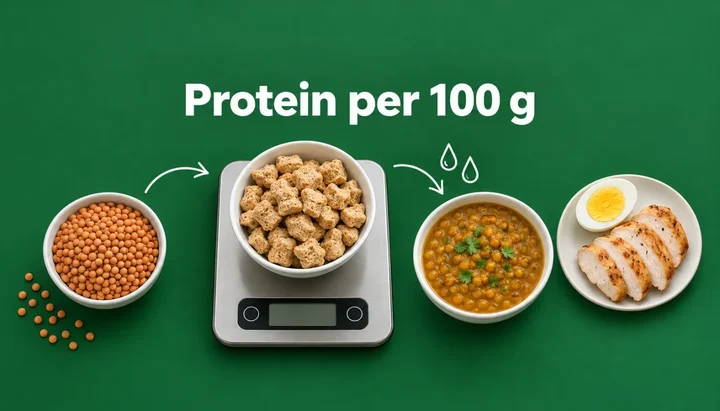
Protein per 100 g is the grams of protein in 100 grams of a food, in whatever state the label or database describes: dry, raw or cooked. Protein per serving is the same figure scaled to a portion. The two disagree most when water enters or leaves the food, which is why dry soya chunks read 52 g and cooked dal reads 9 g.
Numbers checked on October 11, 2026. Dry, raw and cooked pairs come from USDA FoodData Central, with the FDC id linked in each row. Per-serving figures in the food table come from the linked NutriScan food page. Daily intake figures come from the sources named beside them.
Summary
- Per 100 g describes the food, per serving describes your portion. Protein in your portion = protein per 100 g x grams eaten / 100.
- Water moves the per 100 g number. USDA lists raw lentils at 24.6 g of protein per 100 g and boiled lentils at 9.0 g. Raw chicken breast is 22.5 g and roasted is 31.0 g.
- Weigh and look up in the same state. Dry weight goes with a dry entry, cooked weight with a cooked entry.
- 150 g of paneer is about 28 g of protein, and 50 g of dry soya chunks is 26 g. Both follow from the formula and the linked food pages.
- The adult minimum is 0.8 g per kg of body weight per day, a National Academy of Medicine figure reported by Harvard's Nutrition Source. That is 56 g at 70 kg.
What does protein per 100 g mean?
Protein per 100 g is a concentration. A food with 18 g of protein per 100 g is 18% protein by weight, whatever amount you eat. It lets you compare two foods on equal terms, which a per-serving figure cannot do when one serving is 28 g and another is 200 g.
Which figure you see depends on where the pack was sold. The European Commission's nutrition labelling rules say the information "must be expressed per 100g or per 100ml" and may also be given per portion. US Nutrition Facts panels are built around the serving, and the FDA sets the Daily Value for protein at 50 g.

How do you convert protein per 100 g to your portion?
Protein in your portion = protein per 100 g x grams you eat / 100
Two examples from our food pages:
- Paneer has 18.9 g of protein per 100 g. For 150 g: 18.9 x 150 / 100 = 28.35, so about 28 g.
- Soya chunks have 52 g per 100 g dry. For 50 g dry: 52 x 50 / 100 = 26 g.
To go the other way, divide the protein in a serving by the serving weight and multiply by 100. One medium besan chilla weighs 60 g and carries 8.5 g, which is 14 g per 100 g.
Why does the same food have different protein dry, raw and cooked?
The protein stays in the food. The water around it changes. Dry pulses and grains absorb water when boiled, so each 100 g of the cooked food holds less protein. Meat loses water in the pan, so each 100 g of cooked meat holds more. USDA FoodData Central lists both states for many foods:
| Food | State | Protein per 100 g | Water per 100 g | USDA record |
|---|---|---|---|---|
| Lentils | Raw (dry) | 24.6 g | 8.3 g | FDC 172420 |
| Lentils | Boiled | 9.0 g | 69.6 g | FDC 172421 |
| Chickpeas | Raw (dry) | 20.5 g | 7.7 g | FDC 173756 |
| Chickpeas | Boiled | 8.9 g | 60.2 g | FDC 173757 |
| Mung beans | Raw (dry) | 23.9 g | 9.1 g | FDC 174256 |
| Mung beans | Boiled | 7.0 g | 72.7 g | FDC 174257 |
| White rice, long grain | Raw (dry) | 7.1 g | 11.6 g | FDC 169756 |
| White rice, long grain | Cooked | 2.7 g | 68.4 g | FDC 169757 |
| Chicken breast, skinless | Raw | 22.5 g | 73.9 g | FDC 171077 |
| Chicken breast, meat only | Roasted | 31.0 g | 65.3 g | FDC 171477 |
| Egg, whole | Raw | 12.6 g | 76.2 g | FDC 171287 |
| Egg, whole | Hard-boiled | 12.6 g | 74.6 g | FDC 173424 |
Source: USDA FoodData Central, SR Legacy records, values rounded to one decimal.
Boiled lentils are about 70% water and dry lentils about 8%, and the protein figure falls in step. An egg boiled in its shell keeps nearly all its water, so its number barely moves.
Mixing the two states is the most common logging mistake. Our chicken breast page lists a 6 oz cooked breast (170 g) at 54 g of protein. Enter the same 170 g against a raw entry at 22.5 g per 100 g and you record 38 g, which is 16 g short for one piece of chicken.
Soya chunks run the other way. The 52 g figure is for dry chunks, and the soya chunks page notes that they soak up roughly three times their weight in water, so 25 g dry becomes about 100 g on the plate with 13 g of protein. Weigh the chunks before soaking.
How much protein do common foods have per serving and per 100 g?
These are the foods people search for most alongside the word protein. Every figure is from the linked NutriScan food page unless the note under the table says otherwise.
| Food | Serving | Protein per serving | Protein per 100 g |
|---|---|---|---|
| Boiled egg | 1 large (50 g) | 6.3 g | 12.6 g |
| Chicken breast, cooked, skinless | 3 oz (85 g) | 26 g | 31 g |
| Tuna, cooked | 100 g | 29 g | 29 g |
| Tinned sardines in oil, drained | 1 can (92 g) | 22.7 g | 25 g |
| Greek yogurt, plain, nonfat | 170 g container | 17 to 18 g | 10.2 g |
| Mozzarella | 1 oz slice (30 g) | 8.4 g | 28 g |
| Hummus | 2 tablespoons (28 g) | 2.2 g | 7.9 g |
| High-protein popcorn | 1 serving (28 g) | 10 g | 36 g |
| Tofu | 100 g | 8.1 g | 8.1 g |
| Seitan, prepared | 100 g | 21 g | 21 g |
| Spirulina powder | 1 teaspoon (3 g) | 2 g | 57 g |
| Soya chunks, dry | 50 g dry (about 150 g cooked) | 26 g | 52 g dry |
| Paneer | 150 g | 28 g | 18.9 g |
| Mutton (goat), roasted | 100 g | 27.1 g | 27.1 g |
| Dal, cooked | 1 bowl (200 g) | 18 g | 9 g |
| Moong dal, cooked | 1 cup (200 g) | 14 g | 7 g |
| Toor dal, cooked | 1 cup (150 g) | 11.4 g | 7.6 g |
| Chickpeas, cooked | 1 cup (164 g) | 15 g | 8.9 g |
| Besan chilla | 1 medium (60 g) | 8.5 g | 14 g |
| Chapati | 1 medium (40 g) | 3.2 g | 7.9 g |
Paneer per serving and popcorn per 100 g are our arithmetic from the page figures. Chickpeas per 100 g is the USDA value (FDC 173757). Tofu varies with firmness: USDA lists a firm, calcium-set tofu at 17.3 g per 100 g (FDC 172475), so check the label on your block. The mutton row is USDA's roasted goat (FDC 175304), the meat most people in India mean by mutton. Where our nutrition numbers come from is on the NutriScan data sources page.
Spirulina has the highest figure per 100 g in the table and the lowest per serving, because a serving is a 3 g teaspoon. Dal looks modest at 9 g per 100 g, yet a 200 g bowl gives 18 g.
How much protein do you need in a day?
For adults, the National Academy of Medicine recommends a minimum of 0.8 g of protein per kilogram of body weight per day, as reported by Harvard's Nutrition Source. That is 56 g a day at 70 kg and 64 g at 80 kg.
People who train usually aim higher. The International Society of Sports Nutrition position stand (Jäger and colleagues, 2017) states that 1.4 to 2.0 g per kg per day "is sufficient for most exercising individuals".
At 70 kg that range is 98 to 140 g a day.
Our longer guide on how much protein you need per day covers muscle gain, weight loss and older adults, and the protein intake calculator works out a number for your weight.
A note on health
This article is general information. If you have kidney disease, are pregnant or manage another medical condition, your protein target comes from your doctor or dietitian.

How do you turn a protein target into food?
Take the 70 kg adult with a 56 g minimum and read down the per-serving column of the food table.
- With meat and dairy: 2 boiled eggs (12.6 g), a 170 g tub of nonfat Greek yogurt (17 g) and 3 oz of cooked chicken breast (26 g) come to about 56 g.
- Vegetarian: 150 g of paneer (28 g), a 200 g bowl of dal (18 g), 2 chapatis (6.4 g) and 1 besan chilla (8.5 g) come to about 61 g.
For more plates built this way, see our cheap high-protein meals.
How do you log the right weight in NutriScan?
Every item in a logged meal has a portion pill such as "100g" or "2 piece". Tap it to open the portion sheet, where you can type the quantity, switch the unit or edit the grams per unit, and the nutrients update as you change it. If the scan read your dal as 100 g and your bowl holds 200 g, this is where you correct it.
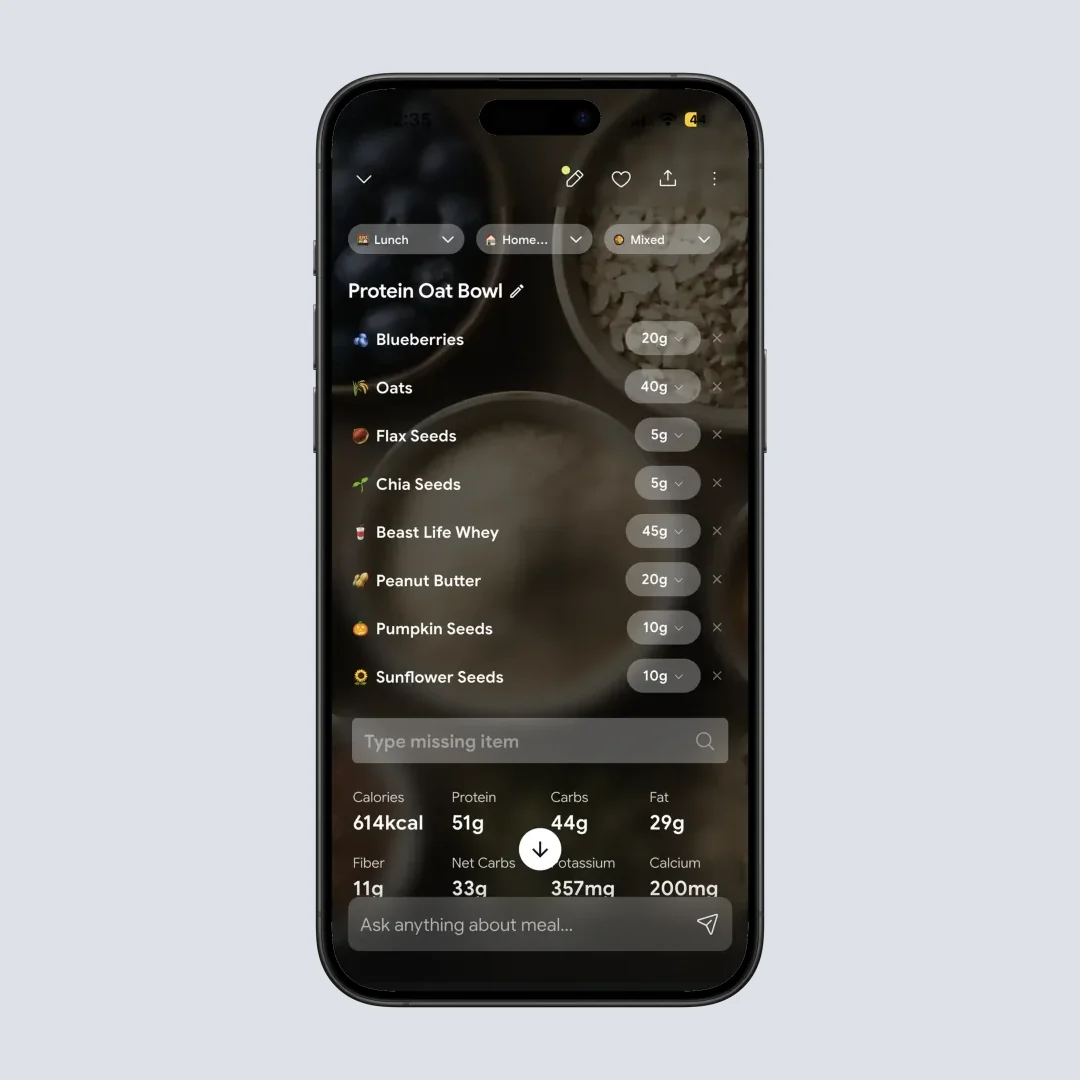
Nutrition Details for a logged meal. The portion pill on each item sets the grams the protein figure is calculated from.
For packaged food, switch the camera to Label and photograph the nutrition panel. The app then asks for the consumed quantity as Full Pack, Grams/ml or By Serving, so a per 100 g label and a per-serving label both end up as the amount you ate. The free plan includes 5 scans a week. Our roundup of the best apps for tracking protein compares other options.
What else do people ask about protein per 100 g?
Is protein per 100 g measured raw or cooked?
It depends on the entry, so read the description. USDA FoodData Central lists raw lentils at 24.6 g of protein per 100 g and boiled lentils at 9.0 g, because boiled lentils are about 70% water. Raw skinless chicken breast is 22.5 g per 100 g and roasted breast is 31.0 g, because water cooks out. Match the entry to the state in which you weighed the food.
How much protein is in 50 g of soya chunks?
50 g of dry soya chunks has 26 g of protein, based on 52 g per 100 g dry on the NutriScan soya chunks page. The chunks soak up roughly three times their weight in water, so 50 g of cooked chunks holds far less. The same page puts 25 g dry, which is about 100 g cooked, at 13 g of protein.
How much protein is in 150 g of paneer?
About 28 g. The NutriScan paneer page lists 18.9 g of protein per 100 g, and 18.9 x 150 / 100 = 28.35, so about 28 g. Paneer is sold and eaten ready to use, so there is no dry or cooked conversion to make.
How much protein do I need per day?
The National Academy of Medicine recommends a minimum of 0.8 g of protein per kilogram of body weight per day for adults, as reported by Harvard's Nutrition Source. That is 56 g at 70 kg. The International Society of Sports Nutrition position stand puts most exercising people at 1.4 to 2.0 g per kilogram. If you have kidney disease or another condition, your target comes from your clinician.