Cheap High Protein Meals for One, Two, or a Family
 ChatGPT
  Claude
  AI Mode
  Perplexity
TL;DR - Cheap high protein meals
• The number: about 1.62 g per kg per day is where extra supplementing stopped adding fat-free mass across 49 trials.
• The anchors: eggs, dairy, dried legumes, soya chunks, tofu, canned fish, whole chicken cut at home.
• The method: set your daily grams ➡️ pick four anchors by cost per 10 g ➡️ write seven dinners ➡️ batch and freeze.
• The trap: bars and ready meals price the same grams at three to ten times the cost of eggs.
• The finding: one cheap plant source matched whey for muscle and strength in a 12-week trial.
The number to anchor on is 1.62 g of protein per kilogram of body weight per day, the intake past which supplementing further produced no additional fat-free mass across 49 randomized trials and 1,863 participants (Morton et al., 2018). NutriScan publishes this post and makes a calorie tracking app.
That ceiling is good news for anyone shopping on a budget. Protein has a stopping point, and a 70 kg person who hits roughly 113 g a day has covered the evidence-backed range for building muscle. The expensive part of most people's protein bill is the packaging: bars, ready meals, flavored shakes, and chicken cut by someone else.
Short verdict: eggs, milk, plain yogurt, dried lentils and beans, soya chunks, tofu, canned fish, and whole chicken cut at home carry almost every cheap high protein meal worth making.
IMPORTANT
Your budget protein plan at a glance.
Four steps, in the order they work.
⏱️ Progress 0/4 • ~0 minutes in • Keep going
⏳ Step 1: Set the daily gram target from your body weight
⏳ Step 2: Pick four protein anchors by cost per 10 g
⏳ Step 3: Build seven dinners that reuse the same four anchors
🔍 The cheap protein that matched whey in a 12-week trial (revealed near the end)
Four Real Grocery Runs, Costed Out 🧾
Prices differ too much between countries to quote, but the structure of the basket travels. Four worked examples.
One person. Take a 68 kg office worker who lifts three times a week and needs about 110 g a day. His week runs on 18 eggs, a 1 kg bag of dried red lentils, 2 kg of bone-in chicken thighs, a 1 kg tub of plain yogurt, and rice. Cooking for one wastes fresh food, so buy dried and cook two portions at a time.
Two people. Take a couple at 62 kg and 78 kg, needing about 100 g and 125 g. Same basket scaled, plus tofu or paneer for meat-free nights. Two people can justify a whole chicken, the largest protein-per-money jump in most countries: roast it Sunday, strip the carcass Monday, boil the bones for stock.
A student on a shared stove. Take a 22 year old with one fridge shelf and no freezer. Her basket is oats, milk powder, eggs, canned tuna, dried chana, and peanut butter. Oats carry 16.9 g of protein per 100 g dry (oats nutrition), and tuna at 29 g per 100 g needs no cooking at all (tuna nutrition).
A family of four. Two adults and two school-age children need roughly 300 g a day between them: a 500 g bag of dried beans, a dozen eggs, 2 litres of milk, 1.5 kg of chicken or mince, and paneer or tofu, weekly. A pot of dal for eight costs barely more in fuel than a pot for two.

Every one of those baskets starts the same way: one board, one knife, and food you cut yourself.
How Much Protein You Actually Need 🎯
The International Society of Sports Nutrition places the daily range for exercising people at 1.4 to 2.0 g per kg of body weight, with roughly 0.25 g per kg per serving, or 20 to 40 g absolute (Jäger et al., 2017). In a calorie deficit the same position stand notes that 2.3 to 3.1 g per kg may help trained people hold lean mass, and Morton's meta-regression puts the supplementation ceiling near 1.62 g per kg (Morton et al., 2018).
For people over 65, the PROT-AGE group recommends at least 1.0 to 1.2 g per kg per day, 1.2 g per kg for those who exercise, and 1.2 to 1.5 g per kg with illness, with an exception for severe kidney disease (Bauer et al., 2013).
| Body weight | 1.2 g/kg (general, active) | 1.6 g/kg (muscle gain) | 2.0 g/kg (upper band) |
|---|---|---|---|
| 50 kg | 60 g | 80 g | 100 g |
| 60 kg | 72 g | 96 g | 120 g |
| 70 kg | 84 g | 112 g | 140 g |
| 80 kg | 96 g | 128 g | 160 g |
| 90 kg | 108 g | 144 g | 180 g |
| 100 kg | 120 g | 160 g | 200 g |
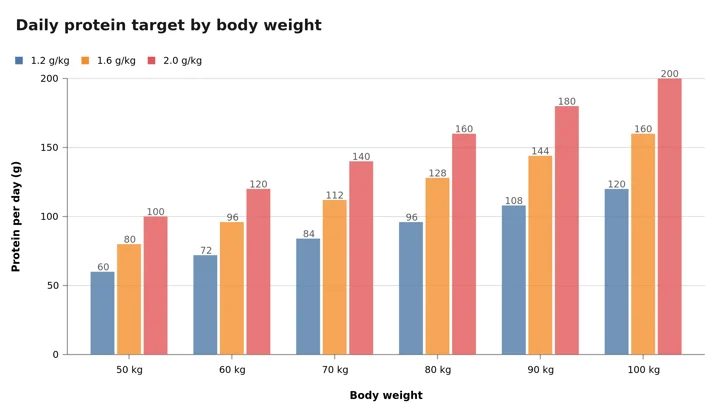
Figure 1: the gap between the general band and the muscle gain band is about four eggs a day at every weight.
Nothing in that table changes by sex: a 60 kg woman training for muscle gain needs about 96 g, and so does a 60 kg man. For the arithmetic, the protein intake calculator takes weight, activity, and goal, and the macro calculator splits the rest of the day.
IMPORTANT
Checkpoint: here's where you are right now.
Quick status update so you always know the next best move.
⏱️ Progress 1/4 • ~1 minute in • Keep going
✅ Step 1: Daily gram target set (done)
👉 Step 2: Pick four anchors by cost per 10 g (you're here)
⏳ Step 3: Seven dinners that reuse them
🧩 The cheap protein that matched whey (coming soon)

The Cheapest High Protein Foods, Ranked by Serving 🥫
Every row links to its nutrition page. Read it as a shopping shortlist: check the price on your own shelf, divide by the protein grams, keep the four best.
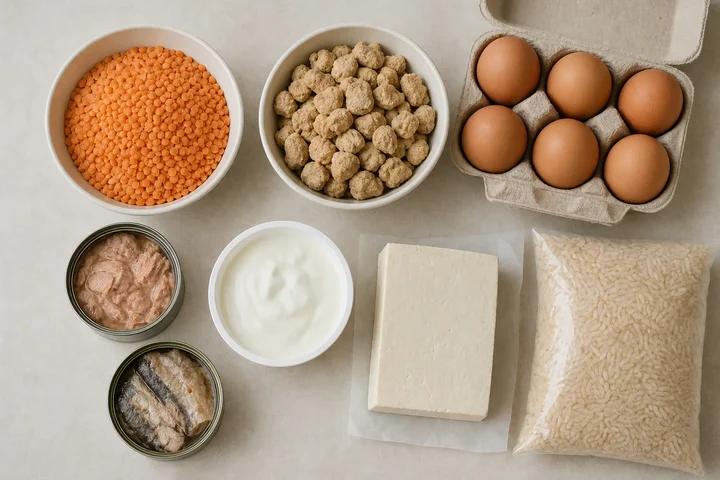
One week of anchors for a single shopper, before anything is cooked.
| Food | Protein | Calories | Where it wins |
|---|---|---|---|
| Soya chunks, dry | 52 g per 100 g | 345 | Most protein per unit weight, anywhere |
| Chicken breast, cooked | 31 g per 100 g | 165 | Leanest animal protein |
| Tuna, canned | 29 g per 100 g | 132 | No cooking, no fridge |
| Whey protein | 24 g per scoop | 120 | Cheapest gap filler per gram |
| Paneer | 18 g per 100 g | 296 | Vegetarian, holds shape in curry |
| Oats, dry | 16.9 g per 100 g | 389 | Protein hidden in a staple |
| Cottage cheese | 11 g per 100 g | 98 | Slow casein, low calorie cost |
| Greek yogurt, nonfat | 10.2 g per 100 g | 59 | Best ratio in the dairy aisle |
| Lentils, cooked | 9 g per 100 g | 116 per half cup | Cheapest cooked protein |
| Tofu, firm | 8 g per 100 g | 80 | Dairy free, takes any sauce |
| Black beans, canned | 7.8 g per serving | 118 | Fiber and protein, zero prep |
| Moong dal, cooked | 7 g per 100 g | 120 | Fastest dal to cook |
| Eggs | 6 g each | 70 | Cheapest complete protein |
| Peanut butter | Fat source | 188 per 2 tbsp | Calories, not a protein anchor |
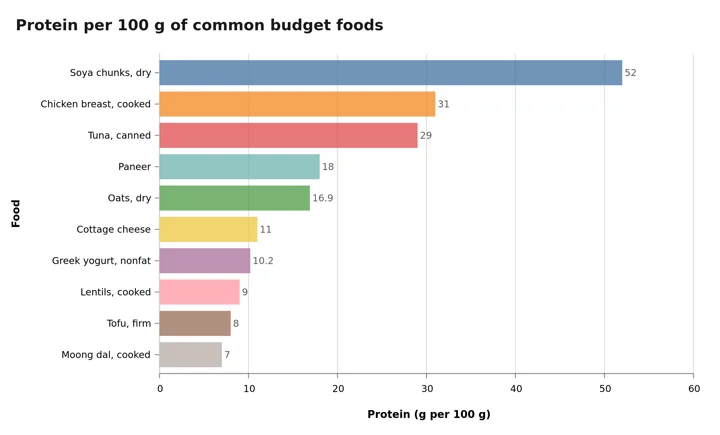
Figure 2: dry soya chunks carry 52 g per 100 g, about seven times cooked moong dal.
The bar chart flatters dry foods. Soya chunks and oats are weighed dry and swell three to four times in the pan, while chicken and tuna are weighed as you eat them.
Two rows that mislead on a shelf
Peanut butter is 76 percent fat and belongs in the calorie column, and white rice at 130 calories per 100 g cooked feeds the meal, not the protein target. Anyone on a protein restriction for kidney disease should get their own number from a clinician first.
UK shoppers know the basket under other names: mince rather than ground beef, tinned tuna, and cottage cheese, now the cheapest protein in the chiller.
Seven Rules That Keep the Cost Down 💡
- Price protein, not food. Divide the pack price by the grams of protein inside. Chicken breast and dried lentils often land within a few cents of each other per 10 g, and both undercut every bar on the shelf.
- Buy the whole animal, not the cut. A whole chicken costs less per kilogram than breast and still contains the breast, plus thighs, wings, and bones.
- Buy dried, not canned, when you have time. Canned lentils and beans earn their premium only on 10-minute nights.
- Let dairy do the work. Plain yogurt, milk, and cottage cheese need no cooking and go into breakfast, snacks, and sauces. Flavored versions cost more.
- Anchor every meal before you plan it. Choose the protein first and let the carbohydrate and vegetable follow. Meals planned the other way end up 20 g short.
- Cook once, eat four times. Fuel, washing up, and your own patience are real costs.
- Skip the protein tax aisle. Bars, protein cookies, protein water, and ready meals price the same grams at three to ten times the cost of eggs.
Build a Week of Cheap High Protein Meals in Six Steps 🗓️
- Set the number. Body weight in kilograms times 1.2 for general health, or 1.6 for muscle gain.
- Divide it into four hits. The per-serving guidance of 20 to 40 g means a 112 g target is four meals of roughly 28 g, not one enormous dinner (Jäger et al., 2017).
- Pick four anchors. One dairy, one legume, one meat or fish, one egg or soy. Few enough to buy in bulk.
- Write seven dinners that reuse them. Chicken and rice, chicken curry, dal and rice, chili, tofu stir fry, tuna pasta, omelette and beans.
- Batch on one day. Cook the legume base, the rice, and the protein four portions at a time, and fill the containers before you eat any of it.
- Check one real week. Log a normal week, not a good one. Most people who think they are at 120 g land near 80 g, and the gap is breakfast and snacks.
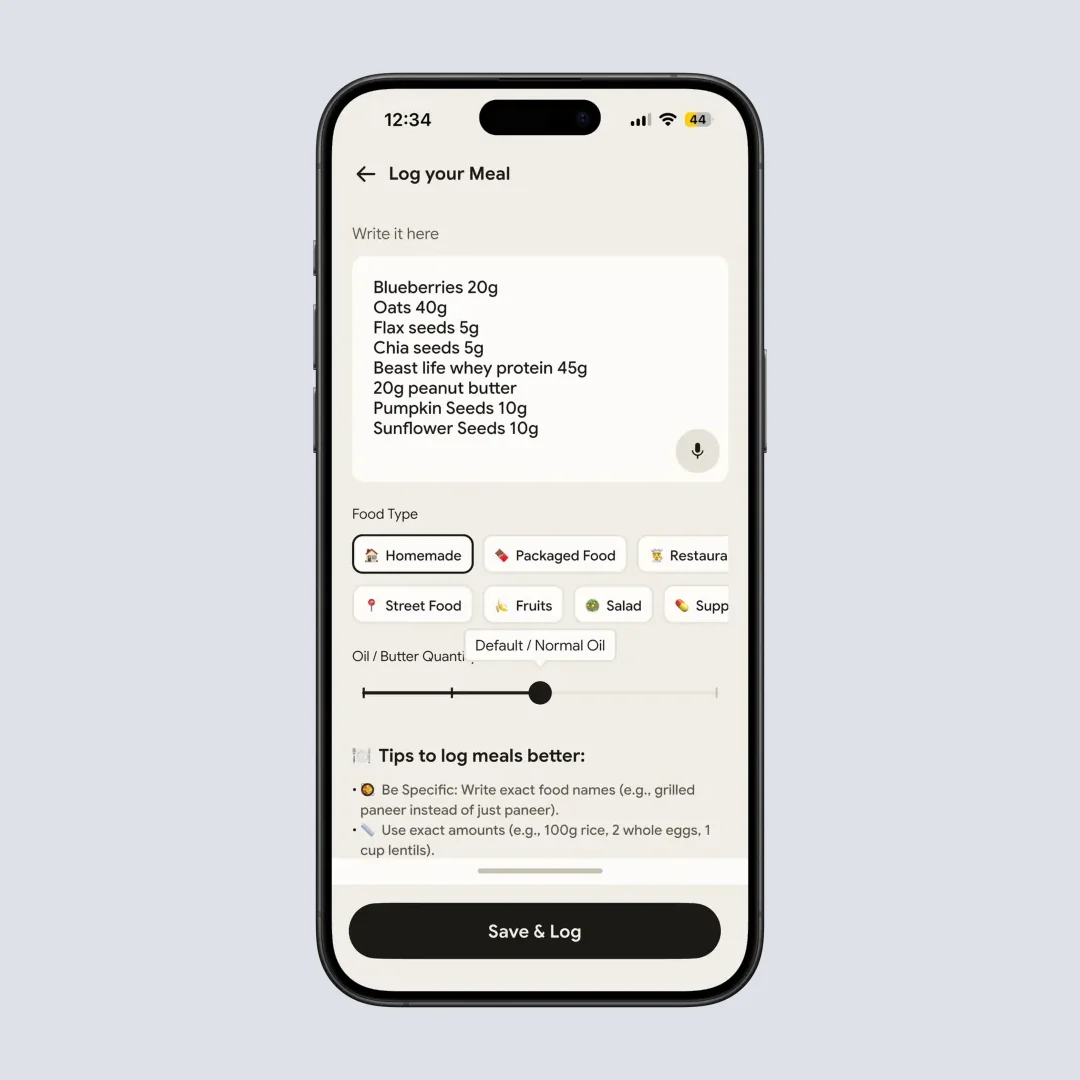
Typing a meal in plain words is the fastest way to check step 6. In-app path: Home > Pencil Icon > Write About Meal.
Weigh the dry things once
Weigh your rice, oats, lentils and soya chunks dry, once, and note what a normal serving actually is. A guessed portion is the most common way to end up 30 g short.
Cheap High Protein Dinners: Rice, Mince, Chicken, and Pasta 🍽️
With rice. Cooked rice carries near-zero protein, so the bowl is only as good as what sits on top: 150 g of chicken breast for around 46 g, a cup of cooked lentils for around 18 g, two eggs for 12 g, or 100 g of paneer for 18 g. The cheapest version is dal and rice, a complete amino acid profile for the price of two dry ingredients.
With ground beef or mince. Buy the leanest you can afford, brown it, drain the fat, and stretch it with lentils or beans in a chili or bolognese. Half mince and half lentils by weight cuts the cost of the pot by close to half and nobody notices.
With chicken. Breast at 31 g per 100 g cooked is the leanest common option, and thighs cost less for a few extra grams of fat. Poach a batch, shred it, freeze it flat, and it goes into wraps, fried rice, salads, and soups all week.
With pasta or no meat. Pasta needs a real protein sauce of tuna, mince, or lentil bolognese. On meat-free nights, a tofu stir fry, bean chili, chana masala, or paneer bhurji all land at 25 to 35 g per portion.
IMPORTANT
Checkpoint: midway progress update.
You're halfway, and the decisions get easier from here.
⏱️ Progress 2/4 • ~2 minutes in • Keep going
✅ Step 1: Daily gram target set (done)
✅ Step 2: Four anchors chosen (done)
👉 Step 3: Seven dinners written (current)
⏳ The cheap protein that matched whey (next)
Indian and Vegetarian High Protein Meals on a Budget 🌱
India is the hardest test case for cheap protein and also the one with the best answer, because soya chunks at 52 g of protein per 100 g dry cost less per gram of protein than almost anything else. In Hindi the shopping list is short: soya badi, dal, paneer, dahi, ande, bhuna chana.
A workable vegetarian day: besan chilla or paneer bhurji with two rotis for breakfast, around 22 g. Dal, rice, and curd for lunch, 25 g. Roasted chana or milk in the evening, 10 g. A soya chunk curry with roti for dinner, near 30 g, because 50 g of dry chunks carry 26 g. Roughly 87 g with no supplement.
The Indian lunch and dinner that work for weight loss keep the protein and drop the oil: a light tarka, tandoori chicken instead of butter chicken, paneer grilled rather than fried, curd instead of cream-loaded raita. For muscle gain, keep the yogurt marinade, grill rather than deep fry, and use leg pieces if breast is priced out of reach. For Indian portion sizes, see the 25 best low calorie high protein foods in India.
Freezer Batches, Small Appetites, and Free-From Swaps ❄️
Freezer meals. Wet, stew-like food reheats without losing anything: dal, rajma, chili, bolognese, curries, soups, cooked lentils and beans, shredded chicken. Freeze flat in bags and label the date. What does not freeze: yogurt, cottage cheese, boiled eggs, salad vegetables.
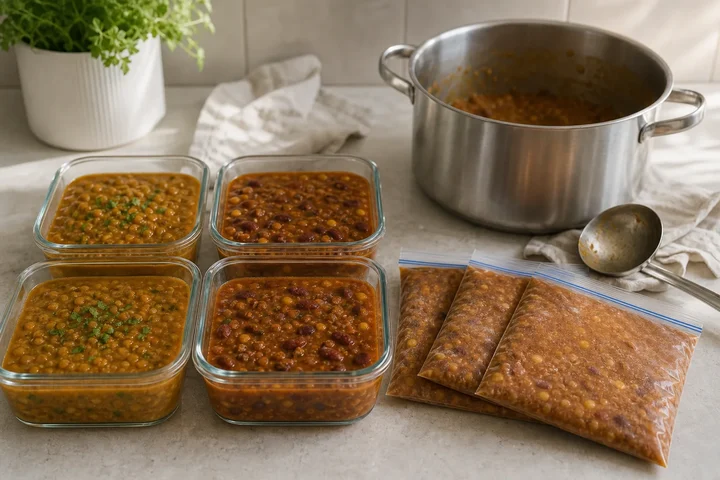
One pot, seven portions, about 20 minutes of work.

The pot does not care whether it holds two portions or eight, which is the whole argument for batching.
Small or low appetite. The fix is density, not volume. Stir milk powder into porridge, use Greek yogurt in place of milk, add an egg to rice, and drink calories between meals. Four 20 to 30 g hits beat two large plates.
Dairy free, lactose free, and gluten free. Tofu, tempeh, soya chunks, lentils, beans, eggs, fish, and meat cover the target with no dairy, and soy or pea isolates give a comparable dose per scoop. Almost every food in the table above is naturally gluten free; the gluten sits in bread, wheat pasta, roti, and seitan.
Low calorie, low carb, and snacks. For weight loss, nonfat Greek yogurt at 59 calories per 100 g, cottage cheese at 98, chicken breast at 165, and canned tuna at 132 are the best protein-to-calorie ratios on a normal shelf. Roasted chana, boiled eggs, and tuna on cucumber all clear 10 g a serving for pocket change (more snacks here).
IMPORTANT
Checkpoint: final stretch before the reveal.
One last nudge, the reveal is next.
⏱️ Progress 3/4 • ~3 minutes in • Keep going
✅ Step 1: Daily gram target set
✅ Step 2: Four anchors chosen
✅ Step 3: Seven dinners written and batched
✨ The cheap protein that matched whey (about to reveal)

The Cheap Protein That Matched Whey Gram for Gram 🔬
It was soy, eaten by people who never touched whey. Nineteen habitual vegans and nineteen omnivores trained twice weekly for 12 weeks, both matched to 1.6 g per kg per day, soy isolate for the vegans and whey for the omnivores. Both gained 1.2 kg of leg lean mass, with no difference in muscle fiber cross-sectional area or leg-press strength (Hevia-Larraín et al., 2021).
That is the finding that pays for this shopping list. Soya chunks top the table at 52 g per 100 g dry and cost a fraction of a tub of whey per gram delivered. Dal, tofu, and beans do the same job when the daily total is met.
More protein stops helping at a defined point. Morton's meta-analysis of 49 randomized controlled trials with 1,863 participants found supplementation raised one-repetition-maximum strength by 2.49 kg and fat-free mass by 0.30 kg on average, and that supplementing beyond 1.62 g per kg per day produced no further fat-free mass gains (Morton et al., 2018).
The effect is real but modest. A meta-analysis of 74 randomized trials found a standardized mean difference of 0.22 for lean body mass in people doing resistance exercise (Nunes et al., 2022). Protein does not replace the training.
On fat loss, a review of higher-protein diets concluded that their body weight benefits come in part from changes in energy metabolism, appetite, and energy intake (Leidy et al., 2015). Protein is what makes a calorie deficit tolerable, which is why the same foods appear on muscle gain and fat loss lists.
Protein Powder on a Budget: What It Does and Does Not Do 🥤
Powder is a gap filler, and the trial above is the clearest evidence that source matters far less than total (Hevia-Larraín et al., 2021).
Buy on price per gram of protein, not on branding. A 30 g scoop of whey concentrate typically delivers 22 to 25 g of protein, not 30. That also answers the tub question: 1000 g divided by a 30 g scoop is about 33 servings, a month at one a day.
The labels map cleanly onto ingredients. Dairy free and lactose free point to soy or pea isolate, or to whey isolate if lactose rather than dairy is the issue. Gluten free is the default for plain unflavored powders; the risk sits in added oats, malt, or flavor blends, which also cost more. To compare tracking tools, the best apps for tracking protein covers what to look for.
Start With One Week, Not One Diet 🚀
Cheap high protein eating is a purchasing habit, not a recipe problem: buy the same four anchors weekly, cook bigger batches than feel sensible, and stop paying for grams that arrive in a wrapper. Most people are 30 g short without knowing, which is why tracking helps for a fortnight even if you never track again. NutriScan is free to start with five photo scans a week, and Premium removes the limit for about $59 a year. Point it at one normal week, find where your 30 g is going missing, and fix that one meal.
For a full week with the numbers worked out, the 1,500 calorie meal plan for a week gives calories and protein for every meal using these same cheap staples.
IMPORTANT
Recap: everything you covered in this guide.
Save this for your next grocery run.
⏱️ Progress 4/4 • ~4 minutes in • Nicely done
✅ Step 1: Target 1.2 to 1.6 g per kg per day; about 1.62 is where supplementing stops paying
✅ Step 2: Anchors are eggs, dairy, dried legumes, soya chunks, tofu, canned fish, whole chicken
✅ Step 3: Seven dinners reusing four anchors, half of them batched and frozen
✅ The cheap protein that matched whey: soy, at 1.6 g per kg per day (revealed)
Frequently Asked Questions ❓
How much protein do I need for muscle gain?
The ISSN puts the range at 1.4 to 2.0 g per kg of body weight per day for exercising people (Jäger et al., 2017), and supplementing past about 1.62 g per kg added no further fat-free mass (Morton et al., 2018). For a 70 kg person, roughly 98 to 140 g a day.
What are the cheapest high protein vegetarian foods in India?
Soya chunks lead at 52 g of protein per 100 g dry, then dals such as moong, masoor, and chana, paneer at 18 g per 100 g, curd, milk, eggs, and roasted chana. In Hindi: soya badi, dal, paneer, dahi, bhuna chana.
Do I need protein powder to gain muscle?
No. In a 12-week trial, vegans and omnivores both matched to 1.6 g per kg per day gained the same leg lean mass and strength whichever source they used (Hevia-Larraín et al., 2021). If food gets you to your total, powder adds nothing.
Can I get a high protein meal plan for free?
Yes. A free plan is a target number plus a repeating grocery list. Set your daily grams with the protein intake calculator, pick four anchors, write seven dinners that reuse them, and log a normal week. Most free tracking apps will hold the diary for you. For a full week with calories and protein per meal, see the high protein meal plan at 120 to 150 g.
What is the highest protein meal at a restaurant like Applebee's?
Grilled steak, grilled chicken, and salmon entrees usually top the protein column, often 40 to 60 g before sides, while breaded versions carry far more calories for the same grams. Check the chain's published nutrition PDF.