How Much Fiber Do You Need a Day? Fiber in 20 Foods
 ChatGPT
 Claude
 AI Mode
 Perplexity
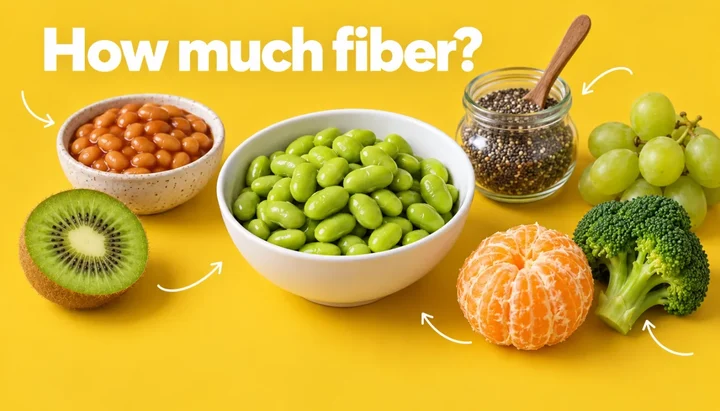
Most adults are told to aim for about 28 g of fiber a day. That is the FDA Daily Value printed on US food labels, and it matches the Dietary Guidelines for Americans, 2020-2025 goal of 14 g per 1,000 calories at a 2,000 calorie diet. One cup of edamame covers 29% of it. A cup of green grapes covers 3%.
Sources checked on October 11, 2026: the FDA Daily Value page, the Dietary Guidelines for Americans 2020-2025 and 2025-2030, two MedlinePlus articles, and the maker pages for Floura, Olipop and Fiber One. Fiber per serving comes from the linked NutriScan food page unless the row says otherwise. The share of 28 g is our own arithmetic.
Summary
- Daily target: the FDA Daily Value for dietary fiber is 28 g, set for a 2,000 calorie diet.
- Scaled to your calories: the Dietary Guidelines for Americans, 2020-2025 use 14 g per 1,000 calories, which gives 22 g for women over 50 and 34 g for men aged 19 to 30.
- Most people fall short: the same guidelines report that more than 90 percent of women and 97 percent of men do not meet the recommended intake.
- Two types: soluble fiber forms a gel and slows digestion. Insoluble fiber adds bulk to the stool. Plant foods carry both.
- Reading a label: the FDA calls 5% of the Daily Value or less per serving low and 20% or more high. For fiber that is 1.4 g and 5.6 g.
How much fiber do you need a day?
The FDA sets the Daily Value for dietary fiber at 28 g, the figure behind the % Daily Value on every US Nutrition Facts label. The Dietary Guidelines for Americans, 2020-2025 scale it to energy intake at 14 g per 1,000 calories, so the goal for adults runs from 22 g to 34 g depending on age and sex.
The FDA Daily Value table is written for a 2,000 calorie diet, and 14 x 2 gives the same 28 g. The guidelines apply the 14 g rule to the calorie level of each age and sex group in their table of daily nutritional goals (Table A1-2, page 133):
| Group | Fiber goal per day |
|---|---|
| Women 19 to 30 | 28 g |
| Women 51 and older | 22 g |
| Men 19 to 30 | 34 g |
| Men 51 and older | 28 g |
Source: Dietary Guidelines for Americans, 2020-2025, Table A1-2.
The current edition, the Dietary Guidelines for Americans, 2025-2030, tells readers to "prioritize fiber-rich whole grains" and gives no gram target for fiber. The 28 g Daily Value on food labels has not changed.
On intake, the 2020-2025 guidelines state on page 101 that "more than 90 percent of women and 97 percent of men do not meet recommended intakes for dietary fiber." MedlinePlus, from the US National Library of Medicine, puts the average American intake at about 16 g a day.
Work out your own number
Multiply your daily calories by 14 and divide by 1,000. At 1,800 calories that is 25 g. At 2,500 calories it is 35 g.

What is the difference between soluble and insoluble fiber?
Soluble fiber attracts water and turns to gel during digestion, which slows digestion. Insoluble fiber adds bulk to the stool and appears to help food pass more quickly through the stomach and intestines. Both descriptions come from the MedlinePlus article on soluble vs. insoluble fiber, and most plant foods contain some of each.
The same article lists where each type is found. Soluble fiber is in oat bran, barley, nuts, seeds, beans, lentils, peas and some fruits and vegetables, and in psyllium supplements. Insoluble fiber is in wheat bran, vegetables and whole grains. MedlinePlus adds that research has shown soluble fiber helps lower cholesterol.
A Nutrition Facts label only has to show total dietary fiber. The 28 g Daily Value counts both types together, so you do not need to track them separately to hit the target.
How much fiber is in common foods?
Per serving, beans and seeds lead this list at 5 to 13 g, most whole fruit lands between 2 and 6 g, and mashed potato and grapes sit under 2 g. The table lists 20 foods from the fiber searches that reach our food pages, with fiber per serving and its share of the 28 g Daily Value.
| Food | Serving | Fiber | Share of 28 g |
|---|---|---|---|
| Butter beans | 1 cup cooked (188 g) | 13.2 g | 47% |
| Floura FiberCrush bar | 1 bar (45 g) | 13 g | 46% |
| Chickpeas | 1 cup cooked (164 g) | 12.2 g | 44% |
| Chia seeds | 2 tablespoons (28 g) | 9.8 g | 35% |
| Olipop prebiotic soda | 1 can (12 fl oz) | 9 g | 32% |
| Edamame | 1 cup shelled (155 g) | 8 g | 29% |
| Lentil soup | 1 cup (248 g) | 8 g | 29% |
| Fiber One brownie | 1 brownie (70 calorie) | 7 g | 25% |
| Sabja (basil) seeds | 1 tablespoon dry (13 g) | 7 g | 25% |
| Yellow dragon fruit | 1 medium (200 g flesh) | 6 g | 21% |
| Baked beans | 1 cup canned (250 g) | 5.2 g | 19% |
| Steamed broccoli | 1 cup (156 g) | 5.1 g | 18% |
| Tamal | 1 tamal (166 g) | 5 g | 18% |
| Potato chips | 100 g | 4.5 g | 16% |
| Apple | 1 medium (182 g) | 4.4 g | 16% |
| Orange | 1 medium (131 g) | 3.1 g | 11% |
| Whole wheat roti | 1 medium (40 g) | 2.4 g | 9% |
| Kiwi | 1 medium, peeled (69 g) | 2.1 g | 8% |
| Mashed potato | 100 g (1/2 cup) | 1.6 g | 6% |
| Green grapes | 100 g (about 1 cup) | 0.9 g | 3% |
Fiber and serving sizes are from the linked NutriScan food page on October 11, 2026, with three exceptions checked against the maker. Floura states 13 g per FiberCrush bar. Olipop states 6 to 9 g per 12 fl oz can depending on the product, and the row uses 9 g. The Fiber One label for the 70 calorie Chocolate Fudge brownie lists 7 g. Where our nutrition numbers come from is on the NutriScan data sources page.
Serving size decides the order. Potato chips show 4.5 g, but that is for 100 g, which is more than three single-serve 28 g bags. Sabja seeds show 7 g from one tablespoon. Compare foods at the amount you would eat.
How much fiber is in edamame?
One cup of shelled, cooked edamame (155 g) has 8 g of fiber on our edamame page, which is about 5 g per 100 g. That cup is 29% of the 28 g Daily Value, so it clears the FDA's 20% line for a high amount per serving.
The figure is for shelled beans. If you buy edamame in the pod, the pods are not eaten, so weigh or measure the beans after shelling. Other beans in the table run higher per cup: chickpeas at 12.2 g and butter beans at 13.2 g.
Do grapes, kiwi and mashed potatoes have fiber?
Yes, in small amounts. Per 100 g, green grapes have 0.9 g and mashed potato has 1.6 g. One peeled medium kiwi of 69 g has 2.1 g. Those are 3%, 6% and 8% of the Daily Value.
Grapes and mashed potato fall at or near the FDA's 5% line for a low amount per serving. Fruit with more flesh and seeds per bite does better: a medium orange has 3.1 g, a medium apple has 4.4 g and a medium yellow dragon fruit has 6 g in 200 g of flesh.

How much fiber do fiber bars and prebiotic sodas add?
A lot per serving. A Floura FiberCrush bar lists 13 g, an Olipop can lists 6 to 9 g and a Fiber One 70 calorie brownie lists 7 g. One bar and one 9 g can together come to 22 g, which is 79% of the Daily Value before any other food.
These products get there with added fibers. The Fiber One ingredient list starts with chicory root extract and includes sugarcane fiber and polydextrose. Added fiber counts toward the 28 g on the label the same way the fiber in beans does.
The amount per sitting is what to watch. MedlinePlus says that eating a large amount of fiber in a short period can cause gas, bloating and abdominal cramps, and that this often goes away as gut bacteria adjust.
How do you add fiber without the bloating?
Add it slowly and drink more water. MedlinePlus advises adding fiber "gradually over a period of a few weeks to avoid stomach distress" and drinking plenty of fluids, about 8 glasses of water or other noncaloric fluid a day, because water helps fiber pass through the digestive system.
Swaps from the table that raise fiber at a meal you already eat:
- Beans for part of the starch. Half a cup of chickpeas adds about 6 g.
- Seeds in something wet. Two tablespoons of chia seeds in yogurt or oats add 9.8 g.
- A vegetable side. One cup of steamed broccoli adds 5.1 g.
- Whole fruit for dessert. An apple adds 4.4 g where a cup of grapes adds 0.9 g.
If you have a digestive condition
This article is general information. The 28 g Daily Value is a population reference, and conditions such as IBS, inflammatory bowel disease or a recent bowel surgery can call for a different amount. MedlinePlus also notes that too much fiber may interfere with the absorption of iron, zinc, magnesium and calcium. Your individual target comes from your doctor or dietitian.
How do you track fiber in NutriScan?
Fiber is one of the daily targets in NutriScan, next to protein, carbs and fat. You set it under Profile > Modify Macros, anywhere from 10 g to 90 g, and it sits below the other macros with the note "Fiber is not part of overall macros" because changing it does not change your calorie goal.
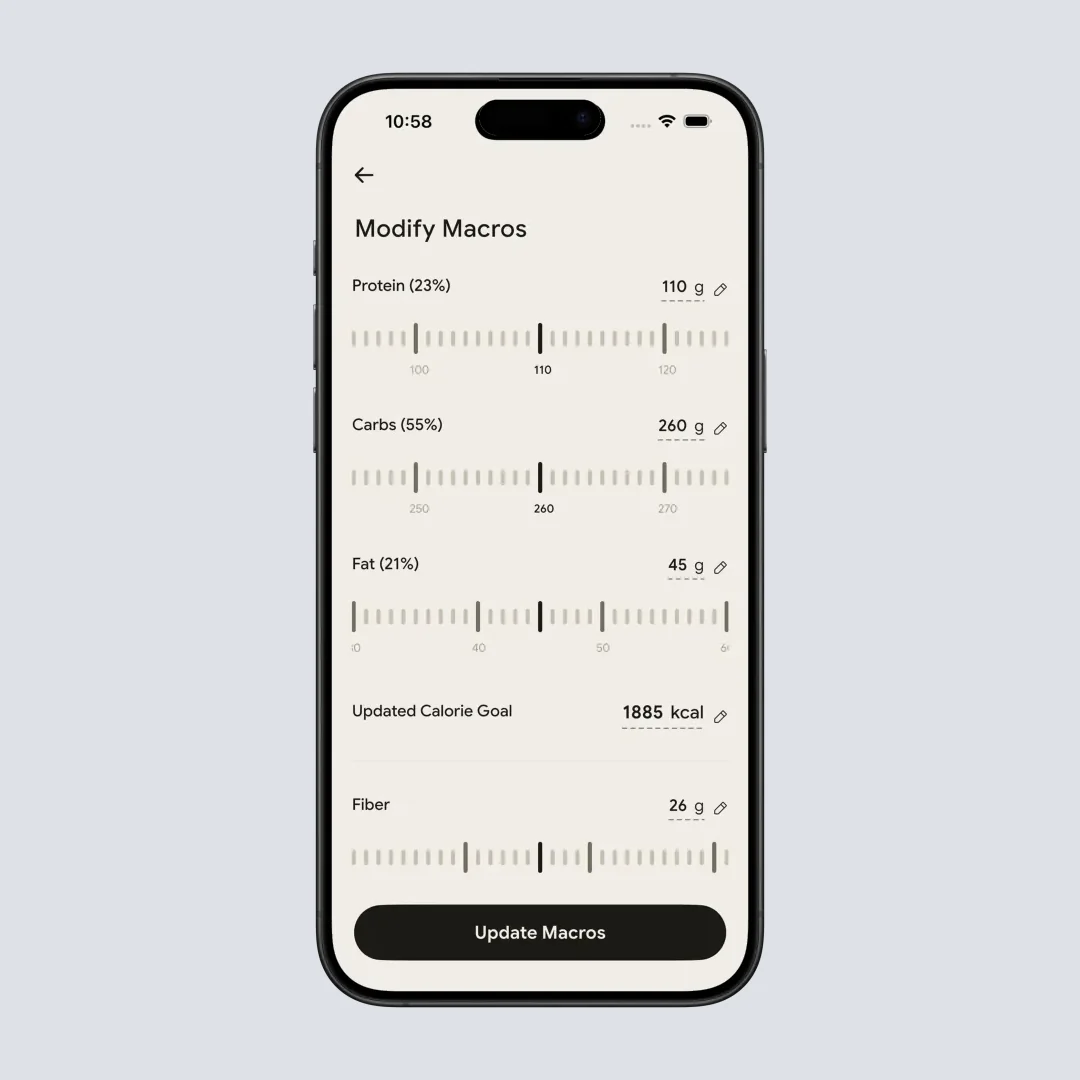
Profile > Modify Macros. Set the fiber field to 28 g, or to 14 g per 1,000 calories of your own target.
To see it every day, open Home > Today's Count > Customize and pin Fiber. It then shows on the home screen as grams eaten over your target. Each meal you scan or log adds its fiber to that count, and the Report tab has a Fiber tile with a chart against your goal.
The free plan includes 5 scans a week. If you have not set calorie and macro targets yet, the online macro calculator gives you a starting point, and our 30-day gut reset challenge puts higher-fiber meals into a plan.
What else do people ask about fiber?
How much fiber do you need a day?
The FDA Daily Value for dietary fiber is 28 g a day, based on a 2,000 calorie diet. The Dietary Guidelines for Americans, 2020-2025 set the goal at 14 g per 1,000 calories, which works out to 22 to 34 g for adults depending on age and sex. A clinician can set a different target for a medical condition.
How much fiber is in edamame?
One cup of shelled, cooked edamame (155 g) has 8 g of fiber on the NutriScan edamame page, about 5 g per 100 g. That cup covers 29% of the 28 g FDA Daily Value.
Do green grapes have fiber?
Yes, a little. 100 g of green grapes, about one cup, has 0.9 g of fiber on the NutriScan green grapes page. That is 3% of the 28 g Daily Value, which the FDA classes as a low amount per serving.
Do mashed potatoes have fiber?
Yes. 100 g of mashed potato, about half a cup, has 1.6 g of fiber on the NutriScan mashed potato page, or 6% of the 28 g Daily Value. Peeling the potatoes before mashing removes the skin, which is where part of a potato's fiber sits.
What is the difference between soluble and insoluble fiber?
MedlinePlus, from the US National Library of Medicine, describes soluble fiber as the kind that attracts water and turns to gel during digestion, which slows digestion. It is found in oat bran, barley, nuts, seeds, beans, lentils and peas. Insoluble fiber is found in wheat bran, vegetables and whole grains and adds bulk to the stool.
How much fiber is in a Floura fiber bar?
Floura lists 13 g of fiber in each FiberCrush bar. That is 46% of the 28 g FDA Daily Value from one 45 g bar.