How Accurate Are AI Calorie Counters? What Studies Measured
 ChatGPT
 Claude
 AI Mode
 Perplexity
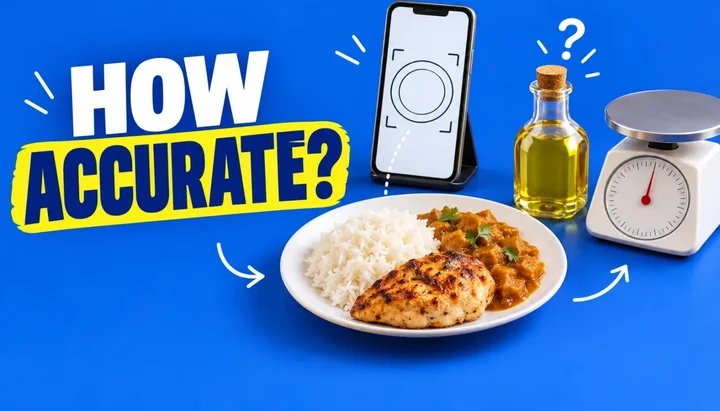
An AI calorie counter gets a simple, well-lit plate close to right and a large, oily or mixed meal noticeably wrong. A 2023 systematic review of 52 studies in Annals of Medicine found average calorie errors from 0.10% to 38.3% against ground truth. Most of the gap comes from portion size and fat the camera cannot see.
Sources checked on October 11, 2026: one systematic review, four peer-reviewed tests and one conference abstract, each linked where it is cited. Every figure below is the study's own number for its own test set. None of them is a ranking of apps.
Summary
- How it works: the app names the foods in the photo, estimates how much of each is there, then looks up nutrition for that amount. Each step adds its own error.
- How accurate: the 2023 review by Shonkoff and colleagues found average calorie errors from 0.10% to 38.3% across AI methods, with the lowest errors on single, simple foods.
- Where it misses: large portions get underestimated, cooking oil is invisible and mixed dishes hide their ingredients.
- Compared with people: the same review reports human estimates from a 30% underestimate to a 1% overestimate. The ranges overlap.
- How to improve it: tell the app what it cannot see (amount, cooking method, oil) and correct the portion after the scan.
How does an AI calorie counter estimate calories from a photo?
Every photo calorie counter runs the same three steps, whatever the brand.
- Recognition. A vision model names what is on the plate: rice, grilled chicken, a curry.
- Portion estimation. The model estimates the weight or volume of each item. A phone photo is flat, so size has to be inferred from the plate, the cutlery and what a normal serving looks like.
- Nutrition lookup. The app multiplies the estimated amount by calories and macros per gram from a food database, or lets the model produce the numbers directly.
Errors multiply through the chain. A correct name with a portion that is 40% too small gives a calorie count that is 40% too small. A correct portion matched to the wrong database record does the same kind of damage. Our note on verified versus community food entries covers that third step.
How accurate are AI calorie counters in published tests?
Researchers test these systems by photographing meals whose contents were weighed first, then comparing the estimate with the weighed truth.
| Study | Published by | What was tested | What they found |
|---|---|---|---|
| Shonkoff et al., 2023 | Tufts University and Merrimack College, Annals of Medicine | Systematic review of 52 AI image studies | Average calorie error 0.10% to 38.3%, volume error 0.09% to 33% |
| Thames et al., 2021 | Google Research, CVPR | A model trained on about 5,000 cafeteria dishes weighed to within 1 g | Calorie error 26.1% from a 2D image, 16.5% with depth data |
| O'Hara et al., 2025 | Royal College of Surgeons in Ireland, Nutrients | 114 meal photos in small, medium and large portions, read by ChatGPT-4 | Weight underestimated in 76.3% of photos; mean difference 27.8% |
| Fridolfsson et al., 2025 | Current Developments in Nutrition | 52 standardized food photos, three general AI models | Energy error 35.8% for two models and 64.2% for the third |
| Isobe et al., 2026 | Nutrients | 15 weighed hospital meals, 10 dietitians vs 10 AI models | Energy within 10% on 86.7% of meals for dietitians, 73.3% for the best AI model |
The range is wide because the test meals differ. Shonkoff and colleagues report that errors were lower for single and simple foods and higher for mixed dishes such as curries and for overlapping foods. They could not pool the studies into one figure because the methods varied too much. Only 27% of the studies used weighed food as ground truth; 51% used nutrient tables.
Depth helps. In Nutrition5k, the Google Research team scanned dishes on a rig with a digital scale and a depth camera. Their model's mean absolute calorie error was 70.6 kcal (26.1%) from a flat image and 41.3 kcal (16.5%) when depth-based volume was added. Most phone photos give an app the flat image only.
Trained people still lead on controlled meals. In the Isobe study, each meal was photographed from directly above under fixed lighting. Registered dietitians landed within 10% of the true energy on 86.7% of meals, ChatGPT-4o on 73.3% and Gemini 1.5 Pro on 60.0%. The authors recommend keeping a person in the loop and adding cooking details to the photo.
What about the calorie apps themselves?
Most published tests use research models or general chatbots. One test of consumer apps exists so far, and it has not been peer reviewed. At NUTRITION 2026, the American Society for Nutrition's meeting in July 2026, researchers from the US National Institute of Diabetes and Digestive and Kidney Diseases presented an abstract in which 102 meals from a metabolic kitchen, with ingredients weighed to 0.1 g, were photographed and run through four apps: MyFitnessPal, LoseIt!, CalAI and Appediet.
All four underestimated calories, by about 250 to 345 kcal per meal on average, and fat by about 30 g. Carbohydrate was estimated more consistently, and high-fat ketogenic meals were the hardest. Treat these as preliminary figures until the full paper is out. The researchers' own advice in the release: "People using a photo-based tracking app without adjusting the portions or entering the amounts of food should take the results with a grain of salt."
Where do photo calorie estimates go wrong?
Portion size
Portion is the largest single source of error, and it runs in one direction for big meals. In the O'Hara study from the Royal College of Surgeons in Ireland, which used portion sizes from Ireland's National Adult Nutrition Survey, ChatGPT-4 estimated small meals well (408 g actual against 431 g estimated). Medium meals of 581 g were judged at 426 g, and large meals of 798 g at 530 g.
Fridolfsson and colleagues found the same slope in ChatGPT-4o, Claude 3.5 Sonnet and Gemini 1.5 Pro: the bigger the portion, the bigger the underestimate. In one case a 480 g serving of lentil curry was estimated at 255 g.
Hidden oil and fat
A tablespoon of oil soaked into rice or stirred into a sauce leaves almost no visual trace, and fat carries more than twice the calories per gram of carbohydrate or protein. Fat is also where studies disagree most. The NIH abstract found the four apps underestimating fat by about 30 g per meal. The Isobe study found every AI model overestimating fat on hospital meals, with a mean bias above 20%. Either way, fat is the number to check first.
Mixed dishes and covered food
A camera sees the top layer. Shonkoff's review singles out mixed dishes and overlapping foods as higher risk, and the Fridolfsson study saw accuracy fall when vegetables at the front of the plate hid the starch and protein behind them. Recognition can fail too: the same paper records one model reading scrambled eggs as pasta, which threw the carbohydrate figure off by 1,788%.
How does a photo estimate compare with logging by hand?
People are not a precise baseline either. Shonkoff's review cites earlier work putting human estimation between a 30% underestimate and a 1% overestimate. A separate systematic review of dietary assessment against doubly labeled water, the reference method for measuring energy use, includes a US study by Park and colleagues in which 4-day food records under-reported energy intake by 18 to 21% and food frequency questionnaires by 29 to 34%.
So a photo and a written log miss by a similar range. A photo captures the meal in seconds, and you can then fix the one or two things it could not see.
How accurate is NutriScan?
NutriScan identifies food at 95% or better accuracy for items covered by our own food database. That is our figure, from internal food-data verification. No third party has certified it and it is not a study result. It also describes one step only, naming the food. It says nothing about how much food is on the plate.
We state the limits on our data sources page: portion size is the hard part, and a dish outside the database falls back to search and AI estimation, where the error is wider. That is why every scanned meal stays editable.
How do you get better results from a photo calorie counter?
These steps follow from where the studies found the errors. The app names in bold are NutriScan's; most photo trackers have something similar.
- Shoot from above in good light, with the whole plate in frame. The Isobe study used a 90 degree overhead angle, and the plate edge gives the model a size reference.
- Spread food out before the photo. The model can only count what it can see.
- Say how much, if you know. In NutriScan you can add text details such as portion size and item names before the scan is processed.
- Tell it about fat. Set the Cooking Method tag and the Oil/Butter slider (No, Low, Default or High) so the oil the camera cannot see is counted.
- Fix the portion afterward. Tap the portion pill on any item in Nutrition Details to change the quantity, unit or grams. Use Type missing item for anything the scan left out and remove anything it invented.
- Weigh the calorie-dense foods once. A kitchen scale on oil, nuts, cheese and rice for a week teaches your eye what your usual portions weigh.
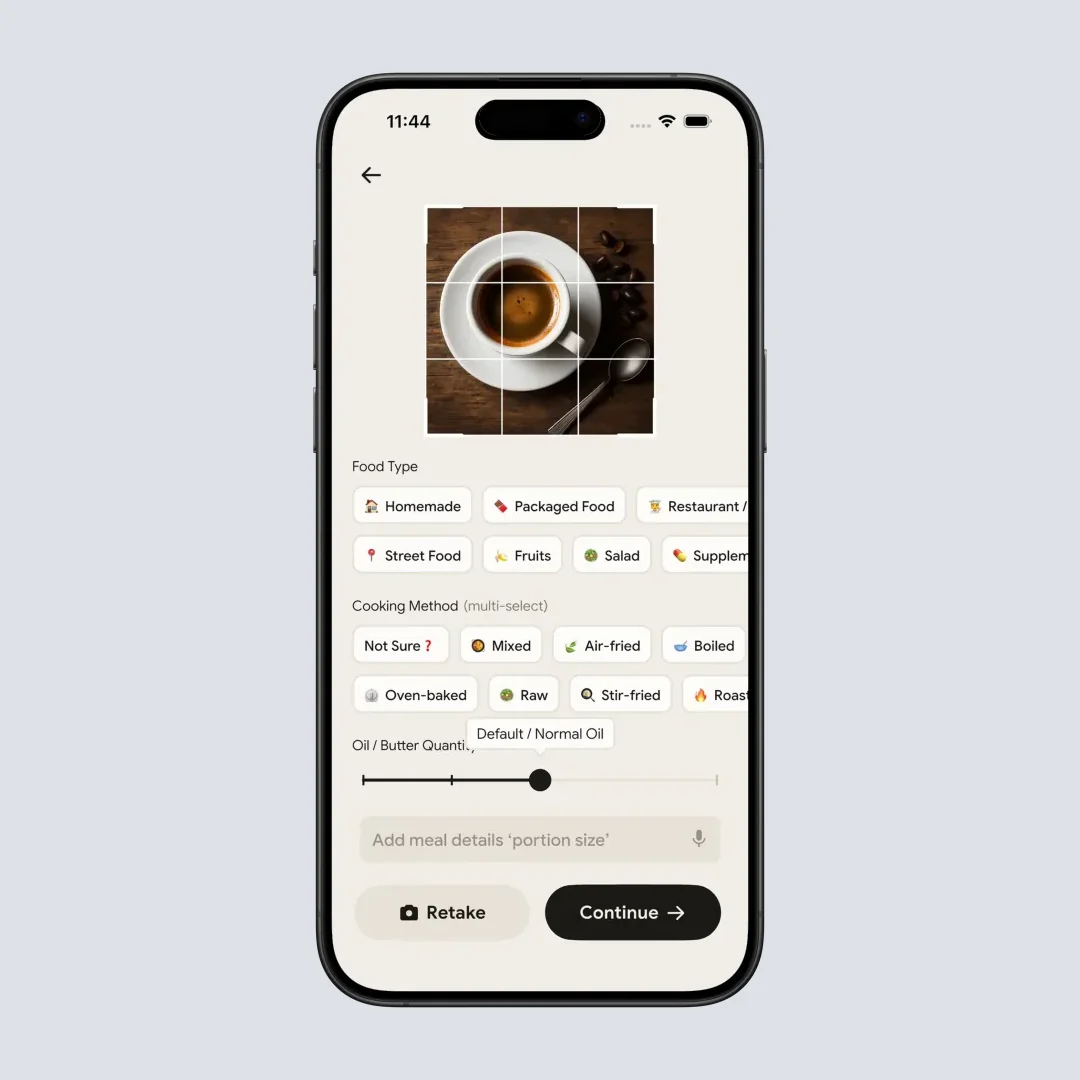
Home > + > Scan Meal. Cooking method and oil level are the two details a photo cannot show. The full walkthrough is in our meal scan guide.
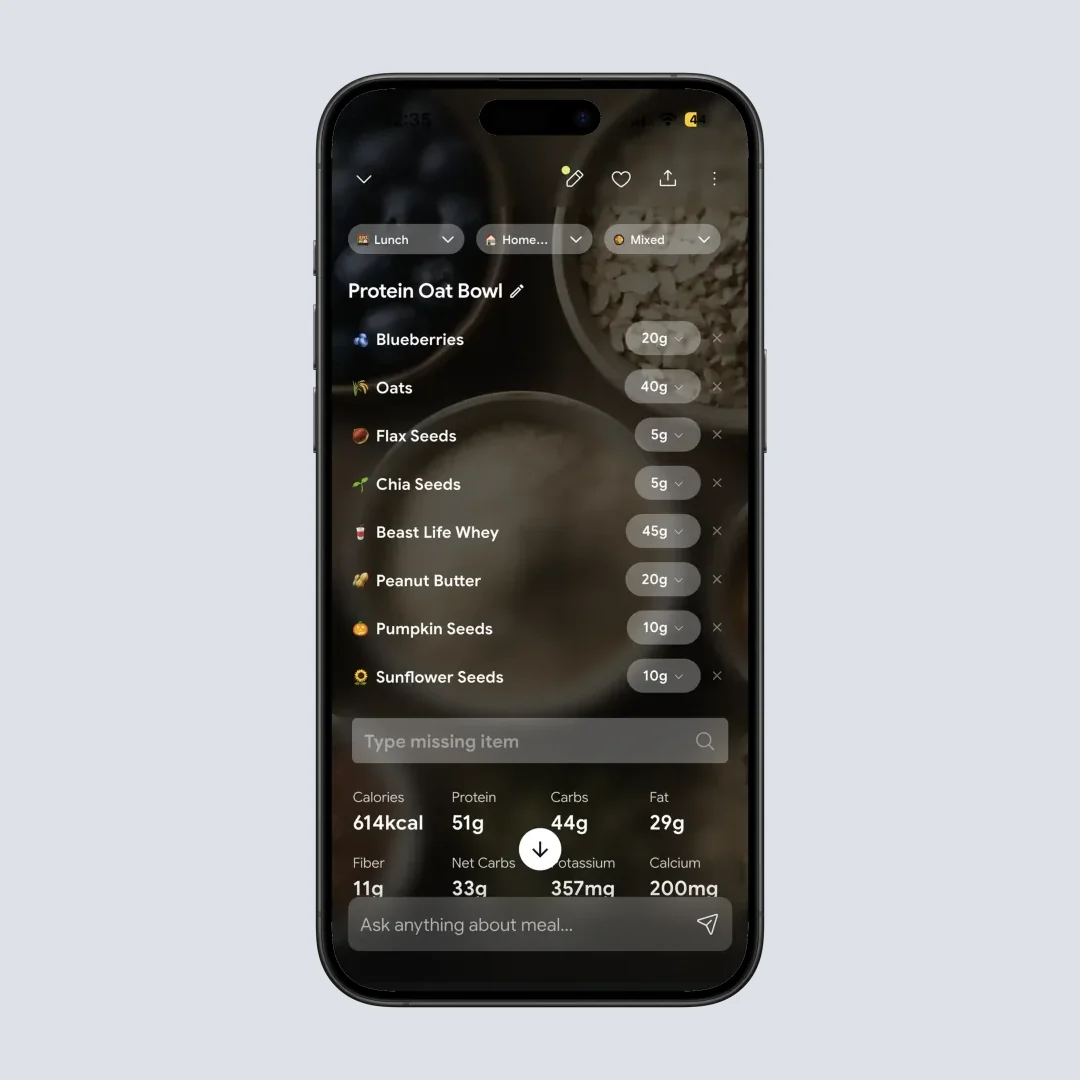
Nutrition Details. Each item has its own portion pill, and changing the grams recalculates the calories and macros for that item.
If a result still looks off, Refresh Meal runs the analysis again with the reason you pick, and Edit Macros lets you overwrite the totals with numbers from a label.
Which AI calorie counter should you use?
Pick the one that lets you correct it quickly. The NIH researchers and the Isobe authors both name human correction as the step that closes the gap. Check three things before you commit: whether you can edit the portion of each item, whether you can add cooking fat, and where the nutrition data comes from.
NutriScan's free plan includes 5 scans a week, and the app has 150k+ downloads and a 4.6 star rating. For side-by-side comparisons, see our pieces on NutriScan as a Cal AI alternative, NutriScan vs SnapCalorie and the best free AI calorie tracking apps. If you only need a daily target to track against, the online calorie calculator gives you one without an account.
A note on health
Calorie estimates are for general tracking. If you manage diabetes, an eating disorder or another medical condition, follow your doctor's or dietitian's advice on what and how to track.
What else do people ask about AI calorie counters?
How accurate are AI calorie counters?
It depends on the meal. A 2023 systematic review in Annals of Medicine covering 52 studies found average calorie errors from 0.10% to 38.3% against ground truth. Single, simple foods sit at the low end. Large portions, mixed dishes and high-fat meals sit at the high end.
Why do AI calorie counters underestimate calories?
Two reasons show up in published tests. First, models underestimate large portions: in a 2025 study in Nutrients, ChatGPT-4 judged small meals correctly but put 798 g meals at 530 g on average. Second, cooking fat is hard to see. A preliminary NIH test of four apps on 102 weighed meals found fat underestimated by about 30 g per meal.
Can AI tell portion size from a photo?
Only roughly. A single photo has no depth information, so the model infers size from the plate, cutlery and how food usually looks. In the Nutrition5k study from Google Research, adding depth data cut calorie error from 26.1% to 16.5%. Typing the amount, or adjusting the portion after the scan, removes most of that guesswork.
Is an AI calorie counter more accurate than logging by hand?
Published results overlap. The 2023 Annals of Medicine review reports human estimation ranging from a 30% underestimate to a 1% overestimate, against 0.10% to 38.3% average error for AI methods. A photo is faster, and a photo that you then correct by hand uses the strengths of both.
How accurate is NutriScan?
NutriScan identifies food at 95% or better accuracy for items covered by its own food database. This is NutriScan's first-party figure from internal food-data verification. No outside study has tested it, and it describes naming the food correctly. The amount on the plate is a separate estimate that you can edit on every meal.