Is Lingo Free? Abbott Lingo Price, Sensor Cost and Refunds
 ChatGPT
 Claude
 AI Mode
 Perplexity
Lingo is not free: Abbott sells it in the US as a $54 2-week plan with one sensor, an $89 4-week plan with two, or a $249 subscription that ships six sensors every 12 weeks, per the Lingo plans page on October 10, 2026. The app costs nothing to download, but it shows nothing without a paid biosensor. Only your first purchase is covered by the 30-day money-back guarantee.
Prices checked on October 10, 2026 on Lingo's US plans page, UK homepage and UK shop, the Lingo Terms of Sale, three articles in the US help center, the Sensor Promise page, the US App Store listing and Dexcom's Stelo site. Taxes are added at checkout in the US.
Lingo is Abbott's over-the-counter continuous glucose monitor (CGM) for adults who do not use insulin. It is built on the same sensor technology as the FreeStyle Libre, which Abbott says roughly 6 million people use to manage diabetes. What the sensor can do for someone without diabetes is a narrower question. A 2024 meta-analysis of 25 randomized trials with 2,996 adults found CGM feedback lowered HbA1c by 0.28 percentage points but did not significantly change body weight or BMI (Richardson et al., 2024). This guide covers what you pay, what you get back when things go wrong, and whether the cheaper plans are worth it.
TL;DR - Lingo Pricing
- Free? No. Only the app download and a 30-minute live info session cost nothing.
- US plans: $54 for 2 weeks (1 sensor), $89 for 4 weeks (2 sensors), $249 per 12-week subscription (6 sensors).
- UK plans: £59, £99 and £289 for the same three plans.
- Per day: $3.86, $3.18 and $2.96. Dexcom's Stelo subscription is about $2.97.
- Refunds: first purchase only, within 30 days of delivery.
- Failed sensors: replaced free if they stop before 14 days. About 1 in 4 may not last the full 14.
IMPORTANT
Your Lingo pricing check at a glance.
Four stops, and the last one decides how much of your money is refundable.
⏱️ Progress 0/4 • ~0 minutes in • Keep going
⏳ Step 1: What each plan costs per sensor, per day and per year
⏳ Step 2: Refunds, failed sensors and canceling
⏳ Step 3: Insurance, Stelo and who can buy
🔍 The first-order choice that decides whether $54 or $249 is refundable (revealed near the end)
The quick answer: Lingo is not free
Two parts of Lingo cost nothing:
- The app. Lingo by Abbott is a free download, rated 4.5 from about 7,600 ratings on the US App Store (version 1.12.2, released September 25, 2026). It reads the sensor, logs meals by photo or search and sends a weekly report. Without a sensor it has no glucose data to show.
- A live info session. The plans page invites buyers to a 30-minute session with one of Abbott's nutritionists on how to use Lingo.
The biosensors are the product, and they are always paid. There is no free trial sensor and no free tier. The closest thing to a trial is the 2-week plan, which Lingo labels "TRIAL" and which does not auto-renew.

The app is free to download. The sensors are where the adding up starts.
Lingo price list for October 2026
The US plans page showed three options on October 10, 2026. All include 14-day biosensors and full access to the app.
| Plan | US price | UK price | Sensors | Per sensor (US) | Renews? |
|---|---|---|---|---|---|
| 2-week plan | $54 | £59 | 1 | $54.00 | No |
| 4-week plan | $89 | £99 | 2 | $44.50 | No |
| 12-week subscription | $249 | £289 | 6 | $41.50 | Every 12 weeks |
UK prices come from the UK homepage (£59 for the 2-week plan) and the UK shop, which showed £99 for 4 weeks ("Save £19") and £289 for the 12-week subscription. In the UK the subscription ships 2 biosensors each month instead of 6 at once.
Two details are worth knowing before you compare this table with older reviews:
- The 2-week price has gone up. Reviews written in 2025 and 2026, such as BetterVitals' Lingo review, still quote $49 for a single sensor. Lingo's own page shows $54. The 4-week and 12-week prices match what those reviews list.
- The terms mention a plan the shop does not sell. Section 14 of the Terms of Sale describes shipping "two (2) Lingo biosensors for a 4-week subscription plan." The plans page sells the 4-week plan as a one-time purchase only, and the 12-week plan is the only subscription.
US prices do not include tax, and the terms allow shipping charges, but the plans page promised free shipping on the day we checked.
What a year of Lingo costs
A sensor lasts 14 days, so continuous wear needs 26 sensors a year. Here is what that costs on each US plan, by our arithmetic:
| How you buy | Cost per day | Cost per year of continuous wear |
|---|---|---|
| 2-week plans, one after another | $3.86 | $1,404 (26 x $54) |
| 4-week plans, one after another | $3.18 | $1,157 (13 x $89) |
| 12-week subscription | $2.96 | $1,079 (4.33 x $249) |
| 12-week subscription, UK | £3.44 | about £1,256 |
Almost nobody should wear one all year. Lingo pitches itself as a tool to "learn how your body responds to food and exercise," and the learning curve flattens. After a few sensors you will know how your usual breakfast, your post-dinner walk and your late snack behave. A realistic budget for most people is one 4-week plan ($89) plus a second one a few months later to test changes, well under $200 a year.
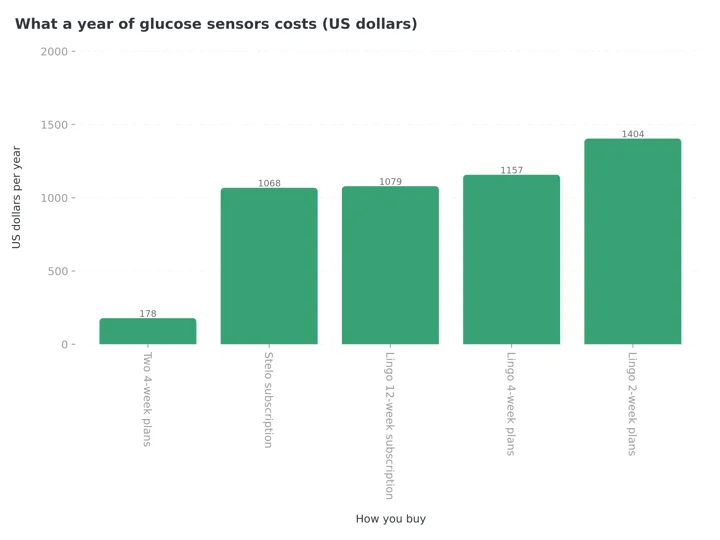
Figure 1: A year of glucose sensors priced five ways, from Lingo and Dexcom Stelo prices on October 10, 2026. The Stelo bar is 12 monthly orders of $89.
As Figure 1 shows, the two-plan experiment costs about a sixth of any year-round option.
If you want to try one sensor first, the 2-week plan is priced for it. Its per-day cost is the highest of the three, but it is the least money at risk.
IMPORTANT
Checkpoint: you know the sticker prices.
Next up is what happens when you change your mind or a sensor quits early.
⏱️ Progress 1/4 • ~3 minutes in • Keep going
✅ Step 1: What each plan costs per sensor, per day and per year (done)
👉 Step 2: Refunds, failed sensors and canceling (you're here)
⏳ Step 3: Insurance, Stelo and who can buy
🧩 The first-order choice that decides whether $54 or $249 is refundable (coming soon)
Refunds: the first-purchase guarantee
Lingo's refund rule is short. The help center says: "Lingo offers a 30-day money-back guarantee on all first purchases only. We don't offer a money back guarantee on subsequent purchases."
The Terms of Sale add the details:
- Only your first order qualifies. The guarantee covers "your first (and only your first) Lingo Purchase."
- You have 30 calendar days from delivery to ask.
- You request it in your account. The refund article says to log in at hellolingo.com, open Order history, select Return order and follow the prompts.
- The money comes back within 14 business days to the card or method you paid with.
- One-time purchases cannot be cancelled. Once you order a 2-week or 4-week plan, the only way to get money back is the first-purchase guarantee or a fault claim.
One wording difference: the UK shop FAQ describes the guarantee as applying to "the 12-week subscription," first purchase only, while the US help center says "all first purchases." In the US, the Terms of Sale are what bind, and they say first purchase of any kind.

After the first order, a change of mind costs the full price of the plan.
Sensor failures and replacements
Lingo is open about how often sensors fail early. A footnote on the plans page says that in a study, "77.1% of biosensors lasted the full 14 days," so about 22.9% may not, and "14.7% of biosensors may last less than 11 days."
At $41.50 to $54 a sensor, that matters. Lingo covers it two ways:
- The Sensor Promise. The Sensor Promise page says that "whether it's your first or your fortieth, if your biosensor stops working before you've used it for 14 days, we'll replace it." Support runs 9 AM to 9 PM Eastern, seven days a week.
- Faulty sensors under the terms. For a defective sensor, the Terms of Sale let you ask for a free replacement or a refund of that sensor's price. Lingo may ask for the sensor back, so do not throw it away before you contact support.
The terms are stricter about sensors that fall off. If a sensor that is not defective falls off early, Lingo will replace it free "a maximum of three (3) times in any six (6) month period," and after the third, it "will not replace any further Lingo biosensors or provide any refunds." The Sensor Promise page does not mention that cap. If your sensors keep coming loose, an overpatch or a different spot on the back of the arm is cheaper than running out of replacements.
How to cancel a Lingo subscription
Only the 12-week subscription renews, so only it needs cancelling. The cancel article gives the steps:
- Go to hellolingo.com, scroll to the bottom and select Account login.
- In your account, select My Subscription.
- Select Cancel subscription.
- Do it at least 48 hours before the renewal date. The Terms of Sale put it as two business days before the next order date, so a Monday renewal needs cancelling by the previous Thursday.
Cancelling does not refund the current 12 weeks unless it is your first purchase and you are inside the 30-day window. You can reactivate the subscription later from the same page, and the UK shop FAQ says you can pause it rather than cancel.
Some users have reported that the My Subscription option was missing from their account, in a Lingo subreddit thread. If that happens, email [email protected] well before the cutoff and keep the reply.
Price changes follow a fixed rule. The terms say Lingo gives at least one month's notice of a subscription price increase, and you can cancel within a month of that notice if you do not accept it.
IMPORTANT
Checkpoint: you are halfway through.
You know what you pay and what you can get back. Now see who else is selling the same idea.
⏱️ Progress 2/4 • ~6 minutes in • Keep going
✅ Step 1: What each plan costs per sensor, per day and per year (done)
✅ Step 2: Refunds, failed sensors and canceling (done)
👉 Step 3: Insurance, Stelo and who can buy (current)
⏳ The first-order choice that decides whether $54 or $249 is refundable (next)
Insurance, HSA and FSA
The plans page says Lingo is HSA and FSA eligible, which can cut the effective price by your tax rate if you pay with pre-tax money.
Lingo does not claim that insurance covers the biosensors. What insurance can cover is optional dietitian sessions with Berry Street, a separate nutrition company. Lingo says "96% pay $0 out-of-pocket" for those sessions, subject to your plan, and adds that "Lingo does not provide nutritional advice." The coaching is a referral you can take or skip.
This is a different model from the coached programs. Nutrisense bundles Stelo sensors with dietitian access at $179 to $249 a month on its plans page, and Signos lists $169 to $299 a month on its plans page. We priced both in our Nutrisense and Signos guides. Lingo's sensor-plus-app price of about $83 per 4 weeks on subscription is a fraction of those, because the coaching is not in the price. Ultrahuman resells the same Lingo sensor in the US as M2 Live at $99 a month, priced in our Ultrahuman M1 guide.
Lingo vs Stelo on price
Dexcom's Stelo is the other over-the-counter CGM in the US, and the two now cost almost the same. The Stelo homepage showed the monthly subscription at $89 (the one-time pack is $99) for two sensors that each last up to 15 days.
| Lingo (12-week subscription) | Stelo (monthly subscription) | |
|---|---|---|
| Price | $249 per 12 weeks | $89 per month |
| Sensors | 6 x 14 days | 2 x up to 15 days |
| Cost per day | about $2.96 | about $2.97 |
| One-time option | $54 (2 weeks) or $89 (4 weeks) | One-time purchase available |
| Coaching | Berry Street dietitians, insurance-billed | Nutrisense dietitians, insurance-billed |
On price per day, it is a tie. The one-time Lingo plans matter more for trying a CGM: $54 buys two weeks with no commitment. Choose on the app you prefer and which phone and watch integrations you need, and check each sensor's phone compatibility list before you pay. Our best apps for CGM users guide compares the apps side by side.
Who can buy Lingo
The plans page sets three conditions: Lingo is "for users 18 years and older not on insulin," it "is not intended for diagnosis of diseases, including diabetes," and its data "should not be used to take medical action" without a health professional. If you use insulin, Lingo is the wrong device, and adults with type 2 diabetes who do not use insulin are the market for Abbott's separate Libre Rio sensor.
If you use insulin or manage diabetes, talk to your doctor first
Lingo says its data "should not be used to take medical action" without a health professional. If you take insulin or other glucose-lowering medication, your care team decides which CGM and targets fit you, and you should not change doses based on a wellness sensor.
Country matters too. The US Terms of Sale cover buyers "located in the United States," and send everyone else to the Lingo site for their country, "if any." Lingo launched in the UK in early 2024 and was cleared by the FDA for the US in June 2024, according to Abbott.
Outside those markets, the glucose programs we have priced are ZOE, which uses a CGM in its test kit, and Lumen, a breath device that estimates fuel use with no sensor under the skin.
What the research says about CGMs without diabetes
Lingo sells glucose data for weight, energy and habits. The research supports some of that and not the rest.
- Modest effects on glucose, none on weight. The Richardson meta-analysis above pooled 25 trials and found HbA1c fell 0.28 points with CGM feedback, but BMI and weight did not change significantly. Most trials were in people with type 2 diabetes.
- People respond differently to the same food. A study of 800 people and 46,898 meals found high variability in glucose response to identical meals (Zeevi et al., 2015). That is the case for testing your own meals.
- One reading of one meal is noisy. In an NIH feeding study of 30 adults without diabetes and 1,189 meal responses, the same meal served a week apart gave responses with low reliability (intraclass correlation 0.17 to 0.28), and the authors said advice needs "aggregated repeated measurements" (Hengist et al., 2025). Test a meal more than once before you drop it.
- Healthy glucose spends most of the day in range. In 153 healthy adults and children, median time between 70 and 140 mg/dL was 96%, and mean glucose was 98 to 99 mg/dL for everyone under 60 (Shah et al., 2019). Short rises after meals are normal.
- Some "normal" people are not so normal. A Stanford study found people with normal standard tests still reached prediabetic glucose levels 15% of the time on a CGM (Hall et al., 2018). That is the best case for a CGM if you have risk factors such as family history.
- Use is growing faster than the evidence. A 2023 review sorted CGM use in people without diabetes into four groups, from metabolic disease to elite sport, and said the field still needs data to support it (Klonoff et al., 2023).
Put simply, a few Lingo sensors can show you how your meals and walks behave and can flag glucose that runs high. They will not make you lose weight on their own. That still comes down to eating less energy than you burn over time.
IMPORTANT
Checkpoint: one stop left.
Prices, exit rules and the evidence are covered. The ordering choice is next.
⏱️ Progress 3/4 • ~10 minutes in • Keep going
✅ Step 1: What each plan costs per sensor, per day and per year
✅ Step 2: Refunds, failed sensors and canceling
✅ Step 3: Insurance, Stelo and who can buy
✨ The first-order choice that decides whether $54 or $249 is refundable (about to reveal)
The first order decides what is refundable
The Terms of Sale say the guarantee "only applies to your first Lingo Purchase," and a reactivated subscription is not covered. So the plan you buy first sets the most you can get back for a change of mind.
Here is the same three months of sensors bought three ways, using the October 10, 2026 prices:
| Your first order | What you buy next | Covered by the guarantee | Final sale |
|---|---|---|---|
| 2-week plan, $54 | 12-week subscription, $249 | $54 | $249 |
| 4-week plan, $89 | 12-week subscription, $249 | $89 | $249 |
| 12-week subscription, $249 | nothing | $249 | $0 |
If you already know you want three months of data, the 12-week subscription as your first purchase puts all $249 under the guarantee. Start with the $54 plan and then subscribe, and only the $54 was refundable.
Two limits apply:
- The window is 30 calendar days from delivery. That covers roughly the first two of the six sensors' wear time, so decide early.
- Ask what has to go back. The UK shop asks for unopened biosensors to be returned. The US help articles we read do not say what happens to used ones, so ask support before you count on a full refund after wearing several.
If you are unsure you will want Lingo at all, the $54 plan is still the smaller bet: the guarantee covers it, and you are not waiting up to 14 business days for $249 to come back.
Who the price makes sense for
Good fit: you are curious about your glucose, have a risk factor for prediabetes, and want a short experiment. One or two 4-week plans at $89 each, paid from an HSA or FSA, is a cheap way to find out whether your usual meals push glucose high and whether a walk after dinner helps.
Fair fit: you want months of data. The 12-week subscription at $249 is the cheapest per day and the same price as Stelo. Make it your first purchase so it falls under the guarantee, and set a reminder to cancel 48 hours before it renews.
Poor fit: you mainly want to lose weight. At about $1,080 a year for continuous wear, you are paying for glucose curves when the research above shows no weight effect from CGM feedback alone. A food log that counts calories and protein does more for that goal at a fraction of the price, and a macro calculator sets the targets for free. Lingo is also the wrong fit if you use insulin or need a device to manage diabetes.
How to buy Lingo without overpaying: 5 steps
- Start with one 2-week sensor. The $54 plan does not auto-renew and shows you how your usual meals behave before you commit.
- Put your biggest order first. The 30-day money-back guarantee covers your first purchase only. If you know you want 12 weeks, buy that first.
- Price per day, not per plan. The subscription is about $2.96 a day, the 4-week plan $3.18 and the 2-week plan $3.86. Stelo's subscription is about $2.97.
- Cancel 48 hours before renewal. Use Account login, then My Subscription, then Cancel subscription. If the option is missing, email [email protected].
- Claim every failed sensor. Lingo replaces a sensor that stops before 14 days. Keep the sensor until support tells you what to do with it.
Where NutriScan fits
Lingo shows how your glucose responds after you eat. NutriScan works on the food side. It logs a meal from a photo and returns calories, protein, carbs and fat for mixed plates. It does not read a CGM: glucose readings are logged by hand, for free, and shown next to the meals you ate around them. The free tier has 5 scans a week, and Premium is about $59 a year. If you finish a Lingo experiment and want to keep tracking what you eat without buying more sensors, NutriScan's pricing is laid out the same way as this guide.
Keep the food log after the sensor comes off
The lasting part of a CGM month is knowing which meals to repeat. Photograph them while the sensor is on, and the log outlives the last sensor.
FAQ
Is the Lingo app free?
The Lingo by Abbott app is free to download, but it only shows glucose data from a Lingo biosensor, and the sensors are paid. The cheapest way in is the 2-week plan at $54 in the US or £59 in the UK, with one sensor.
How much does Lingo cost per month?
In the US, the 4-week plan is $89 for two sensors and the 12-week subscription is $249 for six, which is about $83 per 4 weeks. On the subscription, a year of continuous wear costs about $1,080. In the UK, the plans are £59, £99 and £289.
Can I get a refund from Lingo?
Only on your first purchase. Lingo's 30-day money-back guarantee covers the first order, requested within 30 days of delivery through Order history and Return order in your account. Later orders are not refundable, apart from faulty sensors.
Is Lingo cheaper than Stelo?
On subscription they cost almost the same per day. Lingo's 12-week plan is $249 for 84 days, about $2.96 a day, and Dexcom's Stelo monthly subscription was $89 for two 15-day sensors in October 2026, about $2.97 a day. Without a subscription, Lingo's 4-week plan is also $89 but covers 28 days.
Does insurance cover Lingo?
Lingo does not say insurance covers the biosensors, but they are HSA and FSA eligible. Optional dietitian sessions with Berry Street, a separate company, are billed to insurance, and Lingo says 96% pay $0 out of pocket for them.
IMPORTANT
Recap: everything you checked.
Save this for the day you open the checkout page.
⏱️ Progress 4/4 • ~13 minutes in • Nicely done
✅ Step 1: What each plan costs per sensor, per day and per year
✅ Step 2: Refunds, failed sensors and canceling
✅ Step 3: Insurance, Stelo and who can buy
✅ Only the first order is refundable: subscription first covers $249, the 2-week plan first covers $54 (revealed)