Is Stelo Free? Dexcom Stelo Price, Insurance and Refunds
 ChatGPT
 Claude
 AI Mode
 Perplexity
Stelo is not free: Dexcom sells it as a $99 one-time pack of two 15-day sensors, an $89 monthly subscription or a $252 subscription that ships six sensors every 3 months, per the Stelo buy page on October 11, 2026. The app costs nothing to download, but it shows nothing without a paid biosensor. And every order on stelo.com is final: there are no returns or exchanges.
Prices checked on October 11, 2026 on stelo.com (buy page and help pages), Dexcom's 2024 launch release, the FDA's June 2026 notice and the US App Store. Tax is added at checkout.
Stelo is Dexcom's over-the-counter continuous glucose monitor (CGM), which the FDA cleared for adults without a prescription in March 2024, according to the FDA's June 2026 notice. A 2024 meta-analysis of 25 randomized trials with 2,996 adults found CGM feedback lowered HbA1c by 0.28 percentage points but did not significantly change body weight or BMI (Richardson et al., 2024).
TL;DR - Stelo Pricing
- Free? No. Only the app download and one 30-minute dietitian call cost nothing.
- Plans: $99 for a one-time pack (2 sensors), $89 a month on subscription, $252 every 3 months (6 sensors).
- Per day: $3.30, $2.97 and $2.80. Lingo's 12-week subscription is about $2.96.
- Refunds: none on stelo.com. You get 60 minutes after ordering to cancel.
- Failed sensors: replaced after Dexcom confirms the issue. About 1 in 5 may not last the full 15 days.
- Insurance: cash-pay, but HSA and FSA eligible.
IMPORTANT
Your Stelo pricing check at a glance.
Four stops, and the last one changes what a one-month trial costs.
⏱️ Progress 0/4 • ~0 minutes in • Keep going
⏳ Step 1: Plan prices per sensor, day and year
⏳ Step 2: Refunds, canceling and failed sensors
⏳ Step 3: Insurance, Lingo and who can buy
🔍 The first-order choice that makes a one-month trial $89 instead of $99 (revealed near the end)
The quick answer: Stelo is not free
Two parts of Stelo cost nothing:
- The app. Stelo by Dexcom is a free download on iPhone and Android. The listing says the biosensor is "required for Stelo by Dexcom app use" and "sold separately."
- A first dietitian call. Stelo sends buyers to Nutrisense for 1:1 video calls with a dietitian or nutrition specialist. The buy page footnote says that if insurance coverage is not approved, "you'll receive a 30-minute video call at no cost."
The sensors are the product, and they are always paid. There is no sample sensor, no free tier and no money-back guarantee. The simplest way to try Stelo is the one-time pack, which does not renew.
The app is free to download. The sensors are where the counting starts.
Stelo price list for October 2026
The buy page showed three options on October 11, 2026. All three ship free and include applicators, overpatches and the app.
| Plan | Price | Sensors | Days covered | Per sensor | Renews? |
|---|---|---|---|---|---|
| 1-month supply, one time | $99 | 2 | up to 30 | $49.50 | No |
| 1-month subscription | $89 | 2 | up to 30 | $44.50 | Every month |
| 3-month subscription | $252 | 6 | up to 90 | $42.00 | Every 3 months |
The page headline says "starting at just $84/month," which is the 3-month plan ($252 divided by 3).
Two details matter before you compare this table with other reviews:
- The $99 and $89 prices have not moved since launch. Dexcom's August 2024 release listed "$99 for a single pack of two sensors" and "$89 per month" on subscription.
- Subscriptions are not sold everywhere in the US. The subscription FAQ says recurring plans "are not available for residents of Alaska or Hawaii," who can only buy the one-time pack.
What a year of Stelo costs
A sensor lasts up to 15 days, plus a 12-hour grace period, so continuous wear needs about 24 sensors a year. Here is what that costs on each plan, by our arithmetic from the buy page prices:
| How you buy | Cost per day | Cost per year of continuous wear |
|---|---|---|
| One-time packs, one after another | $3.30 | $1,188 (12 x $99) |
| Monthly subscription | $2.97 | $1,068 (12 x $89) |
| 3-month subscription | $2.80 | $1,008 (4 x $252) |
Very few people need a year of continuous wear. Stelo is sold to show "how food, exercise and sleep can affect glucose," in Dexcom's words, and the lessons come fast. For most people without diabetes, a realistic budget is one $99 pack, then another a few months later to test changes: about $200 a year.
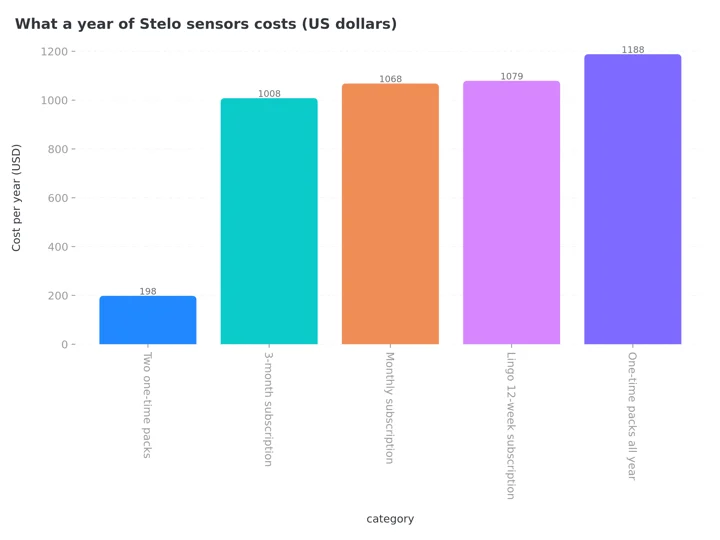
Figure 1: A year of glucose sensors priced five ways, from Stelo prices on October 11, 2026 and Lingo prices on October 10, 2026.
As Figure 1 shows, the two-pack experiment costs about a fifth of any year-round option.
The exception is someone with type 2 diabetes who does not use insulin and wants ongoing data between doctor visits. That is the group Dexcom built Stelo for, and for them the 3-month plan at $1,008 a year is the cheapest route.
IMPORTANT
Checkpoint: you know the sticker prices.
⏱️ Progress 1/4 • ~3 minutes in • Keep going
✅ Step 1: Plan prices per sensor, day and year (done)
👉 Step 2: Refunds, canceling and failed sensors (you're here)
⏳ Step 3: Insurance, Lingo and who can buy
🧩 The first-order choice that makes a one-month trial $89 instead of $99 (coming soon)
Refunds: all sales are final
Stelo's refund rule is one line. The return and warranty policy says: "All sales are final. There are no returns or exchanges." The same text sits under the Add to cart button on the buy page.
That leaves three ways to get money or product back:
- Cancel within 60 minutes. The orders FAQ says you can cancel an order "within 60 minutes of placing the order" from the Orders tab of your account. After that, it ships.
- A replacement for a failed sensor. Covered in the next section. It is a replacement, not a refund.
- Buy somewhere else. The return policy says orders from "another retailer (such as Amazon, Walmart, etc.)" follow that retailer's return, refund and warranty rules. If you want a return window at all, that is the only route to one.
Compare that with Abbott's Lingo, which gives a 30-day money-back guarantee on your first purchase, per its help center. Stelo has no equivalent. If you are unsure whether you will tolerate a sensor on your arm, one month of sensors is the most you should risk.

After the 60 minutes are up, a change of mind gets you a shrug.
How to cancel a Stelo subscription
The cancel article sets the rules:
- Log in to your account on stelo.com.
- Open the Subscriptions tab.
- Cancel the subscription, or skip or move the next shipment instead.
- Do it before the deadline date the Subscriptions tab shows for the next shipment.
The first line of that article is the one people miss: "As a subscription customer you are unable to cancel your first order." Once the first order ships, you can cancel future ones. Cancelling "will only stop future shipments from being sent and billed," and "any shipments already in progress will still be sent and billed."
In practice, if you sign up for the 3-month plan to try Stelo, you have committed $252. That is the wrong first order for a trial. The $99 one-time pack is the obvious one, and there is a cheaper first order than that, covered near the end.
Skipping is the underused option. If you want a break before the next experiment, skip the next shipment and keep the subscription price.
If the Subscriptions tab does not show a cancel option, use SteloBot inside your account well before the shipment deadline and keep a record of the chat.
Sensor failures and replacements
Dexcom publishes its own failure rate. A footnote on the buy page says "77.9% of sensors lasted the full 15 days," that "approximately 20% of sensors may not last for the full 15 days," and that "10% of these sensors may last less than 12 days." At $42 to $49.50 a sensor, one early failure in five is worth planning for.
What Dexcom promises in return:
- A new sensor for a confirmed issue. The buy page says that if you "experience an issue with your biosensor before its 15-day wear is complete, we'll ship a new one, on us." The footnotes add that "product issues will need to be confirmed with our technical agent" and that "validated product issue replacements are not limited."
- Not every request qualifies. The replacement policy says "not all cases warrant a replacement, and some requests may not qualify." You need the sensor's serial number, and you report the issue through SteloBot after logging in.
The practical steps: write down the serial number before you apply a sensor, and report a failure the day it happens. Stelo's page does not say how long you have to report one, so do not wait. A sensor that simply comes loose may not count as a validated product issue. An overpatch is included in the box. Use it.
IMPORTANT
Checkpoint: you know what you can and cannot get back.
⏱️ Progress 2/4 • ~7 minutes in • Keep going
✅ Step 1: Plan prices per sensor, day and year (done)
✅ Step 2: Refunds, canceling and failed sensors (done)
👉 Step 3: Insurance, Lingo and who can buy (current)
⏳ The first-order choice that makes a one-month trial $89 instead of $99 (next)
Insurance, HSA and FSA
Stelo is a cash-pay product. Nothing on the buy page says insurance covers the sensors. What it does say, on the HSA/FSA page, is that Stelo is "FSA and HSA eligible" and you can use your card at checkout or submit your invoice for reimbursement. Subscriptions can be paid from an HSA or FSA card too, but a renewal "will be declined" if the card lacks funds.
Paying with pre-tax money cuts the effective price by your tax rate. If your combined rate is 30%, a $252 3-month plan costs you about $176 in take-home pay.
The insurance piece is the coaching. Stelo sends buyers to Nutrisense for medical nutrition therapy with a registered dietitian or nutrition specialist. The coaching page says "95% of eligible users pay $0 out-of-pocket for ongoing sessions," and that Nutrisense runs a coverage check before booking. If insurance does not approve it, you still get the one free 30-minute call.
Nutrisense's own plans bundle a CGM with dietitian access at $179 to $249 a month on its plans page, and Signos lists $169 to $299 a month. Levels is $15 a month without a sensor. Stelo at $84 to $99 a month is the sensor and the app, with coaching as an optional extra billed to your insurer. Ultrahuman's M2 Live, built on the Lingo sensor, is $99 a month for two sensors, as our Ultrahuman M1 pricing guide shows.
Stelo vs Lingo on price
Abbott's Lingo is the other over-the-counter CGM in the US, and on subscription the two cost almost the same. Lingo's prices come from its plans page, checked on October 10, 2026.
| Stelo | Lingo | |
|---|---|---|
| Cheapest one-time buy | $99 (2 sensors, about 30 days) | $54 (1 sensor, 14 days) |
| Best subscription | $252 per 3 months | $249 per 12 weeks |
| Sensor length | up to 15 days | 14 days |
| Cost per day, best plan | about $2.80 | about $2.96 |
| Refunds | None, all sales final | 30 days, first purchase only |
| Failed sensors | Replaced after confirmation | Replaced under the Sensor Promise |
| App Store rating (US) | 2.5 from 619 ratings | 4.5 from about 7,600 ratings |
Stelo wins on the cheapest daily price by about 16 cents. Lingo wins on the cheapest way in, $54 for a two-week test, and on refunds, since its first purchase is covered for 30 days.
Who can buy Stelo
The buy page says Stelo is "for people not using insulin, ages 18 years and older." It also lists who should not use it: people "on insulin, on dialysis," people with "problematic hypoglycemia," anyone "modifying medication without HCP consultation," and anyone with "a history of eating disorders."
The age limit has changed on paper. On June 12, 2026, the FDA cleared Stelo for "people two years of age and older who do not use insulin," under adult supervision, making it the first over-the-counter CGM cleared for children. As of October 11, 2026, the stelo.com shop still said 18 and older. If you are buying for a child, check with Stelo support and your child's doctor before ordering, since sales are final.
If you use insulin or manage diabetes with medication, talk to your doctor first
Stelo's own page says not to use it if you are on insulin, and to consult your healthcare provider before making any medication adjustments based on sensor readings. Your care team decides which CGM and targets fit you.
Stelo is sold in the US only. For readers elsewhere, the glucose programs we have priced include ZOE, which uses a CGM in its test kit, and Lumen, a breath device with no sensor under the skin. Our CGM app roundup covers apps that read other sensors.
What users say about the Stelo app
The Stelo by Dexcom app was rated 2.5 out of 5 from 619 ratings on the US App Store on October 11, 2026 (version 3.3.1, released October 10, 2026).
The recent reviews point at one cause: a redesign in July 2026. Reviewers complain that the new dark layout is hard to read, that the shortest glucose view went from 1 hour to 3 hours, and that the AI coach "you can't turn it off." Other reviewers like the same update, praising the meal logging, the macro breakdowns and the coach's answers. A type 2 reviewer wrote that the sensor "usually has first day of high variability, then generally is accurate compared to finger stick."
Two practical points: the sensor needs a 30-minute warmup, per the buy page, and several users report a less reliable first day, so do not judge a meal on day one. And look at recent screenshots in the listing before you buy, since every number you read comes through that app.
What the research says about CGMs without diabetes
Stelo is sold for glucose awareness, weight and habits. The research supports some of that and not the rest.
- Modest effects on glucose, none on weight. The Richardson meta-analysis above pooled 25 trials and found HbA1c fell 0.28 points with CGM feedback, but BMI and weight did not change significantly. Most trials were in people with type 2 diabetes, which is the group Stelo was designed for.
- People respond differently to the same food. A study of 800 people and 46,898 meals found high variability in glucose response to identical meals (Zeevi et al., 2015). That is the case for testing your own meals.
- One reading of one meal is noisy. In an NIH feeding study of 30 adults without diabetes and 1,189 meal responses, the same meal served a week apart gave responses with low reliability (intraclass correlation 0.17 to 0.28), and the authors said advice needs "aggregated repeated measurements" (Hengist et al., 2025). Test a meal more than once before you drop it.
- Healthy glucose spends most of the day in range. In 153 healthy adults and children, median time between 70 and 140 mg/dL was 96%, and mean glucose was 98 to 99 mg/dL for everyone under 60 (Shah et al., 2019). Short rises after meals are normal.
- Some "normal" people are not so normal. A Stanford study found people with normal standard tests still reached prediabetic glucose levels 15% of the time on a CGM (Hall et al., 2018). That is the best case for a CGM if you have risk factors such as family history.
Put simply, a pack of Stelo sensors can show you how your meals and walks behave and can flag glucose that runs high. It will not make you lose weight on its own. That still comes down to eating less energy than you burn over time.
IMPORTANT
Checkpoint: final stretch before the reveal.
You have the prices, the rules and the evidence. One choice at checkout is left.
⏱️ Progress 3/4 • ~11 minutes in • Keep going
✅ Step 1: Plan prices per sensor, day and year
✅ Step 2: Refunds, canceling and failed sensors
✅ Step 3: Insurance, Lingo and who can buy
✨ The first-order choice that makes a one-month trial $89 instead of $99 (about to reveal)

The first order decides what a Stelo trial costs
The $99 one-time pack and the $89 monthly subscription ship the same two sensors. The only rule that separates them is in the cancel article: you cannot cancel the first subscription order, but "once your first order ships, you have the option to cancel or update any future subscription orders." The buy page lists the monthly plan as "Pause or cancel anytime" and names no minimum term.
So a monthly subscription cancelled after the first box ships is a one-month trial for $89. Here is the same month of sensors bought four ways, by our reading of those two pages on October 11, 2026:
| Your first order | Charged at checkout | What renews | Cost of a one-month trial |
|---|---|---|---|
| One-time pack | $99 | Nothing | $99 |
| Monthly subscription, cancelled after the first box ships | $89 | Nothing | $89 |
| Monthly subscription, deadline missed | $89 | A second $89 shipment | $178 |
| 3-month subscription | $252 | $252 every 3 months until you cancel | $252 |
The $10 saving has three conditions:
- Cancel before the deadline. The Subscriptions tab shows a deadline date for the next shipment. Miss it and the second box "will still be sent and billed," with no refund.
- Cancel after the first box ships, not before. The first order cannot be cancelled, so there is nothing to do until it is on its way.
- Not in Alaska or Hawaii. Subscriptions are not sold there, so the $99 pack is the only option.
If you would rather not set a reminder, the $99 pack costs $10 more and needs no follow-up.
Who the price makes sense for
Good fit: you have type 2 diabetes or prediabetes, do not use insulin, and want data between doctor visits. The 3-month plan at $252, paid from an HSA or FSA, is the cheapest over-the-counter CGM per day, and our diabetes macro calculator can set the carb and protein targets to test against.
Fair fit: you are curious about your glucose and want a one-month experiment. The $99 one-time pack gives you about 30 days with no renewal, or $89 if you subscribe monthly and cancel after the first box ships. Lingo's $54 two-week plan is cheaper to try and comes with a refund on the first purchase, so compare both before you order.
Poor fit: you mainly want to lose weight. At about $1,000 a year for continuous wear, you are paying for glucose curves when the research above shows no weight effect from CGM feedback alone. A food log that counts calories and protein does more for that goal at a fraction of the price.
How to buy Stelo without overpaying: 5 steps
- Buy one month first. The $99 one-time pack has two sensors, about 30 days, and no renewal. The $89 monthly subscription is the same box if you cancel after it ships.
- Know that every sale is final. The only undo on stelo.com is cancelling within 60 minutes from the Orders tab. Check that your phone runs iOS 18.6 or Android 13 or later before you pay.
- Price per day, not per plan. The 3-month plan is about $2.80 a day, the monthly plan $2.97 and the one-time pack $3.30.
- Cancel before the shipment deadline. Use the Subscriptions tab to cancel, skip or move the next shipment. Your first subscription order cannot be cancelled.
- Report failed sensors with the serial number. Stelo replaces sensors with a confirmed issue before 15 days. Note each serial number before you apply the sensor.
Where NutriScan fits
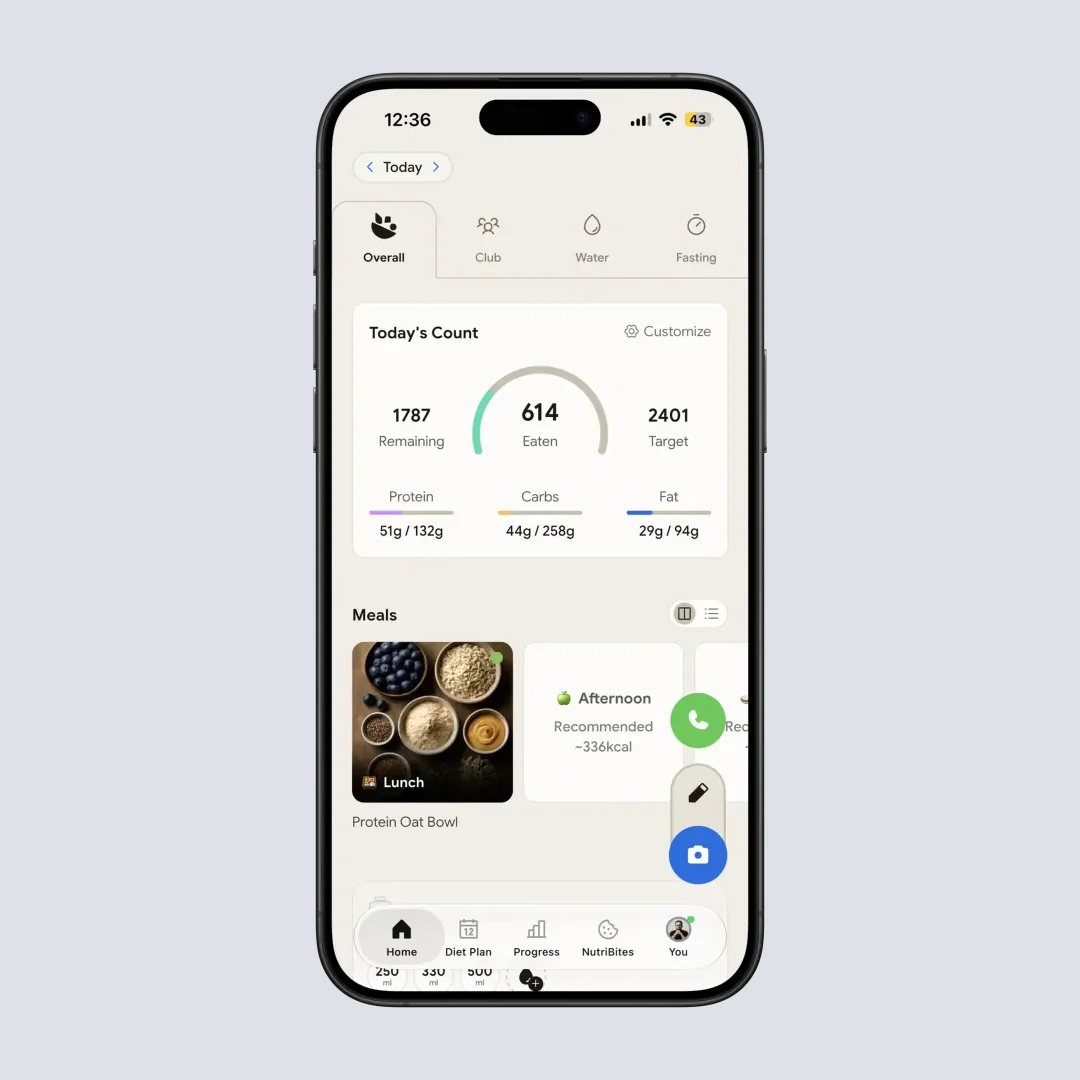
Stelo shows how your glucose responds after you eat, and its app has its own meal logging. NutriScan works on the food side. It logs a meal from a photo and returns calories, protein, carbs and fat for mixed plates. It does not read a CGM. Glucose readings are logged by hand, for free, and shown next to the meals you ate around them. The free plan has 5 photo scans a week, and Premium is about $59 a year. Meal logging by photo is covered in the meal scan guide. If you finish a Stelo experiment and want to keep tracking what you eat without buying more sensors, NutriScan's pricing is laid out the same way as this guide.
Keep the food log after the sensor comes off
The lasting part of a CGM month is knowing which meals to repeat. Photograph them while the sensor is on, and the log outlives the last sensor.
FAQ
Is the Stelo app free?
The Stelo by Dexcom app is free to download, but it needs a Stelo biosensor to show glucose data, and the sensors are paid. The simplest way in is the $99 one-time pack with two 15-day sensors.
How much does Stelo cost per month?
The monthly subscription is $89 for two sensors. The 3-month subscription is $252 for six sensors, which Dexcom advertises as $84 a month. Without a subscription, one pack of two sensors is $99.
Can I get a refund on Stelo?
Not for orders on stelo.com. Dexcom says all sales are final, with no returns or exchanges. You can cancel an order within 60 minutes of placing it. Sensors with a confirmed product issue are replaced, not refunded. Orders from Amazon or other retailers follow that retailer's policy.
Is Stelo cheaper than Lingo?
On the 3-month plan, yes, slightly. Stelo's 3-month subscription is about $2.80 a day and Lingo's 12-week subscription about $2.96 a day. Stelo's monthly subscription at $89 is about $2.97 a day, the same as Lingo.
Does insurance cover Stelo?
Stelo is sold as a cash-pay product, but it is HSA and FSA eligible. The dietitian sessions Stelo offers through Nutrisense are billed to insurance, and Stelo says 95% of eligible users pay $0 out of pocket for them.
IMPORTANT
Recap: everything you checked.
⏱️ Progress 4/4 • ~13 minutes in • Nicely done
✅ Step 1: Plan prices per sensor, day and year
✅ Step 2: Refunds, canceling and failed sensors
✅ Step 3: Insurance, Lingo and who can buy
✅ Monthly subscription first, cancelled after the first box ships: a one-month trial for $89 instead of $99 (revealed)