Is Nutrisense Free? Nutrisense Pricing, CGM Cost and Refunds
 ChatGPT
 Claude
 AI Mode
 Perplexity
Nutrisense is not free: its CGM program lists at $179 to $249 a month on the Nutrisense plans page in October 2026, or $152 to $212 with the NS15 code the site applies at checkout. The app download costs nothing, the app-only plan is $39 a month, and Nutrisense says every charge is non-refundable once it goes through.
Prices checked on October 9, 2026 on Nutrisense's plans, FAQ, cost, Bring Your Own Sensor and Dietitian Coaching pages, four articles in its help center, its Terms of Service (last updated April 13, 2026), the US App Store listing and Dexcom's Stelo shop. Nutrisense sells only in the United States.
A 2024 meta-analysis of 25 randomized trials with 2,996 adults found that feedback from a continuous glucose monitor (CGM) lowered HbA1c by 0.28 percentage points and added 7.4 percentage points of time in the normal glucose range, with no significant effect on body weight or BMI (Richardson et al., 2024). We keep that result next to the Nutrisense price list. A 6-month Nutrisense program costs more than $900 even with a discount code, so it helps to know what the money buys, what insurance covers and what you cannot get back.
TL;DR - Nutrisense Pricing
- Free? No. Only the app download, a 3-day trial of the app-only plan and insurance-covered dietitian calls cost nothing.
- CGM program: $249 for 1 month, $209 a month for 3 months, $179 a month for 6 months at list, with two Stelo sensors a month.
- With the NS15 code: $212, $178 and $152 a month.
- App only: $39 a month or $199 a year if you bring your own sensor.
- Dietitian calls: $0 for most insured members, $50 each on self-pay, $75 for a late cancel.
- Refunds: none. Sensors cannot be returned, and leaving a 3- or 6-month term early costs a fee.
IMPORTANT
Your Nutrisense pricing check at a glance.
Four stops, and the last one is the one that saves money.
⏱️ Progress 0/4 • ~0 minutes in • Keep going
⏳ Step 1: What each plan costs per month and per term
⏳ Step 2: The app-only plan, dietitian calls and insurance
⏳ Step 3: Canceling, refunds and early exit fees
🔍 The same sensors for $179 to $341 less over six months (revealed near the end)
The quick answer: Nutrisense is not free
Three things about Nutrisense cost nothing, and none of them is the program itself:
- The app download. The App Store listing shows the app as free (version 5.57.0, released September 10, 2026, rated 4.3 from 4,314 ratings), but it needs a paid plan to do anything useful.
- A 3-day trial of the app-only plan. The Bring Your Own Sensor page offers a 3-day free trial before the $39 monthly or $199 yearly charge.
- Dietitian calls, if insurance pays. Nutrisense says 95% of those eligible pay $0 out of pocket for one-to-one dietitian video calls.
Everything else is paid: the glucose sensors, the program that ships them, and the app membership. There is no free version with sensors, and the company's FAQ states the floor plainly: CGM plans "start at $179 per month" and app memberships "start at $39 a month."

The app is free to download. The number on the checkout page is the part to read twice.
Nutrisense price list for October 2026
The plans page showed three CGM program lengths on October 9, 2026, each with a 15% discount through the NS15 code:
| Plan | List price | With NS15 | Total over the term (list) | Total over the term (NS15) |
|---|---|---|---|---|
| 1-month (month-to-month) | $249/mo | $212/mo | $249 | $212 |
| 3-month commitment | $209/mo | $178/mo | $627 | $534 |
| 6-month commitment | $179/mo | $152/mo | $1,074 | $912 |
| Bring Your Own Sensor (app only) | $39/mo or $199/yr | n/a | $39 a month | n/a |
The term totals are our arithmetic from the monthly prices. Two details on the Nutrisense site do not line up with this table. The older CGM cost page still describes a 12-month plan at $215 a month, cut to $151 with a SAVE30 code, which makes a year cost more per month at list than six months. We could not find the 12-month plan in the current checkout, so treat it as a leftover until Nutrisense shows it on the plans page.
The NS15 banner on the CGM program page comes with a countdown timer, the kind that resets. Codes change often on this site. Before you buy, compare the price in the cart with this table.
What the CGM program includes
According to the plans page, each program month includes:
- Two Dexcom Stelo glucose sensors a month, with the Stelo app, an overpatch and free monthly shipping.
- The Nutrisense app with Nora AI, which tracks glucose, meals, sleep and activity and flags patterns before your dietitian calls.
- Access to one-to-one dietitian coaching. The program "recommends 2 video calls per month," billed to insurance if you qualify.
- Access to stress management sessions, also billed to insurance where covered.
- Access to advanced lab testing on the 3- and 6-month plans.
The word that matters in that list is "access." The sensors and app are part of the monthly price. The video calls are billed separately to your insurer, and if you have no coverage, they cost extra (see the next sections). The app also includes food logging with a barcode scanner, meal comparisons and Meal Scores, and it syncs with MyFitnessPal, Google Fit and Oura according to the CGM program page.
On phones, Nutrisense needs iOS 16.2 or Android 12, but the Stelo app it relies on needs at least iOS 18.6 or Android 13, per the plans page. Check the Stelo requirement before you pay, since an older phone can read nothing from the sensor.

Nutrisense vs Signos on price
Signos is the closest rival: a US program that also ships Stelo sensors with an app. In our Signos pricing guide, the Signos plans page listed $299 for 1 month, $199 a month for 3 months and $169 a month for 6 months, or $225, $150 and $127 with the code it showed on October 9, 2026.
| Plan length | Nutrisense list | Nutrisense NS15 | Signos list | Signos with code |
|---|---|---|---|---|
| 1 month | $249 | $212 | $299 | $225 |
| 3 months | $209/mo | $178/mo | $199/mo | $150/mo |
| 6 months | $179/mo | $152/mo | $169/mo | $127/mo |
At list, Nutrisense is cheaper on the 1-month plan and a little more expensive on the longer terms. With each site's code, Signos wins on 3 and 6 months. The difference is what you get for it: Signos leans on its app and automated prompts, while Nutrisense bundles human dietitian calls that insurance often pays for. Nutrisense's own FAQ makes that pitch against "Stelo or Signos." If you want a person reading your data, Nutrisense is the better buy; if you want the cheapest sensor-plus-app program, check both carts on the day. The best app for CGM users guide compares more options, including Levels and Lingo.
IMPORTANT
Checkpoint: you know the sticker prices.
Next up is the part of the bill that depends on your insurer.
⏱️ Progress 1/4 • ~3 minutes in • Keep going
✅ Step 1: What each plan costs per month and per term (done)
👉 Step 2: The app-only plan, dietitian calls and insurance (you're here)
⏳ Step 3: Canceling, refunds and early exit fees
🧩 The same sensors for $179 to $341 less over six months (coming soon)
The $39 Bring Your Own Sensor plan
If you already wear a CGM, the Bring Your Own Sensor plan sells the Nutrisense app without the hardware for $39 a month or $199 a year. The yearly price works out to about $16.58 a month, less than half the monthly rate.
It connects to these sensors:
- iPhone: Stelo, Dexcom G7, Dexcom G6, FreeStyle Libre 3, Libre 2, Libre 1 and Abbott Lingo (what Lingo costs).
- Android: the same list without Lingo.
You get glucose charts, Meal Scores, syncing with Apple Health, Fitbit, Oura and Google Fit, and an eligibility check for insurance-covered dietitian calls. You do not get sensors shipped to you, so you buy them from Dexcom, Abbott or your pharmacy. This plan is where the 3-day free trial sits, so it is the only way to try Nutrisense before paying.
Dietitian calls: insurance, self-pay and the $75 late fee
The dietitian is the part Nutrisense sells hardest, and its price depends on your insurer. The Dietitian Coaching page says:
- Nutrisense is in network with Aetna, UnitedHealthcare, Cigna, Anthem and Blue Cross Blue Shield.
- "Most members pay $0 out-of-pocket for 3 or more video calls per year," and 95% of eligible members pay $0.
- If your plan has a copay, Nutrisense tells you before the call.
- Without coverage, self-pay calls cost $50 per session.
- Canceling a call less than 24 hours ahead costs $75, and insurance will not cover that fee.
Two numbers are worth putting side by side. The program recommends two calls a month, and insured members most often get "3 or more" covered calls a year. If your plan covers only a handful of visits, the rest are $50 each on self-pay, so two calls a month on self-pay adds $100 to the monthly bill. Run the free eligibility check before you choose a plan, not after.
Insurance does not pay for the sensor. The CGM program page says "the biosensor itself is an out-of-pocket expense," while the whole program, sensors and app membership included, is HSA and FSA eligible.
IMPORTANT
Checkpoint: you are halfway through.
You know what you pay. Now see what you cannot get back.
⏱️ Progress 2/4 • ~6 minutes in • Keep going
✅ Step 1: What each plan costs per month and per term (done)
✅ Step 2: The app-only plan, dietitian calls and insurance (done)
👉 Step 3: Canceling, refunds and early exit fees (current)
⏳ The same sensors for $179 to $341 less over six months (next)
How to cancel Nutrisense
The cancellation article in the Nutrisense help center, updated January 7, 2026, gives these steps in the app:
- Open the Nutrisense app and tap the icon in the upper left corner.
- Select Programs & Add-ons and choose your program.
- Tap Show product details, then Modify Subscription.
- Tap No, I want to cancel my subscription.
- Tap Cancel When Commitment Ends, answer the prompts and tap Confirm.
You can also cancel by email through the help center form. The timing rule is strict: cancel at least 72 hours before your billing date, or the next month is charged. The same article says all plans "automatically renew monthly unless canceled," and if you do not cancel, "you'll continue to be charged on a month-to-month basis at your current rate." That means a 6-month plan at $152 keeps billing $152 a month after month six until you stop it.
Nutrisense also lets you "snooze" a program instead of canceling, according to its CGM program page. That is useful for travel, but the commitment still has to run its course.
Refunds and early cancellation fees
The billing policy is short: "All Nutrisense membership programs and add-on charges are non-refundable." The refund and return policy adds that monthly subscriptions are non-refundable once charged and that sensors "cannot be returned due to medical, regulatory, and safety guidelines." The only return route the help center mentions is for defective or malfunctioning devices.
Leaving a committed plan early costs more. The early cancellation policy says:
- Early cancellations "will be subject to fees," based on your account and how many months of the commitment you have completed.
- Nutrisense gives you a breakdown of the fee before it cancels.
- If you do not accept the fee, "your subscription will continue to renew at your current rate."
- To cancel early, you fill in the Early Cancellation Form from the app or email [email protected].
- On the month-to-month program, "there is no fee to cancel after your first charge and shipment."
Nutrisense does not publish the fee formula. If you might stop early, the 1-month plan is the only one with a stated no-fee exit, even though it costs $249 at list against $179 for six months.
One more rule from the Terms of Service: if you bought Nutrisense through a third-party reseller, that reseller's refund and cancellation rules apply, and "Nutrisense does not process or issue refunds for these purchases." The terms also carry an arbitration clause with a class action waiver, under Illinois law.

With no refunds and an unpublished exit fee, the math has to happen before checkout.
Who can buy Nutrisense
The Terms of Service say the services "are for use by persons located in the United States only." Outside the US, the sensor-plus-coaching programs we have priced are ZOE in the UK and the HealthifyMe CGM plan in India.
Inside the US, you need a phone that runs the Stelo app (iOS 18.6 or Android 13 and later, per the plans page) and, for covered dietitian calls, an insurer Nutrisense works with.
If you have diabetes, talk to your doctor first
Nutrisense says its program "is not intended to diagnose, cure or prevent any conditions such as diabetes." If you take insulin or other glucose-lowering medication, your care team decides which CGM and targets fit you, and you should not change doses based on a wellness app.
What the research says about CGMs for weight loss
Nutrisense sells glucose data for weight loss, energy and "metabolic health." The research supports some of that and not the rest.
- Modest effects on glucose, none on weight. The Richardson meta-analysis above pooled 25 trials and found HbA1c fell 0.28 points with CGM feedback, but BMI and weight did not change significantly. Most trials were in people with type 2 diabetes, and 11 of 25 had CGM-industry conflicts of interest.
- People respond differently to the same food. A study of 800 people and 46,898 meals found high variability in glucose response to identical meals (Zeevi et al., 2015). This is the basis for personalized advice.
- But one reading of one meal is noisy. In an NIH feeding study of 30 adults without diabetes and 1,189 meal responses, the same meal served a week apart gave responses with low reliability (intraclass correlation 0.17 to 0.28), and the authors said advice needs "aggregated repeated measurements" (Hengist et al., 2025). Test a meal more than once before you drop it.
- Healthy glucose spends most of the day in range. In 153 healthy adults and children, median time between 70 and 140 mg/dL was 96%, and mean glucose was 98 to 99 mg/dL for everyone under 60 (Shah et al., 2019). Short spikes after meals are normal.
- Some "normal" people are not so normal. A Stanford study found people with normal standard tests still reached prediabetic glucose levels 15% of the time on a CGM (Hall et al., 2018). That is the best case for a CGM if you have risk factors.
- CGM use without diabetes is growing faster than the evidence. A 2023 review sorted non-diabetic use into four groups, from metabolic disease to elite sport, and said the field still needs data to support it (Klonoff et al., 2023).
In short: a CGM can teach you how your meals behave and can flag early glucose problems, but weight loss still comes from eating less energy over time. The dietitian part of Nutrisense may matter more than the sensor.
IMPORTANT
Checkpoint: one stop left.
Prices, insurance and exit rules are covered. The cheaper route is next.
⏱️ Progress 3/4 • ~10 minutes in • Keep going
✅ Step 1: What each plan costs per month and per term
✅ Step 2: The app-only plan, dietitian calls and insurance
✅ Step 3: Canceling, refunds and early exit fees
✨ The same sensors for $179 to $341 less over six months (about to reveal)
The cheaper route: Stelo plus the app-only plan
The Nutrisense program ships a sensor you can buy yourself, and the app is sold on its own. Bought separately, the two cost less than the bundle.
Dexcom sells Stelo directly, and its shop page listed the monthly Stelo subscription at $89, against $99 for a one-time order of two sensors, and HSA/FSA eligible on October 9, 2026. Stelo's site even sends buyers to Nutrisense: its nutrition coaching page books insurance-covered calls with Nutrisense dietitians, with the same "95% of eligible users pay $0" line.
That means you can rebuild most of the Nutrisense program from parts. Here is 6 months priced both ways, using the prices above:
| Six months of | Stelo sensors | Nutrisense app | Total |
|---|---|---|---|
| Nutrisense 6-month program, list | included | included | $1,074 |
| Nutrisense 6-month program, NS15 | included | included | $912 |
| Stelo subscription + app monthly | $534 | $234 | $768 |
| Stelo subscription + app yearly plan | $534 | $199 (covers 12 months) | $733 |
| Stelo subscription alone | $534 | none (free Stelo app) | $534 |
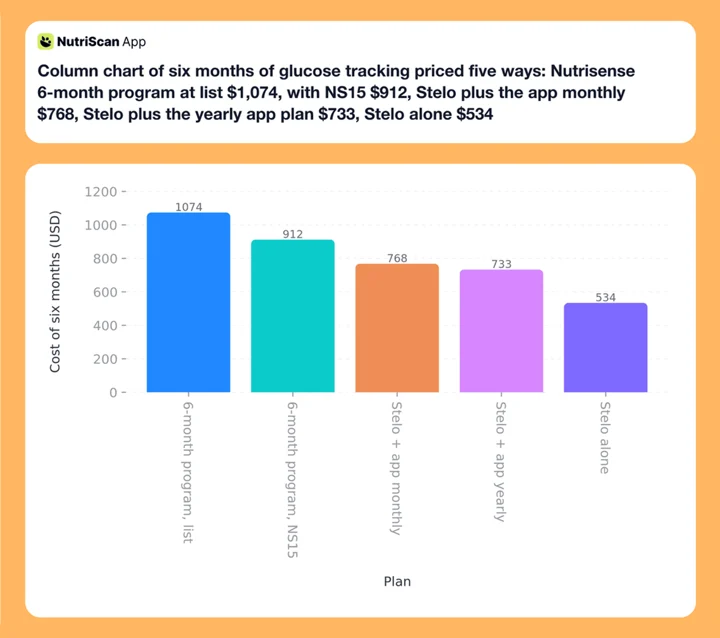
Figure 1: Six months of glucose tracking priced five ways, from Nutrisense and Dexcom Stelo prices on October 9, 2026.
Stelo plus the yearly app plan comes to $733. That is $179 less than the 6-month program with NS15 and $341 less than the same program at list.
In both setups, dietitian calls go through the same insurance check. What you give up by buying the parts: the program's lab testing access, the stress sessions and a single bill. What you keep: no committed term, so no early cancellation fee, and the option to stop sensors after one month while keeping the app for food logging. Stelo's own subscription has its own terms, so read Dexcom's before you order.
Who the price makes sense for
Good fit: you have prediabetes or insulin resistance, your insurer covers the dietitian calls, and you will use two calls a month to turn glucose data into meal changes. For you, the program price buys the sensors plus a covered clinician, and the 3-month plan ($534 with NS15) is long enough to learn your patterns.
Better as parts: you already have a CGM from your doctor or can buy Stelo at $89 a month. Pair it with the $199 yearly app plan and book the covered calls. You pay about $733 for six months instead of $912 to $1,074, with no committed term.
Poor fit: you have no dietitian coverage and mainly want to lose weight. Self-pay calls at $50 each on top of $152 to $249 a month buys glucose curves when the research above shows weight moves with calories, not curves. A food tracker gets you most of the way for a fraction of the cost. Our cheapest nutrition app comparison lists the options.
How to buy Nutrisense without losing money: 5 steps
- Run the insurance check first. It is free on the Dietitian Coaching page. If calls are covered, compare the full program with Stelo plus the $39 app plan.
- Price the whole commitment. The 6-month plan is $1,074 at list or $912 with NS15, per the plans page, and none of it is refundable.
- Start month-to-month if unsure. It costs more per month, but it is the only plan with no stated cancellation fee after the first charge and shipment.
- Schedule the cancellation early. Programs & Add-ons, Show product details, Modify Subscription, Cancel When Commitment Ends. Do it at least 72 hours before a billing date so the plan does not roll over.
- Pay with HSA or FSA funds. Nutrisense says the program, sensors and app membership are eligible, which cuts the real cost by your tax rate.
Where NutriScan fits
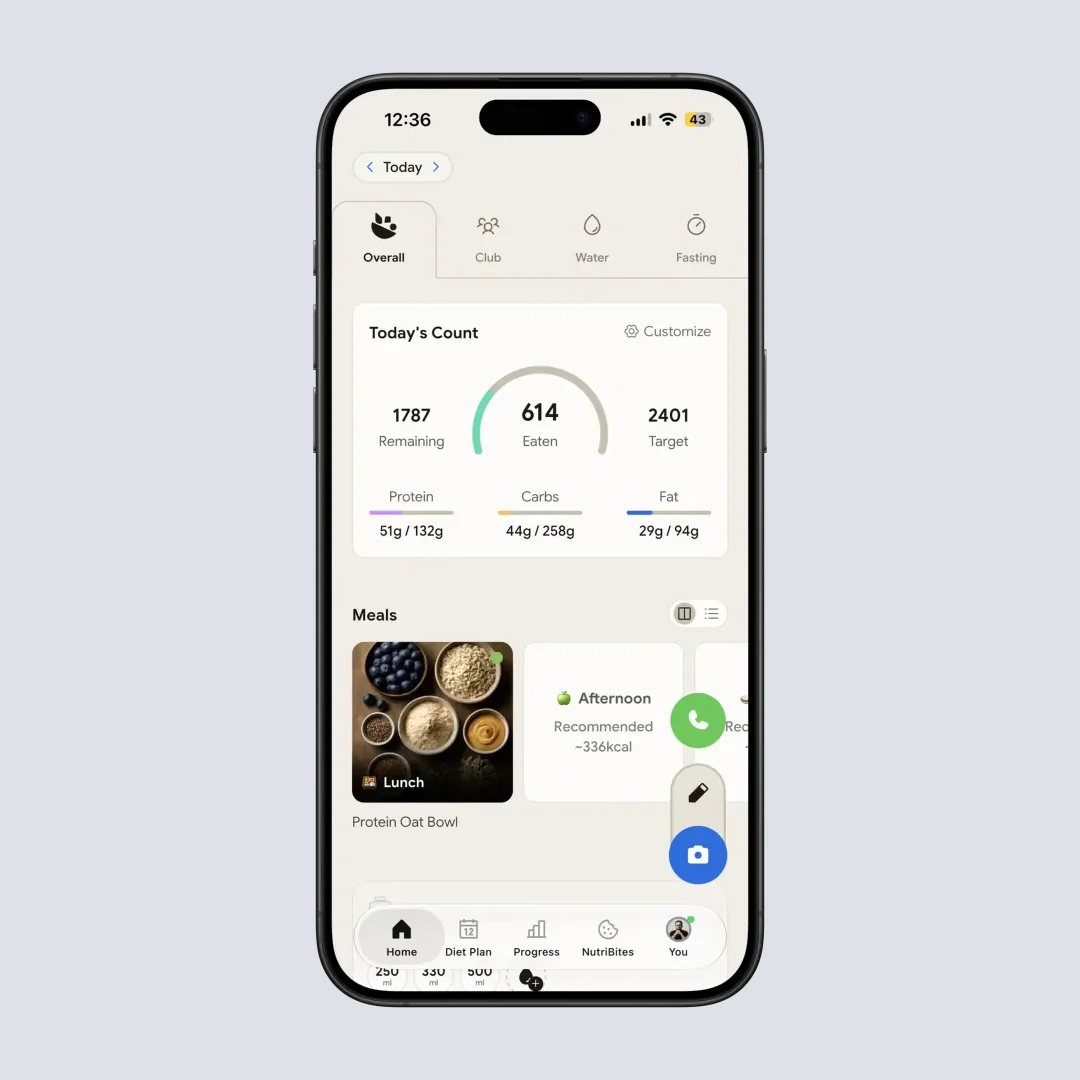
Nutrisense charges for sensor data and a dietitian. NutriScan works on the food side. It logs a meal from a photo and returns calories, protein, carbs and fat for mixed plates. It does not read a CGM: glucose readings are logged by hand, for free, and shown next to the meals you ate around them. The free tier has 5 scans a week, and Premium is about $59 a year. If you finish a Nutrisense term and want to keep logging meals without the monthly fee, NutriScan's pricing is laid out the same way as this guide. To set calorie and carb targets first, use the macro calculator or the diabetes macro calculator.
Keep the food log after the sensor comes off
The lasting part of a CGM month is knowing which meals to repeat. Photograph them while the sensor is on, and the log outlives the subscription.
FAQ
Is the Nutrisense app free?
The download is free, but the app needs a paid plan. The cheapest is the Bring Your Own Sensor plan at $39 a month or $199 a year, which starts with a 3-day free trial and works with a Dexcom or FreeStyle Libre sensor you already have. The full CGM program with sensors starts at $179 a month.
How much does Nutrisense cost per month?
In October 2026 the CGM program lists at $249 for month-to-month, $209 a month on a 3-month commitment and $179 a month on a 6-month commitment. With the NS15 code shown on the site they drop to $212, $178 and $152. The app-only plan is $39 a month or $199 a year.
Can I get a refund from Nutrisense?
No. Nutrisense says all membership programs and add-on charges are non-refundable once processed, and sensors cannot be returned. Leaving a 3- or 6-month plan early adds a cancellation fee based on the months you have completed.
Does insurance cover Nutrisense?
Insurance can cover the one-to-one dietitian video calls, and Nutrisense says 95% of eligible members pay $0 for them. It does not cover the glucose sensors. Without coverage, calls are $50 each on self-pay. The program, sensors and app are HSA and FSA eligible.
Is Nutrisense cheaper than Signos?
It depends on the plan length. At list, Nutrisense is cheaper month-to-month ($249 against $299) and Signos is cheaper on 6 months ($169 against $179). With the codes each site showed on October 9, 2026, Signos was cheaper on the 3- and 6-month plans ($127 against $152 for 6 months). Nutrisense adds human dietitian calls that insurance often covers.
IMPORTANT
Recap: everything you checked.
Save this for the day you open the checkout page.
⏱️ Progress 4/4 • ~13 minutes in • Nicely done
✅ Step 1: What each plan costs per month and per term
✅ Step 2: The app-only plan, dietitian calls and insurance
✅ Step 3: Canceling, refunds and early exit fees
✅ Stelo plus the $199 yearly app plan: $733 for six months, against $912 to $1,074 (revealed)