Is Sensa Free? Sensa Pricing, Trial and Refund Rules
 ChatGPT
  Claude
  AI Mode
  Perplexity
The US App Store lists three Sensa subscription products: $29.99 for one month, $59.99 for three months and $59.99 for six months. The download costs nothing, and nothing useful sits behind it for free.
Sensa's price pages, terms and help articles were read on September 21, 2026, and the store prices, ratings and Trustpilot score were rechecked on October 3, 2026. Two things stood out. Sensa's website never shows you a price until you finish a quiz and reach checkout, and the refund policy is one of the tightest in this category: no refunds at all unless you can prove the product is faulty. This guide covers what Sensa costs, what you get, what the refund rules say, and how to stop a renewal before it charges.
Prices last checked on the US App Store and Google Play listings on October 3, 2026, and in Sensa's terms and help center on September 21, 2026. Prices change by region and offer.
IMPORTANT
Your Sensa pricing check at a glance.
Four stops, so you know what you would really pay.
⏱️ Progress 0/4 • ~0 minutes in • Keep going
⏳ Step 1: Who sells it and what the plans cost
⏳ Step 2: What it buys, refunds and canceling
⏳ Step 3: What the research and users say
🔍 The safest way to buy Sensa, if you buy it at all (revealed near the end)
Who makes Sensa
Sensa is published by Mental Health Solutions, UAB, company code 306145863, with a registered address at Krivių 5, LT-01204 Vilnius and an office at Aludariu 3, LT-01113 Vilnius, Lithuania. Those details come straight from Sensa's own contacts page and are repeated in the privacy policy. Support runs through [email protected].
The store listings name a second company. The Google Play developer is Innodiets UAB, and the iPhone bundle identifier is com.innodiets.sensa, the same Innodiets prefix used by other Vilnius health apps in the Kilo Health group, such as Cardi Health and the Kure hypnosis app. The App Store seller line, however, reads Mental Health Solutions UAB, and the copyright line on the listing reads "© 2022 Mental Health Solutions."
Here is the roster in one place:
| Name | Role |
|---|---|
| Mental Health Solutions, UAB (code 306145863) | Contracting company, data controller, App Store seller |
| Innodiets UAB | Google Play developer, app bundle identifier |
| Kilo Health | Vilnius group whose staff authored the published Sensa study |
The app is Sensa - Mental Coach on iPhone, first released on October 4, 2021 and rated 3.9 from about 1,100 US ratings. On Android it is simply Sensa, with 100,000+ downloads and a 3.2 rating from 3,600 reviews.
One date matters more than the ratings. The iPhone build, version 1.27.13, shipped on April 14, 2025, and the Android listing was last updated the same day. Both stores have been quiet for nearly 18 months, and the subscriptions have kept renewing the whole time.
Is there a free version of Sensa?
No. The app installs at no cost, then asks you to sign in with the email address you used at purchase. Sensa's own download instructions put it in order: "If you have already purchased a subscription, you can access the Sensa app by downloading it directly from the App Store or Google Play." The purchase comes first, the app second.
There is no free tier named anywhere in the terms, no free plan listed on either store, and no limited mode advertised on the website. What you can use without paying is the quiz. It runs long, asks how you identify, what you are struggling with, and how often it affects you, then produces a plan and a price.
What does Sensa cost in 2026?
Two published price sources exist, and they do not agree.
The US App Store list
The In-App Purchases section on the US App Store listing shows three products:
| Plan name in the store | Price |
|---|---|
| 1 month plan | $29.99 |
| 3 month plan | $59.99 |
| 6 month plan | $59.99 |
The three-month plan and the six-month plan carry the same $59.99 price. Apple shows the product names the developer typed in, so either the three-month product is priced at twice its per-month value or the six-month product is the one bargain in the list at about $10 a month. There is no annual product at all.
The Google Play description
Sensa's own Play Store description says the app "offers several subscription options, starting from $30.99." That floor is a dollar above the cheapest product Apple lists, which tells you the two stores are not selling the same catalog, and that the number in the description is stale relative to at least one of them.
The website price
There is no published website price. Sensa's general terms describe the flow instead of the number: you are "asked to provide certain information" first, and only then "will be provided with the Offer," which includes the "payment amount for the relevant Services." The quiz is the paywall. Until you reach the final screen, the site will not tell you what it wants.
That matters because the terms also say all prices are in US dollars unless otherwise indicated, and that "the price applicable is that set at the date on which you place your order." Two people taking the same quiz on the same day can be shown different offers, and neither has a list price to check it against. If you want a price you can read before you commit, our roundup of the cheapest nutrition and health apps sticks to apps that publish one.
 Finishing a ten-minute quiz to find out what an app costs.
The eBook upsells
After purchase, Sensa's all-products page offers three one-time add-ons at heavy discounts: a Mindful Eating eBook at $21.98 marked down from $60.00, a Self-improvement eBook at $16.48 from $30.00, and a sleep guide called Switching Off at $19.99 from $40.00. These are separate charges, not subscription content. Buy all three and you have added $58.45 to whatever the plan cost.

Is there a Sensa free trial?
Sometimes, and only on the company's terms. The general terms say Sensa "may offer the trials of paid subscriptions for the limited time at a special price or without payment," and that the company "will automatically begin charging the Client for the subscription on the first day following the end of the Trial."
Three things follow from that wording. A trial is not guaranteed, so what you see depends on the funnel you land in. A trial can cost money, because the terms allow a trial "at a special price" rather than a free one. And the charge is automatic the day it ends, so the trial only stays free if you cancel inside it.
Neither store listing advertises a trial, which means any trial you meet came from the website quiz. Treat the number on that screen as the only trial terms you have.
IMPORTANT
Checkpoint: here is where you are right now.
You know who sells Sensa and what the stores charge.
⏱️ Progress 1/4 • ~3 minutes in • Keep going
✅ Step 1: Who sells it and what the plans cost
👉 Step 2: What it buys, refunds and canceling
⏳ Step 3: What the research and users say
🔍 The safest way to buy Sensa (still ahead)
What the subscription actually buys
Sensa is a self-guided cognitive behavioral therapy app, not a therapy service and not a service with a human in it. The app features page lists daily lessons based on CBT principles, mindfulness and breathing activities, a mood journal, personal insights, and habit building. Sensa's own blog adds the specifics: an 86-day plan you get on purchase, 32 activities across health, mindfulness, relaxation and physical activity, a Quick Relief set for panic moments, and a DASS-21 assessment you can take once every seven days.
The website gives you ten entry points to pick from: stress and anxiety, ADHD, procrastination, burnout, self-esteem, fatigue, social anxiety, PTSD, ASD and disorganization. Your answer steers which plan you are sold.
The daily time commitment is quoted two different ways on one page. The feature grid says daily tasks are "quick, yet effective from just 10-30 minutes each day," while the section below it says lessons take "just 5-15 minutes of your time." Budget for the larger number.
Sensa's own store description carries the disclaimer that matters most here: mental self-help apps "are not a replacement for or a form of therapy, nor are they intended to cure, treat, or diagnose medical conditions, including psychiatric conditions." If you are choosing between Sensa and a therapist, the company is telling you these are not the same purchase.
The refund policy in plain English
Sensa's refund policy runs to one opening sentence that decides almost everything: "The Company follows a no refund policy, unless the product is proven to be not as described or faulty."
To get anywhere under that clause you must contact [email protected] "within 14 days upon purchase" and "provide detailed information proving Company's product fault (with visual proof attached)." Changing your mind, never opening the app, or finding the plan did not help you are all outside that clause.
 Sensa's refund policy, summed up by a crab.
Four more lines tighten it further:
- Once a refund is issued, you lose access to the product.
- Refunds go back to the original payment method and can take up to 14 working days to land.
- Miss the deadline and, in the policy's own words, "we will be unable to offer a refund."
- Deleting your account does not create a refund right. The help center repeats this in bold: deletion "does not initiate a refund," and it is irreversible.
There is a separate clause aimed at buyers in the EU and UK, where distance selling law normally gives you 14 days to withdraw from an online purchase. Sensa's terms state, in capitals, that for digital content not supplied on a tangible medium "the Client agrees to lose his/her right of withdrawal of the agreement." Ticking the terms box at checkout is what waives it.
Compare that with the guarantees some rivals publish. BetterMe's pricing terms and the money-back promises common across fasting app refund rules give you a defined window with no fault requirement. Sensa requires proof of a fault instead. Note also that cardi.health and klinio.com both publish a standalone money-back page; sensa.health has none, and the URLs where you would expect one return a 404.
One route survives all of this. If you bought inside the App Store or Google Play, the refund decision belongs to Apple or Google, not to Sensa, and their own policies are more generous than this one.
How to cancel Sensa
The rule that catches people first: deleting the app cancels nothing. Sensa's terms say so in capitals, and the Play description repeats it. So does the account deletion article. The subscription outlives all three.
You must also act early. The terms say you "may elect to cancel the subscription at least 48 hours before the end of current period." Cancel 24 hours out and the next period can still be charged.
Where you cancel depends on where you bought:
| Where you bought | How to cancel |
|---|---|
| sensa.health (website) | The Manage Subscription page in the app, the subscription management page on the website, or an email to [email protected] |
| Apple App Store | Apple ID settings only, at Settings, your name, Subscriptions |
| Google Play | Google Play account only, at Payments and subscriptions, Subscriptions |
Sensa's terms are explicit that a store purchase "may be canceled only through his Apple or Google Account." Emailing Sensa about an App Store subscription will not stop it. If you want the same steps for a different app, we keep a walkthrough for canceling NutriScan Premium that mirrors the Apple and Google routes screen by screen.
Cancel first, then decide about deleting your account. Deletion is permanent, it does not stop billing on a store subscription, and it removes the account you would need to argue a refund from.
IMPORTANT
Checkpoint: midway progress update.
You know the money rules. Now, does the app work?
⏱️ Progress 2/4 • ~6 minutes in • Keep going
✅ Step 1: Who sells it and what the plans cost
✅ Step 2: What it buys, refunds and canceling
👉 Step 3: What the research and users say
⏳ The safest way to buy Sensa (next)
What the evidence says about Sensa and CBT apps
There is one published study on Sensa itself. Valinskas and colleagues, 2023, in JMIR Formative Research, looked at 381 community users who started Sensa between October 2021 and March 2022 and took the DASS-21 at least twice. Scores fell on all three subscales: anxiety from a mean of 7.25 to 6.12, depression from 11.05 to 9.01, and stress from 11.42 to 9.96. Users with more than 24 days of use and at least 12 active days had 3.46 times higher odds of reducing their depression score.
Read that with the author list open. Four of the five authors give their affiliation as KiloHealth, Vilnius. It is a retrospective pilot cohort with no control group, so it cannot separate the app from time passing, and the paper is the company reporting on its own users. It is a reasonable signal. It is not independent evidence.
The wider literature is more sober and more useful. Linardon and colleagues, 2024, in Health Psychology Review, pooled 69 randomized trials of mental health apps and found a small effect on perceived stress, g = 0.27, which shrank to g = 0.10 after correcting for small-study bias. For comparison, Carpenter and colleagues, 2018, in Depression and Anxiety, pooled 41 placebo-controlled trials of conventional CBT across 2,843 patients and found g = 0.56 on target symptoms, with response rates carrying an odds ratio of 2.97. Therapist-delivered CBT is the stronger intervention by a wide margin.
As Figure 1 shows, the pooled effect of mental health apps on stress is about half the effect of therapist-delivered CBT, and close to a fifth of it once small-study bias is corrected.
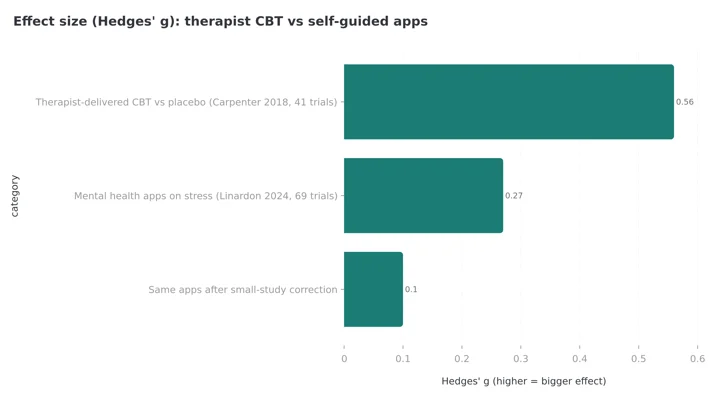 Figure 1: Pooled effect sizes from Carpenter and colleagues (2018) for CBT against placebo and Linardon and colleagues (2024) for mental health apps on stress. The two reviews measured different outcomes in different groups, so read the gap as a rough guide, not a head-to-head trial.
Engagement is where app plans usually fail. Liu and colleagues, 2026, in JAMA Psychiatry, pooled 79 trials and found app uptake of 92.4% but adherence of only 61.8%, with attrition of 18.6% by posttest and 28.4% by follow-up, and those are trial conditions with reminders and researcher contact. Outside a trial, Baumel and colleagues, 2019, in the Journal of Medical Internet Research, tracked real usage of 93 popular mental health apps and found a median 30-day retention rate of 3.3%. Roughly 3 in 100 installs were still opening the app a month later.
That number and Sensa's 86-day plan do not sit comfortably together. The company's own analysis found the benefit concentrated in users past 24 days and 12 active days, and Linardon and colleagues, 2026, in Psychiatry Research, found engagement correlates with improvement at r = 0.16 across 13 trials. The purchase only pays off if you are in the minority who keep opening it.
What Sensa users say
Sensa holds a 2.8 TrustScore from 333 reviews on Trustpilot, on a profile claimed in October 2021. Trustpilot flags two things on the page itself: the company has "no recent history of asking for reviews," and it "hasn't replied to negative reviews."
The store ratings run higher and disagree with each other. The iPhone app sits at 3.9 from about 1,100 US ratings while the Android app sits at 3.2 from 3,600 reviews, a wide gap for one product. Trustpilot tends to attract people who paid on the website, which is also where the no-refund policy and the quiz-gated price apply.
One more mismatch worth knowing. Sensa's terms state that you "shall not access Services if he/she is under the age of 18," while the App Store rates the app 13+ and Google Play rates it Everyone. A 14-year-old can install it and is barred by contract from using it.
IMPORTANT
Checkpoint: final stretch before the reveal.
One more stop on who Sensa suits, then the buying advice.
⏱️ Progress 3/4 • ~9 minutes in • Keep going
✅ Step 1: Who sells it and what the plans cost
✅ Step 2: What it buys, refunds and canceling
✅ Step 3: What the research and users say
✨ The safest way to buy Sensa (about to reveal)
Who Sensa is and is not for
Sensa makes sense if you want structured CBT reading and exercises, you are comfortable working alone, you can commit to daily use for roughly three months, and you accept that the money is gone once it leaves your account. Buying through the App Store or Google Play instead of the website is the single best decision available, because it swaps Sensa's fault-only refund policy for Apple's or Google's.
Look elsewhere if you want a trial you can read the terms of before starting, a published price you can compare, a refund route that exists for buyer's remorse, or any contact with a clinician. If your stress shows up mainly around food and sleep, a habit tracker plus something practical on eating for better sleep covers more ground for less money. And if symptoms are severe, the evidence above points to a therapist: the pooled effect of therapist-delivered CBT is about twice the app effect, and more than five times the corrected one.
Where NutriScan fits
NutriScan publishes this post, and we make a competing app. NutriScan (150k+ downloads, 4.6 stars) does not compete with Sensa. It is a food tracker, with no CBT lessons, mood journal or anxiety plan, so it does not replace anything Sensa sells. What it covers is the food side, which is where stress often shows up first: skipped meals, late snacking and too much caffeine.
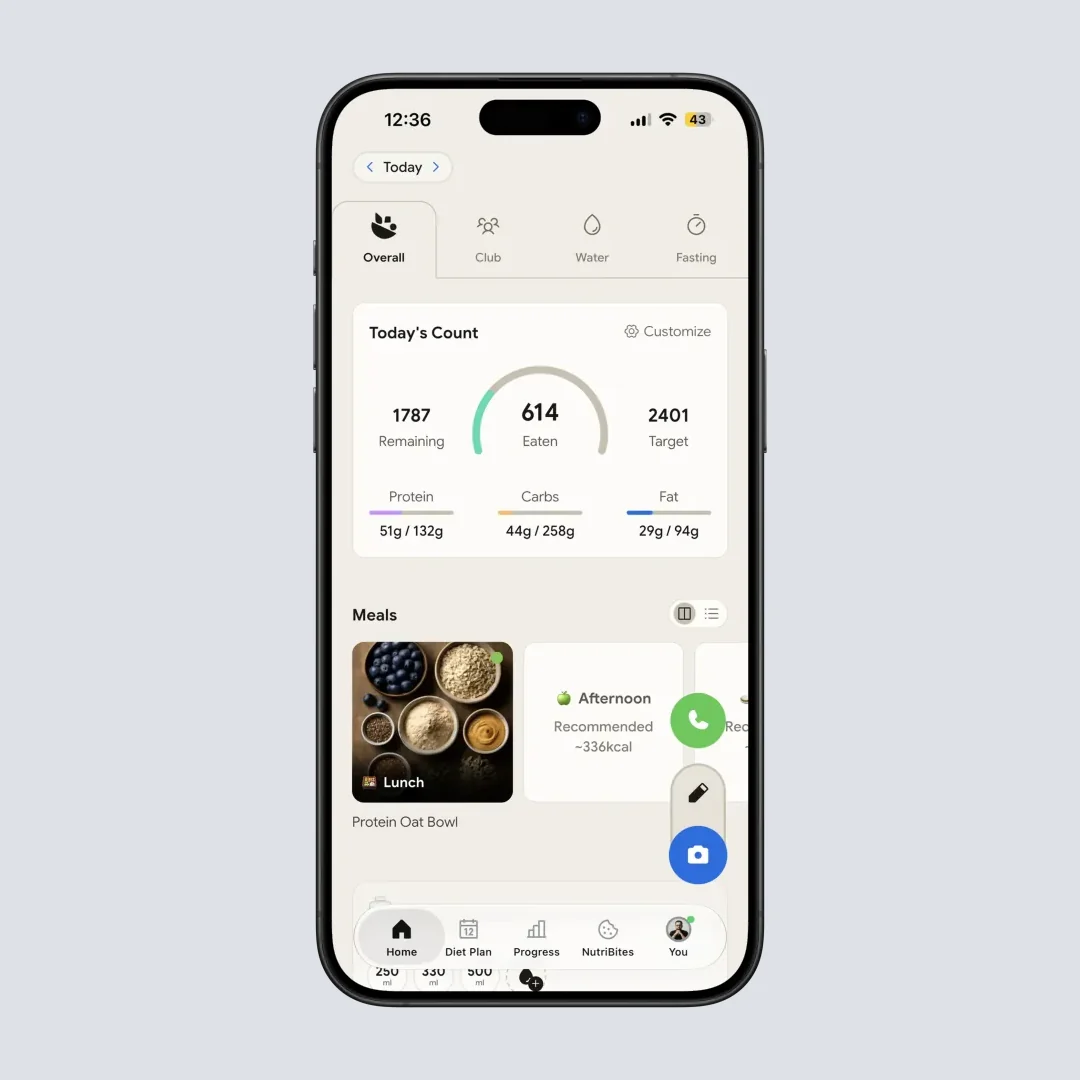
You take a photo of your meal, tag the food type and cooking method, and the app estimates calories, protein, carbs and fat, which you can correct. The Free plan includes 5 meal scans a week, and Premium removes the limit for about $59 a year. The price is printed on our NutriScan pricing page before you sign up.
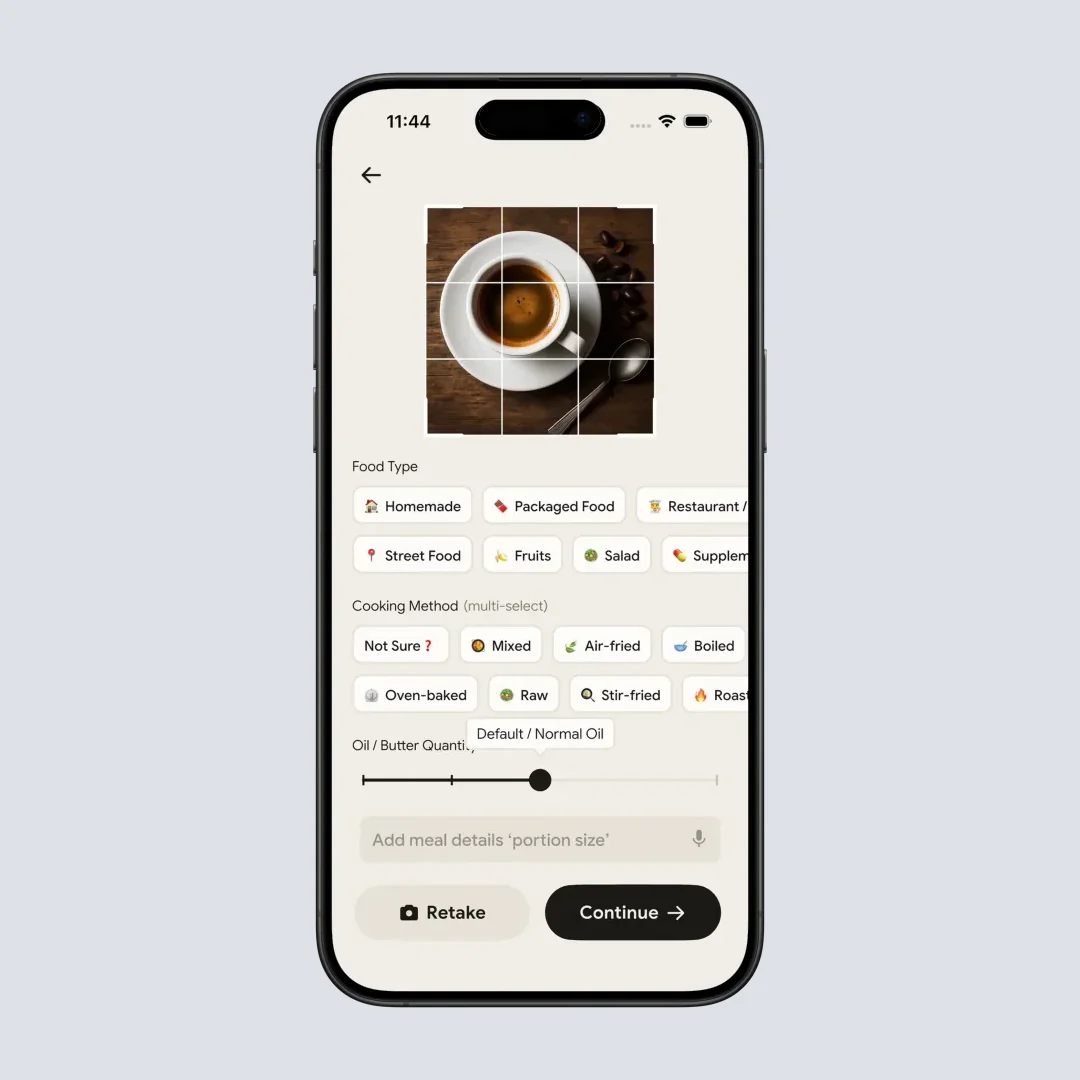
Home > Camera Icon > Click Picture
The home screen shows the day's calories and macros against your target, so a pattern like eating nothing until 3 p.m. is visible in a week of logs rather than a guess.
Home > Overall
To set a calorie target before you track anything, the online calorie calculator takes a minute.
Frequently asked questions
Is Sensa free to download? Yes, the app is free on both stores, but there is no free tier inside it. Sensa's own help center tells you to buy the subscription first and download the app afterwards, signing in with the email you registered at checkout.
How much does Sensa cost per month? The US App Store lists a one-month plan at $29.99. The three-month and six-month plans are both $59.99, which works out at $20.00 and $10.00 per month. The Google Play description says options start at $30.99, and the website terms will not quote a price until you finish the quiz.
Does Sensa give refunds? Only for faults. The refund policy is no refund "unless the product is proven to be not as described or faulty," claimed within 14 days of purchase with visual proof attached. If you bought through Apple or Google, ask them instead, because their policies are broader.
How do I cancel my Sensa subscription? If you bought on sensa.health, use the Manage Subscription page in the app or on the website, or email [email protected]. If you bought through a store, cancel in your Apple ID or Google Play account. Do it at least 48 hours before the period ends, as the terms require, and remember that deleting the app does not cancel anything.
Does deleting my Sensa account get my money back? No. The help center states that deletion "does not initiate a refund" and cannot be reversed. Ask for the refund first and delete the account afterwards, if at all.
Is Sensa a replacement for therapy? No, and Sensa says so in its own store listing. The published trial evidence puts self-guided mental health apps at a small effect on stress, well below the effect found for therapist-delivered CBT in placebo-controlled trials.
Who owns Sensa? Mental Health Solutions, UAB, company code 306145863, based in Vilnius, Lithuania. The Google Play developer is listed as Innodiets UAB, and the published study on the app was written by staff at KiloHealth.
What I would do
Here is the safest way to buy Sensa: buy it on the App Store or Google Play rather than on sensa.health, and if the store shows you the 6-month plan at $59.99, that is the lowest monthly cost in the list, about $10 a month, for the same price as three months. The store price is printed before you pay, the cancel switch sits in a settings screen you already know, and a refund request goes to Apple or Google instead of into a policy that needs you to prove a fault within 14 days.
If you buy on the website anyway, screenshot the offer screen before you pay, because that price appears nowhere else, and set a calendar reminder for 48 hours before the period ends.
Then decide honestly how many days you will open it. Sensa's plan runs 86 days, its own study found the benefit in users past 24 days and 12 active days, and independent tracking of 93 mental health apps put median 30-day retention at 3.3%. The plan is priced for people who finish it.
IMPORTANT
Recap: your Sensa pricing check is done.
Save this before you pay for anything.
⏱️ Progress 4/4 • ~11 minutes in • Nicely done
✅ Step 1: The download is free; App Store plans run $29.99 to $59.99, and the website hides its price behind a quiz
✅ Step 2: Refunds cover proven faults within 14 days; cancel 48 hours before renewal
✅ Step 3: Apps show a small effect next to therapist-delivered CBT, and most users stop within a month
✅ The safest way: buy in the store, where the 6-month plan at $59.99 works out to about $10 a month (revealed)