How to Use AI and ChatGPT to Make a Meal Plan
 ChatGPT
  Claude
  AI Mode
  Perplexity
TL;DR - Getting a usable meal plan out of AI
• Chatbots are good at: structure, variety, a grocery list, a full week drafted in seconds • They are bad at: the numbers. A 30% band on a 1,300 calorie day is 390 calories, a whole meal • The key number: dietitians scoring ten chatbots on two obesity cases found 67.2% accuracy at best • The prompt that works: body weight, calorie target, protein floor in grams, gram weights per item • The routine: one day ➡️ audit the totals ➡️ verify the three biggest items ➡️ scale to a week ➡️ log what you eat
When researchers compared ChatGPT's nutrition estimates against United States Department of Agriculture data, 97% of the model's energy values fell within a 40% difference of the reference figure, and every meal in a chatbot-built daily plan stayed inside a 30% band of the USDA calorie value (Haman et al., 2024). That result gets quoted as proof that AI can plan your diet. Read the band instead of the percentage: 30% of a 1,300 calorie day is 390 calories, which is a whole meal.
Working on NutriScan's food-logging team, I see this every week. Someone arrives with a seven-day plan a chatbot wrote in nine seconds, well structured, sensibly varied, and wrong by a few hundred calories a day in a direction nobody checked. I work on a photo food-logging app, so treat my opinion of tools as an interested one and check every number below against the source I link.
Short verdict: use a chatbot to draft structure, variety and a shopping list. Do not use it as the source of truth for calories, protein or micronutrients. Verify the numbers in a real food database, then log what you eat rather than what the plan said.
IMPORTANT
Your AI meal plan roadmap.
A quick map so you can act fast.
⏱️ Progress 0/4 • ~0 minutes in • Keep going
⏳ Step 1: Three plans people brought me, and what broke each one
⏳ Step 2: The prompt library, by goal and by diet
⏳ Step 3: The eight step build and the checking routine
🔍 The four numbers chatbots get wrong most often (revealed near the end)
Three AI Meal Plans People Brought Me 🍽️
These are composite examples, not real people. The numbers are the ones the chatbots produced.
Take a 68 kg office worker who asked for a 1,300 calorie day. The chatbot returned oatmeal, a chicken salad, salmon with rice and broccoli, and Greek yogurt, totalling a stated 1,297 calories. Structure: good. Problem: not one item had a gram weight. "A serving of salmon" ran from 85 g to 170 g in her kitchen, and "a drizzle of olive oil" was closer to a tablespoon, roughly 120 calories on its own. Her real intake landed near 1,650, because unmeasurable plans drift upward.
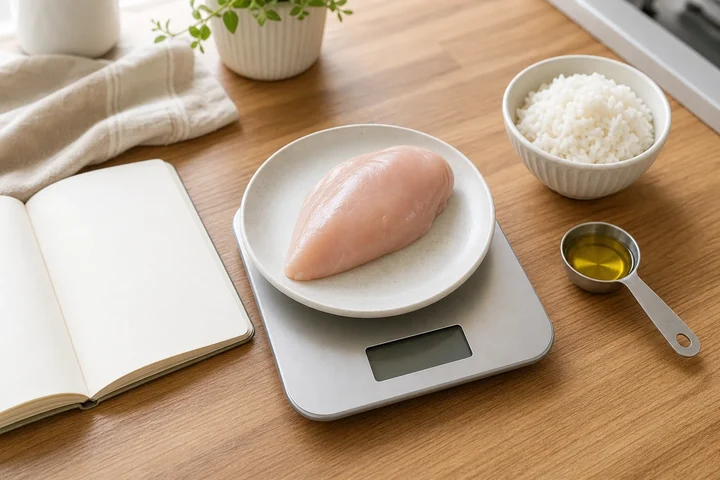 Gram weights are the whole difference between a plan you can check and a plan you can only hope about
Take a 92 kg man who asked for an AI-generated keto meal plan. He got a clean week: eggs and avocado, a bunless burger, steak and buttered greens. The carbohydrate totals were plausible. The fiber was not: three of the seven days landed under 12 g, and two had no potassium source beyond a handful of spinach. The model optimizes the macro you named and drops the nutrients you did not.
Take a 24 year old lifter who wanted a high protein cut. He asked for "a gym diet plan at 2,200 calories with high protein." The model gave him 118 g and called it high. At 82 kg and lifting four days a week, that is under 1.5 g per kg, thin for a deficit. He had never told the chatbot his body weight, so it used a generic idea of "high." Re-prompting with a protein floor in grams rebuilt the plan in one pass.
One lesson: the chatbot answers the question you asked with the constraints you supplied. Vague inputs produce a plan that reads well and measures badly.
 Write your own inputs down before you open the chat window, because that is the part the model cannot guess
IMPORTANT
Checkpoint: here's where you are right now.
Three failure modes named, and every one of them started with a missing input.
⏱️ Progress 1/4 • ~1 minute in • Keep going
✅ Step 1 (done)
👉 Step 2 (you're here)
⏳ Step 3
🧩 The four numbers chatbots get wrong most often (coming soon)
What the Research Actually Says About AI Nutrition Advice 📊
Four studies published since 2024 agree on the shape of the problem.
On plain food numbers, AI is roughly in the right area. The USDA comparison above also found low coefficients of variation across repeated queries, meaning the model gave similar answers when asked twice (Haman et al., 2024). Good enough for a rough draft, not for a 300 calorie deficit.
On clinical scenarios, accuracy collapses. Three registered dietitians scored ten chatbots on two obesity cases. For a 35 year old man with obesity and no other conditions, the best model reached 67.2% accuracy and the worst 21.1%. For a 65 year old woman with obesity, type 2 diabetes, sarcopenia and chronic kidney disease, no chatbot achieved 50%. Most gave contradictory protein guidance, telling the same patient to both reduce and increase protein in one answer (Ponzo et al., 2024).
On sports nutrition, accuracy sits between a third and three quarters. An assessment of ChatGPT, Gemini and Claude across training and racing nutrition found accuracy from 74% down to 31%, with citation quality low under simple prompts and better under detailed ones. On questions modeled on a sports dietetics certification exam, scores ran 89% to 61% (Solomon and Laye, 2025).
On medically restricted diets, current models are not usable. Across fifty hypothetical hemodialysis profiles, four chatbots all misrepresented nutrient content and underestimated phosphorus and potassium (Shi et al., 2026).
One study points at the fix. A Llama model given a knowledge bank built from the American Heart Association's dietary guidance, and made to cite it, outscored off-the-shelf ChatGPT-4o, Perplexity and plain Llama on reliability, appropriateness and guideline adherence, with no harmful responses (Parameswaran et al., 2025). A model grounded in a real document beats a model working from memory, and you can copy that trick by pasting real numbers into the chat.
TIP
Paste the nutrition facts you actually have, from a label or a food database, into the chat before you ask for a plan. You are doing by hand what the grounded model did automatically, and it measurably improves the output.
The Prompt Library: What to Type for Each Kind of Plan ✍️
Every prompt below opens with the same profile block. Detailed prompts improved chatbot performance in the sports nutrition assessment, simple ones did not.
The profile block, paste this first every time:
I am [age], [sex], [height], [weight] kg, activity level [sedentary / 3 gym days / 6 training days]. Goal: [lose fat / maintain / gain]. Daily target: [X] calories with at least [Y] g protein. I cook [N] minutes on weekdays. I dislike [foods]. I cannot eat [allergies]. Give every item a gram weight, and give calories and protein per item plus a daily total. Do not use cups, handfuls or "a serving".
Then add one of these:
| What you want | What to add to the profile block |
|---|---|
| A 1,300 calorie fat loss day | "One day at 1,300 calories, 3 meals plus 1 snack, protein at least 100 g, under 500 calories per meal." |
| A full week you can shop for | "Build 7 days. Repeat breakfast and lunch to cut cooking. End with a grocery list grouped by aisle, in grams." |
| A keto or low carb week | "Net carbs under 30 g a day. At least 25 g fiber, and name a potassium source at every dinner. List net carbs per item." |
| A carnivore-style plan | "Animal foods only. Flag every micronutrient below the Adequate Intake or RDA that this plan cannot supply." |
| A high protein gym plan | "Protein floor 1.8 g per kg, across 4 eating occasions with at least 30 g each. Largest carb serving after training." |
| 2 meals a day | "Two eating occasions only, 11am and 7pm, each 600 to 750 calories, protein at least 45 g per meal." |
| 3 meals a day, no snacks | "Three meals, no snacks, roughly even calories, protein at least 35 g per meal." |
| A workout and diet plan | "Give the training split first. Then, in a second reply, build the meal plan around it." |
Two habits do most of the work. Name the constraint in units, not adjectives: "at least 140 g protein" instead of "high protein". Then close with "list any nutrient here that falls short of the RDA or Adequate Intake for me", which makes the model audit its own draft. It is often right about what it missed even when wrong about the amounts.
WARNING
Never ask a chatbot to build a diet around a medical condition, a pregnancy, an eating disorder recovery, or a drug you take. The hemodialysis study is the clearest evidence of the risk: every model underestimated the exact minerals that were the reason for the diet (Shi et al., 2026). Recovery-phase and clinical plans belong with a registered dietitian.
IMPORTANT
Checkpoint: midway progress update.
You have the prompts. Next comes the part that decides whether the plan survives contact with your kitchen.
⏱️ Progress 2/4 • ~4 minutes in • Keep going
✅ Step 1 (done)
✅ Step 2 (done)
👉 Step 3 (current)
⏳ The four numbers chatbots get wrong most often (next)
Build Your AI Meal Plan in Eight Steps 🧭
Step 1: Write down your inputs. Age, sex, height, weight, activity, goal, allergies, dislikes, weekday cooking minutes, budget. Five minutes here saves three rounds of re-prompting later.
Step 2: Fix your calorie and protein targets outside the chat. Chatbots invent a target from a formula they will not name. Get a maintenance figure from a TDEE calculator, subtract a deficit you can hold, and set your protein floor with a protein intake calculator. Hand the model the gram figure, not the adjective.
Step 3: Send the profile block plus one goal line. Ask for one day first, not a week. A one-day draft is fast to inspect and cheap to throw away.
Step 4: Audit the single day. Add up the per-item calories yourself and compare to the model's stated total. Mismatches are common and tell you how carefully the draft was built.
Step 5: Check the three biggest items in a food database, not in the model's memory. Errors concentrate in the biggest portions, so a look at chicken breast, oats or Greek yogurt catches most of the drift. If a value is out by more than about 15%, correct it in the chat and ask for a rebuild.
Step 6: Scale the corrected day into a week. Repeated breakfasts and lunches, varied dinners, a grocery list in grams grouped by aisle. Ask for fewer ingredients, not more variety: a week with 12 ingredients gets cooked, a week with 40 gets abandoned by Wednesday.
Step 7: Cook it for three days and weigh your portions. Kitchen scale, everything including oil and drinks.
Step 8: Adjust from your log after week two. If weight is flat and your log matches the plan, the target was too high. If weight is dropping faster than 1 kg a week, eat more.
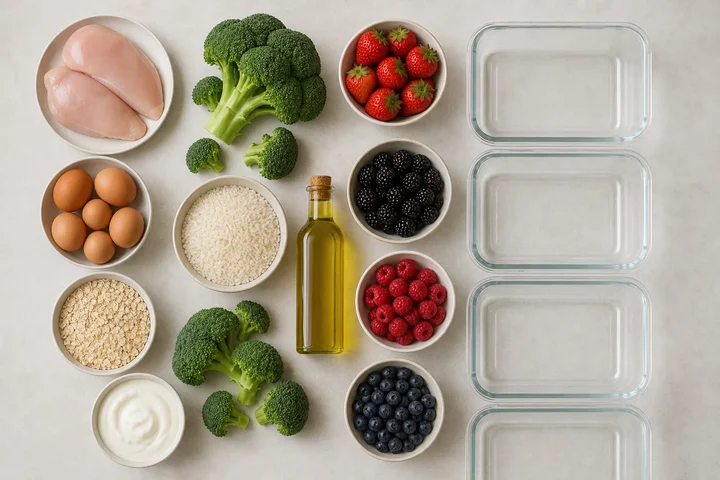 Twelve ingredients across a week is the version people actually shop for and cook
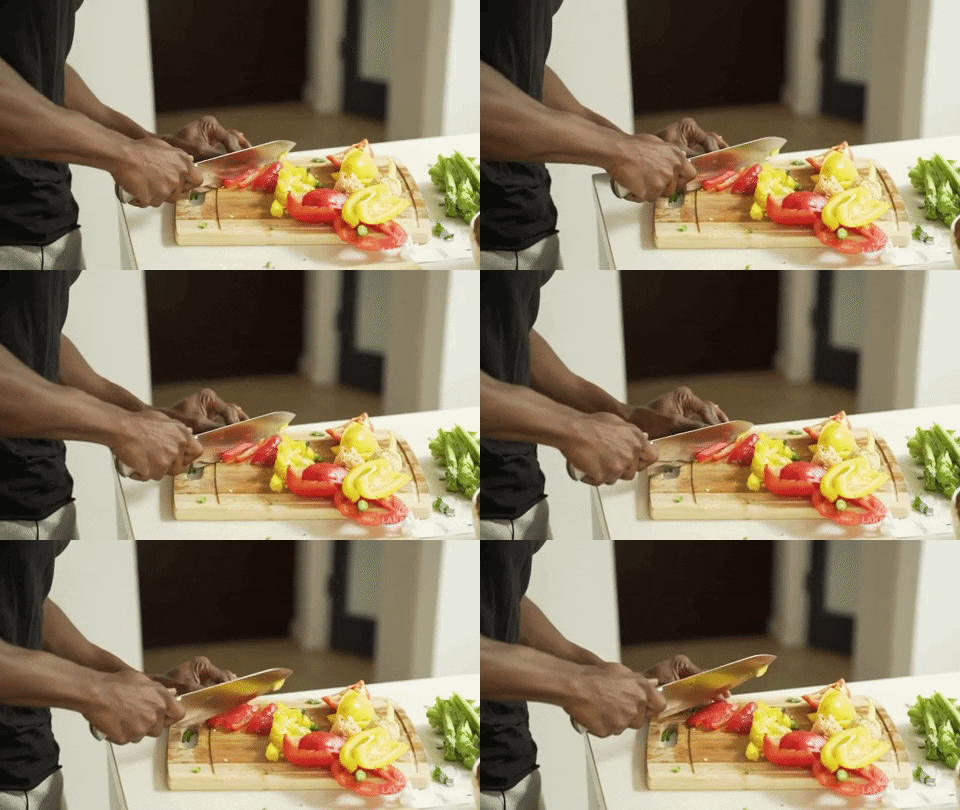 Step 7 is the one everybody skips, and it is the only step that tells you whether the plan is real
Where AI Meal Plans Go Wrong 🔍
Five failure modes account for nearly everything I see.
Vague portions. Cups, handfuls and "a serving" are the largest source of error and the model's default unless you ban them. An unaccounted tablespoon of oil is over 100 calories.
Composite dishes with no numbers. "Vegetable curry with rice" is one line in a plan and a 250 calorie range in real life, the vagueness the hemodialysis study flagged (Shi et al., 2026).
Macro tunnel vision. Name one macro and the model optimizes it while dropping fiber, potassium, calcium and iron. Ask for the shortfall list.
Confident contradiction. The obesity case study found protein increases and decreases in the same response (Ponzo et al., 2024). Read the whole answer, not the summary at the top.
Arithmetic drift. Per-item numbers that do not sum to the printed total. Adding the column yourself takes 30 seconds, and my colleague's case for counting calories with AI versus simply writing them down is the slower, more reliable version of it.
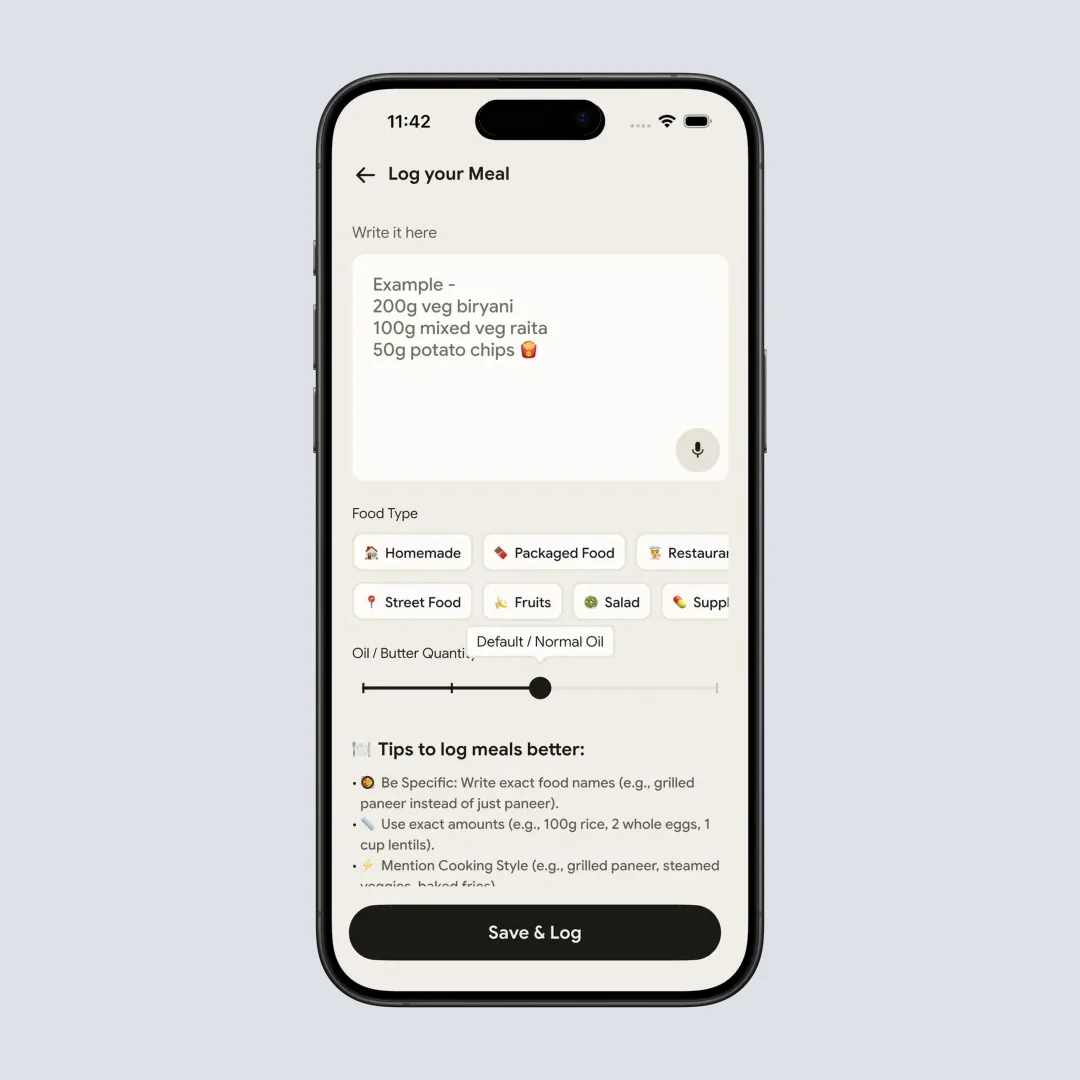
Logging by hand takes about as long as reading the plan for that meal. In-app path: Home > Pencil Icon > Write About Meal
Can AI Replace a Nutritionist? 👩⚕️
The scoring studies answer this. A best case of 67.2% on a straightforward obesity brief, a complex kidney and diabetes case that broke every model (Ponzo et al., 2024), sports nutrition running 74% down to 31% (Solomon and Laye, 2025), and harmful cardiovascular answers from off-the-shelf models where a grounded one produced none (Parameswaran et al., 2025). Those are not the numbers of a replacement.
For practitioners this looks like a change of workload rather than a replacement. Drafting client menus, rewriting a plan for another cuisine, producing a grocery list: that is the unpaid evening admin of practice, not the assessment work. A registered dietitian is a legally protected qualification with supervised practice and an exam behind it, and no chatbot holds one. For a wider comparison of automated plan builders against human coaching, my colleague's review of AI diet plan generators versus a coach puts both side by side.

Free AI Meal Planning Tools, and What Free Actually Buys 🧰
There are three categories, and they solve different problems.
General chatbots write the plan. Free tiers of ChatGPT, Gemini and Claude all produce a menu from a good prompt. What you get is text: no verified nutrition database behind it, no memory of what you ate. This is where the 30% band matters most.
Dedicated meal planning apps solve the grocery and recipe layer. They map plans to a shopping list and keep a recipe library, usually with a free tier capped by number of plans. Stronger than a chatbot at repeat use, weaker at custom constraints.
Food logging apps solve verification. They hold the food database and record what you actually ate, the only data that says whether the plan worked. A diet planning app closes the loop a chat window cannot, and this ChatGPT diet plan alternative is the comparison to read if you have been prompting your way through this.
Which one you need depends on where your plan fails. Cannot write a plan? Chatbot. Write plans and never shop for them? Planner. Shop, cook and still do not lose weight? The missing piece is the log.
IMPORTANT
Checkpoint: final stretch before the reveal.
One last nudge, the four numbers are next.
⏱️ Progress 3/4 • ~7 minutes in • Keep going
✅ Step 1
✅ Step 2
✅ Step 3
✨ The four numbers chatbots get wrong most often (about to reveal)
The Four Numbers Chatbots Get Wrong Most Often 🔢
None of them are hard once you have seen them written down.
One: AI on a nutrient table means Adequate Intake. The NIH defines it as an intake level assumed to ensure nutritional adequacy, set when the evidence is too thin for a Recommended Dietary Allowance (NIH Office of Dietary Supplements). Fiber, potassium, choline and vitamin K use AI values rather than RDAs, so a chatbot meeting "the AI for fiber" is using the nutrition meaning, not talking about itself.
Two: kilojoules are not calories. One food calorie equals 4.184 kilojoules, so the conversions people search for most often work out like this.
| On the label | In calories |
|---|---|
| 350 kJ | about 84 kcal |
| 450 kJ | about 108 kcal |
| 6 kcal | 6 calories, about 25 kJ |
| 14 kcal | 14 calories, about 59 kJ |
| 36 kcal | 36 calories, about 151 kJ |
| 63 kcal | 63 calories, about 264 kJ |
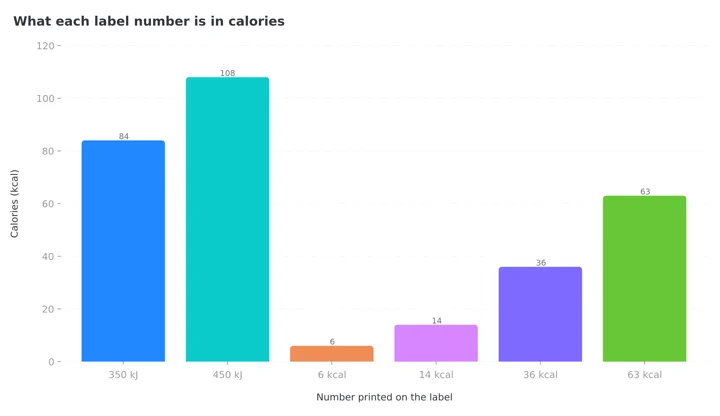 Figure 1: the two kJ bars dwarf the kcal bars because a kilojoule figure is about four times the calorie figure, which is why a chatbot quoting kJ reads like a wildly wrong calorie count
Australian, New Zealand and European labels lead with kilojoules, so a number four times larger than expected in Figure 1 is a unit, not an error.
Three: "calorie free" has a legal definition. Under United States labeling rules, "calorie free" and "zero calories" may be used only if the food holds less than 5 calories per reference amount customarily consumed and per labeled serving (21 CFR 101.60). A 6 kcal drink cannot carry the claim, a 4 kcal one can, and ten "zero calorie" servings still add up.
Four: weight loss speed has a ceiling. The CDC notes that people who lose weight gradually, about 1 to 2 pounds a week, are more likely to keep it off (CDC, Steps for Losing Weight). A chatbot proposing 800 calories a day, or 10 kg in a month, is your signal to reset the prompt.
Turn the Draft Into Something You Actually Eat 🚀
A chatbot is a fast, tireless, slightly overconfident assistant. Give it a real profile, a calorie number, a protein floor in grams and a ban on vague portions, and it writes in seconds what a person would need an hour to draft. Accept that draft unchecked and you have automated the guesswork rather than removed it.
Use the split the research supports: AI writes the structure, a food database supplies the numbers, your log settles the argument. Check the three biggest items, weigh your portions for three days, and re-prompt when a day comes up short instead of abandoning the week.
And if the part you keep skipping is the log, make that part fast. NutriScan is free to try, logs a meal from a photo in a few seconds, and gives you the record that tells you whether the plan your chatbot wrote is actually working.
Frequently Asked Questions ❓
What does AI stand for in nutrition?
On a nutrient reference table, AI means Adequate Intake: an intake level assumed to ensure nutritional adequacy, set when the evidence is not strong enough for a Recommended Dietary Allowance (NIH Office of Dietary Supplements). Fiber, choline, potassium and vitamin K all use AI values.
Can AI replace a nutritionist or a registered dietitian?
Not for anything clinical. Dietitians scoring ten chatbots on two obesity cases found the best model at 67.2% accuracy on the simple case and none above 50% on the case with diabetes, sarcopenia and kidney disease (Ponzo et al., 2024). AI drafts. Assessment and clinical diets stay with a qualified professional.
Is there a free AI meal planner?
Yes. Free tiers of the general chatbots write meal plans, and most dedicated planning apps have a free tier capped by generations or saved plans. Free buys the text. It rarely buys verified nutrition numbers or a record of what you ate, the part that decides whether the plan works.
Is 2 meals a day or 3 meals a day better in an AI plan?
Neither wins on its own. Meal count changes how easy the day is to follow, not the arithmetic. Two meals suits people who are not hungry in the morning and can handle 600 to 750 calorie plates. Three spreads protein better, which matters if you lift. State which you want, or the model defaults to three plus snacks.
How many calories is 350 kJ?
About 84 calories. One food calorie equals 4.184 kilojoules, so 350 divided by 4.184 gives 83.7 kcal, and 450 kJ is roughly 108 calories. Australian and European labels lead with kilojoules, so a chatbot reading one may hand back kJ when you asked for calories.
IMPORTANT
Recap: everything you completed this round.
You finished the run, save this for next time.
⏱️ Progress 4/4 • ~9 minutes in • Nicely done
✅ Vague portions, macro tunnel vision and unstated body weight break most generated plans
✅ Profile block plus one goal line, gram weights demanded, adjectives banned
✅ One day, audit, verify the three biggest items, then scale to a week
✅ AI on a nutrient table means Adequate Intake, 350 kJ is about 84 calories, and 1 to 2 pounds a week is the pace that sticks