Is Nourish Free? Nourish Dietitian Cost, Insurance and Fees
 ChatGPT
 Claude
 AI Mode
 Perplexity
Nourish is not free, but the company says 94% of its patients pay $0 out of pocket because a registered dietitian bills their health insurance (Nourish help center). Without usable insurance, the self-pay rate is $145 per session (Nourish FAQ). A third number matters too: $75 is the fee for a missed appointment or a change made less than 24 hours ahead, and insurance never pays it.
I work on the NutriScan team, which makes a food tracking app, so treat this as an outsider's reading of public documents. Every price and rule below comes from Nourish's help center, its consent form, its terms, the app store listings and customer reviews. Each one is linked so you can check it.
Prices and policies checked on October 30, 2026. Nourish operates in the United States.
IMPORTANT
Nourish pricing at a glance
- Nourish is a telehealth dietitian service. It bills each session to your health insurance.
- Nourish says 94% of patients pay $0 out of pocket. Copays, coinsurance and deductibles still apply if your plan has them.
- Without usable insurance, a session costs $145.
- A no-show, or a change made less than 24 hours before the session, costs $75. Insurance does not cover it.
- A credit card on file is required to sign up.
- If a claim is denied, Nourish says it will not charge you for sessions that already took place.
- The Nourish app is a free download with no in-app purchases listed.
Here is what this guide settles, in order:
- [ ] What insurance pays, and what the 94% figure leaves out
- [ ] The $145 self-pay bill over 12 weeks and over a year
- [ ] Who Nourish turns away (Medicaid, most Medicare)
- [ ] The $75 charge that insurance never covers
- [ ] The one habit that avoids it (last section before the FAQ)
Is Nourish free? The quick answer
It depends on your insurance. Nourish does not sell a subscription. It sells sessions of 50 to 60 minutes with a registered dietitian and sends the claim to your insurer. If your plan pays the full claim, you pay nothing. If it does not, you pay a copay, a share of the cost, or the full $145.
Nourish's own answer to the first-session question is careful. The help article says the session is not free, and that most patients are fully covered and so pay $0. It then adds a promise: "If your initial claim is denied for any reason, you will not be charged for any appointments that have already occurred".
So the honest short answer has three parts:
- Insured and in network: probably $0, sometimes a copay or coinsurance.
- Insured with a deductible you have not met: you may be asked to pay until you meet it.
- No insurance, or a plan Nourish does not take: $145 a session.
What Nourish is and who runs it
Nourish is run by Nourish, Inc. The Google Play listing gives the developer address as 3724 Jefferson St, Austin, Texas. The terms of use, effective December 29, 2025, say arbitration hearings can take place "in New York, where we reside".
The service works like this, according to the help center:
- You sign up and enter your insurance. Nourish checks your coverage.
- You pick a dietitian. The company says it has a network of "9,000+ dietitians" and is available in all 50 states.
- You meet on video. Sessions run on Zoom. Nourish does not offer sessions by text message or email.
- You use the app between sessions. You can message your dietitian, log meals and track progress.
Nourish says every provider is a registered dietitian nutritionist, which it describes as "a legally protected title". A coach inside a typical weight loss app is usually not a licensed clinician, and that difference is why a Nourish session can be billed to insurance.
The first session lasts 50 to 60 minutes. Nourish says most patients then meet weekly or every two weeks, and later move to monthly visits. The same article says: "There are no minimums or commitments".
Nourish cost with insurance
With insurance, your cost is whatever your plan leaves for you to pay. Nourish describes four possible outcomes.
| What your insurer does with the claim | What you pay |
|---|---|
| Pays it in full | $0 |
| Applies a copay or coinsurance | The amount your plan sets |
| Applies it to your deductible | The plan's rate until the deductible is met, or you can cancel the past claims |
| Denies it | $0 for past sessions, then $145 for each future one |
The 94% figure. Nourish repeats one number on almost every page, and the wording changes. One article says "94% of our patients have sessions fully covered by insurance". Another says "94% of in-network patients pay $0 out-of-pocket". The second version is narrower, because it counts only patients whose plan Nourish already accepts. On the pages I read, I found no date, sample size or method for the figure. Treat it as the company's own claim, and check your own plan.
Copays arrive late. Nourish learns your real cost only after the insurer answers the claim. The copay article says this "usually takes between 2-3 weeks". If you meet weekly, you can have three sessions before you know what each one costs.
Visit limits depend on the plan. Nourish says: "Most patients have no visit limits and can do as many sessions per year as they want." Some plans do set a limit. To check yours, call the number on your insurance card and ask about Medical Nutrition Therapy under billing codes 97802 and 97803.
There is a legal reason so many plans pay. HealthCare.gov lists "Diet counseling" for "adults at higher risk for chronic disease" among the preventive services that Marketplace plans and many other plans must cover without a copay (HealthCare.gov). The same page warns that "$0 cost isn't guaranteed in all cases." Whether you count as higher risk is decided by your plan.
Nourish cost without insurance: $145 a session
The self-pay rate is $145 per session. It applies in four situations that Nourish describes:
- Nourish does not take your plan. You can still book at $145.
- You have no insurance, or it is inactive. The help article says: "If you attend a session without active coverage (or no insurance), you will be charged our self-pay rate of $145."
- Your claim was denied. Past sessions are not charged. Future ones are self-pay.
- You chose not to pay toward your deductible. Future sessions are $145.
Three more facts about paying yourself:
- HSA and FSA cards work. Nourish says you can pay with either.
- Out-of-network plans are your job. Nourish says it "does not handle any billing for out-of-network plans." It gives you a superbill, which is an itemized receipt you send to your insurer yourself. The same article adds: "The session fee must be paid at the time of service."
- There is no discount program. The financial assistance article says: "We do not offer any financial assistance programs at this time."
Nourish has published its own view of market prices. A post on its blog puts a first visit with a dietitian at $70 to $150 on average. At $145, Nourish's self-pay rate sits near the top of the range it quotes.
What self-pay Nourish costs over time
Nourish publishes one price, so the total depends only on how often you meet. This table multiplies $145 by the schedules Nourish describes.
| Schedule | Sessions | Total at $145 |
|---|---|---|
| One first session | 1 | $145 |
| Every two weeks for 12 weeks | 6 | $870 |
| Weekly for 12 weeks | 12 | $1,740 |
| Monthly for a year | 12 | $1,740 |
| Every two weeks for a year | 26 | $3,770 |
| Weekly for a year | 52 | $7,540 |
The schedule you agree to matters more than the session price.
If you are paying yourself, ask your dietitian in the first session how many visits they expect you to need. Then decide on a schedule before you book the second one.
Done: insurance rules and the $145 rate. Next: the guarantee's limits, the $75 fee, who is turned away.
The Nourish Guarantee: what it covers
Nourish calls its billing promise the Nourish Guarantee. The guarantee article has three parts.
1. Denied claims. The article says: "If your appointment gets denied, we won't charge you for any appointments that have already occurred."
2. Copay or coinsurance. Nourish gives you an estimate before you start. You will not be charged more than that estimate for sessions you had before Nourish learned the real amount. After that, you pay the real amount for every future session.
3. Deductible. You get two choices for sessions that already happened. You can pay the deductible amount and keep billing insurance. Or you can decline, owe nothing for the past sessions, and pay out of pocket from then on.
The promise is clear, and it has three limits.
- It protects the past only. Once Nourish tells you your real cost, the guarantee stops covering new sessions.
- The estimate is not a quote. The copay explainer says "sometimes the actual cost you get back from insurance may vary."
- It does not cover the $75 fee. A missed session is charged whatever your insurance does.
The delay matters here too. Because a claim takes two to three weeks to come back, I would book the first two sessions and then wait for the insurer's answer before filling the calendar.
The $75 late cancel and no-show fee
This is the charge that surprises people. Nourish's cancellation article sets it out:
- More than 24 hours ahead: cancel or reschedule at no cost in the patient portal.
- Less than 24 hours ahead: $75 for a cancellation or a reschedule.
- You do not attend: $75 as a no-show fee.
The consent form that patients sign is firmer. It says: "This fee is not covered by your insurance and your insurance copay does not apply." It also says Nourish may charge the card on file for these fees "usually on the day they occur".
So a patient whose sessions cost $0 can still be charged $75. A missed session costs about half the price of a full self-pay session.
The fee applies to rescheduling as well as cancelling, so by my reading, moving a 9:00 session to 3:00 the same day counts as a late change.
Two items left: which insurers count, and the 48-hour habit that keeps the $75 away.
Which insurance Nourish takes
Nourish lists these insurers:
- Blue Cross Blue Shield, including Anthem, Highmark and Independence
- United Healthcare, including UMR, Oxford and Student Resources
- Aetna, including Meritain
- Cigna
- Devoted Health
- Medicare, for qualifying diagnoses only
Medicaid is not accepted. The Medicaid article says: "At this time, Nourish does not accept any Medicaid plans."
Medicare has strict rules. Nourish says Medicare covers its sessions only for diabetes, chronic kidney disease at stage 3 or higher, or a kidney transplant in the last 36 months. Its Medicare article adds: "No other diagnoses, including pre-diabetes will be covered." You also need a referral from an MD or DO.
Medicare's own page matches this. It says Part B covers 3 hours of medical nutrition therapy in the first calendar year and up to 2 hours in each later year, and "You pay nothing for these services if you qualify for them" (Medicare.gov). Three hours is about three Nourish sessions. A Medicare patient who wants weekly visits will run out of covered hours within a month.
Nourish has a coverage calculator where you enter your plan and get an estimate before you book.
One item left: the single habit that avoids the $75. It sits in the tips near the end, after the card rules and the reviews.
Why Nourish needs a card, and other charges
You must add a credit card to sign up, even if your plan pays everything. The card article says the card covers copays, coinsurance, deductible amounts and no-show fees. It adds: "You will always be notified before any charge is applied."
The charges a card on file can receive:
| Charge | Amount | Covered by insurance? |
|---|---|---|
| Self-pay session | $145 | No |
| Copay or coinsurance | Set by your plan | Your share only |
| Late change or no-show | $75 | No |
| Some lab panels | Not published | No |
Labs are a newer extra. Nourish now offers lab panels through the app. Its labs article says "some lab panels require payment via CC, and cannot be billed to your insurance." I could not find a lab price list on its website. One App Store reviewer wrote on September 18, 2026 that the app "said that the test would now cost me $19" for a panel they had expected to be free. I could not verify that amount.
Nourish says it has no other charges. Its fees article states: "There are no other hidden or surprise fees with Nourish."
Is the Nourish app free?
Yes. The App Store page lists the app as free, and I found no in-app purchases section on it. The app is a companion to the dietitian service. It is not sold as a separate tracker.
What the stores show:
- App Store: 4.8 from 32K ratings, age rating 16+. Version 2.1.0 came out on October 2, 2026.
- Google Play: 4.1 from 5.46K reviews, more than 100,000 downloads, last updated on October 1, 2026.
- Features listed: appointment booking, chat with your dietitian, "AI-powered meal logging", recipes, meal delivery orders, progress tracking and claim status for past sessions.
The app has changed a lot this autumn. Version 2.0.0 arrived on August 31, 2026, and most recent written reviews are about that redesign. I cover those below.
How to cancel Nourish and dispute a charge
There is no subscription to cancel. You stop Nourish by cancelling your future appointments.
- Open the patient portal at app.usenourish.com, or the Nourish app.
- Cancel each future session at least 24 hours before it starts. Later than that costs $75.
- Check for open claims. A copay for a past session can still be charged weeks later, after the insurer answers.
- Email [email protected] with any billing question, and keep the reply.
For a charge you think is wrong, the terms set a deadline. They say: "If you believe you have been billed in error for a subscription, please notify us within thirty (30) days of the billing date". After that, the terms say no refunds or credits will be issued, "except where required by applicable law."
Two more clauses in the terms affect a dispute:
- Arbitration. Disputes go to individual arbitration through JAMS, and you waive class actions. You can opt out in writing within 30 days of first agreeing to the terms.
- Liability cap. The terms limit Nourish's total liability to $100.
What users say about Nourish
The average rating and the recent written reviews tell different stories, so I read both.
The 4.8 App Store average covers about 32,000 ratings. I then read the 100 most recent written App Store reviews in Apple's public feed, dated September 1 to October 12, 2026:
- 41 gave one star, 25 gave two stars and 23 gave three stars.
- 11 gave four or five stars.
- 74 mention the update, the redesign or AI. This is the main complaint by a wide margin.
- 35 mention their dietitian or nutritionist, often to say the dietitian is the reason they stay.
- 7 mention insurance, billing or a charge. Three of those gave one star and two gave five.
Written reviews are self-selected. People who are annoyed by a redesign write more often than people who are content, so these counts describe the reviews and do not describe all patients.
The dietitians get praise. A Google Play reviewer wrote on September 8, 2026: "My dietician is wonderful, and I'm making great progress with her help. The app has become basically unusable with the latest update." An App Store reviewer wrote on October 3, 2026 that "my insurance covers it 100 percent".
The redesigned app gets blame. Reviewers say meal logging became slower and less accurate after the update. Nourish answers several Google Play reviews with the same line: "We're really sorry the latest update has been such a frustrating experience."
Billing complaints are fewer, and specific. One reviewer wrote on September 9, 2026: "I just received an email requesting an updated payment method for an appointment I had back in April, which I was told would be covered by insurance." Another, on September 21, 2026, said a notice about the fee blocked the screen: "there is a giant blue box telling me about a possible $75 fee I may incur". I could not verify either account.
If you want a wider comparison, our guide to Noom vs Nourish and other Noom alternatives covers Nourish reviews next to six other programs.

What the research says about dietitian care
Dietitian care has been tested in many randomized trials. These five papers are a fair sample.
Weight. A systematic review of 62 randomized trials found that weight management led by a dietitian produced 4.01 percentage points more weight loss than usual care or no treatment, with high certainty (Morgan-Bathke et al., 2023).
Prediabetes. A meta-analysis of 13 trials found that nutrition therapy from a dietitian lowered HbA1c by 0.30 percentage points and fasting glucose by 4.97 mg/dL compared with standard care. The authors rated the HbA1c evidence as low certainty (Dudzik et al., 2023).
Type 2 diabetes. A meta-analysis of 14 trials with 3,338 participants compared dietitians with other health professionals giving diet advice. HbA1c was 0.47 percentage points lower and weight 1.49 kg lower with a dietitian (Siopis et al., 2021).
Cost. A scoping review found only four studies on cost, covering 22,765 adults with type 2 diabetes. The review found dietitian care cost-effective for diabetes-related health costs and hospital charges (Siopis et al., 2021).
Nourish itself. Nourish staff published a study of 3,951 of its own patients with overweight or obesity. Over a median of 2.2 months, 17% lost at least 5% of their weight, and the mean change was 4.5 pounds (Hu et al., 2025). Read this one with care. Two of the three authors list Nourish as their employer, the study looked back at records, and the abstract describes no comparison group.
Together these studies support the service Nourish sells. They do not show that Nourish works better than a local dietitian your plan also covers.
Who Nourish is worth paying for
Nourish may suit you if:
- Your plan is with one of the listed insurers and the calculator shows $0 or a small copay.
- You have a condition a dietitian treats, such as diabetes, prediabetes, high cholesterol or a digestive disorder.
- You keep appointments reliably, so the $75 fee is unlikely to apply.
- You want a licensed clinician and not an app coach.
Nourish may not suit you if:
- You are on Medicaid, which Nourish does not accept.
- You are on Medicare without diabetes or kidney disease.
- You would pay $145 a session yourself and want weekly support. A year costs $7,540.
- Your schedule changes at short notice.
- You mainly want a food log. The app is built around the dietitian visits.
If you are comparing paid programs, these guides cover the same questions for other brands: Noom pricing, WeightWatchers pricing and Noom Med pricing. Fay is another insurance-billed dietitian service; see Fay cost, insurance and fees for its $160 cash rate and $75 no-show fee.
Six tips before you book Nourish
- Run the coverage calculator first. Write down the estimate it gives you. The guarantee caps early charges at that number.
- Call your insurer once. Ask about Medical Nutrition Therapy, codes 97802 and 97803, and whether there is a visit limit.
- Ask about your deductible. If you have not met it, your first sessions may be billed to you.
- Book two sessions, then pause. Wait for the first claim to come back before you add more.
- Put every session in your calendar with a 48-hour alert. That leaves a full day to cancel at no cost.
- Use an HSA or FSA card if you self-pay. Nourish accepts both.
How to see a Nourish dietitian without a surprise bill: 5 steps
- Check your coverage first. Enter your plan in the Nourish coverage calculator and write down the estimate. The Nourish Guarantee caps early charges at that amount.
- Call your insurer. Ask about Medical Nutrition Therapy under codes 97802 and 97803, whether there is a visit limit, and how much of your deductible is left.
- Book two sessions only. A claim takes two to three weeks to come back, so wait for the first answer before you fill your calendar.
- Set a 48-hour reminder. A cancellation or reschedule inside 24 hours costs $75, and so does a missed session. A two-day alert leaves time to change it at no cost.
- Read the first claim email. Nourish emails you when the insurer answers. Decide then whether to continue, pay toward your deductible, or stop before a $145 session is booked.
Tracking food between dietitian visits
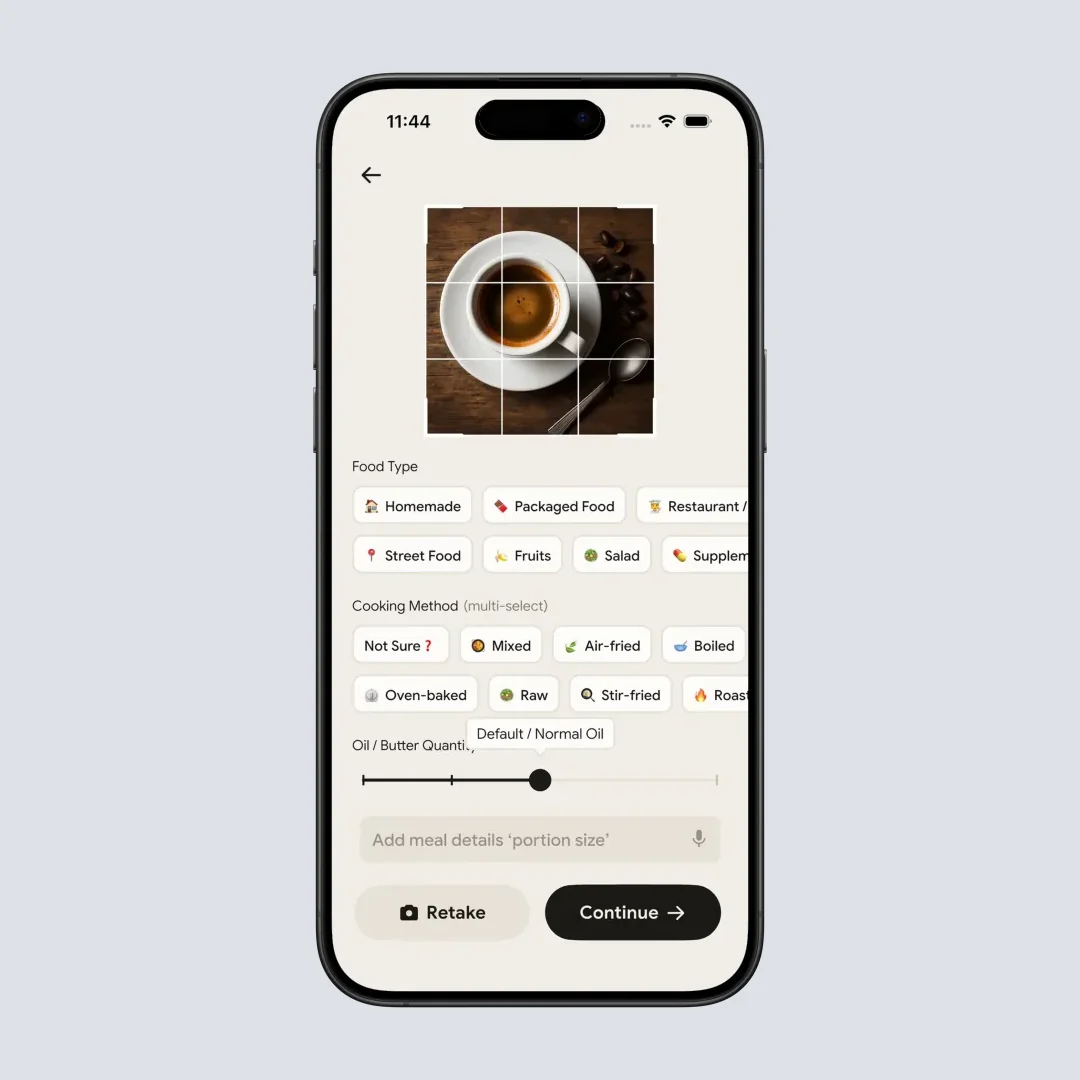
A dietitian sees you for an hour. The food log covers the other 167 hours of the week, and many Nourish reviewers say the redesigned app made that part harder. Our meal scan guide shows how photo logging works.
You do not have to use the Nourish app to log meals. NutriScan, the app my team makes, estimates calories and macros from a photo. It has a Free plan with 5 AI food scans a week and a Premium plan at about $59 a year, and the plans are listed in our pricing breakdown. NutriScan has no dietitians and cannot bill insurance, so it does not replace Nourish. It can give you a meal record to show your dietitian.
Nourish pricing FAQ
Is Nourish free?
Not exactly. Nourish bills each dietitian session to your health insurance, and the company says 94% of its patients pay $0 out of pocket. You still owe any copay, coinsurance or deductible your plan sets, and a session without usable insurance costs $145.
How much does Nourish cost without insurance?
The self-pay rate is $145 per session. Six sessions over 12 weeks cost $870, and 12 weekly sessions cost $1,740. Nourish accepts HSA and FSA cards and says it has no financial assistance program.
What is the $75 charge from Nourish?
It is the late cancel or no-show fee. Nourish charges $75 if you cancel or reschedule less than 24 hours before a session, or do not attend. The consent form says insurance does not cover this fee.
Does Nourish take Medicare or Medicaid?
Nourish takes Medicare for diabetes, chronic kidney disease at stage 3 or higher, or a kidney transplant in the last 36 months, and it requires a referral from an MD or DO. Nourish says it does not accept any Medicaid plans.
Is the Nourish app free?
Yes. The App Store lists the Nourish app as free, with no in-app purchases shown on October 14, 2026. The app is a companion to the dietitian sessions, where you book visits, message your dietitian and log meals.