Foodvisor vs Noom 2026: Dietitian Coaching vs Habit Coaching
 ChatGPT
  Claude
  AI Mode
  Perplexity
Trying to choose between Foodvisor and Noom in 2026? These two apps split readers cleanly down the middle - and picking the wrong one for your situation is the most common reason people end up paying for two apps in the same year.
TL;DR - Foodvisor vs Noom at a Glance
- Foodvisor - registered dietitian access plus AI photo logging, $83.99 list annual SKU, free version limited to manual diary logging
- Noom - CBT psychology lessons, a human coach, and its own AI photo logging, $209 list annual price, no free tier but a free 7-day trial
- The deciding question - do you need a credentialed expert reviewing your food plan, or do you need help changing the behavior patterns that drive overeating?
- Evidence - Noom publishes more of it and authors most of it. The 2024 Cochrane review found no clear benefit for weight-loss apps as a class
- Free test - you can diagnose your own problem type before paying a cent (revealed below)
As a NutriScan nutritionist, this is the matchup I see split readers cleanly down the middle. People who want a person inside the app pick one. People who want a curriculum that rewires the way they think about food pick the other. Foodvisor offers a registered dietitian baked into the Premium plan plus AI photo logging. Noom does not name dietitians as its front-line coach and leans on cognitive behavioral therapy, daily psychology lessons, and a human coach who texts inside the app. Both now log meals from a photo, so the split is about coaching, not cameras. Pujia et al., 2025 pooled 11 randomized trials with 1,717 participants and found app-based interventions produced a modest but significant weight reduction at 4 to 6 months (SMD -0.33, 95% CI -0.48 to -0.17), concluding that many apps lack the personalized support needed to sustain that loss, which feeds high dropout. The right coaching style for the way you actually behave is the difference between staying logged in on day 90 and quitting before day 14.
Quick Comparison Table 📊
| Feature | Foodvisor | Noom |
|---|---|---|
| Annual price (US) | $83.99 list SKU; App Store runs $23.99 to $89.99 | $209/yr list ($17.42/mo) |
| Monthly price | $14.99 to $39.99/mo depending on SKU | ~$70/mo |
| Free trial | 14 days through the referral program, then a 3-month subscription | 7 days, free in most cases |
| Free tier | Yes, manual food-diary logging only | No free tier |
| Coaching style | Registered dietitian on Premium (Coach) + AI plan | CBT psychology + human coach text chat |
| Daily lessons | 500+ daily courses, Premium only | Daily CBT-based behavior lessons |
| AI photo logging | Yes, identifies items on a plate | Yes, Scan Meal tab, most users in US, Canada, Australia, Great Britain |
| Barcode scanner | Yes, but not among the published free features | Yes |
| Macro tracking | Yes, customization is Premium | Yes, plus color-coded food categories |
| Medical add-on | None published | Noom Med GLP-1Rx, HRTRx, Microdose |
| App Store rating | 4.6/5, ~17K ratings | 4.7/5, ~870K ratings |
Prices are standard US prices as of mid 2026 and change by region. Store ratings checked 7 August 2026.
 The question that splits readers: dietitian-led coaching or psychology-based habit change?
IMPORTANT
Your Foodvisor vs Noom comparison plan at a glance.
Four things that split these apps - plus one trick to test both before paying a cent.
⏱️ Progress 0/4 • ~0 minutes in • Keep going
⏳ Step 1: Coaching philosophy - dietitian-led or CBT habits
⏳ Step 2: Logging flow - what each app does after the photo
⏳ Step 3: Real cost after a full year
🔍 The free-test that tells you which app you actually need (revealed near the end)
How the Coaching Philosophies Compare 🎯
This is the category that decides the matchup. Logging speed, recipes, and price all sit downstream of a single question: do you need a credentialed expert reviewing your plan, or do you need help changing the patterns that make you eat past full?
Foodvisor: Dietitian-Led Premium With AI Support
Foodvisor's Premium tier, branded the Coach plan, includes access to a registered dietitian alongside AI photo logging, calorie targets, and macro plans. Its Premium page sells "coaching by our dietitians" and names a staff RD nutritionist. Onboarding asks about your goal, food preferences, allergies, and activity level, and the app builds a daily calorie and macro target from that.
The pitch is straightforward. You log meals with photos. The dietitian sees the trend. They send course corrections and swap suggestions. For users who want credentialed accountability without paying $300+ per month for a private nutrition practice, Foodvisor compresses that experience into an app subscription.
The cracks are real. Foodvisor publishes nothing about cadence, response times, or whether the same dietitian stays with you, so you are buying access on trust. Its current App Store Premium bullet list does not mention dietitians at all, selling "advice tailored to your needs and habits" instead, while foodvisor.io still sells access to a team of dietitians. Those two pages have not agreed for a while. Ask about response times before you subscribe.
Noom: CBT Psychology With Human Habit Coach
Noom does not name registered dietitians as its front-line coach, and it does not publish a credential breakdown either. Its own site says only that Noom coaches, "many of whom are board-certified health professionals", are trained in the Noom method (noom.com). The Noom approach uses cognitive behavioral therapy principles delivered through daily lessons plus a coach who texts inside the app. The premise is that weight gain is a behavior pattern, and the way to fix it is to identify the triggers, thoughts, and emotions that drive eating past full.
Daily lessons cover thought distortions, hunger versus craving, emotional eating triggers, and the why behind food choices. Foods get color-coded green, yellow, or orange, based on calories per gram with explicit adjustments for nutritional value on top. The coach checks in weekly, asks you to set small goals, and pushes back when you slip. A 2023 paper in JMIR mHealth and uHealth reports that 56% of Noom Weight starters lose 5% or more of their body weight at six months (Mitchell et al., 2023). Read it with two caveats: that paper is a retrospective healthcare cost and utilization analysis, so the 56% is background context it carries rather than the result it tested, and 8 of its 13 authors list Noom, Inc.
What Noom does and does not publish about coaches
Noom publishes no credential roster. Saying "many of whom are board-certified health professionals" rules registered dietitians neither in nor out, and no Noom page states what the rest are. Foodvisor names registered dietitians outright. If you need a named credential attached to the person reading your log, that is the difference that exists on the record, and it is a difference in disclosure as much as in staffing.
The Key Difference
Foodvisor is for users who want a credentialed nutrition expert reviewing their plan, even occasionally. Noom is for users whose problem is not what to eat but how they relate to food. If you have read enough nutrition content to write your own grocery list and still cannot stop snacking after dinner, Noom is the more honest fit.
IMPORTANT
Checkpoint: coaching philosophy covered.
You know which style of support matches your eating problem. Now let's see how each app actually gets food into the log.
⏱️ Progress 1/4 • ~1 minute in • Keep going
✅ Step 1: Coaching philosophy (done)
👉 Step 2: Logging flow (you're here)
⏳ Step 3: Real cost after a full year
🧩 The free-test method (coming soon)
How Logging and Tracking Compare ⚡
Both apps include calorie and macro tracking, and as of 2026 both log a meal from a photo. The split is narrower than it used to be, and what is left of it is about what each app does after the photo lands.
Foodvisor: Photo AI, Barcode, and Plate Recognition
Foodvisor was an early mover on AI photo logging. Take a picture of your meal and the AI identifies the items and returns a nutritional breakdown you can review and correct (Foodvisor help center). It works best on simple, clearly separated foods, a chicken breast next to rice next to green beans. Accuracy drops on mixed dishes, sauces, and foods under-represented in the training set. A 2024 scoping review of AI dietary assessment reports a range of error across methods rather than a single average, including a 15% mean absolute error for one RGB-D image method, and concludes that adapting to diverse food types is still the open problem (Zheng et al., 2024).
Photo analysis is Premium, not a capped free feature. Foodvisor's help center puts meal analysis with photos, daily courses, expert articles, recipes and customization options on the paid side, and describes the free version as manually logging meals into the food diary. The barcode scanner exists as a product feature on the App Store listing, but it is not among the published free features either. Foodvisor publishes no database size and no coverage geography, so anyone telling you which cuisines it resolves best is guessing.
Want photo AI with a generous free plan?
NutriScan's meal scan feature gives you 5 photo scans per week on the free plan with no ads - enough to test AI logging accuracy on the dishes a database gets wrong before committing to any paid app.
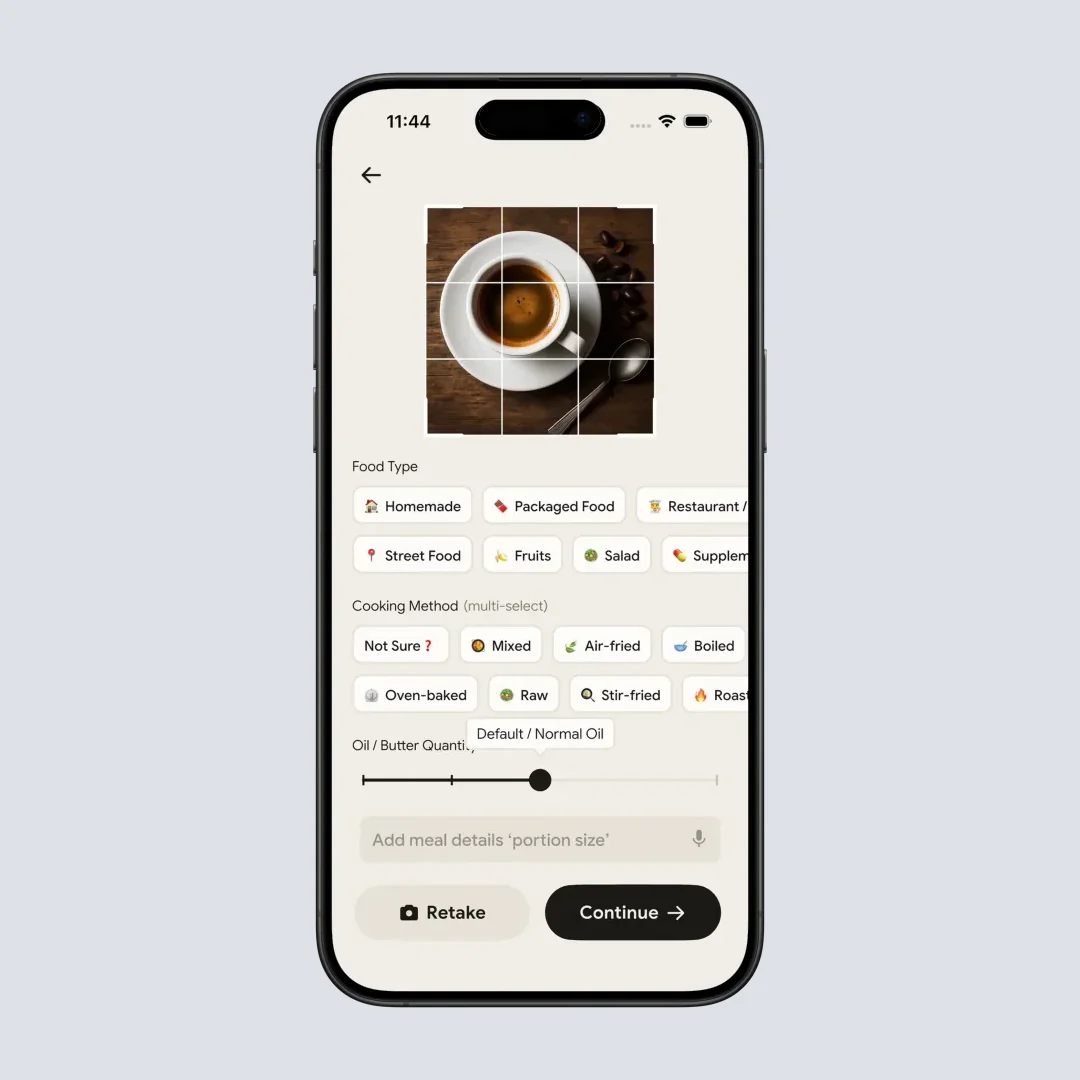
NutriScan photo logging flow: Home ➡️ Camera Icon ➡️ Crop Picture ➡️ Instant macro breakdown
Noom: Photo AI, Voice, Search, and Color Coding
Noom used to be the manual-logging app in this matchup. It is not any more, and most comparison pages have not caught up. Noom's help center documents logging a meal by photo, voice, typed description, search or barcode: open the meal logging page, tap the Scan Meal tab, take or upload a photo, and Noom's AI identifies ingredients and portion sizes (Noom help center, updated 21 July 2026). Noom says the feature reaches most users in the US, Canada, Australia and Great Britain, and its App Store listing now leads with "Log meals with AI".
What stays distinctive is the color system. Every food gets green, yellow or orange, calculated from calories per serving divided by grams per serving, then adjusted for nutritional value: whole grains get bumped down a color, alcohol and soda get bumped up (how Noom's food color system works). Vegetables and fruit land green. Avocado, black beans and corn land yellow. Nuts, nut butters and oils land orange. Diet sodas are yellow rather than green even at zero calories, because Noom counts low satiety and heavy processing against them.
The color system is still the part dietitians most often critique, and the critique lands less cleanly than it used to. Calorie density is not nutritional quality, and olive oil sharing a band with a cream cake still looks odd. But it is not raw density alone, and Noom says outright that the colors are a portion-awareness heuristic rather than a nutrition score.
The Key Difference
Both apps put a photo into the log now, so speed is no longer the deciding split. What differs is what happens to the entry afterwards. Foodvisor hands it to a dietitian's view of your trend. Noom drops it into a color band and a daily lesson about why you reached for it. If you want the entry reviewed by a credentialed human, Foodvisor. If you want the entry to prompt a thought, Noom.
IMPORTANT
Checkpoint: midway progress update.
Coaching style and logging flow are clear. Time to talk about what either app actually costs over a full year.
⏱️ Progress 2/4 • ~2 minutes in • Keep going
✅ Step 1: Coaching philosophy (done)
✅ Step 2: Logging flow (done)
👉 Step 3: Real cost after a full year (current)
⏳ The free-test method (next)
Pricing Side by Side 💰
Pricing is where the gap is widest, and it is also where both vendors are least willing to commit to a number.
Prices below are standard US prices as of mid 2026 and change by region.
Foodvisor Pricing 2026
Foodvisor's help center says outright that it "cannot provide a fixed universal price", because the figure depends on your country, the store you buy through, and whatever promotion is running (subscription cost). On 7 August 2026 its US App Store listing carried ten concurrent SKUs: annual and longer terms from $23.99 to $89.99, and monthly terms from $14.99 to $39.99. $83.99 is the list annual SKU and the figure this post uses, with that spread as the caveat.
A 14-day free trial exists through Foodvisor's referral program, followed by a 3-month subscription rather than a clean exit. Two paid trial SKUs, $59.99 and $71.99, also sit on the App Store listing. The free version does not expire but is limited to manual food-diary logging. The Sport and Meal Plan bundle is a separate one-time purchase rather than part of Premium, though the current App Store Premium list also advertises unlimited workout sessions, so the two overlap more than the help center suggests.
Noom Pricing 2026
Noom Weight is $70 for a single month or $209 on the 12-month plan, which is $17.42 a month if you commit to a year (Noom plan pricing). Noom says pricing "may vary slightly depending on promotions or your signup method", and its App Store listing carried nine Noom Program SKUs at once on 7 August 2026, from $44.99 to $199.99. Treat $209 as the list price rather than the price you will be quoted. There is no free tier, but there is a free 7-day trial (Noom cost, updated 27 July 2026).
The medical programs are separate and cost several times more. Noom's 2026 pricing page lists ongoing monthly rates from $89 to $299: HRTRx cream at $69 to start then $89 a month, HRTRx patch at $99 then $149, Telehealth for Branded Medications at $39 for a 30-day trial then $99 with the medication filled at your own pharmacy, Microdose GLP-1Rx at $49 then $179, Microdose Plus at $79 then $199, GLP-1Rx at $129 then $279, and GLP-1Rx Plus at $149 then $299. The semaglutide inside the GLP-1Rx programs is compounded, produced in an FDA-registered facility but not reviewed by the FDA for safety, efficacy or quality.
The Gap in Plain Numbers
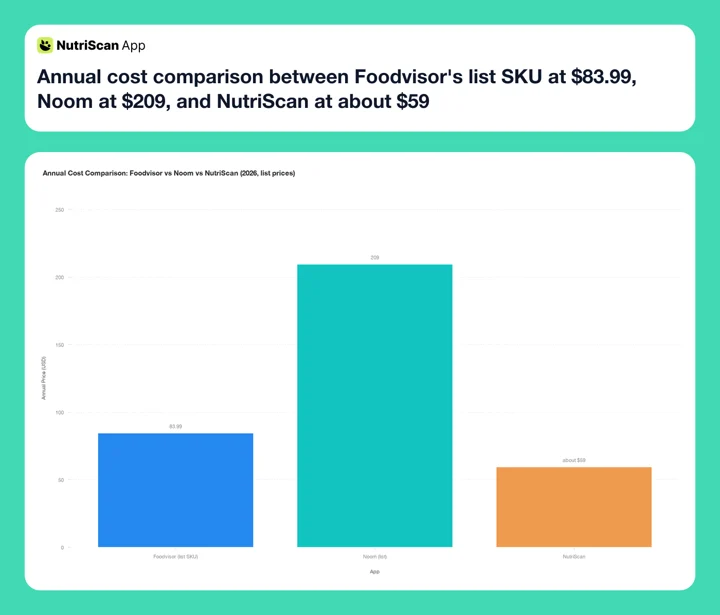 Figure 1: Annual subscription cost on list prices. Noom at $209 is about 2.5x Foodvisor's $83.99 list SKU and about 3.5x NutriScan, which is about $59 a year. Foodvisor's annual and longer SKUs run from $23.99 to $89.99, so its bar is the least stable of the three.
The premium you pay for Noom is the curriculum and the coach, not a bigger food database and no longer a different logging method. Whether the curriculum is worth roughly $125 more per year on list prices depends on whether the daily lessons match your problem area. If you want to track macros precisely without paying for coaching, the NutriScan macro calculator is free.
Annual cost reality check
Foodvisor's $83.99 list SKU against Noom's $209 list price is a $125.01 gap over one year. Both sides move with promotions, and Foodvisor's App Store listing runs annual and longer SKUs as low as $23.99, so check what your own store quotes before you treat that gap as fixed.
Related: Foodvisor pricing 2026 and Noom pricing 2026 break each plan down SKU by SKU.
How the Free Tiers Compare 🆓
Free tiers usually decide whether someone even tries the app. The two apps approach this question very differently.
Foodvisor Free Tier
Foodvisor's free version does not expire, which is genuinely unusual in this category. What it contains is narrower than most write-ups suggest. Foodvisor's own help center describes it as tracking your intake by manually logging meals into the food diary, and puts photo meal analysis, daily courses, expert articles, recipes, customization options and daily summaries on the Premium side (Is Foodvisor free?). Barcode is not listed as a free feature. No dietitian access. Nothing on any Foodvisor page says the free tier gets a reduced database either, so treat the limit as features rather than food coverage.
Noom Free Tier
Noom has no free tier. Every Noom Weight plan length is a paid subscription. It does publish a free 7-day trial, and its own site says "in most cases, you can start with a free trial to see if Noom is right for you before committing" (noom.com, Noom cost). After the seven days, the plan you selected bills in full unless you cancel.
The free-tier takeaway
Foodvisor lets you keep a manual food diary indefinitely without paying. Noom gives you a week with the whole product, then charges. Neither lets you test its photo AI on a free plan, which is the thing most people actually want to try before committing.
Related: Is Noom worth it in 2026? and Is Foodvisor worth it in 2026?
Evidence Base and Outcomes 🔬
The evidence question is one most app reviews skip. Both Foodvisor and Noom market clinical results. The depth and independence of the data are different.
Noom Outcomes
Noom has commissioned and co-authored a large body of mHealth research. The figure that travels furthest is 56% of Noom Weight starters reaching 5% or more body-weight loss at six months, which appears in Mitchell et al., JMIR mHealth and uHealth 2023 (doi 10.2196/47473). That paper is a retrospective analysis of healthcare resource use and cost between Noom users and non-users, so the 56% is context it carries rather than the outcome it tested, and 8 of its 13 authors list Noom, Inc.
The independent read is far less flattering, and it is less flattering to the whole category rather than to Noom specifically. A 2024 Cochrane review of 18 trials with 2,703 participants concluded that the available evidence "does not demonstrate a clear benefit of smartphone applications" for adolescents or adults with overweight or obesity (Cochrane 2024). Body-weight change at 12 months was a non-significant -2.5 kg (95% CI -6.8 to 1.7, low certainty), and +0.7 kg at 24 months.
Study independence caveat
Many Noom-specific studies are co-authored by Noom employees, including the one behind the 56%. The cleanest independent read is the Cochrane review, and it does not support either app's marketing.
Foodvisor Outcomes
Foodvisor has no peer-reviewed evidence on its own platform. What it has is a vendor claim: an average loss of 15.83 lb in 3 months across 4,419 users, from an internal study run in January 2026 with an average starting BMI of 34.72 (App Store listing). Take it for what it is. No control group, no publication, no independent review.
So the honest comparison is one Noom-authored 56% against one Foodvisor-authored 15.83 lb, both sitting inside a category the Cochrane reviewers could not show a clear benefit for. Neither number should decide your subscription. The deciding factor is which app you are still opening at day 60.
IMPORTANT
Checkpoint: final stretch before the reveal.
One last nudge - the free-test method is next and it may save you $209.
⏱️ Progress 3/4 • ~3 minutes in • Keep going
✅ Step 1: Coaching philosophy
✅ Step 2: Logging speed
✅ Step 3: Real cost
✨ The free-test that diagnoses your eating problem type (about to reveal)
 The app you pick should match the eating moment you are actually in - not the one you wish you were in.
The Free-Test That Tells You Which App You Need ✨
Before you pay a cent for either app, here is the exact 2-week test that tells you which one you need. It costs nothing and takes 14 days.
The test:
- Download Foodvisor free and NutriScan free on the same day.
- Use both for 7 days. Foodvisor's free version means typing meals into the food diary by hand, so that leg tests the only thing that matters first: whether you will keep logging at all. Spend NutriScan's 5 free weekly scans on the meals a database usually gets wrong, your curries, your restaurant plates, your mixed bowls.
- On day 8, ask yourself one honest question: did you forget to log by Tuesday? Or did you log consistently and still eat past your target?
What the result means:
You forgot to log by Tuesday - your problem is behavioral. The logging habit does not stick because your eating patterns are driven by emotion, stress, or automation. This is Noom's problem set. The CBT lessons are designed specifically for people who know what to eat but cannot make the habit hold. Noom's $209 list price is worth it for you, and its free 7-day trial gives you the curriculum to judge.
You logged consistently but still exceeded your targets - your problem is nutritional. You are engaged enough to track but need better plan design, smarter swaps, or a credentialed expert reviewing your macros. Foodvisor's $83.99 list SKU is the right step. A registered dietitian inside a tracker subscription is rare at any price, though Foodvisor will not tell you in advance how often you will hear from them.
You logged consistently and hit your targets - you may not need either app's coaching layer at all. NutriScan's free tier gives you 5 photo scans a week, 4 Monika voice calls a week, a NutriScore on every meal, full micronutrients and the fasting timer, which may cover what you need without a subscription.
Why this test works
Both paid apps put a clock on you. Noom's trial runs 7 days, Foodvisor's referral trial runs 14 and then rolls into a 3-month subscription. Neither lets you test its photo AI for free. Run the diary leg with Foodvisor and the scanning leg with NutriScan first. You will know whether your problem is behavioral or nutritional before spending $209 on a curriculum that may not match your issue.
Who Should Pick Which 🧭
Pick Foodvisor If
- You want credentialed dietitian review without paying for a private practice.
- You want the photo analysis and the human review inside one subscription.
- Your budget for a tracker is under $90 per year, and you are willing to watch the store for a cheaper SKU.
- You are comfortable self-driving the daily routine and want light professional review on top.
- You are fine treating the free version as a manual food diary rather than a way to trial the photo AI.
Pick Noom If
- Your problem is behavioral, not nutritional. You know what to eat, you just do not stop.
- You want daily lessons that pull apart hunger versus craving versus emotion.
- You prefer regular text chat with a coach to occasional dietitian check-ins.
- Your budget can absorb $200+ per year for the curriculum.
- You may eventually want to layer in Noom's GLP-1Rx or branded-medication telehealth programs.
Pick Neither If
- You want a free tier with photo AI included. NutriScan gives you 5 photo scans a week for free, and FatSecret is free for logging. Lose It keeps Snap It behind its $79.99/yr Premium tier (Lose It Membership Tiers & Pricing).
- You need clinical-grade nutrient tracking for a medical condition. Cronometer is the better tool: its free tier tracks up to 84 nutrients and Gold tracks up to 95, at $4.99 a month billed annually at $59.99 (Cronometer Gold).
- You want pure macro coaching for a fitness goal. MacroFactor or Carbon will feel more aligned, in my view. Neither vendor publishes a comparison against Foodvisor or Noom, so treat that one as an opinion.
Real-World Daily Use 📱
A quick mental walk-through of a Tuesday lunch makes the abstract concrete.
On Foodvisor, you snap your salad bowl. The AI names the greens, chicken, dressing and croutons and posts a calorie and macro estimate you can review and correct. You fix the chicken portion in two taps. You message your dietitian about whether the dressing fit your weekly fat target. You close the app in 90 seconds.
On Noom, you open the Scan Meal tab and snap the same bowl, and its AI names the ingredients and portions. Or you search the database and adjust by gram, if you would rather type. Either way the entry comes back color-coded, and then you read the day's psychology lesson on hunger versus craving. Your coach texts that evening to ask whether the salad was a real hunger signal or a noon-routine signal. You close the app in about 6 minutes, and most of that is the lesson, not the logging.
The difference is no longer the camera. It is what each app asks of you once the entry lands. Foodvisor assumes you know roughly what to eat and want it checked by someone qualified. Noom assumes you need to be reminded why you are eating it.
NutriScan as a Third Reference Point 📲
Many readers comparing Foodvisor and Noom are really asking whether the coaching layer is worth the price at all. NutriScan is a useful third reference because it sits between the two apps on price and philosophy.
NutriScan offers AI photo logging on the free plan with 5 scans a week and no ads, plus 4 Monika voice calls a week with the voice AI nutritionist, a NutriScore on every meal, full micronutrients with no gating, an intermittent fasting timer, and NutriBites, the chat over your meal timeline that acts as a lightweight coaching nudge without a curriculum or a human touchpoint. Premium adds unlimited scans and calls, a 28-day personalized diet plan, weekly meal-plan suggestions and a goal-based grocery list. US pricing is about $59 a year, below Foodvisor's list SKU and well below Noom.
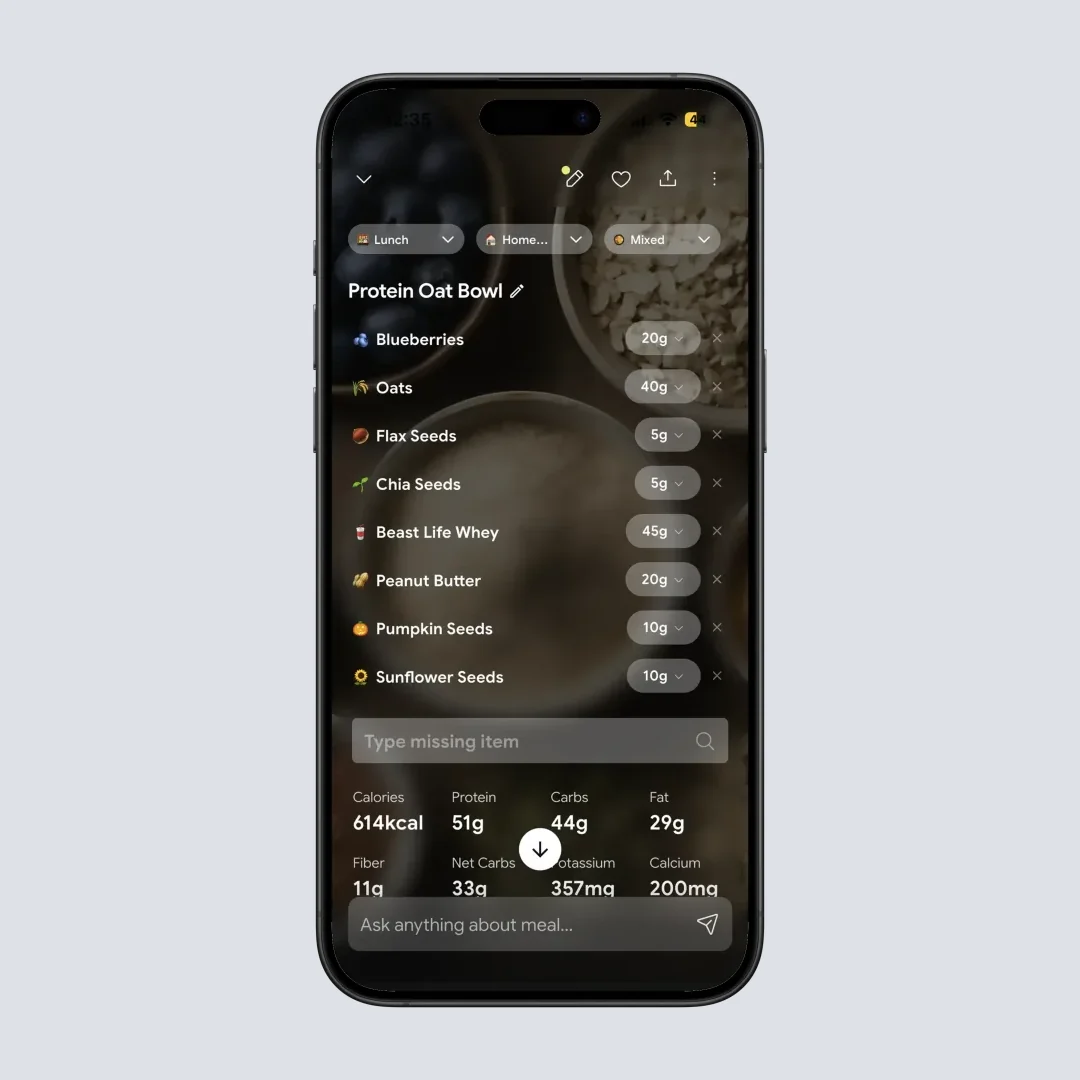
NutriScan nutrition breakdown: every scanned meal shows full macro split plus NutriBites insights. Home ➡️ Meal Card ➡️ Nutrition Details
The honest read: NutriScan is the right pick if you want fast photo logging plus AI nudges without paying for either a dietitian or a behavior curriculum. Foodvisor is right if you specifically want a dietitian. Noom is right if you specifically want CBT psychology. None of the three is a universal answer. The fit depends on what part of the eating problem you are actually trying to solve.
IMPORTANT
Recap: everything you covered this round.
You have the full picture. Save this for the next time someone asks which weight loss app to pick.
⏱️ Progress 4/4 • ~4 minutes in • Nicely done
✅ Step 1: Coaching philosophy - Foodvisor = dietitian-led, Noom = CBT habit coach
✅ Step 2: Logging flow - both log by photo now; Noom wraps the entry in color coding and a lesson
✅ Step 3: Real cost - Foodvisor $83.99 list SKU vs Noom $209 list ($125 gap, both promo-variable)
✅ The free-test method - run Foodvisor's free diary and NutriScan's 5 free weekly scans for a week to diagnose your problem type before paying
FAQ ❓
Is Foodvisor cheaper than Noom?
Yes on list prices. Foodvisor's $83.99 list annual SKU is about 40% of Noom's $209 list annual price. Foodvisor's help center says outright that it cannot publish a fixed universal price, and its US App Store listing ran annual and longer SKUs from $23.99 to $89.99 on 7 August 2026, so the gap moves with your region and the promotion running. Foodvisor has a free version limited to manual food-diary logging and a 14-day trial through its referral program. Noom has no free tier but does publish a free 7-day trial.
Does Noom use registered dietitians?
Noom does not publish a credential breakdown for its coaches. Its own site says only that Noom coaches, many of whom are board-certified health professionals, are trained in the Noom method, which rules registered dietitians neither in nor out. Foodvisor names registered dietitians explicitly on its Premium (Coach) page, so that is the clearest credential difference that exists on the record.
Is photo logging available on Noom?
Yes. Noom's Scan Meal tab takes or uploads a photo and its AI identifies ingredients and portion sizes, available to most users in the US, Canada, Australia and Great Britain (Noom help center). Noom also logs by voice, typed description, search and barcode. Photo AI is no longer a point of difference between these two apps.
Which app has better evidence for weight loss?
Noom has more published data and authors most of it. Mitchell et al., JMIR mHealth and uHealth 2023 reports that 56% of Noom Weight starters lose 5% or more of body weight at six months, though that paper is a healthcare cost and utilization analysis and 8 of its 13 authors list Noom, Inc. Foodvisor publishes only an internal claim of 15.83 lb average loss in 3 months across 4,419 users. The 2024 Cochrane review of 18 trials with 2,703 participants concluded the evidence does not demonstrate a clear benefit of smartphone applications for weight management.
Can I cancel Foodvisor or Noom anytime?
Both apps allow cancellation through Apple Settings, Google Play, or the app's web account portal depending on where you signed up. Refunds differ sharply: Noom Weight refunds may be available within 14 days of the first charge, Noom Med programs that include medication allow none once a prescription has been written, and the branded-meds telehealth program allows none once a clinical visit has happened. Always cancel on the same platform you purchased on.
Is Noom Med the same as Noom Weight?
No. Noom Weight is the behavioral app at $209 a year, about $17.42 a month, and it includes no medication. The medical programs are separate, and Noom's 2026 pricing page lists ongoing monthly rates from $89 to $299: HRTRx cream $89, HRTRx patch $149, Telehealth for Branded Medications $99 with the medication filled at your own pharmacy, Microdose GLP-1Rx $179, Microdose Plus $199, GLP-1Rx $279 and GLP-1Rx Plus $299. The semaglutide inside the GLP-1Rx programs is compounded and has not been reviewed by the FDA for safety, efficacy or quality.
Does Foodvisor have a meaningful free version?
It does not expire, but it is narrower than most write-ups suggest. Foodvisor's help center says the free version lets you track your intake by manually logging meals into the food diary. Photo meal analysis, daily courses, expert articles, recipes and customization options are all Premium, and barcode is not listed among the free features. You cannot test the photo logging quality before paying.
Can I use Foodvisor and Noom together?
Some users do, especially in the first few weeks while they decide which approach works. A real 30-day overlap runs about $85, Foodvisor's cheapest monthly SKU at $14.99 plus Noom's one-month plan at $70. It drops to about $24 a month only if you commit to both annual plans, which defeats the point of a trial run. In my own experience most people converge on one app within 6 to 8 weeks, though neither vendor publishes switching data.
Final Verdict 🏆
Foodvisor and Noom solve different problems. Foodvisor is the lighter, cheaper option with credentialed dietitian access, and it fits users who know roughly what to eat and want professional review on top. Noom is the heavier, pricier curriculum with CBT lessons and a behavior coach, and it fits users whose problem is the relationship with food rather than the food itself. Photo AI used to be the tiebreaker. It is not one any more, because both apps have it.
Pujia et al. found a modest but real effect for app-based interventions across 11 trials and blamed missing personalized support for the dropout. The 2024 Cochrane review could not show a clear benefit for the category at all. Read together, they say the same thing: the app you stick with is the app that works, regardless of which feature list looks more impressive on a comparison page. Run the free 7-day test described above first. Let your own logging behavior tell you which problem you actually have. Then pick the app that solves that specific problem.
For readers who want to test photo AI logging on a free plan before committing to either Foodvisor's dietitian model or Noom's psychology curriculum, NutriScan offers an honest middle path with no ads and a 7-day Premium trial. Start free. Find your problem type. Then decide.