Noom vs HealthifyMe 2026: Coaching, Pricing, Who Each Fits
 ChatGPT
  Claude
  AI Mode
  Perplexity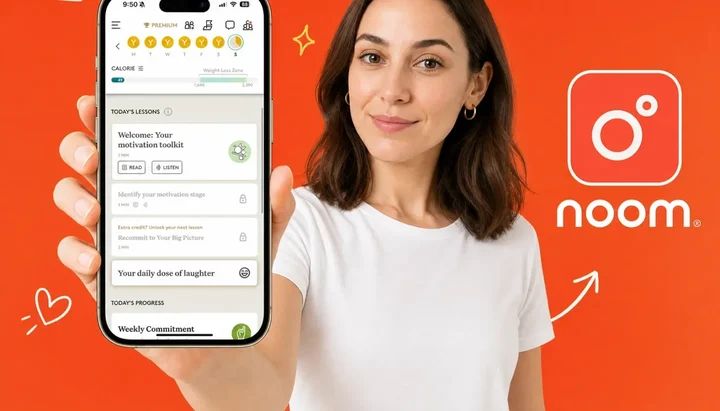
Picking a weight-loss app in India this year usually comes down to two names - and they are built on two completely different theories of how a person actually changes their eating.
TL;DR - Noom vs HealthifyMe at a Glance
- Noom - CBT psychology lessons + US human coach, $209/yr (about ₹19,900), thinks the problem is in your head
- HealthifyMe - Indian food tracker + AI coach Ria + human dietitians, and no published 2026 prices at all, thinks the problem is in your plate
- The deciding question - do you want to be taught, or do you want to be fed a plan in foods you already eat?
- Failure modes differ - Noom fails when you do not read; HealthifyMe fails when you do not log
- A 14-day test tells you which one you would still open in week 7 (revealed near the end)
People in India who pick a weight-loss app this year usually narrow it down to two names. Noom is the American behavioral-change program that turned up in every podcast ad for a while. HealthifyMe is the Bangalore-built tracker with an AI coach called Ria and a database that actually knows what jeera rice is. They look similar from the outside. Both promise coaching, both promise tracking, both promise weight loss. Inside the app, they are built around two completely different theories of how a person actually changes their eating.
Noom thinks the problem is in your head. The app is short psychology lessons, a color-coded food log, and, on the paid tiers, a human coach who messages you a few times a week. HealthifyMe thinks the problem is in your plate, your steps, and your blood sugar. The app is a calorie tracker, an Indian-food database, the AI coach Ria, and on the higher plans, a human dietitian and trainer who build you a custom diet and workout chart, plus an optional CGM bundle for people who want to see glucose response in real time.
This comparison walks through what each one actually does in 2026, how the coaching feels in practice, what they cost in dollars and rupees, and the kind of person each one is built for. By the end, you should know which app you would still open in week 7, which is the only honest test in this category.
Quick Comparison Table 📊
| Feature | Noom | HealthifyMe |
|---|---|---|
| Core idea | Behavior change via CBT lessons | Indian-food tracking + coaching |
| Annual price | $209/yr ($17.42/mo on the 12-month plan) | Not published; AI-only tier last listed near ₹2,500/yr |
| Human-coach tier | Coaching sits on the Noom Weight plans, described by Noom as optional | Sold by the sales team, no published price |
| Coach type | Behavior-change specialist, not a dietitian | Dietitian or weight-loss coach, one-on-one |
| AI coach | No | Yes, Ria, 24/7 in chat |
| Food database | US packaged foods + 850-plus US restaurant chains | Indian dishes, thalis, street food |
| Photo logging | Yes, Scan Meal, listed for US, CA, AU and GB only | Yes, Snap, plus Auto Snap from your gallery |
| CGM option | No CGM hardware; Noom Med is GLP-1 telehealth | Yes, price on request |
| Daily lessons | Yes, CBT-based daily lessons | No lesson track |
| Free entry | 7-day trial | Free tier; no trial length published |
Prices are standard US prices as of mid 2026 and change by region. HealthifyMe's rupee figures are unconfirmed: it has pulled its published plan pages.
 Both apps promise coaching and tracking - but they disagree on what your actual problem is.
IMPORTANT
Your Noom vs HealthifyMe comparison plan at a glance.
Four things that split these apps - plus the 14-day test that tells you which one you would still open in week 7.
⏱️ Progress 0/4 • ~0 minutes in • Keep going
⏳ Step 1: What you are actually paying for in each app
⏳ Step 2: The coaching feel, in practice
⏳ Step 3: Real cost in dollars and rupees, with the catches
🔍 The 14-day test that makes the decision for you (revealed near the end)
What You Are Actually Paying For 💰
Noom's pitch is that weight loss is a thinking problem. The core experience is a daily lesson built on cognitive behavioral therapy, running alongside a color-coded food log for as long as your plan lasts, which is 4, 6 or 12 months (Noom, 2026). The log sorts everything you eat into green, yellow and orange buckets by calorie density (Noom help center). On the paid tiers you also get a human coach in chat and access to a community of other Noom members. The subscription auto-renews until you cancel, and a WebMD review last medically reviewed in October 2024 flagged the same auto-renew trap back when Noom's prices were lower than they are now (WebMD, reviewed October 2024). US News and World Report scores the program 4.1 overall and lists cost among the downsides, calling it "comparatively more expensive than some diet apps" (US News, January 2026).
HealthifyMe's pitch is that weight loss is a data and food problem, especially if your food is Indian. The center of the app is the food tracker. You log meals through search, a barcode (HealthifyMe, 2026), or a photo with Snap, and the app pulls from a database that includes dal, sabzi, dosa, biryani, paratha, and regional breakfasts that no US-built app handles cleanly. Around that you get Ria, the AI coach that answers questions in chat, plus step, water and sleep tracking sitting next to the calorie-and-macro view (Google Play listing, updated 29 July 2026). On the paid plans, a dietitian or a weight-loss coach works with you one-on-one on a customized diet plan, and there is a CGM bundle for people who want to read their glucose response to specific meals. Back in 2017, a Medium writeup by an early Ria user described the AI coach as HealthifyMe's bet to "do what Siri and Google Assistant cannot" for nutrition, with subscription plans then running "Rs 999 to 1699 per month, depending on the number of coaches needed" (Medium, October 2017). The India home page has moved on since: it now opens with HealthifyRx, the company's GLP-1 medical weight-loss program, then Snap photo logging, with AI Coach Ria further down promising "no crash diets, only balanced nutrition, with foods you love to eat" (HealthifyMe, 2026).
So the surface summary is honest: Noom is a behavior school with a US human coach. HealthifyMe is an Indian food tracker with an AI coach and optional human dietitians on top. Where it gets interesting is what those two designs feel like on a Tuesday when you are tired and the kitchen has paratha and pickle in it.
IMPORTANT
Checkpoint: you know what each app actually is.
A behavior school vs a food clinic. Next: what the coaching feels like when you actually use it.
⏱️ Progress 1/4 • ~1 minute in • Keep going
✅ Step 1: What you are paying for (done)
👉 Step 2: The coaching feel, in practice (you're here)
⏳ Step 3: Real cost in dollars and rupees
🧩 The 14-day test (coming soon)
The Coaching Feel, in Practice 🎯
Noom's coaching shows up in two places. The first is the daily lesson, short enough that Forbes Health's tester set a five-minute-a-day learning goal and stuck to it (Forbes Health, 2026). The content is structured: one week is about why you eat when you are not hungry, another is about all-or-nothing thinking, another is about food environments. It is the closest thing in the consumer app world to a guided CBT workbook. The second is the human coach, who lives in the chat tab. Noom publishes weekly check-ins rather than a reply-time guarantee, so do not plan around a same-day answer, and coaches tend to ask questions rather than hand over meal plans. If you ask a Noom coach what to eat for dinner, you are more likely to get "what are you in the mood for, and how did today go?" than a prescription. That style fits people who learn by reading and reflecting. It fits less well on a day when you want someone to say "eat this, sleep, see you tomorrow."
HealthifyMe's coaching is shaped for a different kind of user. Ria, the AI coach, is always available in chat and replies instantly. You can ask Ria "is two chapatis okay for dinner with palak paneer?" and get a back-and-forth with calories, macros, and a tweak suggestion. On the paid plans, the human coach is not a behavior-change instructor. It is a dietitian or a weight-loss coach working with you one-on-one on a customized diet plan (Google Play listing, updated 29 July 2026). That person replies in chat, reviews your food log, and adjusts the plan when your weight is not moving. Indian users commonly describe getting a weekly meal chart written in katoris and bowls, though HealthifyMe does not publish that detail itself.
If you draw the two coach experiences as cartoons, Noom is a smart teacher with limited office hours. HealthifyMe is a busy clinic: an AI receptionist who answers instantly, plus a dietitian and a trainer who do the real plan work behind the scenes.
The difference that matters
People who join Noom and then skip the lessons are paying for the most expensive part of the app and using the least expensive part. People who join HealthifyMe and ignore Ria can still get value because the human dietitian's plan is the product. Noom fails when you do not read. HealthifyMe fails when you do not log your food.
What Each App Does on Day One 📱
A first-time Noom user opens the app and lands in a long quiz about goals, lifestyle, why past attempts failed, and what mood drives eating. After that, you are dropped into the curriculum: a daily lesson, a weigh-in prompt, and a food log. The food log is the heart of the experience. You search a food, you get a calorie count plus a green, yellow, or orange tag. The sort is by calorie density: green foods carry the fewest calories per gram, orange the most. Noom's own guidance is that "the goal isn't to avoid orange foods, it's to balance them" (Noom help center). The point is to make you see your patterns without a number telling you off. Within seven days, most users have logged three to five weigh-ins, built a small habit of reading the day's lesson, and started a back-and-forth with their coach.
A first-time HealthifyMe user opens the app and also lands in a quiz, this one about current weight, goal weight, dietary preference (veg, non-veg, eggetarian, Jain), cuisine type, and medical conditions. The output is a recommended calorie target, a starting macro split, and an initial diet card. Day one is mostly about logging your first meal. You can search "aloo paratha," scan a barcode, or use Snap to photograph a thali, and the app fills in a guess that you can edit. Ria greets you in chat. If you are on a paid plan, your assigned dietitian sends a welcome note and a 24-hour or 48-hour window when they will share your first custom plan. There is no curriculum to read. There is a tracker, a target, and a person on the other side asking for your food preferences.
Day one already tells you something. If "open a lesson, learn about your habits, log a meal" sounds like the right amount of support, Noom wins. If "log paratha, ask Ria a question, wait for my dietitian to send a plan" sounds better, HealthifyMe wins. And whichever quiz you take, it helps to walk in knowing your own numbers - a free macro calculator gives you a calorie and macro baseline to sanity-check whatever target either app hands you.
IMPORTANT
Checkpoint: coaching style and day-one feel covered.
Teacher vs clinic, curriculum vs diet card. Now the part most people skip to - what these actually cost, with the catches included.
⏱️ Progress 2/4 • ~2 minutes in • Keep going
✅ Step 1: What you are paying for
✅ Step 2: The coaching feel (done)
👉 Step 3: Real cost in dollars and rupees (current)
🧩 The 14-day test (coming soon)
Pricing in 2026, With the Catches Included 💸
Noom publishes its ladder, which makes this half easy. The headline number is $17.42 per month on a 12-month plan, billed as a single $209 charge (Noom, 2026). Month to month is about $70, which adds up fast (Noom plan pricing). New users get a 7-day trial, the only trial length Noom publishes anywhere. The ladder is priced so the last two months are close to free: 10 months is $199 and 12 months is $209, a $10 gap for two extra months, which is why the annual works out cheapest per month at $17.42. Noom Med, the medical arm with prescription GLP-1 support, is a separate spend and a much bigger one. Its microdose programs start at $49 or $79 for the first 4-week supply and then run $179 to $199 a month; full dose starts at $129 or $149 and then runs $279 to $299 a month. For the average person not on a GLP-1, the only number that matters is the annual: $209 for a year of coaching and daily lessons.
HealthifyMe's is shaped completely differently, and as of August 2026 it is not published at all. healthifyme.com/in/plans returns a 404 and the online store's plans collection is empty, so there is no vendor page to quote. The tier structure is documented: an AI-only plan with Ria, marketed as the Smart Plan and as Healthify+ (HealthifyMe terms of use), then coach tiers with a human dietitian, then a CGM bundle on top. The AI-only tier was listed near ₹2,500 a year before the store pulled its plan pages; the coach tiers and the CGM bundle go through the sales team. Coach tiers have circulated at roughly ₹4,000 to ₹8,000 a month, but we could not source that band to HealthifyMe or to anyone else, so treat every rupee figure here, ours included, as unconfirmed. The one dated figure that holds up is nine years old: back in 2017 HealthifyMe's coach plans ran ₹999 to ₹1,699 a month depending on how many coaches you wanted (Medium, October 2017). A MouthShut reviewer in October 2019 noted that the same trainer is "available for the cheapest premium membership (199/month) and the most expensive membership (1700+/ month)" (MouthShut). Our read of that, not his: the dietitian rather than the trainer is the real upgrade lever.
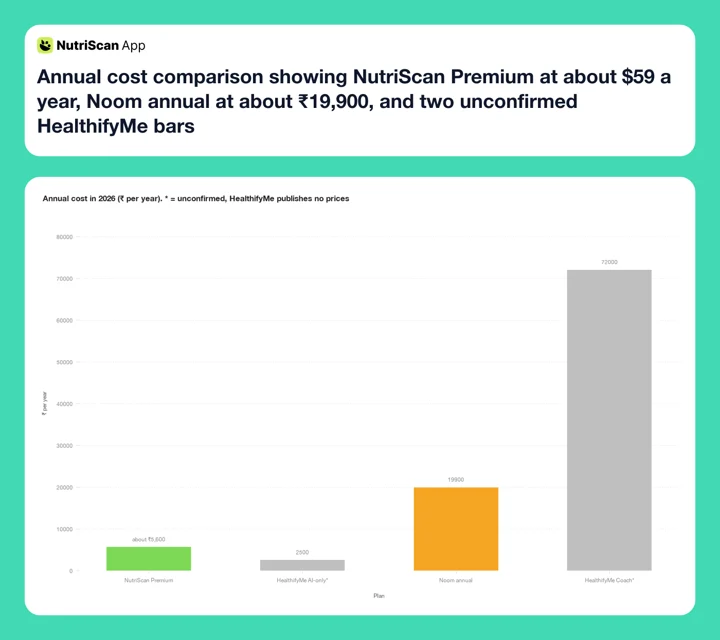 Figure 1: Annual cost in 2026. Noom's $209 converts to about ₹19,900 at ₹95.21 to the dollar (Xe, 7 August 2026). NutriScan Premium is about $59 a year, plotted here as about ₹5,600 at the same rate so it sits on the rupee axis. Both HealthifyMe bars are unconfirmed, because HealthifyMe publishes no plan prices.
As a sticker comparison, Figure 1 shows a year of Noom at $209 landing near ₹19,900. That is well above HealthifyMe's AI-only tier at its last listed ₹2,500 and well below the coach tiers at any figure anyone has quoted. If the ₹4,000 to ₹8,000 a month band is real, a mid-tier year at ₹6,000 a month is ₹72,000, about 3.6x Noom's annual, but that multiplier is only as good as the band it rests on. What is solid is the direction: Noom's annual is a published number you can budget against, and HealthifyMe's coach tiers are a quote you have to ask for. The trade is what you get on the other end. Noom gives you a US-built lesson track plus an English-speaking coach who does not know what idli is. HealthifyMe gives you a dietitian who can put aloo paratha into a 1,600-calorie plan without flinching. So if the goal is behavior change, Noom's $209 is the priced option; if it is Indian-food tracking, start on HealthifyMe's free tier, because nothing above it has a price you can check before you talk to sales.
The upsell catch
MouthShut reviewers from 2019 and 2020 describe repeated sales calls and pressure to upgrade to a coach plan, one of them putting the ask at "approx 2000Rs /month" (MouthShut, 1.5 rating across 1,156 votes). If that pressure is not your thing, the AI-only plan skips most of it. On the Noom side, watch the trial-to-annual auto-renew: the $209 charge lands automatically when the 7-day trial ends. WebMD logged "more than 1,200 complaints from people who say they canceled their trial offer, but were billed $120 or more" (WebMD). Noom's own refund window is 14 days from purchase (Noom help center).
IMPORTANT
Checkpoint: real cost decoded.
Noom publishes $209 a year, about ₹19,900. HealthifyMe publishes nothing, and its tiers run from a free app to a sales call. The tier you pick matters more than the brand. One section of head-to-head verdicts left, then the two-week test.
⏱️ Progress 3/4 • ~3 minutes in • Keep going
✅ Step 1: What you are paying for
✅ Step 2: The coaching feel
✅ Step 3: Real cost (done)
✨ The 14-day test (about to reveal)
Who Each App Fits, Honestly 🧭
Pick Noom If
Noom fits people who want to read their way out of a habit. The classic Noom user has tried four diets, knows the calorie math, and has decided the problem is in their head. The curriculum is written like a friendly self-help book, the coach asks reflective questions, and the color-coded log is teaching you, not policing you. If you underline paragraphs in books like Atomic Habits, you will get along with Noom. The coaching style is also a fit for people who eat mostly Western-style food: salads, sandwiches, grilled protein, the kinds of meals that drop neatly into Noom's database.
Noom is a poor fit for someone whose daily food is rotis, sabzi, dal, rice, idli, dosa, sambar, paratha, or street food. Its published food coverage is US packaged goods and a restaurant database of 850-plus US chains (US News, January 2026), and nothing Noom publishes suggests its coaches are briefed on Indian portions or cooking methods. The ratings tell the same split story. Forbes Health rates Noom 5.0 overall and names it Best Program for Busy Individuals, while scoring its consumer sentiment 4.9 out of 10 and its program philosophy 4 out of 10 (Forbes Health, 2026). A program can be well built and still be built for a pantry that is not yours, and that judgement is ours rather than any reviewer's.
Pick HealthifyMe If
HealthifyMe fits people whose daily food is Indian and who want a structured plan more than a curriculum. The classic HealthifyMe user is someone who would rather follow a diet card than learn about thought distortions, and who wants the calorie count on dal makhani to be roughly correct on the first try. Ria's tone is direct, the photo log is fast, and the human dietitian, on the paid plans, gives you a weekly meal chart with katori counts and oil limits. One commenter in an r/Fitness_India thread on food-tracking accuracy put it as "comparatively healthifyme has a better database of [Indian foods]" than the alternatives (Reddit r/Fitness_India). That is one person's take, not a tested finding.
HealthifyMe is a poor fit for someone whose daily food is mostly American or European, since you are paying for a regional database you will not use. It is also a poor fit for someone who hates pushy upsells, as covered above - though the Smart Plan (AI-only) skips most of the sales contact.
Side by Side: What Matters on Day 30 ⚖️
Most app comparisons stop at the feature checklist. The honest test is what is still working in week 4, when the novelty is gone.
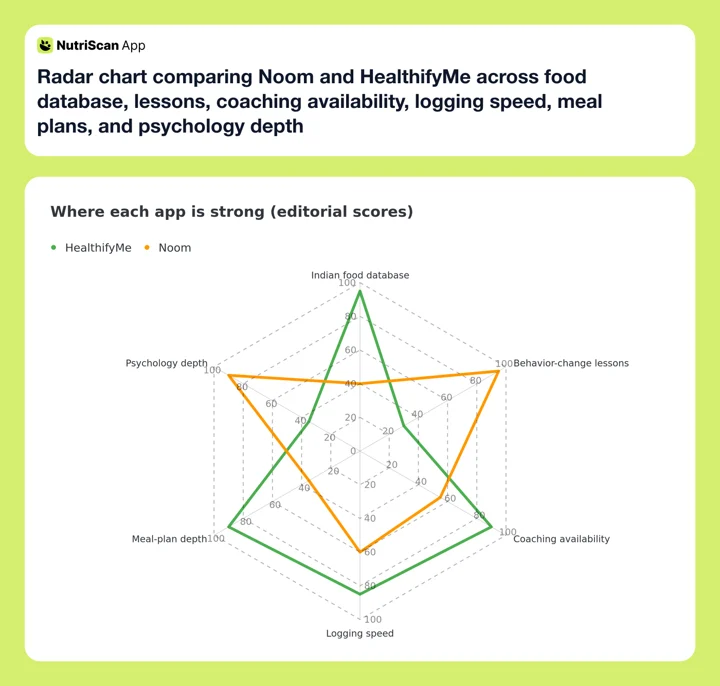 Figure 2: Editorial strength scores. The two apps barely overlap - they are strong in opposite places.
As Figure 2 shows, these two apps barely compete on the same dimensions:
Logging speed. Both ship photo logging now. Noom's Scan Meal reads a photo and identifies ingredients and portion sizes, but Noom lists it as available to most members in the US, Canada, Australia and the UK, and India is not on that list (Noom help center, updated 21 July 2026). So the practical gap for an Indian user is availability, not capability: HealthifyMe's Snap is there, Noom's photo route may not be, and you fall back to picking the right entry out of the search.
Accuracy of the food data. HealthifyMe wins for Indian food. Noom wins for US packaged foods and chain restaurant items. If your fridge is Trader Joes, Noom is closer. If your kitchen is dal, sabzi, and rice, HealthifyMe is closer.
Coaching depth. Mixed. Noom's coach is a behavior-change specialist, which means deep on psychology and light on meal plans. HealthifyMe's coach is a dietitian and a trainer, which means deep on meal plans and light on psychology. If your problem is "I emotional eat," Noom is the better coach. If your problem is "what should I eat for lunch tomorrow," HealthifyMe is the better coach.
Sticking with it. Roughly even. Noom's curriculum gives people a reason to open the app even when the scale is not moving. HealthifyMe's daily diet card and dietitian check-in give people a reason to log even when they are bored. The difference is what pulls you back. Lessons and a coach for Noom, food and a dietitian for HealthifyMe.
Emotional weight. Noom feels heavier. The reading, the lessons, the weekly graphs, all of it asks you to think. HealthifyMe feels operational. Log the food, follow the plan, take the step count. Neither is better. They are different kinds of effort.
Best moment. With Noom, it is the week 3 lesson where something finally clicks about why you eat after a hard meeting. With HealthifyMe, it is the week 4 morning when you realize your dietitian's "two chapatis, palak paneer, dahi" plan has become routine and the scale is down 2 kg.
 The app that wins is the one you still open in week 7 - not the one with the better homepage.
How NutriScan Fits Next to Both 📲
NutriScan is in a third spot from these two, and it is worth naming honestly. NutriScan is a photo-first calorie scanner with AI suggestions, not a behavior-change curriculum and not a coach-led program. If the appeal of HealthifyMe is "snap a photo of my thali, get a calorie count, move on," NutriScan offers the same fast-logging muscle without locking you into a monthly coach plan or a CGM bundle.
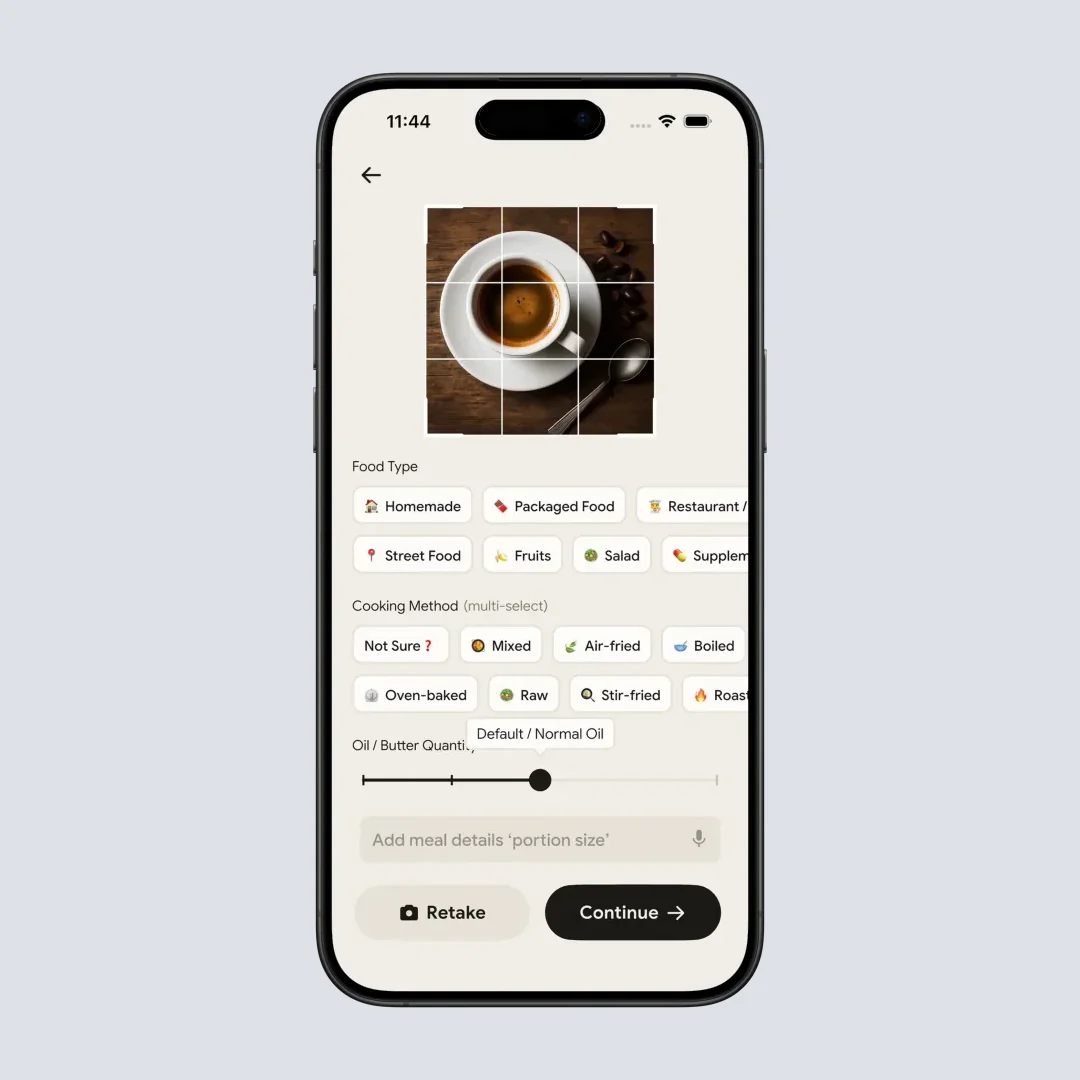
NutriScan's photo logging: snap, crop, and the AI fills in calories and macros. Home ➡️ Camera Icon ➡️ Click Picture
If the appeal of Noom is the food log plus structure, NutriScan is the lighter, lesson-free side of that experience. Every scanned meal gets a full nutrition breakdown, a NutriScore band, and micronutrients, all of it on the free plan, so you get the "what did I actually eat" answer without a lesson plan attached. You can also call Monika, the voice AI nutritionist, and chat your meal timeline in NutriBites.
On price, NutriScan Premium is about $59 a year. The free plan gives you 5 meal scans and 4 Monika calls a week, which is enough to test the scanner on the meals a food database usually gets wrong, your curries, your restaurant plates, your mixed bowls, before you decide whether it is worth paying for. Every new account also gets a 7-day Premium trial; it starts through your app store, and whether a card is collected depends on your platform and region.
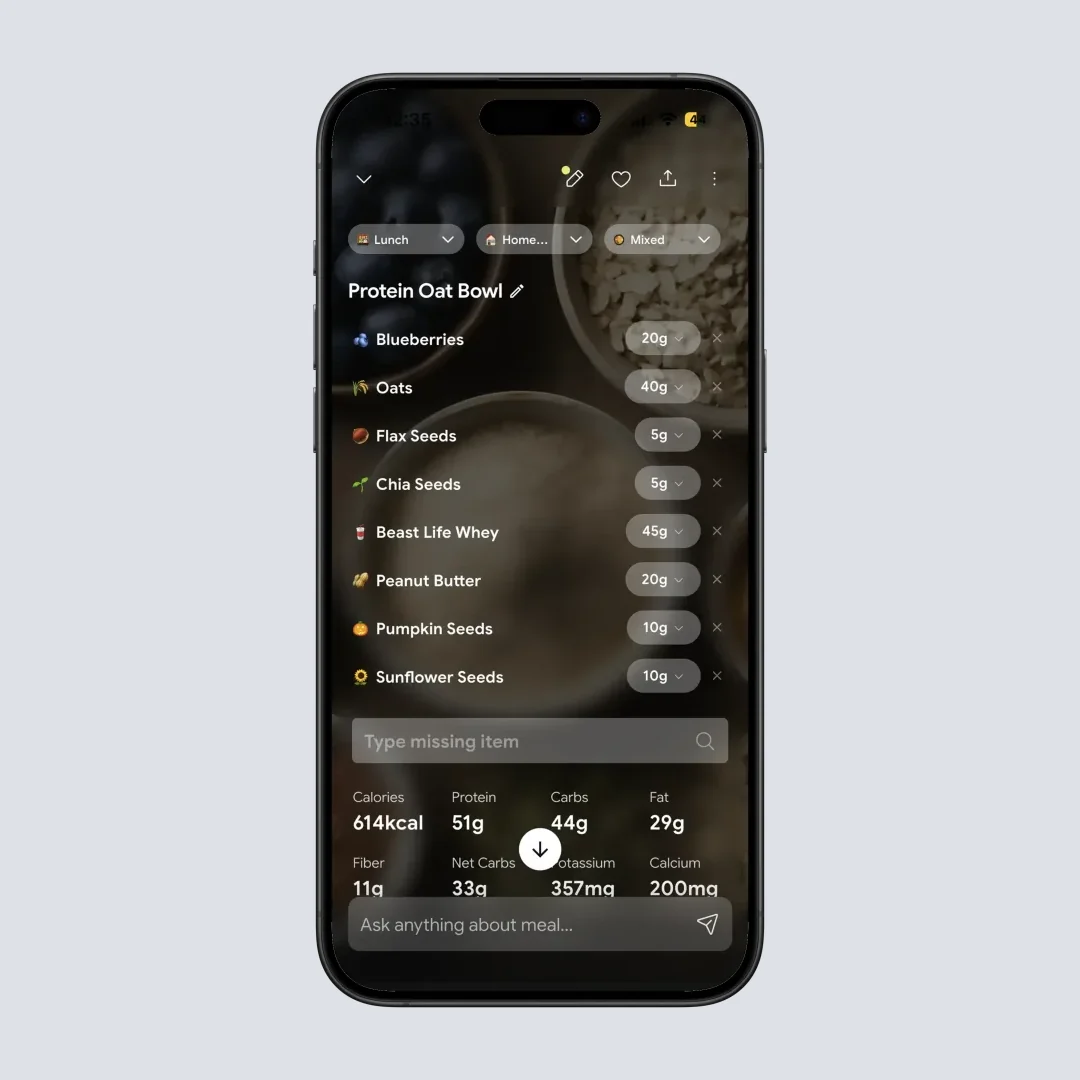
NutriScan nutrition breakdown: full macro split plus NutriBites insights on every logged meal. Home ➡️ Meal Card ➡️ Nutrition Details
The full NutriScan vs HealthifyMe breakdown is in our NutriScan vs HealthifyMe comparison, and a separate writeup covers the NutriScan vs Noom angle for people deciding between coaching and scanning.
The 14-Day Test That Makes the Decision for You ✨
If you are still on the fence after all of the above, stop reading comparisons and run the test. It takes two weeks and, if you cancel on time, close to nothing. One caveat up front: HealthifyMe publishes no trial length for its paid plans, so week 1 runs on the free app, and Noom takes a card at signup, so the cancel is on you.
The test:
- Spend week 1 on HealthifyMe's free tier. Log every meal, ask Ria at least one question a day, follow whatever plan the app hands you.
- Spend week 2 on the Noom 7-day trial. Read every daily lesson, log every meal, message the coach once.
- On day 14, ask one question: which app did you open first in the morning on the day you did not feel like it?
That day is the only data point that matters. Marketing pages tell you what an app does on its best day. Week 7 is decided by what you do on your worst day. The app you reached for when motivation was gone is the one that fits how you actually operate - reader or logger, student or patient.
Pay for that one. Cancel the other on day 13, before any auto-renew lands.
IMPORTANT
Recap: everything you covered this round.
You have the full picture. Save this for the next time someone asks which app to pick.
⏱️ Progress 4/4 • ~4 minutes in • Nicely done
✅ Step 1: Noom = behavior school, HealthifyMe = food clinic
✅ Step 2: Coaching - reflective teacher vs instant AI + dietitian plan
✅ Step 3: Cost - Noom publishes $209/yr, about ₹19,900; HealthifyMe publishes nothing above its free tier
✅ The 14-day test - the app you open on the unmotivated morning wins
Frequently Asked Questions ❓
Which one is cheaper if I am just starting out?
Neither one has a cheap published entry point in India, because HealthifyMe stopped publishing plan prices: healthifyme.com/in/plans is a 404 and the store's plans collection is empty. Its AI-only tier with Ria was listed at about ₹2,500 a year before that happened, so treat the figure as unconfirmed and start on the free tier instead. Noom's $209 a year, about ₹19,900 at ₹95.21 to the dollar (Xe, 7 August 2026), is the lowest dollar-per-day option that includes a US human coach plus daily lessons.
Does HealthifyMe have a human coach like Noom?
Yes, on the paid coach and CGM tiers. Noom's coaches are behavior-change specialists rather than dietitians (WebMD). HealthifyMe's Play listing says you connect one-on-one with dietitians or a weight-loss coach who build you a customized diet plan (Google Play listing, updated 29 July 2026). The AI-only Smart Plan does not include a human.
Is Noom worth $209 a year if I mostly eat Indian food?
Probably not, unless the daily behavior lessons are the reason you are paying. Noom's published food coverage is US packaged foods and 850-plus US restaurant chains (US News, January 2026), and nothing Noom publishes suggests its coaches are briefed on Indian portions. HealthifyMe's database and its Snap photo logging are built for Indian food. That comparison is our own read, not a third party's verdict.
Does HealthifyMe push you to upgrade?
It can. MouthShut reviewers from 2019 and 2020 describe repeated sales calls and pressure to upgrade to a coach plan (MouthShut, 1.5 rating across 1,156 votes). If that pressure is a problem, the AI-only plan skips most of the sales contact since there is no human to assign.
Can I cancel either one easily?
Both. Noom cancels in the app, on the web through its Subscription Portal, or through your device's app store, and its 7-day trial gives you time to back out before the annual charge hits; refunds run 14 days from purchase (Noom help center). HealthifyMe is canceled through your app store on iOS or Android, and its terms say app-store purchases are refunded by Apple or Google rather than by HealthifyMe, with requests made within 24 hours of the subscription starting (HealthifyMe terms of use).
Which one has the better food database?
HealthifyMe for Indian food, with photo logging tuned for thalis, breakfasts, and street food. Noom for US packaged foods, chain restaurants, and Western-style meals where the database is closer to USDA standard. If your day is Indian breakfast, Indian lunch, Indian dinner, HealthifyMe is the more honest answer.
Do I need the CGM bundle on HealthifyMe?
Only if you want to see how your blood sugar reacts to specific meals. HealthifyMe sells the CGM bundle through its sales team and publishes no current price for it, so ask before you commit. It is mainly useful for prediabetic users, PCOS users, or people trying to learn their personal glucose response to rice, roti, and sweets. For a straight weight-loss goal, the AI-only plan or a coach tier is enough.
Final Verdict 🏆
Noom feels more helpful on the day you are confused about why you keep eating after dinner. The lesson will name it, the coach will ask about it, and you will leave that session with a sentence you can use the next time.
HealthifyMe feels more helpful on the day you do not want to think about what to cook. Open the diet card, follow the meal, log the rest with Snap, hit the step target, ask Ria one question about portion size, move on.
Both of those days exist. The honest pick is whichever one matches the days you have more of. People who want to be taught will get more out of Noom. People who want to be fed a plan, in foods they already eat, will stay longer with HealthifyMe. The wrong reason to pick either one is the marketing on the homepage. The right reason is the day in week 7 when you almost did not open the app, and the version of the coach you want for that day is the version you should be paying for now.
And if what you actually want is the fast photo logging without a coach contract on top, NutriScan's free meal scan gives you the snap-and-track core of this whole category with no curriculum, no sales calls, and no annual lock-in. Run the 14-day test. Let your own mornings decide.