Is SnapCalorie Free? SnapCalorie Pricing and Premium Explained
 ChatGPT
  Claude
  AI Mode
  Perplexity
TL;DR - Is SnapCalorie Free?
• Free tier: Yes. Up to 3 AI photo or voice logs a day, plus unlimited manual, barcode, and label logging. No trial clock, no card.
• Premium list price: $19.99 a month or $149 a year on the US App Store, with eight more unlabeled "SnapCalorie Premium" prices from $9.99 to $99.99.
• Real price: Reviewers report in-app offers as deep as 80% off, so the annual plan can land near $15.
• Should you pay: Only if the 3-a-day AI limit is what stops you logging. Research ties weight loss to logging consistency, not to price.
SnapCalorie's own documentation says the app is free for up to 3 AI logs per day, according to SnapCalorie's FAQ. That single sentence answers the question most people search for. The longer answer, the one that decides whether you will ever pay, sits in the US App Store listing: ten separate "SnapCalorie Premium" in-app purchase prices, from $9.99 to $149.00. This post covers what is free, what Premium costs, and how to decide if the paid tier is worth it for you. 📊
Here is what I checked, in order:
- □ Whether the free tier is a trial or permanent
- □ Every Premium price on the US App Store listing
- □ What free users actually get versus Premium
- □ Whether the accuracy claim survives independent research
- □ The one number that tells you if Premium is worth it for you (near the end)
Starting with the free tier.
 Three of these a day cost nothing on SnapCalorie
The short answer: yes, with a daily limit
SnapCalorie is free to download on iOS and Android. The free tier is not a trial. The company's homepage describes core features as "free forever" with no credit card required, and the FAQ sets the concrete limit: up to 3 AI logs per day at no cost.
An AI log is the app's core feature: you take a photo of your plate (or dictate a voice note), and the app identifies the food, estimates the portion, and returns calories, macros, and micronutrients. Three of those per day covers breakfast, lunch, and dinner for many people. Snacks, repeat meals, and barcode scans can go through regular logging, which store reviews describe using on the free plan without reaching a limit.
That structure is unusual in 2026. Most AI photo apps gate scanning behind a subscription from day one. SnapCalorie flips it: the AI is the free draw, and the subscription removes the ceiling.
What SnapCalorie Premium costs in 2026
Here is where the listing gets messy, the same way I found with other AI scanning apps. The US App Store shows these in-app purchases (checked August 2026):
| In-app purchase | Price (USD) | Period label |
|---|---|---|
| SnapCalorie Premium (Monthly) | $19.99 | Monthly |
| SnapCalorie Premium (Annual) | $149.00 | Annual |
| SnapCalorie Premium | $9.99 | none shown |
| SnapCalorie Premium | $15.99 | none shown |
| SnapCalorie Premium | $19.99 | none shown |
| SnapCalorie Premium | $39.99 | none shown |
| SnapCalorie Premium | $49.99 | none shown |
| SnapCalorie Premium | $59.99 | none shown |
| SnapCalorie Premium | $79.99 | none shown |
| SnapCalorie Premium | $99.99 | none shown |
Only two of the ten prices carry a period label. The headline plan is $19.99 a month or $149.00 a year. The unlabeled tiers are the usual signature of regional pricing, older plans, and in-app discount offers that Apple still lists.
The discounts are real and large. One App Store reviewer reports taking an annual subscription for $15 through an 80% off offer inside the app. A European review of the app lists Premium at 89.99 EUR a year with a 7-day free trial (WellnessPulse review). Earlier roundups quoted $9.99 a month and $59.99 a year, and a 2026 reviewer roundup quotes $19.99 a month and $79.99 a year (Garage Gym Reviews). The pattern across all of these: SnapCalorie experiments with price, and the number you see in the app may not match the number your friend sees.
My practical read: treat $19.99 a month and $149 a year as the list price, and expect the app to offer you much less if you start the trial and wait.
- ✓ Free tier: permanent, 3 AI logs a day
- ✓ Premium prices: $19.99 a month, $149 a year, plus eight unlabeled tiers
- → Free vs Premium features (reading now)
- □ Accuracy versus independent research
- □ The one number that decides whether Premium is worth it (coming)
What you get free vs what Premium adds
SnapCalorie does not publish a feature-by-feature comparison table, so this is assembled from the store listings, the FAQ, and the review record.
Free tier:
- Up to 3 AI logs per day (photo or voice note)
- Manual logging with a 500k+ food database verified against USDA data
- Barcode scanning and nutrition label scanning
- Calorie, macro, and micronutrient goals (100+ nutrients listed)
- Visual food timeline and weight tracking
- Apple Health integration (Android fitness integration is listed as in development in the FAQ)
- A free web meal planner on the company site
Premium:
- Unlimited AI photo and voice logs
- The store listings do not itemize further paid features; reviewers mention an AI chat assistant for nutrition questions
The striking part of the review record is how often free-tier users say they never needed to upgrade. A Play Store reviewer with a year of use calls it "pretty solid for a free calorie tracking app." An App Store reviewer writes that "the free version gives you everything you need already, unlike all those paid apps that need a subscription from the beginning." When the loudest praise for a paid app is about its free tier, that tells you who the product serves well.
Who is behind SnapCalorie, and does the accuracy claim hold?
SnapCalorie is made by Perception Labs, Inc., founded by ex-Google AI researchers; the store listing says the founders helped build Google Lens and the Cloud Vision API. TechCrunch covered the company's $3M seed round in June 2023 (TechCrunch).
The research base is real. The team's portion estimation work, Nutrition5k, weighed every ingredient in 5,000 dishes, photographed them from many angles, and was accepted at CVPR 2021, a top peer-reviewed computer vision conference, co-authored with Google Research (Thames et al., 2021).
The company's FAQ claims around 15% mean caloric error, and puts context around it: US nutrition labels are legally allowed 20% error, and it cites much higher error rates for humans estimating from photos. Those comparison figures are the company's own framing, not independent measurements, so treat them as marketing with a citation attached. Independent research is more measured: a 2025 co-design study notes that photo-based dietary assessment tools show measurement errors comparable to traditional methods (Connelly et al., 2025). Comparable to traditional methods is genuinely useful. It is not laboratory precision.
Store reviewers land in the same place. One long iOS review calls the image capture "the best I've come across" but notes complex restaurant dishes "tend to be slightly off." Another reports the AI sometimes misjudges portion weight "by a factor of two." For a free tool that replaces database search, that trade is fine.
WARNING
Don't use SnapCalorie's portion or calorie estimate to dose insulin or make other medical decisions. Reviewers report errors of up to 2x on complex dishes.
Does paying for a tracker actually help you lose weight?
Price only matters if the tracking works. The research here is consistent, and none of it says the expensive app wins.
A 2025 meta-analysis on mobile apps in obesity management found that smartphone apps have a statistically significant effect on weight loss and BMI reduction over 4 to 6 months, with the strongest effects when apps include self-monitoring features and personalized feedback (Pujia et al., 2025). A 2026 scoping review of 68 studies covering 46 calorie-counting apps adds the caveat: adherence declines over time, with self-monitoring in MyFitnessPal falling from 5.4 to 1.4 days a week between weeks 4 and 12 in one included study, and most participants preferred free apps, naming cost as a factor in app choice (Dugas et al., 2026).
What predicts success is showing up. Burke et al. ran a 502-adult randomized controlled trial over 12 months and found that higher adherence to diet, activity, and weight self-monitoring was associated with greater odds of losing at least 5% of body weight (Burke et al., Obesity 2025, PMC11897847). Payne et al., writing in Obesity Science and Practice in 2022, found that consistent and frequent app-based dietary self-monitoring was associated with short-term weight loss (Payne et al., 2022).
Read those together and the pricing question reframes itself. The variable that matters is whether you log tomorrow, not whether you paid $149. If a 3-logs-a-day limit fits your eating pattern, the free tier gives you the full adherence benefit. If the limit is exactly what makes you stop logging snacks, the subscription is buying consistency, and the research says consistency is the active ingredient.
5 tips before you pay for SnapCalorie Premium
- Live on the free tier for two weeks first. Three AI logs a day plus barcode and manual logging covers most eating patterns. You will know quickly whether the limit actually affects you. 📱
- Start the trial, then wait before paying sticker price. The review record shows in-app offers as deep as 80% off the annual plan. Paying $149 on day one is the most expensive way to buy this app, so let the offer come to you.
- Check the period label before you tap. With ten prices named "SnapCalorie Premium" on the listing, confirm on the Apple or Google payment sheet whether you are buying a month or a year. The confirmation sheet is the only place the term is guaranteed to be stated.
- Manage the subscription through your store account, not the app. Both stores bill through your Apple ID or Google account, so cancellation and refund requests go through Apple and Google, not the developer. Turn off auto-renew right after subscribing if you only want one period.
- Match the tool to your riskiest meal. SnapCalorie's depth-sensor portion estimate helps most when you eat out. If most of your meals are home-cooked repeats, a database tracker logs them just as well at zero cost.
- ✓ Free tier, Premium prices, feature split, accuracy: done
- → The one number that decides it (this is the reveal)
The number is your daily AI log count. Open your last week of meals and count how many plates you would want to photograph rather than search. If it is 3 or fewer on most days, SnapCalorie's free tier already gives you the full adherence benefit the trials describe, and Premium buys you nothing. If it is 5 or 6, the daily cap is exactly the friction that makes people quit logging, and the subscription is buying consistency. Count first, then price.
 Count your plates, then decide
How to check what SnapCalorie will cost you (step by step)
Prices vary by country and by promotion, so verify yours before subscribing:
- Install the app free. No credit card is requested for the free tier on either store.
- Finish onboarding and skip any splash offer. Note the first price you are shown, then close it. This is usually the full list price.
- Open the upgrade screen from settings. Compare the monthly and annual figures against the $19.99 and $149 US reference points in this post.
- Check your store's subscription page before confirming. On iPhone: Settings, your name, Subscriptions. On Android: Play Store, profile, Payments and subscriptions. The renewal price and date shown there are the binding ones.
- If you subscribe, set a calendar reminder 2 days before renewal. Refunds for auto-renewals go through Apple or Google review and are not guaranteed, so canceling in time beats asking for money back.
Where NutriScan fits
NutriScan publishes this post, and we make a competing app. Both apps bet on photo logging as the fastest way to keep people consistent. The models differ: SnapCalorie gives unlimited manual logging and caps free AI scans at 3 a day, while NutriScan's free plan caps scans weekly and Premium removes the limit alongside diet plans, a voice assistant, and fasting tools, at about $59 a year. There is a detailed side-by-side in NutriScan vs SnapCalorie, and our own numbers are in the NutriScan pricing breakdown. If you are comparing the wider field, the going rate for AI scanning apps is documented in our Cal AI pricing guide and the free AI tracker roundup. For the other end of the scale, an app with no free tier at all, the Nutri AI pricing breakdown covers the seven apps that share that name.
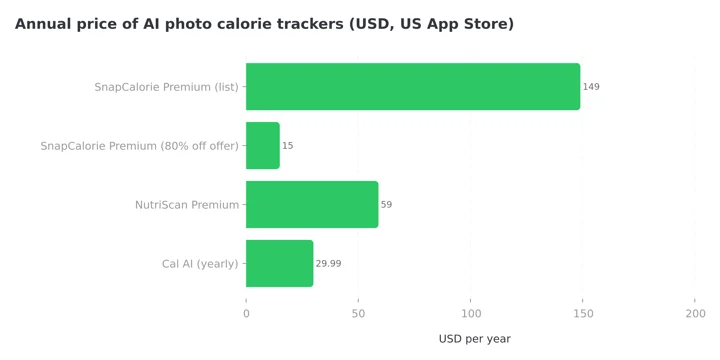 Figure 1: SnapCalorie's $149 list price is the highest of the group, but its reported 80% off offer makes it the cheapest. The sticker price is the least useful number on this chart.
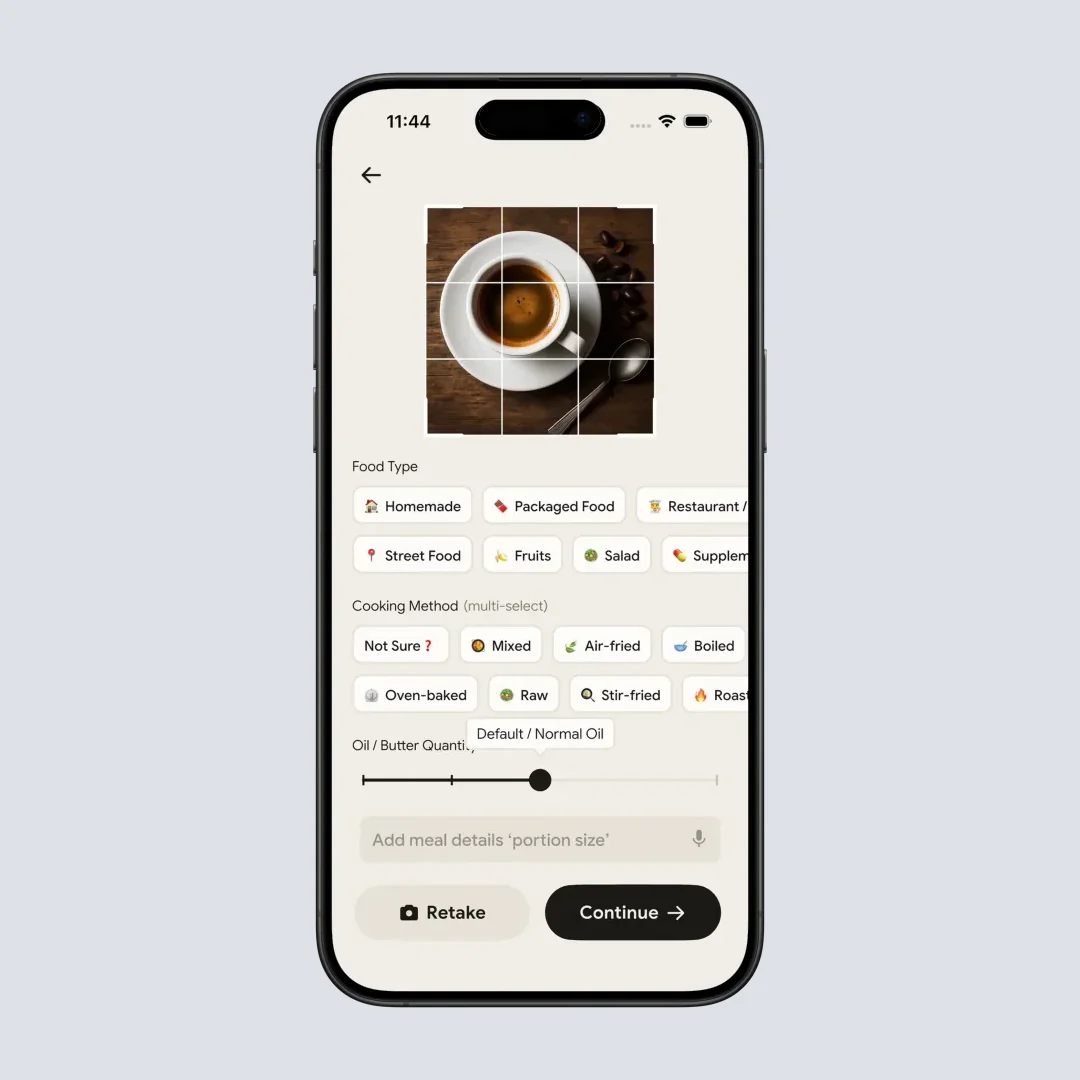
NutriScan's meal scan (Home ➡️ Camera Icon ➡️ Crop Picture) lets you tag food type, cooking method, and oil level before the estimate, on the free plan as well as Premium.
The honest comparison: if you want the most generous permanent free tier for photo logging, SnapCalorie's 3-a-day limit leads the field. If you want one paid app to cover scanning, planning, and coaching together, compare annual totals, not monthly prices: $149 a year is nearly 3 times the price of some competitors.
The takeaway
SnapCalorie is genuinely free for up to 3 AI logs a day, with no trial clock and no card required, which makes it one of the few AI photo trackers you can use indefinitely without paying. Premium's sticker price is $19.99 a month or $149 a year in the US, but the ten-price App Store listing and the discount reports mean your real price may be far lower if you wait for an in-app offer. The research says the deciding factor in weight outcomes is logging consistently, not which tier you buy. Start free, watch whether the daily limit changes your behavior, and pay only for the friction it removes. If you try photo logging and want to see how a weekly-capped free plan compares, NutriScan's free tier is a two-minute download away. 🍎
FAQ
Q: Is SnapCalorie free?
Yes. SnapCalorie's FAQ states the app is free for up to 3 AI logs per day, and the homepage describes core features as free forever with no credit card required. The free tier does not expire. A Premium subscription removes the daily AI limit.
Q: How much does SnapCalorie Premium cost in 2026?
The labeled US App Store prices are $19.99 a month and $149.00 a year. Eight more unlabeled "SnapCalorie Premium" prices from $9.99 to $99.99 appear on the listing, reflecting regional and promotional variants. Reviewers report in-app discounts as deep as 80% off the annual plan.
Q: Does SnapCalorie have a free trial?
Independent reviews report a 7-day free trial on Premium. Because the free tier is permanent, the trial mainly matters if you want to test unlimited AI logs. Cancel through your Apple or Google subscription settings before the trial ends to avoid the charge.
Q: Is SnapCalorie's photo scanning accurate?
The company reports about 15% mean caloric error on its internal 5,000-dish test set, work that was peer reviewed at CVPR 2021 (Thames et al., 2021). Independent research finds photo-based tools comparable to traditional dietary assessment (Connelly et al., 2025). Reviewers say simple plates score well and complex dishes score worse.
Q: Do I need to pay for a calorie tracker to lose weight?
No. Trials link weight loss to consistent self-monitoring, not to price (Burke et al., Obesity 2025, PMC11897847). Pick the app you will actually open every day. Pay only when a specific limit, like SnapCalorie's 3 daily AI logs, is the thing stopping you from logging.