Best Indian Food Tracker: HealthifyMe vs MyFitnessPal
 ChatGPT
  Claude
  AI Mode
  Perplexity
Across India, carbohydrates supply 62.3% of daily energy, and almost none of it arrives with a barcode. It comes in katoris, on thalis and in stacks of roti. Below: which of the three apps survives that, what the research actually says about photo scanning, and the one hour of setup that ends portion guessing for good.
TL;DR - Indian Food Tracking App Guide
• Who it's for: Anyone who has typed a dish into a calorie app and thought "that number cannot be right"
• The real error: Not the database. Portion size and cooking oil, which no app can see from a photo
• Top picks: HealthifyMe if you want a human coach ➡️ MyFitnessPal if you eat mostly packaged food ➡️ NutriScan if you want cooking method and oil captured on every meal
• The bigger lever: One hour with a kitchen scale beats every feature in this comparison
NutriScan publishes this post, and we make a competing app. A common complaint about calorie apps is "it does not have my food." The 2025 ICMR-INDIAB analysis published in Nature Medicine put a number behind that feeling. Drawing on 18,090 adults, it found that carbohydrates supply 62.3% of daily energy nationwide, mostly from refined cereals at 28.5% of energy and milled whole grains at 16.2%, with protein low at 12% (Anjana et al., 2025).
Read that again as a logging problem. Most of the calories on an Indian plate come from foods that arrive in a katori, a bowl or a stack of rotis. They have no barcode, no fixed serving size, and no single recipe. A tracker built around packaged goods and 100-gram portions is being asked to do a job it was never designed for.
So this post looks at the three apps Indian users actually pick between: HealthifyMe, NutriScan and MyFitnessPal. It compares what each one does at the exact moments Indian food gets hard, and what each one costs. The right answer is different depending on whether you eat at home, in a hostel mess, or at a restaurant four nights a week.
IMPORTANT
Your Indian food tracking plan at a glance.
⏱️ Progress 0/4 • ~0 minutes in • Keep going
⏳ Step 1: Understand the four things that break trackers on Indian food
⏳ Step 2: See how the three apps behave at those exact moments
⏳ Step 3: Check what the research says before you trust a photo scan
🔍 Step 4: The one-hour calibration that ends portion guessing (revealed near the end)
Why Indian Food Breaks Most Calorie Trackers 🍛
Four things go wrong, and they go wrong in a specific order.
One dish hides eight ingredients. Rajma chawal is beans, rice, onion, tomato, oil, cream sometimes, and a spice mix. Researchers building the open-access Indian Nutrient Databank had to describe 1,014 commonly consumed recipes on top of 1,095 individual food items to make Indian diets computable at all (Vijayakumar et al., 2024). A search box that returns one line for "rajma" is flattening all of that.
The reference data is thinner than people assume. That same team built stage one of its databank on the ICMR-NIN Indian Food Composition Table from 2017 (ICMR-NIN) and still had to fill gaps using the older 2004 tables plus nutrient databases from the United Kingdom and the United States. If a research group needed three foreign databases to describe Indian ingredients, your app is bridging the same gap with recipes, assumptions or AI.
Nothing has a standard portion. A katori in one house holds 120ml. In another it holds 200ml. A roti made from 30g of atta and a roti made from 50g of atta look almost identical on a plate.
The fat is invisible. Tadka, ghee on the roti, and the oil a restaurant uses to keep a gravy glossy are the calories nobody logs. ICMR-NIN's 2024 Dietary Guidelines for Indians address this plate directly, advising limits on visible fat and recommending that at least half of all cereals and grains be eaten as whole grains (ICMR-NIN, 2024).
An app can only help with the last three. No app fixes the first one for you, because only you know what went into the pot.
 Nobody rolls the same roti twice. That is the whole problem, and it starts before any app opens.
The Portion Problem: One Roti Is Not One Roti
This is the error that quietly ruins months of tracking, and it has nothing to do with the app's database.
A standard whole wheat chapati is about 120 calories (chapati nutrition). That figure assumes a roti of a particular size. Make them larger, the way most home kitchens do for dinner, and each one carries closer to 170 calories. Log four rotis a day at the smaller value and you are under-counting by roughly 200 calories daily.
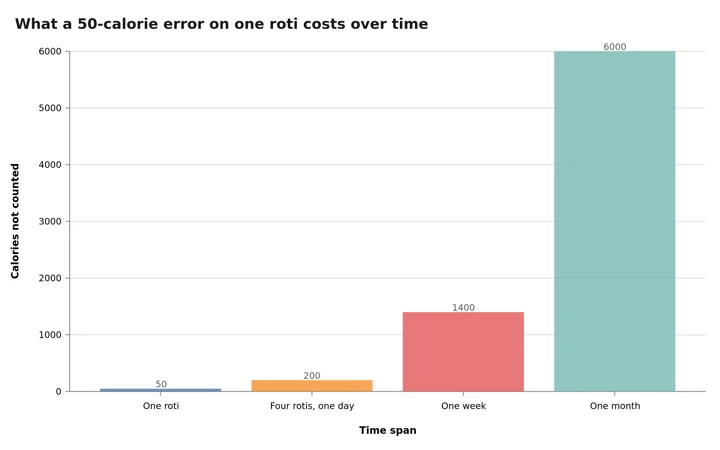 Figure 1: A 50-calorie miss on a single roti is invisible. Four a day for a month is about 6,000 calories, the entire difference between losing half a kilo and losing nothing.
The same applies to dal. One cup of dal tadka runs about 182 calories (dal tadka nutrition), and "one katori" in your kitchen might be two-thirds of that or one and a half times it.
Here is the part that matters for app choice. None of the three apps can see your katori. What separates them is how easy each makes it to correct the portion after the fact, and whether the correction sticks for next time.
The Oil Problem: The Number Your App Cannot See
Cooking oil is 9 calories per gram, so one tablespoon is about 120 calories and a two-teaspoon ghee tadka is about 80. A restaurant dal makhani finished with butter and cream can carry 150 to 250 calories more than the same bowl cooked at home with a teaspoon of oil.
That single variable swings a home-cooked meal by 10% and a restaurant meal by 30% or more. It is the largest controllable error in Indian food logging, larger than any database difference between the apps.
The one question to ask of any tracker
After it identifies your dal, does it give you a way to say how it was cooked? Two of the three apps here treat that as an afterthought.
How the Three Apps Handle Indian Food
Prices below are standard prices as of mid 2026 and change by region.
| What matters | HealthifyMe | NutriScan | MyFitnessPal |
|---|---|---|---|
| Photo scan of a plate | Yes (Snap) | Yes | Yes (Meal Scan), Premium only |
| Asks cooking method before saving | No | Yes, 11 options | No |
| Oil or fat level input | No | Yes, 4 levels | No, unless the entry says so |
| Database style | Company database plus AI | AI reading of the plate plus food database | Crowd-submitted, over 2 million entries |
| Barcode scanner | Yes | No, packaged food goes in through the Packaged Food tag with manual or voice entry | Premium only |
| Free tier with real photo logging | Limited | Yes, 5 AI scans a week | No |
| Human coaching | Yes, paid tiers | No | No |
| Indian language in app settings | Not published | Hindi in the language switcher | Not for Indian languages |
| Entry price | Around Rs 2,499 a year (Smart) | About $59 a year | $79.99 a year (Premium) |
One honest note before the sections below. No company publishes per-cuisine coverage numbers, so treat every "deepest Indian database" claim, including any you read about our own app, as unverified marketing. What you can check yourself is the flow: how many taps it takes to fix a wrong portion, and whether the app ever asks about oil.
1 of 4 done. You know what breaks. Next: how each app behaves at those exact moments. The calibration step is still coming.
HealthifyMe: The Deepest Roots in Indian Food, at Coaching Prices
HealthifyMe has the longest history with this problem. It shipped AI image recognition tuned for Indian dishes back in 2023, years ahead of the Western apps (TechCrunch, 2023). Its Snap feature reads a photo and logs calories and macros. Ria, the AI coach, answers questions in plain language.
Scale is real. The Android listing shows more than 10 million downloads, 569,000 reviews and a 4.3 rating, and describes a database of over 100,000 foods (Google Play).
Two things to know before you pay. First, 100,000 foods is a headline, not a coverage guarantee for your kitchen. Test your own ten meals rather than trusting the number.
Second, the price ladder is steep. The Smart plan, the AI-only tier, sits around Rs 2,499 for twelve months. Coach plans move into thousands of rupees per month and the CGM and medical tiers go higher again (HealthifyMe pricing guide). If you want a human nutritionist reading your log, that is the fair price for a human. If you only want accurate tracking, you are paying for a service you will not open.
Best for: people who want an Indian-food-aware tracker plus a real coach, and who have the budget for the coaching tiers.
MyFitnessPal: The Biggest Database, and the Biggest Caveat
MyFitnessPal advertises nutrition facts for over 2,000,000 foods, one of the largest catalogs anywhere, and that is exactly the problem for Indian food. The bulk of it is user-submitted and unverified. The company's own support documentation explains how to correct a wrong entry (MyFitnessPal Support), which tells you how the data got there in the first place.
Search "dal makhani" and you will get dozens of results ranging from around 120 to 500 calories per serving, each submitted by a stranger guessing at their own bowl. For a packaged biscuit that variation is small. For a gravy dish it is the whole answer.
The research is kinder to MyFitnessPal than the internet is, with one condition attached. A validation study in the Journal of Medical Internet Research had 50 participants complete 4-day dietary records in MyFitnessPal and compared the results against Nubel, the Belgian national food composition database. After cleaning, correlations were strong for energy (r=0.96), carbohydrates, fat and protein (all r=0.90), weaker for fiber and sugar, and weak for cholesterol and sodium (Evenepoel et al., 2020). The condition: those participants were logging European foods that existed properly in the database, and they had careful instructions. Neither is true for someone typing "amma's sambar" at 9pm.
There is also a paywall detail that hits Indian users harder than most. Both barcode scanning and Meal Scan sit behind Premium, which is $79.99 a year in the US (MyFitnessPal). Packaged Indian snacks are where a barcode actually helps. If that combination bothers you, we compared the field in the best MyFitnessPal alternatives.
Best for: people who eat a lot of packaged and international food, already have years of MyFitnessPal history, and are willing to build their own verified entries for home dishes.
NutriScan: Built Around the Questions the Others Skip
NutriScan approaches the same plate differently. The photo scan reads the meal, then the app asks two things before it commits to a number: the cooking method, from 11 options including deep-fried, air-fried, steamed, roasted and boiled, and the food type, from eight tags including home made, restaurant, street food, hostel and hotel buffet. There is also an oil level slider with four settings, from no oil to high oil.
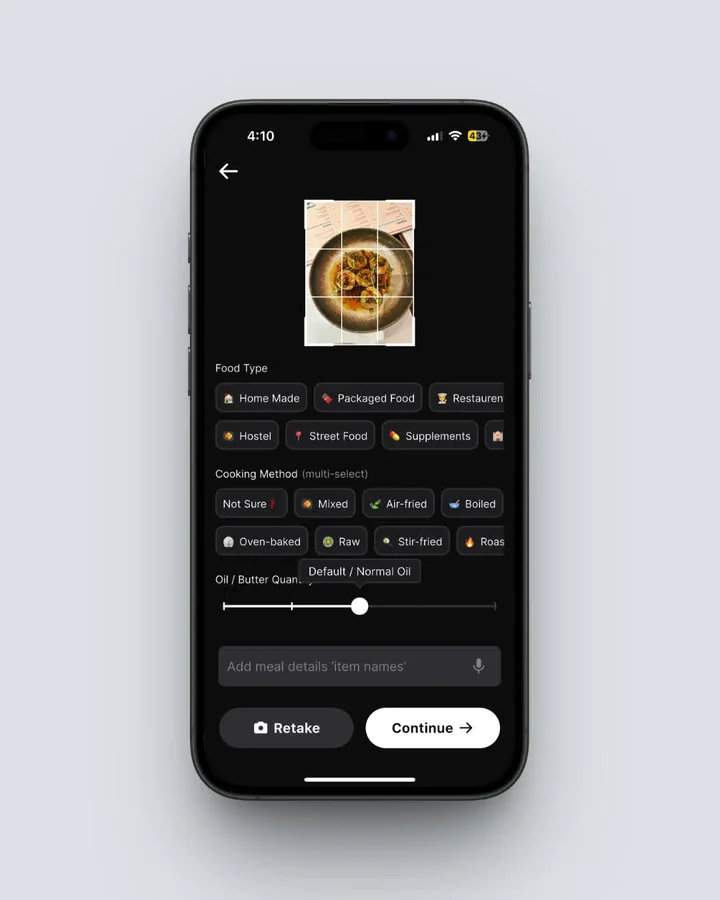 Home > Camera Icon > Crop Picture. Cropping to the katori before the scan is what keeps a thali from being read as one dish.
That sounds like extra work, and it is, by about two taps. It is also the only place in this comparison where the largest error source in Indian cooking gets a direct input.
The rest is straightforward. Portions adjust with plus and minus or by typing an exact number. Missing items get added by voice or keyboard, which is how you handle the papad and the pickle the camera ignored. Every meal gets a NutriScore rating and its top micronutrients. The language switcher includes Hindi alongside English, German, Spanish and French. Repeat meals and copy-to-today exist for the reality of eating the same dal four days a week.
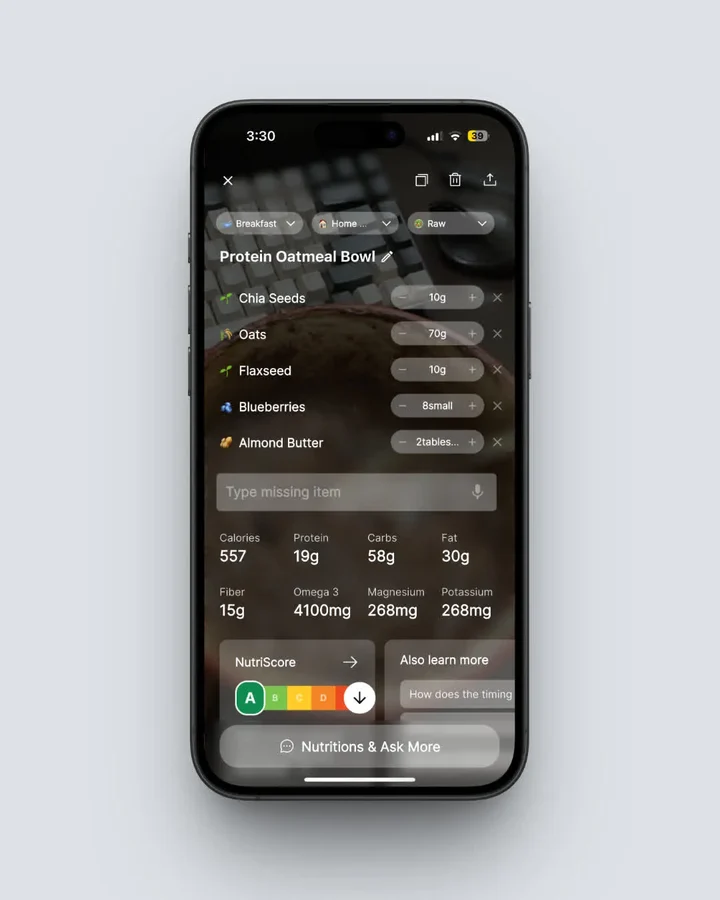 Home > tap any logged meal > Nutrition Details. The NutriScore and micronutrient breakdown come with the free plan, not just Premium.
The free plan includes five AI scans a week with no ads, and keeps macros, micronutrients and NutriScore on every meal. Premium runs about $59 a year and adds unlimited scans, the diet plan builder with an Indian cuisine preference, weekly and monthly grocery lists, and the Monika voice assistant. Full details sit in the NutriScan pricing breakdown, and there is a head-to-head in HealthifyMe vs NutriScan on Indian food.
Best for: home cooks and hostel or office eaters who want the oil and cooking method captured, and anyone who wants to test real photo logging before paying.
2 of 4 done. Apps compared. Now the part most comparison articles skip: whether photo scanning is good enough to trust at all.
What the Research Says About Photo Logging Accuracy
Photo-based logging is now good enough to be useful and not good enough to be exact. Both halves of that sentence matter.
A 2025 study in Nutrients uploaded 114 meal photographs drawn from national dietary survey data and asked a vision model to identify the foods, estimate their weight, and estimate 16 nutrients. It identified the foods with 93.0% precision. Agreement on meal weight was good for small meals but poor for medium and large ones. Percentage difference from the true value exceeded 10% for 13 of the 16 nutrients, and the model underestimated 11 of them (O'Hara et al., 2025).
Recognition is close to solved. Portion size is not, and the error runs downward. That direction matters for Indian meals, because a katori of gravy and a full plate of biryani are exactly the medium and large servings the model reads as smaller than they are.
 The camera is the easy part. Telling the app how big the serving was is where accuracy is won or lost.
The comparison that changes the decision is against humans, not against a laboratory. In the same Nutrients study, seven dietitians estimated energy, protein and carbohydrate for 38 of the meal photographs, and agreement between the model and the dietitians ran from an intraclass correlation of 0.31 to 0.67 (O'Hara et al., 2025). Trained professionals eyeballing a plate do not agree closely with each other either.
A 2025 study in Scientific Reports went further. Researchers trained an AI app to assess the 2:1:1 balanced-plate proportions of three Thai dishes, each prepared in three portion variations, then compared it against dietetics students and registered dietitians. The app had significantly lower mean absolute error than both groups on two of the three dishes (Choochaiwattana et al., 2025).
What this means for your thali
The honest standard is not "is the app right." It is "is the app closer than my own guess, every day, without me quitting." For mixed Indian dishes, a photo plus a cooking-method answer clears that bar. A crowd-sourced text entry chosen in a hurry often does not.
Five Meals That Decide Which App Fits You
These are the meals where the three apps behave differently. The ranges below are what the dish itself can swing by, based on portion and cooking fat, not app outputs.
| Meal | What swings the number | Typical swing | What you need from the app |
|---|---|---|---|
| Dal and 3 rotis | Roti size, ghee on top | 250 to 400 calories | Editable portions that save |
| Rajma chawal | Rice weight, cream in the gravy | 200 to 350 calories | Separate entries for rice and gravy |
| Masala dosa | Oil on the tawa, potato filling size | 150 to 300 calories | Cooking method input |
| Veg thali | Number of items, second helpings | 300 to 600 calories | Add and remove items after the scan |
| Chicken biryani | Meat to rice ratio, oil layer | 250 to 450 calories | Portion typing, not just plus and minus |
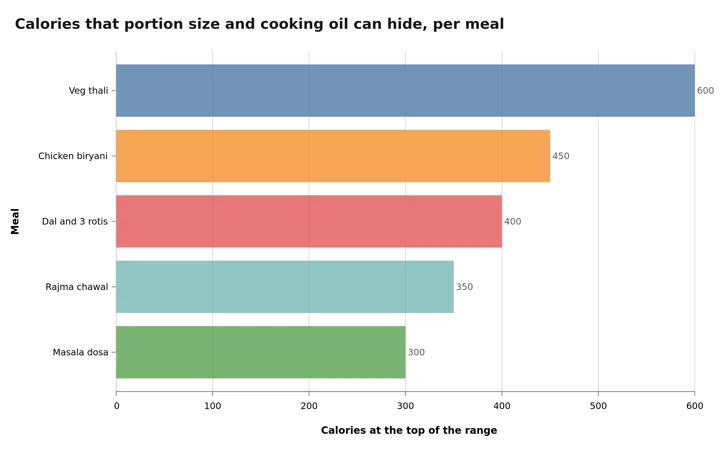 Figure 2: A veg thali can hide up to 600 calories depending on helpings and oil. Four of these five meals need an edit after logging, not a better search result.
Notice that four of the five need an edit after logging. That is the practical test for any tracker you are considering, and it holds for mixed dishes in any cuisine.
3 of 4 done. One thing left, and it is the one that actually moves your numbers. Here it is.
The Calibration Hour That Ends Portion Guessing 🔓
Everything above is about choosing an app. This is the hour that makes any of them work, and almost nobody does it.
Portion error is the largest source of inaccuracy in Indian food logging, and it is the only one you can eliminate completely. It takes about sixty minutes, once, with a kitchen scale.
Weigh your atta. Measure out exactly 200g of flour, make your usual rotis from it, and count how many you get. Eight rotis means 25g of atta each. Six means 33g. Enter one roti as its real weight in your app and every future roti logs itself.
Measure your katori. Fill it to the level you actually serve at, pour that into a measuring cup, and write the number on a sticky note inside the cupboard. Do this for the dal katori, the sabzi katori and the rice serving spoon. Five minutes.
Weigh your cooked rice once. Cook your normal quantity, weigh what lands on your plate. Most people are 30 to 50% above what they assumed.
Weigh the oil for your standard sabzi. Once. Divide by the number of servings. Now the invisible number is visible, and you can set the oil level on every future log honestly instead of optimistically.
Why this beats every app feature
An app can guess your portion. It cannot know it. Once you have these four numbers, the photo scan only has to identify the food, which is the part the research shows it does well at 93.0% precision. You have handed it the part it does badly.
After that hour you can log by count for months. Recalibrate only if you change kitchens, change cooks, or buy different serving bowls. If you want to convert those numbers into daily targets, the macro calculator and our calorie deficit chart for Indian beginners both take grams as input.
Step by Step: Set Up Any App for Indian Food
- Build five custom entries in grams. Your dal, your sabzi, your roti, your rice portion, your chai with sugar. "One bowl" ages badly. "180g cooked dal" does not.
- Log the tadka separately. Add the ghee or oil as its own line item. Five seconds, and it captures the calories most people lose.
- Photograph before mixing. Separated rice and gravy is far easier for any AI to read than a mixed plate.
- Tag restaurant and street food honestly. Outside food carries more oil and salt. If your app has that tag, it is doing arithmetic on your behalf.
- Judge yourself weekly, not daily. Single-meal error is high in every app. Weekly averages are where the signal lives.
Pricing: What Each One Actually Costs
| App | Free plan | Paid entry point | Coaching |
|---|---|---|---|
| HealthifyMe | Limited tracking | Smart, around Rs 2,499 for 12 months | Yes, extra cost |
| NutriScan | 5 AI scans a week, no ads, full macros | About $59 a year | No |
| MyFitnessPal | Logging without barcode or Meal Scan | Premium at $79.99 a year, Premium+ at $99.99 | No |
Two notes. MyFitnessPal's India store price differs from the US figure, so check the in-app price before you assume. HealthifyMe's coach plans are a separate purchase from the app subscription and move into thousands of rupees a month.
Which One Should You Use?
If you want a human coach who reads your log: HealthifyMe. Nothing else here offers that, and the Smart tier is a fair way to try the app before the coaching tiers.
If most of your food is packaged or international: MyFitnessPal, with the discipline to build verified entries for your home dishes. Its size is a genuine advantage outside the Indian kitchen.
If you cook at home, eat in a mess or hostel, or order out often: the tracker that asks about cooking method and oil will beat the one with the larger database, because portion and fat are where your calories actually hide. That is the gap NutriScan was built for: scan the plate, answer two questions, adjust the portion, done. The free plan gives you five real photo scans a week with macros, micronutrients and NutriScore included, so you can test it on your own dal before spending anything. If you want to run the numbers on specific dishes first, the Indian food calorie calculator is free and needs no download.
Whichever you pick, run the same test for one week. Log ten of your regular meals, correct every portion, and see which app made that correction fastest. The best Indian food tracker is the one you are still using in March.
FAQ
Q: Which app has the best Indian food database?
No company publishes per-cuisine coverage, so nobody can answer this with evidence. HealthifyMe's Google Play listing claims over 100,000 foods. MyFitnessPal's own site advertises over 2,000,000, most of them user-submitted and unverified. Neither number tells you how many of your dishes are in there. The reliable test is your own: log your ten most common meals in each app and count how many you had to correct.
Q: Is MyFitnessPal accurate for Indian food?
It is as accurate as the entry you pick, and the entries for Indian dishes are crowd-submitted. A validation study found strong correlations with the Belgian national food composition database for energy and macronutrients, but weak ones for cholesterol and sodium (Evenepoel et al., 2020), and those participants were logging European foods with careful instructions. For dal or biryani, build your own entry once.
Q: Can AI photo scanning handle a full thali?
Partly. A thali with distinct katoris is close to the best case for it. In a 2025 evaluation of 114 meal photographs, a vision model identified foods with 93.0% precision but agreed on meal weight only for small meals (O'Hara et al., 2025). Expect to add what the camera missed and raise portions rather than lower them.
Q: Do I have to weigh my food to track Indian meals?
Not forever. Weigh once to calibrate: your atta per roti, your katori in milliliters, your usual serving of rice. After that you can log by count for months. Recalibrate if you change kitchens or your cook changes.
Q: What is the cheapest way to track Indian food?
Free tiers, if they include what you need. NutriScan's free plan covers five AI photo scans a week with macros, micronutrients and NutriScore, and no ads. If you want to pay, NutriScan Premium runs about $59 a year and HealthifyMe's Smart plan is around Rs 2,499 for twelve months.
Q: Why do calorie apps get roti wrong?
Because a roti has no standard size. A chapati is about 120 calories, but that assumes a particular diameter and amount of atta. Larger dinner rotis carry closer to 170. No app can see the size of yours, which is why the app that makes portion correction fastest beats the app with the larger database.