HealthifyMe vs NutriScan 2026: Best Indian Food Photo Scan
 ChatGPT
  Claude
  AI Mode
  Perplexity
When researchers put 114 meal photographs through ChatGPT and compared its nutrient estimates against the real values, the mean absolute percentage difference was 26.9% across 16 nutrients, on meals ranging from a single item to nine (O'Hara et al., Nutrients 2025). Energy itself came out close, at 0.1%. The weight of the meal did not: the model read 87 of those 114 photographs light, and agreement got worse as portions got bigger. The photographs came from an Irish dietary survey, so not one Indian plate was tested.
You take a photo of dal, two rotis, a katori of sabzi. The app returns a number. But is that number close enough to trust?
For Indian food - variable oil, home-cooked portions that shift daily, regional dishes with 20 local names - a photo has more to guess at than it does on a separated Western plate. Two apps you can point at that problem are HealthifyMe and NutriScan. Both scan meals from a photo. They handle the guessing very differently.
I write for the NutriScan team, so I will disclose that upfront. What follows is not a weighed lab test. It is a walkthrough of what each app asks you and what each one returns, plus every price and study claim traced back to a source you can open yourself.
IMPORTANT
Your comparison plan at a glance.
A roadmap so you know where this is heading.
⏱️ Progress 0/4 • ~0 minutes in • Keep going
⏳ Step 1: How photo scanning works in each app
⏳ Step 2: Head-to-head test on 5 real Indian meals
⏳ Step 3: Database, pricing, and ecosystem
🔍 The oil prompt math that quietly shifts your estimate by 1,000+ kcal/week (revealed near the end)
Quick Verdict 🏆
| What You Need | Pick |
|---|---|
| Photo scan + coaching + human nutritionist | HealthifyMe |
| Photo scan that asks cooking method and oil level | NutriScan |
| Free option with real photo scanning | NutriScan (5 scans/week free) |
| GLP-1 medical weight-loss program | HealthifyMe (HealthifyRx) |
| Voice AI nutritionist, NutriScore and a fasting timer | NutriScan |
| Published, checkable prices | NutriScan |
| Works for dal, sabzi, mixed thali | Both (with differences) |
How Photo Scanning Works in Each App 📸
 That feeling when the nutrition estimate actually matches what you cooked
HealthifyMe: Snap Feature Powered by Ria AI
HealthifyMe launched AI photo scan as part of its Ria AI ecosystem. You open the app, tap the camera icon, snap your plate. Ria processes the image and returns a meal estimate with calorie and macro breakdown, then adds a coaching note. HealthifyMe's own page describes it in three steps: snap the meal, Snap identifies and tracks it, Ria comments.
The database behind it is one HealthifyMe declines to size. Its App Store listing says the food database "is not 1 Million or 10 Million, it's INFINITE" and tells you to "track any food from any corner of the world". That is a marketing line rather than a number, and the company publishes no per-cuisine or per-dish breakdown anywhere, so nobody outside HealthifyMe can say how deep its Indian coverage runs.
The Snap works well on single-dish plates and clearly separated items. Mixed plates are harder, and that is a category problem rather than a HealthifyMe one. The University of Sydney's 2024 review of 18 food apps found apps generally "struggle with mixed dishes", naming spaghetti bolognese and hamburgers in the same breath as Asian dishes, because the mixed components are missing from app databases.
Ria AI coaching layer: After you log a meal, Ria gives you coaching notes - your protein was low, try a high-protein snack, sodium intake is high. On paid plans, a human coach can also review your logs. This coaching layer is the main reason HealthifyMe users stay with the app even when scan accuracy is not perfect.
NutriScan: A Scanner That Asks How You Cooked It
NutriScan is a global app, sold in the US, Europe and India, and it is built around AI food scanning rather than coaching. The core flow is photo logging: you take a picture (Home ➡️ Camera Icon ➡️ Click Picture), the AI identifies the meal, and you confirm or edit. The difference from HealthifyMe is the layer of prompts that follows.
After NutriScan identifies your meal, it asks:
- Cooking method: 11 options, from Deep-fried, Stir-fried and Air-fried through Oven-baked, Roasted, Grilled, Steamed, Boiled and Raw, plus Mixed and Not Sure for dishes that do not fit one.
- Oil level: No Oil, Low Oil, Default / Medium Oil, or High Oil.
- Portion confirmation: shows a portion estimate and asks you to adjust it up or down.
Those two questions cover the variables a photo cannot show. A sabzi cooked in 2 tsp of oil is nutritionally different from the same sabzi in 4 tsp. Dal tadka with a generous ghee tempering is different from plain dal. Most photo scan apps ask neither question.
Photo scanning is not the whole app. NutriScan also gives every meal a NutriScore, one of five bands from Dark Green to Red, tracks micronutrients on every plan, runs an intermittent fasting timer with 14:10, 16:8, 18:6, 20:4 and custom windows, and includes Monika, a voice AI nutritionist you call from the home screen. Premium adds a 28-day personalized diet plan, weekly meal-plan suggestions and a goal-based grocery list.
The free plan includes 5 photo scans a week and 4 Monika calls a week, both resetting weekly. Five scans is enough to test the oil prompt on the dishes it changes most, your curries, your restaurant plates, your mixed bowls, and nowhere near enough to log every meal. NutriScore, micronutrients, the fasting timer and full meal history are on the free plan too. Premium removes the scan and call limits.
NutriBites AI: NutriScan also includes NutriBites, a chat over your meal timeline. You can ask "what should I eat tonight to hit my protein goal" or "was my lunch too high in carbs" and it answers from your actual logged data for the day.
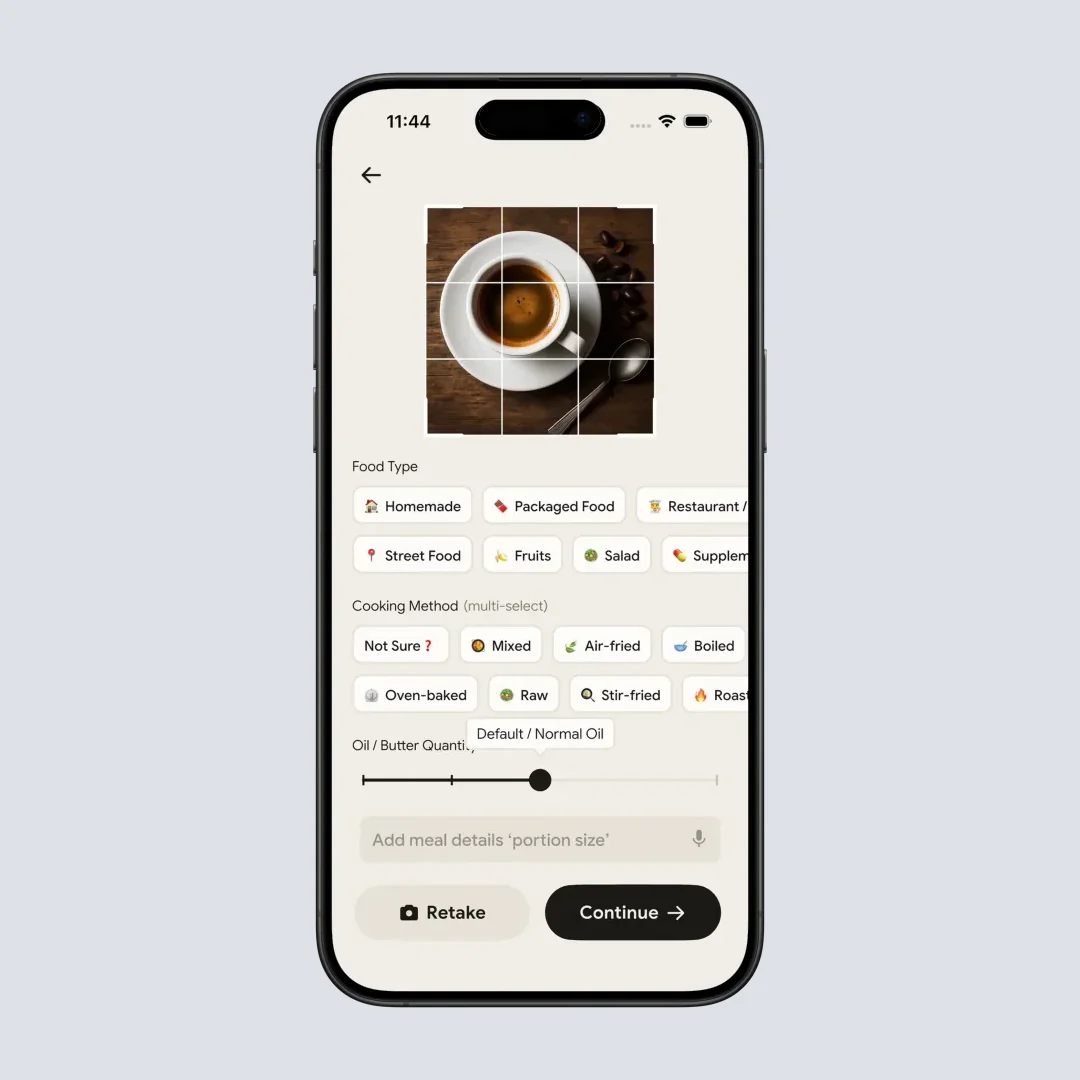
NutriScan meal scan: after identifying your dish, the app asks cooking method and oil level before finalizing the calorie estimate (Home > Camera Icon > Click Picture)
IMPORTANT
Checkpoint: here's where you are right now.
Quick status update so you always know the next best move.
⏱️ Progress 1/4 • ~1 minute in • Keep going
✅ Step 1: How photo scanning works (done)
👉 Step 2: Head-to-head 5 real Indian meals (you're here)
⏳ Step 3: Database, pricing, and ecosystem
🧩 Oil prompt math that shifts your estimate 1,000+ kcal/week (coming soon)
Head-to-Head: 5 Common Indian Meals 🍛
A note on what this is and is not. Each plate below was photographed once through each app, same session, overhead angle, natural light, before mixing. No food scale, no weighed reference values, so treat the numbers as what the apps returned rather than as a verdict on which one was right. What is worth your attention is the shape of each flow: where one app commits to a number straight away and the other stops to ask a question.
1. Dal Tadka with Rice
HealthifyMe Snap: Identified "dal tadka" correctly and returned roughly 180-200 kcal for one serving in a single step. Nothing in the flow asked about the ghee in the tempering.
NutriScan: Identified "yellow dal", then asked cooking method (Boiled) and oil level (Default / Medium Oil, for the tadka). After the oil answer the estimate came out at 210-230 kcal.
What differed: the oil question, and about 30 kcal of tempering that only one app asked about.
2. Chicken Biryani
HealthifyMe: Identified "chicken biryani" immediately, 350-400 kcal for a plate, no follow-up questions.
NutriScan: Identified "chicken biryani", asked cooking method (Mixed) and oil level (High Oil, for a restaurant plate). Estimate landed at 420-460 kcal.
What differed: the same dish name, two different assumptions about how much fat went into it, and a 70 kcal gap that came entirely from answering the oil prompt honestly.
3. Dosa with Sambar and Coconut Chutney
HealthifyMe: Identified dosa and sambar. The coconut chutney was missed and had to be added by hand. Estimate around 200 kcal for dosa plus sambar.
NutriScan: Identified all three items, including the chutney, and asked cooking method for the dosa (Grilled, for a tawa). Combined estimate 250-280 kcal.
What differed: component detection. One app found the chutney, the other needed to be told about it.
4. Rajasthani Thali (Mixed Plate)
HealthifyMe: Partial recognition. Dal baati churma was identified but the churma came back small, and the plate totalled around 400 kcal.
NutriScan: Also struggled with the full thali layout. It identified dal and roti, then flagged two items as uncertain and asked for confirmation. After the churma was confirmed, 520 kcal.
What differed: neither app read the thali cleanly. One guessed quietly, the other said it was unsure. This is the failure mode the Sydney review describes, and no oil prompt fixes it.
5. Street Food: Pav Bhaji
HealthifyMe: Identified "pav bhaji", 450-490 kcal for two pav plus bhaji.
NutriScan: Identified pav bhaji and asked oil level (High Oil, for street-style bhaji on a butter base). Estimate 510-540 kcal.
What differed: the butter. It is invisible in a photo and it is the single largest variable in street-style bhaji.
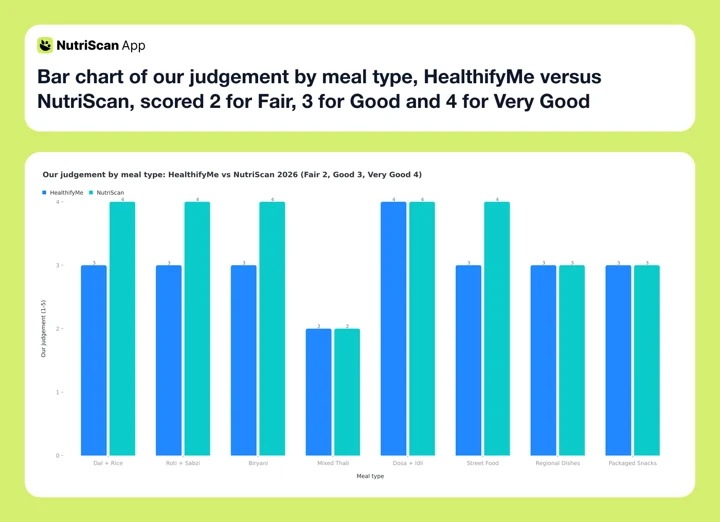 Figure 1: our judgement by meal type on a 1-5 scale, from hands-on use rather than weighed measurement. Fair is 2, Good is 3, Very Good is 4, so it reads the same as the summary table further down. Nothing here is a lab result.
TIP
Testing tip: Download both apps free and photograph your 5 most common meals. The app that more consistently identifies your specific dishes - and gives estimates close to your food scale when you check - is the right fit for you.
IMPORTANT
Checkpoint: midway progress update.
You're halfway - decisions get easier here.
⏱️ Progress 2/4 • ~2 minutes in • Keep going
✅ Step 1: How photo scanning works (done)
✅ Step 2: Head-to-head 5 meals (done)
👉 Step 3: Database, pricing, and ecosystem (current)
⏳ Oil prompt math that shifts your estimate 1,000+ kcal/week (next)
Database and Language Coverage 🌐
HealthifyMe: HealthifyMe has historically shipped Indian-language support, but it does not publish a current list, and its App Store listing declares English as the app's only language in both the US and India storefronts. The "10 regional languages" figure that circulates online traces back to VaccinateMe, the company's 2021 COVID slot finder, not the tracking app. Its database claim is explicitly a global one, "any food from any corner of the world", not an Indian one.
NutriScan: The interface is English, and NutriScan is a global app rather than an India-specific one. Because the scan reads the plate rather than a search box, you do not need the dish's English name to log it. You do need it if you would rather type the meal in by hand.
Advantage: neither company publishes per-cuisine or per-dish coverage, so treat any "deeper database for Indian food" claim, ours included, as unproven. What you can actually check is the flow. HealthifyMe logs in one step. NutriScan asks two questions before it commits to a number.
Pricing Comparison 2026 💰
 When you discover NutriScan's free plan gives you 5 real photo scans per week
Related: HealthifyMe pricing in India 2026 and NutriScan pricing: free vs Premium.
| Plan | HealthifyMe | NutriScan |
|---|---|---|
| Free plan | Not published | 5 photo scans and 4 Monika calls a week, plus NutriScore, micronutrients, fasting timer, NutriBites |
| Paid plan | Not published | about $59 a year |
| Free trial | Not published | 7 days |
| With human coach | Sold as Premium Coaching, price not published | Not available |
Prices are standard US prices as of mid 2026 and change by region. HealthifyMe publishes no prices at all: healthifyme.com/in/plans returns a 404 and its store sells only merchandise and supplements. Any rupee figure you see quoted for a HealthifyMe plan, including figures we have published before, is unconfirmed.
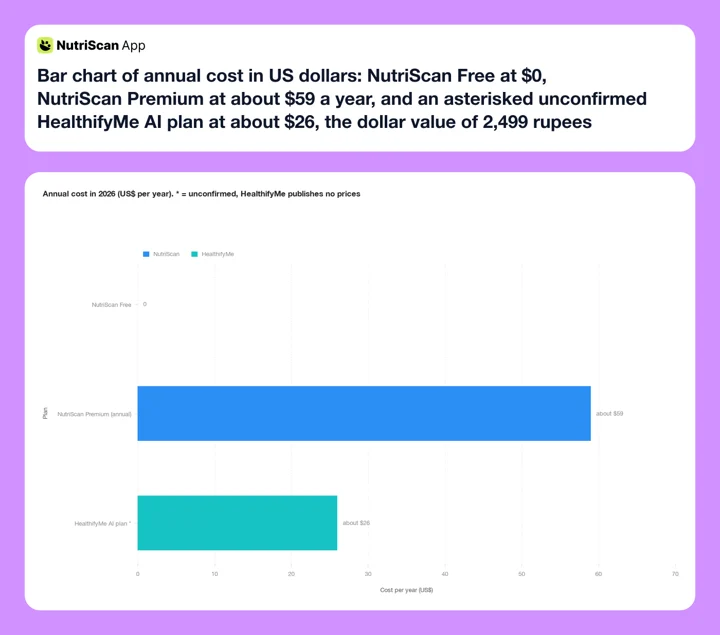 Figure 2: annual cost, both bars in US dollars so they sit on one axis. NutriScan Premium is about $59 a year. The HealthifyMe bar is ₹2,499 converted at about ₹95 to the dollar, and it carries an asterisk because that figure is widely repeated online and appears on no HealthifyMe page.
Key difference: one of these apps tells you what it costs. NutriScan Premium is about $59 a year. The ₹2,499/year commonly attributed to HealthifyMe's AI plan, and the ₹5,500 to ₹8,000/month attributed to its coaching plans, appear on no page HealthifyMe publishes, so we are not treating them as prices. On the numbers that can be checked, NutriScan's annual plan is the only one you can price before you subscribe.
Free plans are harder to compare than they look. NutriScan gives 5 photo scans and 4 Monika calls a week, a test allowance rather than a daily logging plan. HealthifyMe does not publish what its free tier includes, and its own marketing leads with Snap and a public Try Snap with a Photo page with no tier qualifier attached.
NutriScan's 7-day Premium trial starts through your app store; whether a card is collected depends on your platform and region.
Outside India, NutriScan is about $59 a year. HealthifyMe is on the US App Store too, as Healthify: AI Calorie Tracker, rated 4.6 from about 5,970 US ratings against roughly 66,600 in the Indian storefront. It also runs a US site and a US GLP-1 product. The app is global; its user base is still overwhelmingly Indian.
Coaching and Ecosystem 🤝
This is where HealthifyMe has a clear structural advantage.
HealthifyMe beyond photo scanning, from its Play listing updated 29 July 2026 and its India home page:
- HealthifyRx, a GLP-1 medical weight-loss program, now the first thing the home page offers
- Ria AI coaching messages after every meal log
- Auto Snap, which logs meals automatically from your photo gallery
- A GLP-1 medication tracker
- Workout tracking and step counting
- Human dietitian access on Premium Coaching plans
- Water tracking and sleep tracking
NutriScan key features:
- Photo scan with cooking method and oil level prompts
- Monika, a voice AI nutritionist you call from the home screen, 4 calls a week free
- NutriScore on every meal, and micronutrient tracking on every plan
- NutriBites chat over your meal timeline
- Intermittent fasting timer: 14:10, 16:8, 18:6, 20:4 and a custom window
- Club, a healthy-eating leaderboard ranking the top 50
- Invite & Earn: you and the friend who signs up through your link both get a week of Premium
- Apple Health and Google Fit sync
- Personalized 28-day diet plans, weekly meal-plan suggestions and a goal-based grocery list on Premium
NutriScan has no human coaching, no CGM integration, no workout tracking and no barcode scanner. Packaged food goes in through the Packaged Food tag with manual or voice entry. It is a nutrition scanner with a voice coach attached, not a full wellness platform.
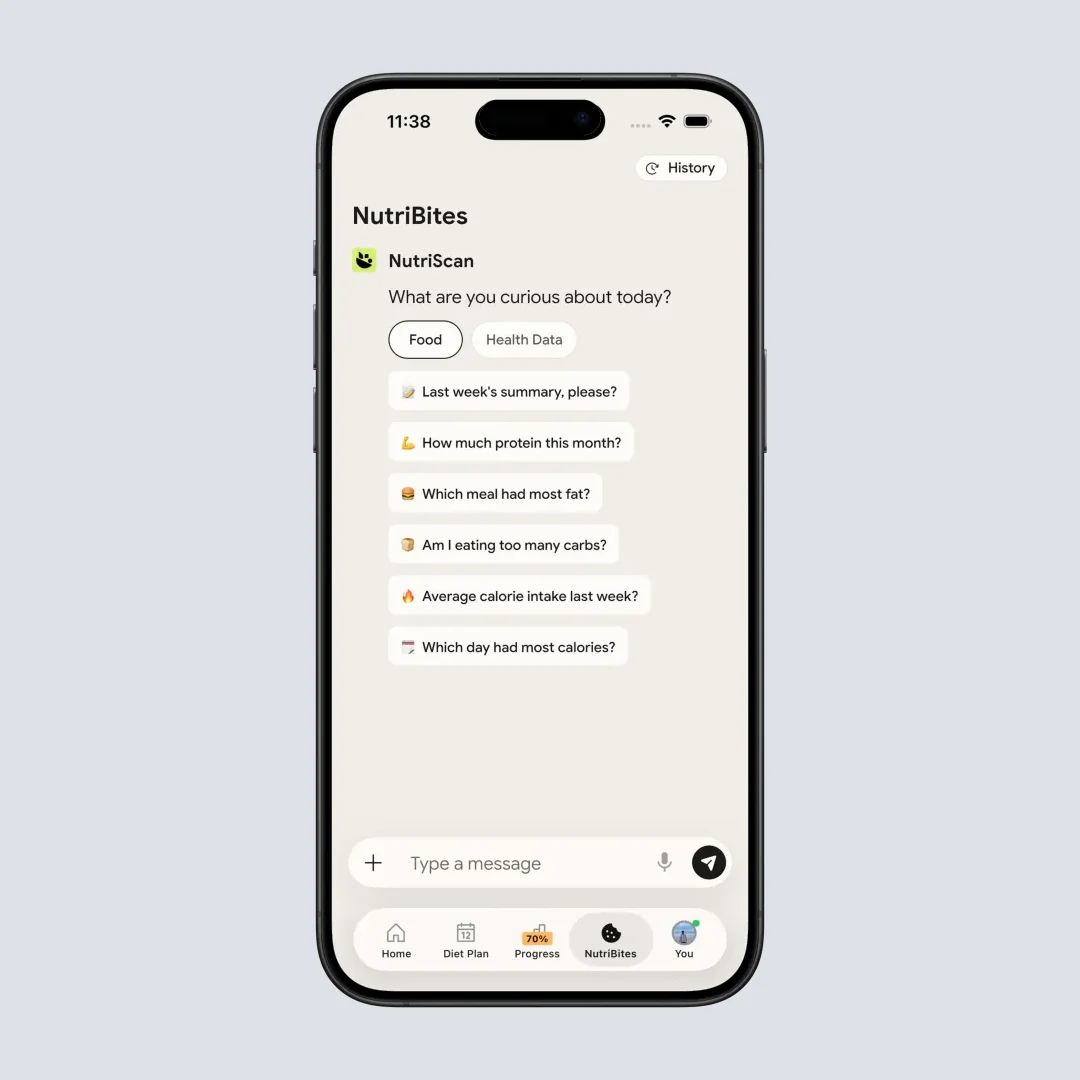
NutriScan NutriBites AI: ask any nutrition question based on your actual logged data for the day
Who this matters for: if you want an app that coaches you, tracks workouts and connects you to a dietitian, HealthifyMe is the more complete platform. If you want the scan itself to ask how the food was cooked, and a clear view of which micronutrients you are short on, that is what NutriScan is built to do.
IMPORTANT
Checkpoint: final stretch before the reveal.
One last nudge - the reveal is next.
⏱️ Progress 3/4 • ~3 minutes in • Keep going
✅ Step 1: How photo scanning works
✅ Step 2: Head-to-head 5 meals
✅ Step 3: Database, pricing, and ecosystem
✨ The oil prompt math that shifts your estimate 1,000+ kcal/week (about to reveal)
5 Tips for Better Photo Scan Results 💡
Pro Tips for Both Apps
These tips apply to both HealthifyMe and NutriScan and will improve accuracy on any food photo tracking app.
Take photos from directly above the plate. Photo-based estimates run light on portion size: in the O'Hara study, the model underestimated meal weight on 87 of 114 photographs, and agreement fell apart on medium and large portions. That paper shot every photograph the same way, so it cannot tell you an overhead angle fixes it. Overhead is still the shot that shows the most of the plate, which is why we suggest it.
Use good light. Both apps do worse in dim restaurant lighting. Take the photo before the lights go down, or use your phone flash.
Separate your plate items if possible. Thalis where dal and sabzi are already mixed before you eat are harder to scan than plates where items are in separate katoris. Take the photo before mixing.
Use the oil prompt honestly in NutriScan. Street food and restaurant food is typically high oil. Home-cooked meals by a health-conscious cook may be low or medium. On the dishes in the table further down, the gap between Low Oil and High Oil is 120 kcal per dish.
Cross-check new dishes manually once. The first time you eat a dish you have never logged before, search the database manually and compare the AI estimate to the database entry. If they are within 15%, you can trust the scan going forward for that dish.
How to Choose: A 5-Step Decision Process 🤔
Step 1: List your top 5 daily meals. Are these mostly home-cooked staples (dal, roti, sabzi, rice, curry)? Or do you eat a lot of street food, restaurant meals, or regional dishes?
Step 2: Do you want coaching alongside tracking? If you want someone - human or AI - to review your logs and suggest changes, HealthifyMe is the better fit. If you only want accurate logging without coaching, either app works.
Step 3: Check which app recognizes your meals. Download both on a free trial. Take 5 photos of your typical meals and compare estimates side by side. The app that more consistently identifies your specific dishes is the better fit for you.
Step 4: Consider your budget. NutriScan Premium is about $59 a year. HealthifyMe publishes nothing, so you will only see its price at checkout. NutriScan's free plan gives 5 scans a week; logging 3 meals a day is 21 scans a week, so free will not carry daily logging. Spend the five on the meals where the oil prompt moves the number most, your home-cooked sabzi and your street food, and see whether the corrected totals are worth paying for.
Step 5: Decide based on your scan test from Step 3. Accuracy on your specific food habits should be the deciding factor. Your own test will tell you more than any comparison article, this one included.
Research: Why Indian Food Photo Scanning is Hard 🔬
Researchers at the University of Sydney screened 800 nutrition apps down to 18 with AI features and ran real meals through them. Their August 2024 release, on work published in Nutrients and led by Dr Juliana Chen, is blunter than the headline usually reported. The apps are "generally better at detecting individual Western foods when they are separated on a plate", and "they often struggle with mixed dishes, such as spaghetti bolognese or hamburgers. This issue is more common with Asian dishes, which usually contain a variety of mixed components that may not be found in the respective apps database."
Two things worth reading carefully there. The mechanism is missing database entries for mixed components, not biased training images. And Western mixed dishes fail the same way; a hamburger broke the apps too. The dishes tested were East and Southeast Asian, not South Asian: beef pho came back 49% over, pearl milk tea up to 76% under.
That still describes the problem an Indian plate poses, because most of what is on it is a mixed dish:
- Variable oil content: home cooking can run from near-zero oil (steamed idli) to a puri deep-fried in reused oil. A single "puri" entry cannot carry that range.
- Regional variation: aloo sabzi in Punjab is not aloo sabzi in Tamil Nadu. Different spice profile, different cooking fat (ghee, coconut oil, sunflower oil), different proportions.
- Mixed plates: the meals in the O'Hara study ran from a single item to nine, and the 26.9% mean absolute percentage difference is the average across all 16 nutrients, driven largely by micronutrients. The paper reports no result split by number of foods, so it cannot tell you whether a nine-item thali is worse than a bowl of dal. It does split by portion size, and there the answer is clear: agreement was acceptable on small portions and poor on medium and large ones, both at p<0.001.
- Portion size: apps estimate volume from a single flat image. In the same study the model got the weight of the meal wrong by 27.8% on average, underestimating on 87 of 114 photographs, with individual errors running from 0.2% to 100%.
The evidence for a prompt-based fix is thinner than we would like. The most recent systematic review of AI dietary assessment tools (Cofre et al., British Journal of Nutrition 2025) concludes that these tools are "reliable and valid methods to determine the amount of energy and macronutrients of individuals", while "the validity for micronutrient determination is moderate to low". It runs no comparison between apps that let you correct the estimate and apps that do not. What it does flag is the gap this article sits in: "AI-based tools could have varied performance in different cultures due to differences in diets, eating habits and food availability. Future studies should focus on cross-cultural validation." Asking about oil and cooking method is NutriScan's answer to that, and it is a design decision, not a published finding.
The ICMR-NIN 2024 dietary guidelines for Indians put fat at 9 kcal per gram, split it into the invisible fat inside foods and the visible oils, butter and ghee you add, and tell readers that "refined cereals and edible oil intake should be reduced". Their own sample day allots 15 g of oil to a single meal.
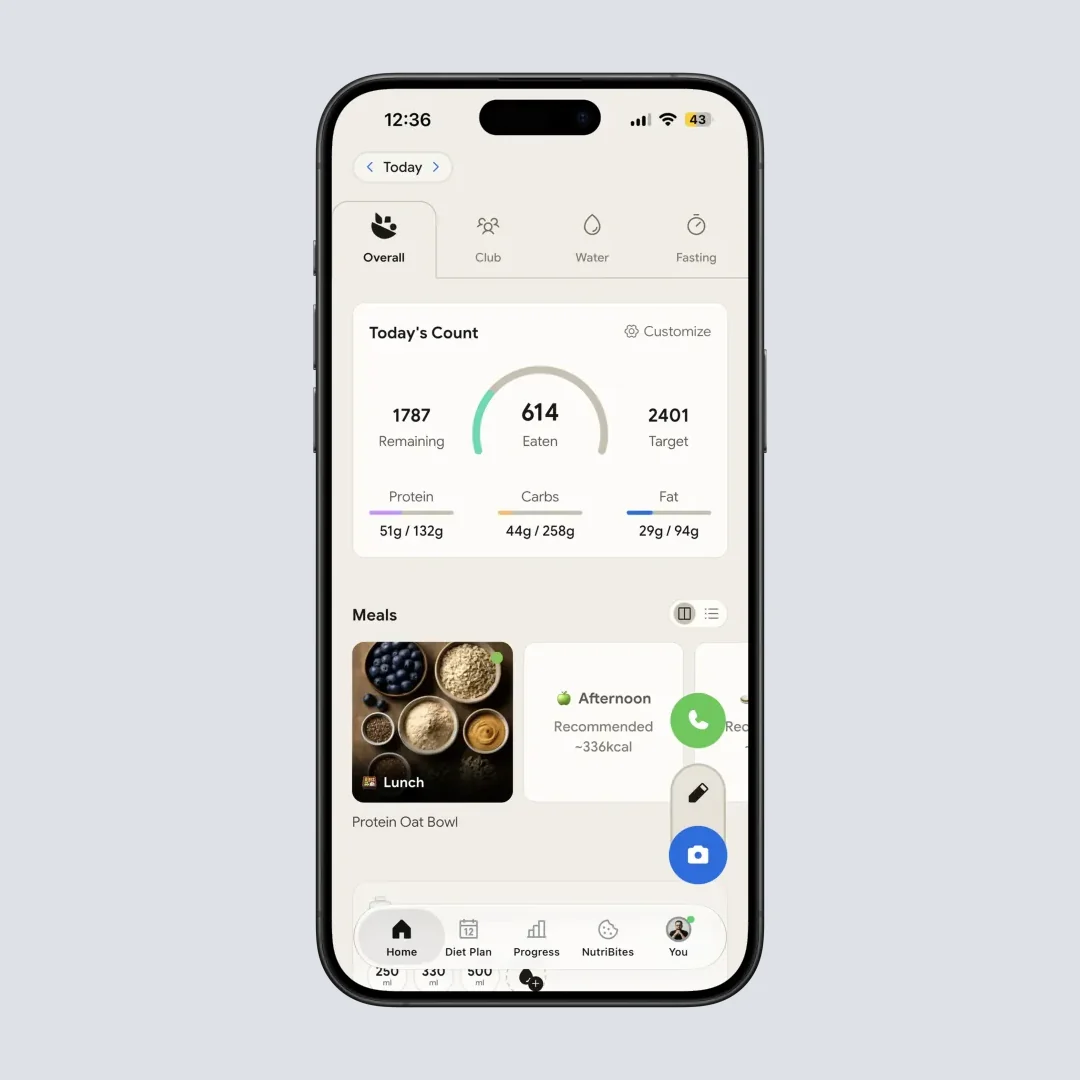
NutriScan home screen: your daily calorie and macro progress, updated every time you log a meal
The Oil Prompt Math That Changes Everything ✨
Here is the reveal many people miss when comparing food tracking apps.
Cooking oil is 100% fat, and USDA FoodData Central puts it at 884 kcal per 100 g (SR Legacy entry 171411, "Oil, soybean, salad or cooking"). A teaspoon is about 4.5 g, so one teaspoon is about 40 kcal, and that holds across pure vegetable and seed oils because they are all essentially the same thing nutritionally.
As a rule of thumb, not a measured figure, home cooking tends to use 1 to 4 teaspoons of oil per dish, and street and restaurant food more, once you count the butter and ghee alongside the oil. Nobody publishes a per-dish teaspoon survey. The nearest official anchor is the ICMR-NIN sample day above, which allows 15 g of oil across one meal.
Here is what a one-to-four teaspoon swing does to four common dishes:
| Dish | Low oil (1 tsp) | Medium oil (2 tsp) | High oil (4 tsp) | Difference |
|---|---|---|---|---|
| Dal tadka | 180 kcal | 220 kcal | 300 kcal | 120 kcal |
| Aloo sabzi | 120 kcal | 160 kcal | 240 kcal | 120 kcal |
| Pav bhaji | 400 kcal | 440 kcal | 520 kcal | 120 kcal |
| Paratha | 200 kcal | 240 kcal | 320 kcal | 120 kcal |
The difference column is 120 kcal on every row, because it is the same three teaspoons of oil every time. That is the whole point: the dish barely matters, the oil does.
Log three meals a day, get the oil level wrong on two of them, and that is 240 kcal a day. Over a week, 1,680 kcal of invisible error in your log.
That is not a rounding issue. That is the difference between being in a real calorie deficit and thinking you are in one while eating at maintenance.
HealthifyMe's Snap does not ask about oil. Its flow is one step by design, and its own Play listing sells that as the feature: "Just click, forget, and Healthify does the work!" For standard restaurant dishes a name-based guess is often reasonable. For home-cooked food, where oil changes with the cook and the day, the guess carries the full 120 kcal spread in that table with no way for you to correct it at the point of logging.
NutriScan's oil prompt asks instead of guessing. It is the one variable a photograph cannot show and a question can settle.
Important Note
The oil prompt only helps if you use it honestly. Selecting "low oil" out of habit when you actually cooked with medium oil defeats the purpose. Take 10 seconds to think about how you actually cooked the dish before selecting.
Accuracy Summary Table 📊
These grades are our editorial judgement from hands-on use, not measurement. We tested five plates head to head, so the roti, idli and packaged-snack rows come from general use rather than that session. Figure 1 plots the same grades on a 1-5 scale: Fair is 2, Good is 3, Very Good is 4.
| Meal Type | HealthifyMe | NutriScan |
|---|---|---|
| Simple dal + rice | Good | Very Good (oil prompt adds detail) |
| Roti + sabzi | Good | Very Good |
| Biryani (restaurant) | Good | Very Good |
| Thali (mixed plate) | Fair | Fair (flags uncertainty) |
| South Indian (dosa, idli) | Very Good | Very Good |
| Street food (pav bhaji, chaat) | Good | Very Good (oil prompt) |
| Regional dishes (Rajasthani, Odia) | Good | Good |
| Packaged Indian snacks | Good | Good |
Conclusion
Both apps are genuinely useful for Indian food tracking. The right choice depends on what you want. If you are still weighing manual logging, see how to count calories in Indian food. To see how both stack up against MyFitnessPal on the same plate, read the three-way Indian food tracker comparison.
Choose HealthifyMe if:
- You want photo scanning bundled with AI coaching, workout tracking, and human dietitian access
- You want a GLP-1 program and medication tracking in the same app
- You prefer a full wellness platform over a focused scanner
- You are comfortable finding out the price at checkout, because HealthifyMe does not publish one
Choose NutriScan if:
- You want the app to ask how the food was cooked instead of guessing, especially for oily home-cooked and restaurant meals
- You want a voice AI nutritionist, a NutriScore on every meal and a fasting timer in the same app
- You want to test 5 free scans a week on your hardest dishes before deciding to pay
- You want a price you can check before you subscribe: about $59 a year
If you want to test how NutriScan handles your specific Indian meals, start with the free plan, no subscription needed. Spend your 5 weekly scans on your 5 daily staples and see how the oil prompts change your estimates. That single test will tell you more than this article.
Try NutriScan Free - or use our Macro Calculator to understand your calorie targets first.
IMPORTANT
Recap: everything covered in this comparison.
You finished the read - save this for when someone asks which app to use.
⏱️ Progress 4/4 • ~4 minutes in • Nicely done
✅ Step 1: How photo scanning works in each app
✅ Step 2: Head-to-head test on 5 real Indian meals
✅ Step 3: Database, pricing, and ecosystem
✅ Oil prompt math: a 240 kcal/day gap from wrong oil selection (revealed)
Frequently Asked Questions ❓
Which app has the bigger Indian food database?
Nobody outside the two companies can answer that. HealthifyMe's App Store listing calls its database "INFINITE" and global, which is not a number. NutriScan publishes no count either. Neither company breaks coverage down by cuisine or by dish. Any article telling you one database is deeper for Indian food, this one included, would be guessing. What you can check is the flow: HealthifyMe logs in one step, NutriScan asks cooking method and oil level before it commits to a number.
Is NutriScan's oil prompt actually accurate or just a gimmick?
The oil prompt rests on straightforward arithmetic. Cooking oil is 100% fat at 884 kcal per 100 g, so a 4.5 g teaspoon is about 40 kcal, and that holds across vegetable and seed oils. Three teaspoons is 120 kcal, which is the gap between the Low Oil and High Oil columns for every dish in the table above, and roughly 840 kcal across a week if you get it wrong daily. The prompt captures a real variable that a photograph cannot show.
Can I use both apps together?
Yes. Some people use HealthifyMe for coaching and meal planning and NutriScan's camera for logging. NutriScan syncs with Apple Health and Google Fit. HealthifyMe syncs with Apple Health, and through it with Apple Watch, Fitbit, Garmin and Samsung devices; it does not list Google Fit, which Google has since shut down. Running both costs more, but the activity and weight data stays consistent through Apple Health.
How accurate is AI photo scanning for Indian food in general?
The honest answer is that nobody has measured it on Indian food. The nearest evidence is a 2024 scoping review of 25 studies (Zheng, Wang, Shen and An, JMIR 2024, doi 10.2196/54557), which reports nutrient estimation errors of 10% to 15%. Note the scope: only 10 of those 25 studies used food images at all, the rest used wearable sound and jaw-motion data or text. At 10 to 15%, a real 500 kcal meal comes back somewhere between 425 and 575 kcal. Correcting the result, answering cooking-method prompts and adding missed items should narrow that, though no published study puts a number on how much.
Does HealthifyMe work outside India?
Yes. HealthifyMe markets itself globally, "trusted by over 40 million users globally" on its Play listing, and it runs a US site and a US GLP-1 product. Its App Store metadata declares English only in both storefronts, so there is no Indian-versus-international language split in the shipped app. Where it is still concentrated is people: about 5,970 US ratings against roughly 66,600 Indian ones, and its coaching operation runs from India. NutriScan is sold internationally in English and works for any cuisine.
What is the NutriBites feature in NutriScan?
NutriBites is NutriScan's AI chat feature. You ask it nutrition questions - "was my lunch today too high in carbs?" or "what should I eat for dinner to hit my protein goal?" - and it answers based on your actual logged data for the day. It is different from HealthifyMe's Ria in that it does not proactively send coaching messages; instead it responds to your specific questions about your own food log.