Best Fastic Alternatives 2026 (Fasting Apps With Courses)
 ChatGPT
  Claude
  AI Mode
  Perplexity
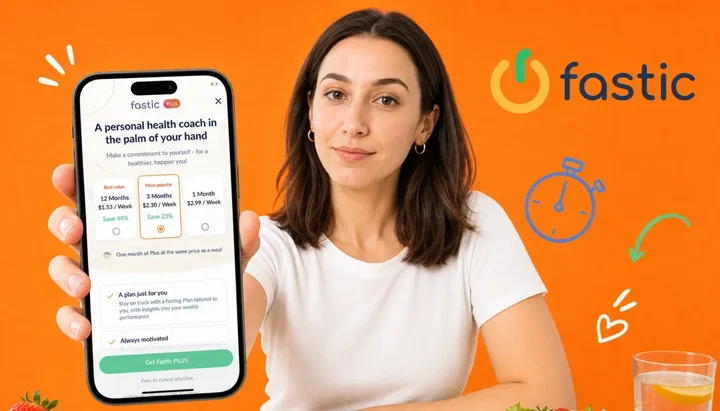
 Fastic Plus lists as high as $79.99 a year and its Academy publishes no course count, so you cannot tell how much reading you are paying for. YAZIO at $47.90 a year is the cheapest full tracker here, Zero and BodyFast sit at $69.99, and Cronometer keeps its timer behind Gold at $59.99. NutriScan is about $59 a year, with a free fasting timer and 5 AI photo scans a week on the free plan.
Last verified: August 23, 2026
TL;DR - Best Fastic Alternatives 2026
• Why people leave: Fastic Plus lists as high as $79.99 a year, the Academy publishes no course count so you cannot tell when the reading ends, the social feed has moderation gaps, and food tracking is shallow next to a dedicated tracker.
• Best if you want ongoing guidance: Simple (AI coach) and BodyFast (weekly renewed plans) keep coaching you after a course library would have ended.
• Best for real food tracking: YAZIO ($47.90/yr), Cronometer (deepest nutrient data, timer sits in Gold), and MyFitnessPal (2M+ foods, widest partner links).
• Best for eating-window logging: NutriScan adds oil and cooking-method prompts and 5 free photo scans per week.
• How to choose: name the one thing Fastic stopped giving you, then pick the app that renews it.
Around 43 percent of people who start a digital health program drop out before finishing it, according to a 2025 systematic review of 35 studies (Loughnane et al., 2025). As a NutriScan nutritionist who tests every major fasting and calorie app at least once a year, I see the same pattern with Fastic: the app is excellent at getting beginners started, but in my testing the learning content stops feeling new long before the subscription price changes.
Fastic deserves credit for what it does well. It claims more than 30 million downloads, a cross-platform figure Fastic publishes itself, while Google Play alone shows 10M+; the same listing holds a 4.4 out of 5 rating from over 421,000 Google Play reviews (Google Play, 2026). Its Fastic Academy course library is one of the main reasons people choose it over a plain fasting timer. The body-stage visualization, which shows what your body is doing at each phase of a fast, is genuinely useful for beginners who want to understand the process instead of just watching a countdown.
Fastic Plus lists as high as $79.99 a year, which puts it at the top of the fasting-app price range. Fastic also runs frequent promotions, and its US App Store listing carries ten Fastic Plus SKUs from $12.99 to $79.99 at the same time (App Store, 2026), so check the price in your own store before you assume the top figure. What Plus buys is real: a 4,500-recipe book, the Academy, daily and weekly challenges, Fasting Buddies, an advanced food and menu scanner, progress insights and a daily plan tailored to you. The fasting timer, the step counter, the water tracker and the calorie tracker are all free features on the same listing. The real question is whether the paid half still earns its renewal once you have read the Academy content you cared about. If you have reached that point, this guide covers seven alternatives matched to what you actually want next.
IMPORTANT
Your Fastic switching plan at a glance.
A quick roadmap so you can decide fast and switch without losing your streak.
⏱️ Progress 0/4 • ~0 minutes in • Keep going
⏳ Step 1: The 3 reasons people are leaving Fastic
⏳ Step 2: All 7 alternatives, priced and compared
⏳ Step 3: How to switch from Fastic in 5 steps
🔍 The one research finding that should decide your pick (revealed near the end)
Why People Are Leaving Fastic in 2026 🔍
After reviewing user feedback, app store reviews, and my own testing notes, three specific frustrations come up again and again.
Reason 1: The Price Stays High Once You Have Read the Academy
Fastic Plus at up to $79.99 a year is priced like a full coaching product, and the Academy is the piece that justifies it while you are learning fasting protocols, hydration habits, and nutrition basics. Fastic publishes no course count, so nobody can tell you where the library ends. That "it runs out" feeling is our read from testing rather than a documented limit, but the renewal notice does not care either way. What Plus still gives you at that point is genuine, the recipe book, the challenges, Fasting Buddies, the food and menu scanner and a tailored daily plan, but for most people none of it is the reason they paid. For comparison, YAZIO PRO costs $47.90 a year, and BodyFast's 12-month Coach SKU lists at $69.99 (App Store, 2026) against Fastic's $79.99, so the honest gap on a yearly plan is about ten dollars, not half price. If the recurring charge is your main issue, our Fastic pricing breakdown shows exactly what Plus does and does not unlock.
Reason 2: The Social Feed Has Moderation Gaps
Fastic's community features, including Fasting Buddies, are a core part of its motivation loop. But user reports from late 2025 described unwanted messages and harassment problems in the social feed, and moderation has not kept pace with the size of the community. A motivation feature that creates discomfort works against the entire point of the app. Several alternatives on this list either skip social feeds entirely or keep community interaction structured and optional.
Reason 3: Food Tracking Is Shallow Compared to Dedicated Trackers
Fastic added calorie tracking, but it is a companion feature, not the core product. On wearables the gap is documented: Fastic publishes exactly two syncs, Google Fit (Google Play, 2026) and Apple Health (App Store, 2026), against YAZIO's "Fitbit, Garmin and more" (Google Play, 2026). On database depth and adaptive calorie targets, Fastic publishes nothing either way, so read our view that it trails Cronometer and MyFitnessPal there as a judgement from testing rather than a vendor-documented fact. Either way, if logging food inside Fastic feels like friction, that friction is the thing most likely to end your streak.
 Logging what you eat should take seconds. When the tracker is shallow, every plate turns into a manual chore.
IMPORTANT
Checkpoint: here's where you are right now.
Quick status update so you always know the next best move.
⏱️ Progress 1/4 • ~1 minute in • Keep going
✅ Step 1: The 3 reasons people are leaving Fastic (done)
👉 Step 2: All 7 alternatives, priced and compared (you're here)
⏳ Step 3: How to switch from Fastic in 5 steps
🧩 The one research finding that should decide your pick (coming soon)
What to Look For in a Fastic Alternative
Before the list, three quick filters that will save you money:
- Ongoing guidance beats a fixed library. A course library is a one-time asset. An AI coach, a weekly plan generator, or adaptive targets keep providing value in month eight. Prioritize apps where the guidance renews.
- Check the free tier first. Several apps on this list include a complete fasting timer for free. Never pay for a subscription before confirming the free tier does not already cover your needs.
- Match the app to your eating-window habits. Fasting apps only manage the clock. What you eat during the eating window decides your results, so if you struggle with food choices, pick an alternative with strong food logging. A free online macro calculator sets a realistic calorie and macro baseline in under a minute before you commit to any app.
A 2025 meta-analysis of diet apps found they do change what people eat, raising fruit and vegetable intake by about 0.48 portions a day and cutting meat by about 0.10 portions (Curtin et al., 2025). It measured food choices, not body weight, so treat any app as a tool that nudges habits and give whichever one you pick long enough for the habit to show.
Fastic vs 7 Alternatives: Quick Comparison 📊
| App | Annual price | Free fasting timer | Learning content | Food tracking depth | Best for |
|---|---|---|---|---|---|
| Fastic | Up to $79.99 | Yes, free feature | Academy courses (count unpublished) | Basic | Beginners who want courses |
| Simple | Not published | Basic | Avo AI coach + article library | Basic | Ongoing AI guidance |
| BodyFast | $69.99 (12 mo) | Yes, generous | Weekly Coach plans | AI food scanner | Renewed weekly structure |
| Zero | $69.99 | Yes, basic | Expert-led library | Plus only | Science-focused users |
| YAZIO | $47.90 | Yes | Light | Full tracker | Fasting + calories in one |
| Cronometer | $59.99 (Gold) | No, Gold only | No courses, AI coach on Gold | Deepest data | Data-driven users |
| MyFitnessPal | $79.99 | Premium only | Light | 2M+ foods | Database and integrations |
| NutriScan | about $59/yr | Yes | NutriBites lessons | Photo-first | Eating-window logging |
Prices are standard US prices as of mid 2026 and change by region, and most of these vendors run promotions with several SKUs live at once. Price alone tells part of the story, as Figure 1 shows.
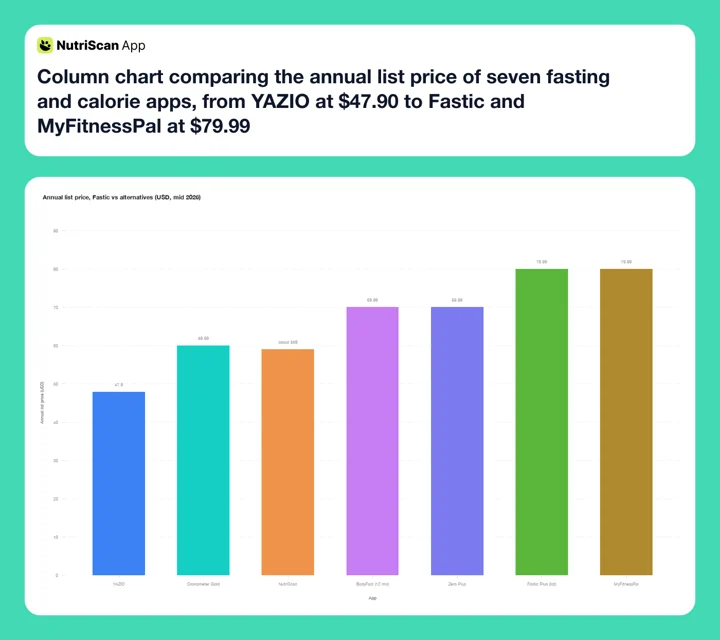 Figure 1: Annual list price on each app's yearly plan. Simple is not plotted because it does not publish a list price. Fastic sits at the top with MyFitnessPal, and BodyFast's 12-month SKU is only ten dollars below Fastic, so most switches are about matching a feature rather than saving money.

1. Simple: Best AI Coaching That Replaces Courses
Simple is the closest thing to hiring a coach instead of buying a textbook. Its AI assistant, Avo, answers questions in plain language, with unlimited replies on Premium against two a day on the free plan (Simple help center). Around Avo sit daily check-ins with streak tracking, a Success Score, and a library of educational articles that updates daily. Fortune ranked Simple as the best intermittent fasting app overall in its 2026 roundup, scoring it 4.0 out of 5 (Fortune, 2026).
Where Fastic gives you a course to complete, Simple gives you a conversation that continues. The article library covers similar ground to Fastic Academy, but the AI layer means the guidance keeps responding to what you actually log. If you want the two side by side, we compared them in Fastic vs Simple.
- Price: Simple does not publish a list price; its own site says pricing varies by subscription length (Simple). Fortune's tested price is a free basic tier plus $29.99 a month for premium (Fortune, 2026), and the App Store carries quarterly and annual SKUs from about $29.99 to $49.99
- Free tier: basic tracking for fasts, meals, hydration, weight and activity, plus two Avo replies and one Avo Vision scan a day
- Strengths: Avo AI coach, daily check-ins and Success Score, daily-updated article library, no community tab (Fortune, 2026)
- Weaknesses: food logging is simpler than dedicated calorie trackers, the price is not published up front, and the constant coaching tone is not for everyone
Choose Simple if: the thing you liked about Fastic was learning, and you want guidance that keeps adapting instead of a library that ends.
2. BodyFast: Best Coach-Planned Fasting Weeks, Renewed Every Week
BodyFast is the most direct Fastic replacement on this list. The BodyFast Coach builds a new personalized fasting plan every week, which is the clearest answer to the staleness problem that hits Fastic users once the Academy stops feeling new. It holds a 4.6 out of 5 rating from about 369,000 Google Play reviews with over 10 million downloads (Google Play, 2026).
The free tier is unusually generous: more than 10 fasting plans including 16:8 and 5:2, a fasting clock with reminders, weight and body measurement tracking, fasting-stage explanations similar to Fastic's body visualization, a water tracker, and a knowledge pool of fasting articles. The paid Coach tier adds the weekly personalized plans, daily coaching tips, custom fasting schedules, and what the company calls a Joker Day, a planned day off from fasting that keeps the plan realistic.
- Price: $34.99 per quarter, or $69.99 on the 12-month Coach SKU against Fastic's $79.99 (App Store, 2026); both listings carry several SKUs at once and both vendors promote heavily
- Free tier: complete fasting timer, 10+ plans, fasting stages, knowledge articles
- Strengths: weekly renewed plans, generous free tier, trophies and challenges without an open social feed
- Weaknesses: nutrition data is thinner than a dedicated tracker even after the July 2026 AI Food Scanner added calories and macros (Google Play, 2026), and the recipe library is 100+ against YAZIO's 3,000+
Choose BodyFast if: you want Fastic's structure, stages, and challenges, but you want the plan rebuilt every week instead of a library you read once.
3. Zero: Best Expert-Led Content and Protein Focus
Zero is the fasting app for people who want the science explained by researchers rather than gamified lessons. Its content library features insights from medical and longevity experts, and the app has expanded into meal logging with a personalized protein score, reflecting the research trend of pairing fasting with adequate protein intake. Interestingly, Fastic itself cites protein-focused fasting research (Arciero et al., 2023), but Zero builds the protein habit directly into daily tracking.
Zero holds a 4.8 out of 5 rating from roughly 445,000 App Store ratings (App Store, 2026). One important caveat: Zero used to be famous as the best free fasting app, but the free tier has narrowed. Free now covers the fasting timer, core tracking for weight, sleep, resting heart rate, calories, activity, glucose and ketones, syncs with Apple Health, Google Fit, Fitbit and Oura, select content, and a week view of your data. Smart Meal Logging, the Protein Score, Fat Burning Mode, premium content and advanced statistics are all Plus (Zero help center). So the protein score that makes Zero interesting sits on the paid side of the line.
- Price: $69.99 per year or $9.99 per month for Zero Plus, with $89.99 SKUs also live on the listing (App Store, 2026)
- Free tier: fasting timer, core biometric tracking and device sync, select content, week view of your data; meal logging is Plus
- Strengths: expert-led education, protein score, hydration tracking, clean design
- Weaknesses: meal logging and statistics sit behind Plus, and the price is close to Fastic's
Choose Zero if: the content is what you are paying for, and you want deeper science than Fastic Academy offers. Our Zero Plus pricing guide covers the yearly-only trial, cancel steps and refund rules.
3 of 7 compared. Still ahead: the full calorie tracker, the data powerhouse, the broadest database, the photo-first pick, and the one research finding that should decide your pick.
4. YAZIO: Best Fasting Plus Full Calorie Tracking
YAZIO solves Fastic's shallow-tracking problem by coming from the opposite direction: it is a full calorie tracker that added excellent fasting support. Fortune named it the best intermittent fasting app with calorie tracking in 2026 (Fortune, 2026).
PRO includes more than 10 guided fasting programs, a food database of over 4 million searchable items, 3,000+ recipes, and wearable sync with Fitbit, Garmin and more (Google Play, 2026), plus an Apple Watch app (App Store, 2026). At $47.90 per year it undercuts Fastic's $79.99 list price by more than 30 dollars while covering both the fasting clock and everything you eat in the window. I compared the two apps in detail in our YAZIO vs Fastic breakdown, and dug into the plan itself in our YAZIO PRO worth-it review.
- Price: $47.90 per year for PRO (App Store, 2026), with promo SKUs as low as $23.90 live on the same listing
- Trial: no standard in-app trial. Fortune's roundup records "no traditional free trial; free version available" (Fortune, 2026); YAZIO occasionally runs a promotional trial on its own site
- Free tier: calorie tracking, barcode scanner, basic fasting timer with 16:8 and 5:2 support
- Strengths: lowest annual list price on this list, real calorie tracking, wearable sync, 3,000+ recipes
- Weaknesses: no standing trial, and in our testing the learning content is thinner than Fastic Academy, though neither vendor publishes a course count to check that against
Choose YAZIO if: you have learned the fasting basics already and now want one app to manage the clock and the food at a lower price.
5. Cronometer: Deepest Nutrition Data, With the Fasting Timer Inside Gold
Worth being clear about this one, because it is the fact most switching guides get wrong: Cronometer's fasting timer is a Gold feature, not a free one (Cronometer Gold). Moving here does not remove the subscription, it changes what the subscription buys. What Gold buys is Cronometer's own claim of a database of over 1M lab-analyzed or verified foods, built on government sources like USDA (USDA FoodData Central), and tracking of up to 95 nutrients against 84 on the free plan.
There is no course library and no gamification, though Gold now ships Crono Coach, an in-app AI assistant that turns your own data, goals and settings into short guidance (Cronometer Gold). Cronometer is the tool for people who have finished learning and now want data: fasting duration, complete micronutrient intake during eating windows, and custom charts that correlate nutrients and biometrics over time. Both the timer and those charts sit on the Gold side of the line. If you like this depth but want to weigh other data-first tools, see our best Cronometer alternatives guide.
- Price: Gold is $4.99 per month billed annually at $59.99, or $10.99 month to month (Cronometer Gold); the fasting timer is included in Gold, not in free
- Free tier: food, exercise and biometric logging, barcode scanner, up to 84 nutrients, and reports and charts within a 7-day window
- Strengths: verified data quality, deep micronutrient tracking, Crono Coach AI guidance on Gold
- Weaknesses: the fasting timer and custom charts cost $59.99 a year, there is no course library, and the interface is functional rather than motivating
Choose Cronometer if: you no longer need motivation features, you want precise data on both your fasts and your nutrition, and you are willing to pay Gold to get the timer.
IMPORTANT
Checkpoint: midway progress update.
You're past the comparison. Decisions get easier from here.
⏱️ Progress 2/4 • ~3 minutes in • Keep going
✅ Step 1: The 3 reasons people are leaving Fastic (done)
✅ Step 2: All 7 alternatives, priced and compared (done)
👉 Step 3: How to switch from Fastic in 5 steps (current)
🧩 The one research finding that should decide your pick (next)
6. MyFitnessPal: Broad Food Database, Fasting Tracking in Premium
MyFitnessPal added intermittent fasting tracking to its Premium plan (MyFitnessPal Premium), positioning it as a fasting option for people who already live inside its ecosystem. The draw is the database: more than 2,000,000 foods by MyFitnessPal's own count, broad restaurant and packaged-food coverage, and partner links to most major fitness platforms. Worth noting that YAZIO publishes a larger figure, over 4 million searchable items, so MyFitnessPal's database is wide rather than provably the biggest on this list.
The honest trade-off is engagement. A decade-spanning scoping review of nutrition apps found MyFitnessPal users declined from 5.4 logging days per week to 1.4 over weeks 5 to 12 (Dugas et al., 2026), so the database advantage only matters if you actually keep logging. The trial is 7 days (MyFitnessPal Premium), the same length most of this list offers, so plan to test it hard in that week. If the database is your main draw, our best MyFitnessPal alternatives guide covers who does it better.
- Price: $79.99 per year for Premium, $99.99 for Premium+, 7-day free trial (MyFitnessPal Premium)
- Free tier: food and exercise logging with ads, custom foods and recipes, nutrient views; barcode scanning, meal scan and voice logging are Premium, and there is no fasting tracker
- Strengths: very large food database, broad partner-app links, restaurant and packaged-food coverage
- Weaknesses: same price as Fastic's list SKU, fasting is a minor feature, and the free tier carries ads and no scanning
Choose MyFitnessPal if: database coverage for restaurant and packaged food matters more to you than fasting-specific coaching.
7. NutriScan: Best Photo Logging for Your Eating Window
NutriScan approaches fasting from the food side, which is where most fasting plans quietly fail. The app includes a fasting timer, but its core strength is photo-based meal logging: point your camera at the plate and it identifies the foods, then asks about cooking method across 11 options and oil level before calculating calories. That oil prompt matters because AI photo estimation of home-cooked and oily dishes is exactly where generic scanners drift, and research on photo-based dietary assessment still shows meaningful error rates, with a 2025 study measuring around 26.9 percent mean absolute error when ChatGPT estimated nutrients from meal photographs (O'Hara et al., 2025). Our meal scan guide walks through the full flow.
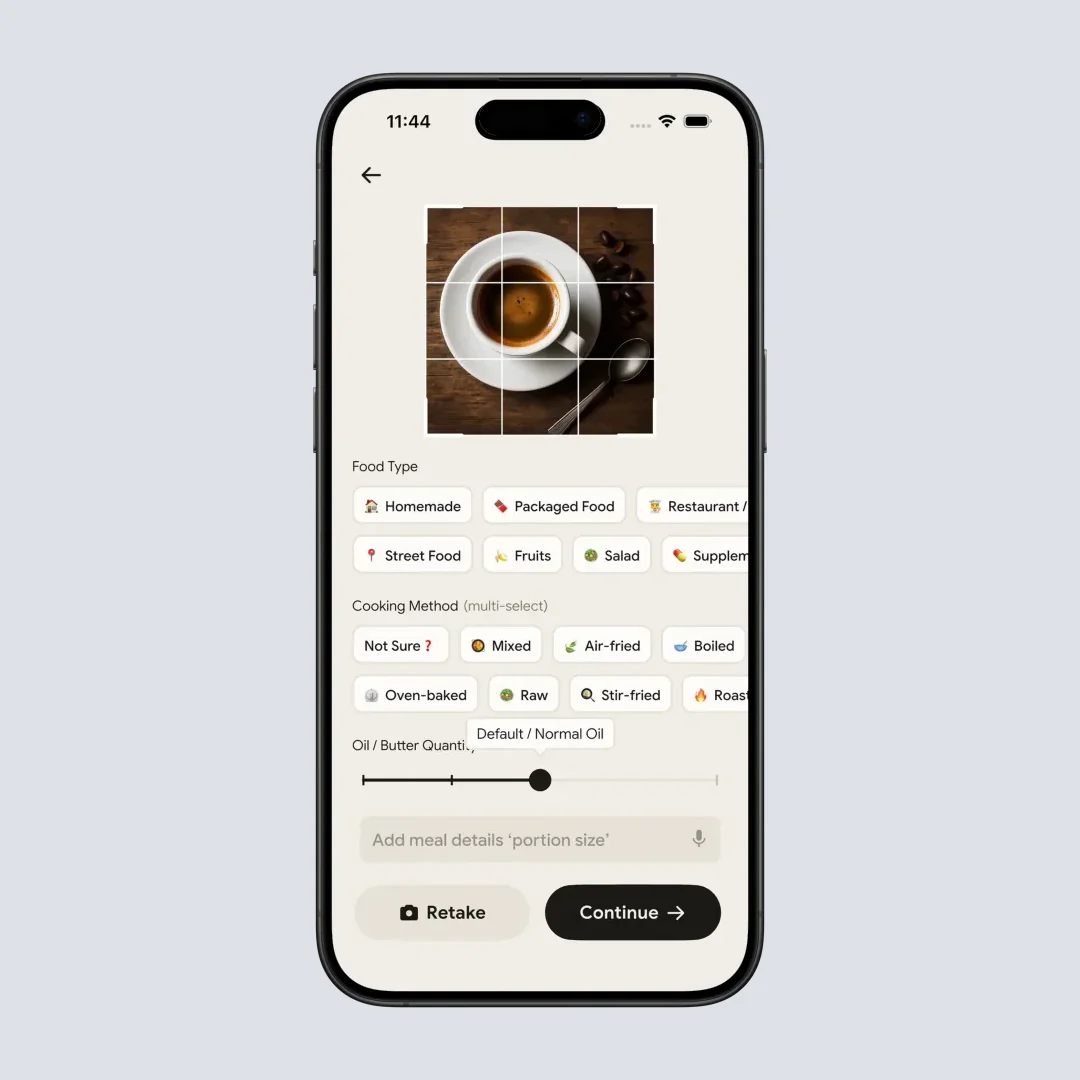
NutriScan's photo scan: Home > Camera Icon > Click Picture > Crop Picture, then confirm cooking method and oil level.
Instead of a course library, NutriScan delivers NutriBites, short lessons that arrive over time, plus meal suggestions for what to eat when your window opens. Monika, the app's voice AI nutrition coach, answers questions and gives "what to eat next" guidance in conversational language rather than macro numbers alone (Home > Call Button, 4 free calls per week, unlimited on Premium).
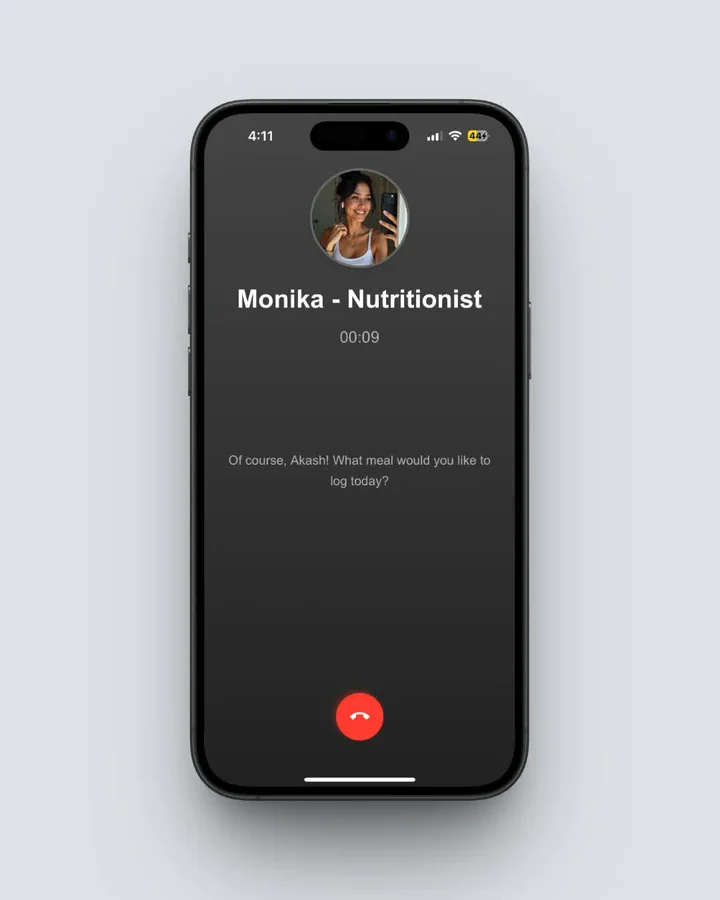 Monika (Home > Call Button) answers nutrition questions by voice, the closest thing to a coaching conversation in a tracking app.
The free tier includes 5 photo scans a week and the fasting timer, enough to test the scanner on the meals that usually break a food database before you decide. The 7-day trial starts through your app store; whether a card is collected depends on your platform and region. Premium adds the 28-day diet plan and weekly meal-plan suggestions.
- Price: about $59 a year, 7-day trial
- Free tier: 5 photo scans a week, fasting timer, food logging
- Strengths: 11 cooking methods and 4 oil levels on every scan, NutriBites lessons, Monika voice coaching
- Weaknesses: smaller community features, no long-form course library
Choose NutriScan if: your fasting clock is fine but logging what you eat in the window is the habit that keeps breaking.

How to Switch From Fastic in 5 Steps 🔁
A scoping review of lifestyle and mental health apps found a median 70 percent of users abandon a new app within the first 100 days (Kidman et al., 2024), and a switch is exactly when a logging habit is most exposed. The sequence below is practical guidance from testing these apps, not a finding from that review.
- Export or note your history. Screenshot your fasting streak, longest fasts, and weight chart in Fastic. Most apps do not import competitor data, so keep a manual record of your baseline.
- Cancel the subscription before deleting the app. Fastic Plus renews through your app store. Cancel in your Apple or Google subscription settings, not by uninstalling. You keep Plus access until the period ends. Our step-by-step Fastic Plus cancellation guide covers every platform.
- Trial your top alternative during your remaining paid time. Run the new app's free trial in parallel while your Fastic subscription winds down. Log the same fasts in both and see which one you open first.
- Recreate your protocol, not just your account. Set the same fasting window you were running in Fastic before you experiment. Changing the app and the protocol in the same week makes it impossible to tell what caused any change in results.
- Give the new app about three months. No study pins twelve weeks as a magic number for app-supported weight loss. What the research does show is that most abandonment happens inside the first 100 days (Kidman et al., 2024), so three months clears that window. Judge the switch then, not after three days.
WARNING
Deleting the Fastic app does not cancel the subscription. The annual Plus charge renews until you cancel through the App Store or Google Play. Note your streak and baseline before you delete anything, because the data does not transfer to a new app.
 Five steps done, fasting streak intact. That is how a clean switch feels.
Who Should Stay With Fastic 🤔
Switching is not always the right call. Fastic remains a good fit in three cases.
If you are still working through Fastic Academy and genuinely completing courses, the subscription is still delivering the thing you bought it for. The library is real content, not filler, and beginners who learn well from structured lessons get value from it.
If the body-stage visualization is what keeps you fasting, no alternative reproduces it exactly. BodyFast's fasting stages come closest, but Fastic's version is more detailed and more motivating for visual learners.
If the Feel Good Guarantee matters to you, Fastic will refund the full amount with no deductions if you decide inside its 14-day free window that the app is not the right fit (Fastic). Neither Zero nor MyFitnessPal publishes a refund policy of its own, so someone unsure about fasting apps in general gets a written promise from Fastic and app store rules everywhere else.
IMPORTANT
Checkpoint: final stretch before the reveal.
One last nudge. The finding that should decide your pick is next.
⏱️ Progress 3/4 • ~4 minutes in • Keep going
✅ Step 1: The 3 reasons people are leaving Fastic
✅ Step 2: All 7 alternatives, priced and compared
✅ Step 3: How to switch from Fastic in 5 steps
✨ The one research finding that should decide your pick (about to reveal)
The One Research Finding That Should Decide Your Pick 🔬
Here is the reveal you have been reading toward, and it is the finding most people never weigh because it hides behind a feature list.
When you choose a fasting app, it is tempting to compare course counts, database sizes, and prices. But three findings from recent research matter more than any feature, and the third one is the one that should actually pick your app.
First, adherence is the part people underestimate. Vasim et al.'s 2022 review of intermittent fasting notes that patient adherence remains a problem, and reports a 38 percent dropout in an alternate-day fasting group against 29 percent on daily calorie restriction (Vasim et al., 2022). That is dropout differing by protocol, not proof that adherence beats protocol, so take the next line as our editorial view rather than a finding: the best app is the one you will still open in month four, whatever schedule it runs.
Second, abandonment is the default. Around 70 percent of health app users stop using a new app within the first 100 days (Kidman et al., 2024). Motivation features like courses and challenges front-load engagement, which is exactly why Fastic feels strong early and weaker later. A finite course library is engagement you spend down.
Third, and this is the deciding finding: the support structure predicts who lasts, and not every kind of support works the same. The same 2025 review reports retention of 80 to 100 percent for human coaching and 90 to 93 percent for AI coaching, against 55 to 56.5 percent for hybrid programs, all measured against a 43 percent pooled dropout rate across digital health interventions overall (Loughnane et al., 2025). Human coaching had the highest ceiling; AI coaching had the tightest band. Hybrid programs, the ones that hand you off between a person and an algorithm, did worst. A coach that keeps showing up beats a library you have finished, but the handoff model is the one to be wary of.
So if you have quit fasting apps before, do not pick the app with the most content. Pick the one with guidance that renews. That points to Simple's AI coach or BodyFast's weekly plans over a pure timer, and if food logging is where you slip, to a photo-first tracker like NutriScan that removes the daily friction. Match your choice to that finding and the switch is far more likely to stick.
IMPORTANT
Recap: everything you completed this round.
You finished the run. Save this for when you make the switch.
⏱️ Progress 4/4 • ~5 minutes in • Nicely done
✅ Step 1: The 3 reasons people are leaving Fastic
✅ Step 2: All 7 alternatives, priced and compared
✅ Step 3: How to switch from Fastic in 5 steps
✅ The deciding finding: renewing guidance beats a finite course library for staying consistent (revealed)
Conclusion: Match the App to What Runs Out
Fastic is a good app. The structural problem is that its main paid draw, the Academy, is something you read through once while the charge repeats every year. Once you notice your renewal is charging up to $79.99 for a timer you already understand and lessons you have finished, it is time to match your next app to what you actually need:
- Renewing guidance ➡️ Simple (price not published) or BodyFast ($34.99/quarter, $69.99/yr)
- Deeper science ➡️ Zero ($69.99/yr)
- Real food tracking ➡️ YAZIO ($47.90/yr), Cronometer ($59.99/yr Gold), or MyFitnessPal ($79.99/yr)
- Faster eating-window logging ➡️ NutriScan (5 free scans/wk, 7-day trial)
Most of these let you test before paying. If food logging is the habit that keeps breaking your fasting results, you can try NutriScan's photo scanning and fasting timer free, with 5 scans a week to point at the plates a database cannot read.
Frequently Asked Questions ❓
Q: Is there a free alternative to Fastic?
A: Yes. BodyFast's free tier includes more than 10 fasting plans, a fasting clock with reminders, fasting-stage explanations, and weight tracking (Google Play, 2026). Zero's free tier keeps a basic fasting timer, core biometric tracking and select content. Cronometer is the exception people get wrong: its free plan covers food logging, a barcode scanner and 84 nutrients, but the fasting timer is a Gold feature at $59.99 a year (Cronometer Gold).
Q: Which Fastic alternative has the best courses?
A: Zero's library carries insights from medical and longevity experts and is the closest match if the science is what you are paying for, though no vendor publishes a course count to rank these against each other. Simple takes a different approach: its AI coach Avo gives unlimited replies on Premium, two a day on free, alongside daily check-ins, a Success Score and a daily-updated article library (Simple help center), so the guidance keeps arriving instead of ending.
Q: Is BodyFast cheaper than Fastic?
A: On a yearly plan the gap is about ten dollars, not half price. BodyFast's 12-month Coach SKU lists at $69.99 (App Store, 2026) against Fastic Plus at $79.99 (App Store, 2026), and BodyFast also sells a $34.99 quarter. Both listings carry several SKUs at once and both vendors promote heavily, so check the current price in your app store before deciding.
Q: Can I track calories and fasting in one app?
A: Yes. YAZIO is the strongest single-app option, combining guided fasting programs with a food database of over 4 million searchable items at $47.90 per year (Google Play, 2026). NutriScan includes its fasting timer on the free plan alongside photo meal logging, Cronometer pairs the deepest nutrition data with a fasting timer that sits inside Gold, and MyFitnessPal includes fasting tracking in Premium.
Q: Do fasting apps actually help with weight loss?
A: The measured evidence is about behavior more than pounds. A 2025 meta-analysis of diet apps found they raised fruit and vegetable intake by about 0.48 portions a day and cut meat by about 0.10 portions, measuring what people ate rather than body weight (Curtin et al., 2025). A 2025 review of digital health programs reported a 43 percent pooled dropout rate, with retention of 80 to 100 percent under human coaching and 90 to 93 percent under AI coaching (Loughnane et al., 2025). The app's job is to make sticking with it easier, so pick the one that fits your routine with the least friction.