Brown Rice vs White Rice: Nutrition, GI, Weight Loss
 ChatGPT
  Claude
  AI Mode
  Perplexity
TL;DR - Brown rice vs white rice
• Calories: almost identical, 123 per 100 g cooked for brown rice against 130 for white. • The real gap: fiber, 1.6 g against 0.4 g per 100 g, plus three times the magnesium in brown rice. • Weight: pooled trials found 2.2 kg more weight lost on brown rice, with no change in blood sugar. • Rice or roti: roti has more calories per gram, but a cup of rice and two rotis land within 45 calories. • Do this: weigh one serving ➡️ fill half the plate with vegetables and protein ➡️ then pick your grain.
Brown rice vs white rice: what actually changes 🍚
In 132,373 adults across 21 countries, eating 450 g or more of cooked white rice a day carried a 20% higher risk of developing diabetes than eating under 150 g, and in South Asia that figure rose to 61% (Bhavadharini et al., 2020). Look closely and the interesting part is the dose. The comparison that mattered was three cups a day against one, not brown grain against white grain.
People often hope one bag in the supermarket is why the weight is not moving. NutriScan publishes this post and makes a calorie tracking app. Swapping the grain changes your day a little. Swapping the serving size changes it a lot. This guide puts numbers on both, using USDA FoodData Central values and published trials.
IMPORTANT
Your brown rice versus white rice plan at a glance.
A quick roadmap so you can act fast.
⏱️ Progress 0/4 • ~0 minutes in • Keep going
⏳ Step 1: The numbers side by side
⏳ Step 2: What the trials found
⏳ Step 3: Portions, roti and your goal
🔍 The cooking step that beats the grain swap (revealed near the end)
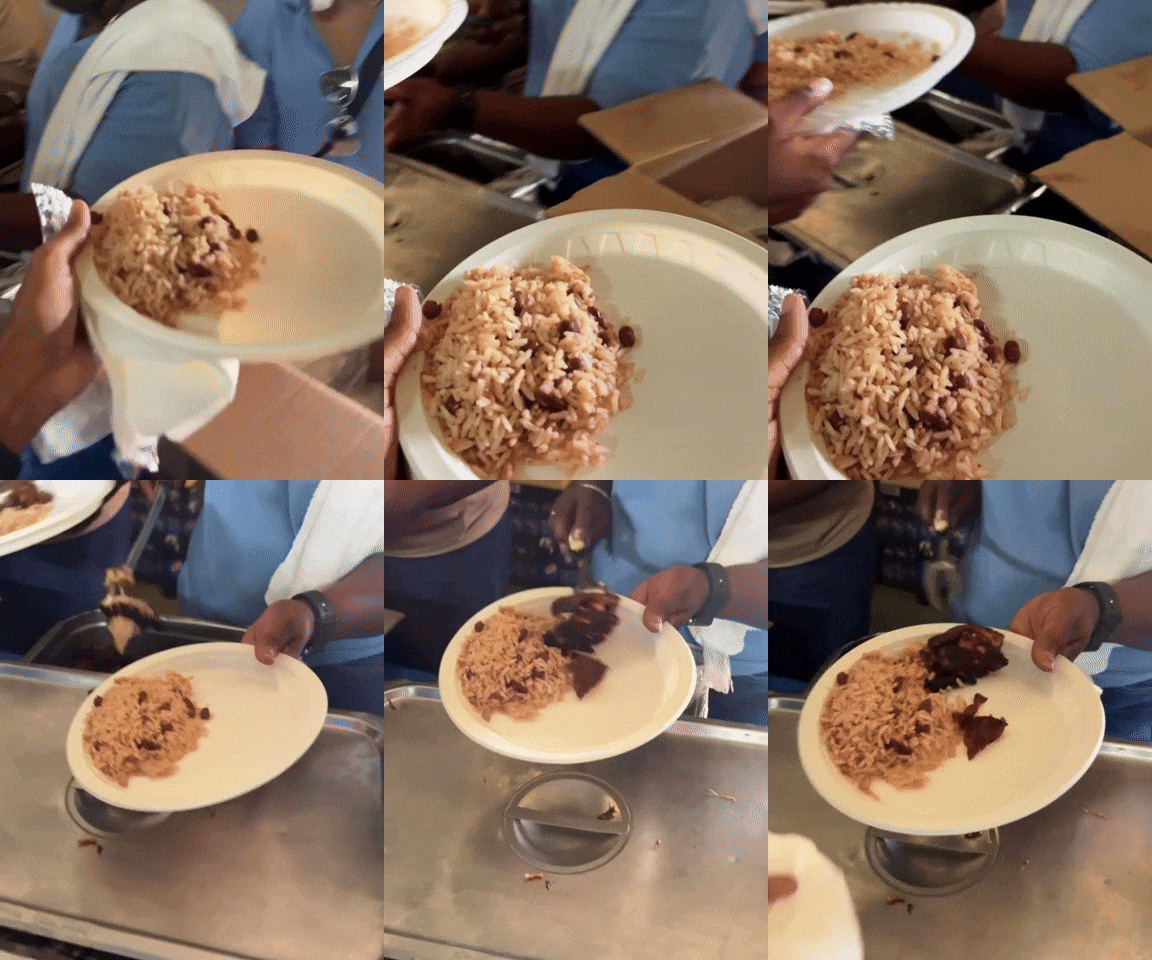
A plate of rice and beans handed across a family table, which is where portion size is actually decided.
Two plates, same kitchen, different rice 🍽️
Take a 62 kg woman who eats rice twice a day and wants to lose weight. Her usual plate is a heaped 250 g of cooked white rice at lunch and dinner: about 650 calories of rice a day, 141 g of carbohydrate and 2 g of fiber.
Switch only the grain and the same two heaped servings of brown rice come to about 615 calories, 128 g of carbohydrate and 8 g of fiber. She saves roughly 35 calories a day and gains 6 g of fiber. Over a month that is about 1,000 calories, a little over a tenth of a kilogram of body fat. Real, but quiet.
Switch only the portion instead. She keeps white rice and serves 150 g at each meal rather than 250 g. That is 390 calories of rice a day, a saving of 260 calories daily, seven times larger than the grain swap. Do both and she saves nearly 300 calories a day while eating more fiber.
Brown rice vs white rice nutrition, side by side 📊
Here are the USDA numbers for both grains, cooked, per 100 g. The PURE study defines one cup of cooked rice as 150 g, so that is the serving used throughout this guide (Bhavadharini et al., 2020).
| Per 100 g cooked | Brown rice, long grain | White rice, long grain, enriched |
|---|---|---|
| Calories | 123 kcal | 130 kcal |
| Carbohydrate | 25.6 g | 28.2 g |
| Protein | 2.74 g | 2.69 g |
| Fiber | 1.6 g | 0.4 g |
| Fat | 0.97 g | 0.28 g |
| Magnesium | 39 mg | 12 mg |
| Manganese | 0.97 mg | 0.47 mg |
| Iron | 0.56 mg | 1.2 mg |
Sources: USDA FoodData Central, brown rice cooked and white rice cooked, enriched.
Four things stand out.
Calories are almost the same. Seven calories per 100 g, about 10 per serving. Nobody has ever lost weight on that margin. For a breakdown of each grain, see our pages on brown rice nutrition and white rice nutrition.
Fiber is the real gap. Brown rice carries four times the fiber because the bran survives milling, 2.4 g against 0.6 g per 150 g serving. Protein ties at roughly 2.7 g per 100 g, so rice is a carbohydrate food in either color, and both are naturally gluten free.
Minerals favor brown, iron favors white. Brown rice holds about three times the magnesium and twice the manganese. Milling strips most naturally occurring B vitamins, minerals and fiber, and enrichment adds back only a fraction, mostly iron (Harvard T.H. Chan School of Public Health).
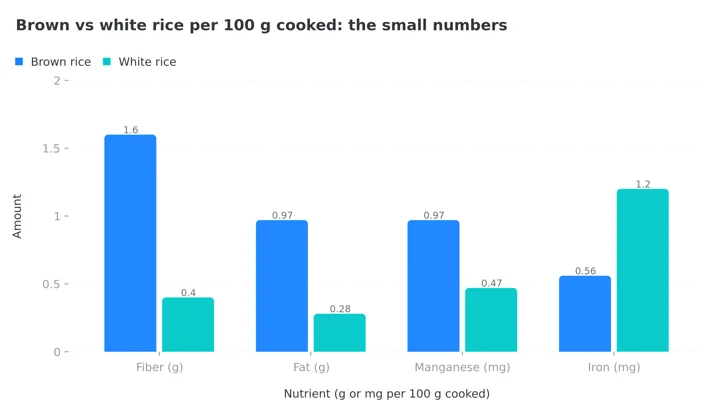
Figure 1: Brown rice wins fiber, fat and manganese by two to four times, then loses iron 0.56 mg to 1.2 mg because white rice is enriched.
IMPORTANT
Checkpoint: here's where you are right now.
Quick status update so you always know the next best move.
⏱️ Progress 1/4 • ~1 minute in • Keep going
✅ Step 1: The numbers side by side (done)
👉 Step 2: What the trials found (you're here)
⏳ Step 3: Portions, roti and your goal
🧩 The cooking step that beats the grain swap (coming soon)

What the trials actually found 🔬
This is where most rice articles overreach, so here is the evidence as it stands.
A 2021 meta-analysis pooled seven trials covering 417 adults with prediabetes or type 2 diabetes who ate either brown or white rice. Brown rice did not improve HbA1c or fasting blood glucose. It did reduce body weight by 2.2 kg against the white rice groups and raised HDL cholesterol slightly, with no effect on LDL (Abdul Rahim et al., 2021). Weight moved, blood sugar did not, which is the opposite of what most people expect.
Widen the lens to whole grains and a 2020 meta-analysis of 25 randomized trials found that replacing refined grains with whole grains improved total cholesterol, LDL cholesterol, HbA1c and C-reactive protein. The clearest cholesterol effect came from whole grain oats, while whole grain rice showed up mainly in triglycerides (Marshall et al., 2020).
Harvard's review adds that a systematic review of 45 studies found no reduction in stroke, heart disease or cancer risk from either white or brown rice specifically (Harvard T.H. Chan School of Public Health). So the fair summary is modest: a small upgrade with decent evidence behind the weight and fiber part, thin evidence behind the blood sugar part, and none at all that it rescues a heavy plate.
Glycemic index: variety beats color 📉
People assume brown rice must be the low glycemic index choice. The data is messier. The 2021 international GI tables, covering more than 4,000 items, report that cereals including whole grain versions vary widely, and that rice comes in high, medium and low GI versions (Atkinson et al., 2021).
Averages still favor brown rice. Harvard puts the average GI of brown rice at 55 and white rice at 64, with published values spanning 48 to 93 (Harvard T.H. Chan School of Public Health). A 2026 controlled test in the Philippines measured a white variety at a GI of 71 and a pigmented black variety lower, with glycemic loads of 17.75 and 12.25 for the same serving (Bayaga et al., 2026).
Two things move the number more than color. Amylose content is the first: short grain and sticky varieties digest faster and score higher than long grain types (Sekarmuti et al., 2025). Parboiling is the second, and parboiled white rice reduced the glycemic response in healthy adults in that same review. A third lever beats both and costs nothing at the till, but it belongs later in this guide.
TIP
If you track blood sugar, test your own bag rather than trusting the color. A long grain basmati often beats a poorly chosen brown rice, and two people can get different readings from the same variety.
Rice vs roti: which has more calories? 🫓
This is the second half of the same dinner argument, and the confusion comes from comparing a wet food to a dry one.
| Food | Serving | Calories | Carbs | Protein | Fiber |
|---|---|---|---|---|---|
| White rice, cooked | 150 g | 195 kcal | 42.3 g | 4.0 g | 0.6 g |
| Brown rice, cooked | 150 g | 185 kcal | 38.4 g | 4.1 g | 2.4 g |
| Chapati or roti, plain | 1 medium, 40 g | 119 kcal | 18.6 g | 4.5 g | 2.0 g |
| Chapati or roti, plain | 2 medium, 80 g | 238 kcal | 37.1 g | 9.0 g | 3.9 g |
Roti values come from USDA FoodData Central, chapati or roti, plain, which lists 297 calories per 100 g for a commercially prepared version containing added fat. A home roti made with only atta and water sits lower.
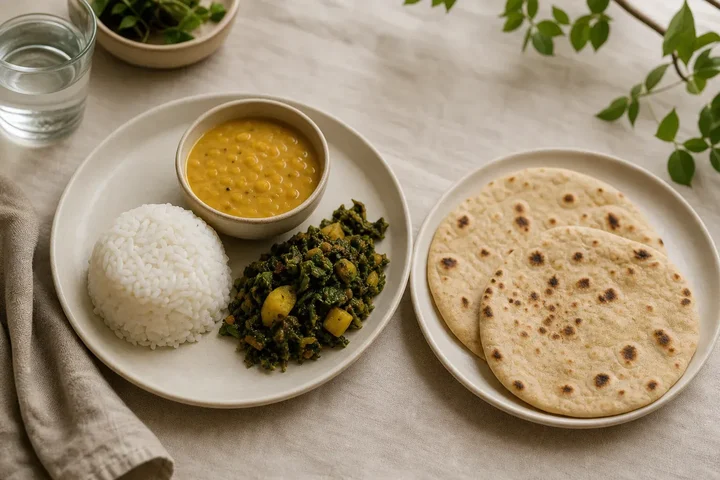
A cup of rice with dal and vegetables next to two rotis, the comparison most people are actually making at dinner.
Gram for gram, roti has more than twice the calories of boiled rice, because rice absorbs water during cooking and roti does not. Per realistic serving they are close, as the chart of those four rows shows.
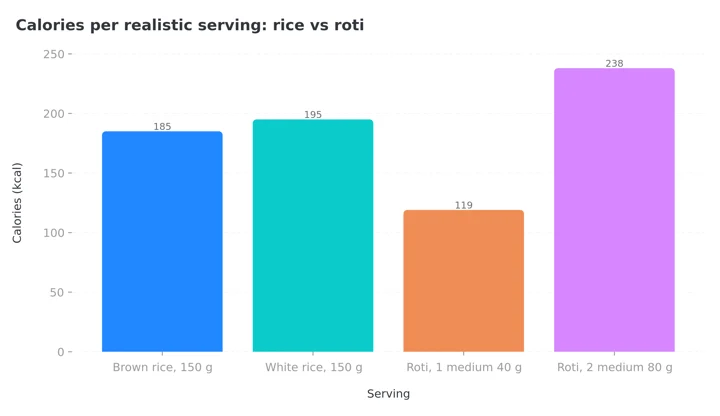
Figure 2: One cup of white rice at 195 calories sits between one roti at 119 and two rotis at 238, so the gap disappears once you count the ghee most people brush on.
Roti wins on protein and fiber: two rotis carry roughly twice the protein of a cup of rice. Neither food is fattening on its own. Our chapati nutrition page has the per-roti numbers, and the online calorie calculator will tell you how much of either fits your day.
IMPORTANT
Checkpoint: midway progress update.
You're halfway, and decisions get easier here.
⏱️ Progress 2/4 • ~2 minutes in • Keep going
✅ Step 1: The numbers side by side (done)
✅ Step 2: What the trials found (done)
👉 Step 3: Portions, roti and your goal (current)
⏳ The cooking step that beats the grain swap (next)
Which rice for your goal 🎯
| Goal | Better default | Why |
|---|---|---|
| Fat loss on a deficit | Brown rice | Four times the fiber for the same calories, 2.2 kg more lost in pooled trials |
| Cutting for a deadline | Either, weighed | Volume control beats color; brown rice keeps you fuller on a low intake |
| Bodybuilding and mass gain | White rice near training | Lower fiber, easier to eat in quantity, gentler around a session |
| Cholesterol | Brown rice, plus oats | Rice alone moved triglycerides and HDL, not LDL; oats carried the cholesterol effect |
| Blood sugar management | Long grain, parboiled or cooled | Variety and cooking method beat color for glycemic response |
| Digestive sensitivity | White rice | Low fiber and low residue is the point during a flare |
| Feeding a family on a budget | White rice | Cheaper, keeps longer, and enriched with iron during processing |
On oats versus rice for weight loss, the trials give oats the edge on cholesterol and rice no edge at all, but for body weight the calorie total decides it. Most people do better using both than crowning one. Our oats nutrition page has the numbers, and the weight loss calculator sets the daily target either grain has to fit inside.
Price, taste and buying either grain 💰
Brown rice usually costs 1.5 to 3 times more than white for the same weight, for structural rather than nutritional reasons. White rice is the milling industry's default output, moves in enormous volumes and stores for years at room temperature. Brown rice keeps the oil-rich bran, which turns rancid within months, so it needs faster turnover, smaller runs and often cooler storage. In India that pushes it onto the premium shelf, which adds a brand markup. Buy it in 1 kg packs you finish in six weeks rather than a 5 kg sack that smells stale by month four.
Taste is the other honest gap. Brown rice is chewier, nuttier and firmer, and needs 35 to 45 minutes to cook against 15 to 20 for white. It does not disappear under a curry the way white rice does, which is why some people love it and others quietly go back to the old bag.
Brown rice against Indian rice compares a processing style to a set of varieties. Most Indian rice, basmati included, is sold polished and therefore white, and unpolished brown basmati exists too. Our basmati rice page covers where it sits, and the Indian food calorie calculator handles the portion side.
Five ways to make either rice work ✅
- Weigh it once. Cook rice as usual, then weigh what lands on your plate. Most people are shocked by the gap between their idea of a serving and 150 g. One weighing session teaches you more than a month of guessing.
- Fill half the plate with something else. Vegetables and a protein source next to the rice cut the total calories and blunt the glucose rise more reliably than swapping grains.
- Mix the two. Half brown, half white cooks in one pot if you soak the brown rice for 30 minutes first. You get most of the fiber and a texture your family will accept.
- Rinse and cook in excess water. Draining rice cooked in plenty of water cuts the arsenic it absorbs from flooded fields. Rice accumulates about ten times more arsenic than other grains, and the FDA measured an average of 154 parts per billion in brown rice (Harvard T.H. Chan School of Public Health).
- Vary your grains. Rotating rice with oats, millets, quinoa and wheat spreads both the nutrients and the contaminant load.
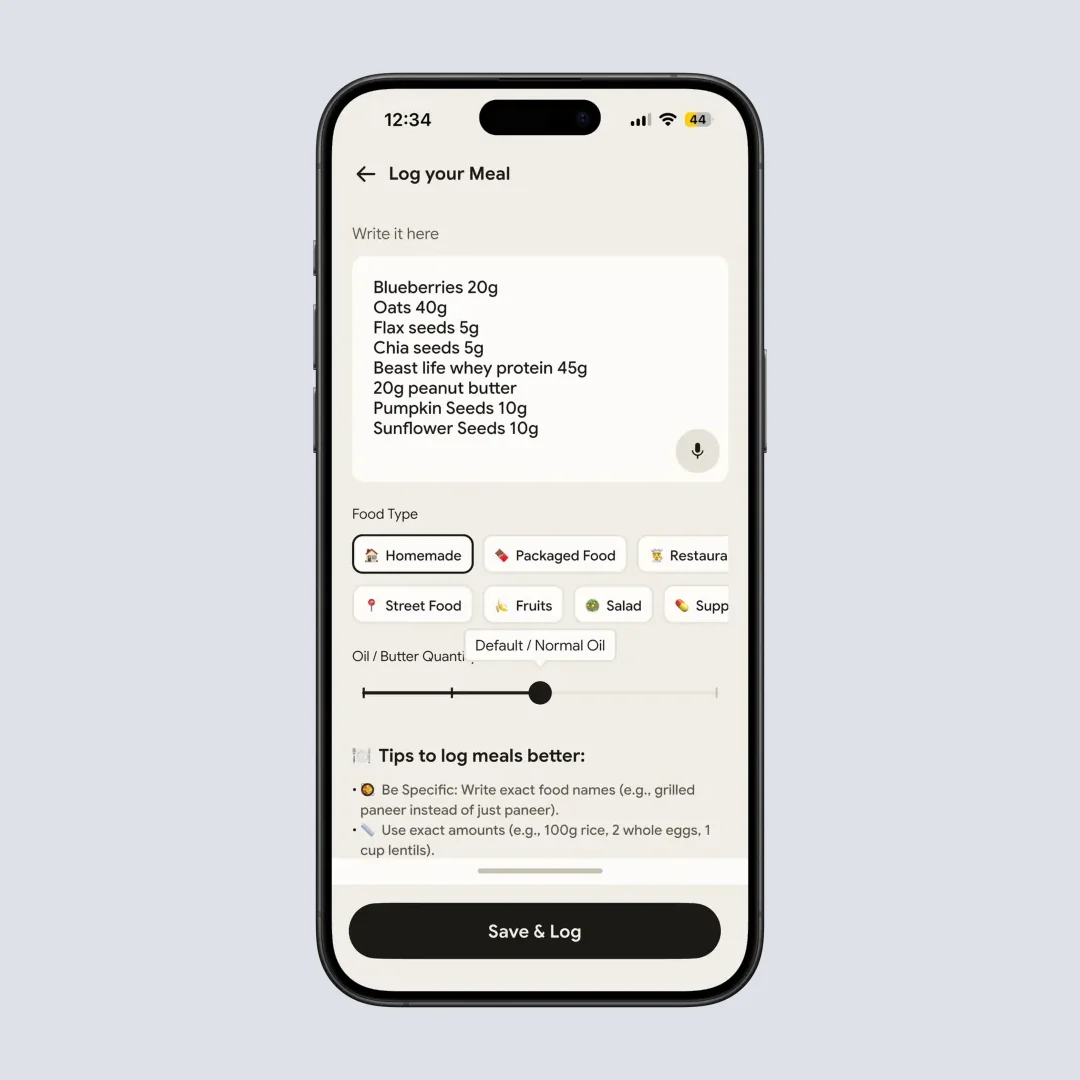
Logging a weighed 150 g serving instead of a heaped bowl makes every other number in this guide usable.

How to switch to brown rice without hating it 🔄
- Start with one meal. Keep white rice at dinner and switch lunch only. Almost every failed switch begins with changing everything at once.
- Soak for 30 minutes. Soaking cuts cooking time by about a third and softens the grain, which is the single biggest complaint people have.
- Use more water and more time. Roughly 2.5 parts water to 1 part brown rice, 35 to 45 minutes covered. Undercooked brown rice turns people off it for years.
- Blend the pot for two weeks. Start at one part brown to three parts white, then move to half and half. Your palate adjusts faster than your opinion does.
- Serve it with something wet. Dal, curry, stew, a saucy stir fry. Brown rice with dry sides is a hard sell.
- Batch cook and freeze. Cook a week of brown rice on Sunday and portion it into 150 g containers. The extra 25 minutes happens once, not seven times.
- Check in after three weeks. If you still dislike it, go back to white rice and fix portions and side dishes instead.
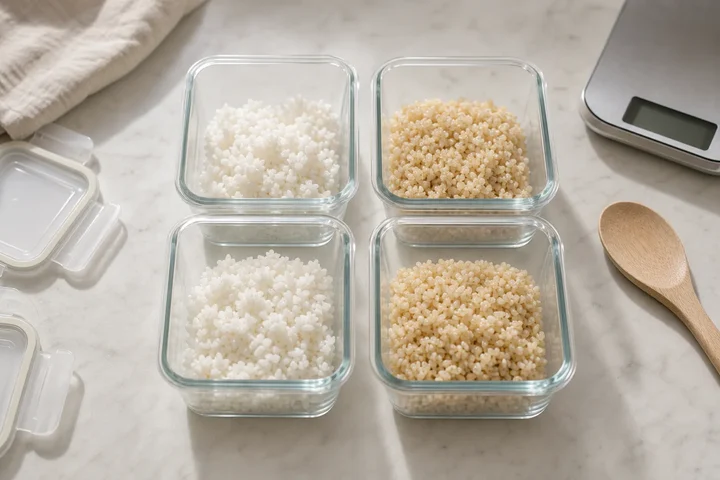
Sunday batch cooking turns the 45 minute brown rice problem into a once a week problem.
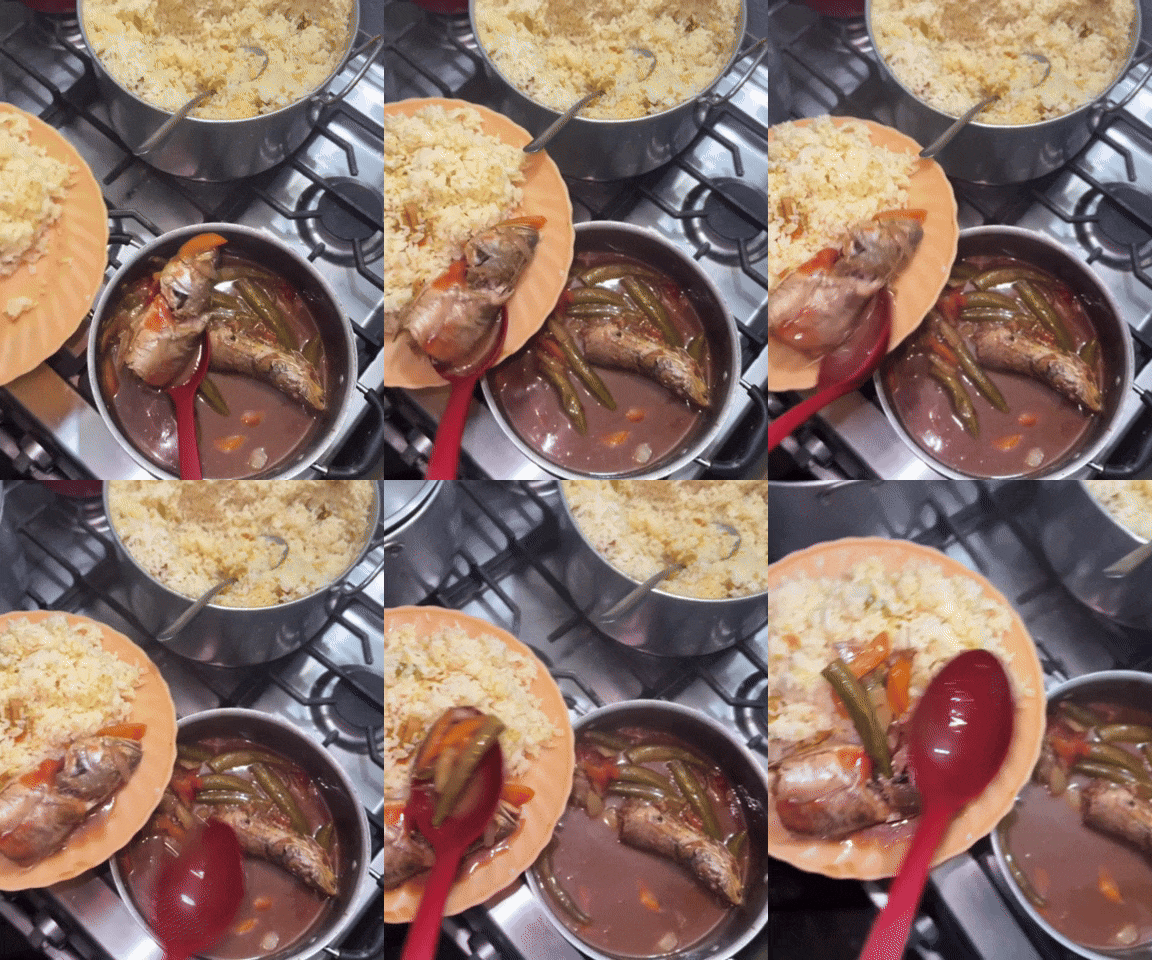
A home stove with rice in one pot and stew in the other, which is step 5 in practice.
IMPORTANT
Checkpoint: final stretch before the reveal.
One last nudge, the reveal is next.
⏱️ Progress 3/4 • ~3 minutes in • Keep going
✅ Step 1: The numbers side by side
✅ Step 2: What the trials found
✅ Step 3: Portions, roti and your goal
✨ The cooking step that beats the grain swap (about to reveal)
The cooking step that beats the grain swap ❄️
Cook your rice, chill it overnight, then reheat it. Cooling converts some starch into resistant starch, which digests like fiber instead of sugar, and in the trials pooled by that 2025 review the cook, chill and reheat sequence lowered the glycemic response of the same rice (Sekarmuti et al., 2025).
Why it beats the grain swap: moving our 62 kg example to brown rice saved 35 calories a day and dropped the average GI from 64 to 55. Cooking, chilling and reheating changes the glucose curve of the rice she already buys, at no extra cost and with no second bag in the cupboard. Planned leftovers are a blood sugar tool.
It is not a licence to eat more rice. The calories barely move, so portion size still runs the show. But if someone in the house refuses brown rice, this is the lever you have been missing.
WARNING
Cooked rice can grow Bacillus cereus if it sits warm on the counter. Spread it out to cool fast, refrigerate within an hour, eat it within 24 hours, and reheat until it is steaming hot all the way through. Never reheat the same batch twice.
What to remember 📌
Brown rice is a modest, real upgrade. More fiber, more magnesium and manganese, about 2 kg more weight lost in pooled trials, and a lower average glycemic index. It is not a fat burner, it does not fix blood sugar on its own, and it will not offset a plate that is two thirds rice.
White rice is not a villain either. The PURE diabetes signal appeared at three or more cups a day, not at one, and enriched white rice supplies more than twice the iron of brown rice. If white rice is what your family enjoys, the more useful move is a smaller serving next to more vegetables and protein.
The thing worth measuring is the amount. Once you know what 150 g of cooked rice looks like in your own bowl, the brown versus white question shrinks to a small and sensible preference. If you want that measurement handled without a kitchen scale at every meal, NutriScan reads a plate from a photo and logs the rice, the dal and the roti together, free for 5 scans a week. Either grain fits, once you can see the number.
IMPORTANT
Recap: everything you completed this round.
You finished the run, so save this for next time.
⏱️ Progress 4/4 • ~4 minutes in • Nicely done
✅ Step 1: 123 calories against 130, and 1.6 g fiber against 0.4 g
✅ Step 2: 2.2 kg more weight lost, no change in HbA1c
✅ Step 3: one cup of rice lands within 45 calories of two rotis
✅ The cooking step, revealed: cook, chill overnight, reheat
Frequently asked questions ❓
Is brown rice or white rice better for cholesterol?
Neither moves LDL much on its own. The brown rice meta-analysis found no LDL effect and a small HDL rise. Broader whole grain research does show improved total and LDL cholesterol, but the effect came mostly from oats, with rice showing up in triglycerides (Marshall et al., 2020). Treat rice as neutral for cholesterol and let oats, nuts and fiber do that job.
Brown rice or white rice for bodybuilding?
Both, at different times. Protein is nearly identical at about 2.7 g per 100 g cooked, so rice is a carbohydrate source. White rice is easier to eat in volume and sits lighter around training, brown rice keeps you fuller between meals during a cut. Many lifters keep both bags open for exactly that reason.
Why is white rice cheaper than brown rice?
Scale and shelf life. White rice moves in far larger volumes and stores for years, while brown rice keeps oily bran that goes rancid in months, so it needs faster turnover, smaller batches and cooler storage. In India it also sits in a premium pack, which adds a brand markup.
Are brown rice and white rice gluten free?
Yes. All plain rice is naturally gluten free, including sticky and glutinous rice, whose name refers to texture and not to gluten. Watch flavored rice mixes and seasoning sachets, which can contain wheat.
Brown rice or white rice for dogs?
Plain white rice is the usual pick for an upset stomach because it is bland and easy to digest, while brown rice keeps more fiber. Serve it plain and cooked soft, and check with your veterinarian first.
Oats vs rice for weight loss?
Oats have the better trial record on cholesterol, rice has none, and for body weight the calorie total decides it. Oats suit breakfast, rice suits lunch and dinner, so use both rather than picking one. If you are building a plan around either, our guide for desk-job weight loss shows how the carbohydrate slot fits a sedentary day.
What are brown rice and white rice called in Hindi?
Brown rice is usually written as brown chawal or unpolished chawal, white rice as safed chawal, and roti keeps the same name in both languages. The numbers here describe the food, not the label, so the comparisons apply either way.