Healthy Breakfast Ideas That Actually Keep You Full
 ChatGPT
  Claude
  AI Mode
  Perplexity
TL;DR - Healthy breakfast ideas that keep you full
• The two numbers: 25 to 30 g of protein and 5 g or more of fiber
• Key number: over 12 weeks, breakfast skippers gained 1.6 kg of fat mass while the 35 g protein group lost 0.4 kg
• Build order: protein ➡️ fiber ➡️ one fat ➡️ check added sugar ➡️ under 10 minutes
• Every constraint has an answer: egg free, dairy free, gluten free, no cook, low carb and vegetarian all reach 25 g
• Kids and toddlers: same shape, softer and blander, with no added salt or sugar
NutriScan publishes this post and makes a calorie tracking app. The number to start with comes from a 12-week randomized trial: 57 habitual breakfast skippers with overweight, average age 19, were assigned a 35 g protein breakfast, a 13 g protein breakfast, or no breakfast, and only the high-protein group avoided gaining body fat, losing 0.4 kg of fat mass while the skippers gained 1.6 kg (Leidy et al., 2015). Same calories. Very different afternoons.
Most breakfast advice is a list of recipes, which is why it stops working the week your enthusiasm runs out. What survives a real Tuesday is a rule you can apply to whatever is in the fridge.
IMPORTANT
Your breakfast plan at a glance.
25 to 30 g of protein, 5 g or more of fiber, under 10 minutes of hands-on work.
⏱️ Progress 0/4 • ~0 minutes in • Keep going
⏳ Step 1: Learn the two numbers that decide whether a breakfast holds
⏳ Step 2: Pick ideas that fit your constraint, your cuisine and your household
⏳ Step 3: Make the habit survive a bad week
🔍 The trial result that says stop chasing an exact protein number (revealed near the end)
The Two Numbers That Decide Whether a Breakfast Works 🌅
A breakfast succeeds or fails on protein and fiber, and almost nothing else about it matters for hunger.
For protein, aim for 25 to 30 g. That comes from the breakfast trials, where the useful contrast is 35 g against 13 g at the same 350 kcal, and from daily totals: the International Society of Sports Nutrition puts intake at 1.4 to 2.0 g per kg of body weight for people who exercise (Jäger et al., 2017), and the floor for everyone else is the National Academy of Medicine minimum of 0.8 g per kg (Harvard Nutrition Source). Either way breakfast has to carry a real share, not the 6 to 8 g a bowl of cereal and milk delivers. For your own number, use the protein intake calculator.
For fiber, aim for 5 g or more. Adults and children need at least 25 to 35 g a day and most Americans get about 15 g (Harvard Nutrition Source). Breakfast is the easiest place to fix that, because oats, fruit, beans and whole grains all belong there already. Everything else is negotiable, including whether the meal looks like breakfast.
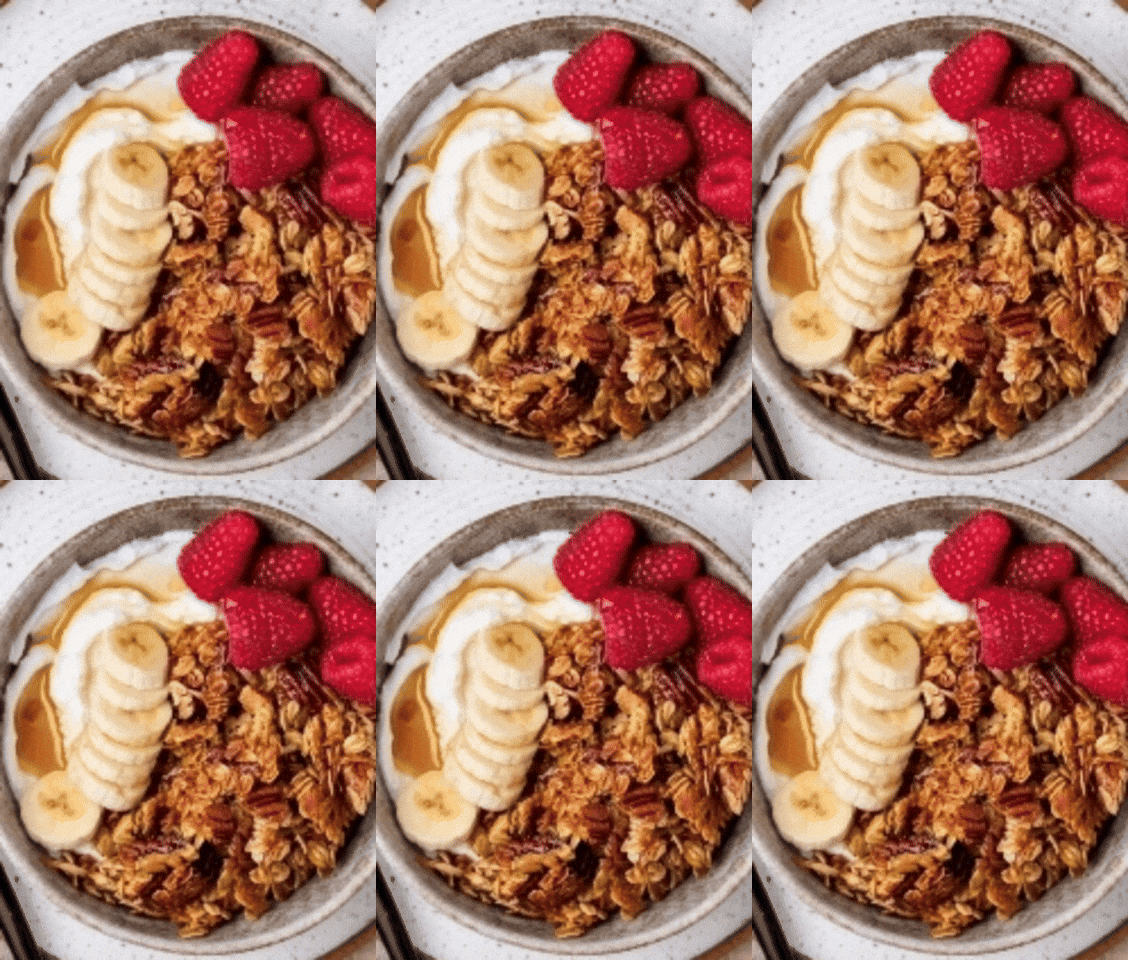
Plain yogurt, oats and fruit is the fastest way to hit both numbers with no stove.
Three Real Mornings, Three Fixes 🍳
Example one: a 70 kg woman eating in a calorie deficit. Toast with jam and black coffee, roughly 8 g of protein, starving by 11. Keep one slice of toast, add two eggs and half an avocado, and the meal reaches about 20 g at a similar calorie count. A pot of plain Greek yogurt takes it to target.
Example two: a 3-year-old who eats four bites and leaves. Go for density and repetition: full-fat yogurt with mashed banana and ground nuts, offered again at snack time rather than replaced by something more exciting. Four bites of that beats twenty of frosted cereal.
Example three: a hostel student with a kettle and a shared fridge. Overnight oats made with milk, peanut butter and a chopped apple, assembled at night in the jar he drinks from. About 20 g of protein, 8 g of fiber, zero morning effort.
None of the three needed a recipe. One component swapped did it.
Swap, do not rebuild
Keep the breakfast you already eat and change one thing. A jam toast morning becomes a 20 g morning with two eggs, not with a new shopping list.
What the Research Actually Shows About Breakfast 📊
Two findings do most of the work. First, protein at breakfast changes appetite for the rest of the day. In a randomized crossover trial, 20 breakfast-skipping late-adolescent girls with overweight ate a 350 kcal breakfast at 13 g of protein, the same 350 kcal at 35 g from eggs and beef, or continued skipping. The 35 g version increased daily fullness, reduced daily ghrelin, raised peptide YY, and was the only condition that cut evening snacking on high-fat foods (Leidy et al., 2013).
Second, this holds whether or not you are already a breakfast person: in a later crossover study of 37 young women with overweight, daily fullness was greater on the 35 g breakfast in habitual eaters and habitual skippers alike (Douglas et al., 2019).
The 12-week trial that opens this article measured all three arms, and the spread is the clearest argument for eating breakfast at all.
| 12-week group | Breakfast protein | Fat mass change |
|---|---|---|
| High protein | 35 g | -0.4 kg |
| Normal protein | 13 g | +0.3 kg |
| Skipped breakfast | none | +1.6 kg |
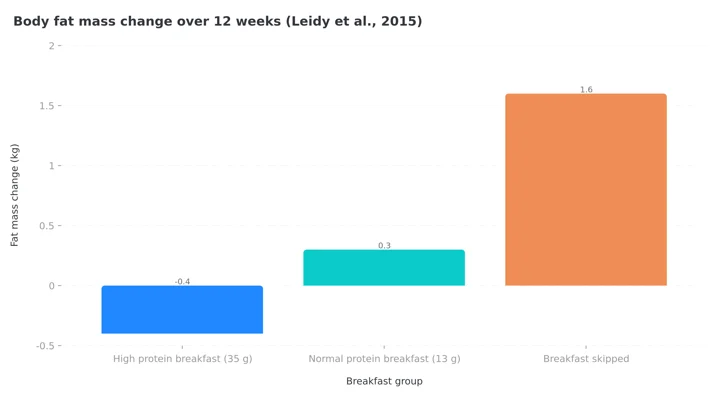
Figure 1: eating breakfast versus skipping it is worth 2 kg of fat mass over 12 weeks, far more than the gap between the two protein doses.
If oats are your default, one more number: at least 3 g of oat beta-glucan a day reduced LDL cholesterol by 0.25 mmol/L and total cholesterol by 0.30 mmol/L across 28 randomized controlled trials (Whitehead et al., 2014). That dose takes a generous 70 to 80 g serving of oats, a full bowl rather than a sprinkle.
IMPORTANT
Checkpoint: here is where you are right now.
You have the two numbers and the evidence behind them. Next comes the part you actually cook.
⏱️ Progress 1/4 • ~1 minute in • Keep going
✅ Step 1: The two numbers (done)
👉 Step 2: Ideas that fit your constraint (you're here)
⏳ Step 3: Make the habit survive a bad week
🧩 The trial result about chasing an exact protein number (coming soon)

Healthy Breakfast Ideas by Constraint 🚫
Most people arrive with a rule attached: no eggs, no dairy, no gluten, no stove, no sugar. Here is the same target met inside each fence.
| Constraint | Breakfast idea | Protein anchor |
|---|---|---|
| Egg free | Greek yogurt with berries, oats and pumpkin seeds | Yogurt |
| Dairy free and lactose free | Tofu scramble with turmeric, onion and spinach, plus whole grain toast | Tofu and fortified soy milk |
| Egg free and dairy free | Soya chunk curry with one roti, or overnight oats with soy milk and peanut butter | Soya chunks |
| Gluten free | Two eggs with a bowl of moong dal, or besan chilla with mint chutney | Eggs, dal, besan |
| Very low carb | Eggs with spinach and cheese, or plain Greek yogurt with walnuts | Eggs and cheese |
| Sugar free | Savory anything: chilla, upma, eggs, dal, curd with cucumber | Dal and curd |
| No cooking | Overnight oats, curd with roasted chana, peanut butter on brown bread with milk | Curd and peanut butter |
| Vegetarian | Paneer bhurji, dahi with chana, oats upma with peas | Paneer and chana |
"Carb free" is a common search but a poor target; even eggs and yogurt contain a few grams, and the change that matters is cutting added sugar. WHO recommends adults and children reduce free sugars below 10 percent of total energy, with additional benefit below 5 percent, roughly 25 g a day (WHO, 2015).
Dairy free does not mean low protein either. Cow's milk gives about 8 g of protein in an 8 oz glass and cooked lentils about 18 g per cup (Harvard Nutrition Source), so a bowl of dal outperforms a glass of milk. Fortified soy milk keeps the number where almond and oat milks do not.
Indian Breakfast Ideas That Reach 25 g of Protein 🍛
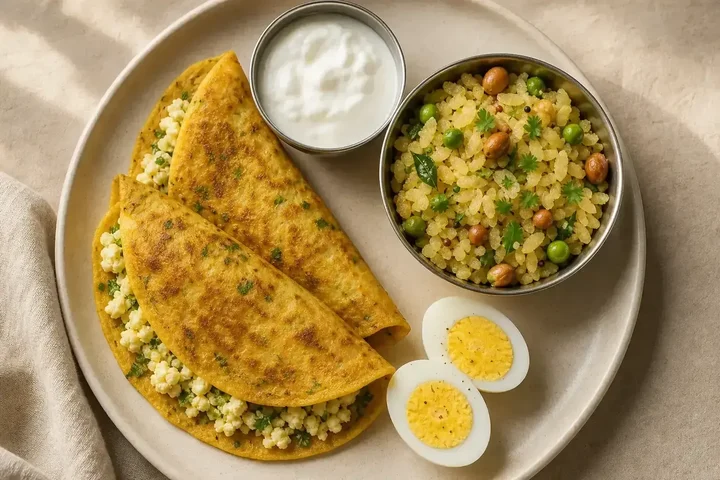
Two paneer-stuffed chilla, curd and a boiled egg turn a 7 g plate into a 25 g one.
The standard Indian plate is carbohydrate-led and lands around 6 to 10 g of protein. The repair is one added component, not a different cuisine.
- Poha with peanuts, peas and a boiled egg or curd. The poha stays; the egg does the lifting.
- Upma made with suji plus a fistful of roasted chana dal and vegetables, served with curd.
- Besan chilla or moong dal cheela stuffed with grated paneer. Two of them is a genuine 25 g breakfast.
- Idli or dosa with sambar rather than only chutney, plus curd. Sambar is where the dal is.
- Paneer bhurji with one whole wheat roti, the closest Indian analogue to scrambled eggs on toast.
- Oats upma, which swaps suji for oats and picks up beta-glucan without changing the tadka.
- Soya chunk keema with pav or roti. Soya chunks are the vegetarian shortcut most people skip.
- Non-vegetarian: egg bhurji with brown bread, or leftover chicken curry with one roti.
For weight loss, keep the carbohydrate portion fixed and add the protein: one roti with paneer bhurji, not two. Portion drift is what turns a good Indian breakfast into a 700 kcal one. See how to count calories in Indian food and 25 low-calorie high-protein Indian foods.
Hindi speakers will find far more recipes under the dish name than under a nutrition phrase. Besan chilla, moong dal cheela, paneer bhurji, oats upma and suji uttapam are all published in Hindi by the large recipe channels including Hebbar's Kitchen.
Breakfast Ideas for Kids, Toddlers and 1-Year-Olds 👶
Small children need the same shape in a smaller, softer, blander package. Three rules cover it.
Keep salt and added sugar out. The NHS is direct for children aged one to four: "There's no need to add salt to your child's food," and keeping added sugar to a minimum helps prevent tooth decay (NHS). That rule alone eliminates most cereals marketed at children.
At twelve months, think soft and full fat. Thick oat porridge made with whole milk, full-fat yogurt with mashed banana, scrambled egg in strips, soft idli, or well-cooked dal with rice.
From two years up, make it recognizable and repeatable. Curd with chopped fruit, peanut butter on brown bread cut into fingers, a small paneer paratha, dosa with sambar, or an omelette with grated cheese. Expect refusal and do not treat it as data: offering the same food repeatedly at low stakes beats negotiating over one meal.
Choking and allergy care under four
Cut grapes, cherry tomatoes and sausages lengthwise, skip whole nuts and popcorn, and stir ground nuts in instead. Introduce a new allergen food on its own, early in the day. Never leave a child under four eating alone.
IMPORTANT
Checkpoint: midway progress update.
You're halfway, and the remaining work is logistics rather than nutrition.
⏱️ Progress 2/4 • ~2 minutes in • Keep going
✅ Step 1: The two numbers (done)
✅ Step 2: Ideas that fit your constraint (done)
👉 Step 3: Make the habit survive a bad week (current)
⏳ The trial result about chasing an exact protein number (next)
Freezer Breakfast Ideas: Burritos, Sandwiches and Bakes 🧊
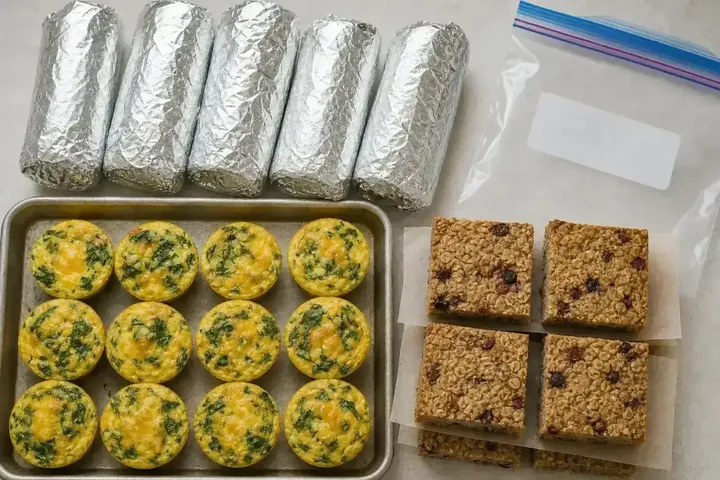
One Sunday hour produces about ten breakfasts: burritos, egg muffins and oat squares.
Freezer prep is what makes a high-protein breakfast survive a bad week. Freeze cooked protein and starch together, anything crisp separately, never plain yogurt.
- Breakfast burritos. Scrambled eggs, black beans, cheese and salsa in a tortilla, wrapped in foil. Two eggs and half a cup of beans puts each over 20 g. Microwave 2 to 3 minutes from frozen.
- Breakfast sandwiches. Egg patties from a muffin tin, cheese and ham or a bean patty, on toasted whole grain muffins.
- Egg muffins. Whisked eggs with spinach, onion and cheese baked in a muffin tin. They freeze flat, reheat in 60 seconds, gluten free.
- Baked oatmeal squares. Oats, milk, egg, banana and cinnamon baked in a tray and cut into portions. A scoop of protein powder lifts the number.
- Chilla, paratha and idli stacks. Cooked besan chillas or paneer parathas with parchment between them, reheated on a dry tawa; steamed idlis re-steam in 3 minutes.

Eggs cooked low and folded rather than stirred reheat without turning rubbery.
Label with the date and eat within about three months. The failure mode is forgetting what is in the bag, not spoilage.
Apple Breakfast Ideas and the Applesauce Swap 🍎
Apples hold texture when cooked and their pectin adds soluble fiber to an otherwise soft meal. An apple chopped into oats, yogurt or a bake adds sweetness with no added sugar. The high-protein versions people search for all add protein to a dessert-shaped base:
- Apple breakfast bake, crumble or crisp. Sliced apples, oats, cinnamon, milk and eggs baked until set, then cut like a cake. Skip the butter-and-sugar streusel; top with chopped nuts.
- Apple protein muffins or bars. Oat flour or oats, grated apple, eggs or dates, Greek yogurt, peanut butter and whey or soy protein. The apple replaces some of the oil and keeps them moist.
- Applesauce as a swap. Unsweetened applesauce replaces oil or butter one for one by volume in bakes, and sugar in oatmeal. Read the label; the sweetened kind returns what you removed.
Cooked apple keeps nearly all its fiber, so a bake is no downgrade. The half cup of sugar in most crumble recipes is.
Six Tips That Make Any Breakfast Better 💡
- Add protein before you subtract anything. Most breakfast complaints resolve by adding 15 g of protein rather than removing carbohydrate.
- Decide the night before. Overnight oats, soaked dal, a boiled egg batch, a burrito in the freezer. Morning decisions are the ones you lose.
- Buy fiber in a form you like. Oats, whole grain bread, beans, fruit with skin, seeds. Fibermaxxing and gut health covers raising it safely.
- Keep one no-cook option stocked. Curd cups, roasted chana, peanut butter, oats. This is what you eat when the plan fails.
- Watch the yogurt aisle. Flavored yogurt can carry as much added sugar as a dessert, and plain plus your own fruit is cheaper per gram.
- Do not skip breakfast to save calories. In the 12-week trial above, the skipping group gained the fat mass (Leidy et al., 2015). See also the guide to high-protein snacks.
How to Build Your Own Breakfast in Five Steps 🪜
- Pick the protein first. Eggs, curd or Greek yogurt, paneer, tofu, soya chunks, dal, milk, leftover meat. One component supplying 20 g, or two supplying 10 g.
- Pick the fiber source. Oats, whole grain bread, fruit with skin, beans, or vegetables cooked into the dish. A handful is usually 3 to 5 g.
- Add a fat for staying power. Nuts, seeds, peanut butter, avocado, a little ghee. A tablespoon is enough; this is the step people overdo.
- Check the added sugar. Cereal box, yogurt tub, granola bag, applesauce jar hide most of it.
- Time-box the assembly. Over 10 minutes on a weekday means moving the work to the night before or the freezer.
Run any idea through those steps and its weak point shows up in seconds, usually at step one.
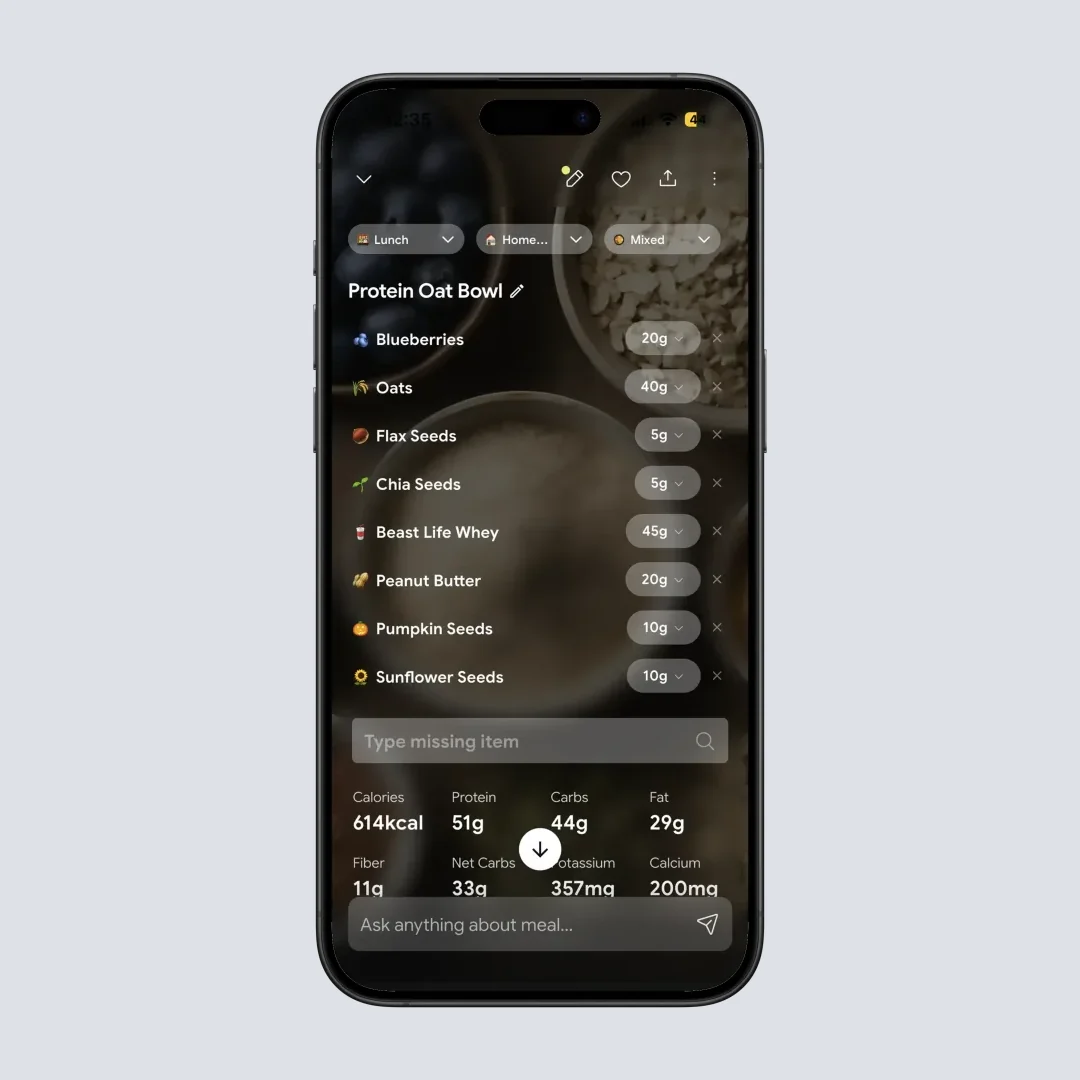
Per-item protein and fiber for one logged meal (Home > Meal Item). A week of this shows which breakfast clears 25 g and which only looks like it does.
IMPORTANT
Checkpoint: final stretch before the reveal.
One last nudge, and then the finding that changes how hard you chase the number.
⏱️ Progress 3/4 • ~3 minutes in • Keep going
✅ Step 1: The two numbers
✅ Step 2: Ideas that fit your constraint
✅ Step 3: Make the habit survive a bad week
✨ The trial result about chasing an exact protein number (about to reveal)
Why Chasing an Exact Protein Number Matters Less Than Showing Up 🔍
Here is the finding buried in the same 12-week trial that opens this article. The 35 g breakfast beat skipping on fat mass, daily intake and hunger; the 13 g breakfast did not. But comparing the two breakfast groups against each other, no difference was detected in any outcome (Leidy et al., 2015). The trial separated eaters from skippers far more cleanly than it separated 35 g from 13 g.
A second pair of trials points the same way. Children aged 4 to 6 and adolescents aged 14 to 17 ate either an egg breakfast or an isocaloric bagel breakfast. Lunchtime energy intake did not differ, and in the teenagers neither did hunger ratings, even though serum peptide YY rose after the eggs (Liu et al., 2015).
So the priority order runs: eat something at breakfast, then add protein to it, then worry about the exact gram count. Missing 25 g by 5 g on a Tuesday costs you almost nothing. Skipping the meal to save calories costs you the effect the trials measured.
The Rule Worth Taking Away 🚀
Healthy breakfast ideas are not scarce. A breakfast you will still be eating in March is. That is why this guide runs on two numbers instead of a list: 25 to 30 g of protein and 5 g of fiber, from whatever kitchen you cook in. Higher-protein breakfasts raise daily fullness and cut evening snacking (Leidy et al., 2013), and no single food does it.
If you would rather know than guess what your breakfast delivers, measure it for a week. NutriScan is free to start, with 5 photo meal scans a week on the free plan and unlimited scans on Premium for about $59 a year. With insulin attached, PCOS breakfast frameworks goes deeper.
IMPORTANT
Recap: everything you completed this round.
You finished the run. Save this for the next grocery trip.
⏱️ Progress 4/4 • ~4 minutes in • Nicely done
✅ Step 1: 25 to 30 g protein and 5 g or more fiber at breakfast
✅ Step 2: Egg free, dairy free, gluten free, Indian and toddler versions all reach the target
✅ Step 3: Freezer burritos, egg muffins and chilla stacks survive a bad week
✅ The exact gram count matters less than eating breakfast at all (revealed)
Frequently Asked Questions ❓
What is a good high protein breakfast without eggs or dairy?
Build it on soy, legumes or nuts. Soya chunks with onion and tomato, besan chilla, tofu scrambled with turmeric, or overnight oats with soy milk and peanut butter all clear 20 g. Use fortified soy milk, not almond or oat milk.
What are easy breakfast appetizer ideas for a staff appreciation spread?
Choose things that hold at room temperature for two hours and need no plate: cottage cheese and grape skewers, mini frittata bites, yogurt cups with fruit, hummus with cucumber sticks, hard-boiled eggs. Label one egg-free tray and one dairy-free tray.
What should a 1 year old eat for breakfast?
Soft, small and unsalted. Full-fat plain yogurt with mashed banana, thick oat porridge made with whole milk, scrambled egg in strips, or soft idli. The NHS advises no added salt and minimal added sugar (NHS), so skip flavored yogurt tubes and frosted cereal.
What is a high protein breakfast for pregnancy?
Protein needs rise in the second and third trimesters, and breakfast is an easy place to add 10 to 15 g. Well-cooked eggs, pasteurized yogurt or paneer, dal chilla and fortified soy milk work. Avoid unpasteurized soft cheese. Our protein in pregnancy guide has the trimester numbers.
What can I eat for breakfast when I have no appetite in the morning?
Drink it. Milk or soy milk blended with a banana, peanut butter and oats delivers protein and fiber without the sensation of a plate of food. If mornings stay hard, eat the same food at 11 a.m.
Is there an app for healthy breakfast recipes?
Plenty, and they solve half the problem. A recipe app gives you ideas; a nutrition app tells you what the idea delivers in protein, fiber and calories. If your goal is a number, the second kind changes your eating.
Can a breakfast really be carb free or sugar free?
Sugar free, easily. Carb free, almost never, and it is a poor target. Eggs with spinach and cheese, or plain Greek yogurt with nuts, are very low carb but not zero. Cutting added sugar is the change that matters: WHO puts the ceiling at 10 percent of daily energy (WHO, 2015).