How Many Calories Do You Burn in an Infrared Sauna? The Math Behind My 400-Calorie Display
 ChatGPT
 Claude
 AI Mode
 Perplexity
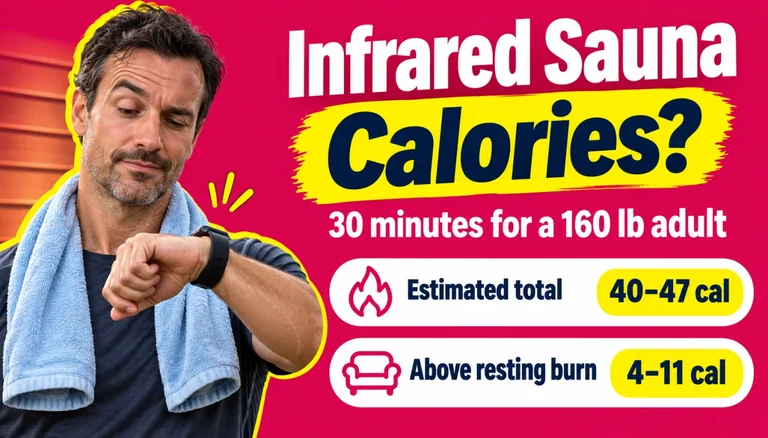
I sit in my SaunaCloud Atlas custom infrared cabin three days a week and a hot rock sauna two other days. Almost every time I step out of a 30-minute infrared session, my tracker or the cabin display tells me I just torched roughly 400 calories.
That number looks great until you check it against actual metabolic data. Measured physiology puts a 155-160 lb adult at roughly 39-47 calories for 30 minutes of infrared heat, which is only 4-11 calories above sitting still.
Key takeaways
- A 155-160 lb adult burns 39-47 calories in a 30-minute infrared sauna session, just 4-11 calories more than sitting on a couch.
- Fitness watches and cabin displays report 300-400 calories because heat spikes your heart rate to cool your body while your muscles stay idle, fooling heart-rate algorithms.
- Of 18 health and fitness articles I checked on whether infrared saunas drive true weight loss beyond water weight, 13 say yes and 5 say no, yet even generous burn estimates require nearly 16 sessions to lose one pound of fat.
How many calories do you burn in an infrared sauna?
An infrared sauna burns roughly 39-47 calories in 30 minutes for a 155-160 lb adult, which is only 4-11 calories above sitting still. That total equals about 33-39 minutes of sitting on the couch, since Harvard Health puts a standard resting baseline at 68-94 calories per hour and estimates a 20-minute traditional sauna session burns 50-150 calories for the average person.
Using the transparent formula of resting calories per hour multiplied by hours in the heat and a 1.1-1.3 heat multiplier, a 160 lb (72.6 kg) adult burns 36 resting calories in 30 minutes plus 4-11 calories from the heat itself. If you'd rather not run the numbers by hand, the calculator at consciousbodyrecovery.com applies this same methodology across different body weights and session lengths.
| Session length | Resting calories (160 lb) | Heat multiplier (1.1-1.3) | Total calories burned |
|---|---|---|---|
| 10 minutes | 12 | 1-4 | 13-16 |
| 15 minutes | 18 | 2-6 | 20-24 |
| 20 minutes | 24 | 3-7 | 27-31 |
| 30 minutes | 36 | 4-11 | 40-47 |
| 40 minutes | 48 | 5-15 | 53-63 |
10, 15, and 20 minutes
Short sessions barely move the needle above your resting metabolism. A 160 lb adult sitting in infrared heat burns 13-16 calories in 10 minutes, 20-24 calories in 15 minutes, and 27-31 calories in 20 minutes. Even if you use Harvard Health's broader 50-150 calorie range for a 20-minute traditional sauna, you're still looking at a modest snack, not a workout.
30 minutes
Half an hour is the sweet spot where most people check their watch and feel like they put in real work. At 160 lb, your body spends 36 calories just keeping the lights on and adds 4-11 calories to shed heat, landing at 40-47 calories total.
40 minutes and the per-hour trap
Stretching to 40 minutes pushes a 160 lb adult to 53-63 calories, and extrapolating out to a full hour lands around 80-94 calories. Even in a much hotter 80°C (176°F) traditional sauna, Leppäluoto et al. measured a 25-33% metabolic rise in 1986, which puts a hard ceiling on hourly burn. Staying in longer and cranking the heat isn't a calorie-burning strategy, and pushing toward an hour mostly invites dehydration.

How to calculate your own sauna calorie burn
The infrared sauna calorie formula is resting calories per hour × hours in the heat × 1.1 to 1.3, counting only minutes on the bench. Cold plunges and post-sauna showers don't count toward the multiplier, and the resting side of the equation comes straight from standard metabolic tables.
Per the 2024 Adult Compendium of Physical Activities, sitting quietly is 1.0 MET (code 07021), which works out to roughly 1 calorie per kilogram of body weight per hour, while fidgety sitting (code 07022) bumps up to 1.5 METs. For a more precise resting estimate than weight alone, the Mifflin-St Jeor equation (published in the American Journal of Clinical Nutrition in 1990) factors in your sex, age, and height.
The 10-30% heat multiplier isn't a guess. Matthews et al. found in 2022 that adding a sauna suit to HIIT increased energy expenditure by 5-9%, or roughly 23 calories, while Leppäluoto et al. measured the 25-33% metabolic jump during an hour in an 80°C traditional sauna in 1986. Because infrared cabins run cooler than traditional rock saunas, 25-33% represents the upper ceiling of what heat alone can add.
Heavier people burn more calories in a sauna than lighter people because larger bodies expend more energy at rest and carry more surface area to cool. Research published in The Scientific World Journal shows that your body weight, age, biological sex, total muscle mass, and metabolism, along with cabin temperature and how long you stay in, all shift the final count:
"This study demonstrated that individuals with higher body mass, body area, body fat mass and muscle mass expend relatively more calories during sauna bathing"
The same researchers noted that "the greatest [body mass loss] was reported in overweight and obese subjects," though sitting close to the panels, fidgeting, and turning up the cabin temperature will nudge anyone's burn slightly higher. Plugging a 160 lb (72.6 kg) person into the math for 30 minutes (0.5 hours) gives 72.6 × 0.5 = 36.3 resting calories, which multiplies out to 40-47 total calories once heat is factored in.
Why your watch or the sauna display says 300-400 calories
When my tracker or SaunaCloud display flashes ~400 calories after half an hour, I'm looking at a software assumption, not a metabolic measurement. Running an AI nutrition and tracking platform at NutriScan makes it obvious how often logged estimates drift away from what your body is actually burning, and heat is one of the fastest ways to break a wearable's math.
Watches convert heart rate into calories as if your muscles were pedaling a bike or running up a hill. In a hot cabin, your heart rate climbs just to pump blood to your skin and dump warmth while your muscles sit idle, and Kriemler et al. showed in 2002 that warm conditions systematically inflate heart-rate-based calorie estimates.
Cardiovascular strain looks like exercise on paper even when zero mechanical work is happening. Ketelhut and Ketelhut showed in 2019 that 25 minutes in a 93°C (200°F) sauna pushed heart rate and blood pressure to levels matching moderate exercise at 60-100 watts, with blood pressure dipping below baseline afterward, yet the calorie cost stayed modest because the muscles never fired.
Even the most-cited sauna calorie study ran into this exact trap. Building on 2014 work, Podstawski et al. studied young sedentary and overweight men in 2019 across four 10-minute dry sauna rounds with 5-minute cooldowns. They reported 73-131 kcal per round, averaging 73 in round one and 134 in round four (one source cites 150). Still, the authors flagged wrist heart-rate monitors as a limitation and noted the results may not generalize to women or people with a normal BMI.
A real-world self-test reported by Kimberly Truong at vice.com shows how cleanly the numbers fall apart. A 26-year-old man (178 cm, 81.8 kg) wore a Garmin watch while his scale weight dropped roughly 300 g (81.8 to 81.5 kg), almost identical to the watch's 278 ml sweat estimate. Across 25 minutes at 47°C (117°F), the Garmin self-test logged 114 total calories (39 resting and 75 active) at an average 90 bpm and 118 bpm max.
Water weight, not fat: what the scale is measuring
That quick drop on the bathroom scale after a session is sweat volume, and it comes right back as soon as you drink water. In 1986, Leppäluoto et al. measured 0.7-0.9 kg (about 1.5-2 lb) of body weight lost per hour in an 80°C (176°F) sauna as pulse climbed from 75-80 to 106-116 bpm. They treated all of it as fluid loss regained with rehydration.
Of 6 guides and articles I checked on how much weight lost in a sauna session is just water regained after rehydrating, 3 say all of it and 3 say 1 to 2 pounds. Either way, stepping off the bench lighter doesn't mean you burned fat, and you should expect that weight back by morning.
Can a sauna help with weight loss?
No, an infrared sauna will not produce measurable weight loss on its own, though it can supplement diet and exercise. It won't melt away belly fat or target fat loss in specific areas either, because any immediate drop on the scale is water lost through sweat and regained when you rehydrate.
Even if you take the generous Podstawski figures of 73 calories per 10 minutes, which works out to roughly 219 calories for a 30-minute session, the math doesn't hold up. At 3,500 calories to a pound of fat, you'd need nearly 16 thirty-minute sessions just to burn off one pound.
Dr. Melissa Young at Cleveland Clinic, quoted by Amy Wilkinson at womenshealthmag.com, says there's no good evidence right now for true weight loss from sauna use and the calorie burn is too small to make a noticeable difference for most people. Dietitian Sydney Lappe, quoted by Christopher Covello at garagegymreviews.com, puts it plainly:
"Relying solely on sauna use in hopes of losing weight might not meet your expectations,"
She adds:
"But combining sauna bathing with regular exercise and a healthy diet can help you meet and sustain your weight loss goals"
Anyone pursuing weight loss should also talk with a physician before building a plan around heat. Of the 18 health and fitness articles I checked on whether an infrared sauna helps with true weight loss beyond water weight, 13 say yes and 5 say no. Wellness marketing and surface-level pieces drive that split by blurring sweat and mild calorie burn into fat-loss claims. The arithmetic and clinical evidence say otherwise.
Where the 600-calorie, fat-melting, and detox claims come from
Inflated claims of 400-600 calories per session trace back to spa marketing, wearable algorithms, and celebrity amplification rather than controlled human trials. Crunch Blogger at crunch.com, for instance, lists 250-400 calories in 30 minutes, 300-690 in 40 minutes, and roughly 150 kcal in 20 minutes, numbers that clash with measured physiological responses showing tens of extra calories, not hundreds.
Fat-melting and the Binghamton study
Dr. Brent A. Bauer of the Mayo Clinic Complementary and Integrative Medicine Program notes that short-term loss is almost entirely water, long-term weight loss is unproven, and manufacturer claims that infrared radiation melts fat cells have nil evidence. Dr. Ian Nelligan at Stanford University School of Medicine adds that no human studies validate exercise-simulation claims, though researchers have some theoretical interest in heat therapy for patients whose arthritis or other chronic conditions keep them from exercising.
Spa marketing often leans on a Binghamton University study where participants used an infrared sauna three times a week for 30-45 minutes over four months and saw up to a 4% body-fat drop compared to no change in controls, with 110°F called ideal and higher core temperatures linked to more fat loss. Because that study didn't control diet or exercise, Nelligan calls the evidence shaky at best.
Detox marketing and celebrity amplification
Detoxification marketing for infrared saunas doesn't hold up either. Sweat is roughly 80% water and 20% solutes. While Kuan et al. (2022, Int J Environ Res Public Health 19(7):4323) noted that sweating may excrete trace heavy metals including nickel, lead, copper, arsenic, and mercury, infrared radiation doesn't destroy fat or replace your liver and kidneys.
The hype stays alive through celebrity gifting, such as Kendall Jenner receiving an infrared sauna for her birthday from the Kardashian sisters, and boutique studio framing like Nikki Ostrower's Nao Wellness in New York City, which pitches holistic benefits, boosting cardiovascular and lymphatic temperature, targeting fat cells, and simulating a power walk.

Infrared vs. traditional sauna: which burns more calories?
A traditional sauna burns slightly more calories per minute than an infrared sauna because it runs hotter, 150-212°F versus 110-140°F. Since Leppäluoto's 25-33% metabolic ceiling was measured in an 80°C (176°F) traditional sauna, cooler infrared cabins sit toward the bottom end of the 1.1-1.3 heat multiplier. Still, according to The Unfinished Man, "Because 120°F is tolerable for a full session, it allows your tissues to absorb more total energy."
How each type heats the body
Infrared saunas, invented in 1965 in Japan, use panels that emit radiant heat absorbed directly by your skin to penetrate deep tissue without overheating the room air, often around 110-140°F with 110°F frequently called ideal. Traditional Finnish saunas heat room air via conduction and convection from hot stones at 150-212°F per Dr. Young (other articles cite 160-200°F or 165-210°F), while steam rooms sit at 110-120°F with high humidity.
In my own routine, three days a week in the SaunaCloud Atlas infrared cabin and two days in a hot rock sauna, the difference in cabin heat and tolerability is obvious firsthand. Practitioners sometimes describe infrared as equally effective and more energy-efficient since it doesn't heat the whole room, and Bauer notes that while traditional dry saunas have substantial long-term research and infrared has a smaller literature suggesting modest benefits, you shouldn't throw the baby out with the bathwater. According to SaunaCloud's brown fat guide, regular infrared sauna sessions still support caloric expenditure, metabolic flexibility, and thermoregulatory training on their own.
Dry-heat practice itself goes back roughly 10,000 years, possibly to 4000 B.C. based on a Scottish Orkney Islands find, alongside Finnish heated-stone pits, Indigenous American sweat lodges, and Japanese bathing houses. That makes 1965 infrared the newest format with the thinnest evidence base, while dry saunas overall carry more studies than steam rooms.
Sauna blankets and the evidence vacuum
If you're looking at portable gear like the HigherDose V4 Infrared Sauna Blanket ($699 via HigherDose, Amazon, or Ulta Beauty, or alternatives like the X-Vcak and All Star Warrior Premium on Amazon, plus a separate 50%-off offer starting at $29.50; prices may vary), there's no direct comparative blanket-versus-cabin calorie study. The closest proxy is the Matthews et al. 2022 sauna-suit HIIT study, which showed only a 5-9% bump in energy expenditure.
What infrared saunas do well
Cardiovascular outcomes and sleep carry the strongest evidence for sauna use, not calorie burn.
Sleep and mental health
The 2019 Global Sauna Survey by Hussain et al. found that 83.5% of roughly 600 regular bathers reported sleep benefits, with emerging links to deeper sleep, faster sleep onset, and relief from stress and anxiety. A JAMA Psychiatry study also found that infrared-lamp heat on the skin may simulate antidepressant effects through serotonin stimulation.
Heart health and cholesterol
Heat raises your heart rate to mimic cardiovascular exercise, as Dr. Young points out. Laukkanen et al. found in 2018 (alongside 2023 follow-up work) that higher frequency and duration of sauna bathing were strongly and inversely associated with fatal cardiovascular events, and Bauer observes:
"People who use traditional saunas long-term do appear to gain some health benefits, such as improved cardiovascular outcomes,"
Gryka et al. found in 2014 that sauna bathing reduced total cholesterol, LDL, and triacylglycerols similarly to moderate exercise, though it still doesn't replace working out or eating well.
Athletic recovery and performance
A 2023 study by Ahokas et al. found that a single 20-minute infrared session improved sport performance, cut muscle soreness and inflammation, and boosted mindset. Earlier work by Scoon et al. in 2007 found post-exercise sauna use enhanced endurance running performance and blood volume.
Emerging areas and the evidence gap
Research links regular sauna use with lower rates of dementia and Alzheimer's, likely through improved circulation, alongside small studies in chronic fatigue syndrome and post-strength-training soreness (two 10-participant clinical studies), Type-2 diabetes, heart failure, headaches, and a two-year chronic pain study. Practitioner lists also cite skin tone and texture, circulation, stress relief, and recovery, though Bauer cautions that infrared-specific literature remains thinner than traditional-sauna research.
How to use an infrared sauna safely
Using an infrared sauna daily is generally fine for healthy adults if you keep sessions to 15-20 minutes and cap them at 30 minutes, while 3-4 sessions a week is typical for pain relief. Chasing a higher calorie number on the display by staying longer or cranking the heat past that point is what creates risk.
Of 7 posters reporting their own experience when asked how long their typical sauna session lasts, 5 say 20 to 40 minutes and 2 say over 1 hour, including one who noted they usually max out at 30 minutes with water on the rocks at 180. That gap shows why 20-40 minutes is common in practice, while pushing past 30 minutes, especially past an hour, raises dehydration risk for negligible extra calories.
Dehydration is the main hazard, signaled by thirst, light-headedness, fatigue, or dark urine, and severe symptoms warrant prompt medical care. Heavy sweating can also deplete electrolytes, so replenish with foods and drinks like coconut water, watermelon, bananas, avocado, or an electrolyte mix. Pregnant women, children, people with heart conditions, multiple sclerosis, seizure disorders, and anyone who recently drank alcohol should avoid saunas, and anyone with a cardiovascular history should check with a doctor first since heat puts real stress on the body.
- Hydrate well before stepping into the cabin and again afterward.
- Start with shorter, cooler sessions to acclimate instead of overstaying to chase sweat.
- Wear light clothing or a towel and practice deep breathing while you sit.
- Cap sessions at 15-20 minutes (30 minutes max), aiming for 3-4 sessions weekly for pain relief.
- Exit immediately if you feel dizzy or unwell, take a cool shower afterward, and keep the cabin clean.
Frequently Asked Questions
How many calories does 30 minutes in an infrared sauna burn?
For a 155-160 lb adult, half an hour in an infrared cabin burns roughly 39-47 calories total. That puts you just 4-11 calories ahead of lounging on the couch, since sitting still already costs a 160 lb body about 36 calories in that same window. You're looking at a tiny bump over your resting metabolism rather than anything resembling a workout.
How many calories are burned in a sauna for 15 minutes?
A 160 lb adult sitting in infrared heat for 15 minutes burns roughly 20-24 calories. Eighteen of those calories are just your baseline resting burn, with the heat itself adding only 2-6 extra calories. Short sessions are great for warming up or winding down, not for denting your daily energy balance.
How many calories do you burn in an infrared sauna per hour?
Extrapolated to a full hour, a 160 lb adult burns about 80-94 calories in an infrared sauna. Even a much hotter 80°C (176°F) traditional sauna only topped out at a 25-33% metabolic jump in Leppäluoto et al.'s 1986 research, so there is a hard physiological ceiling on what heat alone can do. Staying on the bench for an hour won't turn it into cardio: it mostly raises your risk of dehydration.
How do I calculate my infrared sauna calories burned?
Multiply your resting calories per hour by the fraction of an hour spent on the bench, then multiply that by a 1.1-1.3 heat factor, leaving out showers or cold plunges. You can estimate your resting burn at roughly 1 calorie per kilogram of body weight per hour per the 2024 Adult Compendium of Physical Activities, or use the Mifflin-St Jeor equation for more precision. If you want to skip the math, the calculator at consciousbodyrecovery.com runs this exact formula for different weights and session times.
Why does my watch say I burned 300 calories in the sauna?
Wearables and cabin displays, including my own tracker and SaunaCloud display, which routinely flash ~400 calories, translate elevated heart rate into calories as if your muscles were running or cycling. In a hot cabin, your pulse climbs just to shunt blood to your skin and shed heat while your muscles sit idle, which Kriemler et al. showed in 2002 systematically inflates heart-rate calorie math. You're seeing real cardiovascular strain on paper, not real calorie burn.
Is infrared sauna good for weight loss?
On its own, no, an infrared sauna won't drive meaningful fat loss, though it can sit alongside regular exercise and a healthy diet. Even if you use generous estimates of 219 calories per 30-minute session, burning a single 3,500-calorie pound of fat would still take nearly 16 sessions. Any immediate drop on the scale is just sweat that comes right back as soon as you rehydrate.
Does sauna burn belly fat?
No, heat doesn't spot-reduce belly fat or melt fat cells in targeted areas. Dr. Brent A. Bauer at the Mayo Clinic notes there is zero evidence behind manufacturer claims that infrared radiation destroys fat cells, and any quick drop on the scale is water weight. While a Binghamton University study reported up to a 4% body-fat drop over four months, it failed to control diet or exercise, making those results shaky at best.
Infrared sauna vs. traditional sauna: which burns more calories?
A traditional Finnish sauna burns slightly more calories per minute because its air runs much hotter, 150-212°F compared to 110-140°F in an infrared cabin. That higher heat pushes traditional saunas closer to the 25-33% metabolic ceiling measured at 80°C (176°F), whereas cooler infrared rooms sit toward the lower end of the 1.1-1.3 heat multiplier. Even so, the calorie gap between the two is small, and infrared's lower temperature is often easier to tolerate for a full session.
Is it okay to infrared sauna everyday?
Yes, daily sessions are generally fine for healthy adults as long as you keep them to 15-20 minutes and cap them at 30 minutes. Hydrating before and after, and replenishing electrolytes lost in heavy sweat, is essential so you don't run into dehydration or dizziness. Pregnant women, children, anyone who recently drank alcohol, and people with heart conditions, multiple sclerosis, or seizure disorders should skip the sauna or check with a doctor first.
Sponsored