How Many Calories Should I Eat a Day to Lose Weight
 ChatGPT
  Claude
  AI Mode
  Perplexity
TL;DR - How many calories to eat a day
• The formula: maintenance equals Mifflin-St Jeor resting burn times an activity factor of 1.2 to 1.725. • The key number: that equation explains about 71 percent of the variation between people, so expect a 10 to 15 percent personal error. • The deficit: subtract 250 to 500 calories a day to lose 0.5 to 1 kg a week. • The sequence: estimate ➡️ log 14 days ➡️ weigh daily and average by week ➡️ adjust. • The limit: losing 10 kg in a month needs a bigger daily deficit than most adults burn in total.
The equation most dietitians still reach for was built from 498 healthy adults whose resting burn was measured by indirect calorimetry, and it predicts that burn from four inputs: weight, height, age and sex (Mifflin et al., 1990). Four inputs, explaining about 71 percent of the variation between people. The remaining 29 percent is you.
NutriScan publishes this post and makes a calorie tracking app. The honest answer has two halves. The first is arithmetic you can do in ninety seconds. The second is two weeks of watching the scale to find out how wrong that arithmetic was for your body.
Short verdict: estimate maintenance with the Mifflin-St Jeor equation and an activity multiplier, subtract 250 to 500 calories a day for weight loss, log for two weeks, then adjust to what the scale actually did.
IMPORTANT
Your daily calorie plan at a glance.
A quick roadmap so you can act fast.
⏱️ Progress 0/4 • ~0 minutes in • Keep going
⏳ Step 1: Estimate maintenance
⏳ Step 2: Pick your deficit
⏳ Step 3: Log 14 days and read the scale
🔍 The single input that predicts your burn nearly as well as the whole equation (revealed near the end)
What maintenance calories actually are 🔢
Maintenance calories are the daily intake that leaves your weight unchanged over a stretch of weeks. Eat under that number and you lose, over it and you gain. TDEE, energy requirement and daily calorie needs all describe the same quantity. Resting burn is the largest part, deliberate exercise is the part people overestimate, and incidental movement is the part people underestimate.
The Mifflin-St Jeor equation estimates the resting part:
- Men: resting calories = 10 × weight in kg + 6.25 × height in cm − 5 × age in years + 5
- Women: resting calories = 10 × weight in kg + 6.25 × height in cm − 5 × age in years − 161
Then multiply by an activity factor to get maintenance. The conventional multipliers are 1.2 for a desk job with almost no movement, 1.375 for light activity or a few thousand extra steps, 1.55 for moderate training three to five days a week, and 1.725 for hard physical work or daily training.
If you would rather not do the multiplication, our online calorie calculator and TDEE calculator apply the same equation and let you change the activity factor.
The original paper reported an R squared of 0.71, so treat your estimate as accurate to within 10 to 15 percent and plan to correct it.
 The ladle of oil that follows this board decides more of your daily total than the peppers do.
Three worked examples, start to finish 📓
Numbers make this concrete. All three below are illustrations, not real people.
Example one. A 70 kg man, 175 cm, age 32, desk job. Resting burn is 10 × 70 + 6.25 × 175 − 5 × 32 + 5, or 1,639 calories. He walks to the kitchen and back, so the 1.2 multiplier applies: about 1,970 a day at maintenance. To lose weight at a comfortable pace he eats around 1,500.
Example two. A 140 lb woman, 165 cm, age 38, roughly 8,000 steps a day. In metric that is 63.5 kg. Resting burn is 10 × 63.5 + 6.25 × 165 − 5 × 38 − 161, or 1,315 calories. At a light factor of 1.375 she maintains near 1,810, and a 400 calorie deficit puts her at 1,410.
Example three. A 200 lb man, 180 cm, age 52, light activity. That is 90.7 kg, a resting burn of 1,777 and maintenance near 2,440. The same man at 32 would rest 100 calories higher, because the equation subtracts 5 calories per year.
If Example two were breastfeeding, she would add 330 to 400 calories on top of maintenance, not on top of a deficit. That is the CDC range for well nourished breastfeeding mothers, relative to what they ate before pregnancy (CDC, 2026).

Maintenance calories by body weight 📊
People search for their exact body weight, so here it is, assuming a 175 cm man aged 35. Change the height or age and every row shifts, which is the point.
| Body weight | Resting burn | Sedentary (×1.2) | Lightly active (×1.375) | Moderately active (×1.55) |
|---|---|---|---|---|
| 50 kg | 1,424 | 1,710 | 1,960 | 2,210 |
| 55 kg | 1,474 | 1,770 | 2,030 | 2,280 |
| 60 kg | 1,524 | 1,830 | 2,100 | 2,360 |
| 65 kg | 1,574 | 1,890 | 2,160 | 2,440 |
| 70 kg | 1,624 | 1,950 | 2,230 | 2,520 |
| 75 kg | 1,674 | 2,010 | 2,300 | 2,590 |
| 80 kg | 1,724 | 2,070 | 2,370 | 2,670 |
| 85 kg | 1,774 | 2,130 | 2,440 | 2,750 |
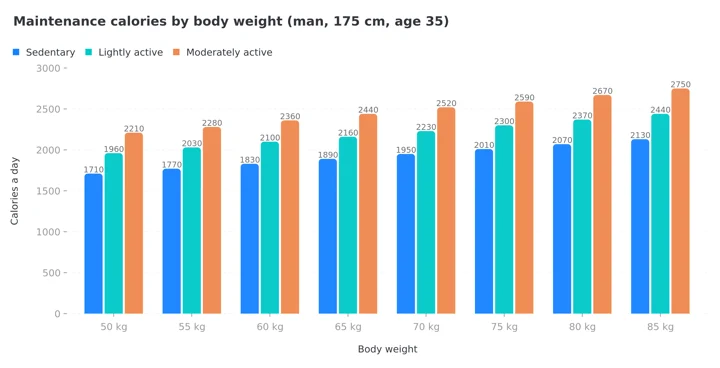 Figure 1: at every body weight in the table, moving from the sedentary to the moderately active column adds about 500 calories, more than 35 kg of body weight adds within the sedentary column.
In Figure 1, the gap between the blue and orange bars is what your activity level is worth; the climb from left to right is what body weight is worth. For women, the same equation at 165 cm and age 35:
| Body weight | Resting burn | Sedentary (×1.2) | Lightly active (×1.375) | Moderately active (×1.55) |
|---|---|---|---|---|
| 50 kg (110 lb) | 1,195 | 1,430 | 1,640 | 1,850 |
| 55 kg (121 lb) | 1,245 | 1,490 | 1,710 | 1,930 |
| 60 kg (132 lb) | 1,295 | 1,550 | 1,780 | 2,010 |
| 63.5 kg (140 lb) | 1,330 | 1,600 | 1,830 | 2,060 |
| 70 kg (154 lb) | 1,395 | 1,670 | 1,920 | 2,160 |
| 75 kg (165 lb) | 1,445 | 1,730 | 1,990 | 2,240 |
TIP
When you are torn between two activity factors, pick the lower one. An honest sedentary estimate that the scale later nudges upward is far easier to live with than a flattering moderate estimate that quietly cancels your deficit.
IMPORTANT
Checkpoint: here's where you are right now.
Quick status update so you always know the next best move.
⏱️ Progress 1/4 • ~1 minute in • Keep going
✅ Step 1: Estimate maintenance (done)
👉 Step 2: Pick your deficit (you're here)
⏳ Step 3: Log 14 days and read the scale
🧩 The single input that nearly matches the whole equation (coming soon)
How many calories a day to lose weight 📉
The classic arithmetic says a pound of body fat holds about 3,500 calories and a kilogram about 7,700. Divide by seven for a daily deficit at any target rate.
| Target loss | Weekly deficit | Daily deficit | Realistic? |
|---|---|---|---|
| 0.5 lb a week | 3,500 ÷ 2 | 250 | Yes, and easy to hold |
| 1 lb a week | 3,500 | 500 | Yes, the standard setting |
| 1 kg a week | 7,700 | 1,100 | At the upper limit |
| 2 lb a week | 7,000 | 1,000 | Only for larger starting weights |
| 3 lb a week | 10,500 | 1,500 | Rarely sustainable |
| 5 lb a week | 17,500 | 2,500 | Exceeds most people's total burn |
| 10 kg in a month | 77,000 | 2,570 | Not achievable by eating less |
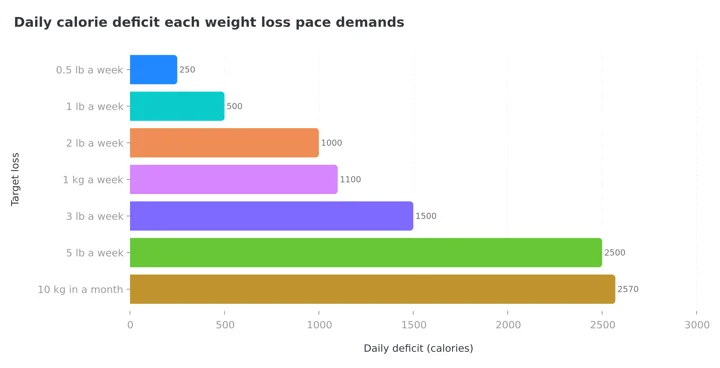 Figure 2: the two longest bars, 2,500 and 2,570 calories a day, are larger than the entire maintenance intake of most women in the table above.
Read the last two bars of Figure 2 carefully. You cannot subtract more than you spend, which is the arithmetic reason the 10 kg in a month goal fails before anyone reaches the physiology.
The NHS advice is to aim for 0.5 to 1 kg, or 1 to 2 pounds, a week, and it warns against losing weight suddenly through crash diets (NHS, 2026). A common choice for most people is 500 a day: large enough to show on the scale within a fortnight, small enough to leave room for dinner with friends. Our weight loss calculator shows the timeline at different deficits, which is often the fastest cure for an unrealistic target.
WARNING
There is no single safe floor for everyone, but resting burn is the number to respect. The woman in Example two burns about 1,315 calories before she gets out of bed, and living far below your own resting burn for weeks takes the shortfall from muscle as well as fat. If you are pregnant, breastfeeding, under 18, or managing a medical condition, set the target with a clinician rather than a calculator.
What your Apple Watch can and cannot tell you ⌚
Apple Health splits your day into resting energy and active energy and adds them for a total. Both the total and the active figure are shakier than the interface suggests.
A 2025 meta-analysis pooled 56 validation studies and 270 effect sizes covering energy expenditure, heart rate and steps. Heart rate came out well, at a mean bias of −0.12 beats per minute. Energy expenditure did not: every subgroup exceeded the 10 percent mean absolute percentage error threshold used to judge validity, while no heart rate subgroup did (Choe and Kang, 2025). A living systematic review published in 2026 reached the same conclusion across 82 studies and 430,052 participants (Lambe et al., 2026).
So what is the watch good for? Its resting energy figure cross-checks your formula result, and a gap of more than about 15 percent means one of your inputs is wrong. Its step count places you in the sedentary or lightly active column. What it cannot do is tell you how much to eat, because no wearable knows your intake, so none can measure a deficit. We compared how different devices handle this in our guide to the best Apple Watch calorie tracker, and the calories burned calculator gives an independent estimate to hold against the ring.
IMPORTANT
Checkpoint: midway progress update.
You're halfway, and the decisions get easier from here.
⏱️ Progress 2/4 • ~2 minutes in • Keep going
✅ Step 1: Estimate maintenance (done)
✅ Step 2: Pick your deficit (done)
👉 Step 3: Log 14 days and read the scale (current)
⏳ The single input that nearly matches the whole equation (next)
Calories in the foods people ask about most 🍎
Individual foods rarely decide the outcome, but the questions come up constantly, so here are the anchors. USDA FoodData Central lists apples raw with skin at 52 calories per 100 grams, with 13.8 g of carbohydrate and 2.4 g of fiber (USDA FoodData Central, entry 171688). Everything else follows from weight:
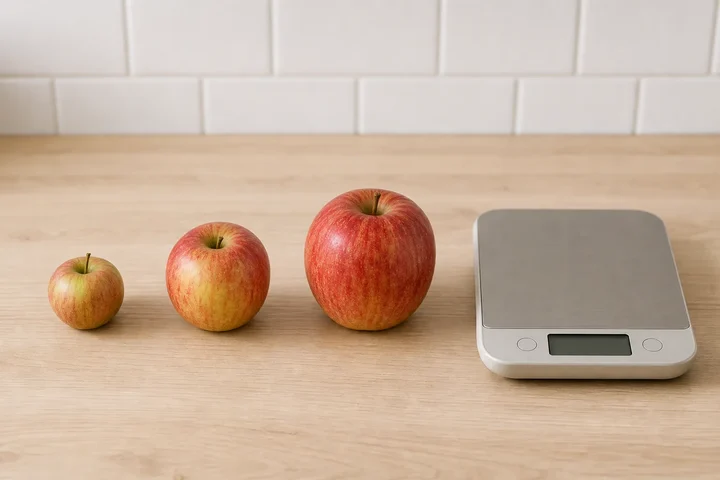 The same fruit, three sizes, a 36 calorie spread between the ends.
| Apple | Weight | Calories |
|---|---|---|
| Small | 150 g | 78 |
| Medium | 182 g | 95 |
| Large | 220 g | 114 |
Red or green makes no meaningful difference; two apples of the same variety differ by more. Cooked dishes work the same way, sized by the serving rather than the recipe. These are the per-serving figures from our food database, each with the full breakdown behind it:
| Food | Serving | Calories |
|---|---|---|
| Chapati | 1 medium, 40 g | 120 |
| Appam | 1 appam, 50 g | 100 |
| Papad or poppadom | 1 piece, 15 g | 56 |
| Cooked rice | 100 g, about half a cup | 130 |
| Dal curry | 250 g cooked | 150 |
| Chicken curry | 200 g serving | 250 |
| Mango | 1 medium, 207 g | 124 |
| Egg | 1 large, 50 g | 71 |
No cuisine is inherently fattening. The Indian Migration Study compared 1,232 same-sex sibling pairs, one urban migrant and one rural sibling. Urban migrants carried 18 percent greater adiposity, ate about 360 calories a day more, and spent 18 percent less energy than their siblings (Kinra et al., 2020). Same food culture, different portions and different movement. We covered measurement in how to count calories in Indian food, and a starting structure in the calorie deficit diet chart for beginners.
Five things that shift your number more than the formula 💡
- Steps. Moving from 3,000 to 10,000 steps a day is worth roughly the gap between two activity columns above. It is the cheapest lever you have.
- Body composition. Two people at 70 kg with different amounts of muscle have different requirements, and the equation cannot see the difference.
- Age. The equation subtracts 5 calories per year, so at 50 you have about 100 fewer resting calories than at 30 at the same size.
- Thyroid status. Untreated hypothyroidism lowers resting expenditure and treatment brings it back toward normal. If your dose is unsettled, trust your four-week trend and talk to your doctor before cutting further.
- Logging drift. Stalled deficits are usually untracked oil, a handful of nuts and the weekend, not metabolism.
Find your number in six steps 🧭
- Estimate. Run the equation or a free calculator, pick your activity factor honestly, and write the number down.
- Log for 14 days without changing anything. Eat the way you normally eat. This step feels pointless and decides whether the rest works. If you quit easily, cut it to 10 days rather than skipping it.
- Weigh daily, first thing, and average by week. Daily weight bounces with salt, sleep and fiber. The weekly average does not.
- Compare. A flat weekly average means your logged intake is your true maintenance, and it beats the formula.
- Subtract for your goal. Take 250 to 500 off for loss, or add 200 to 300 for slow muscle gain alongside resistance training. Do not change food and training in the same week.
- Recheck every four to six weeks, or every 4 kg. The number moves down as you lose weight and up as you build muscle or walk more.
 Seven daily weights, one line. Step 3 is the whole method in a picture.
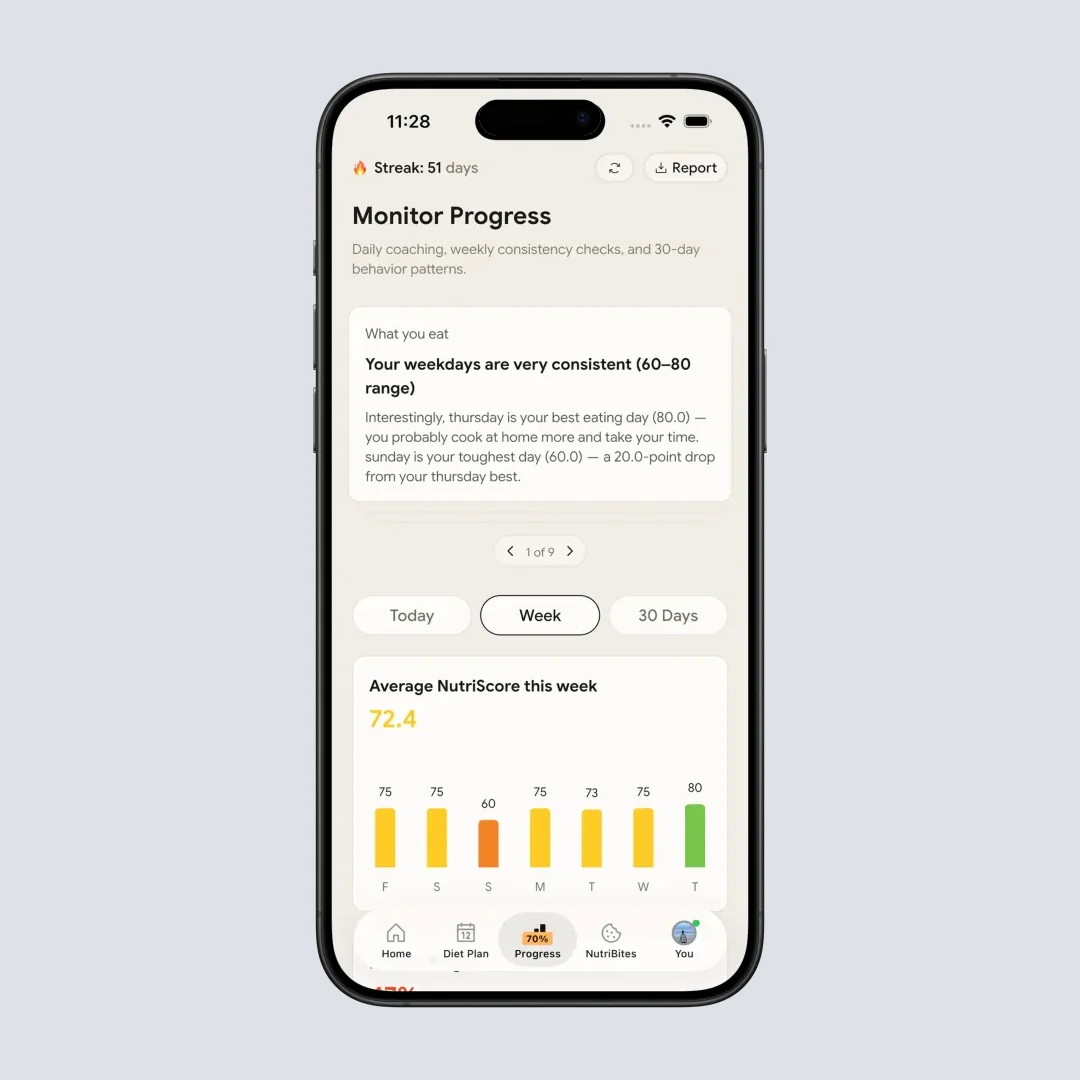
Home > Bottom Nav > Progress > Week. The Progress tab is a Premium screen.
 Step on it every morning, then ignore every individual reading and only trust the weekly average.
For a desk-bound routine, the activity factor is where the errors live. We wrote about that trap in the weight loss guide for sedentary desk jobs.
IMPORTANT
Checkpoint: final stretch before the reveal.
One last nudge, the reveal is next.
⏱️ Progress 3/4 • ~3 minutes in • Keep going
✅ Step 1: Estimate maintenance
✅ Step 2: Pick your deficit
✅ Step 3: Log 14 days and read the scale
✨ The single input that nearly matches the whole equation (about to reveal)

The one input that nearly matches the whole equation 🔍
Here is the finding buried in the 1990 paper that almost nobody quotes. Weight, height, age and sex together explained about 71 percent of the variation in resting burn. Fat-free mass, on its own, explained 64 percent (Mifflin et al., 1990).
One measurement got within seven points of four. Muscle is metabolically busy, stored fat is comparatively quiet, and the four-input equation only sees your total. That is why two people who share a weight, a height, an age and a sex can sit 200 calories apart at rest.
If you know your body fat percentage from a reliable measurement, an equation built on fat-free mass, such as Katch-McArdle, will usually beat Mifflin-St Jeor for you. If you do not, your own logged fortnight is the substitute, because it prices in your muscle mass without measuring it.
What the research says about eating less than you burn 🔬
The 3,500 calories per pound rule is a useful shortcut and a poor model of a human body. It assumes expenditure stays constant while you lose weight, which it does not.
The clearest correction comes from a mathematical model of adult metabolism that simulates how expenditure adapts during weight loss. The bodyweight response to a change in energy intake is slow, with half-times of about one year, and adults with greater adiposity lose more weight for the same change in intake and take longer to reach a steady state (Hall et al., 2011).
So the linear prediction overshoots: a 500 calorie deficit does not deliver a pound a week forever, it delivers most of that early and less later. Plateaus are expected behavior, not evidence you did something wrong.
Averaged weekly over three or four weeks, the scale is the only instrument here that measures the outcome directly.
Putting your number to work ✅
You now have a starting figure, a deficit that matches the pace you want, and a way to check both against reality. What decides the outcome is whether you keep logging past the second week. So make the logging cheap. Photograph your plate instead of typing ingredients, keep repeat meals in a favorites list, and read your weekly average rather than a single day. Photo-based logging in NutriScan is built for that: the free plan covers five photo meal scans a week, and Premium removes the limit for about $59 a year.
IMPORTANT
Recap: everything you completed this round.
You finished the run, so save this for next time.
⏱️ Progress 4/4 • ~4 minutes in • Nicely done
✅ Step 1: Estimate maintenance
✅ Step 2: Pick your deficit
✅ Step 3: Log 14 days and read the scale
✅ Fat-free mass alone explained 64 percent of resting burn against the full equation's 71 percent (revealed)
Frequently asked questions ❓
What are maintenance calories, in plain terms? Maintenance calories are the daily intake that keeps your weight flat over a few weeks. They cover resting burn, digestion, exercise and all the incidental movement in between. A calculator estimates that number. Two to three weeks of honest logging and daily weighing confirm it.
How many calories a day should I eat to lose weight? Take your maintenance estimate and subtract 250 to 500 calories a day, which matches the NHS target of 0.5 to 1 kg, or 1 to 2 pounds, a week. For a woman maintaining at 1,810 that is roughly 1,310 to 1,560. For a man at 2,440 it is roughly 1,940 to 2,190.
Can my Apple Watch tell me how many calories I should eat? No. It estimates what you burn, not what you should eat, and burn is the weakest number it produces. A 2025 meta-analysis of 56 studies found every energy expenditure subgroup exceeded the 10 percent error threshold used to judge validity, while heart rate stayed inside it.
How many calories a day to lose 1 kg a week, or 10 kg in a month? On paper 1 kg of body fat holds about 7,700 calories, so 1 kg a week implies a deficit near 1,100 a day and 10 kg in a month implies about 2,570. The second figure exceeds what many adults burn in total, so eating less cannot get you there.
Is eating 1,500 calories a day good for weight loss? It depends on your maintenance number. For a 63.5 kg woman maintaining near 1,810, eating 1,500 is a gentle 300 calorie deficit. For a 90 kg man maintaining near 2,440, the same 1,500 is a deficit of over 900 and will be hard to hold.
What is the lowest number of calories I can safely eat in a day? No single floor fits everyone, but resting energy expenditure is the number to respect. The 63.5 kg woman in the worked example has a resting burn near 1,315 calories, spent before she stands up. Sitting far below that for weeks funds the gap from muscle as well as fat.